

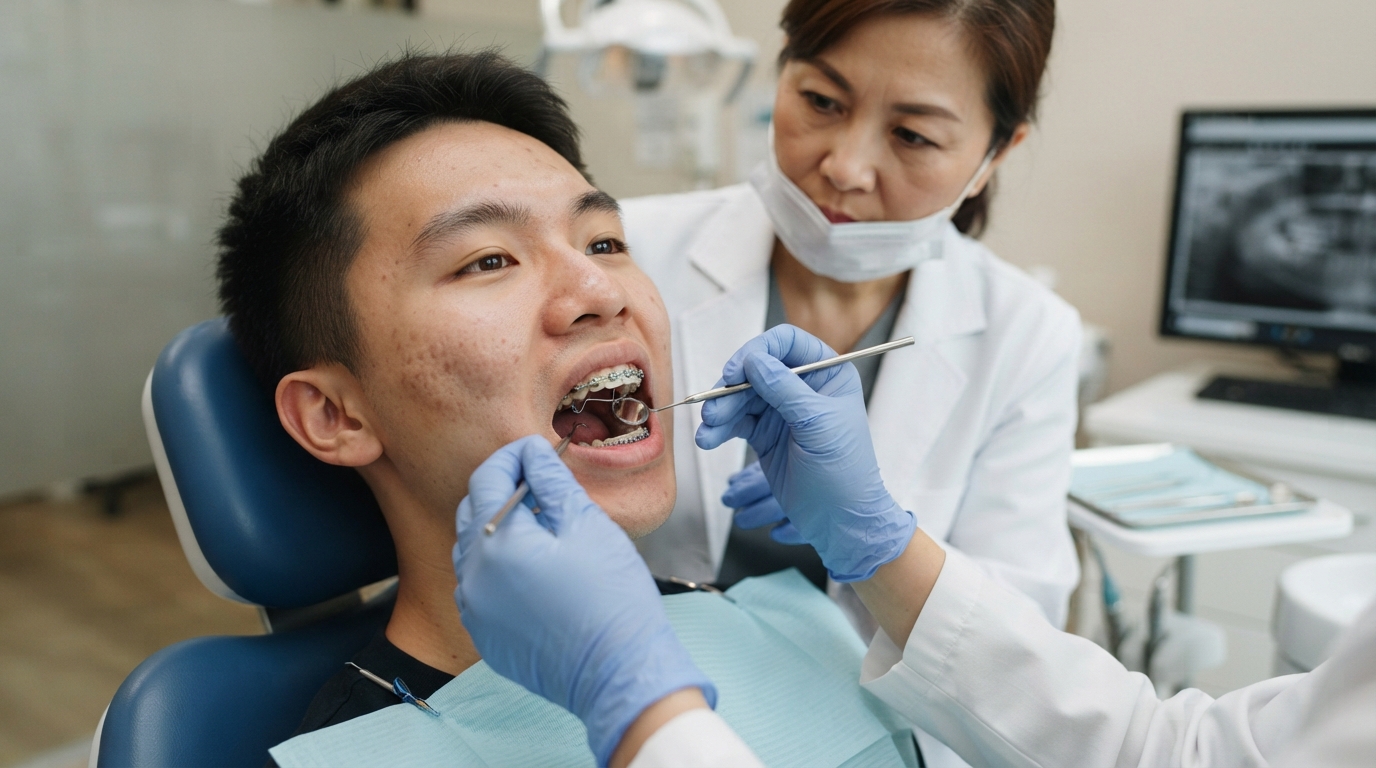
A 19-year-old orthodontic patient in India was eating a firm traditional delicacy when the metal wire across the roof of his mouth suddenly disappeared. It had broken, mixed into the mouthful of food, and gone down with it.
The device was a transpalatal arch, a wire that spans the palate and connects the upper first molars. X-rays showed the swallowed wire in two segments, both in his stomach.
Clinicians at the Armed Forces Medical College in Pune, led by orthodontist Mohammad Sharif, described the case in the Journal of Indian Orthodontic Society in its April 2024 issue. Gastroenterologists retrieved the larger piece with an endoscope. The smaller piece was tracked on X-rays until it left his body.
A Wire Across the Roof of the Mouth
A transpalatal arch is a common orthodontic support. In this patient, it was inserted into small sheaths welded onto bands on the upper first molars on each side, and it had been bent to help adjust the position of those teeth.
After swallowing it, he felt throat discomfort, both at rest and when swallowing, which settled on its own within about 20 minutes. When clinicians examined him about 30 minutes after the incident, the arch was gone.
They ordered chest and abdominal X-rays. The chest film mattered because it helped rule out the more dangerous possibility that the metal had gone into his airway. The abdominal film showed two wire segments in the stomach, confirming that he had swallowed a metal foreign body.
Retrieval and a Wait for the Second Piece
He was referred immediately to the gastroenterology department. Leftover food was first flushed from his stomach through a tube, and the larger part of the broken arch was then located and retrieved with an endoscope. The smaller piece was left to pass naturally, with follow-up X-rays tracking it through the colon until it was eliminated.
The approach fits broader experience with swallowed objects. The authors noted that 80% to 90% of swallowed foreign bodies pass without trouble, but that a sharp object in the stomach or upper small intestine should be retrieved with an endoscope when that can be done safely.
Swallowing Is More Common Than Inhaling
Orthodontic appliances are a recognized source of swallowed objects. A 2019 report in the Turkish Journal of Orthodontics noted that they are the second most common type of dental foreign body to be ingested, and that dental foreign bodies account for 3.6% to 27.7% of all swallowed or inhaled objects. The Pune authors added that objects entering the mouth are far more likely to be swallowed (85.19%) than inhaled (14.81%).
Broken palatal wires are a known, if uncommon, event. A 2003 report in the Journal of Orthodontics by Hussam Abdel-Kader, a professor of orthodontics in Egypt, described a broken transpalatal arch wire swallowed by a patient. He told DrBicuspid that finding such a major part of an appliance swallowed was unusual, adding, “Something like this could endanger the patient’s life.” The same article described a review in which 85% of orthodontic ingestion or inhalation cases happened outside the orthodontist’s office, and 71% of patients had fixed appliances. Those authors suspected cases may be underreported and recommended that orthodontic offices give patients a phone number to call for step-by-step instructions in an emergency.
A 2022 literature review in the Journal of Orthodontic Science catalogued 19 case reports of swallowed orthodontic parts, ranging from wires and molar bands to expansion keys, a quad-helix appliance and a transpalatal arch. A separate systematic review in the Journal of Indian Orthodontic Society included 29 published case reports and series.
Hard Foods and Loose Wires Deserve Attention
Metal makes these cases easier to sort out than many others. Wire shows up clearly on X-rays, which is how doctors confirmed both pieces were in his stomach rather than his lungs.
Clear plastic is another matter. A 2024 case report in BMC Oral Health described a 31-year-old woman in Shanghai who kept wearing a cracked clear aligner and later swallowed a 2-centimeter piece while drinking water. It lodged in her upper esophagus and was hard to see on CT until radiologists adjusted the image settings, and it was then removed with an endoscope. The authors advised that patients stop wearing fractured, loose-fitting appliances until they consult their orthodontist.
This is a single case, and it shows how quickly an appliance can fail during an ordinary meal. Orthodontists commonly advise patients to avoid hard, sticky, or very firm foods during treatment. For clinicians, the Turkish authors recommended tying transpalatal arches, quad-helix appliances, molar bands, and expansion keys with dental floss during adjustments and using radiopaque acrylic so lost pieces are easier to find on X-rays.
Anyone with braces who realizes part of an appliance is missing should contact their orthodontist or seek medical care promptly, even without symptoms, so X-rays can show where it went. Coughing, wheezing, or trouble breathing, which can signal an object in the airway, or chest pain, trouble swallowing, vomiting, or abdominal pain need urgent attention.
Key Questions Answered
What happened?
While eating a firm Indian delicacy, a 19-year-old’s transpalatal arch broke, and he swallowed it along with his food.
What is a transpalatal arch?
An orthodontic wire that crosses the roof of the mouth and connects the upper first molars to stabilize or adjust them.
Where did the wire end up?
X-rays showed two wire segments in his stomach.
How was it removed?
Doctors retrieved the larger piece with an endoscope. The smaller piece passed naturally while being tracked on X-rays.
Are swallowed orthodontic parts common?
They are uncommon but well documented. Swallowing is much more common than inhaling dental objects.
What should someone do if part of their braces goes missing?
Contact an orthodontist or seek medical care promptly so X-rays can locate it. Breathing trouble, chest pain, or abdominal pain needs urgent care.
Published by Medicaldaily.com


