

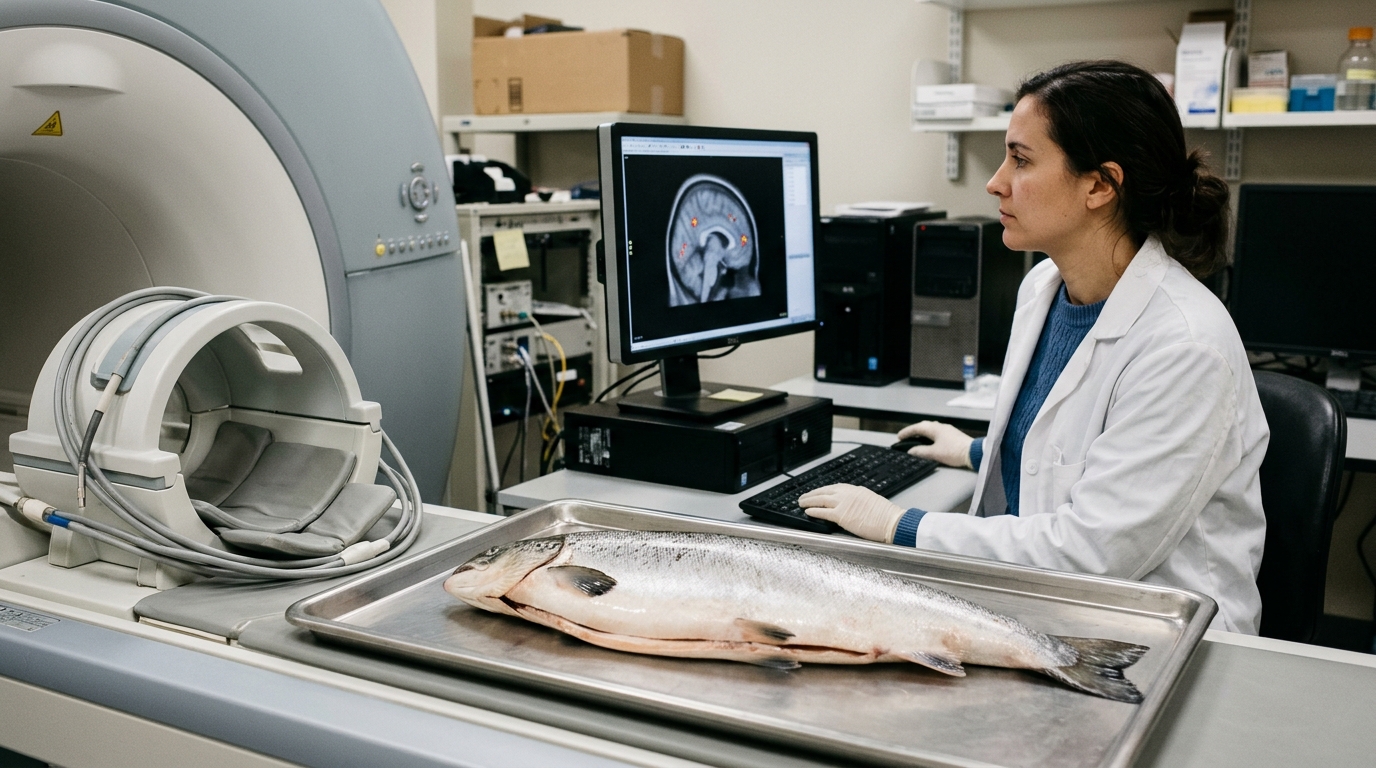
A dead Atlantic salmon, bought at a market and slid into a brain scanner, once appeared to show brain activity while “looking” at photos of people and judging their emotions. The fish was not thinking. The scan, run in 2005 and presented at a 2009 conference, was a deliberate demonstration of how brain-imaging statistics can conjure signals out of noise. Seventeen years later, the salmon is back in circulation, this time invoked by researchers warning that tools used to explain artificial intelligence can fall into the same trap.
One Fish, 8,064 Voxels and 16 False Alarms
The project came from neuroscientist Craig Bennett and colleagues Abigail Baird, Michael Miller and George Wolford, with affiliations at UC Santa Barbara, Vassar College and Dartmouth College. Their 2009 conference poster dryly noted that the roughly 18-inch, 3.8-pound subject was “not alive at the time of scanning.”
Inside a functional MRI scanner, which tracks blood-flow-related signals as a stand-in for brain activity, the salmon was shown 15 photographs of people in social situations. Each appeared for 10 seconds, followed by 12 seconds of rest, and the fish was asked what emotion each person was feeling.
The analysis divided the scan into tiny three-dimensional units called voxels and tested each one for a signal change during the photos. Using a common threshold of p
The explanation is arithmetic. Run thousands of statistical tests, and some will cross the line by chance alone. Bennett’s team noted that a typical fMRI volume contains about 130,000 voxels, making at least one false positive almost certain without correction. When the researchers reran the analysis with two standard corrections, which control the false discovery rate and the familywise error rate, the apparent activity vanished, even at a very relaxed threshold of p = 0.25.
The work later won a 2012 Ig Nobel Prize. In an NPR interview at the time, the researchers said the goal was to illustrate the absurd results that improper statistical approaches can produce.
The Software Audit That Followed the Fish
The salmon was a single-subject stunt, but larger evidence followed. A 2016 study in PNAS by Anders Eklund, Thomas Nichols and Hans Knutsson used resting-state scans from 499 healthy people, data with no real task in them, and ran about 3 million mock group analyses through three widely used fMRI software packages.
Researchers expected a false-positive rate of about 5%. Instead, certain common settings for cluster-based analyses produced rates as high as 70%. The team also identified a bug in one package that had gone unnoticed for about 15 years.
That headline number was widely misread. A 70% chance of at least one false positive in an analysis is not the same as 70% of published brain findings being wrong, and the worst rates applied to particular methods and settings. Nichols later requested corrections to statements in the paper that had fed exaggerated coverage. When the journal did not agree, he posted them publicly.
AI Researchers Find Their Own Dead Salmon
In December 2025, Maxime Méloux, Giada Dirupo, François Portet and Maxime Peyrard posted a paper titled “The Dead Salmons of AI Interpretability.” Interpretability methods are the tools researchers use to explain what a neural network has learned. The authors note that methods including feature attribution, probing, and even causal analyses can produce plausible-looking explanations for randomly initialized networks that have learned nothing. They argue that such explanations should be treated as statistical estimates and tested against clear alternative hypotheses.
A poster by Shivam Dubey and Manan Wadhwa, listed for a NeurIPS 2026 workshop, tried to put a number on the problem. Across six AI models and three families of explanation methods, a naive significance test flagged up to 100% of findings on untrained models. The authors reported that comparing results against a pool of matched untrained models, ideally 20 or more, brought false-positive rates back near expected levels.
That matters for medicine. AI is increasingly used to help read scans and records, and explanations of what a model is focusing on are one way developers and clinicians judge whether to trust it. An explanation that would look just as convincing for a model that learned nothing offers little reassurance.
Reading Brain-Scan Headlines with a Skeptical Eye
The salmon never showed that fMRI is worthless. Bennett’s group framed the experiment as an argument for routine correction, and fMRI remains a valuable research tool with established clinical uses, such as mapping brain function before surgery.
The bigger lesson is about small, flashy studies. A 2022 analysis led by researchers at Washington University School of Medicine and the University of Minnesota found that studies linking brain scans to complex traits such as cognition or mental health often need thousands of participants to produce reliable results. The median published study in that area had used just 25.
Readers can ask a few simple questions about any brain-scan headline. How many people were scanned? Did the researchers correct for multiple comparisons? Has anyone replicated the result? Claims that a single scan can reveal personality, honesty, or a psychiatric diagnosis deserve particular caution, and people with mental health concerns should rely on evaluation by a qualified clinician rather than research imaging results.
Key Questions Answered
Did the dead salmon actually have brain activity?
No. The apparent activity was statistical noise. Once standard corrections for multiple comparisons were applied, no active voxels remained.
What is a multiple comparisons problem?
When researchers run thousands of separate statistical tests, some will appear significant by chance. Corrections adjust the threshold so that chance findings are far less likely to be reported as real.
Does this mean brain scan studies are unreliable?
Not across the board. Well-designed studies that correct their statistics and use adequate sample sizes remain informative. The concern centers on uncorrected analyses, certain software settings, and very small studies.
Why are AI researchers talking about the salmon now?
Recent papers argue that some methods used to explain AI models can produce convincing results even for untrained networks, a false-positive problem similar to the one the salmon exposed.
How can I judge a brain-scan news story?
Look for the number of participants, whether results were corrected for multiple comparisons, whether independent teams have replicated them, and whether the claims go beyond what the study measured.
Published by Medicaldaily.com


