Tag: mindfulness out in the world

  • Feeling Like a Fraud in Your Own Mindfulness Practice

    Feeling Like a Fraud in Your Own Mindfulness Practice

    Over the years, I’ve worked closely with many meditation practitioners and Buddhist authors, some of whom have been clients, and my own practice has grown alongside those relationships. Being surrounded by people with such depth of experience can be inspiring, but it can also quietly raise the bar for where you think you should be in your ability to navigate life’s difficulties.

    One of the most humbling moments for me came during a trip to the emergency room related to complications from my autoimmune disease. I was in excruciating pain when a close friend, who also has a long meditation practice, asked, half joking, “Are you able to outsmart your pain?”

    We both laughed. The joke landed because another friend of mine, physician and meditation teacher Dr. Christiane Wolf, is a colleague and former client who has written about working with chronic pain through mindfulness in her book Outsmart Your Pain.

    I remember telling her at one point, almost defensively, that I meditate every single day. I had this quiet, competitive edge about it. I did not want to miss a day, even in the hospital. Missing a day felt like a failure.

    I remember telling her at one point, almost defensively, that I meditate every single day. I had this quiet, competitive edge about it. I did not want to miss a day, even in the hospital. Missing a day felt like a failure. In hindsight, that belief feels a little ridiculous, but at the time, it carried real weight.

    At that moment, I was not able to outsmart my pain.

    My response was immediate: “No. I’m not able. I’d like the pain meds.”

    Even as I said it, a small part of me felt inadequate. I was feeling like a fraud. If I had spent years around mindfulness practitioners and teachings about working skillfully with pain, shouldn’t I be better at this?

    Health challenges have given me many moments like that, moments when I questioned my ability to navigate difficulty in the way I believed I should.

    What I didn’t understand at the time was that practice does not always show up in the exact moment of distress. Sometimes it shows up in how we move through the experience afterward.

    Christiane later offered a perspective that shifted something for me.

    “Angela,” she said, “if you’re not meditating when you’re hospitalized, it doesn’t make you a failure. Your practice to date has prepared you to navigate these moments. That’s what the practice is for.”

    “Angela,” she said, “if you’re not meditating when you’re hospitalized, it doesn’t make you a failure. Your practice to date has prepared you to navigate these moments. That’s what the practice is for.”

    It was a simple reminder, but an important one. I realized how quickly I had turned a moment of human vulnerability into a judgment about whether I was doing the practice “well enough.”

    Around the same time, I was helping a menopause telehealth company develop educational content and share mindfulness practices for women navigating perimenopause and menopause. I had no trouble guiding others through meditation or creating resources that helped people access the practice.

    Yet privately, I sometimes struggled to apply the same steadiness to my own life.

    That tension, between helping others access mindfulness and questioning my own ability to embody it, was incredibly revealing. It showed me how quickly self-judgment can creep in, and how easily I hold myself to impossible standards. More importantly, it helped me see where I still have work to do, on the cushion and off.

    Naming the Experience

    As months passed, I became more curious about what might be happening beneath the surface of my experience. I understood the stress and anxiety tied to my health challenges. Those had been part of my life for years. But this felt deeper.

    I began to question my beliefs about how I was supposed to handle difficulty. Clearly, I had internalized an idea of what this should look and feel like, especially for someone with as much mindfulness experience as I had. After more than 15 years working in this space, I had unconsciously decided that I should not be struggling at all.

    I began to question my beliefs about how I was supposed to handle difficulty. Clearly, I had internalized an idea of what this should look and feel like, especially for someone with as much mindfulness experience as I had. After more than 15 years working in this space, I had unconsciously decided that I should not be struggling at all.

    Psychologists have a term for a similar pattern in professional life. The impostor phenomenon, first described by Pauline Clance and Suzanne Imes in 1978, refers to the persistent feeling that we are falling short of a role we are supposed to inhabit, even when there is ample evidence that we belong there.

    While this concept is often discussed in career settings, a similar dynamic can arise in contemplative practice.

    Experienced practitioners are still human. We can be just as overwhelmed by everyday stressors as anyone else, and often, the mind is quick to judge that experience. Mine tends to sound like, If you were truly a mindfulness practitioner, you wouldn’t be feeling this way.

    In those moments, the mind takes a very human experience and reframes it as failure. You’re an impostor.

    Part of what makes this so challenging is that we begin looking for evidence to support that belief, convincing ourselves we are failing at something we were never meant to perfect.

    Part of what makes this so challenging is that we begin looking for evidence to support that belief, convincing ourselves we are failing at something we were never meant to perfect.

    What About Stress?

    To be alive in these times is to experience sustained levels of stress. It does not take much, turning on the news, scrolling through headlines, or navigating daily responsibilities, to feel the weight of political unrest, global uncertainty, financial pressure, social division, and personal strain.

    The nervous system absorbs all of it.

    So how do we regulate ourselves in the midst of this? And what does this have to do with mindfulness impostor syndrome?

    Research in stress physiology shows that when the brain perceives a threat, the body shifts into survival mode. Heart rate increases, breathing changes, and attention narrows toward potential danger.

    In these states of activation, it can feel much harder to access the awareness we have worked so hard to cultivate. This can create a confusing internal signal: If I have these tools, why can’t I use them right now?

    For mindfulness practitioners, this can easily be misinterpreted as a failure of practice.

    But the nervous system is not malfunctioning in these moments. It is responding exactly as it was designed to.

    This misunderstanding is where self-doubt can quietly take hold.

    Clear Seeing

    One of the most widely cited insights from psychiatrist Carl Jung is, “Until you make the unconscious conscious, it will direct your life and you will call it fate.”

    As mindfulness practice deepens, awareness expands. We become more attuned to our internal landscape, our thoughts, emotions, and reactions. As a result, we often begin to notice reactivity more clearly than we did before. What can feel like regression may actually be increased awareness.

    As mindfulness practice deepens, awareness expands. We become more attuned to our internal landscape, our thoughts, emotions, and reactions.

    As a result, we often begin to notice reactivity more clearly than we did before.

    What can feel like regression may actually be increased awareness.

    You might notice yourself getting triggered in situations where, in the past, you would have reacted automatically without even realizing it. Now, there is a pause. A recognition. A moment of seeing what is happening.

    That shift can feel uncomfortable, not because something is going wrong, but because something is being revealed.

    Research on mindfulness suggests that practice strengthens meta-awareness, our ability to observe our own mental and emotional states.

    The reactions themselves may not be new.

    What is new is our ability to see them.

    Expectations and Shame Are Here!

    Most of us carry an internal narrative, one that quietly projects expectations onto our daily lives. In mindfulness practice, this often takes the form of how we think we should feel when we sit.

    Calm. Patient. Equanimous. Grateful.

    We tend to measure success by the presence of these states, while overlooking the full range of human emotion, fear, anger, grief, uncertainty, that are equally part of our experience.

    We tend to measure success by the presence of these states, while overlooking the full range of human emotion, fear, anger, grief, uncertainty, that are equally part of our experience.

    When our lived reality does not match that internal expectation, shame can arise.

    During the months leading up to menopause, I found myself navigating unfamiliar sensations in my body. Many of my tools seemed to disappear. I felt reactive, scared, and uncertain about what was happening.

    And the narrative that followed was harsh:

    You should be handling this better.

    Who are you to guide others if you cannot manage this yourself?

    Instead of simply noticing stress, I added another layer: self- judgment.

    At times, mindfulness concepts themselves can become a form of pressure. Psychotherapist John Welwood described this dynamic as “spiritual bypassing,” using spiritual ideas to avoid or override difficult emotional realities.

    In practice, this can show up in subtle ways, but the result is often the same. We begin to feel guilt or shame about what we are experiencing.

    Dealing with Dysregulation

    Our ideas about mindfulness can sometimes work against us. If we believe the practice should make us calm and less reactive at all times, we set ourselves up for disappointment.

    Mindfulness is not about performing calmness.

    Mindfulness is not about performing calmness.

    As Allen Ginsberg once said, the task is simply to “notice what you notice.”

    When we cultivate awareness, we begin to see our reactions as they arise. Maybe you notice yourself getting triggered in a conversation. Maybe you pause instead of immediately reacting. Maybe you recognize, even afterward, that you were overwhelmed.

    These moments matter.

    Mindfulness meets us exactly where we are.

    It does not require that we arrive in a particular state.

    It asks us to meet whatever state we are in with a bit more awareness, and when possible, a bit more kindness.

    Research on self-compassion suggests that responding to difficult emotions with care rather than criticism supports emotional resilience and regulation.

    When we approach our experience this way, the narrative of failure begins to soften.

    Anyone who has spent time meditating knows that emotions will always arise. What changes is not the presence of emotion, but our relationship to it.

    Instead of asking, Why am I still reacting like this?

    We might ask:

    What is happening in the body right now?

    What is this reaction trying to tell me?

    These questions reopen the possibility of practice, even in the middle of difficulty.

    Anyone who has spent time meditating knows that emotions will always arise. What changes is not the presence of emotion, but our relationship to it.

    Moments of reactivity do not disqualify us from the practice.

    They remind us why we practice. Awareness is not something we perfect. It is something we return to, again and again.




    Source link

  • Rethinking Equanimity: Margaret Cullen on Equanimity and Quiet Strength

    Rethinking Equanimity: Margaret Cullen on Equanimity and Quiet Strength

    Equanimity is often discussed in relation to mindfulness, yet it extends beyond formal practice and into the ways we meet everyday life.

    In this conversation, Margaret Cullen reflects on the ideas behind her book Quiet Strength and the five-year journey of study, practice, and dialogue that shaped it.


    Angela Stubbs: Quiet Strength has been in the works for how many years?

    Margaret Cullen: I guess it’s five now. Five years.

    Angela Stubbs: Take us back five years. Set the stage. What was going on in your life when the idea for this book began to settle in?

    Margaret Cullen: Oh, thank you for asking. I haven’t been asked that before. I did talk about it a little in the book’s prologue. I had begun teaching workshops on equanimity close to 10 years before I started writing the book, and about five years ago an editor at New Harbinger reached out to me to write a second book. I wasn’t sure if I wanted to do that.

    But then the idea came to me: a book about equanimity could be really interesting and useful. There were already so many books on mindfulness and quite a number on compassion. Although I had been teaching and writing about both for years, I wasn’t sure I had anything to add to that literature. Very little had been shared on equanimity. That was part of why I got interested in teaching it in the first place. It wasn’t addressed much in either the Buddhist circles I’d been practicing in for decades or in the mainstream mindfulness world.  

    It was time for a deep dive into this quiet virtue that’s been hiding in plain sight for 2,600 years.

    I got excited and went back to New Harbinger, and they said no. They wanted a workbook. I didn’t want to write a workbook. It wasn’t time for a workbook. It was time for a deep dive into this quiet virtue that’s been hiding in plain sight for 2,600 years.

    Angela Stubbs: I really love this sense of inner knowing you had, declining the workbook and following something deeper. It feels like an intuitive process. Can you talk about that, what that felt like?

    Margaret Cullen: I found myself led by the book, which was a fascinating and surprising process. Very early on, the book had its own ideas. I discovered that I was following the book’s lead. The book said, “No, not a workbook”, “No, not New Harbinger”, “No, this is what I want to be.” By following the book’s lead, it became something much bigger, deeper, and richer than I could have imagined on my own.

    That was quite remarkable. It led me to an agent, a big publishing house, and an editor who had a beautiful vision for the book. I felt like the book led, and I was always half a beat behind it.

    Angela Stubbs: As the book began to take shape, you were also wrestling with the lineage and doctrinal differences around equanimity and mindfulness. How did those conversations, including your exchange with Sharon Salzberg, influence the direction the book ultimately took?

    Margaret Cullen: Originally, I planned to write a chapter exploring the doctrinal relationship between mindfulness and equanimity. I’ve been tracking that debate for more than twenty years, beginning when I was co-teaching with Alan Wallace, who defined mindfulness quite narrowly as sati, simply as remembering to return to the present moment.

    But at a certain point, I realized the scholarship wasn’t helping illuminate lived experience. So I tried to simplify the question.

    In the insight tradition, mindfulness includes an attitudinal quality. It isn’t just returning to the present moment. It’s returning in a particular way, with non-judgment, spaciousness, allowing, and non-reactivity. That quality is what we call equanimity.

    In one conversation, I asked Sharon Salzberg to imagine a Venn diagram: one circle mindfulness, one circle equanimity. How much do they overlap? Her answer was immediate. Completely.

    I remember thinking, Really? Completely? We don’t tend to use the terms interchangeably. Yet many Western Vipassana teachers would say that without equanimity, it isn’t truly mindfulness.

    In the insight tradition, mindfulness includes an attitudinal quality. It isn’t just returning to the present moment. It’s returning in a particular way, with non-judgment, spaciousness, allowing, and non-reactivity. That quality is what we call equanimity.

    Angela Stubbs: Is equanimity used in traditions apart from Buddhism and mindfulness? You spoke with Tom Block about Judaism and Sufism. Are those traditions using equanimity in the same way?

    Margaret Cullen: There are differences, of course, but there are also striking similarities. Equanimity appears in many traditions beyond Buddhism. We find it in Judaism, in Sufism, and in Stoicism, often expressed through a similar concern: how we relate to life’s changing conditions.

    In Buddhism, this has the poetic name of the “worldly winds”: pleasure and pain, praise and blame, gain and loss, fame and disrepute. Other traditions articulate the same insight in their own language, but the essential question is the same: How do we meet the constantly shifting winds of fortune?

    What surprised me was how consistently this thread runs through different traditions. If you’re coming to this with fresh eyes and know nothing about equanimity, you might be surprised to discover that it’s almost everywhere, even in some of the least expected places.

    Angela Stubbs: You’ve said equanimity found you when you really needed it. Can you share what was unfolding then, and how equanimity began to function as a teacher for you?

    Margaret Cullen: There have been several times when equanimity has appeared as a teacher for me, but the first was on a retreat with Sharon Salzberg. We had done basic mindfulness and lovingkindness practice, and then spent a week on equanimity.

    In the Vipassana tradition, equanimity is often cultivated through reflecting on certain phrases. One of them invites you to imagine someone you love who is suffering and reflect: their happiness and unhappiness are the result of their thoughts, actions, and circumstances, not your wishes for them. And even so, you continue to wish them well.

    That was a complete revelation to me.

    I worked with those phrases in both sitting and walking practice. One morning after breakfast, I was walking in the desert in Southern California, during that exquisite, fleeting springtime in Joshua Tree. I wasn’t formally meditating, but the phrases had taken on a life of their own.

    I thought of my mother, and the phrase arose: I am not responsible for her happiness. And not only that, I could still love her and wish her well. It wasn’t a binary choice between taking responsibility for her happiness and being a bad daughter.

    My mother struggled with depression and other mental health issues. As long as I could remember, it had felt like my job to make her happy. It was an impossible task, and by my twenties, I had become more and more depressed myself because I was failing at it.

    In that moment, seeing clearly that, oh my goodness, I can’t control her happiness, was incredibly liberating. It sounds obvious now. But at the time, it was a revelation. And, beyond that, it is neither disloyal nor unloving to let go of this futile effort.

    We come to believe that loving someone means managing their emotional state…Equanimity is love without attachment: to outcomes, to roles, to what I need from you, to how I need you to be, even to needing you to be happy.

    Angela Stubbs: Many of us feel responsible for the happiness of people we love, especially within family. How does equanimity shift that dynamic?

    Margaret Cullen: Women, of course, have been inculcated to be caregivers in roles as mothers, wives, sisters, and daughters. Those stereotypical roles, which hopefully my daughter’s generation, maybe your generation, Angela, is breaking out of, have given us distorted pictures of what it means to love.

    In my mother’s case, and often with our children, we take on responsibility for their happiness. We come to believe that loving someone means managing their emotional state.

    But Buddhism is fundamentally a path of connecting with reality. There’s no safer ground to stand on than reality. And the reality is that I am not responsible for your happiness.

    These equanimity phrases expose how easily attachment masquerades as love. In Buddhism, attachment is considered the near enemy of lovingkindness. Without careful attention, we conflate the two. We accuse others of not being loving when they’re not expressing attachment, and we feel guilty ourselves when what we’re feeling is attachment, not love.

    Angela Stubbs: Can you unpack that a bit more?

    Margaret Cullen: Equanimity is one of the Four Immeasurables in Buddhism, along with lovingkindness, compassion, and sympathetic joy. They’re all aspects of love. So equanimity is love without attachment: to outcomes, to roles, to what I need from you, to how I need you to be, even to needing you to be happy.

    It acknowledges your complete sovereignty over your own life. Even that language can be misleading, because I don’t grant or withhold your freedom. I never had that control in the first place. The belief that I do isn’t aligned with reality.

    That’s where our ideas about love get tangled. We confuse attachment with care.

    The author with her forthcoming book, out March 10, 2026.

    Angela Stubbs: In the world we’re living in now, where there’s always something to care about, how do you work with equanimity as a tool in difficult times?

    Margaret Cullen: Having just written a book about it and being interviewed about it, I have unique pressures on myself, and from my friends and family, to be equanimous. The good news is we can turn that into a joke. Humor is actually a great doorway into equanimity.

    I’m reaching for it a lot these days. There are also a few cognitive hacks that I use very frequently. They’re related to the three characteristics in Buddhism that are very close to my heart and central to my practice.

    Angela Stubbs: Tell us about the hacks.

    Margaret Cullen: First, I ask: Is this situation as personal as I’m making it? As meditators, we taste non-self, the experience of being connected to all things. And yet we walk around in our separate, contracted egos. It’s a reminder that there’s another way of relating to experience.

    Second, impermanence. If I’m caught in reactivity, in a moment of suffering or even joy, I remind myself that things change. I loosen my grip on attachment or aversion. That’s reality. That’s the reality I want to align myself with. Things are usually less personal and less permanent than they seem.

    And third, I like this question from Byron Katie: Is it really true?

    Given the current political situation, it can feel like the end of the world. We say the world is on fire. It can feel literally true. But if I step back and ask, is it actually on fire, the answer is no. That’s an expression. And that expression amplifies fear, outrage, and anxiety, and pulls us out of equanimity.

    Angela Stubbs: People often misunderstand equanimity. How do you describe what equanimity is not?

    Margaret Cullen: Equanimity is definitely not indifference. It’s not apathy. It’s not passivity. Those are the near enemies of equanimity.

    Equanimity is not withdrawal.

    I think for a lot of people who care deeply about the world, even if they understand this intellectually, emotionally, it still feels like a withdrawal. I have friends who are longtime practitioners who are afraid of equanimity. They think the world is in so much trouble that equanimity somehow forecloses their opportunity to be activists and engage with the world’s problems. That’s a very important misunderstanding. It’s deep and pernicious. Equanimity is not withdrawal.

    This is part of the beauty and paradox at the heart of equanimity. It’s caring perhaps even more deeply, not less, but draining that love of melodrama.

    This is part of the beauty and paradox at the heart of equanimity. It’s caring perhaps even more deeply, not less, but draining that love of melodrama. It’s loving without attachment. We care just as much, perhaps even more, about this beautiful planet and all the people and species who are thriving and suffering upon it, but without the melodrama and the outrage. That frees up our energy to be as effective as possible in whatever way we engage.

    Angela Stubbs: Earlier, we talked about the overlap between mindfulness and equanimity. If mindfulness is awareness, where does equanimity fit? You’ve described it as a kind of balance. What does that mean?

    Margaret Cullen: The balance we’re talking about is dynamic. It’s not static. We’re not aiming for some frozen state. It’s more like walking. With every step we lose our balance and regain it.

    Equanimity is the capacity to recover more quickly, to create space around our experience when we’re knocked off center. It’s not about being chill or detached. That becomes a near enemy. It’s about flexibility. It’s about resilience.

    Angela Stubbs: The book is titled Quiet Strength: Find Peace, Feel Alive, Love Boundlessly. It wasn’t always called that. How did the title and subtitle evolve?

    Margaret Cullen: I originally wanted to call the book Equanimity: The Quiet Virtue. If it had stayed small and focused only on Buddhism, that might have worked. But once the vision grew, that title no longer worked for my agent or publisher.

    They first suggested Quiet Power, which I liked. Equanimity is quiet but incredibly powerful. In martial arts, power comes from fluidity and balance, not brute strength. But politically, “power” felt like a tainted word. So we landed on Strength.

    The subtitle, Find Peace, Feel Alive, Love Boundlessly, is not language I would normally use. I have an aversion to telling people what to do. My language as a teacher is more invitational and provisional. This is declarative. I joked that I felt like a circus barker for equanimity.

    But the book has a wider vision than my own. I’m one voice among many contributing to what it’s meant to do in the world.

    Angela Stubbs: Is there anything in the book that people haven’t asked you about yet?

    Margaret Cullen: Surprisingly, I’ve been asked very little about the neuroscience. No one has asked about the time I went to a lab in Arizona and had transcranial stimulation applied to my brain to supposedly engender equanimity.

    Neuroscience labs that have studied mindfulness are now adding tools like transcranial stimulation and sophisticated fMRI mapping to reverse-engineer advanced states of meditation.

    Angela Stubbs: That feels like a very different angle on equanimity. What happened when you went into the lab?

    Margaret Cullen: They stimulated my brain and asked what I was experiencing. I didn’t feel anything. I was disappointed because Shinzen Young was there, along with Jay Sanguinetti, who runs the lab at the University of Arizona. Over lunch, they described extraordinary experiences they’d had using the technology.

    I wanted to feel that. I even considered changing my flight home to try again. I believe them. But I didn’t have that experience.

    From my perspective, equanimity is part of some of the most cutting-edge research just beginning to unfold. It’s early. Where it ends up, nobody knows.


    Margaret Cullen is a licensed psychotherapist and a pioneer in bringing contemplative practices into mainstream settings. She was one of the first ten people to be certified as an MBSR instructor and has taught around the world. As a therapist, she facilitated psycho-social support groups for cancer patients and their loved ones for over 30 years.

    She also developed Mindfulness-Based Emotional Balance and co-authored a book about it with Gonzalo Brito Pons. She was a Senior Teacher and Curriculum Developer for Humanize, a contemplative-based dyad program founded by German neuroscientist Tania Singer. Margaret is a Mind and Life Institute Fellow, on the advisory board of the Global Compassion Coalition, and has been a meditation practitioner for over 40 years. You can find Quiet Strength here.


    Source link

  • The Fine Art Of “Failing With Presence”

    The Fine Art Of “Failing With Presence”

    When I was 23 and just starting out in journalism, I made an awful mistake. While covering a high-profile trial in San Jose, California, I wrote that a woman who hadn’t been charged with any crime had plotted a murder.

    The woman I’d wrongly incriminated sued me and my newspaper for libel, demanding $11 million. Had she won, it would have killed my career and financially damaged my employer.

    Alas, this wasn’t my first reporting error.

    In the preceding weeks I’d made a series of smaller mistakes, mostly getting names and dates wrong, although once I’d quoted a rancher as telling me he had to leave to “shoot a horse” when he’d really said “shoe” a horse. He called the news desk the morning that story appeared to demand a correction, saying his sister worked for the Humane Society and had given him hell.

    As these errors piled up, I feared my days at the newspaper were numbered. But I still couldn’t seem to slow down and take the time to check my work. Instead, whenever possible, I blamed the flubs on others. The rancher had mumbled. The copy editor hadn’t done his job. My editors were overworking me and I was tired.

    By the time of the libel lawsuit, I’d run out of excuses. But surprisingly, instead of firing me, the paper’s managing editor—a tough-on-the- outside Lou Grant type who until then had been my biggest fan—suspended me for three days, giving me just one more chance. He also bluntly suggested I use the time to get professional help.

    “You’re sabotaging yourself,” he warned.

    I had no choice but to change: to stop looking for excuses, and to do the hard work to become the kind of person I’d long wanted to be.

    I took his advice and, even before I left the newsroom that day, tracked down a psychiatrist to make my first appointment. I couldn’t bear the thought of losing a job that was then my whole identity, and understood in that moment that I had no choice but to change: to stop looking for excuses, and to do the hard work to become the kind of person I’d long wanted to be—both more competent and more trustworthy. In other words, I had to start being more accountable. The main problem was, I still had so little faith that I could make such a big change.

    Slow Down to Speed Up

    This was (ugh, how time flies!) 1981. Mindfulness wasn’t a mainstream thing yet. But Freudian psychoanalysis, couch and all, was available for those who had really good insurance or could otherwise find the money to pay. My psychiatrist was still in training, reporting to a supervisor. He offered me a hefty discount that made it just affordable.

    His mantra was, “Mistrust your sense of urgency,” which was at once the most helpful thing I’ve ever heard and the most difficult thing I’ve ever done. Again and again, he urged me to sit still and experience my feelings, rather than doing what I most yearned to do, which was to run from them, in any way I could. It’s embarrassing to look back on all the hours I wasted in ridiculous debates with him about whether I really needed therapy at all, and in trying to change the subject, and in throwing myself harder into work and pleading exhaustion as a reason to cancel appointments.

    But at last something shifted and I managed to face my all-but-overwhelming shame at having screwed up so repeatedly—and, more deeply, in believing I was destined to keep screwing up. Only then could I see how much shame had determined my behavior until then, particularly in my insistence on looking for other things and people to blame for my own mistakes. My editor was right—I had been sabotaging myself, for reasons that would take a long time to understand. Four years, to be precise.

    A couple of decades later, when I was bringing up my kids, a wise swim coach observed my eldest son’s fast but awkward freestyle and told him, “You’ve got to slow down to speed up.” Sparing the grisly details, my own speed, just as clumsy, had some roots in childhood events that had conditioned me to tune out whenever I was stressed. Sticking with the therapy helped me first slow down enough to bring my brain’s pilot back into the cabin and stop making those mistakes, and then to patiently learn why I’d been making them. As time went on, my psychiatrist also helped me stop playing the victim whenever I was challenged. He insisted that I behave with integrity, beginning by charging for missed appointments whenever I canceled without a good reason.

    Eventually, this practice—although it still wasn’t popularly called that—of learning to be aware of when I felt like outrunning my feelings and then patiently returning to face them would help make me not only a more careful journalist, but also a better listener. That, in turn, helped me be a better friend, wife, daughter, and mother than I otherwise ever could have been. I’m not suggesting that four years of therapy is the best solution for anyone making errors at work. But for me, slow accountability saved my life.

    Working with the Shame Response

    Once you stop to notice, you may be surprised by the prevalence, variety, and depth of human error. From the simple fender-bender on your way to work to immensely more devastating plane crashes, botched surgeries, and downright horrific cases of parents leaving babies in hot cars, we constantly, mysteriously, act against our own self-interest.

    Once you stop to notice, you may be surprised by the prevalence, variety, and depth of human error.

    My own experience with a far less consequential but still potentially devastating error early in my life has made me obsessed by human error, and particularly how people recover from the shame of seemingly incomprehensible mistakes. Mitch Abblett, a clinical psychologist and former executive director of the nonprofit Institute for Meditation and Psychotherapy, shares this interest, writing powerfully about the way shame can paralyze us.

    “The shame response is very old and comes from a primal part of the brain,” he told me in a recent interview. “As a psychologist I think of our evolutionary biology: Tens of thousands of years ago, if we did something that caused us to feel shame, it was related to our very survival, to fear that we’d be rejected from our social group and die.”

    Abblett says a mindfulness practice can help people move past seemingly intolerable shame, as they ride out the physical sensations arising from shame and the “indignant arrogance” he says often accompanies it to arrive at regret, an emotion that more easily allows us room to make wiser choices—and to be more accountable. He gave the example of the 2007 documentary film, The Dhamma Brothers, which followed four convicted murderers on a 10-day meditation retreat in an Alabama prison. The prisoners said it was agonizing at first to sit still with the awareness of what they’d done to others and what others had done to them. But once they stuck with it, it was also liberating.

    Taking Accountability for Failure

    It’s interesting to contrast the Dhamma Brothers’ experience with the movement, over the last several years, to destigmatize failure in a hurry. “Fail fast, fail often!” and “Move fast and break things!” are the relentlessly cheery slogans of Silicon Valley, a place in which three-fourths of startups go bust. The archives of the TED Talks—the Valley’s influential e-sermons—include more than a dozen presentations about failure, many of which tout its “surprising” benefits. A paean to “celebrating failure” by Astro Teller, the “Captain of Moonshots” at Google’s idea factory, X, has been viewed more than 2.6 million times.

    In 2009, the same ethos inspired a popular program called “Fuckup Nights,” in which entrepreneurs take the stage to talk about their business disasters. The Mexican entrepreneur Leticia Gasca founded the project after her startup, a philanthropic effort to help Native women sell their handicrafts, went bust. Since then, “Fuckup Nights” have been held in more than 250 cities in 80 countries. Gasca’s organization also offers workshops to businesses to help “create a culture that celebrates trying, rather than stigmatizing failure,” according to their website. Using storytelling and a Q&A session, the workshops aim to “eliminate shame to turn it into accountability and autonomy.” FailCon, a similarly themed day-long conference, was founded around the same time by Palo Alto software designer Cassandra Phillips and has also gone global.

    My reporting errors were in another class than the Silicon Valley sorts of failures, which mostly involve mistaken strategies and decisions. But both kinds of blunders share two important things: the potential to harm other people—say, when livelihoods are lost after businesses go bankrupt—and the corresponding need for someone to take responsibility and make changes. Both, in other words, demand accountability. And that might require something more mindful and systematic than just sharing stories of failure.

    Sam Silverstein agrees. A former manufacturing business owner and author of several books about accountability, Silverstein’s main point, which he stresses repeatedly, is that accountability never happens in isolation. “It’s always a matter of being accountable to someone,” he told me. “Accountability is keeping your commitments to people. We’re responsible for things, but we’re accountable to people.”

    I thought back on my tough-love treatment by the managing editor, and how much I’d wanted to redeem myself in his eyes. I also remembered the bond I’d established with my psychiatrist, who so skillfully, over months and years, had gained my trust and respect. It made sense that accountability depends on these kinds of strong relationships, which require long and steady investments of time. Still, I don’t believe you can achieve it without also devoting a lot of individual effort.

    As I recalled all that work with the psychiatrist, predating the mindfulness movement, it felt as if he’d helped me build up my muscles to face down shame on my own the next time it emerged. At the end of our time together, it was up to me to keep those muscles in shape, by honestly questioning my behavior and, importantly, by making sure I always had other relationships in my life—both in and out of work—that would help hold me accountable.

    Failing With Presence Is Slow, Daily Work

    My slow accountability practice has helped me in my marriage and in deepening friendships, but it’s probably helped the most in my relationships with my children. I grew up with the notion—handed down from my own mother—that mothers should be perfect, that we’re older and thus wiser and our mandates shouldn’t ever be challenged. But times have changed, and I do believe that even as parents should set limits for our children, we should also model virtues, including being humble and owning up to our mistakes. So even though my first instinct, after forgetting, for instance, to pick them up from Hebrew School (leaving them waiting an extra 20 minutes) was to deny it ever happened or to make an excuse, I instead took a breath, took the hit, and apologized (sincerely but not excessively) for losing track of time. One of the greatest and also most painful things about having children is they inevitably give us so many opportunities for humility, as long as we’re willing to recognize them and not get defensive or play the victim.

    That kind of accountability happens over time, and because of deep relationships. Contrast that with Fuckup Nights, which offer the hope of a quick catharsis: a funny, self-deprecating story in the spotlight and you’re done. But the more I thought about them, the more they seemed like just another version of running away.

    In fact, the slapdash Silicon Valley approach to failure has been getting some pushback from the people you might least expect. “Every time I listen to Silicon Valley types or students bragging about failing fast and often like it’s no big deal, I cringe,” Gasca said in her own TED Talk last year. She was now extolling the notion of failing “mindfully,” which she described as being aware of the consequences of what you’ve done and the lessons learned—and the responsibility to share those lessons with the world. In other words: failing with presence.

    Somewhat similarly, Phillips, the FailCon founder, told me she’d recently abandoned that effort out of frustration. “I was tired of people not discussing the actual takeaways, the next steps, and taking ownership for what really happened,” Phillips wrote me in an email. Something like that would demand regular, smaller conversations over time, she explained—something she wasn’t then interested in doing. But I understood her point. Genuine accountability depends, as Silverstein told me, on relationships of trust, which take time to develop, as well as on each of us building the habit of rigorous introspection.

    Any way you look at it, it’s not a speedy process.

    Why Our Brain Thrives on Mistakes 

    A slowly growing body of research suggests that our common aversion to failure is itself a failed strategy. Being curious about our mistakes is the royal road to learning. And mindful techniques can help. Read More 


    Source link

  • You Don’t Have to Shut Down or Burn Out When You Care This Much. Do This Instead.

    You Don’t Have to Shut Down or Burn Out When You Care This Much. Do This Instead.

    Three weeks ago, I ended up in the emergency room convinced I was having a heart attack.

    The chest pain had started days earlier—a tightness that wouldn’t release, difficulty taking a full breath, pain radiating down my left shoulder. I told myself it was nothing. Maybe I’d overdone it at the gym. Maybe I’d slept wrong.

    I kept meditating.
    I kept teaching.
    I kept holding space for others.

    I tried to breathe my way through it, the way I’ve taught thousands of people to do. But on Sunday, when my doctor’s office was closed and the pain refused to let up, my husband said gently but firmly, We’re going to the ER.

    After five hours of tests and long stretches of waiting, the cardiologist came back with relief in his voice: my heart was fine.

    I should have felt grateful—and I did.
    But I was also confused.

    If my heart was healthy, what was my body trying to tell me?

    Recognition: The Role of Vicarious Trauma In Bearing Witness Without Choice

    If you have been paying attention to the world around you over the past months, you may be carrying more than you realize.

    Images of devastation in Gaza.
    Israeli families living with constant fear of attack.
    Political violence and ICE shootings at home.
    Rising Islamophobia and antisemitism fracturing communities, relationships, and public life.
    The countless Black, Indigenous, and other people of color whose deaths rarely make headlines, whose names we never learn.
    And the ongoing humanitarian crises in places like Sudan, Yemen, and Iran—where suffering continues largely outside the frame of sustained media attention.

    If you find yourself feeling unusually tense, exhausted, reactive, numb, or unable to turn away—even when you want to—it may not be a personal failing. It may be a natural response to prolonged exposure to suffering.

    For many of us, this witnessing is relentless. Each morning brings new stories, new images, new reasons to feel alarmed or heartbroken. Even when we are not directly affected, our nervous systems are taking it in.

    If you find yourself feeling unusually tense, exhausted, reactive, numb, or unable to turn away—even when you want to—it may not be a personal failing. It may be a natural response to prolonged exposure to suffering.

    There is a name for this: vicarious trauma.

    Vicarious trauma refers to the psychological and physiological impact of sustained empathic engagement with others’ pain. Our bodies and minds do not clearly distinguish between what we experience directly and what we absorb through continuous media exposure, graphic imagery, and ongoing moral urgency.

    Staying informed matters.
    Bearing witness matters.

    But exposure without the capacity to process what we are taking in carries consequences—often beneath our awareness.

    Photo by Tony Lam Hoang on Unsplash

    Withdrawal: When Turning Away Feels Necessary

    For others, the constant stream of suffering can feel overwhelming or futile, leading to disengagement instead. We scroll past headlines, turn off the news, or tell ourselves we need to focus on our own lives. At times, this discernment is necessary. Rest, boundaries, and self-care matter. But when disconnection becomes our primary response to vicarious trauma, something else quietly erodes.

    Many people turn away not because they don’t care, but because they feel powerless. What difference could I possibly make? In the face of global crises, individual action can seem insignificant, even naïve. Shutting down can feel like the only way to survive.

    Yet we live in an interconnected world where complete disconnection is an illusion. And when we disengage for too long, we don’t just lose information—we lose contact. Contact with what is happening. Contact with our own values. Contact with the small but meaningful ways care can move through us. What begins as self-protection can quietly become a loss of agency and connection.

    Vicarious trauma doesn’t just make us sad or tired. It reshapes how we see the world.

    Research shows that it disrupts core beliefs about safety, trust, control, intimacy, and meaning. It shows up cognitively, emotionally, physically, and behaviorally.

    People experiencing vicarious trauma often report:

    • Brain fog and difficulty concentrating
    • Heightened anger, anxiety, or emotional numbness
    • Sleep disturbances and chronic exhaustion
    • Hypervigilance—always bracing for the next blow
    • Physical symptoms like headaches, gastrointestinal issues, and chest pain

    And yes—ER visits.

    But there is something more essential that is lost when we burn out or shut down. 

    Vicarious trauma explains the cost to our nervous systems. But underneath that is something more subtle—and more consequential: a loss of contact with our capacity to respond.

    What gets lost when we engage on default—whether by over-consuming information about suffering or withdrawing from it—is not just nervous system regulation.

    We lose contact.

    Contact with the body as a source of intelligence.
    Contact with our felt sense of what is actually needed now.
    Contact with our agency, beyond outrage or withdrawal.
    Contact with our capacity to sense where our care is most skillful.
    Contact with our ability to stay human without hardening.

    This isn’t just trauma.

    It’s a disconnect from our humanness.

    Oppressive systems don’t need to silence us when exhaustion and reactivity will do the job for them.

    We find ourselves caught in cycles of constant witnessing or reactive outrage, or else turning away and numbing out.

    And when contact is lost, connection suffers.

    Connection with others.
    Connection with purpose.
    Connection with the part of ourselves that knows how to respond wisely.

    Vicarious trauma explains the cost to our nervous systems. But underneath that is something more subtle—and more consequential: a loss of contact with our capacity to respond.

    When we’re dysregulated:

    • We confuse intensity with impact
    • We lose the ability to imagine creative responses
    • We default to attack, despair, or withdrawal

    What’s at stake isn’t just our well-being. It’s our capacity to imagine—and enact—responses that actually reduce suffering.

    Oppressive systems don’t need to silence us when exhaustion and reactivity will do the job for them.

    Collective Capacity: How Not to Lose Each Other

    When this loss of contact happens at scale, movements fracture. Allies turn on one another. Nuance feels like betrayal. Strategic thinking gives way to moral reflex. The very capacities required for sustained change—discernment, patience, relational trust—begin to erode.

    When we are no longer in touch with our discernment, everyone can start to look like a threat. The act of listening itself can feel like moral failure. We confuse intensity with impact, and urgency with wisdom.

    This loss of contact doesn’t just exhaust us personally. It diminishes our ability to work together.

    When we are no longer in touch with our discernment, everyone can start to look like a threat. The act of listening itself can feel like moral failure. We confuse intensity with impact, and urgency with wisdom.

    I’ve seen this up close.

    At one point, someone was publicly attacking me online—not because we disagreed about the need to end suffering, but because I was trying to hold complexity rather than take a single side. I was called complicit. My integrity was questioned. Moral failure was assumed.

    Instead of reacting, I practiced inner calm, compassion, and equanimity—not to bypass harm, but to stay in contact with my own values of deep listening and seeking to understand. The next day, that same person reached out to say: “I’m sorry to have misjudged you so harshly. I’ve been exhausted, and I lashed out.”

    This person wasn’t malicious. They were overwhelmed. I recognized that feeling immediately—that same overwhelm is what had landed me in the ER. The suffering they had been witnessing was real. The vicarious trauma is real. Without tools to return to contact, that pain had nowhere to go but outward.

    I’ve witnessed this pattern repeatedly.

    When I had tried to draft a Town Council resolution that called for ending violence while also acknowledging security concerns on all sides, it was rejected—not because people disagreed with the facts, but because in the midst of collective disconnection, holding both-and felt impossible.

    This is how movements lose their strength—not through genuine disagreement about goals, but through operating from disconnection rather than from our deepest wisdom that comes from listening with care and seeking solutions that include all.

    Sustained change requires more than passion. It requires capacity: the ability to engage and retreat, to stay open without collapsing, to remain connected to one another even when the work is hard.

    When we lose that capacity, we don’t just lose effectiveness. We lose each other.

    People sharing a cheese platter, fruit, and wine around a candle-lit table, finding comfort after a day marked by vicarious trauma.
    Photo by The Cheeserom on Unsplash

    Rest: The Ground That Makes Practice Possible

    Recently, I was invited to a friend’s house for dinner. Simple food. Easy conversation. Board games. And yet, as I sat there, I felt a wave of guilt. How could I be laughing when so many are suffering? I noticed a flash of irritation toward the others at the table—why didn’t they seem as affected as I was? Didn’t they care?

    Then I caught myself.

    This guilt, this judgment—it wasn’t skillful. It wasn’t making me more effective or more compassionate. It was simply isolating me, pulling me away from the people right in front of me.

    Rest is not what we do when the work is finished. It is what makes sustained engagement possible. When we gather, we are restoring contact with the aliveness that oppressive systems rely on extinguishing.

    So I made a choice. I allowed myself to be there. To taste the food. To play the game badly and laugh at myself. To let the warmth of friendship soften something that had gone rigid inside me.

    It was quietly liberating.

    The next day, I returned to my work with more energy, clarity, and steadiness—not because anything had been solved, but because I had remembered what it feels like to be human alongside other humans.

    This is not escape.
    This is restoration.

    Rest is not what we do when the work is finished. It is what makes sustained engagement possible. When we gather with like-minded people—not to organize or persuade, but simply to cook together, laugh, play, or enjoy one another’s company—we are not avoiding the work. We are restoring contact with the aliveness that oppressive systems rely on extinguishing.

    Sometimes, what returns us to contact isn’t a formal practice at all. It’s a shared meal. Music, art, or movement that reminds us we are alive. A walk where we remember that trees still grow and birds still sing—even now.

    These moments are not indulgent.
    They are essential.

    From this restored place, certain skills can help us stay in contact when we re-engage with difficulty.

    Skills: Returning to Contact in Real Life

    Over years of teaching and research, I came to see that mindfulness as it’s often taught—focusing primarily on meditation and non-judging awareness—is necessary but insufficient for times like these.

    Calming the nervous system with meditation is only the first step. Once we re-engage, our default habits return. Without skill, we slide back into reactivity. Even if we can return to a calm, non-judging awareness, it is not enough to navigate nuanced, complex situations, often involving competing needs and worldviews. 

    Through my study of early Buddhist teachings and contemporary psychology, I began to understand mindfulness as a set of trainable skills—skills that help us stay in contact with what’s alive, even in the midst of suffering. They disrupt our default reactions and help us discern what is needed to respond skillfully.

    Three skills become especially essential when we are bearing witness to ongoing crisis:

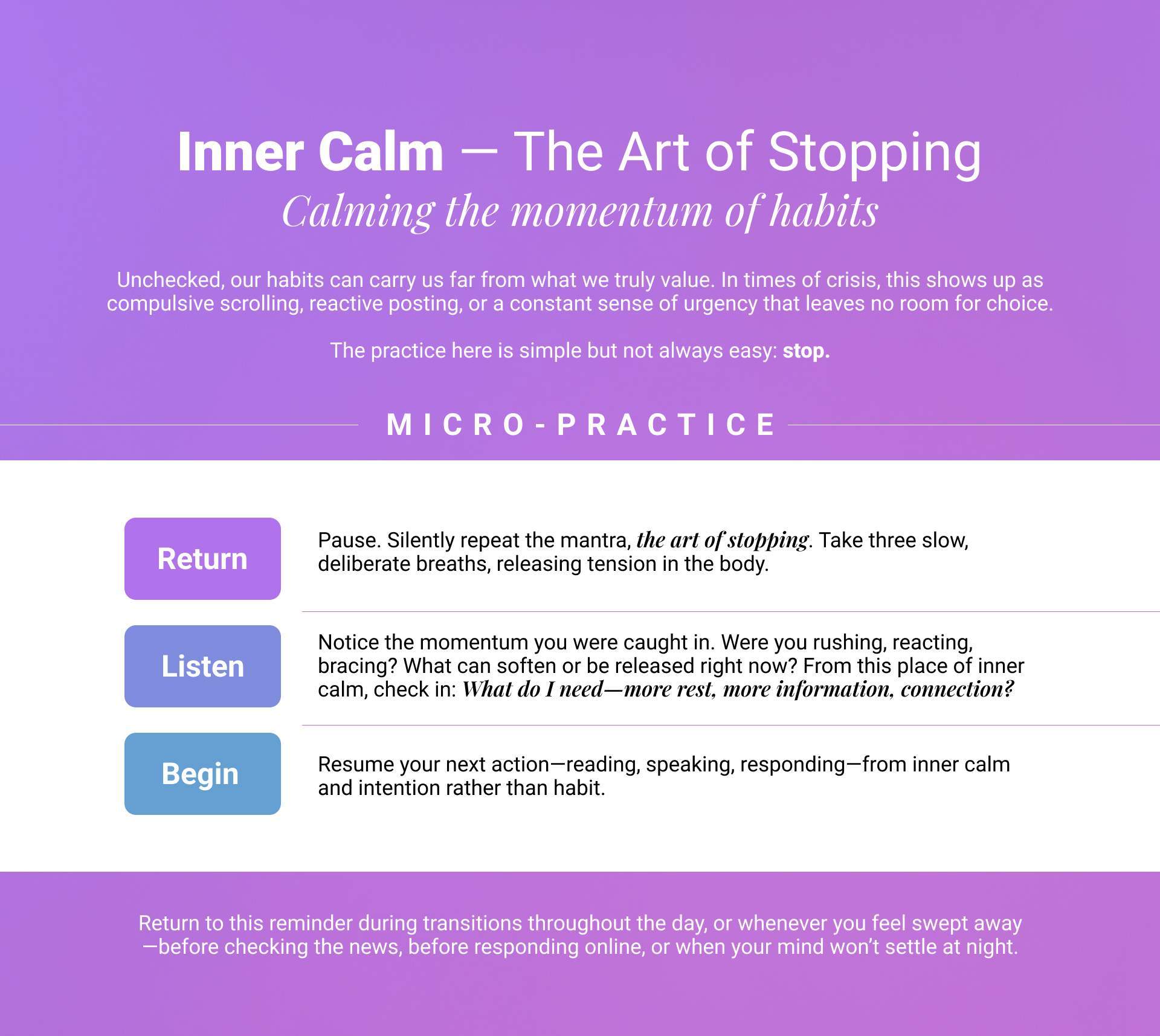
    Inner Calm — Creating Space Without Disengaging

    Inner calm is the art of stopping, looking, and letting go for purposes of healing and clarity. It softens the grip of our attachments to habitual hurrying, beliefs, and expectations that hinder our inner equilibrium.

    Inner calm involves physical composure and mental tranquility, bringing ease to body and mind alike. In the body, composure is experienced in the muscles and as an overall feeling of ease. In the mind, inner calm creates the space to hold everything without attachment and resistance. 

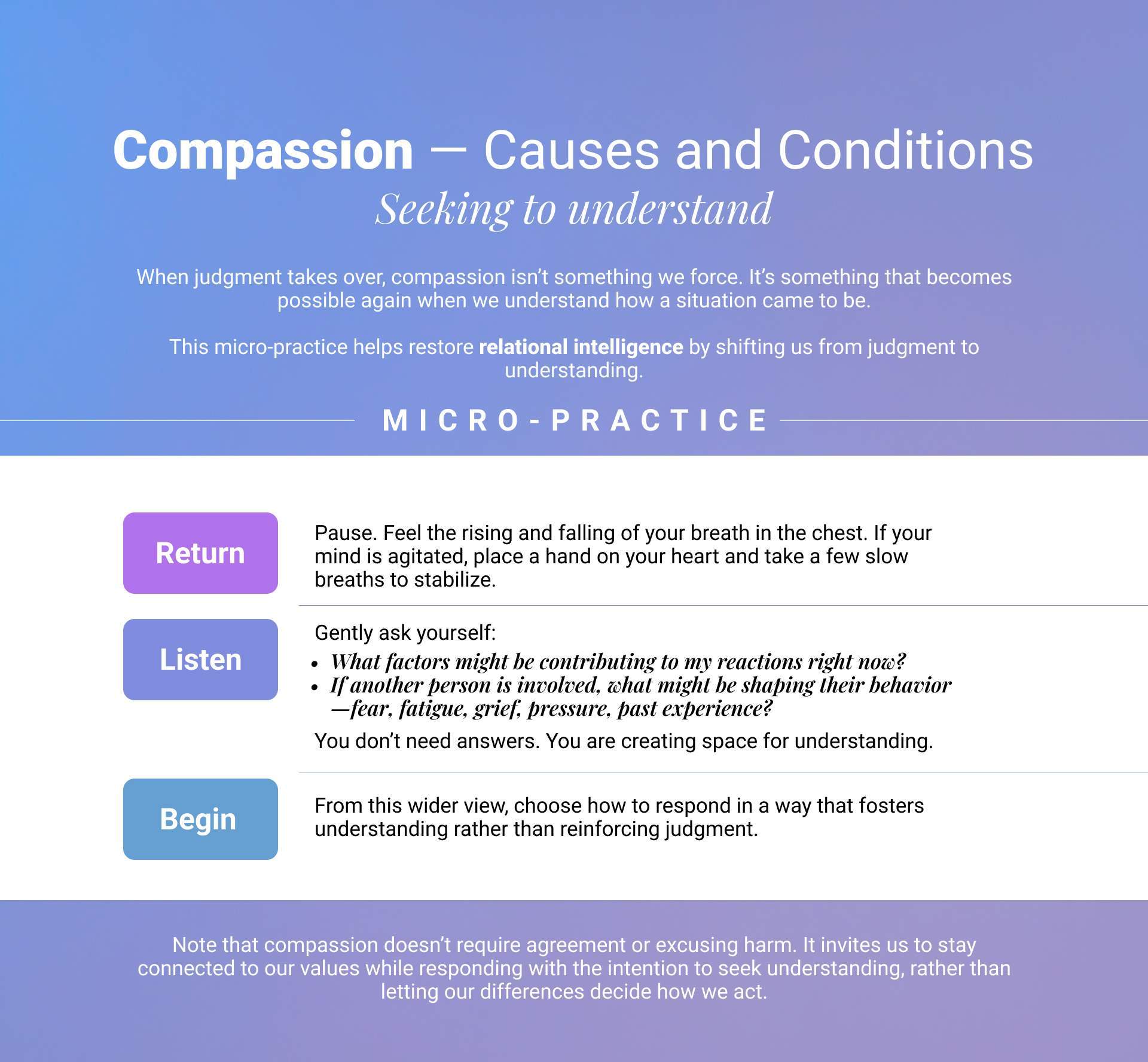
    Compassion — Seeking to Understand

    Compassion is our innate ability to feel, understand, and be motivated to alleviate suffering in ourselves and others. It disrupts our tendency to act on our automatic judgments about ourselves and others by seeking to understand.

    When we lose compassion, we see enemies instead of fellow humans struggling. We attack allies for not being pure enough. We forget that we, too, are worthy of care. We lose our relational intelligence—the capacity to sense how we are affecting others and how to stay connected across differences.

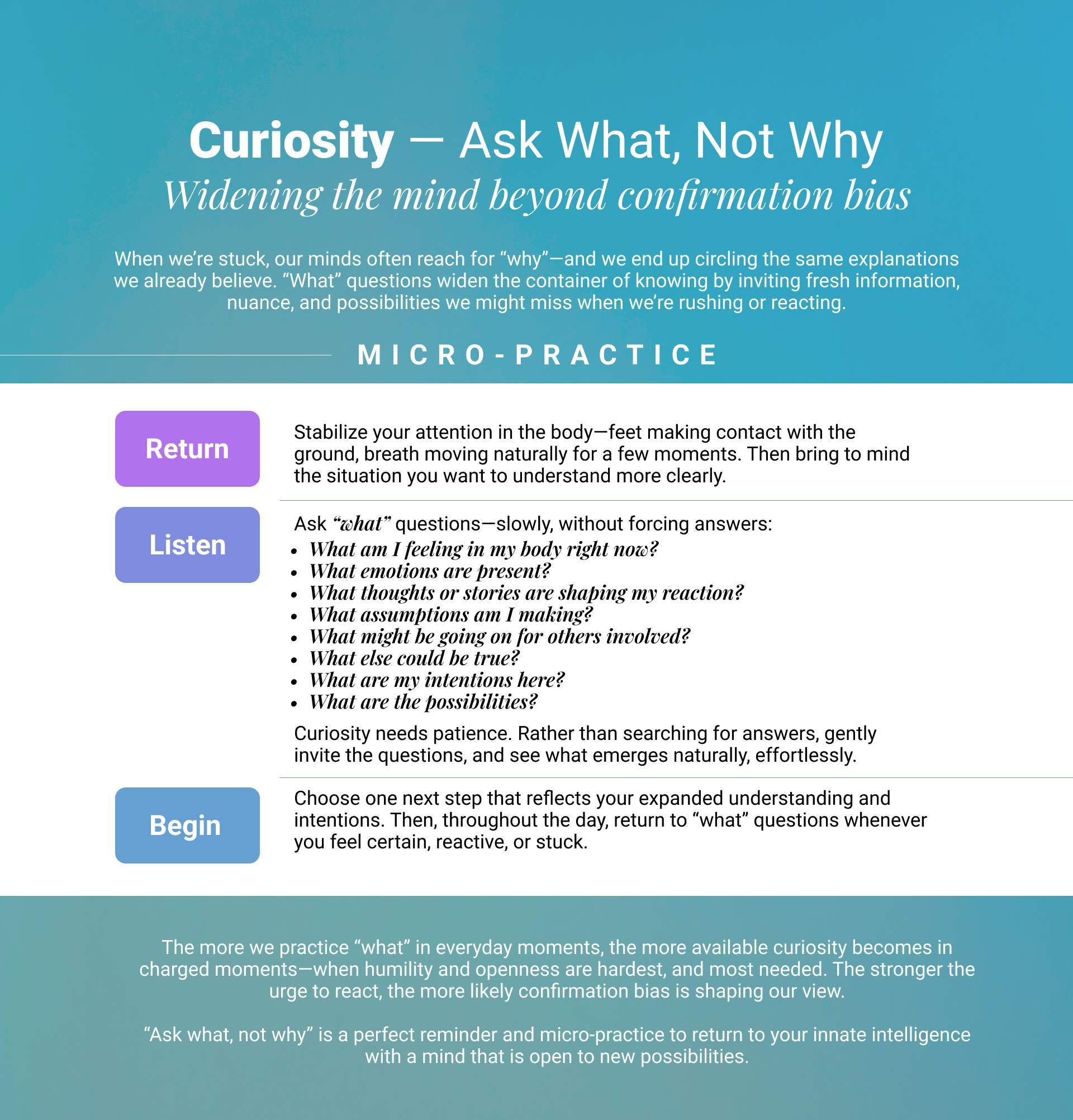
    Curiosity — Returning to Creative Capacity

    Curiosity is our ability to be genuinely interested and care with the purpose of understanding the situation, even when it’s challenging. It disrupts our confirmation bias by staying open and patient in the face of uncertainty and new information.

    Curiosity widens the lens trauma narrows. It restores contact with complexity and helps us sense what might actually help. It’s not about being right. It is about being effective.

    Together, these skills interrupt default patterns and reopen the channel between knowing what matters and being able to act on it.

    Based on our resources, capacity, and unique gifts, what’s ours to do will be different. There isn’t one right way to meet the darkness. Only many necessary ones.

    But here’s what practice has taught me: Skillful response doesn’t look the same for everyone.

    Based on our resources, capacity, and unique gifts, what’s ours to do will be different. The parent raising children who can hold complexity. The artist creating work that helps others process grief. The organizer building coalitions. The healer tending to those on the front lines.

    There isn’t one right way to meet the darkness. Only many necessary ones.

    Reaching to Poetry As Another Anchor

    I too have been learning to live with this question—how to stay engaged without collapsing. Sometimes the sifted language of poetry can speak to our deeper needs and longings. This poem by Michael Dubois captures this truth beautifully and resonates deeply.

    When Things Feel Dark
    by Michael Dubois

    When things feel dark, remember what the world needs:
    More healers, more helpers, more hate exorcisers.
    More artists and poets, more parents ruled by love.
    More cycle breakers, more radical resters,
    more warriors of peace.
    More gardeners who fall deeply in love
    with the earth beneath their feet.
    More meditators, more educators,
    more people willing to use failure as a tool to learn.
    More thinkers, more thankers, forgivers and apologizers.
    More builders of bridges and homes
    with open doors and minds.

    The world needs you—
    because only the ones who see the darkness
    know the importance of turning on the light.

    An Invitation to Practice: 3 Ways to Reconnect

    In times like these, practice is an invitation to return to what is already alive in us, and to offer that wisely.

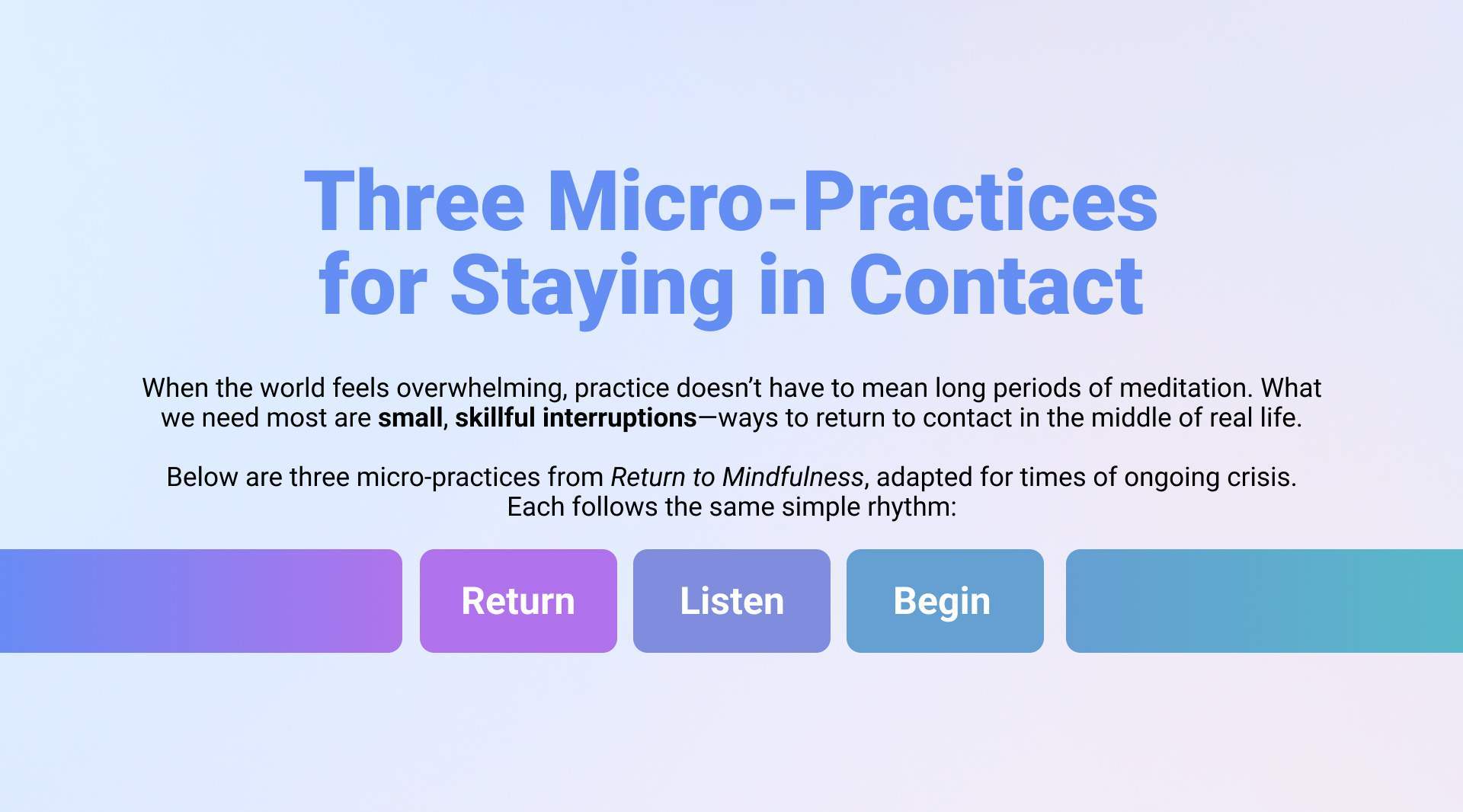
    Below are three micro-practices from my book, Return to Mindfulness, to foster inner calm, compassion, and curiosity.

    May we have the courage to notice when we’ve lost ourselves—and the skill to return.
    May we offer what is uniquely ours to give, trusting that the world needs exactly that.
    May our practice benefit us and all beings.

    Text graphic titled Three Micro-Practices for Staying in Contact with ourselves: Return, Listen, Begin.
    Purple infographic titled Inner Calm, explaining a three-step habit practice for managing vicarious trauma: Return, Listen, and Respond.
    Blue infographic explaining a compassion micro-practice to address overwhelm with steps: Return, Listen, and Begin for understanding others.
    Blue infographic titled Curiosity—Ask What, Not Why, sharing a mindfulness micro-practice to help manage emotional burnout: Begin, Return, Select.
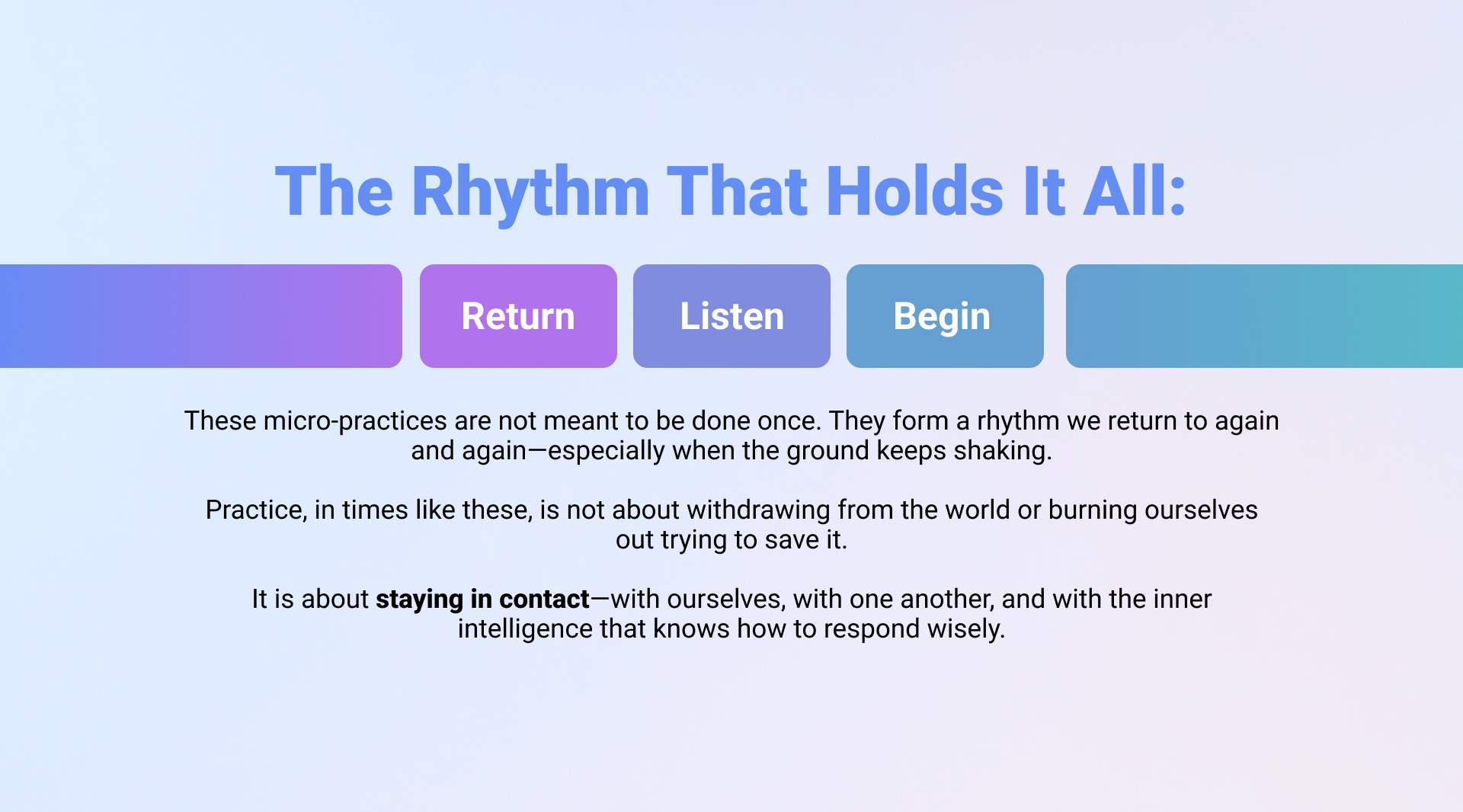
    A graphic titled The Rhythm That Holds It All addresses key steps with buttons: Notice, Return, Listen, Begin, on a gradient background.


    Source link

  • W.A.I.T. a Minute: A Practice to Pause Before You Post on Social Media

    W.A.I.T. a Minute: A Practice to Pause Before You Post on Social Media

    A simple mindful practice that can slow down emotional reaction, invite a breath, and encourage you to pause before you post.

    Social media has made it easy to broadcast our thoughts and feelings far and wide in an instant. At the same time, we often don’t even consider the huge numbers of people who will read what we share. How many friends do you have across your socials? 300 to 400? 500 plus? How often do you really pause before you post?

    When feelings are at a fever pitch, there’s a lot of rapid-fire, non-face-to-face communicating. For teenagers this can be especially tricky, given their proclivity for impulsivity.

    “Adolescents are biologically more prone to making decisions that are not well thought out,” says Tristan Gorrindo, a child and adolescent psychiatrist at The Ross Center in Washington, D.C. “The part of the brain right behind the forehead, which controls judgment, is at that time undergoing a rapid period of development,” says Gorrindo, who is studying the way families use technology.

    For teenagers and adults alike, it’s far too easy for a moment of heightened emotion to result in acrimonious conflict, bullying, or just saying something that lives forever and can be deeply regrettable.

    Gorrindo has created a practice called W.A.I.T., designed with teenagers in mind (but perfect for anyone living in today’s digital world). Here are 4 questions to ask yourself before you post:

    W = Wide Audience
    “Would I say this in front of a school assembly?” (If you’re a grown-up, imagine your entire office.)

    A = Affect
    “Am I in a good emotional place right now?”

    I = Intent
    “Might my intent be misunderstood?”

    T = Today
    “Today, tomorrow, or the next day? Can this wait a day?”

    Evaluating the urgency of what we’re about to say can provide a helpful injection of perspective. Why is it so urgent? What will happen if you take a breath and pause before you post? And if you wait, might you feel differently about it later?


    This article also appeared in a slightly different form in the December 2013 issue of Mindful magazine.


    Source link

  • What’s Good About Being You: How Mindfulness Helps You Get to Know Yourself

    What’s Good About Being You: How Mindfulness Helps You Get to Know Yourself

    The Connection Between Presence and Knowing

    The sitting practice of meditation is a powerful means to get to know yourself, to introduce yourself to yourself. Meditation is a discipline, a technique to transcend technique. You sit down on a cushion or a chair and simply experience yourself: your body, your breath, and your thoughts. You just be there, very simply.

    There are several aspects to meditation that are part of establishing friendship with yourself. One is mindfulness. Mindfulness is keeping track, or keeping a pulse, of being here, in a nonjudgmental way. There is no good or bad. Everything is allowed to be. Among other things, mindfulness is a stabilizing or pacifying influence. The panic of everyday life and every expectation laid on life can subside. This is a huge relief. It is called the discovery of peace.

    Awareness is being in a bigger space, recognizing that there is always an environment around our thoughts and feelings. When you begin to sense that atmosphere, there is both intelligence, or sharpness, and relaxation.

    Finding peace in the practice of meditation involves slowing down. Physically, you call a halt. You park your body somewhere, and you stay put. Your mind may continue to race for a while, maybe for a long time, but you become aware of the mind racing. Awareness is being in a bigger space, recognizing that there is always an environment around our thoughts and feelings. When you begin to sense that atmosphere, there is both intelligence, or sharpness, and relaxation. You begin to see things much more precisely and your native intelligence begins to awaken.

    The Courage to Be Aware

    Becoming more aware is a very courageous thing to do. You allow yourself to look honestly at your experience. And that solid sense of self—of who you are—is revealed as being not so solid. You begin to experience gaps, holes in your suit of armor. You realize that you are really more like Swiss cheese than Cheddar.

    When you are there, just there, without trying to hold everything solidly together, you also begin to find that you don’t need to sustain a storyline about yourself and your life. Who is it for anyway?

    When you are there, just there, without trying to hold everything solidly together, you also begin to find that you don’t need to sustain a storyline about yourself and your life. Who is it for anyway? You can afford to relax with yourself, get to know yourself. You don’t have to put on makeup for yourself; you don’t have to put on a smile. You can leave the mental toupee on the shelf and like yourself just as you are.

    There is something genuinely good about being you. You may not like every little thing about yourself, but overall you have an honest heart and you can connect with it through the practice of meditation. You have the courage to face yourself. From that connection with yourself and from actually liking yourself without conditions, you begin to see how brilliant and available life can be when it is without preconceptions or adornments.

    As you open yourself to yourself, you become more aware of the world you’re living in. The development of awareness here is a bit like having cataracts removed, or getting a hearing aid: you didn’t know your vision was so obscured until you finally see a brilliant yellow daffodil in the field. You couldn’t hear the first bird of spring singing in the meadow. You couldn’t taste the bitter onion flavor of chives by the stream. You didn’t see the face of your beloved, until you ran right into him. Then suddenly you begin to feel your world. You begin to understand love in an entirely new way.

    Noticing the Hall of Mirrors

    At that point, as you become more open, you also may begin to see where you’re stuck, how you’re often living in a hall of mirrors that you create for yourself. You see your speed and how that has produced panic. We may actually recognize and experience ourselves as the monkey bouncing off the walls in our house of mirrors. What you’re bouncing off of is often simply the reflections that you project. When you bounce off yourself, this can take the form of self-hatred or it can be twisted into some kind of false arrogance and pride. Unfortunately, your dearest friends, lovers, relatives, and partners are often the mirrors you project your reflections onto most intensely.

    We demand a lot from intimacy, often more than it can possibly deliver. We ask ourselves and our closest friends to confirm us by reflecting some things and not others. Essentially, we ask, “Mirror, mirror, on the wall, who’s the fairest one of all?” And we expect the answer, “You, my love!” This a burden to others and to us, and ultimately it doesn’t work. The mirrors crack.

    If you want to live in a hall of mirrors, this is a disaster. If you’re willing to find a true relationship with yourself and others, this is welcome relief from your self-imposed isolation. It reveals the tremendous space that is there when the myth of satisfaction is seen to be a fraud.

    Facing reality is not creating something new. It’s allowing a barrier to dissolve.

    Over the course of time, if we are committed to meditation as an ongoing practice, then it can provide us with this honest feedback. Although we might try to filter information, if we sit long enough, reality wells up in us and breaks through. This is inevitable, because it is just discovering what is there and we can’t block what is there forever. Facing reality is not creating something new. It’s allowing a barrier to dissolve. It unlocks in us the power of loving-kindness and is the beginning of real warmth toward ourselves and others.


    Source link

  • Bring Your Practice to Digital Work

    Bring Your Practice to Digital Work

    I’m fascinated by technology, yet I yearn for a calm, peaceful life. This dual interest led me to draw insights from both camps and experiment with a mindful way of being with tech, not against it. For my entire adult life, I’ve been trying to figure out how to live mindfully and love technology at the same time.

    This has been a very personal journey, but a big part of it is professional, too. I love sitting in silence when I can, but I’m also a tech designer and entrepreneur. I lead a fractional product team creating mindfulness-related technologies remotely from a laptop, so I know the struggle of finding balance with tech more than most. 

    It’s not easy to do your best work, think deeply, and be creative in this attention economy. 

    It’s not easy to do your best work, think deeply, and be creative in this attention economy. It’s even harder to stay grounded when the pressure is high and you’re swimming in emails, notifications, and demands. Here are a few of my favorite tips to mindfully fine-tune the ways you engage with tech at work. 

    1. Redesign Your Work Environment

    Recently, I had a big project that demanded a lot of focus. It was hard to even imagine, knowing all the requests that pull at my attention on any given workday. I reduced the burden on my willpower by installing my second computer monitor on a swivel and putting a big, comfy chair on the other side of my desk. 

    Now, whenever I need to focus on something (including as I type these words), I rotate my second monitor to face backward with nothing else visible. I sit on the wrong side of my desk and type on a wireless keyboard with no trackpad. I can’t reach my email, social media, and web browser. And they can’t reach me. 

    Those who create tech aren’t the only ones who can leverage the power of design. My physical setup provides me with the constraint I need to get into a flow without too much effort. I couldn’t redesign the operating system, but I did redesign the room in which it operates.

    This mindset also helps me park my phone outside of work hours. When I’m at home with my family, I try to leave it charging on my desk as much as possible. If I want to check something, I’m forced to politely excuse myself and walk over to my desk. Less convenient, but just enough friction to prevent me from habitually reaching for Slack or my work email while my six-year-old is trying to play with me.

    2. Be Intentional With Email 

    When I start my workday, the first thing on my calendar is a block of time to clear my inbox. I do this for a few important reasons.

    First, I don’t have work email on my phone, so I don’t see messages in the evening or early morning and feel like I need to catch up. On top of that, I like taking time to respond thoughtfully to people to prevent downstream conflicts and miscommunications. I even try to include something in every message that might make the receiver smile.

    Mindfully noticing patterns in how tech influences your state of mind will help you make similar skillful adjustments to accommodate your unique habits and idiosyncrasies.

    At the end of the day, I check my email one last time, but I try not to send any replies. If I do, I’ll ruminate on whatever I sent and compulsively check for replies in the evening. And if I actually get a reply in the evening, instead of satisfying me, it usually ends up with me sneaking back into my office late at night to follow up.

    This tip isn’t necessarily for everyone; it’s a nuance I’ve discovered about myself. Mindfully noticing patterns in how tech influences your state of mind will help you make similar skillful adjustments to accommodate your unique habits and idiosyncrasies.

    3. Reject False Urgency 

    Across both personal and professional information channels, there’s one destructive illusion that makes tech way more stressful than it needs to be: false urgency. Work messaging becomes much saner when you customize it to present with an appropriate level of urgency for the information being conveyed.

    Consider how urgent your current settings are, compared to how urgent they need to be.

    For email, team messaging, calendar alerts, project notifications, or any other information channels, you can consider how urgent your current settings are compared to how urgent they need to be. An alert on your phone notifying you that a critical system just failed makes sense. That same alert is unnecessary for a random email that can easily wait until tomorrow.

    It also helps to manage urgency with your team. At Still Ape, we have a communications charter that describes how urgently we expect each other to reply: Emails warrant a response within two days, work messaging within one day, a text within a few hours, and calls immediately. When we tag someone in a document, we don’t expect them to see it until they’re actively in the file. Not only does our charter protect receivers’ attention, it also prevents senders from anxiously waiting for immediate replies on a non-immediate channel.

    If you’ve been frantically refreshing your inbox, it might feel pretty uncomfortable to slow down. It’ll get easier as you form new habits and your team builds new expectations. Rejecting false urgency frees up a lot of mental energy for focus, creativity, deep thinking, and effective collaboration. 

    4. Use AI Wisely

    You can use AI apps to gather and assemble ideas quickly, but at least for now, you need to pause to verify facts, trim the excess, and edit for clarity and authenticity. For many tasks, AI is more like cruise control than autopilot; you still need to steer.

    By now you’ve probably seen an AI agent join a video call, listen to an entire meeting, and then email everyone an immediate summary. But did you actually read the summary? Probably not, unless a human being who understood the full context edited it down to what actually matters.

    Things are evolving quickly in this space, but as a rule, I recommend making sure it doesn’t take you less time to create something than it will for others to engage with it. If it does, respect your recipient’s attention by spending a bit more time reading it and refining it yourself. Something feels off about having ChatGPT whip up a 10-page report in two minutes and expecting others to read it in-depth when you didn’t even bother.

    Your work might look very different from these examples. It’s all good. People are diverse, and things change over time. What matters is that a mindful relationship with technology is all about paying close attention to how different tech affects you and using that insight to fearlessly experiment in your own life.

    Excerpt from Reclaim Your Mind: Seven Strategies to Enjoy Tech Mindfully by Jay Vidyarthi, published by Still Ape Press. Copyright © 2025 by Jay Vidyarthi. 


    Source link

  • Thanks for the Stuff that Isn’t Just Stuff and Gratitude for What Matters Most

    Thanks for the Stuff that Isn’t Just Stuff and Gratitude for What Matters Most

    Barry Boyce, Mindful’s founder, reflects on the ravages of Hurricane Sandy in 2012, and is thankful for people who remember what matters most, especially in trying circumstances. 

    Something I’ve always loved about Thanksgiving is that we’re mostly thankful for the people (and some good food) and not for “the stuff.” Even with the attendant commercialization that marks the official beginning of The Holiday Season, this brief pause seems to focus on what matters most. 

    For a seemingly increasing number of people the blessed four-day weekend at this time does seem to involve some retail hysteria, but for many families I talk to, it’s still a few days that are focused on the most basic of values. One of my most favorite Thanksgivings was two years ago when I found myself alone with my mother at her nursing home. In a conventional sense, there may have been little for either of us to be thankful for. Her circumstances were reduced, the food could hardly be described as tasty, and other family members were in far flung places having their own Thanksgivings. 

    And yet, we were thankful. Thankful for the company, and just to be breathing air together. We took a long ride in the countryside and my mother opened up and talked about her own mortality in a way she had not before. That too was a thankful moment. We can give thanks for those times when we can be open with someone else about fears and thoughts that by custom we’re not supposed to reveal. Shortly after the next Thanksgiving, my mother did indeed die. I’m ever grateful for that last Thanksgiving with her and the frankness of the conversation 

    This year, I’m particularly inspired by the example of the clothing designer Eileen Fisher and the response of her company to the predations of Hurricane Sandy. Fisher, who launched her business in Tribeca in 1984, made a quality-of-life move upriver to the lovely, un-hectic bedroom community of Irvington in 1992. Known for being a values-conscious retailer and employer (and a mindfulness meditator), by all accounts Fisher has treated her people well, kept her eye on environmental values, and been very community conscious. Her spacious riverfront headquarters includes a second-floor space for yoga and whatnot and a ground floor space where a meditation group has been gathering during off-hours for a few years. 

    On the Monday morning Sandy hit, Fisher’s headquarters filled with water to the height of two file cabinet drawers in some places, her facilities manager told the New York Times. The large plate glass window of her nearby retail store and community gathering space were shattered by the storm. A strikingly beautiful red couch went floating freely and relocated itself to another part of the store. Mud was everywhere in headquarters and store alike. The company’s New Jersey warehouse was shuttered, as was the Manhattan design center, power was spotty, transportation was hampered by gas shortages, shipments were frozen. 

    Twelve dumpster-loads and eight mobile storage units of goods were damaged, to the tune of $1.5 million. And yet Ms. Fisher told the Times, “It was just stuff.” 

    Her composure and equanimity are inspiring, not to say that of her staff, who mobilized on all fronts, to make sure not only that a cleanup could begin quickly and the engine of commerce set in motion again, but also that employees could be paid and offered interest-free loans or advances if they needed cash during the crisis. With few desks to inhabit, they cadged meeting space where they could and car-pooled to save on gas. While everything is far from in full working order weeks after the storm, Eileen Fisher is back in business.

    As Stephanie Clifford wrote in the Times, there was “an almost out-of-body detachment on executives’ part to see past the emotion of sewage-soaked shirts and stained rolls of fabric to the prize of reopening a ravaged business.” That’s a great description of resilience. We might say it’s only a business, but businesses put food on the table and make life for communities. And when a business has a human face, even in crisis, that’s worth being thankful for.


    Source link

  • Why Mindfulness Helps Us Feel Good About Helping

    Why Mindfulness Helps Us Feel Good About Helping

    People often use the words empathy and compassion interchangeably—and certainly they share important qualities. But there is a subtle difference between empathy and compassion, and studies show that mindful attention might be key to making sure that our efforts to help are coming from a healthy, aligned place. Here’s a deeper look at how mindful qualities like present-moment attention can help us genuinely be of greater service to others, and how mindfulness can help us feel good about helping.

    People naturally tend to empathize with others, report C. Daryl Cameron and Barbara Fredrickson in the January issue of the journal Mindfulness. But empathy can go wrong when it leads to distress. We might help out of guilt, obligation, or co-dependence. Or, the help might cause resentment, which could lead us to avoid helping people in the future. Or sometimes, in the absence of strong boundaries, we might unknowingly absorb the feelings of someone in trouble, and if we can’t deal with those feelings of suffering, we might turn away altogether.

    There is another possible response: compassion, which leads people to try to alleviate distress in others.

    The Way to Healthier Helping

    As the authors speculate, “Helping should be most common among people who are able to maximize compassion while minimizing distress.” Previous research has found that cultivating mindfulness—the moment-to-moment awareness of thoughts, feelings, and surroundings—can lead to greater compassion. But what specific components of mindfulness predict real-world helping behavior? In other words, what skills could we develop that would make us more likely to help each other out?

    The study examined two mindful traits—a focus on the present moment (aka, “present-focused attention”) and a non-judgmental acceptance of thoughts and experiences (“non-judgmental acceptance”). Cameron and Fredrickson assessed the mindfulness of 313 adults, asking if, for example, they “pay attention to how my emotions affect my thoughts and behaviors” or often criticize themselves “for having irrational or inappropriate emotions.”

    The researchers confirmed their hypothesis: Present-focused attention and non-judgmental acceptance both predicted more helping behavior … Mindful participants were more likely to experience emotions like compassion, joy, or elevation while giving help. That could mean that they just felt better when helping others, which could lead them to engage in more helping behavior in general.

    Next, the survey asked if they had recently helped someone out. If they had, participants answered questions about how they felt while helping. Did they feel positive emotions like gratitude, hopefulness, inspiration, or joy? Or did they have negative ones, like irritation, contempt, disgust, distaste, guilt, or nervousness?

    In analyzing the answers, the researchers found that 85 percent of participants had engaged in some kind of helping behavior during the previous week, like listening to a friend’s problems, babysitting, giving someone a car ride, donating to charity, or volunteering. In the process, they uncovered some incidental but interesting facts:

    • Men were marginally less likely than women to report engaging in helping behavior;
    • Age did not predict helping; and
    • Participants with higher income were more likely to report helping others.

    However, the biggest predictor of helping behavior had nothing to do with these demographic traits. In fact, the researchers confirmed their hypothesis: Present-focused attention and non-judgmental acceptance both predicted more helping behavior. This link between mindfulness and helping might be traced to the fact that the mindful participants were more likely to experience emotions like compassion, joy, or elevation while giving help. That could mean that they just felt better when helping others, which could lead them to engage in more helping behavior in general.

    What Makes Us Want to Keep On Helping?

    The study also revealed a scientifically important nuance: Participants who scored higher in present-focused attention were more likely to experience positive emotions—and participants high in non-judgmental acceptance experienced fewer negative emotions, like stress, but weren’t necessarily more likely to experience more positive emotions. In other words, acceptance may only clear the way for helping; it’s the present-focus that could actually make the helping an emotionally rewarding experience. Together, the takeaway seems to be that approaching these situations with mindfulness helps us feel good, or at least better, about extending ourselves in service.

    Insights from this study have obvious practical implications for teaching helping behavior to children. This line of research could also help people in helping professions who are at risk for burnout, or people whose mental illnesses make it hard for them to connect with others.

    The study also carries hugely helpful implications for the rest of us, because anyone can feel worn down by helping other people. There’s an invitation to look at our motivations for stepping in, our boundaries and limitations and need for real rest. And there’s an opportunity to enter into opportunities for service with deeper compassionate attention and an open heart. Isn’t it nice to know there are ways we can help ourselves feel better when we do something nice for someone else?


    A version of this article originally appeared on Greater Good, the online magazine of UC Berkeley’s Greater Good Science Center, one of Mindful’s partners. To view the original article, click here.


    Source link

  • We’re Hardwired to Doubt—And It’s a Good Thing

    We’re Hardwired to Doubt—And It’s a Good Thing

    Doubt helps us avoid acting on every passing idea which can prevent us from participating in certain types of risk.

    The post We’re Hardwired to Doubt—And It’s a Good Thing appeared first on Mindful.

    Source link