

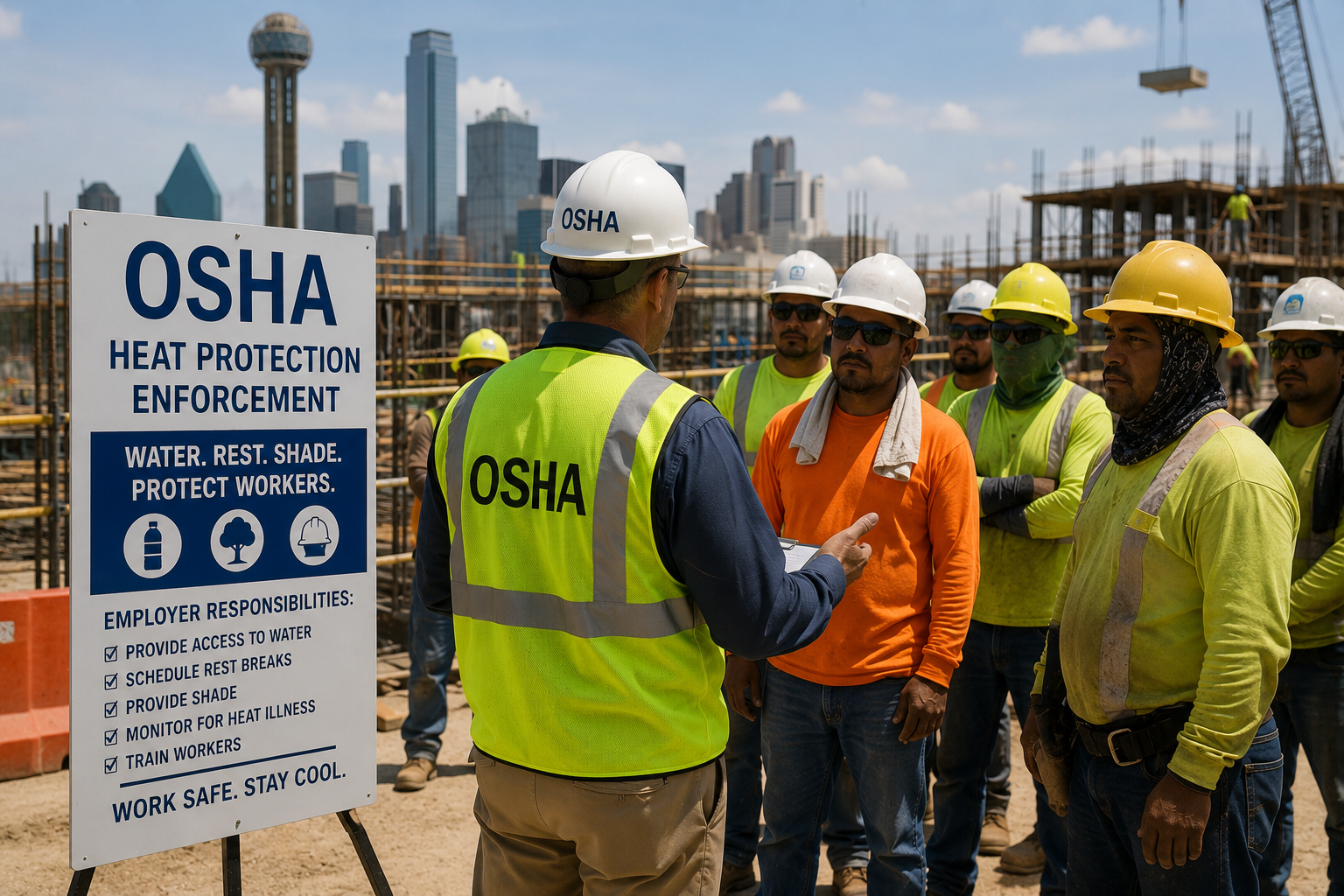
In what workplace safety advocates are calling the most meaningful federal action on worker heat protection in American history, OSHA launched a revised and dramatically expanded National Emphasis Program (NEP) on Heat Injury and Illness Prevention on April 10, 2026 — replacing the previous NEP that had been in operation since 2022 and extending through April 2031.
The new NEP uses Bureau of Labor Statistics injury data from 2022–2025 to target 55 high-risk industries for proactive heat-hazard inspections, expanding the program from approximately 200 heat inspections per year under its original form to approximately 2,400 per year — representing 6% of all OSHA inspections nationwide. Heat inspections have now increased twelve-fold since the program began.
For Dallas–Fort Worth, whose construction, manufacturing, landscaping, food service, and agricultural sectors employ hundreds of thousands of workers in environments that regularly expose them to heat index readings above 100°F during June and July, this enforcement expansion is the most relevant occupational health development of the summer.
The scale of the unprotected heat exposure in Texas’s workforce is documented in the numbers. The Groundwork Collaborative’s May 2026 report on extreme heat and workers found that in 2023 alone, high temperatures caused an additional 28,000 injuries across the United States. Between 2011 and 2021, 436 work-related deaths from heat occurred nationally. These are the officially counted cases; the true toll is documented to be substantially higher, as the same surveillance failures that produce San Antonio’s one official heat death in five years operate across the broader Texas labor system. The DFW construction boom — driven by data center expansion, commercial development, and residential growth — is creating a large and growing population of outdoor workers whose heat exposure during this summer may be the most intense in the metropolitan area’s recent history, given the AccuWeather forecast for potential triple-digit temperatures beginning as early as June 22.
What the New NEP Actually Requires Employers to Do
The expanded NEP does not yet create a permanent federal heat standard — the OSHA rulemaking process for a final heat standard is ongoing. But it dramatically increases enforcement risk for employers who fail to address heat hazards under the existing General Duty Clause of the Occupational Safety and Health Act. The revised NEP directs OSHA compliance officers to proactively inspect workplaces in all 55 targeted high-risk industries — including construction, landscaping, warehousing, food processing, and food service — in any geographic area where the heat index reaches 80°F. At Dallas’s summer temperatures, that threshold is crossed virtually every working day from June through September.
In practice, the General Duty Clause enforcement means OSHA can cite employers who fail to provide water (one cup per hour for outdoor workers), rest breaks in shade or air conditioning, acclimatization protocols for new workers or workers returning from absence, and heat illness training.
The Alert Media summary of the 2026 OSHA heat regulations confirms that even without a final rule, “enforcement risk is at an all-time high” — and employers who have not implemented documented heat illness prevention programs face significant citation liability if workers develop heat illness during the 2026 summer season.
For Dallas-area employers in construction, agriculture, and food service — the industries with the most documented heat exposure — the April 10, 2026 NEP launch is a compliance warning that the summer of 2026 will be the most scrutinized heat safety season in Texas workplace history.
The World Cup Dimension: Temporary Event Workers and Highest-Risk Exposures
The World Cup’s June 14 opening in Dallas creates a specific and time-compressed occupational heat safety scenario that the expanded NEP directly addresses: the large temporary workforce deployed for event operations — security personnel, food vendors, transportation workers, equipment handlers, and cleaning staff — who will work extended shifts in outdoor environments around AT&T Stadium and associated fan festival areas during potentially record-setting June heat.
These temporary workers are precisely the population that OSHA’s updated emphasis program identifies as high-risk: they may be new to outdoor work, may not yet be heat-acclimatized, may be working irregular hours that prevent adequate overnight recovery, and may be employed through staffing agencies whose oversight of heat safety protocols is less systematic than direct employers.
Dallas County Health Director Dr. Philip Huang’s confirmed expansion of public health monitoring for World Cup events covers disease surveillance, but occupational heat safety for event workers falls under OSHA’s jurisdiction.
The Texas Workers’ Compensation Commission and the Texas Department of Insurance track heat-related workers’ compensation claims — data that will be particularly scrutinized in the weeks following the World Cup matches. For workers: know your rights under the General Duty Clause — water, rest, and shade are enforceable protections even without a final OSHA heat standard. For employers: the April 10, 2026 NEP is enforcement notice that the 2026 summer will produce heat citation activity at levels not previously seen in Texas.


