

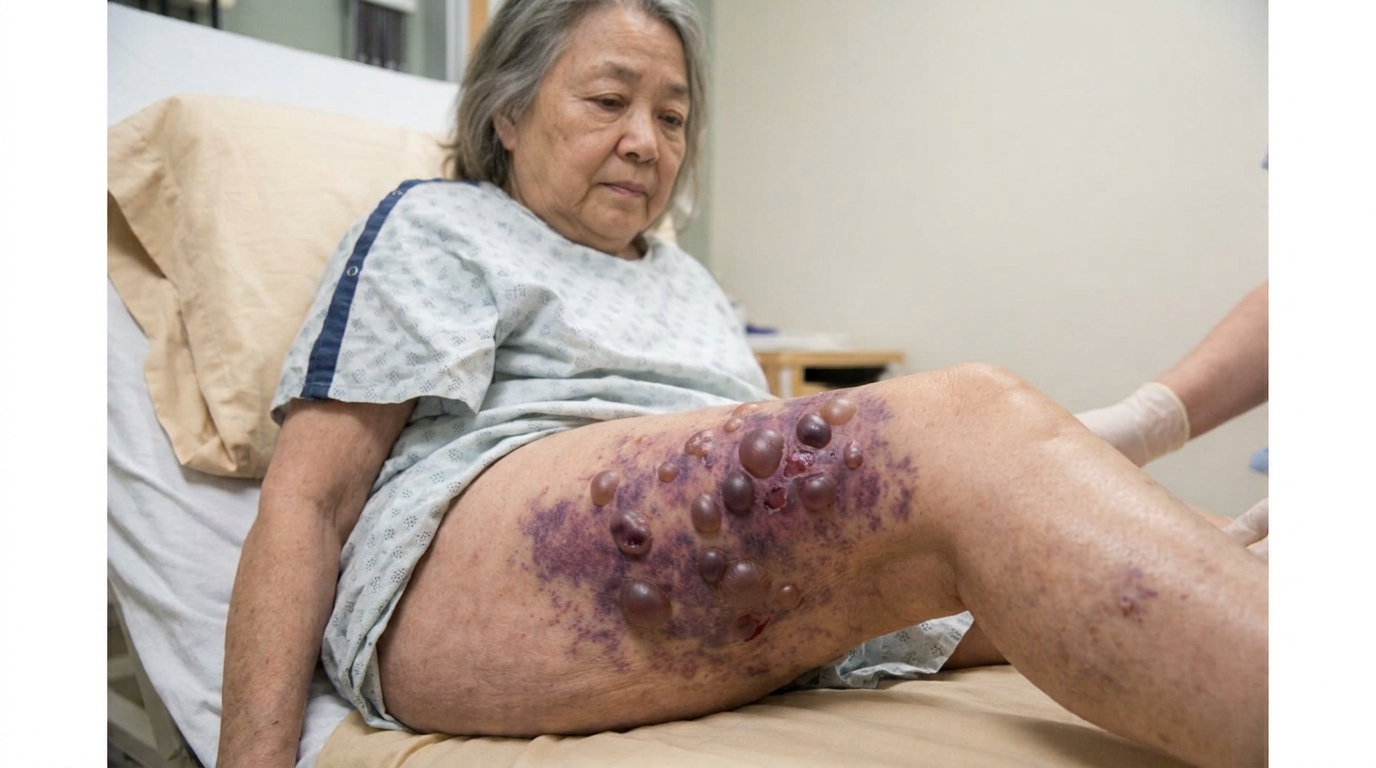
The bruises on a 65-year-old woman’s thighs kept spreading. They turned purple and swollen, then rose into tense blisters filled with blood, and finally broke open into ulcers. To her doctors in southeastern China, the lesions resembled a pattern they had seen with a deadly bacterium, Vibrio vulnificus.
They were not caused by infection. The woman had POEMS syndrome, a rare disorder driven by abnormal plasma cells that can damage nerves and many organs. Treatment eventually began to clear the skin lesions.
Doctors at Putian University and its affiliated hospital in Fujian province described the case in Frontiers in Medicine in July 2025. They believe it is the first reported POEMS case with skin lesions resembling Vibrio vulnificus infection.
A Look-Alike With a High Death Rate
The comparison was not idle. For Vibrio bloodstream infections, the CDC lists fever, chills, dangerously low blood pressure, and blistering skin lesions among the signs. About 1 in 5 people with Vibrio vulnificus infection die, sometimes within a day or two of becoming ill.
The woman’s lesions covered an area of roughly 18 by 7.5 centimeters on both thighs. They were violet, tender, and swollen, with bleeding under the skin, before evolving into blood-filled blisters and ulcers.
The rest of her story did not fit an infection. In the authors’ words, “She denied fever, trauma, or exposure to seawater or seafood.” Cultures found no infection, and her blood counts, C-reactive protein, and procalcitonin did not suggest one. A DNA test of blister fluid for Vibrio vulnificus came back negative. The authors stress that the comparison describes only how the lesions looked.
Eight Months of Clues
Her illness had been building for most of a year. In February 2024, she was hospitalized for a hypertensive emergency with blood pressure of 243/120, along with swelling and shortness of breath. By July, her legs were swelling again, and she was losing protein in her urine.
In September, she was admitted for fluid in her abdomen of unknown cause, along with leg bruising. Her creatinine, a measure of kidney function, was 242 micromoles per liter, well above normal. Doctors ruled out liver disease, tuberculosis, cancer, and thyroid-related causes of the fluid, and fluid drawn from her abdomen showed no infection and no tumor cells.
Skin ulceration and worsening bruising followed late that month. Infectious disease and dermatology specialists suggested a blood vessel problem, but tests for autoimmune and vascular disorders, including ANCA, cryoglobulins and antiphospholipid antibodies, were negative.
The turning point came in early October, when the team ordered nerve testing, protein studies and a blood test for VEGF, a growth factor that drives blood vessel formation. The diagnostic process took nearly eight months in all.
A Growth Factor Eight Times Too High
Her VEGF level was 729.7 picograms per milliliter, against a reference range of 9 to 86, more than eight times the upper limit. Her blood contained an abnormal IgA lambda protein made by a single clone of plasma cells.
Nerve testing showed a symmetrical demyelinating polyneuropathy affecting sensation and movement, and her tendon reflexes were absent. She had an enlarged liver and spleen, an underactive thyroid, darkened skin, and whitened toenails. Fluid had collected in her abdomen and around her lungs, and her platelet count was high.
Together, these met updated 2023 diagnostic criteria for POEMS syndrome. The name stands for polyneuropathy, organomegaly, endocrinopathy, monoclonal protein, and skin changes. The National Organization for Rare Disorders describes it as extremely rare and notes that VEGF appears to play an important role, though its exact role is still unclear. Cleveland Clinic describes it as a rare blood disorder in which too many abnormal plasma cells damage multiple organs.
The authors believe her extremely high VEGF likely contributed to leaky capillaries and fragile blood vessels, which could explain how her bruises turned into blisters. Her family initially refused bone marrow, lymph node, and nerve biopsies. A bone marrow biopsy, performed after the family later agreed, showed abnormal plasma cells of the same lambda type.
Treatment and What Remains Unknown
A stem cell transplant is often considered for POEMS, but she was judged unsuitable because of frailty, organ dysfunction, and socioeconomic factors. She received chemotherapy built around bortezomib, a drug that targets plasma cells, with dexamethasone. One section of the report also lists cyclophosphamide.
After six cycles, her swelling, abdominal fluid, and skin lesions gradually improved, and her neurological symptoms stabilized and partly recovered. Her abnormal protein fell, her kidney function improved, and her VEGF declined.
The report has gaps that the authors acknowledge. She transferred to another hospital, so long-term results are unavailable. Because the lymph node biopsy was refused, Castleman disease, a related lymph node disorder, was neither confirmed nor ruled out, and sex hormone levels were not measured. The paper also contains internal inconsistencies, including whether her VEGF normalized or only trended downward.
The authors recommend VEGF testing and protein studies for patients with unexplained illness affecting many organs and vascular skin changes. For the public, the more common danger remains real. Rapidly spreading, blistering skin with fever, especially after seawater or shellfish exposure, needs emergency care, and Cleveland Clinic advises going to the emergency room immediately for Vibrio vulnificus symptoms.
Key Questions Answered
What happened to the patient?
A 65-year-old woman’s thigh bruises became blood-filled blisters and ulcers that resembled Vibrio vulnificus infection.
Did she have Vibrio?
No. She reported no fever or seawater or seafood exposure; cultures found no infection, and a DNA test of blister fluid was negative.
What is POEMS syndrome?
A rare plasma cell disorder named for polyneuropathy, organomegaly, endocrinopathy, monoclonal protein, and skin changes.
What caused the blisters?
The authors believe very high VEGF levels likely made her blood vessels leaky and fragile.
How was she treated?
With bortezomib-based chemotherapy, which gradually improved her skin, swelling, and nerve symptoms.
When are blistering skin lesions an emergency?
Rapidly spreading blisters with fever, chills, or low blood pressure need immediate care.
Published by Medicaldaily.com


