

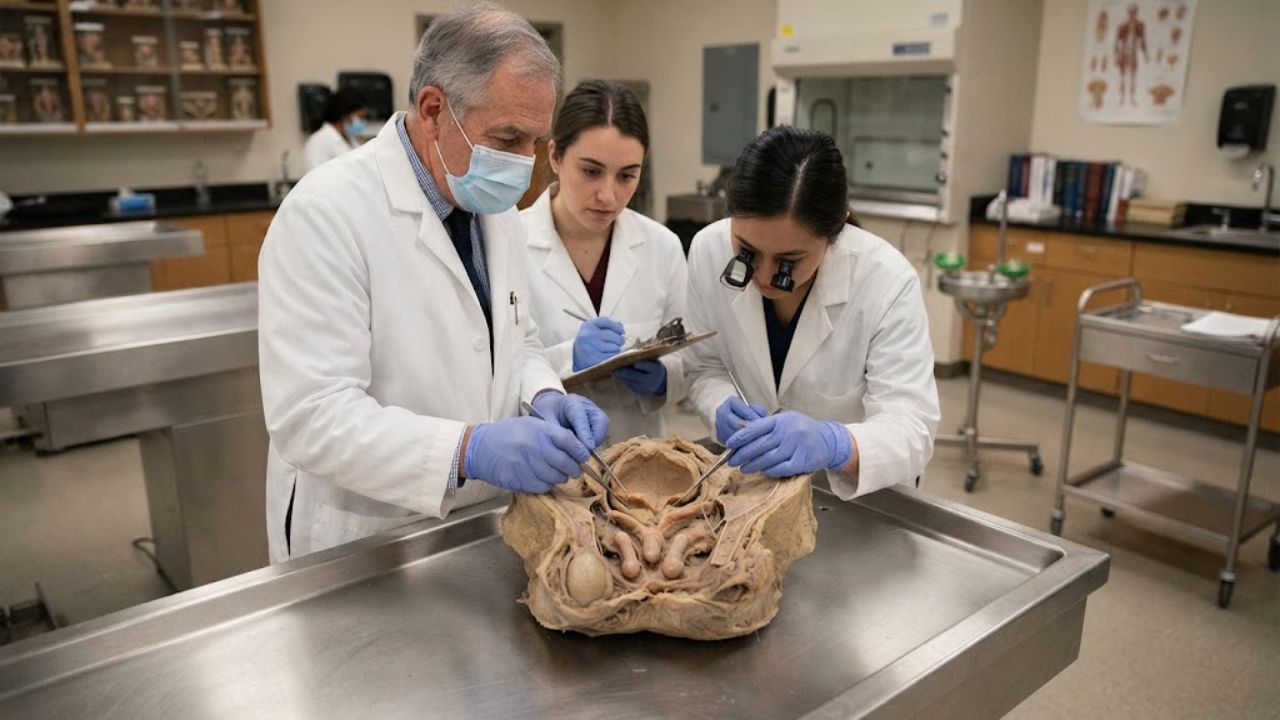
The external anatomy looked entirely ordinary. It was only after a dissection team at the University of Birmingham Medical School divided a donated pelvis down the midline that they found what was inside: two additional penile structures, stacked one behind the other, concealed within the skin of the scrotum.
The finding was published in the Journal of Medical Case Reports as only the second documented human case of triphallia. It drew enormous attention when it appeared, and the version that spread fastest contained a claim the paper never made. The more interesting argument, in any case, is not the count. It is what the authors say the discovery implies about everyone else.
A Teaching Dissection That Became a Case Report
The donor was a white man in his late 70s, around six feet tall. Under the medical school’s policy, researchers were not given his identity or medical history beyond what the dissection itself revealed.
Cutting through the pubic symphysis, penis, and scrotum in the midsagittal plane, they found three penis-like structures aligned front to back, an arrangement anatomists call sagittal stacking. The largest and most dorsal was the only one visible externally. The second, immediately beneath it, had its own corpora cavernosa, corpus spongiosum, urethra, and glans. The third, deeper still, had corpora cavernosa and a glans but no corpus spongiosum and no urethra at all.
What happened next is the detail that gives the case its clinical teeth. When a probe was inserted into the external urethral opening, it would not advance. Further dissection showed why. The single urethra ran from the bladder outlet up through the secondary penis before entering the primary one, a meandering course with no branches.
Notably absent were the anomalies that usually travel with penile duplication. There was no accessory kidney, ureter, or bladder, no duplication of the lower gastrointestinal tract, no bifid scrotum, no imperforate anus, and no abdominal wall defect. Externally visible cases are frequently bundled with defects of that kind. This one was not.
The Number That May Be Wrong
Supernumerary penile formation is usually cited as affecting roughly 1 in 5 to 6 million live births, a figure drawn from the report of the first known triphallia case, a three-month-old boy in Duhok, Iraq. Across 168 papers dating from 1606 to 2023, the Birmingham team counted 112 cases of complete diphallia, 50 of pseudodiphallia and exactly one of triphallia, using a classification proposed in the 1950s. Five papers lacked enough detail to sort.
Their conclusion pushes against that arithmetic. Because this man’s extra structures were entirely concealed, nothing about his external anatomy would have flagged the condition during a routine examination, and no symptoms had brought it to attention. The authors write that “the prevalence of polyphallia may be greater than expected.”
The logic is that the published count reflects cases that announce themselves, either visibly at birth or through urinary and sexual symptoms later. In those, surgeons usually remove an extra penis, typically the smaller or nonfunctional one. Only six diphallia cases with internal accessory penises have been reported. Concealed cases with no symptoms leave no trace in the literature at all.
Correcting a Detail That Traveled Widely
When this case circulated, the framing was that the man lived 78 years without ever knowing. The paper is more careful than that.
The authors state they cannot be certain the anomaly went unnoticed during his life, and they give a specific reason: there was a history of inguinal hernia repair. That is surgery in the region, performed by someone who would have been looking.
They are similarly measured about consequences. In cases with blind ending or duplicated urethras, urine stagnation raises infection risk. Here, because there was no blind ending urethra, they judged that risk unlikely to be elevated. They suggest he may have experienced painful intercourse if the concealed structures became erect, and label that as speculation.
Why This Matters at the Bedside
The practical implication runs through a very common procedure. The authors note that a urinary catheter would have been difficult to pass through that tortuous single urethra. A clinician attempting catheterization on a patient with normal-looking anatomy, meeting unexplained resistance, has no reason to suspect an internal duplication.
Force in that situation causes injury, and the patient has no way to warn anyone about anatomy nobody knew existed. Awareness of the possibility, the authors argue, matters for catheter insertion, urological imaging and surgery, and is worth considering in patients with unexplained urological symptoms.
They also flag a definitional problem. There is no classification system for supernumerary penises that is both comprehensive and clinically usable. The widely used Schneider framework omits phenotypes; a newer system by Kendrick and Kimble captures more but adds complexity that limits its bedside value. The authors call for something simpler.
This remains a single cadaveric case, and it cannot quantify how much more common polyphallia might be. It can only show that at least one case existed that no living examination had recorded, which is a different and more unsettling kind of finding.


