Tag: Track

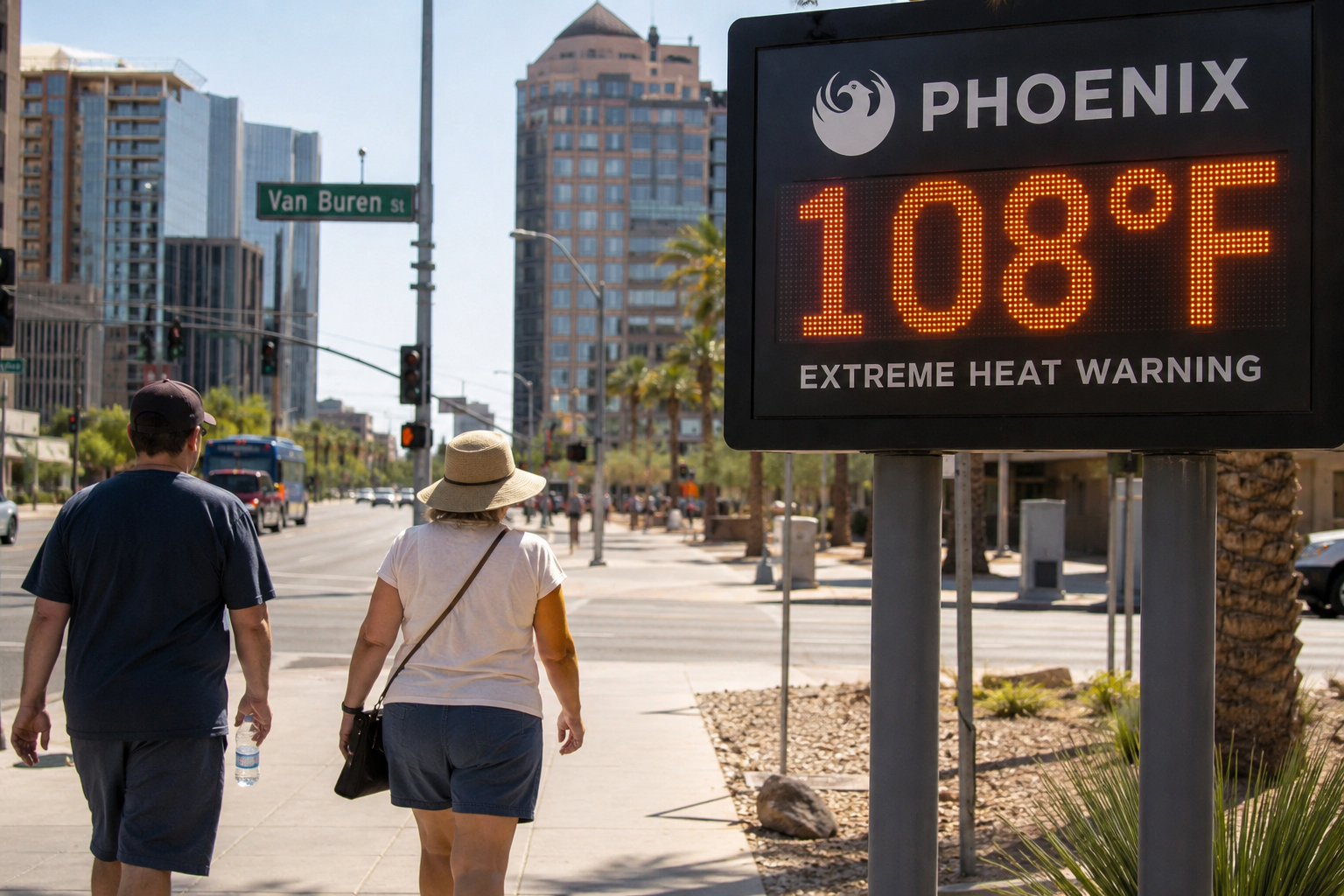
  • HEALTH ALERT: Phoenix Confirms First Heat Death of 2026 as Extreme Heat Warning Tops 108°F — Maricopa County on Track for Another Lethal Summer

    HEALTH ALERT: Phoenix Confirms First Heat Death of 2026 as Extreme Heat Warning Tops 108°F — Maricopa County on Track for Another Lethal Summer

    PHOENIX — Maricopa County health officials have confirmed the first heat-related death of 2026, an older adult male whose passing serves as a grim annual marker that the desert Southwest’s deadliest season has officially begun. The announcement came in April, following a historic March heatwave that sent multiple days above 100°F — a jarring early signal in a region where triple-digit temperatures typically don’t arrive until late May or June.

    Then, in the second week of May, the National Weather Service issued a formal Extreme Heat Warning for the entire Phoenix metro area, with forecasted highs of 104°F on Saturday, 106°F on Sunday, and 108°F on Monday, May 11–13, 2026. That event affected more than 2 million people and triggered immediate activation of emergency protocols: trail closures at Camelback Mountain and Piestewa Peak between 8 a.m. and 5 p.m., expanded cooling center hours across Phoenix, Glendale, Chandler, Mesa, and Tempe, and emergency public health messaging urging residents to hydrate constantly and seek air-conditioned shelter.

    The Death Toll in Context: A City That Has Been Here Before

    Maricopa County recorded 427 heat-related deaths in 2025, down from 608 in 2024 and 645 in 2023. That downward trend is real and reflects genuine effort: the city of Phoenix invested nearly $185 million over five years in capital projects and homeless service operations, created a dedicated Office of Heat Response and Mitigation, and added more than 1,880 temporary and permanent shelter beds since 2022. The county’s Maricopa Heat Relief Network, which launched May 1, 2026, coordinates cooling centers and water distribution points across the county.

    But even 427 deaths — the “improved” figure from 2025 — represents a staggering toll. Since 2013, more than 4,320 people have died from heat exposure in Arizona. The annual heat death toll in Maricopa County has risen approximately threefold since 2019. These are not natural disasters in the traditional sense. As public health experts consistently emphasize, heat deaths are preventable — each one represents a failure of the systems designed to protect the most vulnerable.

    The county tracks heat-related deaths and illness in near real-time through the Maricopa County Heat-Related Illness and Death Dashboard, which updates weekly and is publicly accessible. The dashboard draws on data from the county medical examiner, local hospitals, and the National Weather Service — providing a granular, transparent picture of the crisis that few other counties in the nation match.

    Who Is Dying and Where

    The demographics of Phoenix’s heat deaths tell a story about housing policy and social safety nets as much as they tell a story about weather. In 2023’s deadliest year on record, at least 45% of those who died were unhoused — sleeping behind dumpsters, in parking lots, or on sidewalks baking at temperatures above 150°F at ground level, on days when ambient air temperatures reached 115°F or higher. Senior citizens accounted for roughly one in three deaths.

    Geographic analysis of the data shows a stark pattern: neighborhoods with lower tree canopy coverage, more asphalt and concrete, and fewer green spaces — characteristics strongly correlated with lower household income — consistently record higher heat intensity than wealthier, leafier parts of the city. The urban heat island effect in Phoenix is not distributed equally.

    Outdoor workers — construction laborers, landscapers, agricultural workers, delivery drivers — represent a third major at-risk group. Arizona has no state-level outdoor heat standard for workers with the force of law; federal OSHA’s heat standard, still relatively new and being phased in, provides national-level protections that are subject to enforcement resources and political will.

    The Cooling Infrastructure Gap: What Still Isn’t Working

    Despite genuine progress, Phoenix’s heat response infrastructure has documented gaps. Not all cooling centers are accessible 24 hours — a critical problem because nighttime temperatures in Phoenix rarely drop below 90°F during peak summer, meaning overnight heat exposure is itself lethal, particularly for those sleeping outside. Transportation access to cooling centers remains a significant barrier for elderly residents, people with disabilities, and those without vehicles.

    The concern that federal pandemic-era funding supporting the heat relief network would expire in 2026 — as noted by the county’s own medical director — has materialized. The loss of that funding creates pressure on a system that, by every data point, still needs expansion, not contraction. The city of Phoenix simultaneously faces a $130 million reduction in tax revenue due to a change in Arizona state law, creating a fiscal environment hostile to scaling up heat response services.

    How to Protect Yourself During Extreme Heat Warnings in Phoenix

    • Check the Maricopa County Heat Relief Network for cooling center locations: maricopa.gov/heat.

    • Never leave children, elderly people, or pets in a parked vehicle. Car interiors can exceed 150°F within minutes.

    • Drink water before you feel thirsty — by the time thirst registers, dehydration is already underway.

    • If you see someone showing signs of heat stroke (hot, red, dry skin; confusion; loss of consciousness), call 911 immediately and move them to shade while waiting.

    • If your home lacks air conditioning and you cannot reach a cooling center, call 211 (Arizona’s social services helpline) for assistance.

    Current heat advisories and warnings for the Phoenix metro area can be accessed at weather.gov/phoenix.

    Conclusion: Phoenix Cannot Afford a “Good Enough” Heat Strategy

    Phoenix sits at the intersection of multiple accelerating crises: a warming climate, an unhoused population that grew during the pandemic and has not fully recovered, aging housing stock without central air conditioning, and now a tightening municipal budget. The tools to prevent heat deaths exist — cooling centers, early warning systems, targeted outreach to the elderly and unhoused — but they require sustained political will and adequate funding to deploy at the scale the problem demands.

    The first confirmed heat death of 2026 arrived in April. Summer doesn’t officially begin until June 21. If the pattern of recent years holds, thousands more emergency calls, hundreds more hospitalizations, and an unknown number of additional deaths lie ahead before the season ends. Maricopa County’s data-driven approach is a model worth emulating nationally — but even the best surveillance system is useless if the resources to act on what it finds are not there.

    RELATED ON MEDICALDAILY.COM

    Houston’s Deadly Heat Season Is About to Begin — and the City’s ERs Are Already Behind

    Extreme Heat and the Unhoused: America’s Most Preventable Crisis

    Urban Heat Islands: Why Some Neighborhoods Are Dramatically Hotter Than Others

    Heat Stroke vs Heat Exhaustion: Know the Difference Before It’s Too Late

    Source link

  • Sweat Smarter: 10 Effective Ways to Track Your Fitness Progress for Maximum Results (Targeted keywords: fitness progress, track fitness)

    Sweat Smarter: 10 Effective Ways to Track Your Fitness Progress for Maximum Results (Targeted keywords: fitness progress, track fitness)

    She knows that tracking her fitness progress is essential to achieving her goals, whether she’s a seasoned athlete or just starting out on her fitness journey. By monitoring her progress, she can identify what’s working and what areas need improvement, making adjustments to her routine as needed. In this article, we’ll explore 10 effective ways to track fitness progress for maximum results.

    ## Understanding the Importance of Tracking Fitness Progress

    Tracking fitness progress is crucial for several reasons. Firstly, it helps to monitor progress over time, allowing her to see how far she’s come and stay motivated. Secondly, it enables her to identify patterns and trends in her workouts, making it easier to make data-driven decisions about her routine. Finally, tracking fitness progress helps to ensure that she’s challenging herself enough, preventing plateaus and promoting continuous improvement.

    To get started with tracking fitness progress, it’s essential to set clear and achievable goals. This could be anything from running a certain distance, lifting a specific weight, or completing a set number of workouts per week. By having a clear idea of what she wants to achieve, she can tailor her tracking methods to suit her needs.

    ## 1. Using a Fitness Tracker or Smartwatch

    One of the most popular ways to track fitness progress is by using a fitness tracker or smartwatch. These devices can monitor a range of metrics, including steps taken, distance traveled, heart rate, and calories burned. Many fitness trackers also come with built-in GPS, allowing her to track her runs, cycles, or other outdoor activities. By wearing a fitness tracker or smartwatch, she can get a comprehensive picture of her daily activity levels and adjust her routine accordingly.

    ## 2. Keeping a Workout Log

    Another effective way to track fitness progress is by keeping a workout log. This can be as simple as writing down the exercises she completes, the weights she lifts, and the number of reps she performs. By tracking her workouts in this way, she can monitor her progress over time, identify areas for improvement, and make adjustments to her routine as needed. A workout log can also help her to stay motivated, providing a sense of accomplishment and pride in her achievements.

    ## 3. Taking Progress Photos

    Taking progress photos is a great way to track visual changes in her body. By taking regular photos, she can see how her body is changing over time, whether it’s losing fat, building muscle, or increasing overall tone. Progress photos can also be a powerful motivator, helping her to stay on track with her fitness goals. It’s essential to take progress photos in the same pose, lighting, and clothing each time to ensure accurate comparisons.

    ## 4. Measuring Body Fat Percentage

    Measuring body fat percentage is another way to track fitness progress. This can be done using a variety of methods, including skinfold measurements, bioelectrical impedance analysis (BIA), or hydrostatic weighing. By tracking her body fat percentage, she can monitor changes in her body composition, ensuring that she’s losing fat and building lean muscle mass.

    ## 5. Monitoring Nutrition and Macronutrient Intake

    Tracking nutrition and macronutrient intake is essential for optimal fitness progress. By monitoring what she eats and drinks, she can ensure that she’s fueling her body with the right foods to support her fitness goals. This can involve tracking her daily caloric intake, macronutrient balance, and meal frequency. Many apps and online tools are available to help with nutrition tracking, making it easier to stay on top of her diet.

    ## 6. Tracking Sleep and Recovery

    Sleep and recovery are critical components of fitness progress. By tracking her sleep patterns and recovery time, she can ensure that she’s giving her body the rest it needs to repair and adapt. This can involve using a sleep tracker or smart alarm, as well as monitoring her recovery time after workouts. Adequate sleep and recovery are essential for muscle growth, repair, and overall fitness progress.

    ## 7. Using Online Fitness Communities and Forums

    Joining online fitness communities and forums is a great way to track fitness progress and connect with like-minded individuals. Many online communities offer tracking tools, challenges, and support groups, making it easier to stay motivated and accountable. By sharing her progress and connecting with others, she can gain valuable insights, advice, and support to help her achieve her fitness goals.

    ## 8. Working with a Personal Trainer or Coach

    Working with a personal trainer or coach can be an effective way to track fitness progress. A professional trainer or coach can help her set realistic goals, create a tailored workout plan, and provide ongoing support and guidance. By working with a trainer or coach, she can gain expert advice, stay motivated, and track her progress in a more structured and accountable way.

    ## 9. Using Mobile Apps and Online Tools

    There are many mobile apps and online tools available to help track fitness progress. These can range from simple workout logs and nutrition trackers to more advanced tools that monitor progress over time. Many apps and tools also offer features such as personalized coaching, goal setting, and community support, making it easier to stay motivated and on track.

    ## 10. Regular Progress Assessments

    Finally, regular progress assessments are essential for tracking fitness progress. This can involve scheduling regular check-ins with a trainer or coach, taking progress photos, or monitoring changes in her body composition. By assessing her progress regularly, she can identify areas for improvement, make adjustments to her routine, and stay motivated to achieve her fitness goals.

    In conclusion, tracking fitness progress is essential for achieving maximum results. By using a combination of the methods outlined above, she can monitor her progress, identify areas for improvement, and make data-driven decisions about her routine. Whether she’s a seasoned athlete or just starting out, tracking fitness progress is the key to unlocking her full potential and achieving her fitness goals.

    ## FAQs

    Q: Why is tracking fitness progress important?
    A: Tracking fitness progress is essential for monitoring progress over time, identifying patterns and trends, and making data-driven decisions about your routine.

    Q: What are some effective ways to track fitness progress?
    A: Effective ways to track fitness progress include using a fitness tracker or smartwatch, keeping a workout log, taking progress photos, measuring body fat percentage, monitoring nutrition and macronutrient intake, tracking sleep and recovery, using online fitness communities and forums, working with a personal trainer or coach, using mobile apps and online tools, and regular progress assessments.

    Q: How often should I track my fitness progress?
    A: It’s recommended to track your fitness progress regularly, whether it’s daily, weekly, or monthly, depending on your goals and preferences.

    Q: What are some common mistakes to avoid when tracking fitness progress?
    A: Common mistakes to avoid when tracking fitness progress include not setting clear goals, not being consistent with tracking, and not making adjustments to your routine based on your progress.

    Q: How can I stay motivated to track my fitness progress?
    A: You can stay motivated to track your fitness progress by setting realistic goals, finding a workout buddy or accountability partner, rewarding yourself for milestones achieved, and celebrating small wins along the way.
    sweat-smarter-10-effective-ways-to-track-your-fitness-progress-for-maximum-results-targeted-keywords-fitness-progress-track-fitness

  • Monitor Your Gains: 10 Effective Ways to Track Progress in Fitness

    Monitor Your Gains: 10 Effective Ways to Track Progress in Fitness

    As individuals embark on their fitness journeys, it’s common to feel a sense of uncertainty and confusion about how to track progress. Gaining muscle mass, improving cardiovascular health, and building strength can be a grind, and it’s only natural to wonder if it’s all worth it. But the truth is, tracking progress is crucial for staying motivated and achieving consistent results. In this article, we’ll explore ten effective ways to monitor gains in fitness, helping readers stay on track and achieving their goals.

    Invest in a Fitness Tracker

    One of the most straightforward ways to monitor progress is by investing in a fitness tracker. Devices like Fitbits, smartwatches, and app-enabled trackers can provide in-depth insights into daily physical activity, sleep quality, and heart rate. A fitness tracker can help readers:

    • Monitor daily activity levels, including steps, distance, and calories burned
    • Track sleep patterns, including duration, depth, and quality
    • Monitor heart rate and calories burned during exercise
    • Set and achieve daily movement goals

    Take Measurements

    Taking precise measurements is an essential tool for tracking progress. Not only does it provide insight into changes in body shape and composition, but it also helps to identify any plateaus or stagnation. To take accurate measurements:

    • Use a caliper to measure body fat percentage
    • Take tape measurements around the chest, waist, and hips
    • Record body weight daily or weekly
    • Log body measurements every two to four weeks

    Photo Progress

    Sharing progress photos can be incredibly motivating, as it serves as a visual reminder of hard work and dedication. To take effective progress photos:

    • Take full-body photos in front of a mirror or with a professional photographer
    • Capture key areas, such as before and after shots of problem areas
    • Use makeup and styling to enhance comparison
    • Post photos in a private or public blog to track progress

    Workout Logs

    Keeping a workout log is an effective way to track progress, as it provides a record of sets, reps, weight lifted, and exercises performed. A workout log can also help readers:

    • Document workout routines and progressions
    • Identify areas in need of improvement
    • Adjust training programs based on progress
    • Track injury recovery and rehabilitation

    Progressive Overload

    Progressive overload is a training principle where readers gradually increase weight or resistance to challenge muscles further. To implement progressive overload:

    • Gradually increase weight or resistance every one to two weeks
    • Adjust exercises to accommodate progression
    • Focus on heavy compound exercises like squats, deadlifts, and bench press
    • Monitor strength gains and body composition changes

    Stretching and Mobility

    Incorporating stretching and mobility exercises is essential for tracking progress and maintaining flexibility. To benefit from stretching and mobility training:

    • Incorporate gentle stretching exercises before and after workouts
    • Focus on major muscle groups, like hamstrings, quadriceps, and hip flexors
    • Monitor flexibility changes and range of motion gains
    • Adjust stretching techniques based on individual needs and goals

    Nutrition Tracking

    Tracking nutrition is crucial for realizing progress in fitness. The right diet can fuel fitness goals, while an unsuitable diet can hinder or even reverse progress. To track nutrition:

    • Start a food diary or utilize a nutrition tracking app
    • Monitor macronutrients, including protein, carbohydrates, and fat
    • Log daily water intake
    • Adjust nutrition based on progress and goals

    Sleep and Recovery

    Sleep and recovery play a vital role in enabling the body to adapt and recover from physical activity. To prioritize sleep and recovery:

    • Aim for seven to nine hours of quality sleep each night
    • Establish a consistent sleep routine
    • Incorporate passive recovery techniques, like sauna sessions or massage
    • Monitor sleep quality and alertness

    Mindfulness and Self-Reflection

    Mindfulness and self-reflection are key components of tracking progress and staying motivated. To adopt a mindful approach:

    • Practice meditation and deep breathing exercises
    • Reflect on progress and set realistic goals
    • Identify areas of improvement and adjust training and nutrition accordingly
    • Set aside time for self-reflection and journaling

    Consistency and Patient

    Consistency and patience are essential traits for tracking progress in fitness. To stay on track:

    • Establish a daily routine and stick to it
    • Monitor progress regularily and adjust training as needed
    • Celebrate small victories and milestones along the way
    • View setbacks as opportunities for improvement and growth

    Tracking Progress: Conclusion

    Monitoring progress is critical for achieving consistent results and staying motivated in fitness. By incorporating these ten effective ways to track progress into daily routines, readers can:

    • Gain a comprehensive understanding of their fitness journeys
    • Identify areas for improvement and adjust training programs accordingly
    • Celebrate small victories and milestones
    • Stay motivated and encouraged to continue working towards goals

    Frequently Asked Questions

    Q: What is the most effective way to track progress in fitness?

    A: The most effective way to track progress in fitness is by combining multiple tracking methods, such as wearable devices, workout logs, and progress photos.

    Q: How often should I take progress photos?

    A: It’s recommended to take progress photos every two to four weeks, or as often as monthly, to track visual progress.

    Q: Is it necessary to track food intake?

    A: No, tracking food intake is not necessary for everyone, but it can be highly beneficial for those looking to optimize nutrition and support muscle growth.

    Q: How do I stay consistent with tracking progress?

    A: Consistency is key to tracking progress. Readers can establish a daily routine, set reminders, or find a workout buddy to stay motivated and on track.

    Q: Will tracking progress lead to obsessions or unhealthy habits?

    A: No, healthy tracking habits should focus on progress, not perfection. It’s essential to remain realistic and focused on sustainable progress, rather than letting tracking become an obsession or unhealthy habit.

    monitor-your-gains-10-effective-ways-to-track-progress-in-fitness