Tag: Stop

  • New Toothpaste May Stop Gum Disease Without Killing Good Mouth Bacteria

    New Toothpaste May Stop Gum Disease Without Killing Good Mouth Bacteria

    A new toothpaste developed by German researchers is gaining attention for its different approach to gum disease care. Instead of using broad antimicrobial ingredients that wipe out many bacteria in the mouth, this formula is designed to target harmful microbes linked to periodontitis while preserving beneficial bacteria. That shift may help improve oral microbiome health while still supporting daily brushing routines.

    Traditional oral care products often focus on killing bacteria as widely as possible. While that can reduce harmful germs, it may also disturb the natural balance of the mouth. This new direction in periodontitis treatment aims to reduce damage caused by bad bacteria like Porphyromonas gingivalis while helping good bacteria remain active for better gum disease prevention.

    New Toothpaste: Targeted Pathogen Inhibition Mechanism

    The science behind this new toothpaste centers on selective action. Instead of sterilizing the mouth, it uses targeted pathogen inhibition to interfere with harmful bacteria associated with periodontitis. That means microbes tied to inflammation and gum tissue damage may lose their ability to thrive, while beneficial bacteria can continue supporting normal oral balance.

    According to ScienceDaily, researchers from Fraunhofer developed a compound that blocks disease-causing bacteria without harming healthy microbes in the mouth. Their work led to toothpaste products through PerioTrap Pharmaceuticals, a spin-off focused on microbiome-friendly oral care. This approach may reduce the rebound effect sometimes seen after aggressive antibacterial rinses.

    For consumers, that could mean a brushing product that supports fresher breath, cleaner teeth, and healthier gums while respecting the mouth’s natural ecosystem. As awareness grows around oral microbiome health, more people are looking for products that balance effectiveness with gentler long-term care.

    Gum Disease: Traditional Treatments vs Microbiome-Friendly Alternatives

    Gum disease treatment has long relied on professional cleanings, scaling and root planing, and antiseptic rinses. These methods can be effective, especially when infection is advanced. However, some chemical rinses may remove both harmful and beneficial bacteria, creating a temporary imbalance in the oral environment.

    Based on information from the CDC, gum disease ranges from gingivitis to more severe periodontitis, which can lead to bone loss and tooth loss if not managed. Good oral hygiene and regular dental visits remain essential parts of prevention and treatment.

    That is why microbiome-friendly toothpaste options are attracting interest. Rather than replacing professional dental care, they may serve as an added daily tool that supports healthier plaque control. Keeping beneficial bacteria present may also help reduce inflammation triggers and encourage a more stable oral environment between dental visits.

    Periodontitis Treatment: Clinical Evidence and Product Availability

    The future of periodontitis treatment may involve products that work with the body instead of against it. Researchers studying oral microbiomes have found that some toothpaste formulas can shift bacterial communities toward healthier patterns when used consistently.

    Based on a clinical study available through PerioTrap, participants using microbiome-supportive toothpaste showed measurable changes in oral bacteria associated with better gum health. These findings suggest that brushing products can influence microbial balance, not just surface cleanliness.

    Products linked to Fraunhofer IZI PerioTrap have entered parts of the European market, with wider availability expected to depend on regulatory approvals and distribution plans. As more evidence emerges, consumers may see more options focused on preserving beneficial bacteria while controlling pathogens such as Porphyromonas gingivalis.

    Additional Information About New Toothpaste for Gum Disease

    New research around microbiome-friendly oral care gives readers useful context beyond the main story. These added sections can strengthen the article by explaining practical benefits, risks, and what users should know before trying a new toothpaste.

    • Who May Benefit Most From New Toothpaste: People with early signs of gum disease, bleeding gums, recurring plaque buildup, or sensitivity may benefit from a formula that targets harmful bacteria without disrupting healthy microbes. It may also help those looking for gentler long-term oral care.
    • How to Use New Toothpaste for Best Results: Brush twice daily using the new toothpaste and maintain regular flossing habits for better gum disease prevention. Consistent use is often necessary to support oral microbiome balance over time.
    • What Makes It Different From Regular Toothpaste: Traditional toothpaste often focuses on cleaning, whitening, or broad antibacterial action. A microbiome-friendly toothpaste is designed to support oral microbiome health while selectively addressing harmful bacteria.
    • When to See a Dentist for Gum Disease: If symptoms like bleeding gums, swelling, bad breath, loose teeth, or gum recession continue, professional care is important. Toothpaste can help daily care, but advanced periodontitis treatment usually requires dental treatment.
    • Possible Long-Term Benefits of Oral Microbiome Health: A balanced oral microbiome may help lower inflammation, reduce plaque buildup, and improve gum comfort. Supporting healthy bacteria may also reduce the chance of recurring gum issues.
    • Can New Toothpaste Replace Dental Treatments?: No toothpaste can fully replace professional cleanings or deep cleaning procedures for severe gum disease. It works best as a supportive product alongside dentist-recommended care.
    • How Fraunhofer IZI PerioTrap Stands Out: Fraunhofer IZI PerioTrap products focus on targeted pathogen inhibition, aiming to control bacteria like Porphyromonas gingivalis while preserving beneficial species. This approach differs from older broad-spectrum methods.
    • What to Expect After Switching Toothpaste: Some users may notice fresher breath, less gum irritation, or cleaner-feeling teeth after regular use. Results vary depending on oral hygiene habits and the severity of existing gum problems.

    Revolutionize Gum Disease Prevention With Microbiome-Friendly Toothpaste

    Daily brushing habits are changing as science learns more about the oral microbiome. A new toothpaste that targets harmful bacteria while preserving healthy ones may offer a smarter route to gum disease prevention. Instead of creating imbalance, it aims to support a naturally healthier mouth.

    While no toothpaste replaces regular dental checkups or professional treatment, microbiome-focused products could become valuable additions to home care. For people concerned about bleeding gums, recurring plaque, or long-term oral microbiome health, this new category may represent one of the most promising advances in modern oral hygiene.

    Frequently Asked Questions

    1. How does new toothpaste help gum disease?

    This new toothpaste is designed to target harmful bacteria connected to gum disease instead of killing all bacteria in the mouth. That selective action may help maintain a healthier microbial balance. Good bacteria can continue supporting normal oral conditions. It may become a useful tool alongside brushing and flossing.

    2. Can toothpaste cure periodontitis?

    Toothpaste alone cannot cure advanced periodontitis treatment needs. Severe gum disease often requires professional dental cleaning, deep cleaning, or specialist care. However, the right toothpaste may support gum health between visits. It can be part of a complete treatment plan.

    3. Why is oral microbiome health important?

    The mouth contains helpful bacteria that assist in maintaining balance and resisting harmful microbes. If that balance is disrupted, inflammation and plaque problems may increase. Strong oral microbiome health may help reduce gum issues over time. It also supports overall oral comfort and cleanliness.

    4. Is microbiome-friendly toothpaste safe for daily use?

    Many microbiome-friendly toothpaste products are created for regular brushing use. Safety depends on ingredients, manufacturer standards, and local approvals. It is wise to follow label directions and ask a dentist if you have sensitive gums or dental concerns. Choosing reputable brands is always recommended.


    Source link

  • Med Students Must Stop Performing Pelvic Exams on Unconscious Women Without Their Consent 

    Med Students Must Stop Performing Pelvic Exams on Unconscious Women Without Their Consent 

    Please note: This blog contains descriptions of sexual assault.

    “Recent reports of medical students performing pelvic exams for training purposes on anesthetized women without their consent”—or their knowledge—“have produced a firestorm of controversy and calls for greater regulation.” However, that “burst of public outcry” was in the mid-1990s. California was the first state to make the practice illegal, but the “early gains quickly petered out.”

    As I discuss in my video Ending the Hidden Practice of Pelvic Exams on Unconscious Women Without Their Consent, “This practice, common since the late 1800s, was largely unchallenged until a 2003 study reported that 90 percent of medical students who completed obstetrics and gynecology (ob-gyn) rotations at four Philadelphia-area medical schools performed pelvic exams on anesthetized women for educational purposes.” (A subsequent study found the percentage to be lower than that in other areas of the country.) The bottom line? “Pelvic Exams Done on Anesthetized Women Without Consent: Still Happening.” How can this continue into 2025? Medical ethicists have called such practices “immoral and indefensible.” “At the end of the day, this is a practice that should come to an abrupt and immediate halt.” Some schools vowed they’d end the practice, but, unfortunately, these early victories quickly stalled. At the same time, a handful of schools revamped their policies, an equal number of hospitals and medical schools publicly dug in, defending the practice.

    The Association of Professors of Gynecology and Obstetrics wrote: “As medical educators, we must balance our obligation to develop the next generation of physicians with women’s freedom to decide from whom they receive treatment and what aspects of their care are performed by learners.” “Some especially blunt teaching faculty contend that ‘public’ patients”—those without health insurance—“owe it to the facility and society to participate since they receive free or subsidized care.” Regulations to curb this practice are said to be “placing inappropriate and unnecessary barriers in the way of medical students who need to learn fundamental medical skills” and therefore “should be resisted.” Unsurprisingly, medical students still perform pelvic exams on anesthetized women.

    Professional medical societies have given lip service to the concept of asking for explicit consent, but despite the recommendations, “evidence…suggests that the practice is alive and well.” And the “unauthorized use of women is not a localized phenomenon confined to a handful of errant medical schools,” a few bad med school apples, but an international problem.

    Even with the emergence of the #MeToo movement and even after Larry Nasser, the infamous USA gymnastics doctor, was sentenced to 40 to 175 years in prison for touching women’s genitalia without their consent, “there are still women who are being used as teaching subjects for these exams without their permission, without their consent.”

    A 2020 update from Yale’s Center for Bioethics was entitled: “A Pot Ignored Boils On: Sustained Calls for Explicit Consent of Intimate Medical Exams.” It reads, “Over the last 30 years, several parties—both within and external to medicine—have increasingly voiced opposition to these exams. Arguments from medical associations, legal scholars, ethicists, nurses, and some physicians have not compelled meaningful institutional change.” Yes, there is the lip service paid by medical associations recommending bans on pelvic exams without consent, but those statements are “advisory and incomplete. Associations simply do not have the capacity to compel systemic change, as evidenced by institutions’ inaction.” In response to the medical profession’s inability to police itself, many states have passed legislation to protect patients from this practice.

    But, of course, if you are anesthetized, how would you even know if medical students are lining up or not? “Teaching hospitals take patients who are in the worst position to know what’s occurring—they are unconscious—and use them in ways that leave no physical signs and are often undocumented in the patients’ medical records.” So, when the media loses interest, as it has decade after decade, “what incentive is there for teaching faculty or hospitals to voluntarily change?” Perhaps, “when physicians start being threatened with litigation, they’ll start obtaining informed consent.” As one commentator wrote, “Hospital administrators who allow medical students in their facilities to perform pelvic examinations on unconsenting anesthetized women ought to consult with their legal counsel concerning the definition of rape in their jurisdiction.”

    “The solution is simple: Just ask.” Ask women for permission. It’s their body, their choice. “But recent experience has shown that meaningful and complete hospital-by-hospital change is unlikely to come until a hospital or doctor pays a substantial award [in some lawsuit] for this error in ethical judgment. We believe that day is coming soon, lest that ignored pot finally boil over. 
     
    “Some defend it as harmless and say asking for consent would make it more likely that patients would say no, denying students a crucial part of their training.” When I first wrote about this practice more than 20 years ago in my book Heart Failure about my time in medical school, I talked about how I had gotten the same comments from my classmates: “A well-then-how-are-we-going-to-learn response. To even present such a question is to lose a bit of one’s humanity. The answer, of course, is we should learn from women who give their consent! And to do that—God forbid—we might actually have to first establish a relationship with the patient, a trust—talk to them even. We may have to treat them like human beings.”

    It’s unconscionable that medical students are legally allowed to practice pelvic exams on anesthetized women without their consent. Even if you live in one of the states where this practice is technically illegal, how do you know the law will be respected once you’re unconscious? Maybe medical students should wear bodycams.

    If you missed the related video, see Medical Students Practice Pelvic Exams on Anesthetized Women Without Their Consent


    Source link

  • Stop betting today with BetBreaks Workbook

    Stop betting today with BetBreaks Workbook

    Product Name: Stop betting today with BetBreaks Workbook

    Click here to get Stop betting today with BetBreaks Workbook at discounted price while it’s still available…

    All orders are protected by SSL encryption – the highest industry standard for online security from trusted vendors.

    Stop betting today with BetBreaks Workbook is backed with a 60 Day No Questions Asked Money Back Guarantee. If within the first 60 days of receipt you are not satisfied with Wake Up Lean™, you can request a refund by sending an email to the address given inside the product and we will immediately refund your entire purchase price, with no questions asked.

    (more…)

  • 3 Medications You Can’t Stop Suddenly; One Is Taken By Millions

    3 Medications You Can’t Stop Suddenly; One Is Taken By Millions

    It’s not always easy to stop certain medications once you have started them. Abruptly discontinuing some common drugs can lead to worse conditions than before, or even trigger serious withdrawal symptoms, warns a doctor about three common drugs, one of which is taken by millions of people.

    Dr. Asif Ahmed, a GP in the U.K., took to Instagram to raise awareness about “disease rebounding,” a condition where relapse occurs when certain medications are stopped abruptly.

    In a recent video, he highlighted three common medications that are hardest to come off once you start them. He also explained why they need to be tapered off slowly to avoid serious side effects, dependencies, and complications.

    “Please don’t suddenly stop or change any of your medications if you’re on them. There may be a reason why you need them long-term. However, if you’re worried about any side effects or rebound withdrawal, please make sure you mention it to your doctor,” Dr. Ahmed said in the video.

    The first medication on Dr. Ahmed’s list is venlafaxine, an SNRI (serotonin-norepinephrine reuptake inhibitor) commonly prescribed as an antidepressant. While it can be highly effective for many, Dr. Ahmed warns that it may cause serious side effects when discontinued abruptly.

    “From my experience, it is one of the hardest medications to come off, which is why, despite its effectiveness, it is rarely given as a first-line treatment,” he explained in the video.

    The next drug Dr. Ahmed warns of is benzodiazepines, a class of medications often prescribed for anxiety, insomnia, and other conditions. While effective in the short term, these medications can lead to dependencies quickly and can have dangerous withdrawal effects when stopped suddenly.

    One of the most surprising medications Dr. Ahmed points out is PPIs (proton pump inhibitors), commonly used for acid reflux, such as omeprazole or lansoprazole. Taken by millions, these drugs are widely prescribed, but Dr. Ahmed warns that they are “given far too often,” with many people unaware of the rebound symptoms they can cause when stopped abruptly.

    “Say you get started on this for your heartburn or your reflux, when you start coming off it your stomach actually reacts by producing more acid which makes the reflux even worse and heartburn worse. This means it’s very hard for you to actually come off the medication,” Dr. Ahmed said.

    “The crazy thing is the rebound is often worse than your initial symptom before you started the PPI. Everyone needs to be told about this before they start the medication,” he added.


    Source link

  • Louisiana Health Department Orders Employees to Stop Promoting Mass Vaccinations As it Accuses CDC of Being ‘Woefully Out of Touch’

    The Louisiana Department of Health has ordered its employees to stop promoting mass vaccinations, criticizing the CDC as “woefully out of touch” with public health concerns.

    Louisiana has historically promoted vaccinations for preventable diseases through public health initiatives, community events and partnerships. However, under the leadership of Gov. Jeff Landry and Surgeon General Dr. Ralph Abraham, the state has shifted its stance on vaccines, CNN reported.

    Abraham, a former Republican congressman, has expressed skepticism about mass vaccination efforts and framed vaccine mandates as an infringement on personal autonomy.

    On Thursday, Abraham issued a memo directing Louisiana health workers to cease mass vaccination promotion, emphasizing that vaccines should be treated with “nuance” rather than broad public campaigns.

    The policy, which was not initially communicated to the public, aligns with a growing conservative push against vaccine mandates and mass immunization programs.

    “Government should admit the limitations of its role in people’s lives and pull back its tentacles from the practice of medicine. The path to regaining public trust lies in acknowledging past missteps, refocusing on unbiased data collection, and providing transparent, balanced information for people to make their own health decisions. By demonstrating genuine integrity and respect for personal autonomy, public health agencies can begin to mend the rifts they’ve created,” Abraham and Deputy Surgeon General Dr. Wyche Coleman wrote in a published letter.

    Abraham and Coleman added that vaccination recommendations, particularly for the COVID-19 vaccine, by the CDC have become “woefully out of touch with reality and with most parents.”

    Louisiana, which already struggles with low vaccination rates, is experiencing a significant flu outbreak, and health experts warn that the new directive could further reduce immunization rates and increase the spread of preventable diseases.

    In response, New Orleans’ independent health department has rejected the state’s stance, vowing to continue mass vaccination efforts.

    Public health experts, including Dr. Jennifer Avegno of the New Orleans Health Department and Dr. Paul Offit of the Vaccine Education Center, warn that reduced vaccine promotion will likely lead to declining immunization rates and worsening disease outbreaks.

    Originally published by Latin Times.

    Source link

  • Stop Snoring Exercise Program cb vsl | Blue Heron Health News

    Stop Snoring Exercise Program cb vsl | Blue Heron Health News

    Product Name: Stop Snoring Exercise Program cb vsl | Blue Heron Health News

    Click here to get Stop Snoring Exercise Program cb vsl | Blue Heron Health News at discounted price while it’s still available…

    All orders are protected by SSL encryption – the highest industry standard for online security from trusted vendors.

    Stop Snoring Exercise Program cb vsl | Blue Heron Health News is backed with a 60 Day No Questions Asked Money Back Guarantee. If within the first 60 days of receipt you are not satisfied with Wake Up Lean™, you can request a refund by sending an email to the address given inside the product and we will immediately refund your entire purchase price, with no questions asked.

    (more…)

  • How to stop tracking macros and trust yourself around food

    How to stop tracking macros and trust yourself around food

    “I worried that if I stopped tracking macros, I would lose my physique.”

    After years of careful macro tracking, Dr. Fundaro finally admitted to herself that the method no longer worked for her. Yet she was afraid to give it up.

    If anyone should feel confident in their food choices, it would be Dr. Gabrielle Fundaro. After all, Dr. Fundaro has a PhD in Human Nutrition, a decade-plus of nutrition coaching experience, and six powerlifting competitions under her belt.

    Yet, when she was really honest with herself, Dr. Fundaro realized that she felt far from confident around food. For years, she’d used macro counting as a way to stay “on track” with her eating.

    And it worked… until it didn’t.

    After years of macro tracking, Dr. Fundaro was tired of the whole thing. She was tired of making sure her macros were perfectly in balance. She was sick of not being able to just pick whatever she wanted off a menu and enjoy the meal, trusting that her health and physique wouldn’t go sideways as a result.

    Yet the idea of not tracking freaked her out. Every time she quit tracking, she worried:

    “What if I don’t eat enough protein, and lose all my muscle?”

    “What if I overeat and gain fat?”

    “What if I have no idea how to fuel myself without tracking macros? And what does that say about me as an expert in the field of nutrition?”

    The more Dr. Fundaro wrestled with macro tracking, the more she wanted to find an alternative.

    Something that would support her nutritional goals while also giving her a sense of freedom and peace around food.

    Calorie counting wouldn’t do it. That was just as restrictive as counting macros—maybe more.

    Intuitive eating didn’t seem like a good fit either. Intuitive eating relies heavily on a person’s ability to tune into internal hunger and fullness cues to guide food choices and amounts. After years of relying on external cues (like her macro targets), Dr. Fundaro didn’t feel trusting enough of her own instincts; she wanted more structure.

    Meanwhile, at the gym, Dr. Fundaro began lifting based on the Rate of Perceived Exertion (RPE) scale—a framework that helps individuals quantify the amount of effort they’re putting into a given movement or activity. It’s considered a valuable tool to help people train safely and effectively according to their ability and goals. (More on that soon.)

    While using the RPE scale in her training, Dr. Fundaro found she was both getting stronger and recovering better. There was something to this combination of structure and intuition that just worked.

    And then, it dawned on Dr. Fundaro like the apple hit Sir Isaac Newton on the head:

    If Rate of Perceived Exertion could help her train better, couldn’t a similar framework help her eat better?

    With that, the RPE-Eating Scale was born.

    Dr. Fundaro has since used this alternative method to help herself and her clients regain confidence and self-trust around food; improve nutritional awareness and competence; and free themselves from food tracking.

    (Yup, Dr. Fundaro finally trusts her eating choices—no macro tracker in sight.)

    In this article, you’ll learn how she did it, plus:

    • What the RPE-Eating scale is
    • How to practice RPE-Eating
    • How to use RPE-Eating for weight loss or gain
    • Whether RPE-Eating is right for you or your clients
    • What to keep in mind if you’re skeptical of the concept

    What is RPE-Eating?

    Invented by Gunnar Borg in the 1960’s, Rate of Perceived Exertion (RPE) is a scale that’s used to measure an individual’s perceived level of effort or exertion during exercise.

    Though Borg’s RPE uses a scale that goes from 6 to 20, many modern scales use a 0 to 10 range (which is the range that Dr. Fundaro adapted for her RPE-Eating scale).

    Here’s the RPE scale used in fitness.

    Rating Perceived Exertion Level
    0 No exertion, at rest
    1 Very light
    2-3 Light
    4-5 Moderate, somewhat hard
    6-7 High, vigorous
    8-9 Very hard
    10 Maximum effort, highest possible

    Originally used in physiotherapy settings, the scale is now frequently used in fitness training.

    For example, powerlifters might use it to choose how heavy they want to go during a training session. Or, pregnant women might use it to ensure they aren’t over-exerting themselves during a fitness class or strength training session.

    Because human experience is highly subjective and individual, the scale allows the exerciser to judge how hard they’re working for themselves. A coach can provide a general guideline, such as “aim for a 7/10 this set,” but it’s up to the client to determine exactly what that means for them.

    Dr. Fundaro had used the scale many times with herself, and clients. She always appreciated the sense of autonomy it gave her clients, while still providing some structure.

    So, she decided to take the same 1-10 scale and its principles, and apply it to eating.

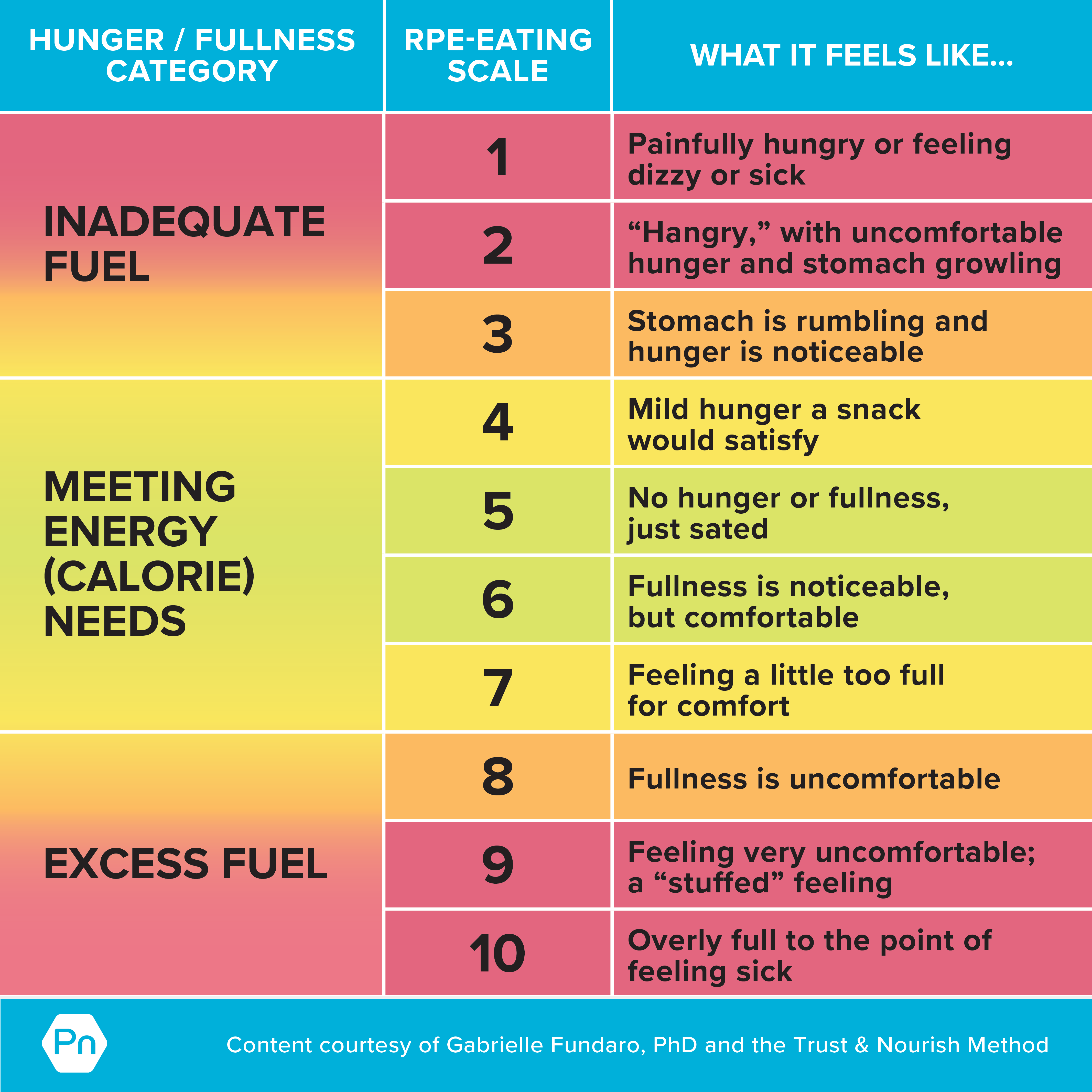
    Here’s what the RPE-Eating Scale looks like:

    Table shows a hunger scale that goes from 1 to 10. 1 represents feeling painfully hungry, dizzy or sick; 2 represents feeling “hangry,” with uncomfortable hunger and stomach growling; 3 represents feeling like hunger is noticeable and stomach is rumbling; 4 represents feeling mild hunger a snack would satisfy; 5 represents feeling no hunger or fullness, just sated; 6 represents feeling a noticeable fullness, but comfortable; 7 represents feeling a little too full for comfort; 8 represents feeling an uncomfortable fullness; 9 represents feeling very uncomfortable or “stuffed”; and 10 represents feeling overly full to the point of feeling sick.

    The goal with RPE-Eating is similar to RPE when training: Develop the skills to determine what is sufficient for you, without having to rely on other external metrics (such as apps or trackers).

    How to practice RPE-Eating

    If you’ve ever practiced RPE-training, you’ll know it takes some time to get used to. RPE-Eating is the same.

    Don’t expect to be in lockstep with all of your body’s internal cues at first, especially if you’ve been ignoring them for a long time.

    With this in mind, apply the steps below to practice the RPE-Eating process.

    Step #1: Get clear on your goals.

    RPE-Eating is not just another diet.

    “It’s not about aiming to change your body,” Dr. Fundaro explains. “It’s not about feeling more control over your diet. Nor is it about feeling like you’re eating the ‘optimal’ diet.”

    If your priority is maintaining a specific physique (such as staying ultra lean) or changing your body (building muscle or losing fat), this method can be adapted for that, though it isn’t the most efficient one to use.

    Instead, RPE-Eating is about sensing into what your body needs and giving yourself appropriate nourishment—while building inner trust and confidence along the way.

    “You have to trust that you’ll be able to nourish your body, and that you’ll be okay even though things may change in your body,” says Dr. Fundaro.

    Admittedly, this can be challenging to do. It can also be difficult to let go of the expectation that you’ll hit the “right” macros at every meal—which RPE-Eating isn’t specifically designed to do.

    However, if your goal is to build more self-trust, RPE-Eating can be a great tool to help you do that.

    Step #2: Practice identifying your hunger cues

    Before we explore this step, let’s distinguish between two motivators for eating.

    First, there’s hunger. Hunger occurs when physical cues in your body (like a general sense of emptiness or rumbling in your stomach, or lightheadedness) tells you that you require energy—known to us mortals as food.

    Then, there’s appetite. Appetite is our desire or interest in eating. It can stay peaked even after hunger is quelled, especially if something looks or tastes especially delicious—like a warm, gooey cookie offered after dinner that you feel you have to try, even though you’re technically full.

    While it’s normal to eat for both hunger and appetite drives, the two can become mixed up. Especially if we have a history of dieting and tracking food.

    The RPE-Eating scale helps you tap back into those true physical hunger cues, and learn the difference between hunger and appetite.

    To put this in practice, try this before your next meal:

    ▶ Using the RPE-Eating scale mentioned above, identify your current level of hunger. Record the number on paper or the notes app on your phone.

    ▶ Then, eat your meal with as much presence as possible. (Note: This in itself takes practice. It can help to limit distractions, such as eating at the table rather than in front of the TV, and focusing on the flavors and textures of the food you’re eating, and how you feel eating it.)

    ▶ About halfway through the meal, check in again. Based on the scale, how hungry are you now? As before, record the number.

    ▶ If you’re still hungry, finish your meal. When you’re finished, repeat the same process, writing down where you are on the scale.

    ▶ Once you’re done, take a minute and tune into what your body feels like. What does it feel like to be full? “Download” that feeling into your mind and internalize it in your body, as if you’re updating your phone with the latest software.

    Repeat this for as many meals as you can. Aim to do it for one meal a day for a week or so, or for as long as feels good to you. Don’t worry if you forget: simply repeat the practice when you can.

    The more you practice this, the better you’ll become at being attuned with your actual hunger cues. With time, you’ll likely find you develop more trust in your internal compass than what the latest diet tracker says for your needs.

    (For more on fully-tuned-in, mindful eating, read: The benefits of slow eating.)

    Step #3: Get to know your non-hunger triggers

    Have you ever come home after a super stressful day and you’ve basically thrown yourself onto a bag of chips or a carton of ice cream?

    We might like to imagine ourselves eating every meal mindfully, using the RPE- Eating system to a tee, but life rarely works like that.

    Chances are, there are certain situations that trigger you to eat more quickly, mindlessly, and beyond the point of hunger.

    That’s okay.

    Dr. Fundaro’s suggestion? Aim to become more aware of the situations that cause you to overeat in the first place.

    To do this, you can practice something we use in PN Coaching: Notice and name.

    When you find yourself scarfing down food faster than you can blink, simply try to notice what’s going on.

    Can you name a feeling—such as anxiety, or sadness?

    Can you identify a situation or moment that happened before you started eating—say, an argument with your teenager, or a nasty email from your boss?

    Once you’ve identified the feeling, event, or person that’s triggered you to eat compulsively, see if you can also identify what you might really be needing or desiring.

    Eating for comfort is normal. However, if it’s the only coping method we have, it can cause more problems than it solves in the long run.

    When you find yourself with an urge to eat mindlessly, consider what non-food coping mechanisms might help you feel better. That could be 10 minutes away from your computer to close your eyes and breathe, a walk outside, or a quick call to a friend to rant—or just talk about something completely unrelated.

    Getting to know your non-hunger eating triggers—plus widening your repertoire of self-soothing methods—is just as valuable as getting to know your hunger cues. Over time, this awareness will allow you to eat with more intention.

    Step #4: Eat for satiety AND satisfaction

    Even when you’re “adequately fueled” from a physical perspective, you might still feel unsatisfied from an emotional perspective.

    That’s because, according to the RPE-Eating framework, eating should fulfill two criteria:

    ▶ Satiety describes the physical sensation of being full; your calorie or fuel needs are met.

    ▶ Satisfaction describes a more holistic feeling of being nourished; your calorie needs are met, but your meal also felt pleasurable.

    If you ate to satiety only, your calorie needs might be met and your physical hunger quelled, but you might still feel unsatisfied—maybe because chocolate is on your “don’t” list, and even though you’ve eaten everything else in your kitchen that isn’t chocolate, nothing quite “hit the spot.”

    In other words, you can eat to satiety at every meal, yet still be “restricting” foods.

    You may not be restricting calories per se, but you may have banned entire food groups—baked goods, pizza, or whatever else curls your toes. This can lead to a feeling of constantly needing to police yourself, and doesn’t leave much room for the flexibility and spontaneity that real-life (enjoyable) eating requires.

    (Plus, avoiding particular foods tends to work like a pendulum: restrict now; binge later. If you want to learn how to stop those wild swings, read: How to eat junk food: A guide for conflicted humans)

    Satisfaction is a key part of eating.

    After all, humans don’t just eat for adequate nutrients and energy. We eat for other reasons too: pleasure, novelty, tradition, community, enjoyment.

    So, to take your RPE-Eating to the next level, Dr. Fundaro recommends trying it with meals and foods you genuinely enjoy.

    If any foods or meals have been “off-limits,” try eating them using the RPE technique. (Macaroni and cheese, anyone?)

    Practice using the scale with a variety of meals (including those you may have restricted previously), and notice how you feel over time.

    With experience, you’ll get to know what it feels like to adequately fuel yourself with a variety of foods—including those you genuinely enjoy.

    How do I know if RPE-Eating is right for me or my clients?

    RPE-Eating isn’t for everyone, but might be a good fit for you (or your clients) if:

    ✅ You feel dependent on food tracking, but you don’t want to be.

    ✅ Every time you stop tracking, the loss of perceived control freaks you out and drives you right back to tracking.

    ✅ You want to stop tracking, but you want to have some type of system or guidance in place.

    ✅ You’re currently tracking (or considering tracking) your food intake, and you have elevated risk factors for developing an eating disorder such as high body dissatisfaction; a history of yo-yo dieting; a history of disordered eating patterns; and/or participation in weight class sports.

    If you’re a coach looking to use this tool with a client, check out Dr. Fundaro’s resources. Remember this tool may not be for everyone, and how you apply it needs to be flexible.

    Note: If you or your client struggles with disordered eating, this tool does not replace working with a health professional who specializes in eating disorders, such as a therapist, doctor, or registered dietician.

    How to use RPE- Eating for weight loss or weight gain

    According to Dr. Fundaro, the best way to use RPE-Eating is in a weight-neutral setting.

    While it could be used for weight modification, she doesn’t recommend treating it as another way to hit your macros or “goal weight.”

    “I’m not anti-weight modification,” Dr. Fundaro explains. “I’m pro safe weight modification. I compare weight loss to contact sports. There are inherent risks but they can be mitigated through best practices.”

    Dr. Fundaro elaborates: “Since RPE-Eating removes macro-tracking, which can increase risk of disordered eating in some people, and relies on biofeedback and non-hunger triggers, RPE-Eating provides a safety net that macro-tracking alone doesn’t provide.”

    But if you do want to use RPE-Eating for intentional weight change, what should you do?

    Dr. Fundaro recommends aiming to hover around the ranges that support your goal.

    (As a reminder, a 1 to 3 on the RPE-Eating scale is categorized as “inadequate fuel; a 4 to 7 is categorized as “adequate fuel”; and a 8 to 10 is categorized as “excess fuel.”)

    ▶ If the goal is weight gain, you’ll likely aim to eat within the 7 to 8 range for most of your meals.

    ▶ If the goal is weight loss, you’ll likely aim to eat within the 4 to 5 range for most of your meals.

    A key thing to remember is that you would never use RPE-Eating for extreme weight-modification such as for a bodybuilding competition. “That would be like using physio exercises to prepare for a powerlifting competition.” In other words, it’s not the right tool for the job.

    Hold up, bro: Isn’t this just feelings over facts?

    If you’re skeptical and think this is just eating “based on your feelings,” keep in mind that RPE was once laughed at by lifters, too.

    These days, RPE and autoregulation are widely accepted in gym culture and have been studied as a valid method for managing and guiding your training. 1

    RPE isn’t perfect, but it’s pretty accurate and incredibly convenient. A lot more convenient than, say, using a velocity loss tracker for every set. 2 3

    And while it might seem like it’s all feelings-based, the RPE scale is actually built around practicing the skill of interoceptive awareness—the awareness of internal sensations in your body.

    The better you get at the skill of interoceptive awareness, the more you’ll be able to use that awareness to make informed decisions about your training.

    RPE-Eating is similar: It builds the skill of sensing into your own body, and lets your internal sensations guide your decisions.

    Similar to how the bar slowing down on a squat would indicate you’re getting closer to failure, experiencing the absence of hunger at the end of your meal would indicate you’re closer to being full.

    Instead of tracking your glucose levels to validate your perceived hunger, you use internal cues that correlate with lowered blood sugar and coincide with hunger.

    And, let’s be real: Being mindful of stomach grumbling or general hunger pangs is much more convenient and accessible than tracking glucose readings.

    This process will not be perfect. You may undereat or overeat at first. But over time, with practice, you’ll build the core skills of RPE-Eating.

    Are there downsides to RPE-Eating?

    While this tool can be helpful, it’s just a tool. A screwdriver is great, but it isn’t useful when you need a hammer.

    RPE-Eating can be great for helping you become more aware of your internal hunger cues and build a better relationship with food along the way.

    It can also be more laborious. It requires paying real attention to your feelings (physical and emotional), and reflecting on them.

    This can be difficult for anyone—but especially people who aren’t able to sit at the table and have a leisurely meal, like parents with small kids, or people with work schedules that require eating on-the-go.

    If this is you, just use RPE-Eating when it does work for you—or simply pick and choose specific steps to use in isolation. For example, maybe you try RPE-Eating on the occasional quiet lunch break. Or, maybe you focus solely on developing your awareness of hunger and fullness cues, without trying to change anything else.

    If you’ve been tracking macros for a long time, it can be hard to stop.

    Tracking macros isn’t inherently bad. It can actually be a helpful tool to teach you more about nutrition. But it’s also not something most people want to do for the rest of their lives.

    The problem is, if you’ve depended on tracking your food intake, stopping can feel scary.

    In these cases, RPE-Eating can be used as a kind of off-ramp to help transition away from rigid and restrictive macro tracking.

    (It can also help loosen the compulsion to “always finish your plate.” Though macros tracking and habitual plate-cleaning may sound different, they’re actually similar: both rely on external cues—such as macro targets or what’s served on your plate—to determine when you’re “done.”)

    RPE-Eating won’t take away all the scary feelings that may come with changing ingrained ways of eating.

    However, it can provide some structure and language to help you, or your clients, eat with less fear, less stress, and a bit more confidence.

    “The goal,” says Dr. Fundaro, “is to know that you’re nourishing yourself—and you don’t need a food tracker to do that.”

    jQuery(document).ready(function(){
    jQuery(“#references_link”).click(function(){
    jQuery(“#references_holder”).show();
    jQuery(“#references_link”).parent().hide();
    });
    });

    References

    Click here to view the information sources referenced in this article.

    1. Helms, Eric R., Kedric Kwan, Colby A. Sousa, John B. Cronin, Adam G. Storey, and Michael C. Zourdos. 2020. Methods for Regulating and Monitoring Resistance Training. Journal of Human Kinetics 74 (1): 23–42.

    2. Hackett, Daniel A., Nathan A. Johnson, Mark Halaki, and Chin-Moi Chow. 2012. A Novel Scale to Assess Resistance-Exercise Effort. Journal of Sports Sciences 30 (13): 1405–13.

    3. Zourdos, Michael C., Alex Klemp, Chad Dolan, Justin M. Quiles, Kyle A. Schau, Edward Jo, Eric Helms, et al. 2016. Novel Resistance Training-Specific Rating of Perceived Exertion Scale Measuring Repetitions in Reserve. Journal of Strength and Conditioning Research 30 (1): 267–75.

    The post How to stop tracking macros and trust yourself around food appeared first on Precision Nutrition.

    Source link
  • Fitness Distilled | Your final stop for trustworthy training and nutrition information.

    Fitness Distilled | Your final stop for trustworthy training and nutrition information.

    Product Name: Fitness Distilled | Your final stop for trustworthy training and nutrition information.

    Click here to get Fitness Distilled | Your final stop for trustworthy training and nutrition information. at discounted price while it’s still available…

    All orders are protected by SSL encryption – the highest industry standard for online security from trusted vendors.

    Fitness Distilled | Your final stop for trustworthy training and nutrition information. is backed with a 60 Day No Questions Asked Money Back Guarantee. If within the first 60 days of receipt you are not satisfied with Wake Up Lean™, you can request a refund by sending an email to the address given inside the product and we will immediately refund your entire purchase price, with no questions asked.

    (more…)