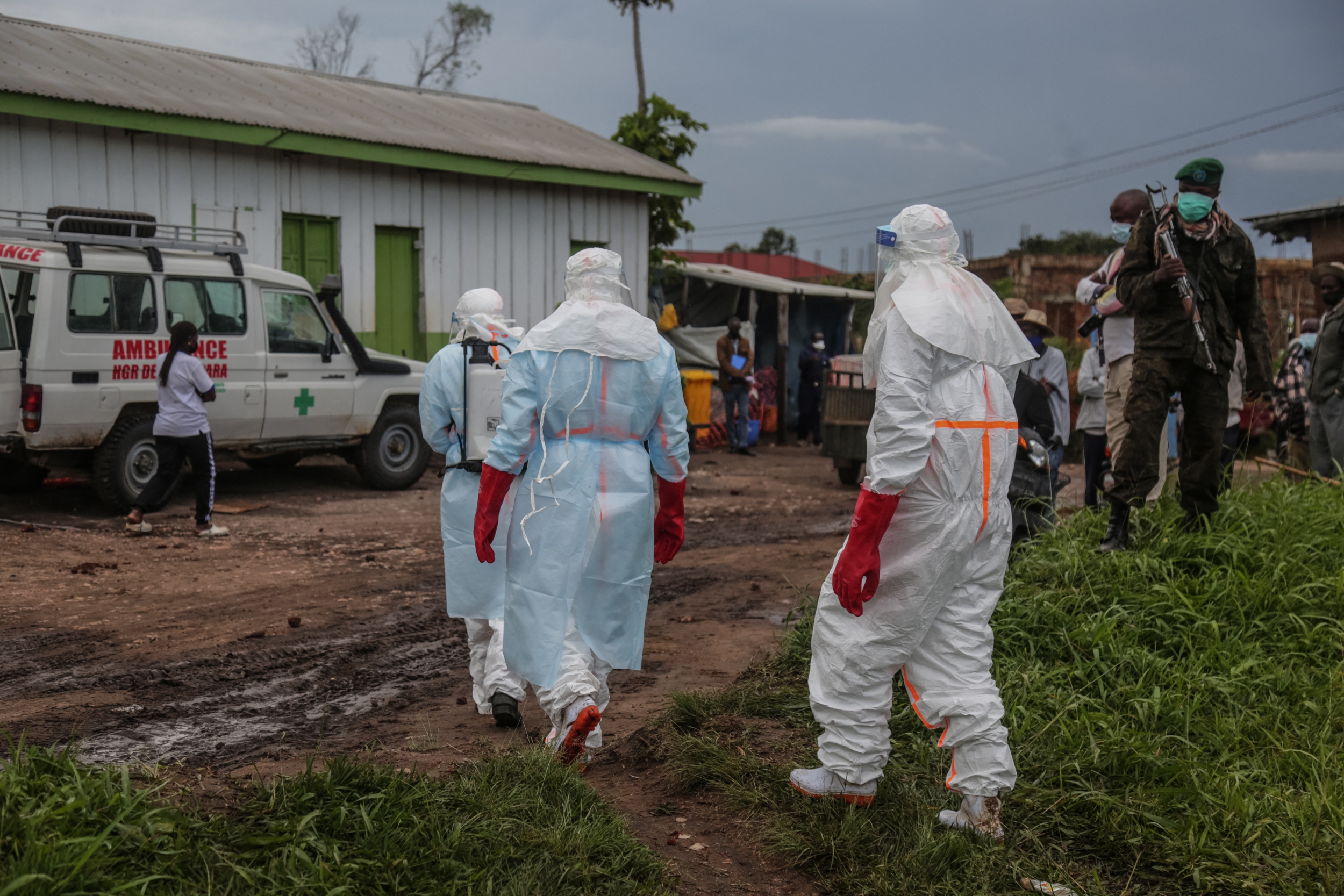
The workers at the epicenter of Congo’s Bundibugyo Ebola outbreak — the surveillance teams tracking contacts, the burial teams managing the dead, the community outreach workers trying to build trust in frightened neighborhoods — went on strike this week. They have not been paid since the outbreak was declared on May 15, 2026, according to reporting from the Associated Press and Reuters.
The work stoppage — centered in Bunia, the capital of Ituri Province, and the neighboring town of Rwampara — has directly compromised continuity of essential health services at the front of an outbreak that has infected 1,759 people and killed at least 600 as of the latest government data, according to Reuters. Bunia and Rwampara together account for roughly 847 confirmed infections — nearly half of Congo’s total.
No Ebola cases associated with this outbreak have been confirmed in the United States. The risk to U.S. residents remains low, according to the CDC. But a response team that cannot function directly threatens the global containment of a disease for which no approved vaccine or specific treatment exists.
Why This Matters
Ebola containment depends entirely on the human beings willing to do the most dangerous work in public health: identifying and following up with contacts of confirmed cases, isolating the sick before they can infect others, and safely burying the dead in a disease where bodily fluids at the moment of death carry the highest viral load.
When those workers stop working, chains of transmission that would otherwise be interrupted continue unchecked. New cases that would have been caught through contact tracing are not caught. Burials conducted without trained teams become sources of additional infection. The mathematical progress the response has made — tracking contacts, sequencing isolates, mapping transmission chains — stops accumulating.
The World Health Organization representative in Congo, Dr. Anne Ancia, said this week that the virus continues to spread, fueled by population movements and insecurity, and that some treatment centers are at near-full capacity. She has stated that the outbreak is spreading faster than the response can contain it — a warning issued before the strike added a new complicating factor.
What We Know So Far
According to the Associated Press, front-line workers told reporters they had not received wages or bonuses since the outbreak was declared on May 15. The affected workers span multiple roles: epidemiological surveillance committee members, community outreach and sensitization teams, burial teams, and security personnel.
Workers at the Rwampara Ebola treatment center staged a protest on Monday, setting tires alight outside the facility. Police intervened to restore order. A senior worker confirmed to the AP that the action was continuing.
“Since the Ebola virus disease outbreak was declared, we’ve been demanding payment for our work,” Dr. Biensi Kano, a member of the epidemiological surveillance committee in Bunia, told the AP. “The non-payment of benefits exposes us and our families to significant socio-economic difficulties and seriously undermines our living conditions.”
Dr. Ghislain Maneba, an epidemiologist and community investigator in the Rwampara health zone, described the scope of the problem: “We are doing everything we can to make the public understand how dangerous this disease is. I came here to save people’s lives, but this is how I am being thanked. We are working day and night without being paid.”
Congo’s Health Minister Samuel Roger Kamba acknowledged the payment problems publicly, attributing part of the delay to logistical disruptions — specifically the closure of the Bunia airport, which has complicated both the delivery of supplies and the transfer of funds to frontline workers.
Where the Response Is Most At Risk
The Bunia and Rwampara health zones — where the strike is most concentrated — account for close to half of Congo’s confirmed Ebola cases. They represent the geographic and epidemiological core of the outbreak. A functional lapse in contact tracing, burial safety, or community engagement in these zones is not a marginal disruption; it strikes at the most critical pressure points in the containment effort.
Bloomberg reported that Congo’s National Institute of Public Health confirmed in a report on Wednesday that continuity of essential health services in Bunia and Rwampara has been compromised.
The outbreak is also occurring in a region with persistent armed conflict — a factor that has repeatedly impeded response operations by restricting travel, diverting law enforcement attention, and driving population displacement that makes contact tracing vastly more difficult. The Bunia airport closure attributed by health officials as a payment bottleneck is itself a product of the security situation in eastern Congo.
What Officials and Workers Say
Akilimali Pierre, incident manager at Congo’s National Institute of Public Health, told the AP that the airport closure “is hampering the very implementation of the response, particularly certain aspects of the flow of funds. This is one of the reasons that may account for the delay in payment.”
Africa CDC official Wessam Mankoula, speaking at an online press conference, said the agency was working with Congolese authorities to speed up payments. According to Reuters, Africa CDC has provided Congo approximately $2 million to support the Ebola response — some of which could be directed toward delayed worker payments.
“This is very important to keep the morale,” Mankoula said of ensuring payment to frontline workers.
The WHO’s Dr. Ancia had described the situation in Ituri as one where she witnessed “firsthand the dedication of staff who continue to serve their communities despite enormous challenges” — a dedication now being tested by the absence of compensation for those same workers.
What the Evidence Shows — and What It Does Not
As of July 10, 2026, the Bundibugyo Ebola outbreak has produced 1,759 confirmed cases and more than 600 confirmed deaths in Congo, plus 20 cases and 2 deaths in Uganda, and one imported case in France. No U.S. cases have been confirmed.
The outbreak’s case fatality rate in the current outbreak is approximately 20% to 30%, lower than the Zaire strain of Ebola but still among the most lethal infectious diseases circulating anywhere in the world. There is no approved vaccine for Bundibugyo virus. A clinical trial of two experimental therapies — the monoclonal antibody MBP134 and the antiviral remdesivir — began July 2 but has produced no results yet.
Whether the strike will materially worsen outbreak trajectory depends on its duration and whether payment resolutions can be reached quickly. If the work stoppage lasts days, the damage may be containable. If it lasts weeks, the modeling predictions for outbreak growth could shift significantly.
MedicalDaily Outbreak Status Summary
- Congo confirmed cases: 1,759 (as of latest government data)
- Congo deaths: 600+
- Uganda cases: 20; Uganda deaths: 2
- Imported case: France (1)
- U.S. cases: Zero confirmed
- Approved vaccine: None for Bundibugyo strain
- Approved treatment: None; clinical trial underway (MBP134 + remdesivir)
- Strike status: Active as of July 9–10, 2026, in Bunia and Rwampara
- Services compromised: Contact tracing, burial teams, community outreach in hardest-hit zones
- U.S. entry restriction order: Active through approximately July 21, 2026
Who Is Affected and Who Is at Risk
Front-line health workers in Ituri Province face the most direct and immediate harm from the payment failure: they are working in conditions of extreme danger — physical violence from suspicious residents, biological exposure risk, and the psychological burden of managing an uncontrolled outbreak — without compensation.
The secondary impact falls on all Congolese residents in the outbreak zone, whose exposure risk increases as contact tracing lapses.
For U.S. residents: the CDC continues to assess the risk of Bundibugyo virus reaching the United States as low, based on the virus’s biology (direct contact with bodily fluids required; no airborne transmission), the country’s public health infrastructure, and the current entry screening measures in place at four U.S. airports. No U.S.-based cases have been confirmed from this outbreak.
Travelers who have been in DRC, Uganda, or South Sudan within the past 21 days should monitor for fever or illness and contact their local health department before visiting a healthcare facility if symptoms develop.
Symptoms and Warning Signs to Watch For
For travelers who have recently returned from DRC, Uganda, or South Sudan, the following symptoms — appearing within 21 days of last potential exposure — warrant immediate contact with a public health authority (before going to a clinic):
- Sudden fever
- Severe headache
- Muscle pain and weakness
- Vomiting or diarrhea
- Unexplained bleeding or bruising
- Rash
Do not go to a hospital or clinic without calling your local health department first. Public health teams need to coordinate safe isolation and transport procedures to protect healthcare workers and other patients.
What You Can Do Now
For U.S. residents who have recently traveled to DRC, Uganda, or South Sudan:
- Monitor your health for 21 days after your last possible exposure to the outbreak area.
- If you develop fever or other symptoms, call your local health department first — before going to a hospital.
- Check the CDC Ebola situation page for current travel advisories and entry screening information.
- Plan ahead for travel to this region: U.S. entry restrictions currently in place require routing through designated screening airports and post-arrival monitoring.
For anyone who wants to support the Ebola response in DRC, Médecins Sans Frontières (Doctors Without Borders) and International Medical Corps are among the organizations with active operations in the affected area.
Cost and Access: What Patients Should Know
Any U.S. resident who is evaluated for suspected Ebola will be tested and cared for through the public health system at no direct cost, as part of emergency infectious disease protocols. No prior authorization or insurance is required for emergency isolation and testing under these circumstances.
If a case were confirmed in the United States, treatment would occur at one of ten federally designated biocontainment units. The nearest facilities to major U.S. cities include Emory University Hospital (Atlanta), Nebraska Medical Center (Omaha), and the NIH Clinical Center (Bethesda, Maryland).
What Happens Next
Whether Congo can rapidly resolve the payment dispute will determine how much damage the strike causes to the outbreak trajectory. Africa CDC’s offer to redirect $2 million in existing funds toward delayed payments suggests a path to resolution, but the logistical challenge of the closed Bunia airport means financial transfers may still face delays.
The U.S. entry restriction order from June 21 expires around July 21 — 11 days from now. The CDC’s decision on whether to renew will be shaped in part by the outbreak’s trajectory in the coming days. A strike-related worsening of case trends could shift that calculus toward extension.
MedicalDaily will continue monitoring both the strike situation and the outbreak’s overall trajectory.
The Bottom Line
Ebola response workers in Congo’s hardest-hit provinces walked off the job this week because they have not been paid since the outbreak began two months ago. The strike threatens to degrade the contact tracing, burial safety, and community engagement operations that are the primary tools for containing an outbreak for which no approved vaccine or specific treatment exists. The outbreak has already infected 1,759 people and killed more than 600. The risk to U.S. residents remains low — but a failing response anywhere in the world raises the probability of wider spread, which is why the U.S. has maintained entry restrictions and airport screening since May.