Perhaps it seems strange to be investigating what we consider to be a positive emotion, but I think we often miss joy. We don’t actually pay a lot of attention to it; we can often let it slip by without much notice. The good news is, there are practices to cultivate it. And these practices can help us attend to and support joy in our felt experience. It’s actually a pretty important emotion.
Joy aids us in waking up to our lives. And it’s a factor in supporting concentration. So if you’re someone who feels distracted much of the time, have difficulty focusing or paying attention, cultivating and attending to joy is a great way to deepen your concentration.
First, let’s explore what joy is. For me, it can be pleasurable to experience, but it’s essentially different from pleasure. I experience joy as a really internal occurrence. It can be sparked by something external, but it’s also something I can very much cultivate internally. One of the great ways to do that is to consider the things in my life that I’m grateful for. Another way is to savor—really stop and savor—what’s beautiful and good and working in my life.
This is a profoundly important ability because as humans we operate with a negativity bias. In and of itself, that bias makes a lot of sense: we tend to focus our minds on what is wrong or threatening or what could harm us so that we might be better protected through the vagaries of life. But if we allow that negativity bias to run rampant, we risk missing out on what’s beautiful and joyful and nourishing in our lives. Not to mention, we grow less and less equipped to actually cultivate such beauty and joy and nourishment ourselves. So training ourselves to receive and enjoy what’s good is no frivolous pursuit. Learning to savor joyful moments helps us unhook from negativity and open to new possibility.
So let’s practice. And again, as we’ve done with all of our practices with emotions, we’ll mostly attend to the physical sensations of joy. And maybe we’ll see it grow as we pay attention to it. While we’re at it, we’ll also try to notice how focusing on joy can help strengthen our concentration. The great thing is, if you give the mind something pleasant and joyful to pay attention to, it will want to go there. Maybe you’ll decide to begin each mindfulness practice with joy cultivation. (Talk about a great motivator for sitting down for a few minutes). You may also want to employ this approach in your everyday life.
A 12 Minute Meditation to Unhook from Negativity and Savor Joy
Watch the video:
Listen to the practice:
Read and practice the guided meditation script below, pausing after each paragraph. Or listen to the audio practice.
1. Let’s take our seat wherever we happen to be. As always, you’re welcome to lie down if you’re in a place where you can do that. Let’s take a few deeper breaths. Just settle in here: lengthen your inhale and your exhale. During these opening breaths, simply scan your mind and body and notice how you’re feeling. Let’s use the breath to bring some balance in this moment. If you’re feeling tired or drowsy, just take in a little bit more air, emphasize the inhale. If you’re feeling agitated or restless, emphasize the exhale—really extend it. And then allow your breath to come to its natural rhythm. Feel your contact with the chair, your feet on the ground. Find that support and contact with the earth.
2. Now let’s bring to mind some recent joyful moments from our lives. Alternatively, you could reflect on some of the things you’re grateful for in your life. What’s working these days? You’re alive, so something must be working … Maybe it’s simply that you found this 30-day challenge and you’ve done some practices—you’ve found the time to take care of yourself in this way. Or maybe you’ve been seeing some benefits in your life. Perhaps there’s a relationship you’re enjoying; you’re feeling loved and connected. This could be with a person, or it could be that you have a puppy or a cat in your life. Or maybe you’ve been to a place that’s stirred joy in you: some place in nature, perhaps near a lake, surrounded by trees, a spot where you could gaze upon a vista you love. Choose one or a few moments to focus on and really get the joy going. What brings you joy? Maybe it’s recalling movement such as dancing or swimming or another physical activity that stirs joy for you. Perhaps it’s travel, a recent trip. Or maybe it’s learning something new.
3. Really reflect on receiving the joy of these experiences. Bring your attention into your body. Notice how you experience joy in this moment. Where do you feel it in your body? The chest, the belly, the throat, the face? What do you notice? Is there a temperature to the joy? Is there a flow or movement to the energy of joy in your body? How big is it? As you pay attention to it, can you kind of relax your attention into the joy? Breathe into it. And if there’s a sense that this energy of joy wants to grow, let it. Maybe it expands to other parts of your body—all the way out to your fingertips and your toes. Just notice: is it tingling, vibrating, flowing?
4. If at any point you lose that felt sense of connection, just recall again the images, people, situations that bring you joy. Then return to feeling into and savouring and maybe even expanding that felt sense and felt energy of joy in your body. Breathe into it.
5. As we close out this short practice, let’s take a moment to reflect on and notice the people, places, situations that bring us joy. What were the things that really inspired a felt, energetic sense of joy for you? Maybe they surprised you. Maybe they’re things that you don’t do that often. But you could. You could bring more of that into your life. So, how could you do that?
6. Before we finish, let’s make a simple commitment to do one of those things that brings us joy. Let’s commit to bringing in more of that joy-inducing activity or more of that connection or more time with the people in our lives that bring us joy.
7. When you’re ready, open your eyes if they were closed. Take a deep breath. Are you orienting yourself to the space around you? Notice how you feel right now.
As you go back into your day, I invite you to pay more attention to what’s joyful in your life. Then, commit to drawing more of that in, and to cultivating it further.
Jessica Morey is a meditation teacher and coach. She has been practicing meditation for almost 3 decades. She is also the co-founder and former executive director of Inward Bound Mindfulness Education, a nonprofit organization bringing in-depth mindfulness and compassion training to youth.
Meditation has been practiced for thousands of years, originating from ancient Eastern cultures as a means to cultivate mental, emotional, and spiritual well-being. In recent decades, the Western world has increasingly adopted meditation as a tool for improving mental health and overall wellbeing. The practice involves training your mind to focus, relax, and become more aware of your thoughts, feelings, and bodily sensations. As the world grapples with rising rates of anxiety, depression, and other mental health challenges, meditation has emerged as a powerful adjunctive therapy, offering a variety of benefits that can enhance mental health and promote a sense of wellbeing.
Understanding Meditation
Meditation is a broad term that encompasses a range of practices, including mindfulness meditation, loving-kindness meditation, transcendental meditation, and movement meditation, among others. At its core, meditation involves setting aside time to sit comfortably, close your eyes, and focus your mind on a particular object, thought, or activity. For beginners, this often starts with focusing on the breath, noticing when the mind wanders, and gently bringing it back without judgment. Regular practice can lead to a deeper understanding of oneself, reduced stress levels, and an improved ability to handle life’s challenges with grace and resilience.
The Surprising Benefits for Mental Health
The benefits of meditation on mental health are multifaceted and well-documented. Regular meditation practice has been shown to reduce symptoms of anxiety and depression, improve sleep quality, enhance cognitive functioning such as attention and memory, and boost the immune system. Meditation also promotes emotional regulation, allowing individuals to better manage their emotions and respond to stressful situations in a more thoughtful and less reactive manner. Furthermore, meditation cultivates self-awareness, enabling individuals to understand their thoughts, emotions, and behaviors more clearly, which is crucial for personal growth and development.
Impact on Anxiety and Depression
One of the most significant benefits of meditation is its impact on anxiety and depression. These are two of the most prevalent mental health disorders worldwide, characterized by persistent feelings of worry, fear, sadness, and loss of interest in activities. Meditation has been found to decrease the production of stress hormones like cortisol, leading to a reduction in the symptoms of anxiety and depression. By teaching the mind to stay present and focused on the current moment, rather than dwelling on the past or worrying about the future, meditation helps to break the cycle of negative thinking that often accompanies these conditions.
Enhancing Cognitive Function
Beyond its emotional benefits, meditation has a profound impact on cognitive function. Regular practice has been linked to improvements in attention, memory, and problem-solving abilities. Meditation helps to strengthen the neural networks within the brain, enhancing communication between different brain regions. This can lead to better performance in work and academic settings, as well as improved overall cognitive health. Furthermore, meditation has been shown to have neuroprotective effects, potentially reducing the risk of age-related cognitive decline and neurodegenerative diseases like Alzheimer’s.
Promoting Better Sleep
Sleep is a critical component of mental health, with sleep disturbances often being a symptom or cause of various psychiatric conditions. Meditation can help improve sleep quality by reducing stress and anxiety, making it easier to fall asleep and stay asleep throughout the night. Regular meditation practice before bedtime can signal to the body that it is time to sleep, creating a healthy sleep routine. Improved sleep quality, in turn, can enhance mental health, lead to better mood regulation, and reduce the risk of developing mental health disorders.
Cultivating Emotional Regulation
Emotional regulation is the ability to manage and modulate emotional responses to various situations. Meditation cultivates this skill by increasing self-awareness and teaching the mind to observe emotions without judgment, rather than becoming overwhelmed by them. This can lead to more harmonious relationships, improved decision-making, and a reduced tendency to react impulsively to stressors. By learning to navigate emotions in a healthier way, individuals can develop resilience and better cope with life’s challenges.
How to Incorporate Meditation into Your Life
Incorporating meditation into daily life can be simple and accessible. Starting with short sessions, even just a few minutes a day, can be beneficial. Using guided meditation apps, joining a meditation group, or following meditation videos can provide structure and motivation for beginners. Finding a quiet, comfortable space to meditate and making it a consistent part of your daily routine, such as right after waking up or before bedtime, can help turn meditation into a sustainable habit.
Conclusion
Meditation offers a wide range of benefits for mental health and wellbeing, from reducing symptoms of anxiety and depression to enhancing cognitive function and promoting better sleep. By incorporating meditation into daily life, individuals can cultivate greater self-awareness, improve their emotional regulation, and develop resilience in the face of stress and adversity. As the world continues to navigate the complexities of mental health, the ancient practice of meditation stands as a powerful tool, available to anyone, anywhere, offering a pathway to improved mental health and a deeper sense of wellbeing.
FAQs
Q: What is meditation, and how does it work?
A: Meditation is a practice that involves training your mind to focus, relax, and become more aware of your thoughts, feelings, and bodily sensations. It works by reducing stress, improving emotional regulation, and enhancing cognitive function, among other benefits.
Q: Do I have to be religious or spiritual to meditate?
A: No, meditation is a practice that can be adapted to anyone’s beliefs and values. It is about cultivating mental and emotional wellbeing, and can be practiced by people of all religious and spiritual backgrounds.
Q: How often should I meditate to see benefits?
A: The frequency of meditation can vary, but starting with daily practice, even if it’s just a few minutes, can be beneficial. Consistency is key, and as you continue, you can adjust the duration and frequency based on your needs and schedule.
Q: Can meditation help with specific mental health conditions?
A: Yes, meditation has been shown to help with a variety of mental health conditions, including anxiety, depression, PTSD, and substance abuse. It is often used as an adjunct to traditional therapies and treatments.
Q: How do I get started with meditation if I’m a beginner?
A: You can start by using guided meditation apps, following meditation videos, or joining a meditation group. Finding a quiet, comfortable space and making meditation a part of your daily routine can help you get started and maintain your practice.
We live in a noisy world that’s constantly vying for our attention. But as teacher Sharon Salzberg reminds us, our attention is at its most potent when we’re able to rest and restore it.
When we talk about attention, we often use active and extractive verbs: pay, give, court, leverage. In mindfulness, attention isn’t a commodity to be used; it’s a gift to be nurtured. What might it feel like to rest our attention?
This week, teacher Sharon Salzberg offers a guided meditation that’s down-to-earth and deeply restorative as we practice holding our awareness with the lightest touch possible
A Meditation to Rest Your Attention
Read and practice the guided meditation script below, pausing after each paragraph. Or listen to the audio practice.
In this meditation, you can sit comfortably or lie down. Close your eyes, or if you’re keeping them open, just find a spot in front of you to rest your gaze.
Center your attention on the feeling of the in and out breath, at the nostrils, at the chest, or at the abdomen. Just the normal, natural breath.
When I become silent, that’s the signal for you to put into practice what I’ve just suggested.
As you feel the sensations of the breath, you can make a very quiet mental notation of breath. With the in breath, and then again with the out breath. Maybe it’s once or maybe it’s twice that you silently repeat the word breath as you breathe in, breath as you breathe out.
Think breath when a thought or a feeling arises that’s strong enough to take your attention away from the breath. Simply note it silently as not breath: It’s not the breath and you can recognize it in just that way. So we have breath and we have not breath.
It’s important to understand that it doesn’t matter if it’s the most beautiful thought in the world or the most terrible thought in the world. It’s simply not the breath. You don’t have to judge yourself. You don’t have to get lost in a thought or elaborate it. You recognize it’s simply not the breath Very gently let go and bring your attention back to the feeling of the breath.
Some of your thoughts or feelings may be tender, caring. Some might seem cruel or hurtful, but they’re not the breath. You can see them, recognize them, let them go, and bring our attention back to the feeling of the breath. These thoughts and feelings are like clouds moving through the sky. Some are very light and fluffy looking, very inviting. Some are quite ominous and threatening, but they’re all not the breath. We just let them go.
Our habitual tendency is to grab onto a thought or a feeling, to build an entire world around it or push it away, struggle against it. Here we stay even, balanced, calm. We simply recognize it’s not the breath. Very gently we let it go. We bring our attention back one breath at a time
When you feel ready, you can open your eyes or lift your gaze, and we’ll end the meditation.
Our bodies come in all varieties, and we all have different interests, skill, and abilities. But as today’s teacher Cara Bradley observes, movement of any kind—from the slightest glance to the most intense exercise—can be mindful.
This simple meditation helps you celebrate your physicality with practices to connect with your breath and your body, expand your awareness, and appreciate the gift of being alive.
A Meditation to Make Movement Mindful
Read and practice the guided meditation script below, pausing after each paragraph. Or listen to the audio practice.
The intention behind this practice today is to stabilize our bodies and minds, to synchronize our breath and movement, and to energize all over physical, emotional, and mental well-being. What’s important to remember from this all is that when our bodies are calm, our minds get calm. And when our bodies feel stable and steady, our minds feel stable and steady. What’s happening physically also reflects mentally. In fact, in many ways, our nervous system is a reflection of what’s happened in our mind. So if you’re feeling really crazy-busy, I’m going to encourage you to look at your nervous system first with some of the tools that I’m going to teach you here in this meditation.
We are going to be moving and breathing in rhythm. This helps us to facilitate what’s called coherence. Coherence is a way of harmonizing our nervous system, our heart rate, our brain waves. Research shows that when we’re in coherence or in a coherent state, we feel better. We feel calmer, more clear. We feel more energized. And our minds are more quiet. The best way to find coherence is by finding your breath and breathing in rhythm.
Don’t worry about perfect, it doesn’t exist. Don’t worry about big or small or advanced or beginner, it’s not about that at all. This is a mindful movement practice, so this is your practice to cultivate awareness of both mind and body. We’ll be moving for maybe six to seven minutes, real simple movements that everybody can do, and then we’ll be taking rest. Now I encourage you to give yourself the time to take a minute or two rest. It’s when we start to integrate. It’s where we integrate and really allow ourselves the opportunity to experience ourselves in that coherence. In a more settled and stable state of being. You’re worth it and your life is worth it.
Place your feet hip-width distance, get a comfortable stance, and here we go. Let’s just find that rhythm. Inhale, reach your arms forward and up. Spin your palms open, exhale arms out and down. Inhale, reach forward and up. Spin palms open, exhale out and down. One more time. Inhale, reach forward and up. Spin palms, exhale out and down.
Next is what I call Sinking Body and Mind. Exhale, reach over to your left. Inhale, rise back up to center. Exhale, sway to your right. Inhale, reach up. So we’re moving slowly on purpose, everyone. Exhale, reach left. Inhale, reach up. Exhale, reach to the right. One more time, inhale up. Exhale, laugh. Inhale up. Exhale right. Inhale, reach back up. Exhale to your left, we’re going to hold, bring your hand to your hip. Breathe in, reach, exhale. So just following breath, inhale nice and deep. Reach, exhale, press your hips to the right, breathe in. Breathe out. Just one more, inhale.
If you can, reach a little further. Inhale, reach both arms up. Exhale, sway to your right. Inhale. Exhale, reach. Just stay on breath. Inhale. Exhale, reach. Great side stretch here, inhale. Exhale, last one, inhale, exhale, reach, hold, inhale, reach both arms up.
Now, place your hands on your knees like you’re a baseball player. With straight arms, pull your bum back, now reach your arms back. On your inhale, reach arms forward, up, look up, exhale arms back and down, inhale reach up, give them a swing, exhale back. Inhale, reach up, exhale back. One more time. Inhale, reached up. Exhale back. Reach your arms all the way up, this time interlock your fingers behind your head. Send your hips forward and just lay your head back for a moment here.
Now, root through your feet and send your hips forward. Can you really let your head go on your hands? What does that feel like? Open your elbows up just a little wider, one more breath, inhale, big stretch your lungs. Exhale, reach both arms up overhead. One more time, hands to your knees like a baseball player. This time drop your elbows to your knees if you can. If you have some low back stuff, stay right here. Otherwise you can drop elbows right here and look down, nice forward flexion.
Let’s take three breaths here. Inhale, pull your hips back, exhale. Again, finding breath. Inhale, hips back. Exhale. One more time, breathe in, sink your hips a little lower. Little dynamic movement, inhale, straighten legs. Exhale, bend your knees. So they don’t have to straighten completely. Inhale, straighten, matching movement and breath. Exhale, bent. Three more, inhale. Go find that breath, that’s the coherent breath. Exhale, nice and deep and rhythmic. Inhale. Exhale. This is it. Last one. Inhale. Exhale, bend deep and hold.
While we’re here, let’s take it to the floor. Come all the way down onto your belly. Dynamic backbend, so reach your arms out to the side legs together. On your inhale, lift up. Exhale, lower halfway. Inhale, lift, up. Exhale, low. So this is so healthy for our spines, everyone. Inhale, and lift up, Exhale, lower. Last one. Inhale, lift up, hold. Hold, reach. Reach through your fingers. Lift your chest, lift your legs, and release down.
We’ll take it onto our backs to finish up. So roll onto your back, straighten both legs out, and again, working dynamically. Pull your right knee in, give yourself a good hug here, good squeeze. Really helpful for your hips. Now breathe in, breathe out, switch your legs, left knee in, inhale. Exhale, switch your legs, inhale. Exhale. One more time, switch, inhale, squeeze, exhale. Bring both knees in, just give yourself a squeeze, and I’ll bring your knees to 90 degrees. Take your arms out to the side.
Take our final spinal twist here, our final movement. On your inhale, lower knees to your right. Look to your left. Exhale, lift to center. So they don’t need to touch. Inhale to your lift, good twist for your spine. Exhale, center. Following breath and movement, inhale, right. Exhale, center, inhale, left. Exhale, center. One more time. Inhale, right. Exhale center, inhale left. Exhale center. Now place your feet to the floor, straighten your legs, separate your feet everybody, spin your palms up so you’re like a snow angel, big and wide, and just close your eyes here and allow yourself these next few minutes to really connect into your body.
As you lay here in stillness, notice any sensations, any sense of coolness or heat. Maybe something’s tingling. Our body speaks to us through the language of sensation. And by connecting body and mind through breath and movement, our awareness is heightened.
We start to become more fluent in that language of sensations. So what are you feeling in your body? And finally, notice your breath. Just notice how your body is breathing, what it feels like to be inhaling, what changes in your ribs, around your back, and what happens when you exhale. Just noting, using your body, your breath, your pulsing, your sensations as anchors for your awareness in this mindfulness practice.
Now just open your eyes and notice what it feels like to be you right now in this moment. Do you feel more clear and calm? Or stable, or at ease. Maybe you feel more energized and ready for your day. Pull your knees to your chest and just roll over to one side. And roll on up, have a seat for one more moment. With your chin up and your gaze up. Thank yourself for making it through this practice. Thank yourself for giving yourself this gift of movement, of deep, coherent breathing, and of some stillness and silence.
There’s no shortage of mindfulness and meditation apps these days, promising to help you combat anxiety, sleep better, hone your focus, and more. In fact, the Wall Street Journalreports that more than 2,000 new meditation apps launched between 2015 and 2018, and offerings have only increased as a result of higher demand during the pandemic—according to the New York Times, mindfulness apps surged in 2020. We took the overwhelm out of finding the most valuable and easy-to-use meditation apps that are available free and narrowed it down to these five apps.
Summary
Mindfulness.com
Platforms: iOS, Android, web
Highlights: Over 2,000 guided meditations with a customizable “For You” experience, quick mini exercises,sleep aids, and calming soundscapes.
Paid Upgrade: Offers Mindfulness Plus+ for enhanced features like daily coaching.
Insight Timer
Platforms: iOS, Android, web
Highlights: Massive library of 80,000+ free meditations from 10,000+ teachers, live events, and a global community showing real-time meditation stats.
Paid Upgrade: Annual subscription unlocks courses, offline downloads, and advanced player controls.
Smiling Mind
Platforms: iOS, Android, web
Highlights: Not-for-profit with structured programs for different age groups and needs, including quick sessions and family-friendly content.
Cost: Entirely free with no premium options.
UCLA Mindful
Platforms: iOS, Android
Highlights: Developed by UCLA’s Mindful Awareness Research Center, featuring bilingual guided meditations and research-based practices, plus longer “podcast” sessions.
Cost: Free.
Healthy Minds Program
Platforms: iOS, Android
Highlights: Merges neuroscience with meditation training using a four-pillar approach (Awareness, Connection, Insight, Purpose) and offers micro practices for on-the-go mindfulness.
With over 2,000 guided meditations from world-leading teachers, this app caters to both beginners and seasoned practitioners.
The interface includes five tabs: Mini, where you can find quick and easy mindfulness exercises you can do anytime throughout the day; Meditate, where you’ll find all of the app’s 2,000+ guided meditations; Sleep, which houses restful and relaxing meditations for deep sleep; Radio, where you can find mindfulness music and sound scapes for focus and calm; and finally the For You tab, which is really what makes this app stand out.
Throughout your use of this app, you’ll be prompted to provide information about your preferences, goals, and the type of support you’re looking for. The app will then offer personalized daily coaching videos paired with guided meditations on the For You tab. You can choose what length you’d like your daily meditations to be—from five to 30 minutes—depending on your schedule and level of practice. Opportunities to dive deeper include meditation courses, expert Q&As, breath work, journaling prompts, and more.
Whether you’re looking to reduce stress and anxiety or seeking support for overall mental health, the Mindfulness.com app is a solid resource. The multitude of functionalities offered by this app puts your mindfulness journey in your hands and enables you to grow in the direction of your choosing at your own pace.
Paid option: For $84.99 per year (with a 14-day free trial) or $169 for a lifetime membership, both with a 30-Day money-back guarantee, Mindfulness Plus+ includes: daily mindfulness video coaching and meditations; courses and tools to help manage anxiety, sleep, and stress; over 2,000 meditations, calm music, nature soundscapes, and more.
Available for iOS, Android, and web
Entry price: Free
Insight Timer has a huge library of content: over 80,000 free guided meditations from over 10,000 teachers on topics like stress, relationships, healing, sleep, creativity, and more.
Right from the beginning, the app feels like a global community—the world map on the home screen shows a collective of 18 million meditators, and announces, “741k today, 7k now.” After you finish a meditation, you’ll learn exactly how many people were meditating “with you” during that time—and by setting your location, you can even see meditators nearby and what tracks they’re listening to.
Once you find a teacher you enjoy—like Jack Kornfield, Tara Brach, Sharon Salzberg, or Rhonda Magee—you can follow them to make sure you don’t miss any new content. You can also tune in to free talks for life advice and inspiration. For those craving real-time interactions, Insight Timer offers live events every hour of the day to join on a whim or plan into your schedule.
You can even sign up to Circle for Teams, one of their newer offerings, which allows you to create circles (read: groups) to meditate in real-time with friends or colleagues.
If you prefer a quieter meditation, however, you can simply set a timer and meditate to intermittent bells, calming ambient noise, or soothing music.
Depending on your preferences, Insight Timer’s extensive collection can be either a blessing or a curse—an endless list of choices that leave you overwhelmed or a buffet of tempting options to sink your teeth into.
Paid option: For $60 per year (with a 30-day free trial), you get access to courses with well-known teachers, the ability to download meditations and listen offline, and advanced player functions like repeat mode and fast forward and rewind.
The not-for-profit app features hundreds of meditations, enough to keep you engaged without overwhelming you with choice. They are organized into structured programs like Mindful Foundations (35 sessions), Sleep (6 sessions), Digital Detox (8 sessions), and Stress Management (10 sessions), but you have the flexibility to choose where to start and to easily jump between programs. Most meditations are in the five- to fifteen-minute range, with a few practices up to 45 minutes for advanced meditators. Smiling Mind also offers bite-sized meditations between 2 to 5 minutes for moments when you’re in need of a quick, mindful pause in the day.
Downloaded by over 5.5 million people, the app also has a variety of specialized programs for families, children and teens of various ages, healthcare workers, and educators (including curricula they can use in the classroom); all developed with the help of psychologists and health professionals.
While you could use a meditation app as a temporary break from your hectic life, Smiling Mind wants you to take your mindfulness practice off the cushion and into the rest of your day. Interspersed with some of the meditation programs are instructions for “activities” like Journaling Exercise, Go Offline, Where Did My Food Come From, and Count Your Senses. In the Count Your Senses activity, for example, the audio prompts you to bring your attention to your senses by counting things that can be seen, felt, heard, smelled and tasted.
Smiling Mind was originally created for kids, so they offer a robust selection of kid- and youth-appropriate mindfulness sessions.
Created by a nonprofit by the same name, Smiling Mind is entirely free—so you don’t have the distraction of paid content that’s inaccessible to you as a free user. The app wants to put a “smile on your mind”—and it might just succeed.
If all the research on mindfulness has persuaded you that you need to meditate, the UCLA Mindful app could be a good place to start.
Developed by the Mindful Awareness Research Center at the University of California, Los Angeles (UCLA), the app features about a dozen meditations of different types in English and Spanish. You can learn to focus on your breath, your body, or sounds; work with difficult emotions; and cultivate loving-kindness in sessions ranging from 3 to 19 minutes long.
If you’re new to mindfulness, you might choose to take advantage of their Getting Started section, which offers information on what mindfulness is, how to choose a meditation, which posture is best for your practice, and what research-backed benefits you might expect from it.
As a bonus, the app also offers longer meditations that it calls “podcasts.” These are half-hour audio recordings of meditations that include talks, typically by UCLA Director of Mindfulness Education Diana Winston, before and after the meditation, as well as plenty of silent practice time.
If you’re looking for an app that is heavily grounded in the science of mindfulness, you can put your trust in UCLA Mindful.
The Healthy Minds Program app wants to help you develop the skills for a healthy mind—by strengthening mental focus, decreasing stress, and growing resilience, compassion, and better immune health.
Founded by neuroscientist Dr. Richard Davidson (who also founded the research institute Center for Healthy Minds at the University of Wisconsin-Madison), the app integrates neuroscience and research-based techniques with meditation training to increase overall well-being.
The framework of the app’s mindfulness and well-being training is organized into four pillars: Awareness, Connection, Insight, and Purpose. Each pillar consists of three to five parts, and each part contains three series and multiple sessions within. For the Connection pillar, for example, the Innate Self-Worth series includes five sessions packaged to foster self-worth (think sessions like Practice Seeing the Good In Ourselves, and Learn Negativity Bias). You have a choice of either a Sitting or Active type of practice—“active” practices include guidance for being mindful while you exercise, or during your commute—and you can customize the length of time (five minutes to 30 minutes).
The app offers a collection of 27 meditations outside their four-pillar wellness framework, including one-minute Micro Practices for when you’re in need of a brief respite.
At times the podcast-style app may encourage more thinking compared to typical guided meditations, but for the listener who is seeking guided meditations with the greater goal to increase awareness, cognition, and well-being, Healthy Minds Program app may be just the ticket.
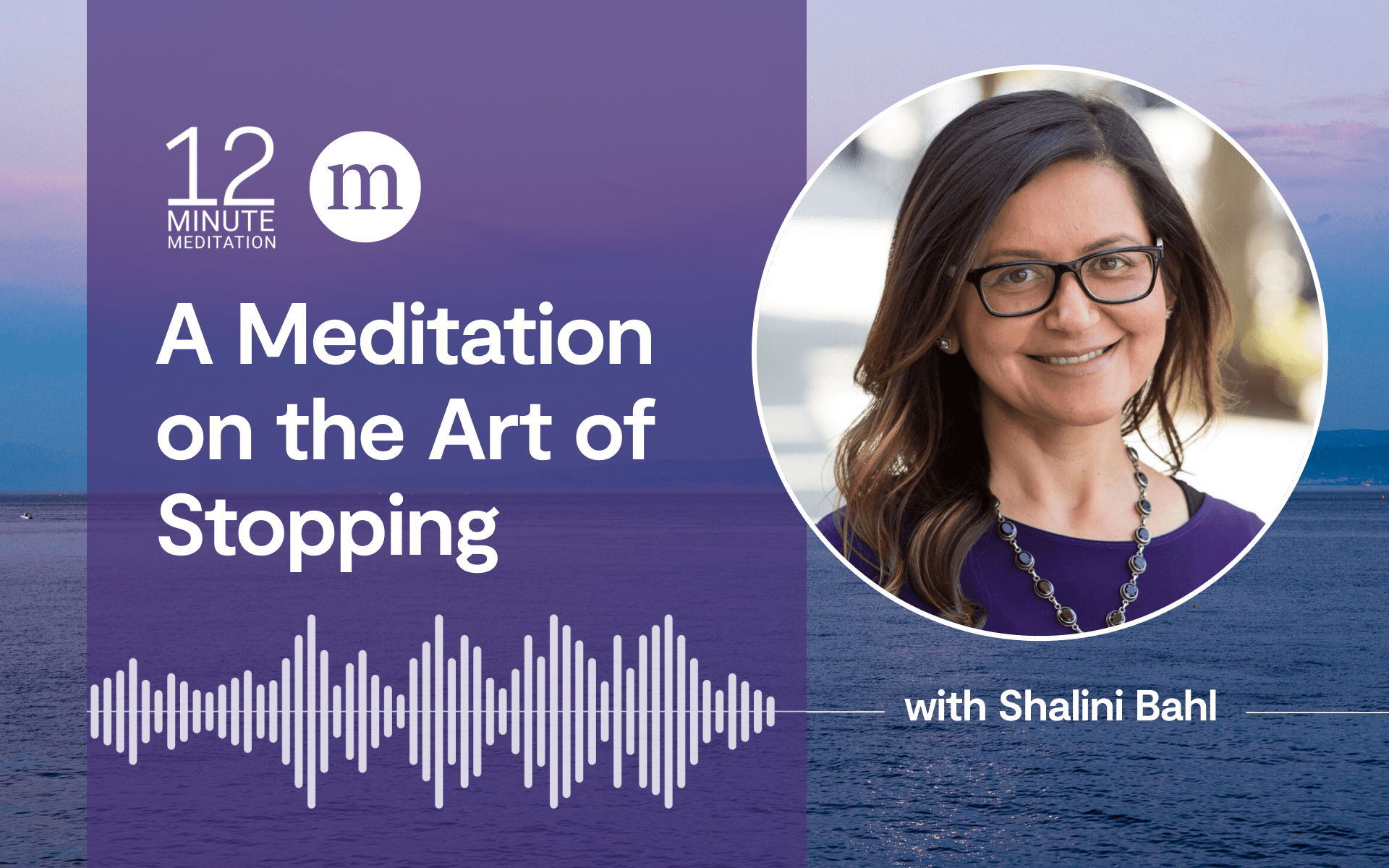
In this practice, teacher Shalini Bahl reminds us that in its simplest form, mindfulness is just about stopping—stopping to notice, to breathe, to gently interrupt our engrained habits of thought with our quiet presence.
We often think of mindfulness and meditation as a drawn-out, sustained exercise—when in reality, they’re just a collection of micro-moments of stopping, breathing, really noticing our own bodies and our own lives, getting distracted, and then coming back again. Over and over.
As this week’s teacher Shalini Bahl puts it, today’s guided practice is about the art of stopping: letting go of our regular habits of the mind—the pushing, pulling, running in circles— and instead just being for a moment.
This is an extended practice, but as a bonus, we’re also sharing a micro-practice version below that you can take into busy days.
And don’t miss Shalini’s article on Mindful.org that’s all about the power of micro-practices to affect our daily choices.
A Meditation on the Art of Stopping
Read and practice the guided meditation script below, pausing after each paragraph. Or listen to the audio practice.
Start by coming to a comfortable posture where you feel supported. If you need more cushions or something to support your back so you feel the elongation along the back of your spine and rolling your shoulders up, back, and down. Rest your hands facing palms up or palms down. When you feel ready, lower or close your eyes.
Receive the sound of the bells as an invitation to the mind to be fully present. To this body, to this breath. Notice the fact that you’re breathing. There’s no need to change your breath in any way. If it’s shallow, let it be shallow, if it’s deep, let it be deep. Just rest your awareness in this breath, entering your body, following it as far as it wants to go. Notice the slight pause when the in-breath changes to out-breath. Then rest in the awareness of that exhale until the out-breath fully leaves your body. And then the pause, resting in that pause before the breath enters the body.
Follow this cycle of breathing at your own pace, resting in awareness. You’re not thinking about your breath, you’re really starting to sense the breath, the coolness, the touch of the breath as soon as it enters your nostrils. Feel it move in your body, the expansion, as you breathe in, in your lungs, in your chest, in the belly, wherever you feel it. As you inhale, breathe in and then exhale, really sensing that contraction, the letting go.
Every time your mind wanders, which it will, just notice that with kindness. Let go of that thought for now, knowing you can always return to the plans, to your thoughts, after the practice. For now, just let go of those thoughts and return back to this awareness of the breath.
Just for these few moments, let go of any rushing, of any judging, of expectations. Allow yourself to breathe just the way you are, as you are. Give your full care and attention to every inhale. To every exhale. And the spaces in between.
When you’re ready, find one place in your body where you can really feel the direct sensations of breathing. It could be the touch of the breath in the nostrils or the upper lip region where you feel the coolness of the new breath entering the nose, the tingling in your nostrils, or the warmth as you exhale, touching your upper lip.
If it feels more natural for you, you can turn your attention to feel your breath in the region of your chest or your belly. Find that one place where you can feel the direct experience of breathing. For the next few minutes, stay there with the direct sensations of breathing. Again, keep it effortless, just a very gentle resting in that awareness of the breath.
If it feels dull, you can open your eyes a little bit. Make your inhale more conscious. If your mind is really active, give more attention to the exhale, the slowing down of your exhale.
What we are practicing here is the art of stopping and letting go—letting go of our distractions, of our regular habits of the mind, of pushing, pulling, running in circles. We’re just being here, fully present to your breath, allowing yourself to feel your breath directly.
Notice your expectations of what’s next, of how things should be, even how this practice should be. Notice how your attachments can get in the way of your experience of inner calm in this moment. Soften the grip of those attachments and just return to your direct experience of the breath. Just this one breath.
Now, expand your awareness of this breath, of the feeling of this breathing in your whole body. You can stay either focused on that one place or you can expand the awareness of this breath moving through your body. Feel your whole body breathing in, breathing out. Notice those micro-moments of letting go of distractions and staying present.
Before we end this practice, take a few moments to listen within to what’s present. Just listen, taking a few moments to listen as your mind and body are a little calmer. Maybe there’s clarity of way you can bring in more of this practice of inner calm in your life, whether it’s in your relationships, with yourself, in your work. Just listen within to where this practice of inner calm can be most skillful, most beneficial to you and your loved ones. May we carry forward these qualities of inner and outer calm in all our actions and interactions.
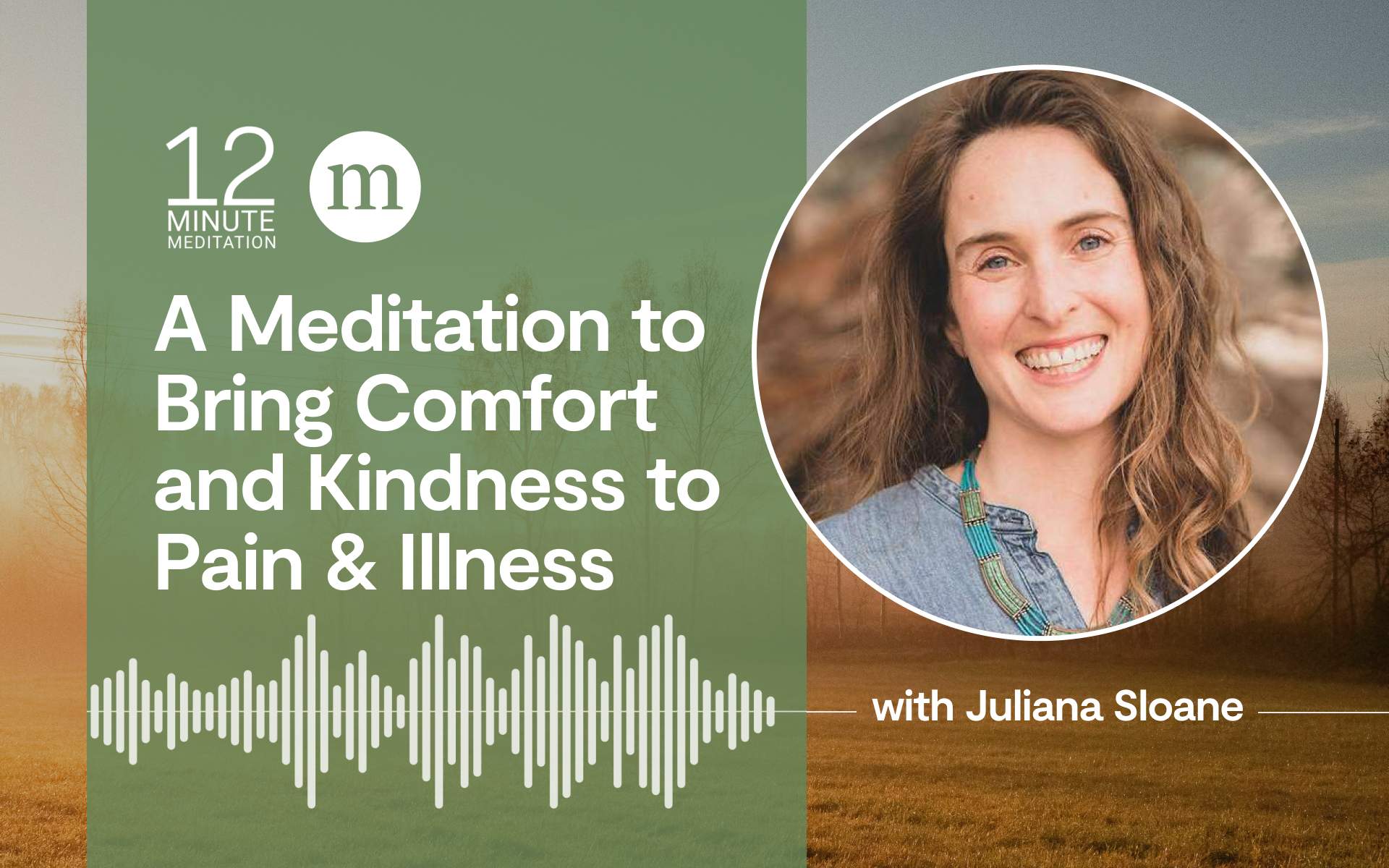
Chronic, complex medical conditions rarely have easy answers—but as meditation teacher Juliana Sloane reminds us in this soothing practice, we can always meet our suffering with creativity, gentleness, and compassion.
Learning to live with pain and illness is challenging, arduous work. Often, people can go for months or even years without sufficient answers. Life gets turned completely upside down. The body you thought you had suddenly becomes something you don’t recognize or know how to work with.
This week, meditation teacher and hypnotherapist Juliana Sloane offers an imaginative meditation that invites softness and self-compassion in the midst of discomfort.
A Meditation to Bring Comfort and Kindness to Pain and Illness
Read and practice the guided meditation script below, pausing after each paragraph. Or listen to the audio practice.
In this meditation, we’ll be using some imaginative and mindfulness-based practices to work with discomfort or illness or pain in the body. These practices have been shown to be very supportive for symptom management, as well as finding ways to meet challenging health situations with more patience, more kindness, and more space.
Begin by getting comfortable, allowing yourself to find a place seated or lying down where you can really relax. Close your eyes if that feels comfortable, or soften your gaze.
Imagine that right now, any place in your body where you rest your attention could begin to soften and relax and get more comfortable. Begin by resting your attention on the muscles around your mouth. Invite those muscles around your mouth to move into relaxation, ease, comfort, letting those muscles just let go.
Now notice the space inside your mouth. The surface area of the roof of your mouth, the sides of your cheek. Rest your attention on the back of your tongue. And allowing the back of your tongue to begin to relax. Let that tongue come down maybe from the roof of the mouth or allow it to just soften or loosen or come into resting.
Bring your awareness to the cheeks and jaw and just let that jaw, those cheeks loosen and soften. You might feel the mouth open slightly as you do, or you might feel those cheeks just get heavier and looser.
Bring your attention now to the muscles around and behind the eyes. Let those muscles around the eyes relax.
Move your attention up to the forehead, letting those muscles in the forehead soften and relax. Notice the top of your head and imagine that as you rest your attention there on the top of the head, you could even allow the scalp to relax.
Now slide your attention down the back of your head, almost like that relaxation could just flow down the back of your head. Down your neck and shoulders, letting those shoulders loosen and soften and relax.
Notice the space between your shoulder blades, and breathe that sense of softening and relaxation into that space. Let your attention flow down to your arms and hands, inviting every muscle in those arms and hands to begin to relax and soften, as if those arms and hands could just get heavy, as if they’re saturated with that comfort, that ease, that relaxation.
Let that same softness flow down into your chest and belly. Down into your legs and your feet.
Now, choose a sensation that doesn’t feel too overwhelming. It might be a specific symptom or a place where there’s pain in the body. Rest your attention there on that place where the symptom has been, or the place where you’re experiencing discomfort. Get a little closer to it with a sense of curiosity and creativity and even resourcefulness.
Now imagine: if this sensation had a color, what color would it be? You might notice the specific color, whether it’s dark or light. Notice how big that color is, how much space it takes up. Imagine what qualities, what resources this color might need—for example, maybe it needs kindness. Maybe it needs patience. Maybe it needs more understanding.
Sense into what might support this color here in the body. When you land on that, allow yourself to imagine if that resource, if that supportive quality had a color, what color would that be? Once you have that supportive, beautiful quality in its colo, imagine that you could take this resource, this support, this other helpful color, and you could wrap it around that first color. And as you do, you can imagine that now this supportive color is moving into that space and changing the color of the entire area, filling it with that supportive, resourcing energy of that color. You might imagine this almost like you were wrapping that area with color and that color had a healing balm or a medicinal quality to it as you infuse the space with that color, bringing that kindness or that patience or that understanding.
Imagine that that supportive, beautiful color could begin to move outward. It could fill the body so that you could rest in this color.
Spend some quiet time with this image. Notice what’s different. Know that right now, you can send that color that’s so supportive, so soothing into any place it’s needed. Let’s rest in that color for one more moment. Then, gently come back into the room, stretching and opening your eyes.
There is a moment so small you almost never notice it.
The moment before you click. Before you reply. Before you reach for what’s easy.
These moments shape your life.
And they’re the ones most meditations never touch.
The Belief I Never Paused to Question
I’ve meditated for over two decades—Vipassana retreats, MBSR certification, thousands of hours on the cushion. I’m also a mindful marketing professor who teaches conscious marketing and consumer behavior, a former town councilor, and a mindfulness teacher. I care deeply about this work.
So when I say I ordered from Amazon for over ten years, I want to be clear: I was not unaware. I knew about the working conditions. I watched local bookstores close. I taught my students about values-aligned consumption. When I could, I shopped local.
Underneath all of it was a quiet belief I had never paused to examine. But the assumption I had built my consumer life around was simply not true.
But life was full—raising a family, teaching, serving on council, writing, offering free community classes. Amazon was convenient. Books, audiobooks, protein bars, gifts—it was one-click easy, and I was doing good in so many other ways.
Underneath all of it was a quiet belief I had never paused to examine: There is no real alternative to Amazon. Not an articulated belief. Just an assumption so woven into my decision-making that it felt like fact.
Then I learned that Amazon was actively funding politics that conflicted with everything I teach and stand for. That was the moment I felt compelled to confront my belief—and visible beliefs can be questioned.
I paused. I looked for alternatives and almost immediately found Thrive Market. It had been there the whole time. So had a local food cooperative. Some items were actually cheaper in the alternative stores. The assumption I had built my consumer life around was simply not true.
This is about something deeper: whether mindfulness can change how we actually think and make decisions—beyond the cushion, in our lives.
I want to be clear: this isn’t about judging anyone who shops at Amazon. It’s about pausing long enough to ask whether my choices are aligned with my values—and discovering that when I finally asked, the answer had been waiting for me all along.
Three qualities of mind that I had cultivated in meditation for twenty years seldom showed up at checkout—Curiosity, Compassion, and Inner Calm. They’re three of eight mindfulness skills that disrupt the default habits running our decisions. We’ll meet the others as we go.
The evidence that mindfulness reduces stress is well established. That’s not what this article is about. This is about something deeper: whether mindfulness can change how we actually think and make decisions—beyond the cushion, in our lives.
Reducing stress and changing decisions are not the same thing. A person can feel calmer and continue making the same unconscious choices—choices that may perpetuate the very conditions that create stress in the first place.
We don’t have one unified self making all these decisions. We have different selves that take turns being in charge depending on context. Each runs on its own defaults. And the mindfulness your morning self cultivated does not automatically transfer to the decision the consumer self is about to make.
The deeper question is whether mindfulness can reach the place where our decisions are actually formed. The emerging evidence says yes.
Researchers Maymin and Langer presented participants with 22 classic cognitive biases—the endowment effect, overconfidence, anchoring, loss aversion, confirmation bias, and seventeen others. Half received a brief induction in active noticing—instructions to look for what’s new and unfamiliar in their environment. On 19 of the 22 biases, those induced into this curious, attentive state were significantly less likely to show the bias. Not through years of meditation. Through a brief shift into the kind of active noticing that disrupts our habitual ways of categorizing and assuming—what I call Curiosity.
This is not stress reduction. This is the quality of thinking itself changing.
My own research adds another layer. We don’t have one unified self making all these decisions. We have multiple I-positions—different selves that take turns being in charge depending on context. Your morning self sets intentions on the cushion. Your consumer self shops. Your work self navigates meetings. Each runs on its own defaults. And the mindfulness your morning self cultivated does not automatically transfer to the decision the consumer self is about to make.
Longer meditation matters enormously. It builds the nervous system’s capacity to stay present with difficulty. It deepens the reservoir that micro-practices draw from.
What Meditation Builds, What Micro-Practices Reach
Let me be clear: longer meditation matters enormously. When we settle the mind over twenty, forty, or sixty minutes, patterns rise to the surface that are invisible in the rush of ordinary life—the conditioning we inherited, the beliefs we absorbed without choosing them, the default ways of thinking that shape our decisions before we’re aware a decision is being made. Formal practice is where we discover them. It builds the nervous system’s capacity to stay present with difficulty. It deepens the reservoir that micro-practices draw from.
Even though the research suggests we don’t need decades of meditation to begin shifting decisions, the ability to calm the mind enough to see deeper interconnections and patterns comes from taking time for that—whether in mindful walking, a sitting practice, or any practice dedicated to sharpening our attention and perceptions.
But calm alone is not enough. Wagner and colleagues demonstrated why in their 2025 study published in Communications Psychology. Simply repeating a choice in a given context—independent of any reward—biases us toward making that choice again. Each repetition increases our valuation of the option and decreases our uncertainty about it. We become more confident in choices we’ve merely repeated—mistaking familiarity for wisdom.
Longer meditation is like going to the gym—it builds capacity, strengthens attention, and uncovers the deeper patterns running our decisions. Micro-practices are like taking the stairs instead of the elevator—small, repeated choices woven into the day that change how we actually move through our lives.
This repetition bias operates at the checkout, in the meeting, at the dinner table—deepening every time we make the same choice without awareness intervening. A morning meditation may bring calm and clarity, but it is often not enough to offset a bias that has been compounding with repeated decisions throughout the day over time. To disrupt repetition bias, we need micro-practices that meet the moment and invite the right skills to disrupt and transform the defaults.
Longer meditation is like going to the gym—it builds capacity, strengthens attention, and uncovers the deeper patterns running our decisions. Micro-practices are like taking the stairs instead of the elevator—small, repeated choices woven into the day that change how we actually move through our lives.
And unlike a longer meditation, micro-practices don’t require separate time. They happen inside what you’re already doing—in the pause between activities, the breath before you speak, the moment before you reach for your phone. Saying we’re too busy for micro-practices is like saying we’re too busy to breathe.
What makes them powerful is that they meet the nervous system and mind in context, where change is actually possible. And the more we practice in non-critical moments—with the morning coffee, the commute, the routine checkout—the more available these skills become in critical ones. Over time, we gradually shift from our old default reactions to making mindfulness itself our new default.
We need both. The gym builds the strength. The stairs put it to use. One without the other leaves a gap—a gap our defaults will happily fill.
Eight Defaults, Eight Skills
Through my research—studying original contemplative texts alongside modern psychology and neuroscience, and testing this framework with hundreds of practitioners and students—I’ve identified eight default habits that consistently run our decisions and eight innate qualities of mind that disrupt them.
We’ve already met several. Curiosity disrupted confirmation bias. Compassion disrupted the judging mind. Inner Calm disrupted attachment. Awareness made autopilot visible.
My research published in the Journal of Consumer Affairs found that these eight skills relate differently to stress and life satisfaction—confirming that we need different skills in different situations. A one-size-fits-all approach to mindfulness misses this.
Figure: Eight Mindfulness Skills to Disrupt Default Habits, from Return to Mindfulness
The question is not, “Which skills do I need to learn?” but “How do I get them to show up in the pause before the click, the reply, the reaction?” That is the work of a micro-practice.
These skills are not new qualities we need to acquire. Every human being has experienced moments of compassion, curiosity, and calm. The problem has never been their absence. It has been their absence at the moment they are most needed.
The question is not Which skills do I need to learn? but How do I get them to show up in the pause before the click, the reply, the reaction?
That is the work of a micro-practice. And it has a specific architecture.
Three Steps to Meet the Moment: Return–Listen–Begin
Knowing that our defaults run faster than conscious thought still leaves a practical question: what do I actually do in the pause? Return–Listen–Begin is a three-step framework—simple enough to use in a single breath, deep enough to draw on the full architecture of the eight skills.
Step 1: Return
Return is a deliberate redirection of attention from the automatic pattern to present-moment experience. The body is the most reliable anchor—feeling the breath, the heartbeat, sensations of touch.
In my Amazon moment, Return was the pause itself—the instant before the click when something said wait. Awareness made the autopilot visible. Inner Calm softened my attachment to convenience long enough for a question to arise.
If restlessness, attachment, or resistance arises, that is not an obstacle to the practice—it is the practice. The hindrance becomes the path.
Return is not about pushing past whatever is in the way. If restlessness, attachment, or resistance arises, that is not an obstacle to the practice—it is the practice. The hindrance becomes the path. We invite the relevant skill to meet what’s blocking our presence, and in doing so, we learn what we need to return to our inner knowing.
Step 2: Listen
Listen is turning toward what lies beneath the surface of what is immediately observable—within ourselves and between ourselves and others. This is not an analytical process. It is heartfelt. We listen for the underlying causes and conditions of the situation—the needs, fears, assumptions, and patterns that aren’t visible in the immediate reaction but are driving it. We listen to our own deeper knowing and also seek to understand others’ experiences and perspectives. We open to possibilities we couldn’t see when the default was running.
In my Amazon moment, Listen was the question beneath the question—not just Is there an alternative? but What do I actually value here, and who is affected by my choice?
When Confirmation Bias is present, we invite Curiosity to question assumptions.
When the Judging Mind is present, we invite Compassion—for others and for ourselves.
When Negativity Bias is present, we invite Appreciative Joy to stay open to what might actually be possible.
Trust that you will know what you need to know. Be patient and kind to yourself.
Step 3: Begin
Begin is taking the clarity gained from listening into skillful action. But here is an important truth: profound insights don’t automatically translate into action. Our deep-seated habits may impede our ability to act on what we’ve seen. We may need to invite the skills again:
Energy to move past Status Quo Bias
Focus to gather the Distracted Mind
Equanimity to steady us against Impulsivity
Begin wasn’t just the act of closing Amazon that day—it was choosing, in every subsequent moment of temptation, to pause again rather than let the old groove pull me back.
Before acting, we can ask: Are my thoughts, speech, and actions aligned with my intentions? Are they promoting well-being for me and others, or are they causing harm?
And in moments when there isn’t time for a full pause—when a response is needed now—three questions can serve as a compass:
What’s present?
What’s important?
What’s possible?
In a culture that has turned mindfulness into a billion-dollar commodity, the difference between true micro-practices and what gets marketed as “mindfulness in five minutes” is easy to miss.
What Makes Micro-Practices More Than a Hack
Ron Purser coined the term “McMindfulness” to describe what happens when mindfulness is stripped of its ethical roots and sold as a quick fix for busy people—a do-it-yourself technique for stress reduction that leaves the systems producing the stress completely unexamined. His critique is worth taking seriously, because in a culture that has turned mindfulness into a billion-dollar commodity, the difference between what I’m describing and what gets marketed as “mindfulness in five minutes” is easy to miss.
On the surface, these look like micro-practices. Both are brief. Both fit into a busy day. But the difference runs deep—and it starts with intention. The intention shapes what the practice holds and what it leaves out.
A hack privatizes the problem. It treats difficulty as an individual deficiency—you’re stressed, you’re distracted, you’re reactive—and offers a personal fix. Breathe for five minutes. Sharpen your focus. Calm your nerves before the presentation. These effects are real. But the hack never asks whether the meeting itself needs examining, whether the system that produced the stress needs changing, or who else is affected by how you move through the situation. It adjusts the person to fit the system. The system stays intact.
A micro-practice situates the person inside the larger picture. It starts not with a goal but with what is actually present—the causes and conditions for this moment to arise, not just in the last five minutes but in the patterns and systems we’ve been participating in. It asks: What default is running? What does this moment need—not just for me but for everyone involved? Are my actions promoting well-being or perpetuating harm?
A hack draws on one dimension—typically cognitive—to produce one outcome: improved individual performance. A micro-practice draws on the full range of our intelligences—physical, emotional, mental, and spiritual—not to force our way into being present but to realign with what is genuinely important: our values, our intentions, the others we are present with, and the systems our choices help sustain or disrupt.
In Thich Nhat Hahn’s concept of interbeing, we do not exist as separate selves improving in isolation. When I pause before a purchase, I am not practicing consumer discipline. I am reconnecting with the people and communities my choice affects.
The same five-minute practice can carry either orientation. A breathing exercise before a meeting can be a tool for sharper performance—or it can be a return to awareness that includes the people in the room, the conversation, the values we want our next words to reflect. We can be effective and aligned with what matters most. The technique is identical. What it holds is not.
Thich Nhat Hanh called this interbeing—the understanding that we do not exist as separate selves improving in isolation. When I pause before a purchase, I am not practicing consumer discipline. I am reconnecting with the people and communities my choice affects. Our awareness—or our autopilot—shapes not only our own experience but the experience of everyone our lives touch.
The question is not, How do I feel after five minutes of breathing? The question is, What kind of person am I becoming through the way I practice—and what kind of world am I participating in through the choices that practice shapes?
The Invitation
This week, try both.
Practice a longer meditation—whatever length and tradition is yours. Let the mind settle. Let the deeper patterns surface. This is the foundation.
Then, practice the Art of Stopping at transition points and decision points in your day—before a purchase, before hitting send, before reaching for what’s easy, between meetings, during the commute, in the pause before you speak. When you feel the pull of a habit, stop and return to the three steps.
Return. Simply stop. Without judgment, observe the momentum of your thoughts, strivings, or emotions. Take three deliberate, deep breaths and exhale slowly, releasing any tension in the body.
Listen. Once you find stillness, listen within. Notice your ingrained habits of rushing and reacting. What are your actual needs and intentions? What are the causes and conditions that brought you here?
Begin. Once you soften the grip of your habitual reactions, begin your response with inner calm and clarity. Let your next action arise from awareness rather than autopilot.
This practice might be five or six minutes—a guided meditation before a difficult conversation or while waiting in line. It might be sixty seconds—pausing before opening your laptop to check in with your intention. Or it might be a single conscious breath—the space between the impulse to add to cart and the click that completes the purchase.
At the end of the week, notice what’s different. Not whether you feel calmer—though you might. Notice whether any decisions changed. Whether a belief you hadn’t questioned became visible. Whether a habit you thought was fixed turned out to be a choice you’d simply been making on autopilot.There is a moment so small you almost never notice it.
Now you know it’s there. The practice is learning to meet it— both in meditation and in the moments that shape your life.
Experiencing a season of struggle with your kid? You’re not alone. This gentle practice can help reconnect you with steadiness so you can keep parenting from love.
In our concern for our children, sometimes we respond from a place of fear and worry. From time to time, we can even lose touch with the love that lies beneath that concern.
Reconnecting with the ground of our love and the wish for our children to be happy and well, especially in moments of difficulty, can be incredibly beneficial.
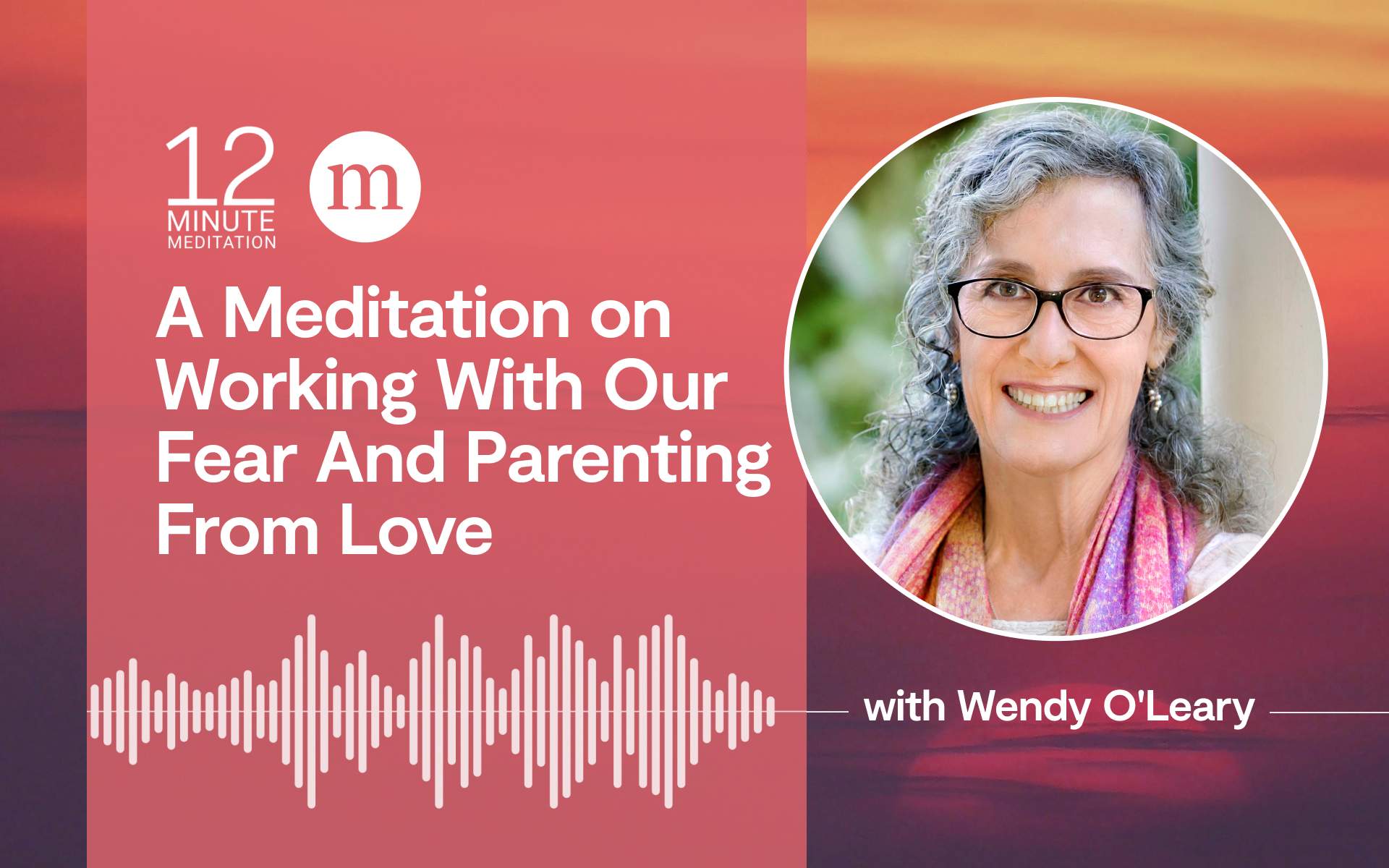
This practice from Wendy O’Leary offers a pause of support and encouragement that can bring you back to that core of compassionate wisdom—and you can return to it anytime you need help parenting from love.
A Meditation on Working With Our Fear And Parenting From Love
Read and practice the guided meditation script below, pausing after each paragraph. Or listen to the audio practice.
Get into a comfortable seated position. You can close your eyes or gently look down and soften your gaze, whatever works best for you.
As we settle in here, bring your attention to your breath or feel the sensations of your body as it connects with the earth. Feet on the floor, backs of the legs on a chair or a cushion. Invite the attention to settle in a bit. Arrive in this moment by dropping into the body with the breath and the sensations of the contact points of the body. Gently settle in.
Now, I invite you to shift your attention to think about your child, maybe even picturing them in your imagination, calling to mind a time when you felt warm and loving feelings towards them. Notice what they were doing and remember how you felt in that moment. You might even imagine that someone has asked you, What do you love about your child? What words, phrases, images, or descriptions come to mind?
Gently check in and notice how you feel in your body, mind, and heart as you recall what you love about your child. You could even invite that feeling of love and connection to grow and expand in your body, gently resting here in this felt sense of love for your child. Let yourself marinate in this feeling of love and warmth and care.
Now, think of the time when your child was struggling. You don’t need to think of the most difficult struggle—instead, go with something that is a three or a four on a one to 10 scale.
As you allow the situation to more fully enter your awareness, check in again with your body. Often, when we are focused on a difficulty, especially when it’s related to our child, there can be a habitual tendency to contract and lean forward. Check it out and see if that’s true for you. To counteract this tendency, gently lean back just a little. This can be a physical leaning back or even an energetic settling back. Settle back and now invite the body to soften, even widen, creating space to hold whatever is there. We aren’t forcing anything here, it’s just a very gentle invitation to settle back and soften. Gently softening around the edges of any emotions we’re experiencing.
Now intentionally invite back that sense of love, holding the challenge in a spacious field of loving care and awareness. To help you do this, you might once again remind yourself of all the things you love about your child. You could even offer them some wishes of well-being and happiness as you picture them in your mind. May you be happy. May you well. May you safe. Or any wishes that feel true for you in this moment.
If the situation you’re calling to mind requires some response from you in some way, you might ask yourself, How would this love respond?You can also offer yourself a bit of care, because if your child is struggling, you are, too. So maybe place a gentle hand on the heart, or take a moment to remind yourself of our common humanity. You might say something to yourself like, Every parent struggles with their children sometimes. Every parent worries about their child at times. Or another phrase that might fit your situation. You could even say to yourself, This is hard, and I’m here for you, honey.
As you’re ready, you can open your eyes to close our formal practice. This practice can be a powerful way of reconnecting with feelings of love and cut through the worry and fears that we often experience as parents. It can be helpful to do the first part, remembering the love and care as a brief daily practice for a while, so you can more easily call up those feelings of love and connection in the midst of a challenging moment when you need the most help parenting from love. We want to acknowledge the hard stuff and not lose sight of the good and love that is underneath our worries and sometimes even our difficulties with our children. With my very best wishes, may you be happy and peaceful and move through life with ease and equanimity. Thank you for practicing with me.
Take a restorative moment to release tension and feel deeply into gratitude for your hard-working body.
Taking a moment to pause with the intention to simply allow our bodies to rest in awareness can bring about a great sense of restoration and renewal to the heart. Our bodies are so overworked and often ignored. This guided awareness practice will allow us to feel a sense of gratitude for our body, in all of its beauty and mystery.
A 12-Minute Meditation to Rest Your Body in Gratitude
Read and practice the guided meditation script below, pausing after each paragraph. Or listen to the audio practice.
Starting off, find the posture that feels comfortable for you in this moment. There are many different postures that we can choose from. Check in with your body to sense into what posture is best for me right now?
Take a few moments to feel what it means to be alive in your body right now. With attention resting lightly on the body, just notice: How is my body expressing its aliveness in this moment? Maybe that’s with lots of sensation, maybe the body just feels relaxed and at ease, or maybe there’s energy moving through some of our bodies. Whatever is true for your body right now, allow this aliveness to be what you sense into in this moment. This is my body and I’m grateful for my body.
Now, allow your attention to lightly rest on the sensations associated with the body touching whatever is supporting it. Maybe it’s the floor or a cushion, or a bed or couch. Allowing your attention to lightly rest, feel the liveness of the body touching and being supported by whatever is under you. This is my body resting, supported by what’s under me at this moment and I’m grateful for this body and for this support and this moment to rest. Resting just like a newborn rests in the arms of a parent or caregiver. Allow your body to rest, letting the support, the stability, and the comfort of having something holding you really infuse your body and your awareness. In this moment, I’m being held and supported and this support is stable, and unconditional, and I am grateful. Continue to feel the connection and the support of whatever is holding you in this moment, remaining connected to that experience.
We’re going to begin to invite our bodies to rest in the feeling of the space around the body. So, we’re really just allowing our attention to rest on the skin of the body. And with each exhale, let your attention begin to relax and expand out beyond the skin, just going out a few inches around the skin, resting in this space. Rather than focusing entirely on the physicality of the body, now we’re inviting the energy in the body—the tingling, the sensations—to actually rest in the space around us. You might use your imagination a little bit to imagine that, with every exhalation, you begin to sense your body being held by the vastness of the space surrounding the body.
It may be helpful to start with your back, inviting the back to rest. Just let go into the space behind you. And shifting to one side of the body, feeling that side, feeling the skin, and then inviting that side of the body to just let go. To relax into the space around that side of the body. And then going to the front of the body: feeling the skin, the body sensations, and the aliveness, and just allowing the front of the body to be held and to rest into the space in front. And lastly, arriving at the other side of the body, sensing the skin of the body, then letting your attention relax into the space around that side of the body.
For a few moments, as you’re breathing in and out naturally, allow your attention to rest as the body is resting, in the space around the body. The body can let go now. Breathing in, feeling the body held in our awareness. Breathing out, we’re grateful for the space around the body. It allows the body to relax.
As we bring this practice to a close, the invitation is for you to place a hand on your heart, feeling a sense of gratitude and appreciation for the body, the space around the body, and this moment of resting. And remember that gratitude for the body is a way that we can always reconnect with this sense of rest, presence, and ease.