Get the latest on everything mindfulness
Our free newsletter delivers updates on the science of mindfulness, guided mindfulness meditation practices from leading teachers, special offers, and rich content to support your mindful growth.
Source link

Get the latest on everything mindfulness
Our free newsletter delivers updates on the science of mindfulness, guided mindfulness meditation practices from leading teachers, special offers, and rich content to support your mindful growth.
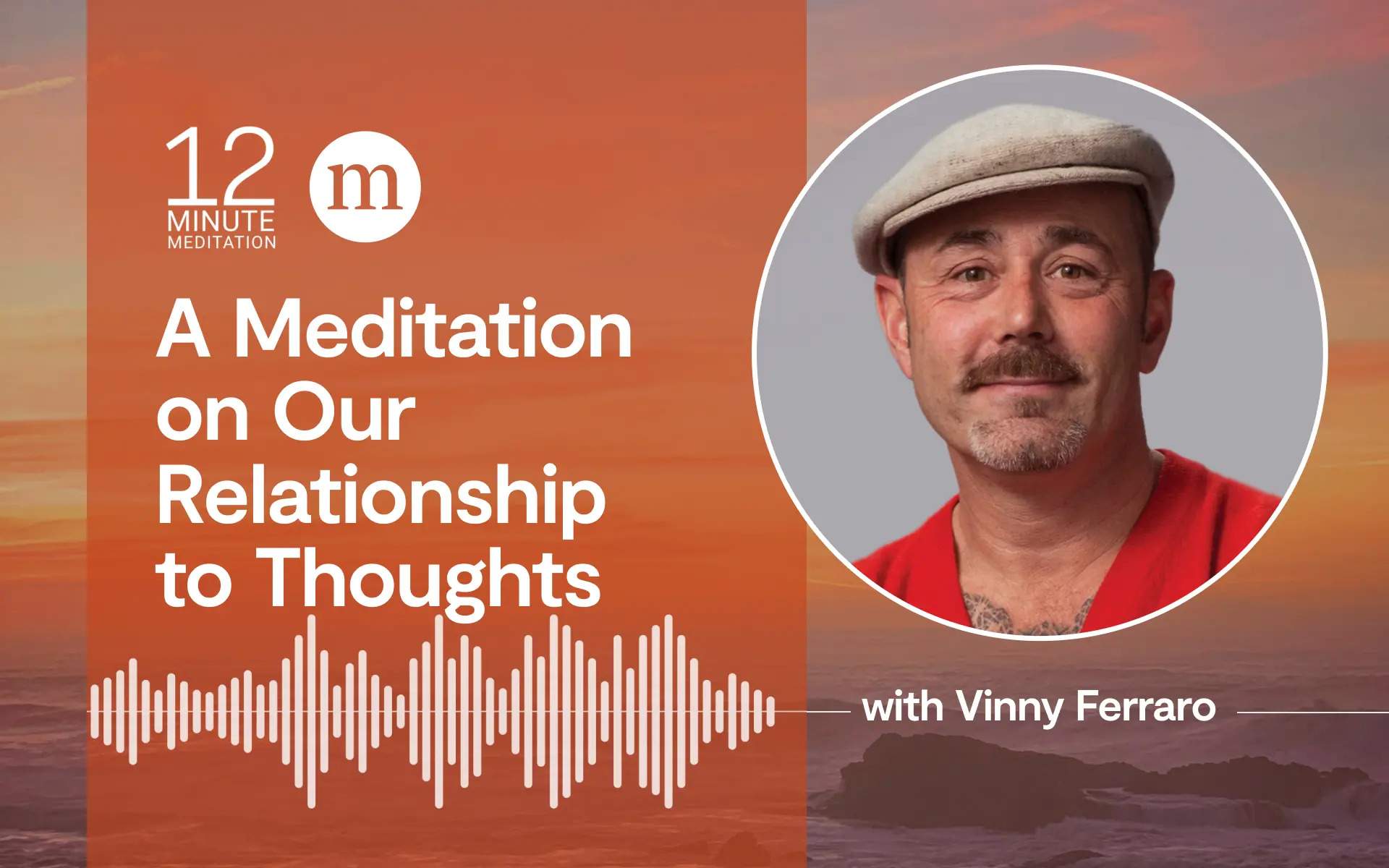
Meditation teacher Vinny Ferraro offers a practice to notice our relationship to thoughts: to see them clearly as they arise, gently note them, and return to the breath and body.
The nature of the mind is to make thoughts. All day long, mostly without our even noticing, the mind is generating thousands of thoughts. What is our relationship to thoughts? Not only does the mind have a mind of its own, but, literally, we can have thoughts about not having thoughts. All of this is completely independent of our own doing.
It’s very easy to villainize thought as some kind of enemy of practice. We get in our heads that if there were no thoughts we would be at peace, but even that’s just another thought.
It’s very easy to villainize thought as some kind of enemy of practice. We get in our heads that if there were no thoughts we would be at peace, but even that’s just another thought. So, we’ll be using a noting practice, where we practice seeing thoughts clearly as they arise, gently noting them, and returning to the breath and body. If there is no mindfulness of mind, we live in a world completely defined by our thoughts. Here, we let go of that orientation and just see things as they are. We still hear the internal talk, we still see the images, but we know them as phenomena. We see their impermanence.
If we look, we may see how often our thoughts include judgment, fear, grasping, or just arguing our point of view. When we see how compulsively these thoughts repeat themselves, we begin to understand the circular, repetitive nature of thought. So, this training in awareness is a training in wisdom.
We can’t stop thoughts from arising but we can stop getting lost in them. Here we can see our views, our thoughts, our worries, as only one part of a much larger story. As we begin this session, feel your body and allow yourself to arrive. This is the practice of kind awareness. Allow the breathing to be natural, easy. See if there’s a sense of relief that you don’t have to make anything happen or stop happening.
Just simply note when thoughts arise. When you notice thoughts arise, gently note: “planning, planning,” or: “judging, judging.” We’re not noting things so that we can change them, we’re just turning toward this phenomenon and noticing thoughts that usually fly under the radar, just like the light little whisper. We don’t usually feel their impact; most of the time, we’re not even aware that they’re there and the next thing you know we’re carried off. So, we don’t want to be lost in the dream of our own mental activity.
Don’t “quiet” your thoughts. You don’t have to control thoughts or quiet them down; we just want to be aware of them as they arise, because any moment we’re aware of them, we’re not lost in them. You can think about it like we’re sitting in a movie theater, and there are images and voices projected on the screen of the mind, but we’re witnessing this phenomenon instead of being seduced by it. This frees up a lot of our awareness, when we don’t have to chase every thought, so we can see the well-worn patterns of the mind and begin to recognize some of the themes that we’re working with.
Note thoughts without empowering them. Note thoughts without indulging or empowering or needing to suppress or avoid them. This way, whatever arises is known and allowed to simply pass through. Thought bubbles are touched lightly, their content completely irrelevant—they are just another object.
Rest in your body. Here we are resting in the body, aware of sensation, watching thoughts come and go, and yet we remain. As things pass through the mind, be open and empty. This is a being, not a doing, so we don’t have any need to search for something to note. But as thoughts are known, gently note them. Lightly touching thoughts, not lost in content, not trying to figure it out, but resting in the witnessing of what is naturally unfolding. The practice is to keep noticing, not by bearing down on thoughts or drilling into them, but by resting in your intuitive awareness and opening up your field of attention to include thoughts. Thoughts are so prevalent, they are a worthy anchor for a meditation.
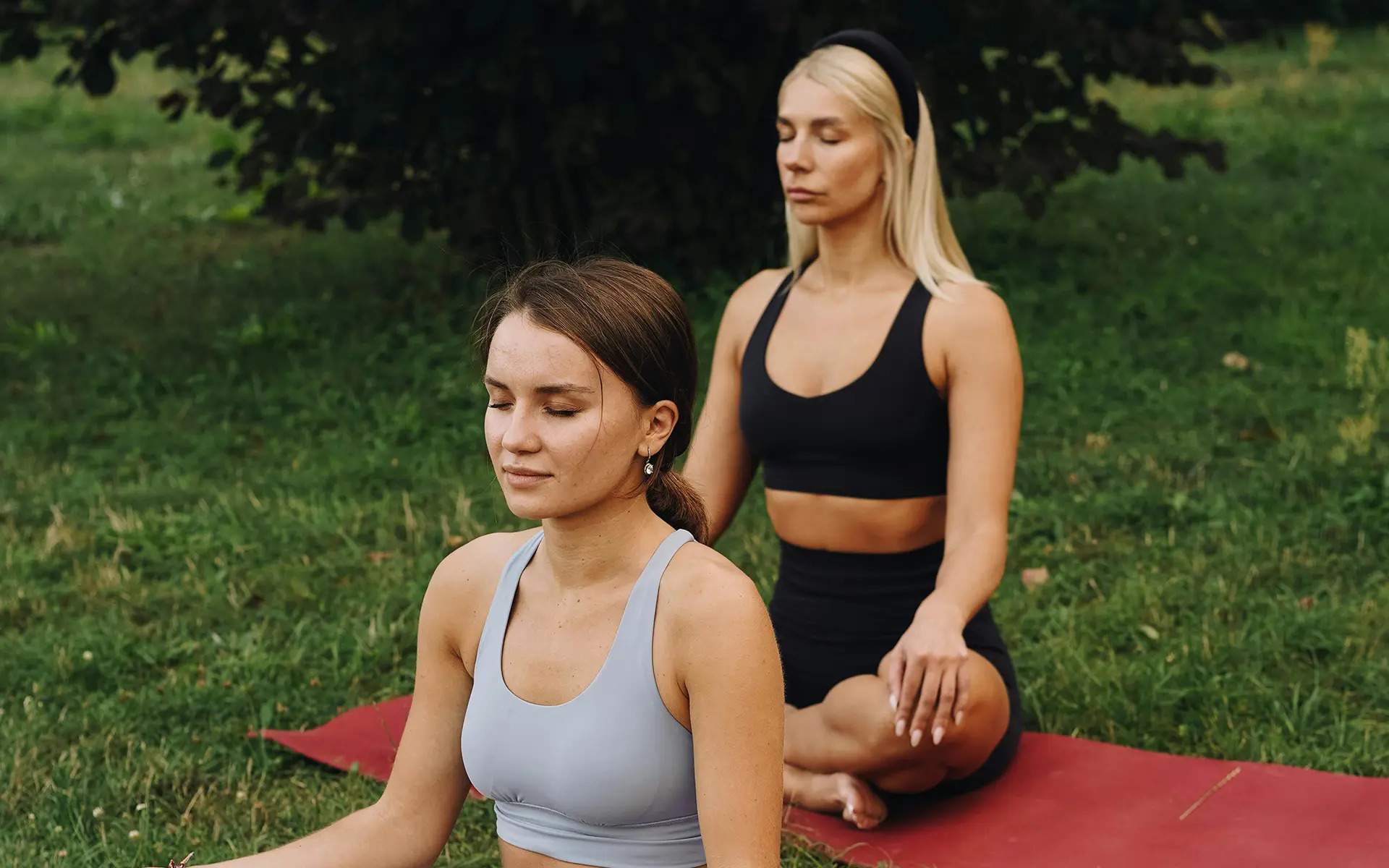
Meditation is everywhere these days. Guided meditations or visualizations, mindfulness, walking meditations, body scans, and even mantra meditation are taught in classrooms and workplaces as well as being featured on popular meditation apps. Some people swear by their specific type, others dabble in different ones, and many are simply curious to try but have not yet.
For me, mantra meditation—more specifically Transcendental Meditation (TM)—has been life-changing. In this piece, I explain what TM is, explore its benefits, and discuss differences between TM and mindfulness meditation.
Fifteen years ago, in 2009, I began meditating. At the time, my life was shifting in almost every possible way. I had just moved back to my hometown of San Francisco after seven years of teaching in Los Angeles. I had been diagnosed with an autoimmune disease, ulcerative colitis. Now, even today, we don’t know everything about this disease, but what we do know is that stress is a major trigger. There I was, diagnosed with a chronic illness, trying to understand my symptoms, manage them, and plan for an unpredictable future. At the same time, another major life event was unfolding: I had just turned 30 and was embarking on the difficult journey of trying to have a baby—an experience that ended up taking three years, filled with doctor’s visits, uncertainty, and loss.
On top of all this, I was transitioning professionally—moving from being a classroom teacher in LA to working in the central office for SF Unified School District’s new teacher Induction program. It was a lot—personally, professionally, emotionally—and this was the exact moment I started meditating.
The style of meditation I learned in 2009 was Transcendental Meditation (TM), through a grant from the David Lynch Foundation offered to employees in the San Francisco Unified School District. TM is a form of mantra-based meditation where you silently repeat a specific word (mantra) to help you focus and transcend ordinary thought patterns. The idea is that the repetition of the mantra allows the mind to settle into a deep state of rest and alertness, fostering a sense of inner peace.
TM is a form of mantra-based meditation where you silently repeat a specific sound or word (mantra) to help you focus and transcend ordinary thought patterns.
Learning TM typically involves enrolling at a TM center and paying for instruction, which may be delivered one-on-one or in a small group. When I learned, the program was offered free of charge to SFUSD employees and was conducted in a small group over several sessions, with monthly group check-ins. At the time, the foundation was conducting a clinical trial to explore TM’s impact on health, so participants were divided into two groups: one received instruction in the mantra-based meditation practice immediately, while the other (the control group) began six months later.
Regardless of whether you learn TM individually, in a group, or as part of a study, you are given a personal mantra by a certified TM teacher. This mantra—a nonsensical, lyrical word—is meant to be kept private and not shared with others. Some have noted that mantras are assigned based on the age of the practitioner at the time of learning.
Though TM has its roots in India’s Vedic traditions—some of the oldest known spiritual and philosophical systems, dating back over 3,000 years—the form of TM practiced today originated in the 1950s. While the use of mantras may be linked to ancient Sanskrit texts, TM is taught as a secular practice, distinct from any religious framework. It is presented as a scientific method for reducing stress and enhancing overall health. The technique gained widespread popularity, in part, due to high-profile advocates like The Beatles, who helped bring attention to this form of meditation.
Scientific research has shown that TM can reduce stress and anxiety, lower blood pressure, and improve overall well-being, immune function, and sleep. It has been found to enhance cognition, increase creativity, and even help with mental resilience during challenging times. Many people continue to be drawn to TM because of its structured nature—it’s easy to learn, and practitioners are typically taught one-on-one by certified instructors, which provides personalized guidance.
For me, TM quickly became an anchor in my daily life. As someone who values routines, it was a simple ritual that brought a deep sense of peace and clarity. I found myself looking forward to that post-meditation feeling: lighter, more grounded, and better equipped to face whatever was swirling around me. The anxious thoughts that used to loop endlessly—about infertility, miscarriages, managing colitis through diet, or the stress of potential layoffs as well as the economic recession—began to feel less heavy, less consuming.
Inspired by the power of TM, I also began to shape a personal approach to mantra-based meditation, one that felt more flexible and accessible. I was curious about how choosing my own mantra or intention might shift the experience. The concept is simple: pick a word or phrase, repeat it silently, and let the mind soften and settle. It’s a calming, effective practice that doesn’t require expensive training or long hours. While TM is one established form of mantra meditation, there are many variations, each adaptable to your own rhythm, needs, and curiosity.
Mindfulness meditation is all about being present in the moment, observing your thoughts and feelings without judgment. As teacher and educator Diana Winston explains in her Tedx Talk, this type of meditation can be understood as “paying attention to present-moment experiences with openness, curiosity, and a willingness to be with what is.”
While it’s common to incorporate an intentional focal point in mindfulness meditation—like the breath, a visual cue like a candle, or bodily sensations—this technique is often practiced by simply sitting or lying down in silence and just being with whatever arises. If worry, anxiety, pinging thoughts, or physical pain cause distraction, the meditator notes the distraction without judgment and then gently returns attention to the present moment.
This type of meditation is accessible, flexible, and encourages people to start where they are. Similar to TM, studies have shown that mindfulness meditation is effective in reducing symptoms of stress, anxiety, and depression, improving sleep, and increasing the markers of physical, mental, and emotional well-being.
While mindfulness can be highly effective for calming the mind, some people find it challenging, especially if their mind is constantly racing. The free form offers lots of room for personalization, but that same lack of structure or focus can be frustrating, especially for newer meditators.
If you’re someone who has tried mindfulness meditation and found it difficult to make progress, let me share why I gravitated toward mantra meditation.
So, how do you decide which type of meditation is best for you?
It really comes down to what resonates with you. Mindfulness meditation is all about being present in the moment, observing your thoughts and feelings without judgment. It’s often practiced by focusing on the breath or bodily sensations. While mindfulness can be highly effective for calming the mind, some people find it challenging, especially if their mind is constantly racing. That’s where mantra-based meditation can be helpful. By focusing on a simple word or sound, it can provide an anchor for the mind, making it easier to enter a state of calm.
For some, mindfulness offers a deeper connection to the present moment, fostering awareness throughout your usual daily activities. For others, TM or mantra meditation can provide quicker relief from mental chatter, especially in stressful moments.
For some, TM or mantra meditation can provide quicker relief from mental chatter, especially in stressful moments. But for others, mindfulness offers a deeper connection to the present moment, fostering awareness throughout your usual daily activities.
In my experience, mantra meditation offered a structured way to quiet the mind, whereas mindfulness meditation required more of an open awareness toward the thoughts and emotions that pop up during practice. There’s no one-size-fits-all when it comes to meditation. Some people thrive with mindfulness, while others prefer mantra meditation. And of course, many benefit from incorporating both practices, depending on the situation.
Starting a meditation practice can feel intimidating. There are so many styles, techniques, and ideas about what meditation “should” look like. But in reality, it’s incredibly simple. You don’t need expensive accessories. You don’t need to sit a certain way or clear your mind of all thoughts. You just need a few minutes, a comfortable seat, and a willingness to try.
There are so many styles, techniques, and ideas about what meditation “should” look like. But in reality, it’s incredibly simple.
I practice using a mantra, a simple word or phrase that I repeat silently to focus my mind. I set a timer, close my eyes, and let my thoughts come and go while gently returning to the mantra. That’s it. No pressure, no perfection, just presence. Over time, this small practice has helped me become more creative, more patient, and more resilient. It’s allowed me to meet life’s challenges with a clearer mind and an open heart.
Start small—just five minutes. Try it for a week and see how you feel. And if you ever have questions or want to learn more about my mantra-based technique, reach out via my website.
At the end of the day, any form of meditation—mindfulness, mantra, TM, guided or another type—is one of the best gifts you can give yourself. It’s a practice that supports you through life’s toughest moments, enhances your best ones, and ultimately helps you show up as the best version of yourself.
So, what do you say—let’s get more people meditating! With that goal in mind, I’ve launched a series on TikTok and Instagram called #DeadOrMeditating, aimed at making meditation go viral. Remember when planking took off and people were posting photos of themselves planking in public spaces? That simple trend raised awareness and sparked conversations. Why not do the same with meditation?

In a world that feels uncertain, chaotic, and often disconnected, people are seeking greater peace, clarity, and emotional balance. In that searching, many have found respite and healing in a regular meditation practice. However, if you’re brand new to meditating, it can be a little intimidating at first. Where do you begin? Are there foundational guidelines or rules of meditation that should be followed?
While there are many forms of meditation, some core principles guide successful practice. These principles act as a springboard to help you navigate your meditation journey more effectively. Whether you’re new to meditation or a seasoned practitioner, understanding these “8 rules of meditation” can deepen your practice and enhance its benefits.
And, if you read to the end, we’ve included a final guideline that might surprise you—and that might be the most important thing to remember as you explore the challenges and rewards of meditation.
Let’s dive into these key principles to discover how they can enrich your meditation experience.
One of the first and most important rules of meditation is finding a comfortable, stable posture. While many people envision sitting cross-legged on the floor, the truth is that meditation posture can vary. You don’t have to twist into complicated poses to meditate effectively.
The key is to find a position where your body feels supported and relaxed. That can be sitting on a chair, cushion, or even lying down. In fact, it can be a useful practice to simply tune into your body before each meditation session and determine which position might be the most comfortable for that day. This is a gentle way to start focusing your attention.
If you choose to sit, either in a chair, on the floor, or against a wall, remember to:
Comfort is key because physical discomfort can easily become a distraction during your practice. By settling into a comfortable posture, you allow your mind to focus more easily.
You’ll hear meditation teachers speak a lot about the power of the breath.
This is because the breath is a natural anchor for meditation. It’s always with you and can be observed without a lot of effort. Focusing on your breath helps quiet the mind and center your awareness in the present moment. This rule of meditation teaches you to tune into your body, observing how the breath moves in and out, without trying to control it.
When meditating, pay attention to the sensation of air entering and leaving your nostrils or the rise and fall of your abdomen. If your mind wanders—which it inevitably will—gently bring your attention back to the breath. This act of returning to the breath is a key part of meditation, strengthening your mental focus.
A common misconception is that a quiet mind is the goal of meditation, but the reality is that thoughts will always arise. It’s not possible for meditation to be about controlling or suppressing your thoughts, because producing thoughts is just what the brain does.
That’s why much of the work of meditation is just learning to accept whatever arises in your mind without judgment. Whether it’s stress, irritation, or joy, let the thoughts and feelings come and go like clouds passing through the sky. That can look like gently saying to yourself something like, I notice I’m thinking about work right now. I have a lot of worries about my job right now. That’s okay. I can think about work later, but right now, I’m choosing to return to the present.
The key here is non-resistance. Instead of fighting your thoughts, simply observe them. Recognize that thoughts are fleeting and don’t define who you are. Over time, you’ll learn how to detach from the endless stream of thoughts and emotions, allowing them to pass without becoming consumed by them.
And remember that when your attention wanders and you bring it back, that is similar to doing a rep with a weight. The wandering and coming back is not a “failure”—it’s precisely what builds strength in your focus and attention over time.
Consistency is crucial in meditation. As we mentioned above, strengthening focus and attention is like any skill: the more you practice, the more you’ll benefit. It’s better to meditate for a few minutes every day than for an hour once a week. Regular practice builds mental discipline and helps integrate mindfulness into your daily life.
Start small if you’re new to meditation—perhaps with just five minutes a day—and gradually increase your time. Find a routine that works for you, whether it’s in the morning, during lunch, or before bed. The important thing is to establish a habit and stick to it. Even short, regular sessions will lead to noticeable improvements in your focus, clarity, and emotional regulation.
As you might imagine, and perhaps have already experienced for yourself, frustration is a very normal part of starting and maintaining a meditation practice.
Meditation is a journey, not a destination. In Western culture especially, we’re training to approach everything as if it’s something to be perfected or conquered. It can be extremely strange to engage in a lifelong activity where “mastering” it isn’t the goal.
It’s normal to experience challenges, especially in the beginning. Your mind may feel restless, your body may feel almost unbearably uncomfortable at times, and might be surprised and annoyed by what pops into your head when you’re just trying to be still for a second. It’s easy to get discouraged when progress seems slow. This brings us to one of the most important rules of meditation: patience.
Understand that meditation is a practice of observing the mind and its patterns. There will be good days where meditation feels effortless, and there will be days when your mind seems like a chaotic storm. Both experiences are part of the process and both are completely normal. Patience means accepting where you are today without judgment. Trust that with time and consistency, the benefits of meditation will reveal themselves.
A common pitfall in meditation is having expectations about what “should” happen. Many people sit down expecting immediate calm, profound insights, or even emotional or spiritual awakenings. When those expectations aren’t met, disappointment and frustration can follow. One of the core rules of meditation is to let go of expectations.
Meditation is not about achieving a specific outcome but about being present with whatever arises. You might experience moments of peace, and at other times, you might face discomfort or boredom. The practice is about accepting each moment as it is without trying to manipulate the experience. By letting go of expectations, you create space for authentic, unfiltered awareness.
Meditation is not confined to your time on the cushion. One of the most powerful benefits of meditation is the ability to bring mindfulness into your everyday life. Meditation is one exercise that helps you stay aware and present in one particular moment, so that you can stay aware and present throughout the day, no matter what you’re doing.
Whether you’re eating, walking, working, or talking, try to bring mindful awareness to the present moment. Notice how your body feels, observe your surroundings, and pay attention to your thoughts and emotions without getting lost in them.
More good news? This is all a virtuous cycle: staying mindful during everyday activities deepens your meditation practice, which in turn helps to cultivate a sense of peace and clarity that extends out into all the little moments of your beautiful, imperfect human life.
One of the many side benefits of a regular meditation practice is an expanded capacity to hold compassion—for yourself and others. Meditation is not just about focusing the mind; it’s also about opening the heart. As you observe your thoughts and emotions, practice self-compassion. Recognize that it’s okay to struggle and be kind to yourself when things get tough.
Likewise, extend that compassion to others. Over time, meditation helps you develop a sense of interconnectedness with the world around you. By practicing loving-kindness meditation or simply holding an attitude of empathy, you foster compassion for all beings. This rule reminds us that meditation is not just a personal practice but a way to connect with others and contribute to the well-being of the world.
Like the rest of these rules of meditation, there is a kind of counter-intuitive and cyclical nature to expanding compassion. The more we make room for imperfection and mistakes in our meditation practice, the stronger our practice will become over time. The less we put pressure on ourselves to always “get it right”—and judge ourselves by a standard of perfection—the more room we have the ability to extend that grace to ourselves and others in the rest of our lives.
Mindfulness and meditation are counter-cultural in so many ways.
For example:
When we see a phrase like “the eight rules of meditation,” it’s easy to slip into thinking about this process the way we think about so many things in life: through the lens of striving, achievement, mastery, and perfection. We can get attached and rigid—and that actually makes growing in the process more difficult.
So, in the end, here’s a final invitation: hold all of the rules of meditation lightly. Lean into them for support, guidance, and encouragement. Allow them to be gentle reminders of why you’re here.
But also remember that there is so much room for every day to be different. Some days will feel amazing, and some won’t, and that’s okay. It’s all part of the experience, and even the days when it feels like it’s not working…it’s still working.
Meditation is a journey, and each time you practice, you take a step closer to greater self-awareness and inner peace. Whether you’re just starting or have been meditating for years, these guidelines can serve as a compass to help you navigate your path with a little more awareness and grace.
A: The key is finding a position that works for you and your body’s needs. If sitting with your legs crossed is hard on your knees, for example, you can sit in a chair with your feel on the floor. It’s fine to lie down, as well. It can be a useful practice to simply tune into your body before each meditation session and determine which position might be the most comfortable for that day. This is a gentle way to start focusing your attention on your body and your breath before you even officially start your practice.
A: Yes, it’s completely normal! The mind does what it does: it generates thoughts, feelings, reactions, stories. That’s its job. You might find your mind wandering dozens of times in just the span of five or 10 minutes. Be patient with yourself, and be aware of how you respond to this very natural movement of the mind. Instead of harshly criticizing yourself, try noticing, thanking your mind for doing its thing, and then bringing your attention back to the breath. Each time you return your attention to the present moment, think of it like lifting a weight—you’re actually strengthening your focus each time your bring it back.
A: It can be super frustrating to start a practice and to hope to see and feel big results right away. The truth is, learning to meditate takes time, and most often the changes aren’t sudden or dramatic.
One key way to notice shifts as a result of your practice is just to pay attention to how you respond to discomfort or disappointment. You might start to be aware that you’re less reactive, that you have just a moment between when something happens and when you respond that wasn’t there before. Or maybe you notice your inner dialogue shifting—maybe you’re more patient with yourself or others, maybe a little less critical when you make mistakes. You might notice that your focus is sharper, that you see and appreciate “little things” a bit more. Again, it might not be dramatic, but part of a mindfulness practice is becoming more aware of micro-changes in yourself over time.
In my college days, a thousand years ago, I used to hang out in part of the library that contained a large multivolume work: Pokorny’s Indo-European Etymological Dictionary. I would idle away hours looking up the derivations of words and tracing their meanings as they wended their way through many languages and cultures. It instilled in me a spirit of looking beneath the surface of a word to find the depth and breadth that lay within.
When I first discovered that the word “education” derives from an ancient root roughly meaning to draw out, to lead out, it lit up my mind. At that point, education had seemed mainly to be a process of having information and ideas poured into you, or wisdom bestowed on you from on high. This deeper sense of education conveyed both something being drawn out from within as well as the prospect of being led on a journey of discovery. It was a revelation, and an inspiration.
Even if I was overthinking the etymology—we can’t really know what people thousands of years ago meant when they used a word; the great Julius Pokorny was only making educated guesses—I came to find teachers who met this deeper standard of education. They were teachers who elicited something within that was ready to be brought out. For sure, they led me to new information, but with a spirit of inquiry and examination, rather than indoctrination. Many of them taught me mindfulness.
When it comes to learning meditation, having teachers who guide you in this facilitative way is vitally important. Meditation lies somewhere between an intellectual pursuit and skills training of the kind that athletes, martial artists, and musicians, among others, rely on. It involves techniques that have physical aspects, and it is indeed a bit like building up a muscle—at first the “attention muscle”—so some coaching and coaxing are integral aspects of real teaching.
Nowadays a lot of resources are readily available to get us started and help us along the way. Instructions for how to practice mindfulness and related practices abound—in books, magazines, apps, podcasts, and in video and audio form. The practice itself, as any number of teachers have said, couldn’t be simpler. In fact, it seems too simple. “That’s it? That’s all there is to it?” (One of the reasons it’s nice to have teachers around is to help us navigate that paradox.)
If you think you need a teacher, chances are you already have one—or many, for that matter.
In addition, authors regularly offer insightful commentary on the sorts of things that occur when one practices meditation. If you can afford it (or get financial aid), you can go to conferences and meditation programs to learn more and deepen your practice. Some of these ways of getting instruction can feel pretty intimate: Listening to a teacher on an app or podcast can make you feel as if you’re being spoken to directly, and in videos teachers can instruct with a lot of gesture and expression. When you’re reading, you can return again and again to a passage that speaks to you especially.
All of these supports actually are a form of having a teacher, or many teachers. So, if you think you need a teacher, chances are you already have one—or many, for that matter. It’s helpful to have some gratitude for that fact. Countless people in the world do not have the leisure or opportunity to access a wealth of meditation teachings.
Patience also pays off. Desperately rushing to find “the teacher” who solves it all results mostly in frustration. As Jessica Morey, cofounder and lead teacher at Inward Bound Mindfulness Education, says, “Meditation practice can lead you to become striving-oriented, obsessed with trying to get somewhere, to gain experiences.” Being a gardener, patiently planting seeds and allowing nature to take its course, rewards better than being a driver speeding to get to an appointment.
Eventually, however, no matter how patient we are, obstacles and challenges arise that ruffle our feathers. Mindfulness, awareness, kindness, and compassion practices do not simply work in a linear fashion: x amount of time and effort yields y results. They involve ongoing exploration of how we see ourselves, the world around us, and our relationships. They challenge preconceived views and fixations. They turn us toward life’s ups and downs, rather than away from them. They take us to difficult places.
This is where support from someone outside yourself who can hear you and what’s going on in your mind—not a generic mind—can make a difference. This is where a teacher can provide true education: drawing out what’s inside us and leading us on a journey, not a journey that is prepackaged in a book or on an app, but a journey we cocreate. It’s not a paved road. It’s a trail that we must blaze—with help.
As longtime meditation teacher and author of You Belong: A Call for Connection, Sebene Selassie, says, while some people are “natural self-teachers, most of us benefit from guidance and instruction… We’re not practicing to become super-meditators. We’re practicing to gain some insight and wisdom. So, I’ve found it’s definitely helpful to have some insightful and wise people around.”
Such wise and insightful people come in various forms. They can simply be fellow practitioners with whom we have common cause and a developing bond of trust. They may be in a local group (formal or informal) or online, perhaps supported by an occasional gathering at a group program or retreat.
Finding human beings to support our practice, either as fellow travelers or teachers, may not be an easy prospect. It depends to a certain degree on the availability of teachers and practitioners who are compatible with the kind of path you would like to follow. For most of the history of meditation practice, it has been transmitted largely through religious organizations. The methods of teaching and supporting practitioners varied from tradition to tradition, but they have included everything from simple fellowship to intense forms of followership, with students taking very explicit directions from teachers in the form of commands, supported by vows on the part of students. As these religious traditions undergo many changes in the modern era, non-religious ways of teaching and practicing mindfulness and related practices have broken through. The expansion of these forms of practice is the reason that Mindful and mindful.org were founded.
Secular forms of practice have been happening explicitly for about 40 years, so while there are a fair number of teachers, this movement has not developed to the point that there are many secular places to go on retreat with an optimal ratio of teachers at varying levels of ability to students, which would allow for widespread, ongoing individual attention. The supply of teachers is growing, but nowhere near as fast as the number of people interested in taking up meditation. And someone doesn’t become a teacher overnight. Think of wine—it can take decades for a vintage to become finely aged, and not every wine is up to the task. Still, many are very drinkable on the way to becoming fine. Teachers are like that—mastery may be decades off, but many have wisdom and insights to share even at early stages.
Support from someone outside yourself who can hear you and what’s going on in your mind—not a generic mind—can make a difference. This is where a teacher can provide true education: drawing out what’s inside us and leading us on a journey.
As many teachers have noted, people often come to a weekend program, go on a retreat, or take a mindfulness-based course such as MBSR, and then drift away, without finding the ongoing support—and human interaction—they need to truly integrate mindfulness into their lives. Mark Leonard of Mindfulness Connected, who played a key role in establishing the Oxford Mindfulness Centre, believes that the lack of ongoing connection with others, in favor of a kind of private mindfulness, cuts us off from more profound effects at both the personal and societal level. Presenting at the 2020 Mindful Society conference, he emphasized that “well-being is a social function, it’s not a psychological process.”
I look at the guidance we receive from others on the path of meditation as coming at three different levels, with each a bit more intimate and intensified, and placing more trust in the teacher: fellowship, mentorship, leadership. The lines between them are not hard and fast, and one is not better than another. They work together.
1. Fellowship
As I mentioned above, we already have a teacher—in fact, many teachers—in the form of resources full of instruction and insightful guidance available via so many channels. But one of the principal elements we need is something that keeps us coming back to meditation regularly, and in this case, fellow meditators can make a great difference. As we get trapped in old habit patterns or fall into ruts, lose our inspiration to keep going, or start to feel we’re the only one who has difficulties, connection with meditating friends—in person, online, or both—can make all the difference.
It’s not that we’re all leaning on each other so that we’ll all fall down together. Rather, we help each other stand on our own two feet, as it were. We may do retreats together or find ways to integrate practice in other areas of life, such as starting a mindfulness program in a local school or hospital. There is great power in learning together.
Tara Healey, program director for mindfulness-based learning at Harvard Pilgrim Health Care, is a strong believer in the efficacy of ongoing small doses of support, because as she says, “Mindfulness is self-correcting. As we go off course, it will guide us, as will our fellow meditators and friends. The ability to appreciate the quiet and listen to how you’re being guided gets clearer and clearer the more you practice. The practice itself serves you the life lessons you need.”
Fellowship, being in community with others, becomes an important foundation for going forward on the path of meditation, because it gradually encourages us to think less of mindfulness as a personal pursuit and more as collective pursuit, the social well-being that Mark Leonard talks about.
Caverly Morgan, who founded Peace in Schools in Portland, Oregon, and established the groundbreaking for-credit Mindful Studies course in the high schools there, is committed to encouraging students to find how the personal expands into a greater whole, how mutual awareness leads to mutual understanding:
In the same way a teen experiences a sense of empowerment by discovering that she, he, or they can direct their attention to the moment versus a conditioned internal story, we have the capacity to do so collectively. The result: collective empowerment. When we are practiced at seeing where and how our attention moves personally, internally, in the privacy of our own minds, it becomes easy to see how our attention moves and is directed collectively. In our communities. In our culture. In our world.
2. Mentorship
At the level of mentorship, there is much more personal give-and-take with a teacher. It may also occur in a group, but is also often enhanced by one-on-one time. Many of us have experienced an inspiring talk by a teacher, perhaps to a crowd of hundreds or even thousands—what some people call “the sage on the stage.” That’s OK for getting an inspirational boost, but a mentor comes down off the stage and sits down with you at eye level, for extended periods.
The way that meditation mentors lead people is probably best described as facilitation. It can happen at an individual level, but quite often it occurs in small group programs, such as MBSR or MBCT or any meditation class, really, where personal instruction and group work combine. Facilitating is the act of making it possible for students to find their way. While in fellowship, there is a danger of incestuousness and group think, mentors can cut through that, since part of their role is to draw our habit patterns out into the light, to be examined with care in a safe space.
The skillful means that effective mentors use to facilitate learning are too many to enumerate. They’re inexhaustible, in fact, since they often emerge creatively in the moment, so the marks of effective mentorship are often spontaneity, humor, and a sense of play. While mindfulness involves work, a good mentor conveys that it is definitely not drudgery.
While the skillful methods are endless, two examples—inquiry and stewardship—may help to convey what these kinds of skills are about.
Patricia Rockman, MD—senior director of education and clinical services at the Centre for Mindfulness Studies in Toronto, and co-author of Mindfulness-Based Cognitive Therapy: Embodied Presence and Inquiry in Practice—is one of the foremost articulators of the power of inquiry, which she describes as “an interactive process, a reflective process, on an experience that has just occurred.” She goes on to say that “what we’re trying to do… is enhance people’s ability to be with their direct experience versus what we normally do, which is to immediately have interpretations, ideas, conclusions, judgments about our experience.” In addition, she says that inquiry enhances people’s “capacity to reflect on the unfolding nature of experience and learn to track that experience without running off into storytelling or narrative or other ideas and conclusions.”
Rockman also points out that encouraging people to inquire about what’s happening moment to moment in their minds helps them “develop a language of experience, a vocabulary of experience—whether that’s describing their sensations, being able to describe their thoughts versus analyzing them, being able to name emotions in an attempt to manage them better and make them less overwhelming, and to begin to see how the body is a source of information” and the place where the sensory correlates of emotion (such as a tightening chest, when we are anxious) reside.
The marks of effective mentorship are often spontaneity, humor, and a sense of play. While mindfulness involves work, a good mentor conveys that it is definitely not drudgery.
Don McCown, co-author of Teaching Mindfulness: A Practical Guide for Clinicians and Educators, has written extensively about the process of teaching mindfulness, particularly in small groups. In a chapter in Resources for Teaching Mindfulness: An International Handbook, he talks about how, in his view, the primary skill of a mindfulness teacher mentoring small groups is to be a steward who tends to the atmosphere of the class.
While McCown acknowledges the atmosphere in a room may seem like a vague notion, still, he says, “We all walk into the room and know, through body sensation and affect, that the atmosphere is tense, or friendly, or calm, or maybe a little sad.” In fact, he goes on to say that “a group can agree on, and even engage in dialogue about, what it is like in the room at a particular moment.”
A skilled teacher of mindfulness-based programs is the steward of this quality of atmosphere, “tracking the unfolding of a class session moment by moment,” paying mindful attention to something that is “evident not only to teachers but also to participants, making it a valuable and valid measure for the relational state of the group.” In this way, the quality of a mindfulness group is something the teacher and the group give rise to together.
In stewardship, McCown points out, the teacher uses all the care at their disposal to pay attention to the setting, how people relate to each other, the interplay between silence and talking, maintaining ethical behavior, and a number of other elements. In this way, he says, “Atmosphere not only teaches participants, it teaches the teacher.”
3. Leadership
The ultimate—and the most intimate—level of teaching is when the teacher transmits, rather than simply teaches. Transmitting is embodying and sharing, most often by example, whatever understanding a teacher has. It’s not a highfalutin idea. In fact, quite the opposite. We see transmission happening in the most mundane of places. In describing a French baker he studied with, Bill Buford wrote in the New Yorker recently:
For Bob, farms were the “heart of Frenchness.” His grandfather had been a farmer. Every one of the friends he would eventually introduce me to were also the grandchildren of farmers. They felt connected to the rhythm of plows and seasons, and were beneficiaries of a knowledge that had been in their families for generations. When Bob described it, he used the word transmettre, with its sense of “to hand over”—something passed between eras.
A teacher committed to transmission cares little about their own stature as a teacher. Like the master baker, they care only about the results, the quality of the bread. They long to see students bake bread even better than they could bake. They don’t seek acolytes, a kind of permanent one-upmanship. They seek colleagues. They wish not merely to teach students but to learn together with them.
In so doing, like a good martial arts master, they will challenge the student to find the way by themselves. They also pay close attention to what’s going on with you, always alert to teachable moments, to turning points and possibilities for opening. It’s like the Deacon says in Season 4 of the HBO series The Wire: “A good church man is always up in everybody’s shit. It’s how we do.”
Their main tool is rarely the simple answer and more often the hanging question. Steve Hickman, executive director of the Center for Mindful Self-Compassion and a longtime mindfulness teacher, spoke with me recently about how the most powerful teaching involves highly attentive listening and probing: “Students benefit the most not from simply having their questions answered,” he said, “but from seeing the example of your ongoing warmth, curiosity, and attention, as you listen and inquire, so they find handholds and pathways of their own. Then, they are empowered, not just taught.”
The mark of the teacher’s work succeeding is that the world itself and your circumstances become the teacher. When you have a setback, such as a financial loss or the death of a friend, there may be less discursive mental drama surrounding the event. It becomes more a message to you of how to let go further of the story of what you have to have, to find more simplicity. If in the midst of being isolated in a pandemic, your partner tells you, “I wish you would clean up more after yourself,” you may skip the steps of resisting or beating up on yourself, and simply see the opportunity for attention and mindfulness and kindness to reach into more areas of your life.
You yourself may begin to become a teacher, even simply because of your example. You may become a great source of fellowship to others, and even a mentor and leader. Your interactions with your teachers, your friends, even strangers—the grocery clerk or a fellow passenger on the subway—and yes, those you fiercely oppose, have a tendency to draw you out of your shell of self-cherishing. You are more vulnerable and yet more resilient and confident. Every day brings discoveries, as if you’ve baked a fresh loaf of aromatic bread to share with the world. These messages from the outside are really messages from the inside, what you’ve internalized from your teachers, your friends, and your experiences. The inherent brilliance of your natural state of being is drawn out.
That is real education.
ACCESS MBCT is an international listing of mental health professionals who are committed to excellence in the delivery, training, and dissemination of Mindfulness-Based Cognitive Therapy.
The International Mindfulness Teachers Association is a certification and accrediting body and membership organization that includes a member directory of Certified Mindfulness Teachers and Accredited Mindfulness Teacher Training Programs.
Mindful Directory Ltd—a collaboration with mindful.org—is a platform where mindfulness teachers and other professionals register their credentials and list their events.
The Mindfulness Center at Brown University maintains a Mindfulness-Based Stress Reduction (MBSR) Teacher Recognition List, which includes teachers who have provided appropriate documentation of their teaching credentials.
Mindful Leader offers an MBSR Certified Teacher Directory provided to the organization by the University of Massachusetts Medical School, which has verified the credentials of the teachers listed.
The next step toward deepening your mindfulness practice may be finding a teacher that can offer you new insights. In our easy-to-use guide, we’ve outlined what to look for in a mindfulness teacher, and how to find the right one for you.
Read More
Mindful self-compassion teacher Steve Hickman offers advice for his fellow teachers to lovingly acknowledge the turbulence of their own hearts, and those of their students, during times where compassionate presence and action are needed more than ever.
Read More 

When we allow our mind to float freely, says Jenée Johnson, our body releases stress and tension, so that we can truly restore ourselves.
Relaxation is a practice, like any other. Stress, trauma, and tension can hamper our ability to rest and relax, so we can do “relaxation drills” to get in the habit of full, deep relaxation. Try taking 20 minutes once or twice daily to deeply relax and notice how it effects you during the rest of the day. Just remember not to be hard on yourself if you don’t feel a sense of ease right away. The best tools you can use during meditation are patience, self-kindness, and a comfortable place to sit.
Relaxation meditation can help us move through our days with more calm, clarity, and awareness. From this place of peacefulness, we’re better equipped to handle challenging situations, to make thoughtful and informed decisions, communicate well, come up with creative ideas, and more.
To help you deepen your mindfulness practice (or get started), we’ve rounded up a list of guided meditations that have resonated most with our readers over the past year. Read More