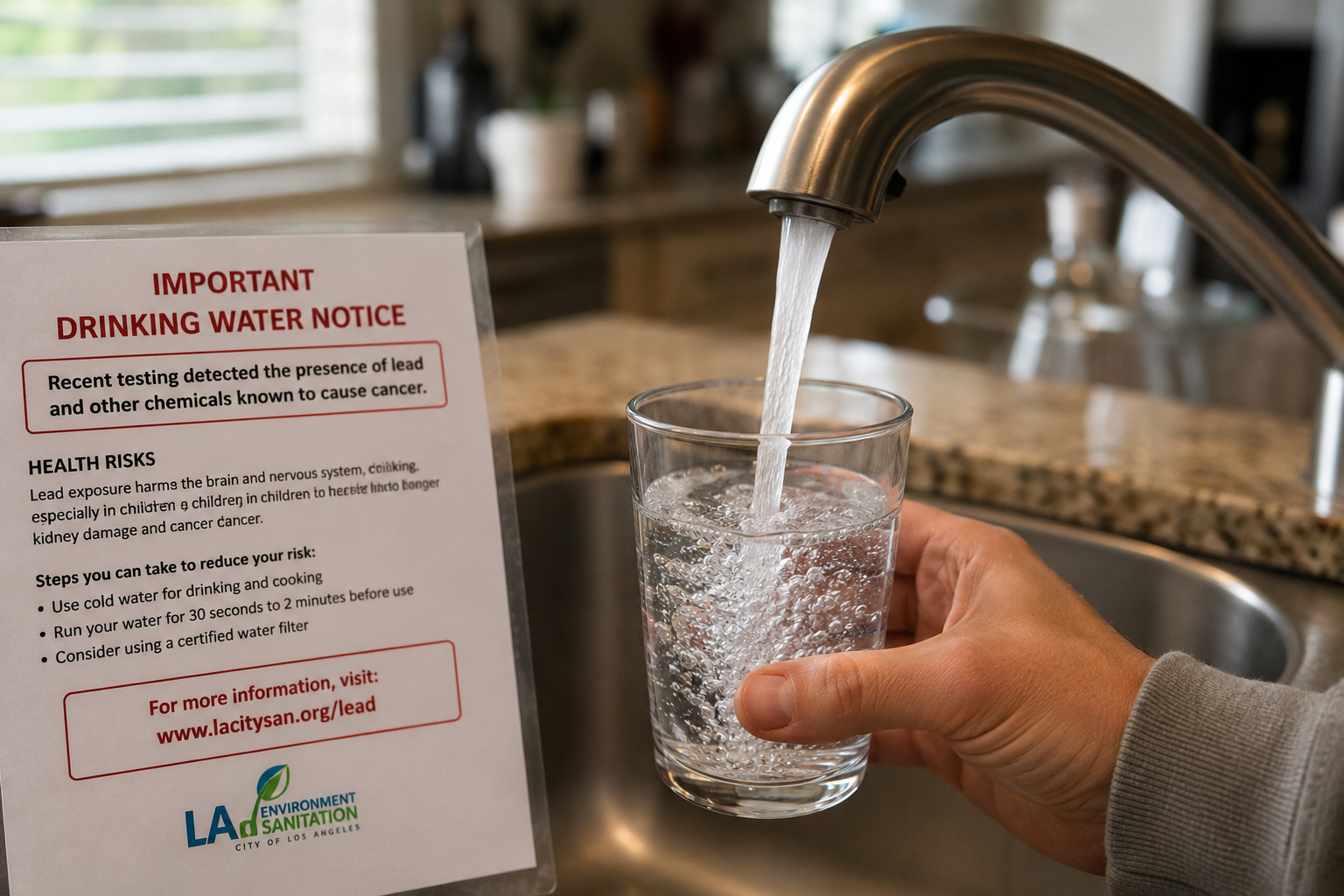
LOS ANGELES — In a unanimous 10-0 vote that sent shockwaves through City Hall, the Los Angeles City Council has demanded an immediate investigation by the Department of Water and Power (LADWP) and the city’s Housing Authority after samples of drinking water in the Watts neighborhood were found to contain elevated levels of lead. The discovery has drawn national comparisons to Flint, Michigan — where a decade-long water contamination crisis poisoned a generation of children — and has raised urgent questions about the safety of tap water across one of America’s largest and most densely populated cities.
An analysis of LADWP’s own 2026 water quality data, reviewed by the Environmental Working Group (EWG), reveals a troubling picture: several contaminants are present at levels that exceed the EWG’s health guidelines, even if they remain within the EPA’s more permissive regulatory limits. The distinction matters enormously for public health — particularly for children, pregnant women, and communities with the least access to filtered or bottled water alternatives.
Lead in Watts: The Crisis That Triggered a City Council Vote
The Watts neighborhood — one of Los Angeles’s most historically marginalized communities, with a majority-Black and Latino population — has experienced chronic environmental health challenges for decades. The discovery of lead in tap water samples collected from Watts public housing units was not entirely surprising to residents who have complained about water quality for years. What was surprising was the speed and unanimity of the City Council’s response: a 10-0 vote demanding emergency action.
Lead is a potent neurotoxin. There is no safe level of lead exposure for children, according to the CDC, which lowered its reference blood lead level threshold to 3.5 micrograms per deciliter (mcg/dL) in 2021 — acknowledging that even previously “acceptable” levels cause measurable cognitive and developmental harm. For children under 6, whose brains are still developing, lead exposure causes irreversible reductions in IQ, increased impulsivity and aggression, and long-term learning disabilities.
The primary suspected source of the lead in Watts’s water is aging infrastructure: lead service lines and lead solder in the plumbing of older buildings. Many housing units in Watts were constructed before 1978, the year lead-based paint was banned nationally, and before the widespread replacement of lead plumbing. When water sits in lead pipes overnight, it leaches the metal, delivering it straight to the morning’s first glass or the baby’s formula.
Beyond Lead: Chromium-6 and PFAS in LA’s Water Supply
Lead is not the only contaminant of concern in Los Angeles’s water. The LADWP’s 2026 water quality data shows that Chromium-6 — the carcinogenic industrial chemical made internationally infamous by the Erin Brockovich case — has been detected in LADWP water at levels below California’s proposed regulatory standard of 10 parts per billion (ppb), but significantly above the EWG’s health guideline of 0.02 ppb, which is based on National Toxicology Program studies linking chromium-6 to gastrointestinal tumors.
The sources of chromium-6 in LA’s water include natural chromium in the geology of Eastern Sierra source water areas, historical industrial use of chromium compounds in the San Fernando Valley, and regional industrial contamination that has leached into groundwater. Standard activated carbon filters — like Brita pitchers used by millions of Americans — do not remove chromium-6. Only reverse osmosis or anion exchange resin filtration systems are effective.
PFAS (per- and polyfluoroalkyl substances, commonly called “forever chemicals”) contamination is also a growing concern in the greater LA region, particularly in groundwater sources in the San Gabriel and San Fernando Valleys. PFAS are associated with kidney cancer, thyroid disease, immune suppression, and developmental harm in children. For more information on PFAS in drinking water, visit the EPA PFAS resource page.
Who Is Most at Risk — and What They Can Do
The residents most at risk from LA’s water quality issues are those who lack the economic resources to purchase bottled water, install filtration systems, or move to neighborhoods with newer plumbing. That demographic overwhelmingly overlaps with the populations already bearing the greatest burden of environmental harm in Los Angeles: low-income communities of color in South LA, East LA, and the San Fernando Valley.
For residents concerned about lead exposure specifically, the following precautions are recommended by the Los Angeles County Department of Public Health and the EPA:
• Use only cold tap water for drinking, cooking, and making baby formula. Hot water leaches more lead from pipes.
• Flush your tap for at least 30 seconds to 2 minutes before using it for the first time each morning, or after extended periods of non-use.
• Consider installing an NSF-certified water filter rated specifically for lead removal. Pitcher-style filters (Brita, Pur) do NOT reliably remove lead. Look for filters certified under NSF Standard 53.
• Have children under 6 and pregnant women tested for blood lead levels. Talk to your pediatrician or call the LA County Department of Public Health.
Residents can also request a free lead-in-water test kit from the LA County Department of Public Health. More information is available at publichealth.lacounty.gov.
Conclusion: The Watts Crisis Is a Preview of a Citywide Reckoning
The Watts water contamination episode is not an isolated plumbing problem. It is a symptom of a systemic failure to prioritize infrastructure investment in communities that have long been told their concerns would be addressed “eventually.” Flint, Michigan waited years for “eventually.” The lesson from Flint — that regulatory compliance thresholds protect utilities, not people — must not be repeated in Los Angeles. The EWG’s data makes clear that LA’s water contains chemicals that exceed science-based health guidelines even when they technically comply with EPA rules.
A city as wealthy and as large as Los Angeles has both the resources and the obligation to close the gap between what the law permits and what public health demands. The unanimous City Council vote is a first step. The work of actually replacing aging lead lines, upgrading filtration, and ensuring equitable access to clean water for all 4 million residents of the city is the much harder task that lies ahead.
RELATED ON MEDICALDAILY.COM
• What Are PFAS “Forever Chemicals” and Why Are They in Your Drinking Water?
• Lead Exposure in Children: The Invisible Epidemic Still Harming American Kids
• Chromium-6 in Drinking Water: A National Problem with Local Consequences