Tag: Ideal

  • Ideal vs. Normal Cholesterol Levels 

    Ideal vs. Normal Cholesterol Levels 

    Having a “normal” cholesterol level in a society where it’s normal to die from a heart attack isn’t necessarily a good thing.

    “Consistent evidence” from a variety of sources “unequivocally establishes” that so-called bad LDL cholesterol causes atherosclerotic cardiovascular disease—strokes and heart attacks, our leading cause of death. This evidence base includes hundreds of studies involving millions of people. “Cholesterol is the cause of atherosclerosis,” the hardening of the arteries, and “the message is loud and clear.” “It’s the Cholesterol, Stupid!” noted the editor of the American Journal of Cardiology, William Clifford Roberts, whose CV is more than 100 pages long as he has published about 1,700 articles in peer-reviewed medical literature. Yes, there are at least ten traditional risk factors for atherosclerosis, as seen below and at 1:11 in my video How Low Should You Go for Ideal LDL Cholesterol?, but, as Dr. Roberts noted, only one is required for the progression of the disease: elevated cholesterol.

    Your doctor may have just told you that your cholesterol is normal, so you’re relieved. Thank goodness! But, having a “normal” cholesterol level in a society where it’s normal to have a fatal heart attack isn’t necessarily good. With heart disease, the number one killer of men and women, we definitely don’t want to have normal cholesterol levels; we want to have optimal levels—and not optimal by current laboratory standards, but optimal for human health.

    Normal LDL cholesterol levels are associated with the hidden buildup of atherosclerotic plaques in our arteries, even in those who have so-called “optimal risk factors by current standards”: blood pressure under 120/80, normal blood sugars, and total cholesterol under 200 mg/dL. If you went to your doctor with those kinds of numbers, you’d likely get a gold star and a lollipop. But, if your doctor used ultrasound and CT scans to actually peek inside your body, atherosclerotic plaques would be detected in about 38% of individuals with those kinds of “optimal” numbers.

    Maybe we should define an LDL cholesterol level as optimal only when it no longer causes disease. What a concept! When more than a thousand men and women in their 40s were scanned, having an LDL level under 130 mg/dL left them with atherosclerosis throughout their body, and that’s a cholesterol level at which most lab tests would consider normal.

    In fact, atherosclerotic plaques were not found with LDL levels down around 50 or 60, which just so happens to be the levels most people had “before the introduction of western lifestyles.” Indeed, before we started eating a typical American diet, “the majority of the adult population of the world had LDLs of around 50 mg per deciliter (mg/dL)”—so that’s the true normal. “Present average values…should not be regarded as ‘normal.’” We don’t want to have a normal cholesterol based on a sick society; we want a cholesterol that is normal for the human species, which may be down around 30 to 70 mg/dL or 0.8 to 1.8 mmol/L.

    “Although an LDL level of 50 to 70 mg/dl seems excessively low by modern American standards, it is precisely the normal range for individuals living the lifestyle and eating the diet for which we are genetically adapted.” Over millions of years, “through the evolution of the ancestors of man,” we’ve consumed a diet centered around whole plant foods. No wonder we have a killer epidemic of atherosclerosis, given the LDL level “we were ‘genetically designed for’ is less than half of what is presently considered ‘normal.’”

    In medicine, “there is an inappropriate tendency to accept small changes in reversible risk factors,” but “the goal is not to decrease risk but to prevent atherosclerotic plaques!” So, how low should you go? “In light of the latest evidence from trials exploring the benefits and risks of profound LDLc lowering, the answer to the question ‘How low do you go?’ is, arguably, a straightforward ‘As low as you can!’” “‘Lower’ may indeed be better,” but if you’re going to do it with drugs, then you have to balance that with the risk of the drug’s side effects.

    Why don’t we just drug everyone with statins, by putting them in the water supply, for instance? Although it would be great if everyone’s cholesterol were lower, there are the countervailing risks of the drugs. So, doctors aim to use statin drugs at the highest dose possible, achieving the largest LDL cholesterol reduction possible without increasing risk of the muscle damage the drugs may cause. But when you’re using lifestyle changes to bring down your cholesterol, all you get are the benefits.

    Can we get our LDL low enough with diet alone? Ask some of the country’s top cholesterol experts what they shoot for, “and the odds are good that many will say 70 or so.” So, yes, we should try to avoid the saturated fats and trans fats found in junk foods and meat, and the dietary cholesterol found mostly in eggs, but “it is unlikely anyone can achieve an LDL cholesterol level of 70 mg/dL with a low-fat, low-cholesterol diet alone.” Really? Many doctors have this mistaken impression. An LDL of 70 isn’t only possible on a healthy enough diet, but it may be normal. Those eating strictly plant-based diets can average an LDL that low, as you can see here and at 5:28 in my video.

    No wonder plant-based diets are the only dietary patterns ever proven to reverse coronary heart disease in a majority of patients. And their side effects? You get to feel better, too! Several randomized clinical trials have demonstrated that more plant-based dietary patterns significantly improve psychological well-being and quality of life, with improvements in depression, anxiety, emotional well-being, physical well-being, and general health.

    For more on cholesterol, see the related posts below.



    Source link

  • Feeling Groggy After A Full Night’s Sleep? A Doctor Explains Simple Math To Find Your Ideal Bedtime

    Feeling Groggy After A Full Night’s Sleep? A Doctor Explains Simple Math To Find Your Ideal Bedtime

    You get a full night’s sleep but still wake up feeling groggy, while a short nap leaves you feeling refreshed. Ever wondered why? It could be because your sleep schedule is disrupting your body’s natural rhythm, either by going to bed at the wrong time or waking up in the middle of a sleep cycle.

    It’s not just about going to bed earlier; it’s about syncing your sleep schedule with your body’s natural sleep cycle, suggests Dr. Charles Puza, a New York City dermatologist who shares sleep tips on Instagram.

    “Ever wake up from 8+ hours of sleep and still feel groggy? It’s because you’re going to bed and waking up at the wrong time. You should be timing your sleep to align with natural sleep cycles of around 90 minutes,” Dr. Puza wrote in a recent Instagram post.

    While getting eight hours of sleep is important, researchers also suggest that the timing of your bedtime and waking up after completing natural sleep cycles are key to feeling truly rested.

    Natural sleep cycles last around 90 minutes, and throughout a typical night’s sleep of 7.5 hours, we go through about five full cycles. Each cycle includes different stages, from light sleep to deep rest. To feel refreshed after a night’s sleep, a person needs to have complete undisturbed stages of these cycles.

    However, when you go to bed late and depend on an alarm to wake up at a set time, you might be interrupting the cycles, preventing you from reaching deep sleep stages, essential for feeling truly rested. This disruption results in fragmented sleep, which has been linked to a range of negative effects, from increased stress and mood swings to poor overall health and well-being.

    To avoid this, it’s crucial to understand your body’s ideal bedtime that aligns with the natural sleep cycle. Dr. Puza offers a simple formula for those looking to get a restful night’s sleep:

    “You need to decide if you need five cycles or six cycles of sleep overnight. Factor in about 15 minutes to fall asleep,” he said.

    For those wanting five cycles need to simply subtract 7h45m others or 9h15m from your wake-up time to find your ideal bedtime.


    Source link

  • An Ideal Waist Size 

    An Ideal Waist Size 

    The book Dieting Makes You Fat was published originally in the 1980s and then repeatedly republished. Since most people who lose weight go on to regain it, there is a concern that there may be adverse health consequences of “yo-yo dieting.” This idea emerged from animal studies that, for example, showed the detrimental effects of starving and refeeding obese rats. This captured the media’s attention, leading to “a pervasive view found in many media outlets” about “the ‘dangers’ of weight cycling,” discouraging people from even trying to lose weight.

    But even the animal data are inconclusive. For example, weight-cycling mice make them live longer. Most importantly, a review of the human data concluded that “evidence for an adverse effect of weight cycling appears sparse if it exists at all.” Bottom line? “Yo-Yo Dieting Is Better than None.”

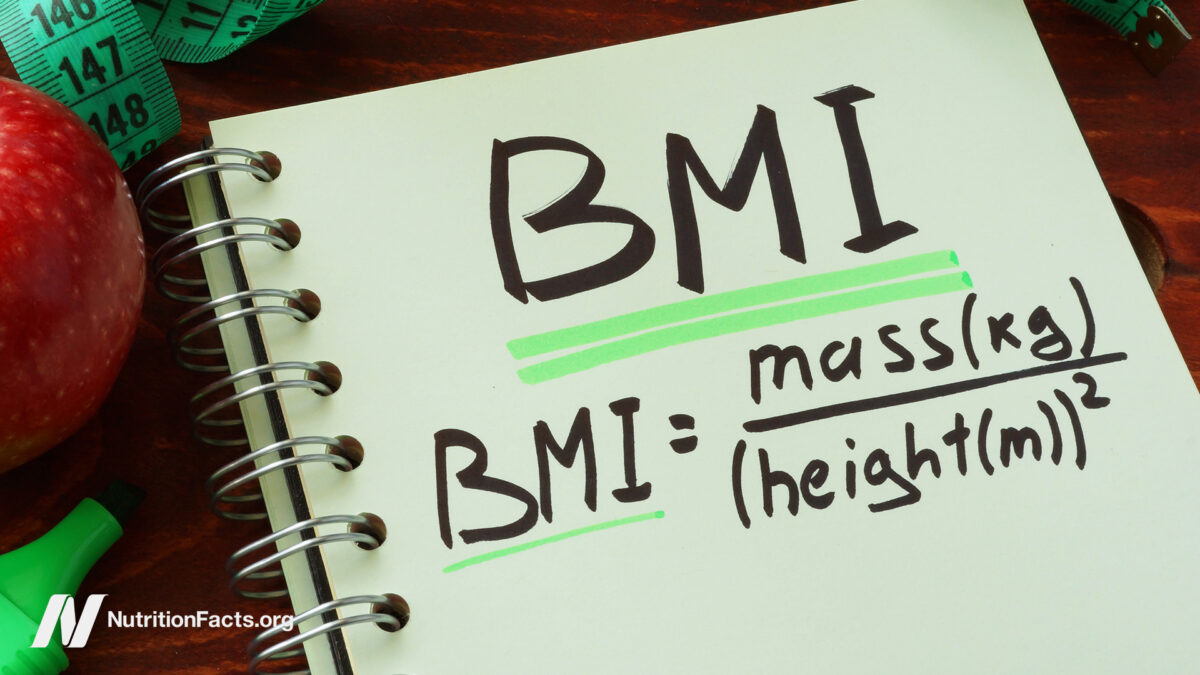
    Ideally, we’d be at a body mass index (BMI) of 20 to 22. (You can see a unisex BMI chart below and at 1:05 of my video What’s the Ideal Waist Size?.) However, BMI doesn’t take into account the composition of the weight. Bodybuilders are heavy for their height, for instance, yet can be extremely lean. The gold standard measure of obesity is body fat percentage, but an accurate calculation can be complicated and expensive. All you need to measure BMI is height and weight, but it may underestimate the true prevalence of obesity. 

    The World Health Organization defines obesity as a body fat percentage above 25 percent in men or 35 percent in women. At a BMI of 25, which is considered just barely overweight, body fat percentages in a representative sample of U.S. adults varied from 14 percent to 35 percent in men and 26 to 43 percent in women. So, you could be at a “normal” weight but actually obese. Using the BMI cutoff for obesity, only about one in five Americans was obese in the 1990s, but based on their body fat, the true proportion even back then was closer to 50 percent. Half of Americans are not just overweight, but obese. 

    So, using only BMI, doctors may misclassify more than half “of patients with excess body fat as being normal or just overweight and…miss an opportunity to intervene and reduce health risk in such individuals.” What’s important is not the label, though, but the health consequences. Ironically, BMI appears to be an even better predictor of cardiovascular disease death than body fat percentage. That suggests that excess weight from any source—whether fat or lean—may not be healthy in the long run. The lifespan of bodybuilders does seem to be cut short. They have about a one-third higher mortality rate than the general population. The average age of death is around 48 years, but this may be due in part to the toxic effects of anabolic steroids on the heart, as shown below and at 2:57 in my video

    Pre-eminent nutritional physiologist Ancel Keys (after which “K-rations” were named) suggested the mirror method: “If you really want to know whether you are obese, just undress and look at yourself in the mirror. Don’t worry about our fancy laboratory measurements; you’ll know!” All fat is not the same, though. There is the pinchable superficial flab that we may see jiggling about our body, and then there’s the riskier, deeper visceral fat that coils around and infiltrates our internal organs. Measuring BMI is simple, cheap, and effective, but it does not take into account the distribution of fat on the body, whereas waist circumference can provide a measure of the deep underlying belly fat.

    Both BMI and waist circumference can be used to predict the risk of death due to excess body fat, but, as you can see below and at 3:53 in my video, even at the same BMI, there appears to be nearly a straight-line increase in mortality risk with widening waistlines. Someone who has “normal-weight central obesity”—meaning someone who isn’t overweight, according to their BMI, but is fat around the middle—may have up to twice the risk of dying compared to someone who is obese, according to their height and weight. This is why the current guidance recommends measuring both BMI and waist circumference. This may be especially important for older women. “Between the ages of 25 and 65, the average woman will lose approximately 13 pounds of bone and muscle mass, while her visceral fat will nearly quadruple in size….” (Men tend to only double their visceral fat.) So, even if a woman doesn’t gain any weight according to the bathroom scale, she may be gaining fat. 

    What is the waistline cut-off? Increased risk of metabolic complications starts at an abdominal circumference of 31.5 inches (80 cm) in women and 37 inches (94 cm) in most men, though it is closer to 35.5 inches (90 cm) for South Asian, Chinese, and Japanese men. The benchmark for substantially increased risk starts at about 34.5 inches (88 cm) for women and 40 inches (102 cm) for men. Once you get above an abdominal circumference of about 43 inches (110 cm) in men, mortality rates shoot up about 50 percent compared to men with 8-inch-smaller (20-cm-smaller) stomachs, and women suffer 80 percent greater mortality risk with waists of 37.5 inches (95 cm) compared to 27.5 inches (70 cm). The reading of a measuring tape may translate into years of one’s lifespan. 

    The good news is the riskiest fat is the easiest to lose. Our body appears smart enough to preferentially shed the villainous visceral fat first. Although it may take losing as much as 20 percent of our weight to realize significant improvements in quality of life for most individuals with severe obesity, disease risk drops almost immediately. At 3 percent weight loss, which is only 6 pounds (2.7 kg) for someone weighing 200 pounds (91 kg), for instance, blood sugar control and triglycerides start to improve. At 5 percent, blood pressure and cholesterol improve. Our risk of developing diabetes may be cut in half by just a 5 percent weight loss, about 10 pounds (4.5 kg) for someone starting at 200 pounds (91 kg), for instance.

    This is the final video in this series on obesity and weight. If you missed any of the others, see related posts below.

    I cover all of this and more at length in my book How Not to Diet, and its companion, The How Not to Diet Cookbook, has more than 100 delicious Green-Light recipes that incorporate some of my 21 Tweaks for the acceleration of body fat loss. 


    Source link

  • An Ideal BMI 

    An Ideal BMI 

    Is there a unisex chart for optimal weight based on height?

    We seem to have become inured to the mortal threat of obesity. If you go back in the medical literature almost a quarter of a century ago when obesity wasn’t run-of-the-mill, the descriptions are much grimmer: “Obesity is always tragic, and its hazards are terrifying.” Not just obesity, though. Of the four million deaths attributed to excess body fat each year, nearly 40 percent of the victims are overweight, not obese. According to two famous Harvard studies, weight gain of as little as 11 pounds (5 kg) from early adulthood through middle age increases the risk of major chronic diseases, such as diabetes, cardiovascular disease, and cancer. The flip side, though, is that even modest weight loss can have major health benefits.

    What is the optimal body mass index, commonly known as BMI? The largest studies in the United States and around the world found that having a BMI of 20 to 25 is associated with the longest lifespan. Put all the best available studies with the longest follow-up together, and that can be narrowed down even further to a BMI of 20 to 22. That would be about 124 to 136 pounds (56 to 62 kg) for someone who’s five-foot-six (168 cm), as you can see below and at 1:22 in my video What’s the Ideal BMI?.

    Even within a “normal” BMI range, the risk of developing chronic diseases, such as type 2 diabetes, heart disease, and several types of cancer, starts to rise towards the upper end—starting as low as a BMI of 21. BMIs of 18.5 and 24.5 are both considered to be within the “normal” range, but a BMI of 24.5 may be associated with twice the risk of heart disease compared to a BMI of 18.5. 

    Below and at 2:05 in my video is a graph of diabetes risk and BMI among women. There is a fivefold difference in diabetes rates within the so-called ideal range with a BMI under 25.

    Just as there are gradations of risk within a normal BMI range, there is a spectrum within obesity. Class III obesity (BMI over 40) can be associated with the loss of a decade or more of life. At a BMI above 45, for example, a person standing at 5’6″ (168 cm) and weighing 280 pounds (127 kg), life expectancy may shrink to that of a cigarette smoker. 

    However, “skeptics have argued that the consequences of rising obesity levels have either been greatly exaggerated or are unclear.” A “motley crew,” “obesity skeptics are made up of a kaleidoscope of interest groups…includ[ing] feminists, queer theorists, libertarians, far right-wing conspiracy types and new ageists.” It “has also been popular on far right-wing, pro-gun, pro-America websites where the idea that obesity alarmists are nanny-state communists who simply want to stop us from having fun plays well….”

    Unlike activists who organized to raise consciousness and stamp out the AIDS epidemic, for example, some in the size acceptance movement appear to have the opposite goal and “have called for less public awareness and intervention regarding obesity,” less treatment of the problem. I’m all for fighting size stigma and discrimination—I have a whole section on weight stigma in my book How Not to Diet—but the adverse health consequences of obesity are an established scientific fact.

    Can’t you be fat but fit? In a study of more than 600 centenarians, only about 1 percent of the women and not a single one of the men were obese. There does appear to be a rare subgroup of individuals who are obese and do not suffer the typical metabolic costs, such as high blood pressure and cholesterol. This raises the possibility that there may be such a thing as “benign obesity” or “metabolically healthy obesity.” It may just be a matter of time, though, before the risk factors develop. Even if they don’t, though, when followed long enough, even “metabolically healthy obese adults” are at increased risk of diabetes, as well as increased risk of fatty liver disease. They are also at greater risk of cardiovascular events, such as heart attacks, and/or premature death, as shown below and at 4:20. 

    Bottom line? There is “strong evidence that ‘healthy obesity’ is a myth.”

    Many “fat activists” try to downplay the risks of obesity, even as they may be among “the greatest victims” of the epidemic. “Leading fat acceptance activist Lynn McAfee, who is director of medical advocacy for the Council on Size and Weight Discrimination and takes part in obesity conferences and government panels on obesity,” is quoted as saying, “‘I’m not actually particularly that interested in [health] and God I hate science….”

    If you missed the previous blog posts in this series on obesity, see related posts below.

    The final video in this series is What’s the Ideal Waist Size?.


    Source link

  • Know Ideal Waist Size If You’ve Diabetes

    Know Ideal Waist Size If You’ve Diabetes

    Fat deposition around the waistline is often considered a risk factor for those with diabetes. But does a smaller waistline always indicate better health? Researchers have found that, in some cases, a larger waist circumference might actually help reduce mortality risk for people with diabetes.

    After examining survival data of around 6,600 U.S. adults from the National Health and Nutrition Examination Survey (NHANES) with diabetes, researchers of a recent study found that the relationship between waist circumference and the risk of death is not linear. This means the risk changes in a more complex pattern, depending on factors like gender.

    For women with diabetes, the link between waist size and risk of death follows a U-shape, with the lowest risk at about 42 inches (107 cm), much higher than what is usually considered healthy. However, for each extra centimeter above this, the risk of death increased by 4%, and for each centimeter below, the risk increased by 3%.

    In men, the curve is J-shaped, with the lowest risk of death at about 35 inches (89cm). The risk increases by 6% for each centimeter below this threshold and 3% for each centimeter above it. The findings were published in Chronic Metabolic Disease.

    However, according to current clinical guidelines, a waist circumference of 35 inches (88 cm) is considered central obesity for women, while for men, it’s 40 inches (102 cm).

    The researchers hence believe that their findings suggest a phenomenon called the “obesity paradox.” The concept refers to the idea that, in some cases, being overweight or having a higher body fat percentage than normal might offer some protective benefits.

    However, the findings do not mean that having a larger waistline is always better, and the researchers do not suggest all diabetic patients gain weight around the waistline. It is important to note that the study only focused on how the waistline affects mortality risk in diabetes patients without considering other health outcomes. Also, since the study is observational it has not established a cause-and-effect relationship between waist circumference and risk of death.

    “Further research is needed to explore the underlying mechanisms rather than promoting preconceived notions about an optimal waist circumference,” the researchers wrote.

    Source link