Tag: Drinking

  • HEALTH ALERT: Los Angeles Drinking Water Tested Positive for Lead and Cancer-Linked Chemicals — City Council Demands Emergency Investigation

    HEALTH ALERT: Los Angeles Drinking Water Tested Positive for Lead and Cancer-Linked Chemicals — City Council Demands Emergency Investigation

    LOS ANGELES — In a unanimous 10-0 vote that sent shockwaves through City Hall, the Los Angeles City Council has demanded an immediate investigation by the Department of Water and Power (LADWP) and the city’s Housing Authority after samples of drinking water in the Watts neighborhood were found to contain elevated levels of lead. The discovery has drawn national comparisons to Flint, Michigan — where a decade-long water contamination crisis poisoned a generation of children — and has raised urgent questions about the safety of tap water across one of America’s largest and most densely populated cities.

    An analysis of LADWP’s own 2026 water quality data, reviewed by the Environmental Working Group (EWG), reveals a troubling picture: several contaminants are present at levels that exceed the EWG’s health guidelines, even if they remain within the EPA’s more permissive regulatory limits. The distinction matters enormously for public health — particularly for children, pregnant women, and communities with the least access to filtered or bottled water alternatives.

    Lead in Watts: The Crisis That Triggered a City Council Vote

    The Watts neighborhood — one of Los Angeles’s most historically marginalized communities, with a majority-Black and Latino population — has experienced chronic environmental health challenges for decades. The discovery of lead in tap water samples collected from Watts public housing units was not entirely surprising to residents who have complained about water quality for years. What was surprising was the speed and unanimity of the City Council’s response: a 10-0 vote demanding emergency action.

    Lead is a potent neurotoxin. There is no safe level of lead exposure for children, according to the CDC, which lowered its reference blood lead level threshold to 3.5 micrograms per deciliter (mcg/dL) in 2021 — acknowledging that even previously “acceptable” levels cause measurable cognitive and developmental harm. For children under 6, whose brains are still developing, lead exposure causes irreversible reductions in IQ, increased impulsivity and aggression, and long-term learning disabilities.

    The primary suspected source of the lead in Watts’s water is aging infrastructure: lead service lines and lead solder in the plumbing of older buildings. Many housing units in Watts were constructed before 1978, the year lead-based paint was banned nationally, and before the widespread replacement of lead plumbing. When water sits in lead pipes overnight, it leaches the metal, delivering it straight to the morning’s first glass or the baby’s formula.

    Beyond Lead: Chromium-6 and PFAS in LA’s Water Supply

    Lead is not the only contaminant of concern in Los Angeles’s water. The LADWP’s 2026 water quality data shows that Chromium-6 — the carcinogenic industrial chemical made internationally infamous by the Erin Brockovich case — has been detected in LADWP water at levels below California’s proposed regulatory standard of 10 parts per billion (ppb), but significantly above the EWG’s health guideline of 0.02 ppb, which is based on National Toxicology Program studies linking chromium-6 to gastrointestinal tumors.

    The sources of chromium-6 in LA’s water include natural chromium in the geology of Eastern Sierra source water areas, historical industrial use of chromium compounds in the San Fernando Valley, and regional industrial contamination that has leached into groundwater. Standard activated carbon filters — like Brita pitchers used by millions of Americans — do not remove chromium-6. Only reverse osmosis or anion exchange resin filtration systems are effective.

    PFAS (per- and polyfluoroalkyl substances, commonly called “forever chemicals”) contamination is also a growing concern in the greater LA region, particularly in groundwater sources in the San Gabriel and San Fernando Valleys. PFAS are associated with kidney cancer, thyroid disease, immune suppression, and developmental harm in children. For more information on PFAS in drinking water, visit the EPA PFAS resource page.

    Who Is Most at Risk — and What They Can Do

    The residents most at risk from LA’s water quality issues are those who lack the economic resources to purchase bottled water, install filtration systems, or move to neighborhoods with newer plumbing. That demographic overwhelmingly overlaps with the populations already bearing the greatest burden of environmental harm in Los Angeles: low-income communities of color in South LA, East LA, and the San Fernando Valley.

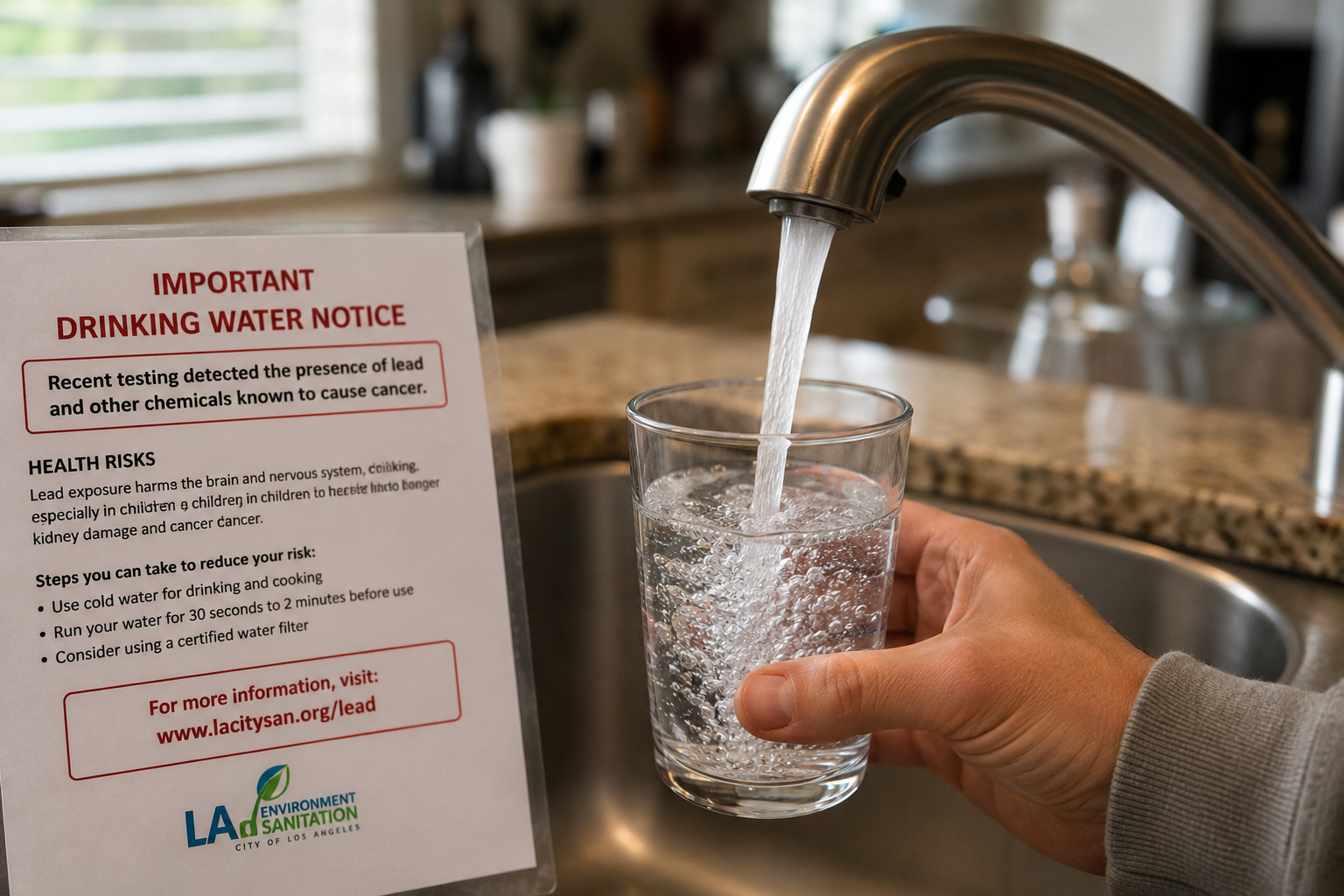
    For residents concerned about lead exposure specifically, the following precautions are recommended by the Los Angeles County Department of Public Health and the EPA:

    • Use only cold tap water for drinking, cooking, and making baby formula. Hot water leaches more lead from pipes.

    • Flush your tap for at least 30 seconds to 2 minutes before using it for the first time each morning, or after extended periods of non-use.

    • Consider installing an NSF-certified water filter rated specifically for lead removal. Pitcher-style filters (Brita, Pur) do NOT reliably remove lead. Look for filters certified under NSF Standard 53.

    • Have children under 6 and pregnant women tested for blood lead levels. Talk to your pediatrician or call the LA County Department of Public Health.

    Residents can also request a free lead-in-water test kit from the LA County Department of Public Health. More information is available at publichealth.lacounty.gov.

    Conclusion: The Watts Crisis Is a Preview of a Citywide Reckoning

    The Watts water contamination episode is not an isolated plumbing problem. It is a symptom of a systemic failure to prioritize infrastructure investment in communities that have long been told their concerns would be addressed “eventually.” Flint, Michigan waited years for “eventually.” The lesson from Flint — that regulatory compliance thresholds protect utilities, not people — must not be repeated in Los Angeles. The EWG’s data makes clear that LA’s water contains chemicals that exceed science-based health guidelines even when they technically comply with EPA rules.

    A city as wealthy and as large as Los Angeles has both the resources and the obligation to close the gap between what the law permits and what public health demands. The unanimous City Council vote is a first step. The work of actually replacing aging lead lines, upgrading filtration, and ensuring equitable access to clean water for all 4 million residents of the city is the much harder task that lies ahead.

    RELATED ON MEDICALDAILY.COM

    Flint Happened There. Now It’s Los Angeles: The Ongoing Lead and Toxic Chemical Crisis in LA’s Drinking Water

    What Are PFAS “Forever Chemicals” and Why Are They in Your Drinking Water?

    Lead Exposure in Children: The Invisible Epidemic Still Harming American Kids

    Chromium-6 in Drinking Water: A National Problem with Local Consequences

    Source link

  • RFK Jr. Admits Removing Fluoride From Drinking Water Will ‘Probably’ Lead to More Cavities in Children

    RFK Jr. Admits Removing Fluoride From Drinking Water Will ‘Probably’ Lead to More Cavities in Children

    Health Secretary Robert F. Kennedy Jr. admitted that one of the points on his agenda, removing fluoride from water supplies across the nation, would “probably” result in more Americans getting cavities hence worsening dental health in the United States.

    Kennedy appeared on Fox News with Oklahoma Governor Kevin Stitt on Thursday in conversation with host Harris Faulkner. The two were hosting an event at the Oklahoma State Capitol in Oklahoma City on the same day in order to begin the “Make Oklahoma Healthy Again” campaign focused on promoting “common-sense health policies, medical freedom, and a return to personal responsibility.”


    “On the issue of fluoride, what has been the response from dentists in America who may be concerned that some children in lower incomes in particular don’t get those dental preventative situations where they can go in and get their teeth indemnified and treated against cavities?” Faulkner asked.

    “Well, people will still get indemnified for it, to the extent that they are already indemnified. But you know, it is an issue. It’s a balance. You’re gonna see probably slightly more cavities, although in Europe, where they banned fluoride, they did not see an uptick in cavities. The issue is, parents need to decide, because science is very clear on fluoride,” Kennedy responded.

    Social media users quickly took to online platforms to ridicule the Health Secretary’s rhetoric.

    “Fluoride is safe and effective. RFK has no medical or Dental background that makes him an expert on Fluoride,” wrote one.


    “On the downside there will be more cavities but on the upside there will be… um actually there is no upside,” joked another.


    “More cavities for kids in families who can’t afford dental care. And neglected cavities can cause other health issues with infections etc, not to mention leading to the need for more serious and expensive dental work…” noted a third.


    “So they admit that taking out fluoride is bad, yet they’ll still do it. Morons,” said a fourth.


    “Some dentists are excited. They will have a lot more business soon,” said another.


    The American Dental Association has reiterated their support for fluoridating water supplies after RFK Jr. announced his intention to direct the Centers for Disease Control and Prevention to denounce water fluoridation.

    “As dentists, we see the direct consequences fluoride removal has on our patients and it’s a real tragedy when policymakers’ decisions hurt vulnerable kids and adults in the long term. Blindly calling for a ban on fluoridated water hurts people, costs money, and will ultimately harm our economy,” said ADA President Brett Kessler, D.D.S.

    Originally published on Latin Times


    Source link

  • HydroLean XT – Drinking To Your Health

    HydroLean XT – Drinking To Your Health

    Product Name: HydroLean XT – Drinking To Your Health

    Click here to get HydroLean XT – Drinking To Your Health at discounted price while it’s still available…

    All orders are protected by SSL encryption – the highest industry standard for online security from trusted vendors.

    HydroLean XT – Drinking To Your Health is backed with a 60 Day No Questions Asked Money Back Guarantee. If within the first 60 days of receipt you are not satisfied with Wake Up Lean™, you can request a refund by sending an email to the address given inside the product and we will immediately refund your entire purchase price, with no questions asked.

    (more…)

  • Rare Water Allergy Causes Excruciating Pain For Woman—From Drinking To Showering, She Shares Her Daily Struggle

    Rare Water Allergy Causes Excruciating Pain For Woman—From Drinking To Showering, She Shares Her Daily Struggle

    You may never realize how often water touches our lives until you have a disorder like the 25-year-old young mother from the U.K. who describes simple daily activities such as washing hands, drinking water, or taking a bath as “excruciatingly painful”.

    An extremely rare condition called aquagenic urticaria makes the life of Kendall Bryce, from Durham, UK, a real struggle. As a young mother of one, pregnant with her second child, she finds it difficult to take care of herself and or her child while battling the condition.

    “I’ve never been able to give my one-year-old son a bath. My mom has to do it for me. And I even feel my throat burning when I drink water,” she said.

    “It really is a daily struggle. I can only have a bath or take a shower twice a week because of how excruciating the pain is, so I constantly worry I stink,” said Bryce.

    Bryce’s condition began when she was just 15 when she started noticing hives after she took a bath. But little did she realize that was the beginning of her battle with water allergy until she was diagnosed with the condition four years back.

    “The GP didn’t have a clue what to do. It’s just such a rare condition, so not many people have it and not many people know about it,” Bryce recalled, still living with the constant pain. The pain is so severe that her body sometimes goes into shock.

    “My life is dictated by the weather as I have to avoid rain — and even hot humid days. I check the forecast every day and stay home if it’s raining or going to rain, but if I get caught out by surprise, my body reacts and it’s really painful,” she added.

    There is currently no cure for water allergy, but treatment options are available to manage the symptoms. Treatments include the use of oral antihistamines, topical medications like creams or emulsions, phototherapy using artificial UV light, and sometimes other medications like asthma drugs, anabolic steroids, or SSRIs.

    While pregnant, Bryce’s treatment options are however limited. “They’ve tried lots of different medications but I kept reacting. I still haven’t found something that helps,” Bryce said. However, she hopes that by sharing her story, she might connect with someone who knows how to treat her condition.

    Source link

  • Is Your Drinking Water Safe? This Metal In Your Supply May Pose Cancer Risk

    Is Your Drinking Water Safe? This Metal In Your Supply May Pose Cancer Risk

    With the rise in cancer diagnoses, it’s high time we pay attention to what we consume daily, including food and water. Could your drinking water be a source of exposure to carcinogenic metals? A recent study conducted in Texas found that even low levels of arsenic in water, below the regulatory threshold of 10 parts per billion, could pose health risks, including an increased risk of kidney cancer.

    In the latest study, researchers from the Texas A&M University School of Public Health investigated the link between arsenic levels in drinking water and kidney cancer rates across 240 Texas counties. Arsenic is naturally present in groundwater in Texas and other regions.

    Kidney cancer is the seventh most common cancer in the U.S. It has an age-adjusted incidence rate of 17.2 per 100,000 people from 2017 to 2021. Several factors can increase the risk, including being male, African American, or having a family history of the disease. In addition, lifestyle choices such as smoking, alcohol use, and obesity, along with health conditions like high blood pressure, diabetes, and advanced kidney disease, can elevate the risk. Studies also show that exposure to certain chemicals, such as trichloroethylene, may increase the risk of developing kidney cancer

    The latest study results suggest a dose-response relationship between arsenic in drinking water and kidney cancer, with cancer risk increasing by 4% with each doubling of arsenic levels. The researchers also noted that moderate levels (1–5 ppb) and high levels (>5 ppb) of arsenic exposure raised cancer risk by 6% and 22%, respectively.

    “Some public water systems are poorly managed and could expose customers to arsenic, but the 40 million people in the United States who rely on private wells are particularly vulnerable,” said Taehyun Roh, from the Department of Epidemiology and Biostatistics who was involved in the study.

    “This [study] suggests that even low-level arsenic exposure in drinking water may be associated with an increased risk of kidney cancer, which aligns with previous research indicating an association between this exposure and lung, bladder, and skin cancers,” Roh said.

    The researchers caution that the study establishes associations between factors but does not prove causality. They emphasize the need for future studies to assess the effects of factors such as lifestyle, family history of kidney cancer, and other potential sources of arsenic exposure. However, based on the findings, researchers call for stricter regulation and targeted public health interventions.

    “Our findings indicate that reducing arsenic exposure could reduce the incidence of kidney cancer, and this could be achieved through efforts such as enhanced regulatory oversight and targeted public health interventions,” Nishat Tasnim Hasan, a researcher involved said.

    Source link

  • Drinking Water, Losing Weight 

    Drinking Water, Losing Weight 

    A few times a day, drink two cups of cold water on an empty stomach for weight loss.

    After drinking two cups (half a liter) of water, you can get a surge of the adrenal hormone noradrenaline in your bloodstream, as if you had just smoked a few cigarettes or had a few cups of coffee, boosting your metabolic rate up to 30 percent within an hour, as shown below and at 0:22 in my video Optimizing Water Intake to Lose Weight. When put to the test in randomized controlled trials, that appeared to accelerate weight loss by 44 percent, making drinking water the safest, simplest, and cheapest way to boost your metabolism. 

    Now, this entire strategy may fail if you’re on a beta-blocker drug. (Beta blockers are typically prescribed for heart conditions or high blood pressure and tend to end with the letters lol, such as atenolol, nadolol, or propranolol, sold as Tenormin, Corgard, or Inderal, respectively.) So, for example, as you can see below and at 0:59 in my video, if you give people the beta-blocker drug metoprolol (sold as Lopressor) before they drink their two cups (480 mL) of water, the metabolic boost is effectively prevented. This makes sense since the “beta” being blocked by beta blockers are the beta receptors triggered by noradrenaline. Otherwise, drinking water should work. But what’s the best dose, type, temperature, and timing?

    Just a single cup (240 mL) of water may be sufficient to rev up the noradrenaline nerves, but additional benefit is seen with drinking two or more cups (480 mL). A note of caution: One should never drink more than about three cups (710 mL) in an hour, since that starts to exceed the amount of fluid your kidneys can handle. If you have heart or kidney failure, your physician may not want you to drink extra water at all, but even with healthy kidneys, any more than three cups of water an hour can start to critically dilute the electrolytes in your brain with potentially critical consequences. (In How Not to Diet, I talk about a devastating, harrowing experience I had in the hospital as an intern. A patient drank himself to death—with water. He suffered from a neurological condition that causes pathological thirst. I knew enough to order his liquids to be restricted and have his sink shut off, but I didn’t think to turn off his toilet.)

    Getting back to it. What kind of water are we talking about? Does it have to be plain, regular water? It shouldn’t matter, right? Isn’t water just water whether it’s flavored or sweetened in a diet drink? Actually, it does matter. When trying to prevent fainting before blood donation, drinking something like juice doesn’t work as well as plain water. When trying to keep people from getting dizzy when they stand up, water works, but the same amount of water with salt added doesn’t, as seen below and at 2:40 in my video. What’s going on? 

    We used to think the trigger was stomach distention. When we eat, our body shifts blood flow to our digestive tract, in part by releasing noradrenaline to pull in blood from our limbs. This has been called the gastrovascular reflex. So, drinking water was thought to be a zero-calorie way of stretching our stomachs. But, instead, if we drink two cups (480 mL) of saline (basically salt water), the metabolic boost vanishes, so stomach expansion can’t explain the water effect.

    We now realize our body appears to detect osmolarity, the concentration of stuff within a liquid. When liquids of different concentrations were covertly slipped into people’s stomachs via feeding tubes, detection of plain water versus another liquid was demonstrated by monitoring sweat production, which is a proxy for noradrenaline release. It may be a spinal reflex, as it’s preserved in people who are quadriplegic, or picked up by the liver, as we see less noradrenaline release in liver transplant patients (who’ve had their liver nerves severed). Whichever the pathway, our body can tell. Thought we only had five senses? The current count is upwards of 33.

    In my Daily Dozen recommendation, I rank certain teas as among the healthiest beverages. After all, they have all the water of water with an antioxidant bonus. But, from a weight-loss perspective, plain water may have an edge. That may explain the studies that found that overweight and obese individuals randomized to replace diet beverages with water lost significantly more weight. This was chalked up to getting rid of all those artificial sweeteners, but, instead, it may be that the diet drinks were too concentrated to offer the same water-induced metabolic boost. As you can see below and at 4:29 in my video, diet soda, like tea, has about ten times the concentration of dissolved substances compared to tap water. So, plain water on an empty stomach may be the best. 

    Does the temperature of the water matter? In a journal published by the American Society of Mechanical Engineers, an engineering professor proposed that the “secret” of a raw food diet for weight loss was the temperature at which the food was served. “Raw food, by its very nature, is consumed at room temperature or lower.” To bring two cups (480 mL) of room-temperature water up to body temperature, he calculated the body would have to dip into its fat stores and use up 6,000 calories. Just do the math, he says: A calorie is defined as the amount of energy required to raise one gram of water one degree Celsius. So, since two cups of water are about 500 grams and the difference between room temp and body temp is about a dozen degrees Celsius, it’s about 500 x 12 = 6,000 calories needed. 

    Do you see the mistake? In nutrition, a “calorie” is actually a kilocalorie, a thousand times bigger than the same word used in the rest of the sciences. Confusing, right? Still, I’m shocked that the paper was even published.

    So, drinking two cups of room-temperature water actually takes only 6 calories to warm up, not 6,000. Now, if you were a hummingbird drinking four times your body weight in chilly nectar, you could burn up to 2 percent of your energy reserves warming it up, but it doesn’t make as much of a difference for us.

    What about really cold water, though? A letter called “The Ice Diet” published in the Annals of Internal Medicine estimated that eating about a quart (1 L) of ice—like a gigantic snow cone without any syrup—could rob our body of more than 150 calories, which is the “same amount of energy as the calorie expenditure in running 1 mile.” It’s not like you directly burn fat to warm up the water, though. Your body just corrals more of the waste heat you normally give off by constricting blood flow to your skin. How does it do that? Noradrenaline.

    If you compare drinking body-temperature water, room-temperature water, and cold water, there’s only a significant constriction in blood flow to the skin after the room-temperature water and the cold water, as seen below and at 6:39 in my video

    What’s more, as you can see here and at 6:45 in the video, neither the warm nor tepid water could boost metabolic rate as much as cold (fridge temperature) water. Our body does end up burning off more calories when we drink our water cold (at least indirectly). 

    So, two cups of cold water on an empty stomach a few times a day. Does it matter when? Yes, watch my Evidence-Based Weight Loss lecture to see how you can add the benefit of negative-calorie preloading by drinking that water right before your meals.

    Too good to be true? No. Check out my other three videos on water and weight loss in the related posts below.


    Source link

  • Does Drinking Water Affect Our Adrenal Hormones? 

    Does Drinking Water Affect Our Adrenal Hormones? 

    Drinking water can be a safe, simple, and effective way to prevent yourself from fainting.

    Within three minutes of drinking a few cups of water (12 mL/kg of body weight), the level of the adrenal gland hormone noradrenaline in our bloodstream can shoot up by 60 percent, as you can see in the graph below and at 0:19 in my video The Effect of Drinking Water on Adrenal Hormones

    When researchers had people drink two cups (500 mL) of water with electrodes on their legs, about a 40 percent increase in bursts of fight-or-flight nerve activity within 20 minutes was documented, as shown in the graph below and at 0:25 in my video

    If you drink two or three cups (11 mL/kg of body weight) of water, blood flow squeezes down in your arms and calves, clamping down nearly in half, as the arteries to your limbs and skin constrict to divert blood to your core, as you can see in the graph below and at 0:42 in my video. That’s why drinking water can be such a safe, simple, and effective way to prevent yourself from fainting, which is known medically as syncope. 

    Fainting is “the sudden brief loss of consciousness caused by diminished cerebral blood flow,” that is, to the brain. About one in five people experience this at least once, and about one in ten may have repeated episodes. It’s the cause of millions of emergency room visits and hospitalizations every year. Though fainting can be caused by heart problems, it is most often triggered by prolonged standing (because blood pools in our legs) or strong emotions, which can cause our blood pressure to bottom out. 

    About 1 in 25 people has what’s called blood-injury-injection phobia, where getting a needle stick, for example, can cause you to faint. More than 150,000 people experience fainting or near-fainting spells each year when they donate blood. To help prevent yourself from getting woozy, try drinking two cups of water (500 mL) five minutes before getting stuck with the needle. The secret isn’t in bolstering your overall blood volume. If you drink two cups of water or even a whole quart (500 to 1,000 mL), your blood volume doesn’t change by more than 1 or 2 percent. Rather, it’s due to the shift in the distribution of blood toward your center, caused by the noradrenaline-induced peripheral artery constriction, as you can see in the graph below and at 1:56 in my video. 

    Drinking water stimulates as much noradrenaline release as drinking a couple cups of coffee or smoking a couple unfiltered cigarettes. If the simple act of drinking water causes such a profound fight-or-flight reaction, why doesn’t it cause our heart to pound and shoot our blood pressure through the roof? It’s like the diving reflex I talked about in my previous video. When we drink water, our body simultaneously sends signals to our heart to slow it down, to “still your beating heart.” You can try it at home: Measure your heart rate before and after drinking two cups (500 mL) of water. Within ten minutes, your heart rate should slow by about four beats per minute. By 15 minutes, you should be down by six or seven beats, as you can see in the graph below and at 2:42 in my video

    One of the ways scientists figured this out was by studying heart transplant patients. When you move a heart from one person to another, you have to sever all the attached nerves. Amazingly, some of the nerves grow back. But still, if you give healed heart transplant patients two glasses of water, their blood pressure goes up as much as 29 points. The body is unable to sufficiently quell the effect of that burst of noradrenaline. Some people have a condition known as autonomic failure, in which blood pressure regulation nerves don’t work properly and their pressures can skyrocket dangerously by more than 100 points after drinking about two cups (480 mL) of water. That’s how powerful an effect the simple act of drinking water can be. The only reason that doesn’t happen to all of us is that we have an even more powerful counter-response to keep our hearts in check. (This reminds me of the woman who had a stroke after taking the ice bucket challenge due to an insufficient diving reflex to tamp down all that extra noradrenaline release.)

    This remarkable water effect can be useful for people suffering from milder forms of autonomic failure, such as orthostatic hypotension, which is when people get dizzy after standing up suddenly. Drinking some water before getting out of bed in the morning can be a big help. What about that metabolic boost, though? With so much noradrenaline being released and your adrenal gland hormones in overdrive, might drinking a few glasses of water cause you to burn more body fat? Could tap water be a safe form of ephedra, giving us all the weight loss but with a nice slowing of our heart rate instead? Researchers decided to put it to the test, which we’ll explore next.

    If you missed the previous video, check out How to Get the Weight Loss Benefits of Ephedra Without the Risks.

    Stay tuned for What Is the Safest Metabolism Booster? and Friday Favorites: Optimizing Water Intake to Lose Weight.

    What kind of water is better? Find out in Is it Best to Drink Tap, Filtered, or Bottled Water?.


    Source link