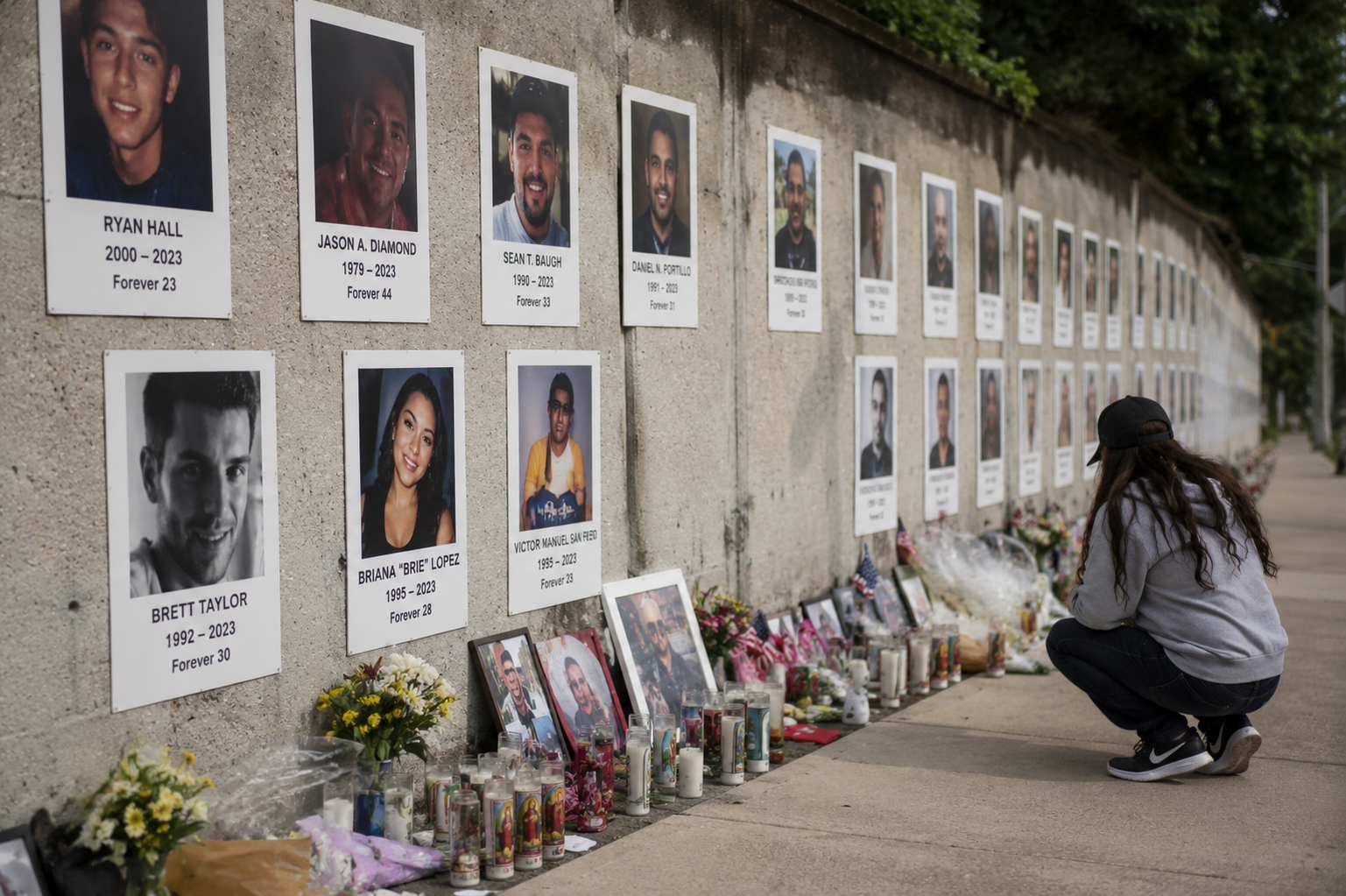
When Los Angeles County officials announced in mid-2025 that overdose deaths had dropped 22 percent in 2024 — the most significant single-year decline in the county’s recorded history — the announcement was framed as a public health success story. District Attorney Nathan Hochman called it a vindication of prevention, education, and aggressive prosecution. The Los Angeles County Department of Public Health credited expanded naloxone access, harm reduction investments, and improved treatment availability.
And on the narrow metrics cited in the press release, the numbers are genuinely encouraging. Deaths fell from 3,137 in 2023 to 2,438 in 2024. Fentanyl-related deaths specifically declined by 37 percent. Methamphetamine-related deaths dropped by 20 percent. These are not trivial improvements. In a crisis of this scale, every life saved represents a family intact, a child who still has a parent, a community that did not have to hold another funeral.
But 2,438 people still died in Los Angeles County in a single year from drug overdoses and poisonings. That is an average of more than eight people every day. Every single day. Fentanyl — a synthetic opioid 50 times more potent than heroin and 100 times more potent than morphine — still accounted for 52 percent of all accidental overdose deaths in the county, even after the record decline. And the long-term trajectory of this crisis remains one of the most dramatic public health collapses in any American city’s modern history.
The full LA County Department of Public Health data report on fentanyl overdoses: Data Report — Fentanyl Overdoses in Los Angeles County, October 2025. The official county announcement: Public Health Reports Most Significant Decline in Drug-Related Overdose Deaths in LA County History.
| ⚠ LOCAL DATA ALERT: In LA County, fentanyl overdose deaths surged 1,652% between 2016 and 2024. In the poorest communities (30%+ poverty rate), the fentanyl death rate is nearly FOUR TIMES higher than in the wealthiest neighborhoods — 39.1 vs. 10.0 per 100,000 population. |
THE LONG ARC: FROM 109 DEATHS TO 2,438 IN UNDER A DECADE
To understand what Los Angeles County is actually facing, the short-term improvement must be placed in its proper context. In 2016, when routine toxicology testing for fentanyl began in LA County death investigations, 109 people died from fentanyl-related overdoses. By 2021, that number had risen to 1,504 — a 1,280 percent increase in five years. By 2023, the total had climbed to 3,137 — a 1,652 percent increase from the 2016 baseline. The 2024 decline brings the county back to roughly the 2022 level, which was itself an unprecedented crisis point.
Fentanyl’s rise in Los Angeles has tracked a national pattern of drug supply contamination driven by illicit manufacturing. Unlike the opioid crisis of the 2000s and 2010s — which was substantially driven by overprescription of pharmaceutical opioids — the current crisis is primarily a fentanyl poisoning crisis. People who believe they are purchasing counterfeit prescription pills, cocaine, or methamphetamine are receiving products laced with illicitly manufactured fentanyl. Seven out of every 10 illicit pills seized in Los Angeles County contain a lethal dose of fentanyl, according to LA County District Attorney Nathan Hochman — who has characterized fentanyl as ‘an indiscriminate assassin.’
The DA’s office announced several first-of-their-kind murder prosecutions for fentanyl distribution in 2025: LA County Sees Sharpest Decline in Overdose Deaths as DA Hochman Intensifies Fentanyl Fight.
THE INEQUALITY BURIED IN THE DATA: GEOGRAPHY AND POVERTY AS DEATH SENTENCES
The LA County October 2025 data report contains a figure that deserves to be front-page news in its own right. The rate of fentanyl overdose deaths in the least affluent communities — defined as areas where more than 30 percent of families live below the federal poverty level — was 39.1 deaths per 100,000 population in 2024. In the most affluent areas — where less than 10 percent of families are below the poverty line — the rate was 10.0 per 100,000. That is a nearly four-fold difference in death rates based solely on neighborhood income level.
This disparity is not a natural phenomenon. It reflects differences in access to treatment and recovery services, differences in housing stability that affect treatment continuity, differences in access to naloxone and harm reduction infrastructure, differences in health insurance coverage, and differences in the concentration of street drug markets in lower-income communities. It also reflects the cumulative effect of decades of underinvestment in mental health and addiction treatment infrastructure in communities that needed it most.
In practical terms, the geography of fentanyl death in Los Angeles correlates with neighborhoods on the south and east sides of the city and county — communities with higher concentrations of unhoused individuals, higher poverty rates, and lower access to primary care. These communities saw the highest absolute death rates at the peak of the crisis and will be the slowest to benefit from the percentage declines being celebrated at the county level.
THE NATIONAL PICTURE: LA’S DECLINE IN CONTEXT
Los Angeles County’s 22 percent improvement in 2024 is broadly consistent with a national trend. According to provisional data released by the CDC on May 13, 2026, approximately 69,973 people died from drug overdoses in the 12 months ending December 2025 — a 13.9 percent decline from the previous year. This represents the longest sustained decline in overdose deaths in decades: more than two full years of falling national mortality after the 2022 peak of 107,941 deaths.
Full CDC overdose prevention data, updated May 13, 2026: CDC Overdose Prevention — About Overdose Prevention. National Institute on Drug Abuse death rate data: NIDA Overdose Death Rates.
But as Brown University researcher Brandon Marshall noted in January 2026 reporting by U.S. News: ‘The monthly death toll is still not back to what it was before the COVID-19 pandemic, let alone where it was before the current overdose epidemic struck decades ago.’ The celebration of declining overdose numbers requires constant calibration against the baseline. Fewer people are dying than at the peak, but far more people are dying than in any year before this crisis began — and the crisis is showing no signs of resolving, only of moderating.
THE FENTANYL VACCINE: A FUTURE SOLUTION THAT IS NOT HERE YET
One of the most closely watched developments in overdose prevention science entering 2026 is the progression of an experimental fentanyl vaccine into early-phase human trials. The vaccine is not designed to treat opioid addiction directly but to prevent fentanyl from crossing the blood-brain barrier in individuals who use the drug — effectively reducing overdose risk by preventing the euphoric effect that drives compulsive use and by limiting the respiratory depression that causes overdose death.
If successful, this approach could function as a pharmacological safety net for individuals in active recovery who face high relapse risk — a population for whom current naloxone-centered harm reduction strategies are important but insufficient. However, every addiction medicine specialist commenting on early trial data has been clear: widespread clinical availability of a fentanyl vaccine is likely years away, not months. It cannot be counted as a near-term solution to a crisis killing eight people per day in Los Angeles County alone.
Background on the fentanyl crisis trajectory entering 2026: The Fentanyl Crisis in the United States Heads Into 2026 With Cautious Optimism.
WHAT EVERY LOS ANGELES RESIDENT NEEDS TO KNOW
Naloxone (brand name Narcan) is available without a prescription at pharmacies across Los Angeles County, and at no cost through Los Angeles County Department of Public Health distribution programs. It is the only pharmacological intervention capable of reversing a fentanyl overdose in progress. Every household in Los Angeles — not only those with someone who uses drugs — should have naloxone available. Fentanyl-laced counterfeit pills are indistinguishable from pharmaceutical tablets by appearance. A teenager who accepts what appears to be an Adderall or Xanax from a peer at a party is at risk. A young adult who takes a single pill at a social event is at risk. This is not a drug user’s problem. It is a community-wide threat.
Fentanyl test strips — small, inexpensive paper strips that can detect fentanyl in a drug sample before consumption — are now legal in California and available through harm reduction organizations across Los Angeles. Their use does not enable drug use; it prevents death. Stigma around carrying test strips has cost lives. This is not a debate about whether drug use is acceptable. It is a debate about whether the appropriate response to a poisoned drug supply is to let people die from accidental contamination.
Naloxone access and overdose prevention resources for Los Angeles residents: LA County Department of Public Health — Naloxone Access. National overdose prevention resource: CDC Overdose Prevention Resources.
MEDICALDAILY.COM ASSESSMENT
Los Angeles County’s 22 percent overdose death reduction in 2024 is real and meaningful — and it is also vastly insufficient relative to the scope of the crisis. Going from 3,137 deaths to 2,438 deaths is a step in the right direction. It is not a resolution. The nearly four-fold disparity in death rates between LA’s poorest and wealthiest communities tells a story that the headline percentage decline obscures: the communities that were hardest hit in this crisis are recovering the slowest, and the gap between them and more affluent neighborhoods may be widening rather than closing. The 1,652 percent long-term surge in fentanyl deaths since 2016 represents a civilizational failure in drug policy, mental health infrastructure, and social support systems that a single year of positive trend data cannot undo. Los Angeles has earned a moment to acknowledge the improvement. It has not earned a moment to declare victory.