Tag: Confidence

  • Cultivating Courage and Confidence in Motherhood

    Cultivating Courage and Confidence in Motherhood

    My memories of motherhood are filled with moments of self-doubt. No mother alive doesn’t go through some self-doubt. Given all of the ideas of what is best for children, it is easy to doubt your decisions. From the mundane to the seemingly “big decisions,” it is easy to spiral into negative emotion doubting ourselves. 

    A client of mine spent some time talking with me about the fact that she and her son and husband didn’t have a ritual for dinner together. It made sense for her family and their schedule that her son ate before her husband got home, yet nearly every day she would have thoughts of doubt about whether that was really okay. Turns out it was just fine, as now he is a wonderful young adult and they are very close. It seems silly looking back that we can get so hung up on things like this but it’s easy to do. How do we know it’s going to be okay?

    Magazines, newspapers, and websites often produce stories out of research findings that show how some action or behavior is linked to some outcome, even when there is no definitive evidence that it was the cause for the outcome. The best test of how something works for your family is how it works for your family, over time!

    How nice it would be to have a crystal ball to be able to know for sure that any given choice would be the “right choice,” and that everything would turn out okay. The mind can blow things way out of proportion and make the risk to their development and well-being seem enormous. In our grasping for certainty and our fear of our doubt, we may create a lot of optional suffering. It is helpful to kindly remind yourself that kids are resilient and that you can be too. You can always make new choices after seeing the outcome.

    When Fear Is Present

    Like self-doubt, fear is another major topic in parenting. From the barrage of news reports about terrible things happening to children, mass shootings, catastrophic weather events, wars, etc., there is plenty to fearfully focus on. Add to that “time travel” in the mind, thoughts of what might or could happen, and that’s a whole lot of optional suffering in motherhood. Using mindfulness, especially a regular practice of mindfulness of thoughts and feelings, can help you step out of autopilot to see if you are actually suffering unnecessarily.

    You can shift the focus of your mind at any time. Fear is not a sign that the feared outcome is going to happen. Trying to imagine how you would face something you are afraid of that isn’t happening right now is often a waste of energy and can lead to self-condemnation. My favorite mantras, “Just this moment,” and “Just here, just now,” really help me to get out of my mind and get back into the flow of life. When you find yourself trying to “think it away,” you have to choose to redirect the mind to just be with now, to be with what is right in front of you and let fear fade into the background. It may arise again, and you can refocus again.

    I have come to understand that when fear is present, I must dig deep to move toward the thing I value. I don’t need to be rid of the fear to get through it.

    I have come to understand that when fear is present, I must dig deep to move toward the thing I value. I don’t need to be rid of the fear to get through it. I can decide to dig deep anyway, giving myself positive self-talk along the way.

    Uncovering Your Courage 

    Being brave or having courage is often described in a way that looks like having no fear. Motherhood calls for courage from the very beginning. We may go into it with sweet ideas, but we soon come to see how much we are needing to face that’s frightening or intimidating. Just like with appreciation, it is useful to stop and recognize where you were courageous. Acknowledging when you were afraid and did stuff anyway helps grow a sense of confidence.

    A client of mine was worried about whether she could be brave in the face of helping her four-year old daughter through a surgery and an overnight stay at the hospital. She noticed that she often took her fearful thoughts to mean that she wouldn’t be brave. They were some kind of bad sign. If she thought these things now, how could she do it?

    Anxious anticipation can undermine any of us.

    She also felt terrible about herself for dreading it. I encouraged her to validate herself, when she noticed the dread, by saying, “This is really hard. It’s okay.” She found it really helpful to acknowledge that simple fact, rather than to indict herself as a bad mother for all of the fear and negative thoughts. No one wants to go through hard things, and there is so much that is hard. It’s really okay to acknowledge it.

    Choosing to Be Brave

    I will always remember one of the more profound moments when I decided to be brave; where I showed myself that I could be courageous. I was finishing up the bath with my toddler son when I heard my toddler daughter fall in the other room. I ran to see her and found she had fallen and split her chin open. Blood was everywhere and I was freaked out. Here was one of the moments as a mother I had feared I wouldn’t be up to when it finally arrived. I was terrified.

    Despite the urge to cry and run the other way, I soothed her and cleaned her up anyway. After calling the pediatrician’s office who recommended I take her to the emergency room to see if she needed stitches, I called my husband to tell him to drop everything and come home. I told my husband he would be going to the ER with her!

    We can choose again and again to turn toward what we want for ourselves or our child, regardless of the mind’s first reaction.

    It dawned on me a few minutes after I hung up with him that I wanted my kids to see me be strong. I wondered what kind of message I would be sending my daughter, who was leaning on me and my soothing, if I sent her off with her dad who had just come home from being gone all day. Certainly, it wouldn’t have hurt her, but I realized here was an opportunity.

    So, as much as I dreaded it, I asked my husband to stay with our son and I took her to the ER. A few stitches and several hours later we were back home and doing fine. Courage and confidence are not something you have or not. Remember the growth mindset. We can choose again and again to turn toward what we want for ourselves or our child, regardless of the mind’s first reaction.

    When we string together moments like that, those choices lead to courage and confidence. Another gift of motherhood! Where I once went running away, I tamed my fears of spiders, bees, and snakes as well! Motherhood can show us how brave we can be.


    Excerpt reproduced with author’s permission from Just This Moment: A Guide for Moms Who Want to Enjoy Parenting, Raise Great Kids and THRIVE! by Elizabeth Torres, Psy.D. ABPP. (2019). 

    Mindfulness for Kids 

    When we teach mindfulness to kids, we equip them with tools to build self-esteem, manage stress, and skillfully approach challenges. Explore our guide on how to introduce mindfulness and meditation to your children—at any age. Read More 

    • Mindful Staff
    • June 11, 2020

    No posts found


    Source link

  • Does Mindfulness Make You Kinder? Key Studies On What We Know (and Don’t Know Yet).

    Does Mindfulness Make You Kinder? Key Studies On What We Know (and Don’t Know Yet).

    Do mindful people feel better in their own bodies? Does mindfulness make you kinder? Researchers are diving into these questions and uncovering the benefits of mindfulness.

    People come to mindfulness practice for many reasons. They might need support dealing with stress, or want a go-to way to help improve their sleep. There are plenty of questions, too, like: What does the research say about mindfulness and physical health? Does it really matter how often you meditate? Does mindfulness make you kinder for real, or is that mostly just what people just say?

    While studies are numerous and ongoing, and of course not every question can be answered definitively—we can look at some research gathered from Greater Good Science Center at UC Berkeley, Center for Healthy Minds at University of Wisconsin–Madison, Center for Mindfulness at UMass Medical School, and American Mindfulness Research Association, to help explore some of these questions more deeply.

    Feeling good in your own skin

    Do mindful people feel better about their bodies? Researchers asked 115 female college students about their level of mindfulness, body responsiveness, body shame, and overall health. Women who reported greater awareness and who tended to be nonjudgmental and nonreactive—key mindfulness skills—had less body shame, were more attuned to their bodies, and were healthier overall. The researchers say it’s not yet clear whether mindfulness increases body satisfaction, or vice versa. 

    Building your meditation muscle 

    In a comparison of adults who listened to either a guided meditation or a podcast daily for 13 minutes, researchers found that meditators reaped more benefits. For instance, after eight weeks meditators felt less anxiety and reported fewer negative mood states. And their performance on a set of computerized tests showed that they’d developed better attention and memory skills than podcast listeners. 

    The brain networks that work to keep us in the present moment and remember information are like mental muscles: They need exercise to keep them sharp and well-functioning, and meditation may provide that workout. The study also found that people in the meditation group were better at regulating their emotions, which was tied to having fewer negative moods. 

    But before you think this was a quick fix, think again. When the researchers checked to see if these benefits could be detected after four weeks, they came up empty-handed. Most of the gains didn’t show up until after eight weeks of steady practice. As with exercising a physical muscle, it takes time, patience, and repetition for change to take effect. 

    Does mindfulness make you kinder to yourself and others?

    Self-compassion may make aging easier. A review of the research showed that adults over 65 who practiced self-compassion tended to be less anxious and depressed, and felt a greater sense of well-being, than those who didn’t. (Tip: It probably doesn’t hurt to start practicing when you’re young.) 

    Mindful menopause

    Researchers at the Mayo Clinic in Minnesota surveyed nearly 1800 women aged 40 to 65 to see if those with a more mindful disposition might experience fewer menopausal difficulties. In fact, those with higher mindfulness scores were less stressed and had fewer symptoms like mood swings, hot flashes, insomnia, and fatigue—encouraging results for the millions of women experiencing this midlife passage.

    Mindful ripples 

    Does mindfulness make you kinder? That’s the question researchers asked when reviewing 31 studies on mindfulness and prosocial behavior. They found that dispositionally mindful people and those who completed some form of mindfulness training tended to be more compassionate and helpful. Being nonjudgmental, empathic, having a positive outlook on life, and knowing how to regulate emotions also increased behavior that benefitted others. 

    There were a few catches. Adults tended to be more prosocial than teenagers, and people who rated themselves higher in mindfulness were more helpful to people they knew than to strangers. 

    This didn’t apply to those who’d attended formal mindfulness training, though. They were just as kind to people they didn’t know as to those familiar to them. One big surprise was that people who’d received mindful awareness training and those who’d had compassion-focused instruction were equally prosocial, debunking the myth that the benefits of mindfulness are only limited to the individual. In other words, just being mindful may be enough to up your kindness quotient. 


    Source link

  • A Meditation for Working With Our Self-Judging Voice

    A Meditation for Working With Our Self-Judging Voice

    A guided meditation to get familiar with our self-judging voice and how we relate to our flaws, so that we can cultivate compassion and recognize our own worthiness.

    Mindfulness is about paying attention to our present moment experiences with openness, curiosity, and a willingness to be with what is. Mindfulness is about paying attention to the present moment with openness to things as they really are, as opposed to how we want them to be or how they could be, or wishing that they were different, which we do quite a bit. This includes our uncomfortable experiences—like being with our fear, grief, regret, and that self-judging voice that sometimes makes us feel so small.

    Self-compassion is the idea that even with all of our flaws, we can still care about ourselves.

    Self-Compassion vs. Self-Esteem

    I want to talk about the concept of self-compassion. Self-compassion is different from self-esteem. There seems to be this epidemic of self-judgment in the world, where people are often self-critical and have a lot of self-hating voices in their heads. Self-compassion is not the build up of self-esteem, because the build up of self-esteem tends to lead people to needing a lot of external validation to feel ok. Instead, self-compassion is the idea that even with all of our flaws, we can still care about ourselves, that we can make mistakes, that we can screw up, that we can have problems, but we’re still fundamentally a good human being. We can connect with that understanding and have compassion for ourselves, even with the flaws that we have. 

    What’s so amazing about mindfulness practice is we can use mindfulness to be aware when we have those self-critical voices, and we can label that voice as “judging”. We can notice when we have those judging voices because we have a mindfulness practice that allows us to have quite a bit more self-awareness, more ability to regulate emotions, and all of the positive things that come with the mindfulness practice. When these thoughts come we can be on top of them and not get so caught up.

    I sometimes talk about getting on the train – when you have a really powerful thought and you start thinking about it, and suddenly twenty minutes later you realize you’ve been on this train and were not in the present moment at all. However, the moment you recognize this, you can get off the train. Or, you can recognize this initially and not get on the train in the first place. You can stay at the platform and just let the thoughts go.

    A Meditation for Working With Our Self-Judging Voice

    1. Find your seat. Let’s begin by settling back into our comfortable posture, with your body upright but not too rigid or tight. Put your feet on the floor, hands resting on your lap, and your eyes can be closed. Most of us do this practice with our eyes closed but you don’t have to. You can keep them open but not looking all around, just looking downward. 
    2. Begin to notice your breathing. Begin with a few deep breaths letting you relax a little bit more. Invite in the possibility of relaxation with each deep breath. For this next period of time, you don’t have all of the worries and concerns. You’ve left them at the door, I hope. They may pop up into your mind but you can remind yourself that you don’t have to get on that train, and just come in to the present moment, feeling, or breath, while being present. 
    3. Focus on where you feel the breath most. Bring your attention to your stomach and notice if it’s tight or contracted. Take a deep breath if it is and just let it go. Notice your hands softening, and relax them. Notice your shoulders, jaw, throat, and face, and sense everything that’s obvious to you, maybe on the surface of the skin and maybe more internal. Do this with curiosity and with an eye out to relaxing a little bit.
    4. Let yourself be here right now, in this moment, and see if you can bring your attention to your breathing and to your breath in your body, wherever you feel your breath the clearest within your body. You might notice your abdomen rising and falling, or your chest rising and falling, expanding, and contracting with the breath. You might notice the tingling at your nostrils as air enters and exits. Some people notice the whole torso breathing with the air moving through their body, and that’s fine too.
    5. Shift attention to sounds. Now turn your attention to the sounds around you, just listen to sounds one after the next. Both the sound of silence, and the sounds that come and go. Don’t be lost in a story about the sounds, but just simply listen to them. 
    6. Find an object to anchor your attention. Find a focus for your meditation today. It could be your breath in your abdomen, or chest, or nose, or the full body breathing, or it could be listening to the sounds—any of those things work fine. Go to whichever one seems the most interesting to you, there’s no right way to do. If you can’t decide then just pick one, it doesn’t matter too much. 
    7. Notice the body breathing. Notice your abdomen moving up and down, chest expanding and contracting, air moving through your nose with each breath, full body breathing, or the sounds around you. 
    8. Stay with the sensations of breathing. We begin this mindfulness practice by attending to breath after breath, or sound after sound, staying with it to the best of our abilities, feeling the breath. 
    9. When the mind wanders, label your thoughts. At a certain point your attention will wander, and thoughts will come into your consciousness. When you notice that you’re lost in a thought, you can say a soft word like “thinking” or “wondering”, and come back to your main focus. Keep doing that again and again. This is emphasized for today’s practice because we are talking about how mindfulness can help us with self-judgment, and recognizing that you can notice the type of thought you’re having and give it a label.
    10. You can keep an eye out for judging thoughts, and every time you judge you can say in your mind a soft word like “judging”, or “self-judgment”, or “criticism”, or you can find the word that makes sense to you. It will help you to see the way in which the judgments arise. It’s not personal by the way; you didn’t set out to make yourself feel bad. It just happens. “That person is a better meditator than I am”, or “I’ll never get this right”, or “Why did I do that thing yesterday, it was so foolish”.  These are the kind of voices that come into our mind for some of us frequently. For others they may be rare; that’s fine too. 
    11. Notice self-critical thoughts as they arise. Use mindfulness practice to not judge yourself, to not judge yourself for being judgmental, and just notice judging. If you want to count the occurrences you can; for example “judging 1, judging 2… judging 20.” While you’re noticing these thoughts, you might get drawn to other types of thoughts. If so, you can use other labels like “planning”, “remembering”, “imagining”, and so forth. 
    12. Invite self-compassion. As you do this practice, please keep a quality of kindness towards yourself. Be curious. Notice how interesting your mind is without judging yourself. Maintain the spirit of kindness and investigation. 
    13. Reflect on the quality of your meditation. For the last few minutes of this meditation, just notice how you are doing with this awareness practice, with the mindfulness of breath, and with mindfulness of the way your thoughts operate. You can ask yourself, “Did I get on the train?”, “Did I get off the train?”, or “Did I stay at the platform maybe once or twice?”
    14. Did you notice many judging thoughts? I’m hoping you brought a kind attitude to yourself for the judging thoughts, if they were present. 
    15. Close with kindness. We will do a little bit of kindness meditation to conclude. Notice how you’re feeling, and see if you can also bring to mind someone you love, someone who makes you happy. It could be a dear friend, a child, a pet cat or dog. If you can’t think of anyone, it can be someone you’ve read about who you admire. 
    16. Repeat kind phrases. Say these phrases, and repeat them in your mind (or you can come up with your own). May you be safe and protected. May you be happy and peaceful. May you be healthy and strong. May you be at ease. 
    17. Send kind phrases to loved ones. Send these words and heartfelt feeling out to this loved one. Notice how it feels inside to make those wishes for them. Imagine that they send it back to you. May you be safe and protected. May you be happy and peaceful. May you be healthy and strong. May you accept yourself, just as you are.  
    18. See if you can “take” the kindness. Imagine the kindness moving through your body, wherever you are. Can you bring compassion to yourself exactly where you are, for whatever is happening right now? May I hold this with kindness. May I hold myself with compassion. Take a breath and notice if this is possible, to bring kindness to the best of your abilities wherever you are, however it makes sense to you. May I be with myself exactly as I am.
    19. Open your eyes. When you’re ready you can open your eyes, but take your time. 


    Source link

  • From Fear to Confidence: How Positive Thinking Can Transform Your Career

    From Fear to Confidence: How Positive Thinking Can Transform Your Career

    From Fear to Confidence: How Positive Thinking Can Transform Your Career

    Are you tired of feeling nervous, anxious, and self-doubting about your career? Do you often find yourself second-guessing your abilities and worried about making mistakes? You’re not alone. Many of us struggle with imposter syndrome, fear of failure, and self-doubt, which can hold us back from reaching our full potential. However, the good news is that positive thinking can be a game-changer in transforming your career and helping you achieve confidence and success.

    The Power of Positive Thinking

    Positive thinking is the practice of focusing on the positive aspects of a situation, rather than dwelling on the negative. It’s a powerful tool that can help you overcome self-doubt, build confidence, and achieve your goals. Research has shown that people who practice positive thinking tend to be more optimistic, resilient, and successful in their personal and professional lives.

    How Positive Thinking Can Transform Your Career

    So, how can positive thinking transform your career? Here are a few ways:

    • Boosts Confidence: When you focus on the positive, you begin to see yourself in a more positive light. You start to recognize your strengths, accomplishments, and abilities, which boosts your confidence and gives you the courage to tackle new challenges.
    • Improves Performance: With increased confidence, you’re more likely to take on new responsibilities, innovate, and try new approaches, which can lead to better performance reviews, promotions, and career advancement.
    • Buys You Time: When you’re positive and focused, you’re more likely to take calculated risks, rather than playing it safe. This can help you seize opportunities and stay ahead of the competition.
    • Enhances Resilience: Positive thinking helps you bounce back from setbacks, failures, and rejections. It allows you to learn from mistakes, and try again, rather than getting discouraged and giving up.
    • Strengthens Networks: When you exude confidence and positivity, others are more likely to notice and be drawn to you, leading to stronger professional relationships, mentorship, and potential job opportunities.

    Overcoming Fear and Self-Doubt

    So, how do you overcome fear and self-doubt to unlock the benefits of positive thinking? Here are a few strategies to help you get started:

    • Reframe Negative Thoughts: The next time you catch yourself thinking negative thoughts, challenge them by reframing them in a positive light. For example, instead of "I’ll never be good enough," try "I’ll learn and grow from this experience."
    • Practice Self-Care: Take care of your physical, emotional, and mental well-being. Get enough sleep, exercise regularly, and engage in activities that bring you joy and relaxation.
    • Set Realistic Goals: Break down large goals into smaller, achievable steps. Celebrate your successes, no matter how small, to build momentum and confidence.
    • Seek Support: Surround yourself with positive and supportive people who encourage and believe in you.
    • Ask for Help: Don’t be afraid to ask for help when you need it. Seek guidance from mentors, coaches, or peers who can offer valuable insights and advice.

    Conclusion

    From fear to confidence, positive thinking can be a powerful catalyst for transformation in your career. By reframing negative thoughts, practicing self-care, setting realistic goals, seeking support, and asking for help, you can overcome self-doubt and unlock your full potential. Remember, confidence is not the absence of fear, but the willingness to take action despite it. Start your journey towards positive thinking and confidence-building today, and watch your career soar to new heights.

    FAQs

    Q: Is positive thinking just a matter of attitude?
    A: While attitude plays a significant role, positive thinking is a practice that requires intentional effort and discipline.

    Q: Can anyone learn to think positively?
    A: Yes, anyone can learn to think positively. It’s a skill that can be developed with practice and patience.

    Q: How long does it take to see results?
    A: The time it takes to see results varies, but with consistent effort, you can start to notice improvements in your mood, energy, and performance within a few weeks.

    Q: Is positive thinking a one-size-fits-all solution?
    A: While positive thinking is a universal principle, everyone’s journey is unique, and what works for one person may not work for another. Be patient, and experiment with different approaches to find what works best for you.

    Q: Can positive thinking fix all my problems?
    A: While positive thinking can help you navigate challenges, it’s not a silver bullet. It’s just one of many tools to help you overcome obstacles and achieve success. Be realistic about the potential outcomes and challenges you’ll face.

  • Navigating behaviour change with confidence

    Navigating behaviour change with confidence


    What if the key to lasting behaviour change isn’t just what you teach your clients—but how you connect and communicate with them? In this episode of The Dietitian Connection Podcast, we sit down with Stephanie Notaras, a dietitian and expert in counselling and communication, to explore how clear and confident communication can help overcome barriers to change.

    Hosted by Brooke Delfino 

    Biography

    Stephanie Notaras is an APD, a PhD Candidate, the host of the Nutrition Counselling Corner podcast, a published author and the owner of the Dietitian Counselling Skills practice helping dietitians improve their counselling skills for better client retention, outcomes and revenue in their practice. She has a master’s in counselling and has developed and published a counselling framework for dietetic practice. Stephanie was awarded Dietitian of the Year 2024 at the Australian Allied Health Awards.


    In this episode, we discuss:

    • Why communication is just as crucial as nutrition knowledge
    • The difference between coaching and counselling in dietetic practice
    • How to use the Stages of Change Model to guide client progress
    • Strategies to compassionately challenge clients and move them toward action
    • How strong counselling skills improve client retention and outcomes


    Additional resources


    Click here to listen to the Nutrition Counselling Corner podcast (on Apple Podcasts and Spotify)

    Click here to join the Dietitians: Counselling Skills Community Facebook Group

    Connect with Stephanie Notaras at stephanienotaras.com or in Instagram @dietitiancounsellingskills

    Click here for Dietitians Unite 2025 tickets in Melbourne on 30 May


    The content, products and/or services referred to in this podcast are intended for Health Care Professionals only and are not, and are not intended to be, medical advice, which should be tailored to your individual circumstances. The content is for your information only, and we advise that you exercise your own judgement before deciding to use the information provided. Professional medical advice should be obtained before taking action. The reference to particular products and/or services in this episode does not constitute any form of endorsement. Please see  here  for terms and conditions.


    Source link
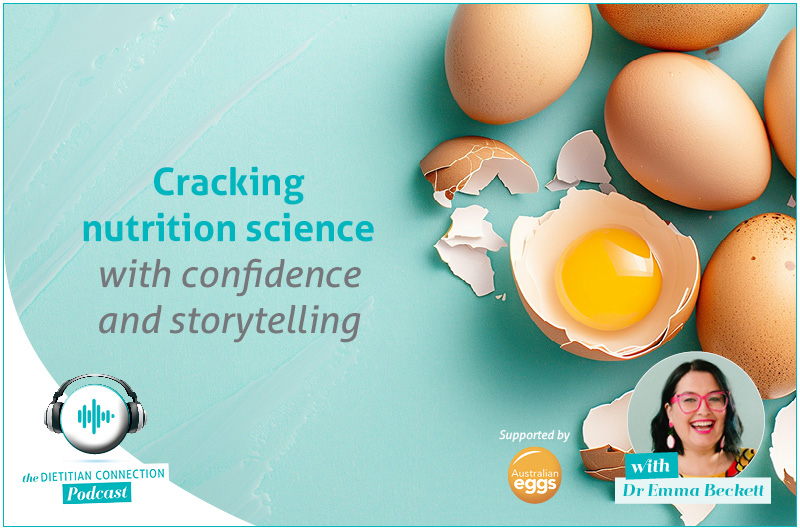
  • Confidence and storytelling in science

    Confidence and storytelling in science

    How can dietitians effectively communicate ever-evolving nutrition science and guidelines while maintaining public trust? In this episode, food and nutrition scientist Dr Emma Beckett unpacks the art of communication, emphasising the importance of ‘sticky stories’ to make complex scientific concepts relatable and easy to understand. Using the humble egg as a case study for storytelling, Emma highlights strategies for addressing common misconceptions, including concerns about fat content, cholesterol and pregnancy safety, without triggering the ‘backfire effect’. We also explore how dietitians can effectively cut through misinformation on social media to empower clients with engaging evidence-based guidance.

    Hosted by Brooke Delfino

    Biography

    Known as the “Dynamic Foodie” at FOODiQ Global, Dr Emma Beckett combines her diverse education and experience across food, nutrition, biomedical sciences, epidemiology, academia, industry and science communication to drive positive changes in the world through food. Her aim is to empower people to interpret food and nutrition information so that they can make informed choices without fear or judgment, and to empower health professionals to use the evidence-base to diversify and update their toolkits for use on the same mission. She has won several research and communications awards, including being named as a NSW Young Tall Poppy in 2017.

    In this episode, we discuss:

    • Why it’s important to acknowledge the journey of changing science
    • How storytelling can make communicating scientific facts more effective
    • Using anecdotes for their power of persuasion
    • The backfire effect (and how to avoid it)
    • The importance of starting new nutrition conversations
    • Tips for better translating up-to-date nutrition science for better translating up-to-date nutrition science


    Additional resources

    Sign up here for research updates and resources from Australian Eggs, shared straight to your inbox every two months.


    Supported by


    The content, products and/or services referred to in this podcast are intended for Health Care Professionals only and are not, and are not intended to be, medical advice, which should be tailored to your individual circumstances. The content is for your information only, and we advise that you exercise your own judgement before deciding to use the information provided. Professional medical advice should be obtained before taking action. The reference to particular products and/or services in this episode does not constitute any form of endorsement. Please see  here  for terms and conditions.

    Source link

  • 10 Simple Habits to Boost Your Confidence and Self-Esteem

    10 Simple Habits to Boost Your Confidence and Self-Esteem

    10 Simple Habits to Boost Your Confidence and Self-Esteem

    Building confidence and self-esteem takes time and effort, but there are many simple habits that can help. Developing these habits can have a profound impact on your overall well-being, relationships, and success. Here are 10 simple habits to boost your confidence and self-esteem.

    Habit 1: Practice Positive Affirmations

    Positive affirmations are simple, yet powerful phrases that can help rewire your brain with positive thoughts. Repeat phrases like "I am capable and competent," "I am worthy of love and respect," or "I can achieve my goals" to help you build confidence and self-esteem. Try using a mirror, journal, or even a sticky note to remind yourself of these affirmations throughout the day.

    Habit 2: Take Care of Your Physical Health

    Exercise, healthy eating, and sufficient sleep are all essential for boosting your mood and energy levels. Regular physical activity releases endorphins, which can improve your mood and self-confidence. Eating a balanced diet rich in whole foods, fruits, and vegetables can also provide the necessary nutrients for a healthy brain and body. Aim for 7-8 hours of sleep each night to help regulate your hormones and give your brain a chance to recharge.

    Habit 3: Practice Gratitude

    Focusing on what you have, rather than what you lack, can significantly improve your self-esteem. Take a few minutes each day to write down three things you’re grateful for. This can be as simple as a good cup of coffee, a beautiful sunset, or a supportive friend. Reflecting on the positive aspects of your life can help shift your focus away from negative self-talk and cultivate a sense of gratitude and appreciation.

    Habit 4: Take Calculated Risks

    Step outside your comfort zone and take calculated risks to challenge yourself. This can help build confidence and self-esteem by proving to yourself that you’re capable of handling new challenges. Whether it’s asking for a promotion, taking on a new project, or trying a new hobby, remember that growth often occurs outside your comfort zone.

    Habit 5: Practice Mindfulness

    Mindfulness meditation and deep breathing exercises can help you stay present and focused, reducing stress and anxiety. Regular mindfulness practice can also improve your self-awareness, allowing you to recognize and challenge negative thoughts and emotions. Start with short, 5-10 minute sessions each day to build your mindfulness muscle.

    Habit 6: Surround Yourself with Positive People

    The people you surround yourself with can have a significant impact on your mood, self-esteem, and confidence. Nurture relationships with positive, supportive, and encouraging individuals who uplift and inspire you. Limit your exposure to toxic or negative relationships that drain your energy and self-worth.

    Habit 7: Celebrate Your Achievements

    Acknowledge and celebrate your accomplishments, no matter how small they may seem. This can help build confidence and self-esteem by recognizing your hard work and progress. Reflect on your achievements and accomplishments regularly, and be kind to yourself when you encounter setbacks.

    Habit 8: Challenge Negative Self-Talk

    Negative self-talk can be a significant obstacle toconfidence and self-esteem. Pay attention to your inner dialogue and challenge negative thoughts by reframing them in a more positive and realistic light. For example, instead of "I’ll never be able to do this," try "I’ll learn and grow from this experience."

    Habit 9: Practice Self-Care

    Taking care of your physical, emotional, and mental well-being is crucial for building confidence and self-esteem. Schedule time for self-care activities that bring you joy, such as reading, taking a walk, or enjoying a relaxing bath. Prioritize your own needs and make self-care a non-negotiable part of your daily routine.

    Habit 10: Embrace Your Imperfections

    Perfection is a myth, and it’s essential to remember that everyone makes mistakes. Embrace your imperfections and don’t be too hard on yourself when things don’t go as planned. Celebrate your uniqueness and individuality, and recognize that your imperfections are what make you, you.

    Conclusion

    Developing these 10 simple habits can have a profound impact on your confidence and self-esteem. Remember that building confidence and self-esteem is a journey, and it takes time, effort, and patience. Start with small, achievable steps, and be gentle with yourself as you work towards building a stronger, more positive you.

    Frequently Asked Questions

    • Q: How long does it take to develop these habits?
      A: The amount of time it takes to develop these habits varies, but with consistent effort, you can start to notice improvements in your confidence and self-esteem in as little as 30 days.

    • Q: Are these habits only for people with low self-esteem?
      A: No, these habits can benefit anyone looking to boost their confidence and self-esteem, regardless of their current level of confidence.

    • Q: Are there any specific resources or tools I can use to support these habits?
      A: Yes, there are many resources available, such as meditation apps, gratitude journals, and positive affirmation workbooks. Find what works best for you and use it to support your habits.
  • Best Body Posture Correctors To Help You Walk With Confidence And Ease

    Best Body Posture Correctors To Help You Walk With Confidence And Ease

    Spending long hours slouched over a desk or constantly craning our necks in front of our computers and laptops can cause significant health issues in the long run. These habits may cause muscle imbalances, strain the neck and upper back and affect our posture.

    Poor posture not only affects our appearance but can also cause neck pain, lower back pain, or even spinal misalignment. Lower back pain affects around 619 million people worldwide and it is the leading cause of disability worldwide, according to a survey by National Centre for Health Statistics.

    How To Improve Posture?

    Take Breaks: You must avoid sitting for prolonged periods of sitting or focusing on screens. According to doctors, you must take a break every 30 minutes if your work requires you to sit for long hours.

    Stretch And Exercise: Incorporating yoga and other forms of exercises in your daily routine may be able to help alleviate muscle imbalances and help you maintain the correct body posture. Right body posture can keep away many diseases such as Carpal Tunnel Syndrome and lower back pain.

    Buy Orthopedic Pillows: You can take assistance of lumbar and cervical support pillows to relieve pressure on your spine. Lumbar and cervical pillows are specially designed to alleviate pain and enhance sleep quality.

    Invest In Posture Correctors: Orthopedic pillows and ergonomic chairs are not the only solution to fix your body posture and help align your spine and neck, you can also take help of posture correctors.

    Posture correctors work by removing pressure off your back, neck, shoulder, and clavicle pain. Posture correctors are devices designed to provide support and promote proper alignment of the spine and shoulders. They can be worn discreetly under clothing, and are available in various forms, such as braces, straps, or shirts.

    You can train your muscles by using a posture corrector regularly. However, posture correctors must not be used as a long-term crutch but rather as a temporary aid to assist in developing better posture.

    However, you must consult a healthcare professional before using any posture correction devices, especially if you have pre-existing medical conditions or concerns.

    What Must You Look For In A Posture Corrector?

    Material Quality: You will be spending considerable time wearing the posture corrector, therefore, you must look for a product that is durable and is made of breathable soft fabric.

    Ease-of-Use: It is imperative that you are able to adjust it to your desired fit. An adjustable posture corrector ensures users of different body types can use it comfortably.

    Usage: Some posture correctors come with various functions; they combine back support and correction in a single product. Look for a product that comes with multiple features so you get the best value for your money.

    Here Are the 25 Best Posture Correctors Based On Reviews:

    1. ComfyBrace Posture Corrector

    This posture corrector has a 3.9-star average rating from almost 44,983 reviews on Amazon. It is suitable for chest sizes of 30″ to 43″. It is adjustable and breathable and can easily be worn under your clothes. You can wear it for 5-10 minutes per day and gradually increase the duration if you need it. It also features high-end durable stitching and remains silky soft to the touch.

    2. Fit Geno Back Brace Posture Corrector

    This posture corrector can be used by both men and women. It offers supports to your lumbar area without making your armpits feel constricted. It is adjustable and easy to wear. Its breathable mesh material keeps the sweat away. It has two flexible ABS support bars to straighten your back. This lumbar brace will also relieve pain in your shoulders and waist. It has four fiber rod support rods that are sealed and non-removable, making it a sturdy option.

    3. JMPOSE Posture Corrector for Back Support

    This adjustable premium-quality posture corrector is designed to relieve neck and back pain in addition to correcting your spine. It trains your muscles to stay in a healthy position. Made from ultra-soft, ultra-light, breathable, skin-friendly materials, this product features among Amazon bestsellers. It is suitable for home, office, leisure, study, and driving.

    4. BDLLMDES Posture Corrector

    The use of breathable mesh material sets this product apart from others on the market. Its fabric allows for optimal airflow and prevents you from sweating too much. It’s flexible, adjustable, and easy to wear. Suitable for people who are suffering from hunchback, low back pain, and shoulder and neck discomfort, this posture corrector can be worn 15–20 minutes a day.

    5. Norxlight-S Posture Corrector for Women and Men

    This back brace sold by Norxlight-S not only improves the spinal health of the body but also provides pain relief in the lumbar, back, shoulder, and neck areas. It is lightweight, easily adjustable, and easy to wear and can be used by both men and women. It is made of breathable fabric, so you do not feel uncomfortable while carrying out your daily tasks.

    6. Alsoay Posture Corrector

    Made with soft and comfortable materials, this back brace provides maximum support to your neck, spine, and shoulders. It helps you fix your posture by straightening the back. Its durable construction ensures you do not have to worry about replacing it often. It can be worn under the clothes. It corrects a poor posture by providing spinal support.

    7. Reatowrol Back Brace Posture Corrector

    Based on ergonomic design, Reatowrol’s posture corrector has highly elastic straps that can be adjusted as per your need. It is made of lightweight, breathable, elastic, soft, and non-deformed fabric. You can wear it at work, the gym, or while doing any casual activities. This product is fit for all women and men and can be worn 20-30 minutes per day initially. However, you must consult your doctor about the duration.

    8. Vicorrect Posture Corrector

    This 2-in-1 back posture corrector comes with four flexible ABS support rods to help straighten your back and is suitable for all body types. It’s perfect for everyday use due to its breathable design that prevents sweat and overheating. It’s easy to clean and can aid in the correction of kyphosis and hunchback.

    9. Upright GO 2 Premium Posture Corrector

    This posture corrector promises to improve your posture within two weeks. The brand has a dedicated app that is exclusively designed to train you every day and track your progress once you start wearing it. The app lets you create custom training programs and comes with a device that vibrates every time you sleep.

    10. SHAPERKY Posture Corrector for Men and Women

    This product is best for those looking for a product that is slightly bigger than the average posture correctors available in the market. The back is unisex and fits waist sizes ranging from 27 to 47 inches. It comes with an upgraded, high-quality back support plate design. It comes with a new underarm adjustment strap so it does not poke your armpits. It is made with breathable, strong, washable, and high-quality materials.

    11. NLNYCT Posture Corrector For Women

    This back posture corrector for women comes with a keel support bar for enhanced stability. It remains inconspicuous after being worn under the clothes, ensuring you can smoothly into your personal and work life. It is best for people with slight hunchbacks and the ones who have to spend hours sitting. It is made of breathable, comfortable, and easy to clean.

    12. VOKOKOYA Posture Corrector for Women and Men

    This unisex posture corrector uses a cross-guide strap to help you correct your posture. It is available in different sizes and is specifically designed for hunchbacks. You can wear it comfortably without needing any help. The brand recommends purchasing a larger size between the two sizes. It can be worn at home, in the office, and at the gym. A posture corrector may just be the best gift for your loved ones.

    13. SFDFF Posture Corrector for Women & Men

    This back straightener posture corrector will help reduce pain in the neck, back, and shoulders in addition to helping you fix the spine alignment. Made with breathable material, this product ensures comfort and a streamlined look. It can be easily put on like a backpack. Feel more confident and beautiful with this efficient posture corrector.

    14. Fitsupport Back Brace Posture Corrector

    Great for relieving pain and symptoms of diseases such as sciatica, lordosis, and scoliosis. This back brace support is made with high-quality material that is both comfortable and breathable. You can wear it at home, at work, or while performing casual activities. It comes with adjustable straps in multiple sizes.

    15. Selbite Back Brace Posture Corrector

    Poor posture can cause several lifestyle issues; this posture corrector gives you a chance to prevent all of them. Constructed using a breathable and extra strong mesh, this back brace is super comfy and super flexible. It can be worn over or under clothing. The improved posture will make you look more attractive.

    16. DIANMEI Posture Corrector for Women and Men

    One of the notable features of this posture corrector is its emphasis on comfort and flexibility. It is ergonomically effective in building muscle memory to ensure you stand tall once you stop wearing the back brace. It can be worn under clothes, which gives you the option to wear it at work as well. Walk with confidence wherever you go with the help of this posture corrector.

    17. EGJoey Back Brace for Lower Back Pain Relief

    This posture corrector comes with removable bionic spine supports. Unlike traditional braces, this gives you the option to insert steel support or ABS support. It offers extra stability with the help of its flexible steel supports along the waist. Its double-layer design gives you considerable stability on your abdomen. The back support belt allows you to walk, sit, bend, or stretch without having to worry about the pain.

    18. Bodystance Backpod

    This backpod has been developed by professional physiotherapists in New Zealand. It has been clinically proven to help with conditions such as costochondritis and Tietze’s syndrome, according to the brand. With its ergonomic design, it helps with the strain caused by long hours of desk work. The back brace has been designed for daily use and guarantees long-lasting durability.

    19. GrabArt Back Brace Posture Corrector

    Say goodbye to poor posture and hunched back posture within months with the help of GrabArt’s back brace. It is an ideal product for both men and women. The adjustable belt and breathable material provide maximum comfort and support. It is an ideal back brace if you wish to address back pain and provide your spine some support.

    20. BraceTop Upgraded Posture Corrector

    This uniquely designed back brace comes with a wide belt to ensure your waist gets the best support. Its perforated elastic band provides resilience and solid support. It is made of dense mesh cloth, making it more breathable and skin-friendly. The mesh design keeps you cool and comfortable. The shoulder straps are adjustable and super comfy. You can wear it anytime and anywhere.

    21. SNUSIM Posture Corrector

    SNUSIM’s back brace is easy to wear and comes with a soft sponge pad shoulder strap. You can adjust it easily and wear it under the clothes; it won’t look bulky. Suitable for chest sizes from 25″ to 45″ inches, this product prevents bad posture. And supports your back and shoulders equally. The brand recommends wearing it 30 minutes a day initially and then gradually increasing it.

    22. Potensgo Back Brace Posture Corrector

    Walk with confidence and comfort with the help of this back brace posture corrector. It is designed to provide superior support and reduce back pain. Its ergonomic design also supports your upper back, lower back, and abdomen. Unlike traditional posture correctors, this one offers four times more back support. It comes equipped with detachable fiber rods for increased back and waist coverage.

    23. Gaiam Restore Posture Corrector

    A unisex product, this posture corrector can be used for several purposes. It helps not just your back but your neck and shoulders as well. It promotes muscle memory and effectively reduces slouching. Light and comfortable to wear, this back brace is made of soft-touch neoprene fabric. The fabric keeps you cool for hours. It can be worn over the clothes or under the clothes.

    24. POAGL Posture Corrector For Men

    By assisting in straightening the back, this posture corrector can effectively alleviate pain in the shoulder, neck, and waist. It is durable and comfortable, making it a reliable choice for those seeking long-term relief. Its sleek and lightweight design allows you to wear it under your clothes. It is made of strong padded straps made of breathable fabric. It perfectly fits the contours of your body and also offers the best support to your spine.

    25. Fitomo Back Brace for Women

    It is one of the few posture correctors available on the market that are made of carbon fiber splints. The carbon splints are much stronger and lighter than the aluminum ones. This lower back brace is crafted using ultra-thin mesh fabric to keep the sweat and heat away. Suitable for both men and women, this back brace provides complete support during physically strenuous activities.

    (Disclaimer: This article is meant for informational and educational use only and is not a replacement for professional medical advice. For any health-related concerns or questions, please consult a licensed healthcare provider. Additionally, Medical Daily suggests opting for products that have been verified by independent third-party testing to ensure their quality and effectiveness. Editorial Policies & Methodology: These products are selected independently and objectively, based on online reviews, various data sources, and proprietary research.)

    Published by Medicaldaily.com

    Source link