Tag: compassion

  • The Walk for Peace: An Invitation to Reimagine Where Peace Begins

    The Walk for Peace: An Invitation to Reimagine Where Peace Begins

    The Walk for Peace has been, in many ways, easy to miss. There are no slogans, no signs held up, no calls to action. 

    Instead, there is just walking. One step, then another. Breath moving in and out. Bodies moving steadily through places designed for speed.

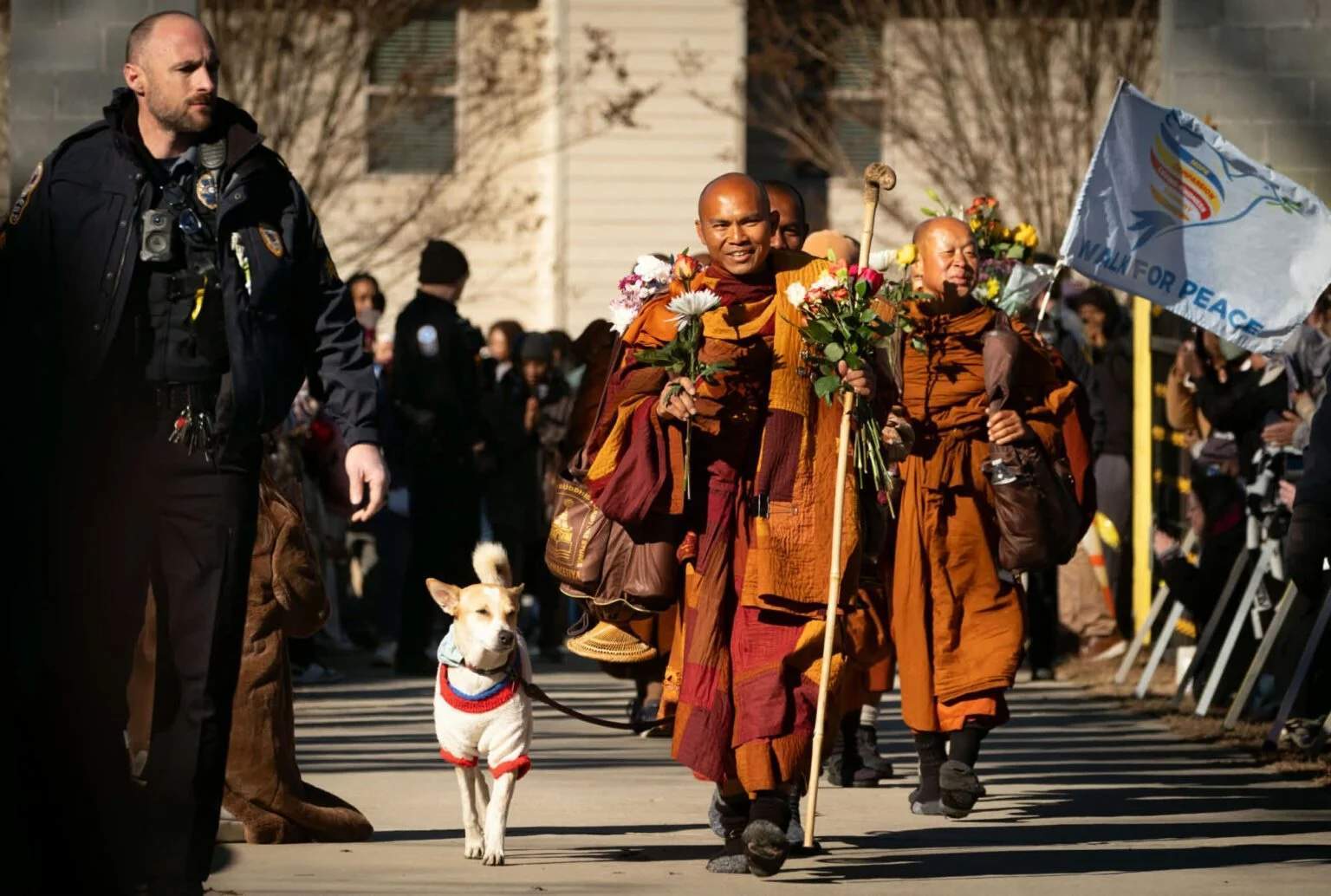
    After 108 days and over 2,300 miles, the Buddhist monks and their beloved dog Aloka have arrived at their destination in Washington, D.C. On February 11, 2026—Day 109—they will host a global loving-kindness meditation at 4:30pm EST. 

    Our current culture is shaped by loud, frantic things: urgency, outrage, and constant stimulation. This long-distance pilgrimage across the United States offers something distinctly countercultural. It is quiet, steady, unassuming, and attentive.

    It’s a (sometimes uncomfortable) reminder that our ideas about peace are often future-oriented and externalized. We imagine a time that’s not-now, where the horrors that plague us are gone, and we can finally feel okay. 

    I live in Minneapolis, right in the city. It is not peaceful here right now. We’re surrounded daily by realities that are destabilizing, uncertain, and frightening. Smack in the middle of that, people here are also quietly nurturing a web of care that extends to neighbors and strangers alike, that is stubbornly insistent on the possibility that we belong to each other.

    What I notice is that we are starved for gentleness in a world that glorifies dominance and control. We ache for compassion in a world that keeps telling us that softness makes us weak and defective.

    This past month, I’ve found myself multiple times a week checking in with the Walk for Peace. I watch videos of such tender interactions as people go to watch these monks pass by, sometimes offering flowers or just an encouraging hello. They spontaneously weep, and I do, too. 

    What I notice is that we are starved for gentleness in a world that glorifies dominance and control. We ache for compassion in a world that keeps telling us that softness makes us weak and defective.

    It’s difficult, but also strangely empowering, to sit with the truth that the monks are embodying. Something shifts in me when I begin to think of peace, not as something “out there,” but  as a thing that starts as a tiny kernel in each of us—something we tend like an ember, ignite with our own breath and attention, and then intentionally carry and share with others—moment by moment, step by step.

    What Is the Walk for Peace?

    The Walk for Peace is a long-distance walking journey across the United States, led by a small group of Buddhist monks and supported by volunteers and community members along the way. The route of the walk has stretched over 2,000 miles, beginning in Fort Worth, Texas, and ending in Washington, D.C., crossing ten states along the way.

    While it draws from contemplative Buddhist traditions, the walk itself is not a religious event. It is a lived experiment in mindfulness, compassion, and nonviolence—expressed through the simple act of walking.

    At its core, the walk is a moving mindfulness practice. The participants walk attentively, often in silence, allowing each step to re-anchor them to the present moment. For observers and those who join briefly, the experience can feel unexpectedly grounding. There is nothing to argue with, nothing to agree or disagree with. It’s just people moving through space with care, which is on the surface completely unremarkable—but somehow it feels like the most revolutionary thing.

    By walking attentively through public spaces, the participants model an alternative way of being—one that does not require agreement, belief, or affiliation. With each step, they seem to be simply saying, Notice your breath, notice your pace, notice the people around you. 

    Unlike marches designed to persuade or protest—and of course those also have their place—the Walk for Peace makes no demands. It invites reflection rather than reaction. Many who encounter it describe a sense of calm or curiosity. It’s a noteworthy pause in the usual mental clutter of daily life.

    Rather than addressing specific political outcomes, the walk focuses on something more foundational: how people relate to themselves and one another in everyday life.

    As an intentional mindfulness practice, the walk has highlighted several key principles:

    • Slowing down in a culture that rewards speed
    • Embodied awareness, using movement as an anchor to the present moment in a culture that often uses distraction and numbing
    • Compassion, practiced through respectful presence rather than persuasion
    • Nonviolence, not only as the absence of harm, but as an intentional orientation toward care

    By walking attentively through public spaces, the participants model an alternative way of being—one that does not require agreement, belief, or affiliation. With each step, they seem to be simply saying, Notice your breath, notice your pace, notice the people around you. 

    Peace, in this context, is not an end point, but a capacity that grows with practice.

    The monks have been accompanied by Aloka, a stray who found them in India on another peace pilgrimage. Photo credit: Aloka the Peace Dog

    The First Steps

    Walking has long been associated with reflection and insight. It naturally regulates the nervous system, invites awareness of breath and sensation, and brings attention out of abstraction and into the body. By choosing walking as their medium, the organizers grounded their response in something universally human.

    The Walk for Peace began with a simple question: How do we respond to a world marked by division, stress, and suffering without adding more noise?

    In an informational ecosystem shaped by influencers and social media, we’re accustomed to slogans and sound bites, having people talk at us, trying to shape our thinking and feeling. But these monks aren’t delivering a message to people; they’re living out a practice among them.

    Instead of issuing statements or organizing events, they chose to walk—slowly, visibly, and consistently—through the very communities shaped by the pressures and pains of modern life.

    Portions of the walk, through places like Selma and Montgomery, Alabama, were tracing steps taken by leaders of the Civil Rights movement.

    What is it like for us, generations on, to watch humble people radiating compassion and healing over so much painful ground, to watch them bear witness to realities and tend to wounds that we, collectively, still haven’t fully contended with?

    The steady gaze, pace, and breath of people like the monks remind me [that] no one person is bearing all of this alone. They’re carrying and surrendering, rejoicing and connecting, witnessing and walking, together.

    I drive through Minneapolis and see in real time the trauma of racialized violence: weary but resolute people holding signs on street corners, begging for mercy and humanity; “closed” signs in business windows where workers have been taken; a car parked askew on the road, driver’s side window smashed, door still open. Did someone see it happen at least so that the owner’s loved ones can be notified?

    It is so painful to witness, to look this moment in the eyes. I want to turn away. In my chest, it feels like I’m drowning. But the steady gaze, pace, and breath of people like the monks remind me of two important things.

    First, the longer we resist offering our attention to these unhealed places, the more we will keep living through the reverberating echoes of those same wounds over and over and over again. Different possible futures are only made possible by first giving our loving awareness to what’s happening right now—even (maybe especially) when it surfaces sorrow, hopelessness, or anger that we’re not sure we can handle in the moment.

    Second, no one person is bearing all of this alone. There’s no hero doing all the work. They’re carrying and surrendering, rejoicing and connecting, witnessing and walking, together.

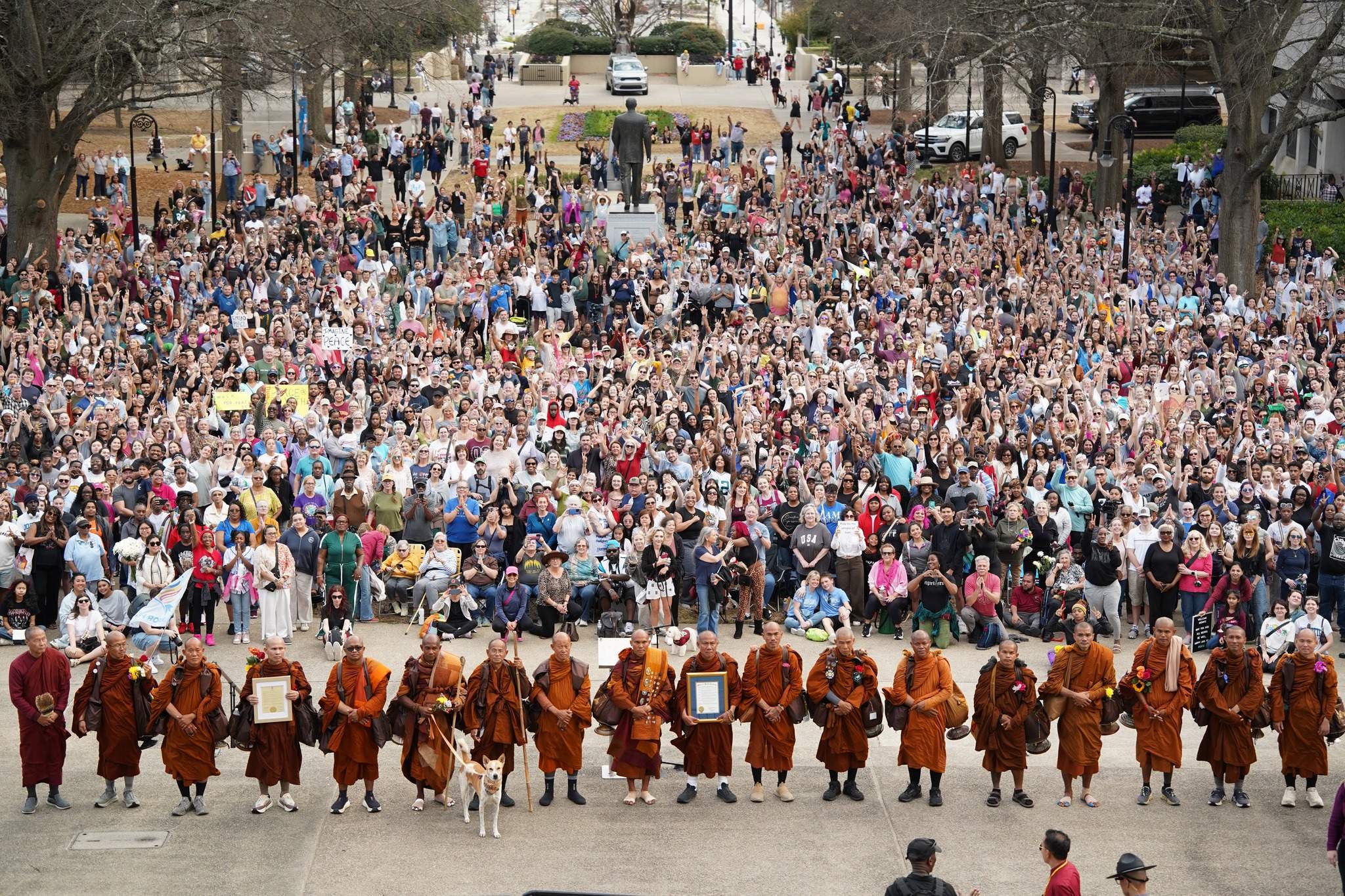
    A large crowd gathers behind monks in orange robes at a Walk for Peace outdoor event, united to reimagine peace together.
    A crowd gathers in South Carolina. Credit: Walk for Peace Facebook page

    How Do People Respond? 

    In many communities, people have gathered along the route—sometimes in the hundreds, sometimes in the thousands—drawn less by promotion than by word of mouth and curiosity. 

    Some offer food or encouragement. Some walk quietly for a stretch, or just stand and watch.

    Online, the walk has attracted millions of followers. Photos and short videos of monks walking through rain, heat, and traffic circulate widely, often accompanied by comments describing a sense of calm or inspiration. 

    Some people express skepticism, questioning whether walking can have any real impact in a world facing complex systemic challenges.  

    This tension is familiar within mindfulness circles, as well. Practices that emphasize inner awareness are sometimes dismissed as passive or insufficient. I understand that skepticism, even as research and lived experience increasingly suggest that attention, regulation, and compassion are not luxuries—they are necessary for wise action.

    Many people who encounter the walk haven’t reported dramatic transformations. They describe something smaller and maybe more sustainable—a softened interaction, an experience of being deeply seen, a reminder to slow down. Again: we so often come looking for drama because we’re conditioned for it—but perhaps what heals us shows up in a thousand quiet, un-social-media-worthy moments.

    Being Peace When Peace Feels Absent

    The Walk for Peace does not claim to solve global problems. It does not promise immediate results. 

    What it offers instead is a living question: What changes when we choose to move through the world with awareness and care?

    Peace is not something we wait for, hoping for external conditions to improve, but something we practice within the conditions we have. 

    Mindfulness practice is rooted in such elemental things—the breath, the body, the next moment. The mind wanders, as it always does, to other things. I think these days of my neighbors, my friends, my worry and anger, the work that needs to be done, what will become of my city, my country. 

    My practice has never been fancy, and even over years now, I have always been more earnest than skilled. Tears sometimes spill over, and my practice is like a cool hand on my forehead, like a reassuring mother, calling me home. 

    The walk has embodied this return home on a collective scale. It suggests that peace is not something we wait for, hoping for external conditions to improve, but something we practice within the conditions we have. 

    I know the walk is coming to its end. In all honesty, I’m going to miss the images and the videos. They have been a kind of nourishment over these long, dark weeks.

    I also know that something real has passed between real people. Maybe for the first time in a long while, we’ve had a glimpse of what happens when we just stop, even for a few moments, and notice one another. On the surface, it’s so tiny it’s almost nothing, just a breath or a blink or a step—but I swear I can sense that spark of compassion leap from one person to another. I’ve felt it here, and I know it matters.


    Source link

  • Save the Planet Through Compassion?- Mindful

    Save the Planet Through Compassion?- Mindful

    Karen Armstrong, founder of the Charter for Compassion, on what we need to do to make a better world.

    When British author Karen Armstrong won the TED prize in 2008, she used the money to convene a group of religious thinkers from a wide range of faiths to craft an updated version of the Golden Rule for the 21st century. What emerged was the Charter for Compassion, which calls on people around the world “to work tirelessly to alleviate the suffering of our fellow creatures, to dethrone ourselves from the center of our world and put another there, and to honor the inviolable sanctity of every single human being, treating everybody, without exception, with absolute justice, equity and respect.”

    That document inspired the creation of an international network, which now includes hundreds of organizations and more than 75 cities, ranging from Kara- chi to Belfast to Chippewa Falls. Below is a 2016 conversation with Armstrong about the charter, her vision for a more compassionate world, and why this particular mindful quality is actually essential to save the planet.

    Why the focus on compassion?

    Every one of the major religions has formulated its own version of the Golden Rule. That’s the essence of faith and spirituality. And it seemed to me that it wasn’t just a nice idea; it was an urgent global imperative. Unless we learn to ensure that all people, no matter where they live, are treated the way we would like to be treated, the world isn’t going to be a viable place.

    You’ve said that a compassionate city has to be an uncomfortable city. What do you mean?

    It should be a city that’s uncomfortable about pain and suffering in the world. Especially in the West, we live lives of such privilege that we often block out the awful things that are going on in the world. We shouldn’t be able to sleep, for example, when we see all these migrants literally dying to get into Europe.

    The Golden Rule insists that we cannot confine our benevolence to just our own congenial group.

    The Golden Rule insists that we cannot confine our benevolence to just our own congenial group. “You must have concern for everybody,” says one Chinese sage. “Love the stranger, the foreigner,” says Leviticus. “Reach out to all tribes and nations,” says the Koran. That’s the message of the Charter.

    That’s nice, but don’t we live in a me-first culture?

    People always say to me, “We have to have compassion for ourselves.” That’s true. Unless you face up to the pain in your own life, you’re going to be hard on other people. But you can’t stop there. A few years ago, I wrote a book called Twelve Steps to a Compassionate Life, and I made self-compassion step three. There are nine other steps after that, ending with: Love your enemies.

    We have to see ourselves as a collective. The alienation the West is causing is as dangerous for humanity as climate change.

    How so?

    One thing that makes me angry about Europe is that we think that we’re the only ones who are being attacked by terrorists. Two days before the most recent attacks in Paris, 44 people were blown up in Beirut by an ISIS suicide bomber, and the media in the West barely mentioned it. This is noticed in the Muslim world. Earlier this year, I gave a lecture in Amman, Jordan, and a man who’d brokered the peace deal between Jordan and Israel came up to me and said, “The West has lost its humanity.” We care only for ourselves. This is not compassion.

    Is there a city that inspires you?

    Karachi, Pakistan. They’ve created a network of schools there that integrate compassion with the core subjects in the curriculum rather than teaching it as a separate entity. It was the children who asked the mayor to make Karachi a compassionate city. They said they wanted a community where there was more equality and they could go out in the streets and not be blown up by a suicide bomber.

    What gives you hope?

    I’m happy that so many of the people who’ve come forward to help are business people. I’m a writer who sits around writing about ancient history. What do I know about building organizations? But business people know how an idea becomes part of the structure of life, not just a lot of wild do-gooding that makes people burn out.

    This is a broken world and one has to look at it squarely and with love. If we succumb to despair then all is lost. One must keep on, but always maintain that high state of discomfort.


    Source link

  • Connect With Loving-Kindness: Simple Meditation- Mindful

    Connect With Loving-Kindness: Simple Meditation- Mindful

    This classic loving-kindness meditation can help you to awaken to how connected we all are. You don’t have to like everybody, or agree with everything they do—but you can open up to the possibility of caring for them, because our lives are inextricably linked.

    This classic loving-kindness meditation can help you to awaken to how connected we all are. You don’t have to like everybody, or agree with everything they do—but you can open up to the possibility of caring for them, because our lives are inextricably linked.

    A Meditation to Connect With Loving-Kindness (Even When It’s Hard)

    Read and practice the guided meditation script below, pausing after each paragraph. Or listen to the audio practice.

    1. Begin by thinking about someone who has helped you; maybe they’ve been directly generous or kind, or have inspired you though you’ve never met them. When you think of them, they make you smile. Bring an image of the person to mind, or feel their presence as if they’re right in front of you. Say their name to yourself, and silently offer these phrases to them, focusing on one phrase at a time.

    May you live in safety.

    May you have mental happiness (peace, joy). 

    May you have physical happiness (health, freedom from pain). 

    May you live with ease.

    Don’t struggle to fabricate a feeling or sentiment. If your mind wanders, simply begin again.

    2. After a few minutes, move on to a friend. Start with a friend who’s doing well right now, then switch to someone who is experiencing difficulty, loss, pain, or unhappiness.

    3. Offer loving-kindness to a neutral person who you don’t feel a strong liking or disliking for: a cashier at the supermarket, a bank teller, a dry cleaner. When you offer loving-kindness to a neutral person, you are offering it to them simply because they exist—you are not indebted to or challenged by them.

    4. Offer loving-kindness toward a person with whom you have difficulty. Start with someone mildly difficult, and slowly work toward someone who has hurt you more grievously. It’s common to feel resentment and anger, and it’s important not to judge yourself for that. Rather, recognize that anger burns within your heart and causes suffering, so out of the greatest respect and compassion for yourself, practice letting go and offering loving-kindness.

    5. Finish by offering loving-kindness to anyone who comes to mind: people, animals, those you like, those you don’t, in an adventurous expansion of your own power of kindness.

    Loving-kindness offers us a profound sense of connection, guiding us to live our lives with greater intention and compassion. In this online course from Mindful, Sharon Salzberg—one of the world’s leading loving-kindness meditation teachers—offers us her distinctive approach to loving-kindness practice. Learn more and sign up today!


    Source link

  • A Meditation For When the Suffering In the World Feels Heavy

    A Meditation For When the Suffering In the World Feels Heavy

    If you’re feeling overwhelmed by the pain, uncertainty, and suffering in the world right now, here is a practice to find courage, peace, acceptance, and connection.

    Many of us are carrying the weight of the world’s suffering right now. How can we acknowledge the immense suffering in the world, including our own—and still tend to our hearts, minds, and bodies in a way that keeps us grounded and able to take compassionate action?

    This week, mindfulness teacher and author Wendy O’Leary shares a guided practice that offers refuge and reminds us of our real and loving connection to one another.

    There are three main parts of the practice. First, stabilizing or grounding. Second, settling back, softening, and soothing. And third, the one for me, one for you practice, which is based on the giving and receiving compassion practice from the Mindful Self-Compassion Program.

    A Meditation For When the Suffering In the World Feels Heavy

    Read and practice the guided meditation script below, pausing after each paragraph. Or listen to the audio practice.

    1. I invite you to get into a comfortable seated position. You can close your eyes or gently look down and soften your gaze. Whatever works best for you.
    2. Begin by directing your attention into your body, allowing it to gently move in and drift down as it drops all the way down to your feeling the connection of your feet on the floor. If your feet aren’t on the floor, simply notice wherever the feet are connected. That experience of contact and pressure. Or you might feel the contact and pressure of the backs of your legs on the chair or cushion. Connecting with this felt experience of being grounded and rooted, supported and held here on earth. As you feel the somatic experience of those contact points, the feet or the seat. Rooted, grounded, steady and stable. Connected and supported by the earth.
    3. From this place of steadiness and stability, bring to mind someone you know who’s having a hard time. It could be someone you know personally or more generally someone or a group of people you are aware of who are struggling at this time. On a scale of one to 10, choose an example of someone who is somewhere in the middle. So not the most difficult situation.
    4. As you allow them to more fully enter your awareness, check in with your body. Often, when we’re focused on difficulty, ours or others’, there can be a habitual tendency to contract, to tighten, and to even lean forward. Check it out to see if this is true for you. Counteract this tendency. I invite you to gently lean back, physically or even energetically, just a little. Settle back.
    5. Now, invite the body to soften and even widen, creating space to hold whatever is there. So we aren’t forcing anything here. It’s a very gentle invitation to settle back and soften. If it feels supportive for you, you can place your hand on your heart center as a way to care for and soothe the body, heart, and mind. Settle back, soften, soothe.
    6. Now begin to gently direct your attention to rest with the breath, feeling the flow of the breath moving in and out of the body. Just this in-breath. And just this out breath. Connecting with this experience of the breath, moving through the body like a wave moves through the ocean. And bringing back to mind this person or group of people whom you know are suffering.
    7. Check in with yourself to see what would best support you in being with their struggles. So that could be, for example, patience or calm, strength, acceptance. Whatever you feel would best support you. On the in-breath, offering that to yourself, and then gently releasing on the out-breath. If no word comes to mind, that’s totally fine. You can simply think to yourself, one for me on the inhale, and gently release on the exhale. One for me, and gently release.
    8. If it feels right for you, you can now consider what it is that they most need. It may be the same thing you need, or it could be something different. And again, if a word doesn’t come to you, you could think, one for you.
    9. Continue to take in for yourself what you need on the inhale, and offer them what they need on the exhale. Taking in one for me on the in-breath and one for you on the out-breath. One for me. And one for you.
    10. As you feel ready, open your eyes or look up as we close this practice. As we practice this more formally, it becomes accessible to us in our daily life, more available for us to use these practices when we come in contact with suffering in our lives. 

    Thank you for practicing with me and may our practice benefit all beings.


    Source link

  • Inside AffirmedRx’s Patient Care Advocate Model That Turns Pharmacy Calls into Compassion

    Inside AffirmedRx’s Patient Care Advocate Model That Turns Pharmacy Calls into Compassion

    For Greg Baker, Chief Executive Officer of AffirmedRx, advocacy is a responsibility. Their Patient Care Advocate (PCA) model reflects that belief, offering a unique way to think about pharmacy benefits that centers on personal connection, proactive engagement, and meaningful support for members.

    AffirmedRx is a Public Benefit Corporation and a Pharmacy Benefit Manager (PBM) committed to transparency, fairness, and improving the member experience. The company partners with employers and organizations to manage prescription drug benefits with a focus on clarity, access, and accountability. “Our purpose has always been to build trust in an area that can often feel confusing for members,” Baker says. “We are here to simplify that experience and make sure every person gets the care they need.”

    At the heart of this approach lies the PCA model, a relationship-driven framework where each advocate serves as a consistent point of contact for members. Whether coordinating prior authorizations, helping locate cost-effective options, or clarifying benefit details, the advocate remains committed until the issue is fully resolved. “We don’t measure success by call length or volume,” Baker notes. “We measure it by resolution and trust.”

    Technology helps make that possible. The PCA platform integrates real-time claim visibility and data-driven alerts, allowing advocates to identify when a member may need help even before they reach out. “The technology provides insight,” Baker says, “but it’s the human connection that provides the solution.”

    That connection often becomes life-changing. Earlier this year, during a conversation with a member, an AffirmedRx advocate unearthed that a member’s heart failure medication was a financial barrier. Recognizing that delays could affect the member’s health, she immediately began researching alternative access options. She found a patient assistance program through the manufacturer that could supply the medication at no cost and coordinated the necessary paperwork with both the prescribing physician and the patient. To ensure continuity of care, she also arranged for the physician to provide samples during the approval process. Within days, the member was enrolled in the program and received their medication free of charge through the end of the year.

    “The member didn’t have to experience the stress of waiting or worrying about affordability,” says Megan Mullaney, VP, Client Management of AffirmedRx. “That’s the impact of an advocate, someone working quietly in the background to make sure care continues without disruption.”

    AffirmedRx’s approach is structured around consistency and compassion. Each advocate is trained as a community health worker, equipped with both clinical and interpersonal skills to support members in ways that go beyond pharmacy coordination. Advocates help members access assistance programs, locate community health resources, and even understand the practical steps to maintain adherence. “A PCA’s role is part navigator, part listener, part problem-solver,” Baker says. “It’s about understanding the whole person, not just the prescription.”

    The data underscores the value of that approach. According to Baker, AffirmedRx’s PCAs have completed more than 52,000 proactive outreach calls so far this year, reaching members before small barriers turn into larger challenges. Baker emphasizes that these interactions are intentional efforts to anticipate needs, clarify options, and build trust. “It’s about being present before someone asks for help,” Baker says.

    That attentiveness can also benefit employers. By resolving pharmacy concerns directly with members, PCAs help reduce the administrative load often placed on human resources or benefits teams. “When we take on the role of advocate, it means fewer interruptions for our clients and more confidence that their employees are being supported,” Mullaney says. “It creates a sense of assurance that the system is working as it should.”

    The ripple effects extend to overall well-being and continuity of care. Studies have shown that when medication costs exceed $125, a significant percentage of patients choose not to fill their prescriptions. AffirmedRx’s PCA model addresses this gap by identifying cost barriers early and finding alternative pathways or resources to keep members on their treatment plans. “Adherence is about removing the obstacles that keep people from getting the care they deserve,” says Baker.

    As a Public Benefit Corporation, AffirmedRx integrates purpose into every level of its operations. The PCA program is an expression of that mission, a blend of technology, empathy, and accountability designed to serve both individuals and organizations. “We believe that care should always start with listening,” Mullaney says. “When we listen, we learn. And when we act on what we learn, we build a system that truly supports people.”

    For Baker, that philosophy defines the future of pharmacy benefit management: one that moves forward through collaboration, transparency, and compassion. “Every time an advocate helps someone access the medication they need, it’s a reminder of why we are here,” Baker says. “It’s about care in the truest sense of the word.”

    Source link

  • Boost Compassion With A Loving-Kindness Meditation

    Boost Compassion With A Loving-Kindness Meditation

    Time required

    15 minutes daily

    Loving-kindness meditation:

    Relax Your Body:

    Close your eyes. Sit comfortably with your feet flat on the floor and your spine straight. Relax your whole body. Keep your eyes closed throughout the whole visualization and bring your awareness inward. Without straining or concentrating, just relax and gently follow the instructions.

    Take a deep breath in. And breathe out.

    Bring Your Attention To The Warmth of Your Heart

    Keeping your eyes closed, think of a person close to you who loves you very much. It could be someone from the past or the present; someone still in life or who has passed; it could be a spiritual teacher or guide. Imagine that person standing on your right side, sending you their love. That person is sending you wishes for your safety, for your well-being and happiness. Feel the warm wishes and love coming from that person towards you.

    Now bring to mind the same person or another person who cherishes you deeply. Imagine that person standing on your left side, sending you wishes for your wellness, for your health and happiness. Feel the kindness and warmth coming to you from that person.

    Now imagine that you are surrounded on all sides by all the people who love you and have loved you. Picture all of your friends and loved ones surrounding you. They are standing sending you wishes for your happiness, well-being, and health. Bask in the warm wishes and love coming from all sides. You are filled, and overflowing with warmth and love.

    Send Loving-Kindness to Loved Ones

    Now bring your awareness back to the person standing on your right side. Begin to send the love that you feel back to that person. You and this person are similar. Just like you, this person wishes to be happy. Send all your love and warm wishes to that person.

    Repeat the following phrases, silently:

    May you live with ease, may you be happy, may you be free from pain. 
    May you live with ease, may you be happy, may you be free from pain.
    May you live with ease, may you be happy, may you be free from pain.

    Now focus your awareness on the person standing on your left side. Begin to direct the love within you to that person. Send all your love and warmth to that person. That person and you are alike. Just like you, that person wishes to have a good life.

    Repeat the following phrases, silently:

    Just as I wish to, may you be safe, may you be healthy, may you live with ease and happiness.
    Just as I wish to, may you be safe, may you be healthy, may you live with ease and happiness.
    Just as I wish to, may you be safe, may you be healthy, may you live with ease and happiness.

    Now picture another person that you love, perhaps a relative or a friend. This person, like you, wishes to have a happy life. Send warm wishes to that person.

    Repeat the following phrases, silently:

    May your life be filled with happiness, health, and well-being.
    May your life be filled with happiness, health, and well-being.
    May your life be filled with happiness, health, and well-being.

    Send Loving-Kindness to Neutral People

    Now think of an acquaintance, someone you don’t know very well and toward whom you do not have any particular feeling. You and this person are alike in your wish to have a good life.

    Send all your wishes for well-being to that person, repeating the following phrases, silently:

    Just as I wish to, may you also live with ease and happiness.
    Just as I wish to, may you also live with ease and happiness.
    Just as I wish to, may you also live with ease and happiness.

    Now bring to mind another acquaintance toward whom you feel neutral. It could be a neighbor, or a colleague, or someone else that you see around but do not know very well. Like you, this person wishes to experience joy and well-being in his or her life.

    Send all your good wishes to that person, repeating the following phrases, silently:

    May you be happy, may you be healthy, may you be free from all pain. 
    May you be happy, may you be healthy, may you be free from all pain. 
    May you be happy, may you be healthy, may you be free from all pain. 

    Send Loving-Kindness to All Living Beings

    Now expand your awareness and picture the whole globe in front of you as a little ball.

    Send warm wishes to all living beings on the globe, who, like you, want to be happy:

    Just as I wish to, may you live with ease, happiness, and good health. 
    Just as I wish to, may you live with ease, happiness, and good health.
    Just as I wish to, may you live with ease, happiness, and good health.

    Take a deep breath in. And breathe out. And another deep breath in and let it go. Notice the state of your mind and how you feel after this meditation.

    When you’re ready, you may open your eyes.

    This article was adapted from Greater Good In Action, a site launched by UC Berkeley’s Greater Good Science Center. This exercise draws on a guided meditation created by researcher Emma Seppälä, Science Director of Stanford University’s Center for Compassion and Altruism Research and Education and author of The Happiness Track (Harper One, 2016) and Sovereign (Hay House, 2024).


    Source link

  • Wise Engagement with the World: What to Do When You Wish Things Were Different

    Wise Engagement with the World: What to Do When You Wish Things Were Different

    Summary

    • Wise engagement starts with caring for yourself through loving, patient attention.
    • Staying present with your difficult emotions is a form of wise engagement that changes how you relate to your pain.
    • Engaging wisely with the truth that everything changes can give our actions more wisdom and clarity, helping to benefit others.

    What should you do when you feel helpless, hostile, or outraged? Maybe your spouse betrayed your trust, a friend criticized you behind your back, or your child refuses to listen. Or maybe, like many of us today, you’re heartbroken and angry about the actions of political leaders, corporations, or governments—especially when they cause harm to people, animals, or the planet.

    You’re not morally wrong and you’re not a bad person to feel the way you do, but your emotions aren’t hurting the people causing harm. They’re hurting you. They cloud your mind, contract your heart, and make it harder to act with the wisdom and clarity the world so badly needs right now.

    That’s why it’s essential to take care of yourself—not by checking out or pretending things are okay, but by meeting your pain with loving attention, patience, and kindness. This is the practice of non-hatred—the profound and deeply wise choice to relate to suffering without fueling the fires of rage, despair, or blame.

    Choosing Presence and Acceptance

    Taking care of your difficult emotions means staying present with your body, heart, and mind, even when it’s painful. You might put your hand on your heart or belly and bring your attention to the sensations, thoughts, and energies arising in you. You can gently say to yourself, “I’m here for you,” or use Thich Nhat Hanh’s powerful words: “I see you, [name the feeling], and I’m not going to leave you.” This simple act of acknowledgment softens the edges of emotional pain. You’re not trying to get rid of it—you’re learning to relate to it with openness, understanding, and tenderness. That’s how healing begins and wisdom arises.

    You’re learning to relate to emotional pain with openness, understanding, and tenderness. That’s how healing begins and wisdom arises.

    It also arises through metta, or loving-kindness. In the Buddhist tradition, this quality is sometimes translated as “non-hatred.” When you’re feeling hurt or upset with people or policies, you might not be able to wish them well. But you can choose to not wish them ill. Non-hatred doesn’t mean approving of harm. It means not letting malice or aggression take root in your own heart. It’s the wisdom of protecting yourself from the corrosive effects of hostility and ill-will while still taking meaningful action.

    Non-hatred includes compassion for your own distress and for those who are suffering. It’s rooted in the recognition that sustained anger clouds judgment, causes deep inner pain, and often leads us to act in ways that perpetuate harm rather than stop it. Choosing non-hatred allows us to respond—rather than react—with steadiness, strength, and clarity.

    Choosing non-hatred allows us to respond—rather than react—with steadiness, strength, and clarity.

    Contrary to current cultural messages, responding in this way isn’t weakness. It’s strength guided by wisdom. It means we stop harm when we can, but we do it from an undisturbed mind and a compassionate heart.

    Taking Comfort in Change

    You can also ground yourself and steady your upset with the truth of change.

    Nothing exists in isolation, and nothing stays the same forever. Even a simple wooden table is the result of countless factors: the tree, the soil, the weather, the lumber mill, the delivery system, the craftsman. Each of those conditions has its own causes.

    The same is true for suffering—personal, cultural, and global. Everything harmful or broken exists because of specific conditions. That’s good news, because if we can change the conditions, we can change the outcomes.

    Everything harmful or broken exists because of specific conditions—and if we can change the conditions, we can change the outcomes.

    That’s why your actions matter. What you think, say, and do shapes the world. Even small acts—motivated by wisdom, compassion, and non-harming—contribute to the conditions necessary for unity, generosity, and harmony. When your actions arise from steadiness and goodwill rather than reactivity, they’re far more effective. Calm, clear, and courageous responses don’t just feel better—they do better.

    You may not be able to control the actions of others or the circumstances of the world, but you can always choose to respond with wisdom and clarity.

    You begin by turning toward your distress with openness and gentleness. Then you cultivate the practice of non-hatred. And finally, you commit to using your thoughts, words, and actions to contribute to the conditions that bring benefit and avoid causing harm. You make a choice to participate in the creation of a more just, generous, and loving world—for yourself, your friends and family, and all living beings.


    Source link

  • 4 Ways Mindfulness Helps Us Find Our Way Through the Dark

    4 Ways Mindfulness Helps Us Find Our Way Through the Dark

    No matter what your political persuasion is, it’s hard to avoid the feeling that we’re living in a time of chaos, pain, and carnage—with many people saying it’s a “dark” time that has made them feel anxious and helpless. Many of us feel we want to do something, but we don’t know what to do on the larger stage and we’re not sure what to do for ourselves and those around us. Many people have raised the question of whether and how meditation, mindfulness, and awareness can help us right now. It can seem almost puny against such massive forces.

    If it couldn’t help us now, though, what good would it be?

    Before helping us with what to do, though, mindfulness first helps us with how to be. And it seems that’s where we need to start. When times are tough, we need to go back to square one.

    Before helping us with what to do, mindfulness first helps us with how to be. That’s where we need to start.

    4 Ways Mindfulness Can Help Us Right Now

    1. Be in the Body

    One of the first facets of mindfulness meditation practice to appreciate, especially in times of great stress and fear, is that it grounds us in our body. When we take in difficult news, either near at hand (a loved one dying of cancer) or from afar (such as news of war over the internet or on TV), our connection to our body can weaken. It can even feel like we leave our body. In such a condition, freed from the gravitational pull, our mind begins to race. We’re more influenced by what our mind projects than by our immediate perception of our surroundings. When our mind is galloping off, even just a little close attention to our breathing while feeling the weight of our body pulling us to earth can bring our mind back home.

    One of the phenomena that takes us away so easily, of course, is media. It’s worthwhile (as many of you probably already do) to go on a news diet. Oliver Burkeman, author of Meditations for Mortals—who explores the relationship between how we spend our time and our well-being—counsels us to pay close attention to the time we spend digesting “news.” News, often in the guise of social media nowadays, is designed to activate our emotions more than inform us of need-to-know information. When we start to leave our body in response to “news,” it’s worthwhile to return to the perception of our body, and to appreciate our surroundings. As we notice a bird alighting on a branch, we can absorb a different sense of time: the tree and the bird are not part of the next news cycle. In terms of keeping up with things, Burkeman counsels being “news-resilient” by returning the news to a place where it’s just something you dip into rather than wallow in, and keeping up with what’s going right as well as what’s going wrong. I would add to engage in mindful reading: searching out reading, listening, and viewing that is reflective and thoughtful, that can generate insight, not just fear and panic.

    2. Rest in Choiceless Awareness

    The grounding quality of mindfulness—noticing the details inside and out—opens us up to our innate awareness, a more panoramic view that’s not caught up in chasing down every stray thought. As a result, we can be less reactive, and take a bigger view of space and a longer view of time. This deep kind of awareness is said to be choiceless: we couldn’t be rid of it if we tried.

    Awareness sees our anxiety but is not itself anxious. It manifests a mountain-like settledness, as well as confidence or courage that knows that no matter what happens, awareness goes on. We can rest in it.

    Being grounded in awareness is not about being detached, unfeeling, and uncaring. In fact, it’s awareness that allows us to truly feel—to have a natural reaction to something unpleasant or off-putting, such as a raving egomaniac talking about taking chain saws or wood chippers to things that help vulnerable people—and yet have space and sense of humor around the feeling. Awareness sees our anxiety but is not itself anxious. It manifests a mountain-like settledness, as well as confidence or courage that knows that no matter what happens, awareness goes on. We can rest in it.

    3. Feel the Wonder of Not Knowing

    When we’re sure that we know something, our awareness becomes clouded. Fresh perceptions are filtered through our fixed knowledge. Instead, like the great Zen masters, artist Maira Kalman, one-time Mindful contributor and author most recently of Still Life with Remorse, abides in “not knowing.” It is the source of her artistic practice. As she said to me in an interview, “At the end of the day or the end of a life, everybody ends up saying, ‘I don’t know what I know.’” Rather than responding to “the noise we’re bombarded with every day by those who are trying to unnerve us for our money, forcing us to form reactions and opinions,” we can rest in not knowing. When we allow ourselves to question what we know, and shy away from clinging to fixed opinions, the inquisitive quality of our awareness takes over and we perceive the world more freshly. We can be awestruck by the world’s magic.

    4. Cultivate Compassion and Community

    We can also be awestruck by the world’s pain and horror, and this is where the doing part comes in. Precisely what we do and how we do it naturally varies greatly depending on circumstances. Just as awareness is inherent, so is the basic warmth of compassion, our fellow feeling. It can be obscured, but it’s there for us all.

    Just as awareness is inherent, so is the basic warmth of compassion, our fellow feeling. It can be obscured, but it’s there for us all.

    As we become grounded in our body and rest in awareness, touching in with that warmth can guide us to what we can actually do, where we might have some agency. Not knowing brings with it a humbleness that tells us we can’t fix everything. Since we can’t be sure how things will turn out, we don’t cling to certain outcomes. The great heroes who have championed the causes of the oppressed tend to come from this stance, willing to plant seeds in a garden whose harvest they may never see and committed to—as the popular African-American expression goes—Making a Way Out of No Way.

    Whatever we do, one thing we do know in the deep fiber of our being is that we’re connected unavoidably to others, so finding community is never a bad place to start.


    Source link

  • Unpacking the Benefits of Compassion: Why Emphasis on Emotional Intelligence Can Bridge Gaps

    Unpacking the Benefits of Compassion: Why Emphasis on Emotional Intelligence Can Bridge Gaps

    Unpacking the Benefits of Compassion: Why Emphasis on Emotional Intelligence Can Bridge Gaps

    In the fast-paced and often chaotic world we live in, it’s easy to get lost in the hustle and bustle. We often find ourselves surrounded by people, yet feeling more isolated than ever. This sense of disconnection can be devastating, leading to feelings of loneliness, anxiety, and depression. But what if there was a way to bridge these gaps, to bring people closer together, and to foster a sense of community and belonging? The answer lies in compassion.

    Emotional Intelligence (EI) is the ability to recognize and understand emotions within ourselves and others, and to use this awareness to guide thought and behavior. Compassion is a key component of EI, and it is essential for building strong, meaningful relationships. When we exhibit compassion, we are not only helping others, but also ourselves. By prioritizing compassion, we can:

    Heal Emotional Wounds

    Compassion has the power to heal emotional wounds, both old and new. When we are met with kindness, empathy, and understanding, we feel seen, heard, and validated. This can be especially true for those who have experienced trauma or abuse. By extending compassion to ourselves and others, we can create a safe and supportive environment that fosters growth, healing, and recovery.

    Build Strong Relationships

    Compassion is the foundation upon which strong, meaningful relationships are built. When we prioritize empathy and understanding, we create a sense of connection and community. This, in turn, can lead to deeper, more meaningful interactions, and a greater sense of belonging.

    Reduce Stress and Anxiety

    Stress and anxiety are rampant in today’s society, and it’s easy to see why. With the constant demands on our time and attention, it’s little wonder we feel overwhelmed. But what if we could reduce these feelings by being more compassionate to ourselves and others? Research has shown that practicing compassion can lead to a decrease in stress and anxiety, and an increase in overall well-being.

    Foster Creativity and Innovation

    Compassion is not just about feeling empathy for others; it’s also about being open to new ideas and perspectives. When we prioritize compassion, we create a space for creativity and innovation to flourish. This can lead to new solutions, new ideas, and a more vibrant, engaging work environment.

    Lead to Better Communication

    Communication is key to building strong relationships and achieving success. Compassion can lead to better communication, as we become more attuned to the needs and feelings of others. This, in turn, can lead to more effective collaboration, and a greater sense of teamwork and cooperation.

    Conclusion

    In conclusion, compassion is essential for building strong, meaningful relationships and bridging the gaps that can separate us. By prioritizing empathy and understanding, we can create a world that is more caring, more supportive, and more compassionate. It’s time for us to shift our focus from competition to connection, from conflict to cooperation. By doing so, we can create a brighter, more compassionate future for all.

    FAQs

    Q: How can I practice compassion in my daily life?

    A: Start by practicing mindfulness, paying attention to your thoughts, feelings, and actions. Take a few minutes each day to reflect on your own emotions and needs, and to offer kindness and understanding to yourself. You can also try doing small acts of kindness, such as holding the door for someone or sending a kind message to a friend.

    Q: How can I show compassion to others?

    A: Start by actively listening to others, and asking open-ended questions to help them feel heard. Be patient, understanding, and empathetic, and strive to see things from their perspective. You can also try doing small acts of kindness, such as buying someone’s coffee or offering to help with a task.

    Q: How can I cultivate compassion in my work or personal relationships?

    A: Start by prioritizing empathy and understanding in your interactions with others. Be willing to listen, to compromise, and to find common ground. You can also try active communication, such as using "I" statements instead of "you" statements, and being clear and direct in your needs and expectations.

    Q: How can I prioritize self-care and self-compassion?

    A: Start by making time for yourself, and for activities that bring you joy and relaxation. Prioritize self-care, and be gentle with yourself when you make mistakes. Practice self-compassion, and try to reframe negative self-talk. You can also try journaling, meditation, and deep breathing exercises to help reduce stress and anxiety.

  • A Meditation for Unconditional Love When You’re Struggling

    A Meditation for Unconditional Love When You’re Struggling

    In this guided meditation, Caverly Morgan invites us to move beyond “positive thinking” in difficult moments and instead tap into a deep well of unconditional love for ourselves

    When we’re wrestling with experiences that challenge our identities or our confidence—like failures at work, relationship struggles, or letting go of old belief systems—it can be tempting to reach for positive self-talk that pushes back against the difficult feelings we might be having.

    In today’s guided practice, Caverly Morgan offers something much sturdier, what she calls unconditional reassurances.

    In this practice, we’re not just saying the opposite of what we’re feeling, hoping that it will be true. Rather, it’s about anchoring into a deep-down sense of worthiness and compassion that’s always present, regardless of how well things are going for us or how great we feel about ourselves in any given moment. It’s the difference between saying, Don’t feel bad! You’re the best! and saying, Whether you succeed or you don’t, I love you no matter what.  

    A Meditation for Unconditional Love When You’re Struggling

    Read and practice the guided meditation script below, pausing after each paragraph. Or listen to the audio practice.

    1. I invite you to begin this meditation with three of the longest and deepest inhalations and exhalations you’ve taken yet today. So often we take the breath for granted. Give yourself permission right now to simply enjoy breathing
    2. Picture a moment in your life in which you are struggling. If the scale is one to ten, ten being the greatest struggle you’ve ever known, pick something in the middle. Think of some time, perhaps in your recent past, when you were resisting what is, or seeking a different experience. 
    3. Notice what you were saying to yourself as you were struggling. Or to be even more accurate, what “the judge” was asserting, maybe commanding. Maybe for you there wasn’t any negative self-talk present, or perhaps the voice of the inner critic wasn’t alive in that moment. But for most of us, in moments of struggle the judge is somewhere on the scene. For this contemplation, see if you can get a sense of what’s being said. 
    4. Now see yourself as the one who’s listening to the judge. Really play with this in your imagination. Maybe you even see a young part of you that’s taking this message in. You might even let yourself feel, consciously identifying with this young part of you feeling what they feel. 
    5. From this space, ask, What do I need to hear? What do I need to know? If it’s not this, what is it? 
    6. Now in this struggle, take on the feeling as though you’re drowning, flailing your limbs around. See someone sitting on a dock nearby. Someone that really loves you, knows you, sees you. It might not be a real person in your life. It might be a kind stranger that is walking by the lake and doesn’t want to see you drown. See this person? With a bright, shiny, brand new life preserver in their hand, see them tossing it to you as your arms flail. Let yourself grab on to it. 
    7. If there were messages inscribed on this life preserver, what would the messages be? Perhaps it’s really simple. Like, I’m here. You don’t need to flail around any longer. You can hang on to me. I’ve got you. What phrases light up for you? What sentiments? Touch that unmet need. There’s no right or wrong here. 
    8. What is important is that the sentiments are unconditional. If they were to come in the form of phrases, they’re phrases that have no opposite. For example, they wouldn’t be something like, You’re a winner! Rather, they would be things like, I love you no matter what. 
    9. Take a moment now to say these phrases to yourself. Offer this part of you who’s been struggling unconditional Love. It’s not transactional or based on performance. Offer that now. Really see the part of you that needs to hear these things, needs to know these things. 
    10. If it feels difficult to access unconditional Love in this moment, that is absolutely fine. It’s just not the right moment to touch it. A part of you might be blocking the love. That’s always in the backdrop of our experience, but they can often feel out of reach. See if you can touch this love, this recognition that you are worthy.  
    11. Next, play with the image of releasing the life preserver. Just breathing and floating in the sea of presence. You don’t need to strive. Floating isn’t the byproduct of your hard work and your effort to do this “right.” It is your nature to float, just as it is your nature to love. If you meditate to be a better person, you’ll always be busy trying to be a better person. If you meditate because you’re in love, resting in your own luminous, infinite being in this sea of love, you’ll always be in love. 
    12. For one more full minute, let yourself rest in love. I’ll stop talking now. And if you wish to rest in this way for longer than a minute, I invite you to do so. If you need to move into your day, just give yourself one more minute before doing so. Resting in love. Letting yourself float. Thank you.


    Source link