Tag: City

  • HEALTH ALERT: Los Angeles Drinking Water Tested Positive for Lead and Cancer-Linked Chemicals — City Council Demands Emergency Investigation

    HEALTH ALERT: Los Angeles Drinking Water Tested Positive for Lead and Cancer-Linked Chemicals — City Council Demands Emergency Investigation

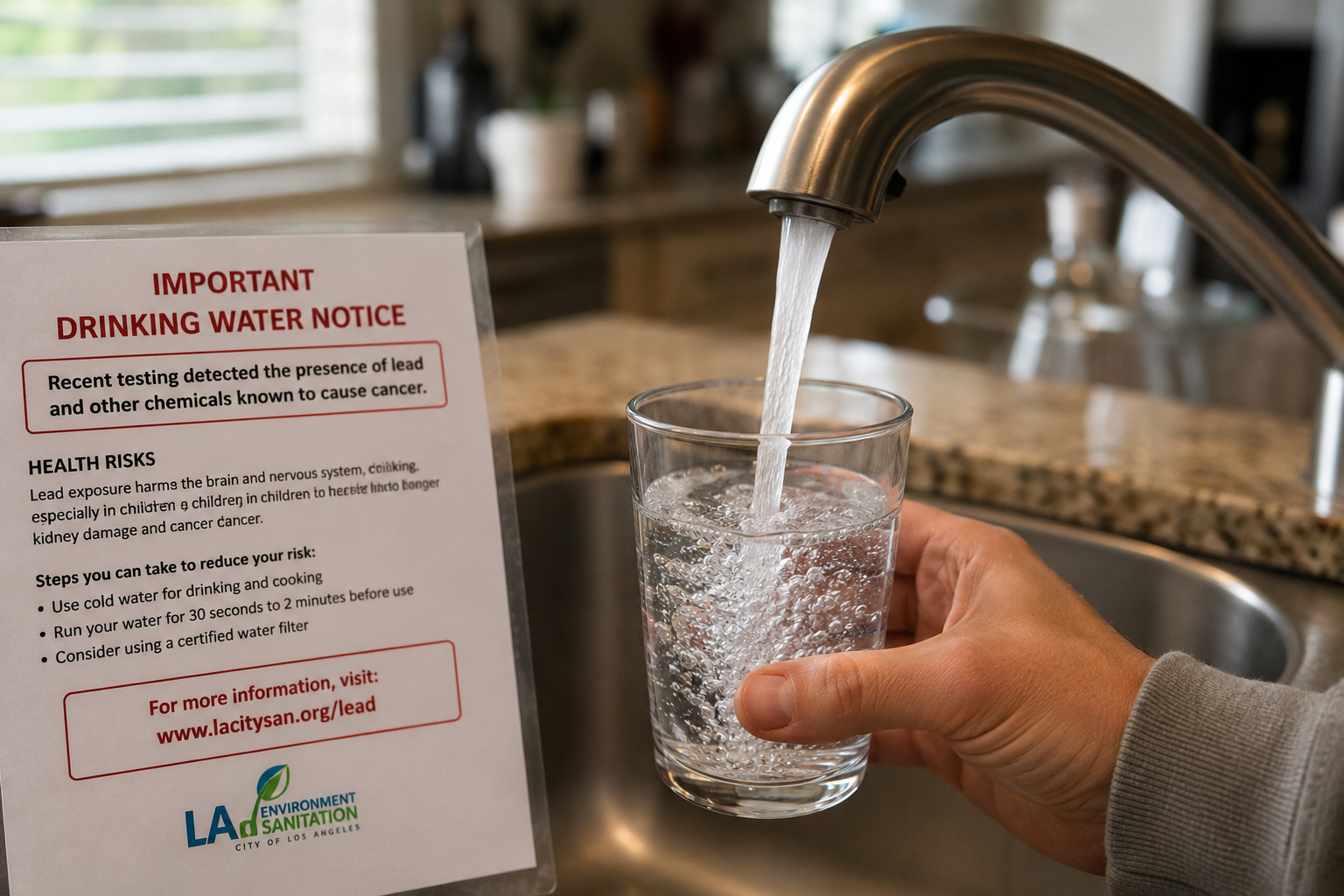
    LOS ANGELES — In a unanimous 10-0 vote that sent shockwaves through City Hall, the Los Angeles City Council has demanded an immediate investigation by the Department of Water and Power (LADWP) and the city’s Housing Authority after samples of drinking water in the Watts neighborhood were found to contain elevated levels of lead. The discovery has drawn national comparisons to Flint, Michigan — where a decade-long water contamination crisis poisoned a generation of children — and has raised urgent questions about the safety of tap water across one of America’s largest and most densely populated cities.

    An analysis of LADWP’s own 2026 water quality data, reviewed by the Environmental Working Group (EWG), reveals a troubling picture: several contaminants are present at levels that exceed the EWG’s health guidelines, even if they remain within the EPA’s more permissive regulatory limits. The distinction matters enormously for public health — particularly for children, pregnant women, and communities with the least access to filtered or bottled water alternatives.

    Lead in Watts: The Crisis That Triggered a City Council Vote

    The Watts neighborhood — one of Los Angeles’s most historically marginalized communities, with a majority-Black and Latino population — has experienced chronic environmental health challenges for decades. The discovery of lead in tap water samples collected from Watts public housing units was not entirely surprising to residents who have complained about water quality for years. What was surprising was the speed and unanimity of the City Council’s response: a 10-0 vote demanding emergency action.

    Lead is a potent neurotoxin. There is no safe level of lead exposure for children, according to the CDC, which lowered its reference blood lead level threshold to 3.5 micrograms per deciliter (mcg/dL) in 2021 — acknowledging that even previously “acceptable” levels cause measurable cognitive and developmental harm. For children under 6, whose brains are still developing, lead exposure causes irreversible reductions in IQ, increased impulsivity and aggression, and long-term learning disabilities.

    The primary suspected source of the lead in Watts’s water is aging infrastructure: lead service lines and lead solder in the plumbing of older buildings. Many housing units in Watts were constructed before 1978, the year lead-based paint was banned nationally, and before the widespread replacement of lead plumbing. When water sits in lead pipes overnight, it leaches the metal, delivering it straight to the morning’s first glass or the baby’s formula.

    Beyond Lead: Chromium-6 and PFAS in LA’s Water Supply

    Lead is not the only contaminant of concern in Los Angeles’s water. The LADWP’s 2026 water quality data shows that Chromium-6 — the carcinogenic industrial chemical made internationally infamous by the Erin Brockovich case — has been detected in LADWP water at levels below California’s proposed regulatory standard of 10 parts per billion (ppb), but significantly above the EWG’s health guideline of 0.02 ppb, which is based on National Toxicology Program studies linking chromium-6 to gastrointestinal tumors.

    The sources of chromium-6 in LA’s water include natural chromium in the geology of Eastern Sierra source water areas, historical industrial use of chromium compounds in the San Fernando Valley, and regional industrial contamination that has leached into groundwater. Standard activated carbon filters — like Brita pitchers used by millions of Americans — do not remove chromium-6. Only reverse osmosis or anion exchange resin filtration systems are effective.

    PFAS (per- and polyfluoroalkyl substances, commonly called “forever chemicals”) contamination is also a growing concern in the greater LA region, particularly in groundwater sources in the San Gabriel and San Fernando Valleys. PFAS are associated with kidney cancer, thyroid disease, immune suppression, and developmental harm in children. For more information on PFAS in drinking water, visit the EPA PFAS resource page.

    Who Is Most at Risk — and What They Can Do

    The residents most at risk from LA’s water quality issues are those who lack the economic resources to purchase bottled water, install filtration systems, or move to neighborhoods with newer plumbing. That demographic overwhelmingly overlaps with the populations already bearing the greatest burden of environmental harm in Los Angeles: low-income communities of color in South LA, East LA, and the San Fernando Valley.

    For residents concerned about lead exposure specifically, the following precautions are recommended by the Los Angeles County Department of Public Health and the EPA:

    • Use only cold tap water for drinking, cooking, and making baby formula. Hot water leaches more lead from pipes.

    • Flush your tap for at least 30 seconds to 2 minutes before using it for the first time each morning, or after extended periods of non-use.

    • Consider installing an NSF-certified water filter rated specifically for lead removal. Pitcher-style filters (Brita, Pur) do NOT reliably remove lead. Look for filters certified under NSF Standard 53.

    • Have children under 6 and pregnant women tested for blood lead levels. Talk to your pediatrician or call the LA County Department of Public Health.

    Residents can also request a free lead-in-water test kit from the LA County Department of Public Health. More information is available at publichealth.lacounty.gov.

    Conclusion: The Watts Crisis Is a Preview of a Citywide Reckoning

    The Watts water contamination episode is not an isolated plumbing problem. It is a symptom of a systemic failure to prioritize infrastructure investment in communities that have long been told their concerns would be addressed “eventually.” Flint, Michigan waited years for “eventually.” The lesson from Flint — that regulatory compliance thresholds protect utilities, not people — must not be repeated in Los Angeles. The EWG’s data makes clear that LA’s water contains chemicals that exceed science-based health guidelines even when they technically comply with EPA rules.

    A city as wealthy and as large as Los Angeles has both the resources and the obligation to close the gap between what the law permits and what public health demands. The unanimous City Council vote is a first step. The work of actually replacing aging lead lines, upgrading filtration, and ensuring equitable access to clean water for all 4 million residents of the city is the much harder task that lies ahead.

    RELATED ON MEDICALDAILY.COM

    Flint Happened There. Now It’s Los Angeles: The Ongoing Lead and Toxic Chemical Crisis in LA’s Drinking Water

    What Are PFAS “Forever Chemicals” and Why Are They in Your Drinking Water?

    Lead Exposure in Children: The Invisible Epidemic Still Harming American Kids

    Chromium-6 in Drinking Water: A National Problem with Local Consequences

    Source link

  • A Guided Walking Meditation to Notice the Beauty Around Us—Even in the City

    A Guided Walking Meditation to Notice the Beauty Around Us—Even in the City

    This guided walking meditation from Kazumi Igus offers an opportunity to slow down and notice the wonder of the natural world in our urban environments.

    City life can often feel frantic, loud, and cut off from natural beauty. It’s not often we slow down and take in all there is to experience. But even in urban areas, if you pay attention, you can hear the call of a bird, notice your favorite color in shop windows, and look up at the vast sky above. 

    In this guided meditation, we slow our roll and take in the beauty of our surroundings, no matter where we find ourselves.

    A Guided Walking Meditation to Notice the Beauty Around Us—Even in the City

    Read and practice the guided meditation script below, pausing after each paragraph. Or listen to the audio practice.

    1. Let’s start with taking three deep breaths. 
    2. As we begin, I want to bring your attention to how you are moving if you’re walking through the city or trying to get from one place to another. How fast are you moving? How are you walking? What’s your pace? Do you have a destination and a timeframe? Or do you have some space? Wherever you are, slow it down just a little bit. If you can afford to walk really slow and won’t hold up traffic, you’re welcome to. And if you’re not walking and you’re in a wheelchair, you’re welcome to slow down. If you really need to be somewhere, try to relax into this space, whatever it is. Slow and steady, but maybe not too slow depending on where you are. 
    3. Bring your attention to how you are walking—your balance. Are you taking a step? Start to notice the small changes, the muscles involved. And whatever you’re thinking, all of it is OK. You’re just noticing where you are in this space right now. 
    4. Then, acknowledging that our minds sometimes race and we have a lot of things going on in our lives, just take a deep breath and bring your attention back to each step. Start to settle into a rhythm. Notice every muscle that’s involved with creating this locomotion to propel you forward and shift your weight. Maybe if you’re in a wheelchair, you’re using your arms. How are the hands involved? Are you holding something? Maybe a backpack, bag, or someone’s hand. Focus on really being present with your physical space, your physical body. Take a deep breath. As we move through our urban environment, we start to notice other things outside of ourselves. 
    5. The first thing I want you to bring your attention to is the smell around you. Depending on where you are, that can be pleasant or unpleasant. Breathing in, can you identify a particular smell? Maybe you’re getting a lot of smells all at once. Maybe you notice the change in smells as you move past different areas. And as you experience these smells, notice what you’re thinking. Are you creating a story? Are you finding yourself wanting to be near a pleasant smell or maybe pushing away, trying to avoid an unpleasant smell? If that’s the case, that’s all right. All of it is normal. Just experience the smell and label it as pleasant, unpleasant, or neutral. See if you can identify pizza, poop, grass, or whatever it is. 
    6. Then take a deep breath and shift your attention to sights. What can you see? Start by focusing on a color that brings you joy. If it’s a bright color you might notice it in wrappers from candy or chips, maybe in ads, signs, storefront windows that have lots of flyers. If it’s something more earthy, like green or brown, you might start to notice it in nature—the trees and plants. Just pick your color and start noticing it on your journey. Even if the color is on a man-made object like clothing, hats, backpacks, signs, and things like that, that’s a part of the urban environment. If it’s flowers, trees, plants, we’re just noticing the natural portions of the urban environment. Both are necessary. 
    7. Taking another deep breath, we shift to looking at nature. Starting with animals. And for this, let’s maybe not focus on people and their pets. Let’s look for the animals that exist in this environment without being owned by a person. You might notice lizards depending on where you are in the world, cats that don’t have owners, squirrels, insects. 
    8. I’d like to bring your attention to the birds. Birds are what we call an indicator species. They tell you if your environment is healthy. So look up. Look around. Listen. You might even need to stop for a moment. If you can hear birds, start to listen for the variations in their calls, maybe even a different species. If you have mockingbirds, sometimes it’s the same bird making a bunch of different calls. Really stop to listen to it as though they’re telling you something. If the sound of traffic muffles some of the calls, it’s OK. The urban environment is complex. It has both manmade and natural things. If you can see the birds, notice their behaviors, the coloration, and any other details that might pop out at you. And notice your thoughts while seeing or hearing the birds. You might be able to see or hear seagulls if you’re near a coast, rock doves, a.k.a. pigeons, finches, sparrows, chickadees. Notice if you can identify any of these species by site or by call. Take a deep breath, noticing where the birds are. Probably in plants, trees, bushes, or on grass. 
    9. Those of us who live in urban environments often have plant blindness and don’t notice the plants. Take a moment to notice leaves and if you can see any patterns in how those plants are growing. Are there any flowers? Maybe you can recognize a specific species. Can you name it? Take a deep breath. Experience being around plants and animals in nature. 
    10. And as you continue moving keep noticing your color, new plants, new animals. Notice what you’re thinking and if you’re telling yourself a story or if you’re asking a lot of questions. And if you are, take a deep breath and then focus back on the details of the experience—the shape of the leaves, the color of the feathers. As humans, we cannot survive without the natural parts of the environment. So it’s very important for us to be mindful of how our movement through the world affects the nature around us and how the nature around us can affect our experience. Take another deep breath. If there’s a big tree or a squirrel that’s standing there looking at you, or a plant that’s intriguing, take a moment to stop. 
    11. Be grateful for its part of this urban environment. Expressing some gratitude that you are even able to experience it today. Taking a deep breath. Finding your walking rhythm. Slow but steady, or whatever works for you. Continuing to notice your color, plants, the animals. And continuing to take deep breaths. 


    Source link

  • Home Sweet Staycation: How to Turn Your Current City into a Mini Vacation

    Home Sweet Staycation: How to Turn Your Current City into a Mini Vacation

    Introduction

    Are you tired of the same old routine and craving a break from the daily grind? Do you think that taking a vacation means traveling to a far-off destination? Think again! A staycation is a great way to take a break without breaking the bank or leaving your current city. In this article, we’ll explore the concept of a staycation and provide you with tips and ideas on how to turn your current city into a mini vacation.

    What is a Staycation?

    A staycation is a vacation where you stay in your own city or hometown, rather than traveling to a different location. It’s a great way to explore your local area, try new things, and relax without the hassle and expense of traveling. Staycations can be just as enjoyable as traditional vacations, and they offer a unique opportunity to discover hidden gems and experience the best of what your city has to offer.

    Benefits of a Staycation

    There are many benefits to taking a staycation, including:

    • Saving money: Staycations are often less expensive than traditional vacations, since you don’t have to pay for transportation or accommodation.
    • Reducing stress: Staycations can be less stressful than traditional vacations, since you don’t have to worry about traveling or navigating unfamiliar places.
    • Increasing flexibility: Staycations can be tailored to fit your schedule and preferences, so you can stay for as long or as short as you like.
    • Supporting local businesses: Staycations are a great way to support local businesses and contribute to your community’s economy.

    Planning Your Staycation

    To make the most of your staycation, it’s a good idea to plan ahead. Here are some tips to help you get started:

    • Research local attractions: Look for museums, parks, landmarks, and other attractions that you may have missed or overlooked.
    • Try new restaurants: Staycations are a great opportunity to try new restaurants and cuisines that you may not have had a chance to experience before.
    • Take a tour: Consider taking a guided tour of your city to learn more about its history, culture, and hidden gems.
    • Get outdoors: Staycations are a great chance to get outside and enjoy nature, whether that means hiking, biking, or simply taking a walk in a nearby park.

    Ideas for Your Staycation

    Here are some ideas to get you started:

    • Visit a local museum or art gallery: Many cities have museums and art galleries that offer free or discounted admission on certain days of the week or month.
    • Take a cooking class: Cooking classes are a fun and interactive way to learn about new cuisines and cooking techniques.
    • Go on a hike: If you live near a park or nature reserve, consider going on a hike to get some exercise and enjoy the scenery.
    • Attend a local event: Check out local event listings to see what’s happening in your city, from concerts and festivals to markets and street fairs.

    Making the Most of Your Staycation

    To make the most of your staycation, it’s a good idea to approach it with a tourist mindset. Here are some tips to help you do just that:

    • Be open-minded: Be willing to try new things and explore new places, even if they’re not typically on your radar.
    • Take your time: Staycations are a chance to slow down and enjoy the moment, so be sure to take your time and savor the experience.
    • Get off the beaten path: Consider exploring neighborhoods or areas that you may not have visited before, to discover new hidden gems and unexpected delights.
    • Take plenty of photos: Staycations are a great opportunity to capture memories and create a sense of nostalgia, so be sure to take plenty of photos along the way.

    Conclusion

    In conclusion, a staycation is a great way to take a break from the daily grind and explore your local area. By planning ahead, being open-minded, and approaching your staycation with a tourist mindset, you can make the most of your time and create lasting memories. Whether you’re looking to save money, reduce stress, or simply try something new, a staycation is a great option to consider. So why not give it a try? Start exploring your city today and see what hidden gems you can discover!

    FAQs

    Q: What is a staycation?
    A: A staycation is a vacation where you stay in your own city or hometown, rather than traveling to a different location.
    Q: How can I plan a staycation?
    A: To plan a staycation, research local attractions, try new restaurants, take a tour, and get outdoors. You can also consider taking a cooking class, attending a local event, or visiting a local museum or art gallery.
    Q: What are the benefits of a staycation?
    A: The benefits of a staycation include saving money, reducing stress, increasing flexibility, and supporting local businesses.
    Q: How can I make the most of my staycation?
    A: To make the most of your staycation, approach it with a tourist mindset, be open-minded, take your time, get off the beaten path, and take plenty of photos.
    Q: Can I take a staycation alone?
    A: Yes, you can take a staycation alone. In fact, staycations can be a great way to spend quality time with yourself and recharge your batteries.
    Q: How long should a staycation be?
    A: A! staycation can be as long or as short as you like, depending on your schedule and preferences. You can take a staycation for a weekend, a week, or even just a day.
    Q: Can I take a staycation with my family?
    A: Yes, you can take a staycation with your family. Staycations can be a great way to spend quality time with your loved ones and create lasting memories.
    Q: What if I’ve already explored my city?
    A: Even if you think you’ve already explored your city, there’s always something new to discover. Consider trying a new restaurant, taking a different tour, or exploring a new neighborhood to find hidden gems and unexpected delights.
    Q: Can I take a staycation on a budget?
    A: Yes, you can take a staycation on a budget. Look for free or low-cost activities, consider taking a picnic instead of eating out, and take advantage of discounts and promotions to make the most of your staycation.