All orders are protected by SSL encryption – the highest industry standard for online security from trusted vendors.
Start Your Somatic Reset Now — And Give Your Body The Calm It Deserves is backed with a 60 Day No Questions Asked Money Back Guarantee. If within the first 60 days of receipt you are not satisfied with Wake Up Lean™, you can request a refund by sending an email to the address given inside the product and we will immediately refund your entire purchase price, with no questions asked.
If you’re feeling restless before bed or in the middle of the night, try this extended practice to soothe racing thoughts and ease tension in the body.
There are so many reasons why we might struggle to get to sleep and stay asleep. Work or relationship stress, health concerns, hormonal changes, the state of the world—there’s plenty to keep us awake at night.
Here, Mark Bertin offers a soothing sleep practice to help soften our restlessness, using the breath as a calming anchor to gently allow our busy minds and tense bodies to rest.
This is a great go-to practice to keep as part of your regular sleep routine, or whenever you need support to settle mind and body. The more you do it, the more it will signal to your brain and body that it’s time for rest.
A Meditation to Settle Mind and Body for Sleep
Read and practice the guided meditation script below, pausing after each paragraph. Or listen to the audio practice.
Find a comfortable posture, typically lying on your back. Allow your arms and legs to fall gently to the side. If this posture isn’t comfortable for you, then find another posture you’ll be able to relax into over the course of this meditation.
Keep your eyes open if you like, or allow them to lightly close. Begin the practice by taking a few deeper breaths and focusing as best as you’re able on that physical sensation your body makes with each breath, noting perhaps the rising and falling of your belly and chest. Perhaps a movement of the back of your body against whatever surface you’re lying on.
Let go of any sense that you’re trying to make anything specific happen. We can’t force ourselves to relax any more than we can force ourselves to sleep. But using that sense of physical movement that your body makes with each breath as a place to lightly anchor your awareness and attention.
Your mind may stay busy for now, and that’s normal. With a sense of gentleness and care, each time you notice your mind caught up in an emotional state or some pattern of thinking, simply come back with that sense of gentleness. You can say: I am aware I’m breathing in and aware I am breathing out.
We’ll begin a guided body scan in which we’ll be paying attention to different parts of our body, both as a way to bring our mind back from its thinking and the places it wanders and also as an opportunity to relax our body physically.
Start by bringing your awareness to your feet. You might notice touch or temperature. If you’re covered by a blanket, you might notice the sensation of the blanket draped over your feet and. For the next few minutes, when your mind wanders, bring your awareness back to your feet and let go a little bit of any tension or tightness you notice in your feet. No need to do anything with them, no need to move them around.
Notice any sense that you’re getting wound up a little bit, that you are caught up in the need for sleep or wanting things to be different than they are. So make that sense of care and letting go part of this practice, too. You can’t force that away, but noticing it’s part of the experience now and returning again to the sensation of your feet wherever they’re lying right now.
Next, move your awareness from your feet up into your lower legs. Relax them if you notice anything tight or uncomfortable. Stay patient with yourself as best as you’re able.
Next, move attention into your knees and your upper legs. Notice where your thoughts go or where your awareness wanders. Come back as many times as you need.
Next, move your awareness through your pelvis and your buttocks. Up into your lower back. Noticing the pressure against the bed or wherever you’re lying. Maybe there’s a sense of movement with each breath.
If at any point, because of discomfort or anything else, you feel like you need to make a little physical adjustment, that’s normal and that’s okay too. Maybe settling and observing for a few breaths, and then with a sense of intention, make whatever adjustment you need to make next.
Now, move your awareness into your upper back—aplace many of us hold a lot of tension and tightness. Respect that and pay attention to it, while also letting go and relaxing whatever you find available right now. Stay patient with your mind for staying busy and come back to your body as many times as you need.
Next, move your awareness to your belly. Note if you like the gentle rising and falling of your belly with each breath. Note any other physical sensations that might be happening now in this part of your body. Often in the belly, we also encounter some reflection of our emotional state. Note that and let go a little bit if you can—not forcing it away, but recognizing it and releasing a little bit if you’re able to do that right now.
Now, shift your awareness into your chest. Keep using that same perspective of observing patience. Note the movement as your body breathes. Note any reflection of your emotional state in this moment. And then without forcing anything, see if you can sustain that awareness and let go a little bit around it. Ease up if there’s a sense of tightness or tension there.
What if that becomes difficult? That’s okay. Simply come back to that physical movement of your body with each breath.
Now, move your awareness into your hands. Relax your hands. Ease all the muscles of your palms and the back of your hands and your fingers and let go.
When you’re ready, transition to your forearms. Then your upper arms and your shoulders with that same sense of awareness and letting go. Then your shoulders and relaxing your shoulders. Your neck and relaxing your neck. And then noticing your facial expression and the muscles of your face. And relaxing your facial expression as much as you’re able. And then the entirety of your head.
Now, expand your awareness for a few moments to the entirety of your body. Use your breath as an anchor, if that open awareness is too distracting. There’s nothing special to do right now, except as best as you’re able, noticing the state of your mind and returning to your body.
As we continue this practice with a sense of open awareness, it might be helpful to add a short mental phrase, such as I am aware I’m breathing in and aware I am breathing out. Allow your body and mind to settle into this space, not wrestling with thoughts or emotions, but perhaps engaging with them a little more gently, noticing them and coming back again to the breath as many times as you need.
Continue now, as long as you need, with this sense of body awareness and letting go, allowing things to be. There will be no ending bell. Simply let yourself drift now, into a healthy night’s sleep.
We often hear about inner calm, but it can be so much more than a fleeting moment of peace after yoga or the perfect massage. Inner calm is actually our ability to let go of attachments and reactions to life’s events, resulting in ease and clarity.
As a mindfulness skill, inner calm is the ability to let go of attachments and reactivity based on an understanding of impermanence—the changing nature of our thoughts, emotions, and desires. When we find ourselves rushing and reacting, we can remind ourselves, This too shall pass. The purpose is not to negate what we’re feeling but to put brakes on accelerated feelings. Once we return to our inner stillness, we can look at the source of our reactivity, intimately seeing its changing nature: This right here is what frees us.
Once we return to our inner stillness, we can look at the source of our reactivity, intimately seeing its changing nature: This right here is what frees us.
As a practice, inner calm is the art of stopping, looking and letting go for purposes of healing and clarity. It involves physical composure and mental tranquility. It can be seen as the ultimate balm for your soul—like a cool breeze on a hot day. Inner calm brings ease to body and mind alike. In the body, composure is experienced in the muscles and as an overall feeling of ease. In the mind, inner calm creates the space to hold everything without attachment and resistance. Conversely, the absence of inner calm may show up as restlessness in the body and agitation or reactivity in the mind.
Seeking inner calm can often leave us wanting more, but it’s ironic that true inner calm is achieved when we let go of our desires, even the desire for inner calm itself—a catch-22 if there ever was one. This paradox becomes evident when we consider the case of a client dealing with anxiety who turned to meditation as a way to ease his mind. Surprisingly, he found himself even more anxious post-meditation. He had hoped that meditation would improve his sleep, but he was left frustrated when he observed his restlessness during a body scan meditation, which only seemed to worsen his sleep problems.
The moral here? To find peace, he had to let go first of his expectations around finding peace. In order to let go, he learned to see the three hindrances to his achieving mindfulness: running in circles (a restless mind), pulling (striving to sleep), and pushing (frustrated with his restlessness). With practice, he learned to accept his restless mind, which softened the striving and frustration, and he was able to find ease, even when he couldn’t sleep, which ultimately allowed him to sleep.
Letting go of attachments to certain outcomes doesn’t, however, mean that we’re suppressing or evading challenging situations. Instead, this release occurs organically when we comprehend that emotions arise and dissolve—all within ninety seconds.
The Ninety-Second Rule
Inner calm is not about suppressing, denying, or avoiding our emotions. When we don’t give in to the urge to react, we’re cultivating the ability to stay with unpleasantness (knowing that emotions are physiological responses in the body that will arise and dissolve). Just as happiness triggered by external events doesn’t last, negative emotions also don’t last. Have you heard of the ninety-second rule? Neuroscientist Jill Bolte Taylor reveals in her book My Stroke of Insight: A Brain Scientist’s Personal Journey that all emotions have a beginning, middle, and end—all within ninety seconds from when they first arise.
The reason we continue to experience negative emotions, sometimes for days, weeks, and even years, is that we continue to fuel these feelings with our narratives. Instead, if we stop and let the emotion move through our body, we’ll create space in our minds to better understand what they are trying to tell us. Rather than suppressing or using positive thinking to bypass our experience, we can form an alliance with our feelings. By doing this, we can uncover how they’re trying to protect us, address our unmet needs, or draw our attention to new information in the environment.
The ninety-second rule is a helpful reminder to ride the waves of our emotions, but emotions can sometimes be so powerful that they hijack our rational thought processes. It’s helpful in these situations to remember where those emotions come from—deep in the past, when we were hunter-gatherers facing real tigers!
How Inner Calm Supports Resilience
So much of our lives are marked by perceived threats to our identity, career, or relationships. Our primal reactions—fight-flight-freeze—can be unhelpful when it comes to navigating these everyday psychological and social stressors. What’s needed to resolve problems common to the modern world is clarity and creativity, but our reaction is the opposite—to fight, flee, or freeze. This evolutionary response to any threat is automatic and unconscious.
What’s needed to resolve problems common to the modern world is clarity and creativity, but our reaction is the opposite—to fight, flee, or freeze.
When our emotions are triggered such that we can’t think or see clearly, it’s called an “amygdala hijack”—a term popularized by emotional intelligence expert Daniel Goleman. The amygdala is the emotional center of the brain. One of its functions is to scan the environment for threats and prepare the body for an emergency response. When it perceives a threat, such as a tiger lurking in the bushes, it sends an immediate signal to release stress hormones—adrenaline and cortisol—that ramp up an emergency response. Blood stops flowing to the organs and instead floods into the limbs to prepare us for fight or flight. Meanwhile, the prefrontal cortex (which is responsible for thinking and executive decision-making) shuts down because there is no time to think and analyze when we’re facing what the brain perceives as a life-threatening situation.
During an amygdala hijack, it is said that our IQ temporarily drops by ten to fifteen points. Maybe this explains that feeling after we’ve reacted to a verbal trigger: What was I thinking when I said that? That’s exactly the point. We stop thinking rationally. It also compromises memory, which is why we can’t remember a single good thing about a person with whom we have a conflict or why we can’t find our keys in the middle of a panic attack. Being in a continuous state of fight or flight from modern threats also compromises the integrity of other systems, like immunity and digestion.
Cultivating inner calm is an important step in avoiding the amygdala hijack so we can think clearly even in highly charged situations. Using practices to promote inner calm—like breath awareness—helps slow our escalating emotions and allows the parasympathetic nervous system to kick back in so we can once again think clearly. Another activity that nudges the prefrontal cortex to start thinking again is “noting” or “labeling.” The act of noting or labeling our emotions gets the prefrontal cortex to regain healthy communication with the amygdala and avoids the hijack. Inner calm offers opportunities to learn and improve or for us to provide a deeper understanding of the “what” and the “why” behind our actions. We can replace tension and misunderstanding with harmony and understanding. Inner calm is key for resilience in relationships and life in general.
Where Are You on the Inner Calm Continuum?
You can strengthen your ability for inner calm, regardless of your circumstances. First, pay attention to when you’re calm and when you’re not. Next, notice the causes and conditions that promote calm and what stops you from being calm. By cultivating a habit of calming the mind and body, you’ll develop the ability to access this place more quickly and easily.
Daily Practice: One-Minute Rest
Rested, we care again for the right things and the right people in the right way. —David Whyte
Take time in your day, several times a day, if possible, to empty your cup and make space for what matters. You can do this very quickly by checking in with your body.
Any tension or tightness in the body is a clue that you’re holding on to something that needs your loving attention. You can’t let go without knowing what it is you’re trying to let go. Just turning your attention to places you’re holding tension can help you uncover the emotions and thoughts associated with that tension.
Once you can see the cause of your tension, you can figure out the solution. It’s also clarifying to realign with your intentions as you’re emptying your cup—what is it you’re clearing the space for?
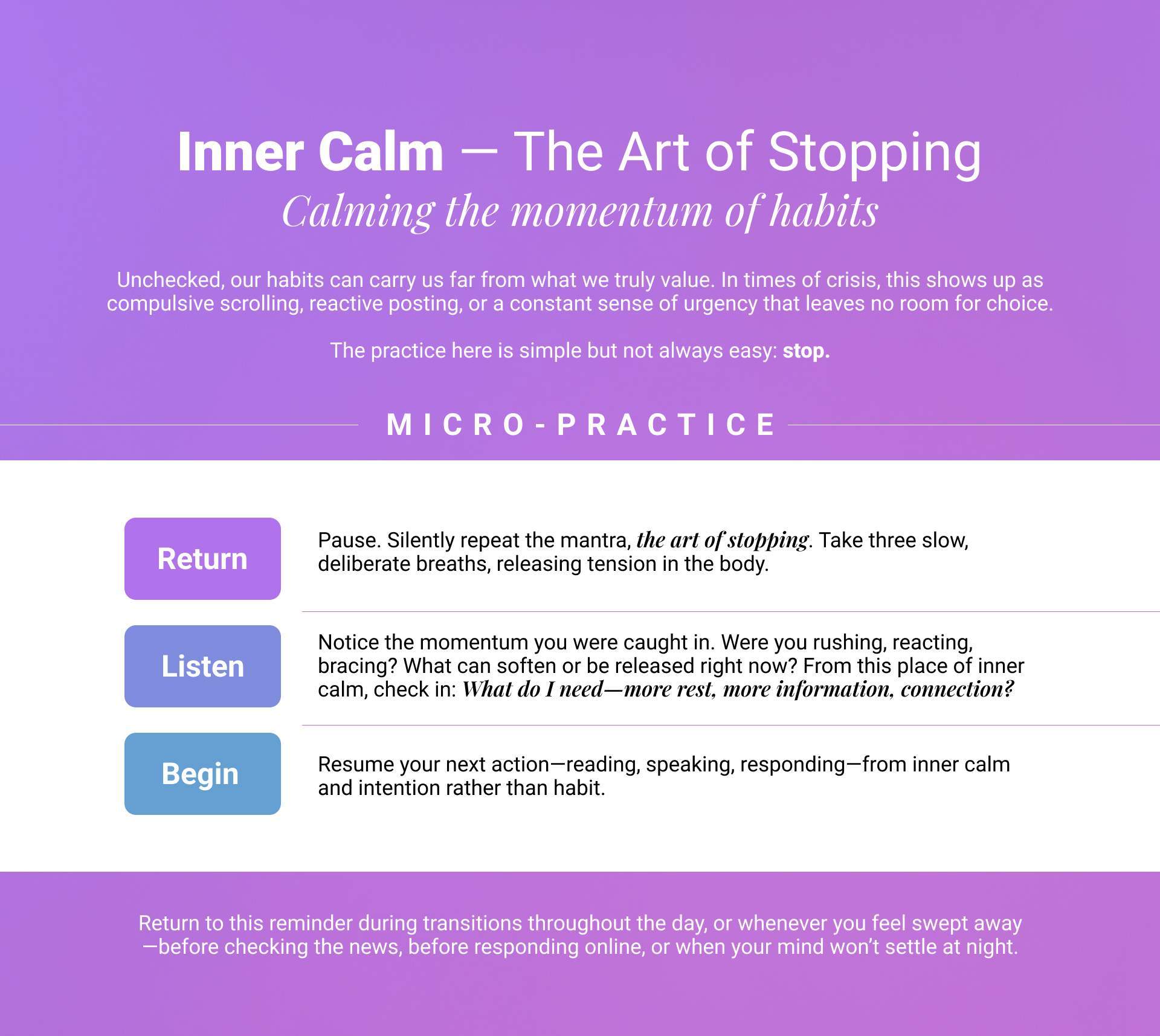
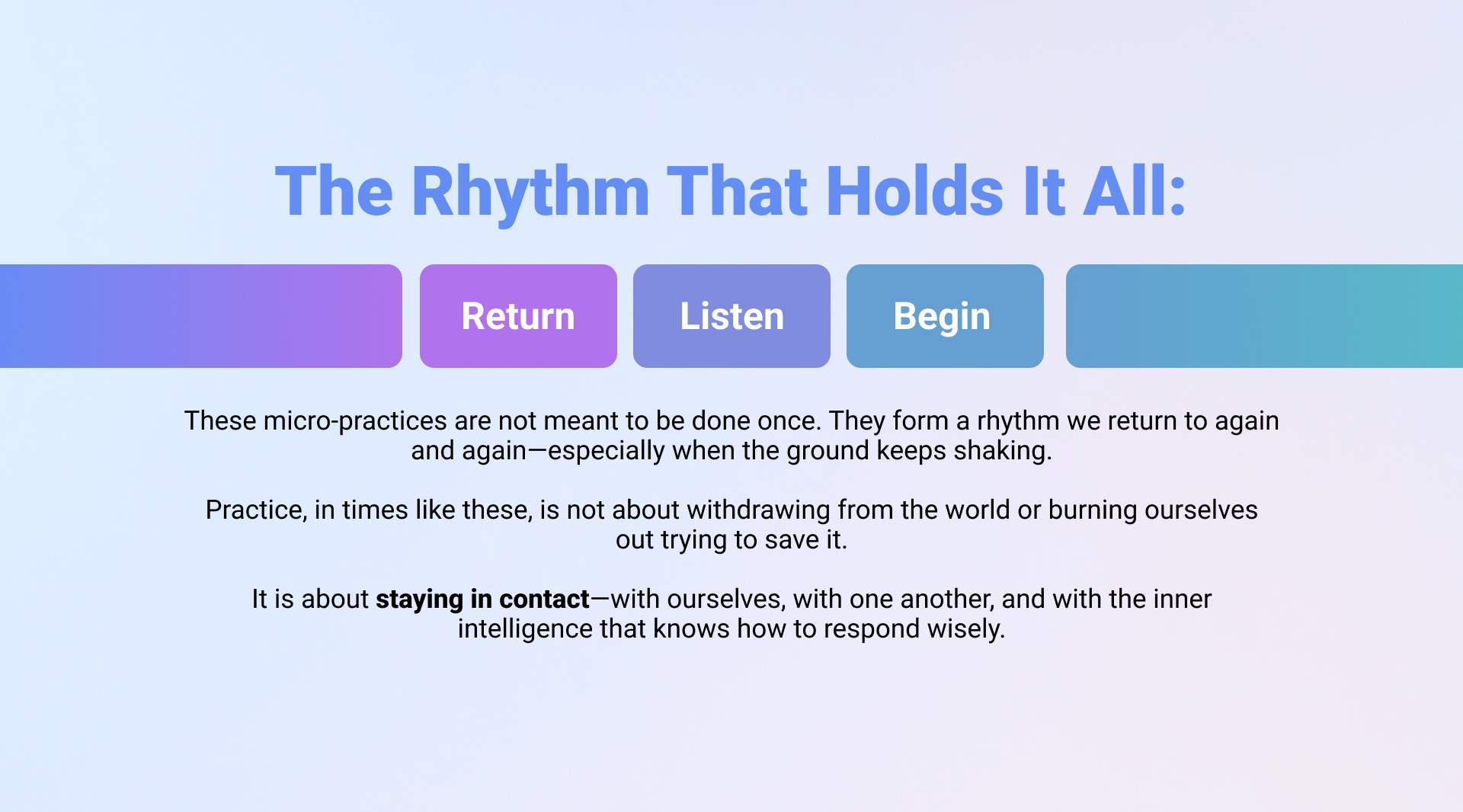
Return. Take a one-minute rest and return to your body. Rub the palms of your hand and place them on your eyes, allowing them to rest. Move your hands to your jawline, neck, shoulders, chest, or wherever feels good in your body.
Listen. Listen within. What can you let go of at this moment to make room for what matters?
Begin. Begin your activities with a relaxed body and mind aligned with what matters.
Try practicing and playing with this reminder with your family, with team members, and in your community before beginning a meeting or activity together.
Equanimity is often discussed in relation to mindfulness, yet it extends beyond formal practice and into the ways we meet everyday life.
In this conversation, Margaret Cullen reflects on the ideas behind her book Quiet Strength and the five-year journey of study, practice, and dialogue that shaped it.
Angela Stubbs: Quiet Strength has been in the works for how many years?
Margaret Cullen: I guess it’s five now. Five years.
Angela Stubbs: Take us back five years. Set the stage. What was going on in your life when the idea for this book began to settle in?
Margaret Cullen: Oh, thank you for asking. I haven’t been asked that before. I did talk about it a little in the book’s prologue. I had begun teaching workshops on equanimity close to 10 years before I started writing the book, and about five years ago an editor at New Harbinger reached out to me to write a second book. I wasn’t sure if I wanted to do that.
But then the idea came to me: a book about equanimity could be really interesting and useful. There were already so many books on mindfulness and quite a number on compassion. Although I had been teaching and writing about both for years, I wasn’t sure I had anything to add to that literature. Very little had been shared on equanimity. That was part of why I got interested in teaching it in the first place. It wasn’t addressed much in either the Buddhist circles I’d been practicing in for decades or in the mainstream mindfulness world.
It was time for a deep dive into this quiet virtue that’s been hiding in plain sight for 2,600 years.
I got excited and went back to New Harbinger, and they said no. They wanted a workbook. I didn’t want to write a workbook. It wasn’t time for a workbook. It was time for a deep dive into this quiet virtue that’s been hiding in plain sight for 2,600 years.
Angela Stubbs: I really love this sense of inner knowing you had, declining the workbook and following something deeper. It feels like an intuitive process. Can you talk about that, what that felt like?
Margaret Cullen: I found myself led by the book, which was a fascinating and surprising process. Very early on, the book had its own ideas. I discovered that I was following the book’s lead. The book said, “No, not a workbook”, “No, not New Harbinger”, “No, this is what I want to be.” By following the book’s lead, it became something much bigger, deeper, and richer than I could have imagined on my own.
That was quite remarkable. It led me to an agent, a big publishing house, and an editor who had a beautiful vision for the book. I felt like the book led, and I was always half a beat behind it.
Angela Stubbs: As the book began to take shape, you were also wrestling with the lineage and doctrinal differences around equanimity and mindfulness. How did those conversations, including your exchange with Sharon Salzberg, influence the direction the book ultimately took?
Margaret Cullen: Originally, I planned to write a chapter exploring the doctrinal relationship between mindfulness and equanimity. I’ve been tracking that debate for more than twenty years, beginning when I was co-teaching with Alan Wallace, who defined mindfulness quite narrowly as sati, simply as remembering to return to the present moment.
But at a certain point, I realized the scholarship wasn’t helping illuminate lived experience. So I tried to simplify the question.
In the insight tradition, mindfulness includes an attitudinal quality. It isn’t just returning to the present moment. It’s returning in a particular way, with non-judgment, spaciousness, allowing, and non-reactivity. That quality is what we call equanimity.
In one conversation, I asked Sharon Salzberg to imagine a Venn diagram: one circle mindfulness, one circle equanimity. How much do they overlap? Her answer was immediate. Completely.
I remember thinking, Really? Completely? We don’t tend to use the terms interchangeably. Yet many Western Vipassana teachers would say that without equanimity, it isn’t truly mindfulness.
In the insight tradition, mindfulness includes an attitudinal quality. It isn’t just returning to the present moment. It’s returning in a particular way, with non-judgment, spaciousness, allowing, and non-reactivity. That quality is what we call equanimity.
Angela Stubbs: Is equanimity used in traditions apart from Buddhism and mindfulness? You spoke with Tom Block about Judaism and Sufism. Are those traditions using equanimity in the same way?
Margaret Cullen: There are differences, of course, but there are also striking similarities. Equanimity appears in many traditions beyond Buddhism. We find it in Judaism, in Sufism, and in Stoicism, often expressed through a similar concern: how we relate to life’s changing conditions.
In Buddhism, this has the poetic name of the “worldly winds”: pleasure and pain, praise and blame, gain and loss, fame and disrepute. Other traditions articulate the same insight in their own language, but the essential question is the same: How do we meet the constantly shifting winds of fortune?
What surprised me was how consistently this thread runs through different traditions. If you’re coming to this with fresh eyes and know nothing about equanimity, you might be surprised to discover that it’s almost everywhere, even in some of the least expected places.
Angela Stubbs: You’ve said equanimity found you when you really needed it. Can you share what was unfolding then, and how equanimity began to function as a teacher for you?
Margaret Cullen: There have been several times when equanimity has appeared as a teacher for me, but the first was on a retreat with Sharon Salzberg. We had done basic mindfulness and lovingkindness practice, and then spent a week on equanimity.
In the Vipassana tradition, equanimity is often cultivated through reflecting on certain phrases. One of them invites you to imagine someone you love who is suffering and reflect: their happiness and unhappiness are the result of their thoughts, actions, and circumstances, not your wishes for them. And even so, you continue to wish them well.
That was a complete revelation to me.
I worked with those phrases in both sitting and walking practice. One morning after breakfast, I was walking in the desert in Southern California, during that exquisite, fleeting springtime in Joshua Tree. I wasn’t formally meditating, but the phrases had taken on a life of their own.
I thought of my mother, and the phrase arose: I am not responsible for her happiness. And not only that, I could still love her and wish her well. It wasn’t a binary choice between taking responsibility for her happiness and being a bad daughter.
My mother struggled with depression and other mental health issues. As long as I could remember, it had felt like my job to make her happy. It was an impossible task, and by my twenties, I had become more and more depressed myself because I was failing at it.
In that moment, seeing clearly that, oh my goodness, I can’t control her happiness, was incredibly liberating. It sounds obvious now. But at the time, it was a revelation. And, beyond that, it is neither disloyal nor unloving to let go of this futile effort.
We come to believe that loving someone means managing their emotional state…Equanimity is love without attachment: to outcomes, to roles, to what I need from you, to how I need you to be, even to needing you to be happy.
Angela Stubbs: Many of us feel responsible for the happiness of people we love, especially within family. How does equanimity shift that dynamic?
Margaret Cullen: Women, of course, have been inculcated to be caregivers in roles as mothers, wives, sisters, and daughters. Those stereotypical roles, which hopefully my daughter’s generation, maybe your generation, Angela, is breaking out of, have given us distorted pictures of what it means to love.
In my mother’s case, and often with our children, we take on responsibility for their happiness. We come to believe that loving someone means managing their emotional state.
But Buddhism is fundamentally a path of connecting with reality. There’s no safer ground to stand on than reality. And the reality is that I am not responsible for your happiness.
These equanimity phrases expose how easily attachment masquerades as love. In Buddhism, attachment is considered the near enemy of lovingkindness. Without careful attention, we conflate the two. We accuse others of not being loving when they’re not expressing attachment, and we feel guilty ourselves when what we’re feeling is attachment, not love.
Angela Stubbs: Can you unpack that a bit more?
Margaret Cullen: Equanimity is one of the Four Immeasurables in Buddhism, along with lovingkindness, compassion, and sympathetic joy. They’re all aspects of love. So equanimity is love without attachment: to outcomes, to roles, to what I need from you, to how I need you to be, even to needing you to be happy.
It acknowledges your complete sovereignty over your own life. Even that language can be misleading, because I don’t grant or withhold your freedom. I never had that control in the first place. The belief that I do isn’t aligned with reality.
That’s where our ideas about love get tangled. We confuse attachment with care.
The author with her forthcoming book, out March 10, 2026.
Angela Stubbs: In the world we’re living in now, where there’s always something to care about, how do you work with equanimity as a tool in difficult times?
Margaret Cullen: Having just written a book about it and being interviewed about it, I have unique pressures on myself, and from my friends and family, to be equanimous. The good news is we can turn that into a joke. Humor is actually a great doorway into equanimity.
I’m reaching for it a lot these days. There are also a few cognitive hacks that I use very frequently. They’re related to the three characteristics in Buddhism that are very close to my heart and central to my practice.
Angela Stubbs: Tell us about the hacks.
Margaret Cullen: First, I ask: Is this situation as personal as I’m making it? As meditators, we taste non-self, the experience of being connected to all things. And yet we walk around in our separate, contracted egos. It’s a reminder that there’s another way of relating to experience.
Second, impermanence. If I’m caught in reactivity, in a moment of suffering or even joy, I remind myself that things change. I loosen my grip on attachment or aversion. That’s reality. That’s the reality I want to align myself with. Things are usually less personal and less permanent than they seem.
And third, I like this question from Byron Katie: Is it really true?
Given the current political situation, it can feel like the end of the world. We say the world is on fire. It can feel literally true. But if I step back and ask, is it actually on fire, the answer is no. That’s an expression. And that expression amplifies fear, outrage, and anxiety, and pulls us out of equanimity.
Angela Stubbs: People often misunderstand equanimity. How do you describe what equanimity is not?
Margaret Cullen: Equanimity is definitely not indifference. It’s not apathy. It’s not passivity. Those are the near enemies of equanimity.
Equanimity is not withdrawal.
I think for a lot of people who care deeply about the world, even if they understand this intellectually, emotionally, it still feels like a withdrawal. I have friends who are longtime practitioners who are afraid of equanimity. They think the world is in so much trouble that equanimity somehow forecloses their opportunity to be activists and engage with the world’s problems. That’s a very important misunderstanding. It’s deep and pernicious. Equanimity is not withdrawal.
This is part of the beauty and paradox at the heart of equanimity. It’s caring perhaps even more deeply, not less, but draining that love of melodrama.
This is part of the beauty and paradox at the heart of equanimity. It’s caring perhaps even more deeply, not less, but draining that love of melodrama. It’s loving without attachment. We care just as much, perhaps even more, about this beautiful planet and all the people and species who are thriving and suffering upon it, but without the melodrama and the outrage. That frees up our energy to be as effective as possible in whatever way we engage.
Angela Stubbs: Earlier, we talked about the overlap between mindfulness and equanimity. If mindfulness is awareness, where does equanimity fit? You’ve described it as a kind of balance. What does that mean?
Margaret Cullen: The balance we’re talking about is dynamic. It’s not static. We’re not aiming for some frozen state. It’s more like walking. With every step we lose our balance and regain it.
Equanimity is the capacity to recover more quickly, to create space around our experience when we’re knocked off center. It’s not about being chill or detached. That becomes a near enemy. It’s about flexibility. It’s about resilience.
Angela Stubbs: The book is titled Quiet Strength: Find Peace, Feel Alive, Love Boundlessly. It wasn’t always called that. How did the title and subtitle evolve?
Margaret Cullen: I originally wanted to call the book Equanimity: The Quiet Virtue. If it had stayed small and focused only on Buddhism, that might have worked. But once the vision grew, that title no longer worked for my agent or publisher.
They first suggested Quiet Power, which I liked. Equanimity is quiet but incredibly powerful. In martial arts, power comes from fluidity and balance, not brute strength. But politically, “power” felt like a tainted word. So we landed on Strength.
The subtitle, Find Peace, Feel Alive, Love Boundlessly, is not language I would normally use. I have an aversion to telling people what to do. My language as a teacher is more invitational and provisional. This is declarative. I joked that I felt like a circus barker for equanimity.
But the book has a wider vision than my own. I’m one voice among many contributing to what it’s meant to do in the world.
Angela Stubbs: Is there anything in the book that people haven’t asked you about yet?
Margaret Cullen: Surprisingly, I’ve been asked very little about the neuroscience. No one has asked about the time I went to a lab in Arizona and had transcranial stimulation applied to my brain to supposedly engender equanimity.
Neuroscience labs that have studied mindfulness are now adding tools like transcranial stimulation and sophisticated fMRI mapping to reverse-engineer advanced states of meditation.
Angela Stubbs: That feels like a verydifferent angle on equanimity. What happened when you went into the lab?
Margaret Cullen: They stimulated my brain and asked what I was experiencing. I didn’t feel anything. I was disappointed because Shinzen Young was there, along with Jay Sanguinetti, who runs the lab at the University of Arizona. Over lunch, they described extraordinary experiences they’d had using the technology.
I wanted to feel that. I even considered changing my flight home to try again. I believe them. But I didn’t have that experience.
From my perspective, equanimity is part of some of the most cutting-edge research just beginning to unfold. It’s early. Where it ends up, nobody knows.
Margaret Cullen is a licensed psychotherapist and a pioneer in bringing contemplative practices into mainstream settings. She was one of the first ten people to be certified as an MBSR instructor and has taught around the world. As a therapist, she facilitated psycho-social support groups for cancer patients and their loved ones for over 30 years.
She also developed Mindfulness-Based Emotional Balance and co-authored a book about it with Gonzalo Brito Pons. She was a Senior Teacher and Curriculum Developer for Humanize, a contemplative-based dyad program founded by German neuroscientist Tania Singer. Margaret is a Mind and Life Institute Fellow, on the advisory board of the Global Compassion Coalition, and has been a meditation practitioner for over 40 years.You can findQuiet Strength here.
Three weeks ago, I ended up in the emergency room convinced I was having a heart attack.
The chest pain had started days earlier—a tightness that wouldn’t release, difficulty taking a full breath, pain radiating down my left shoulder. I told myself it was nothing. Maybe I’d overdone it at the gym. Maybe I’d slept wrong.
I kept meditating. I kept teaching. I kept holding space for others.
I tried to breathe my way through it, the way I’ve taught thousands of people to do. But on Sunday, when my doctor’s office was closed and the pain refused to let up, my husband said gently but firmly, We’re going to the ER.
After five hours of tests and long stretches of waiting, the cardiologist came back with relief in his voice: my heart was fine.
I should have felt grateful—and I did. But I was also confused.
If my heart was healthy, what was my body trying to tell me?
Recognition: The Role of Vicarious Trauma In Bearing Witness Without Choice
If you have been paying attention to the world around you over the past months, you may be carrying more than you realize.
Images of devastation in Gaza. Israeli families living with constant fear of attack. Political violence and ICE shootings at home. Rising Islamophobia and antisemitism fracturing communities, relationships, and public life. The countless Black, Indigenous, and other people of color whose deaths rarely make headlines, whose names we never learn. And the ongoing humanitarian crises in places like Sudan, Yemen, and Iran—where suffering continues largely outside the frame of sustained media attention.
If you find yourself feeling unusually tense, exhausted, reactive, numb, or unable to turn away—even when you want to—it may not be a personal failing. It may be a natural response to prolonged exposure to suffering.
For many of us, this witnessing is relentless. Each morning brings new stories, new images, new reasons to feel alarmed or heartbroken. Even when we are not directly affected, our nervous systems are taking it in.
If you find yourself feeling unusually tense, exhausted, reactive, numb, or unable to turn away—even when you want to—it may not be a personal failing. It may be a natural response to prolonged exposure to suffering.
There is a name for this: vicarious trauma.
Vicarious trauma refers to the psychological and physiological impact of sustained empathic engagement with others’ pain. Our bodies and minds do not clearly distinguish between what we experience directly and what we absorb through continuous media exposure, graphic imagery, and ongoing moral urgency.
For others, the constant stream of suffering can feel overwhelming or futile, leading to disengagement instead. We scroll past headlines, turn off the news, or tell ourselves we need to focus on our own lives. At times, this discernment is necessary. Rest, boundaries, and self-care matter. But when disconnection becomes our primary response to vicarious trauma, something else quietly erodes.
Many people turn away not because they don’t care, but because they feel powerless. What difference could I possibly make? In the face of global crises, individual action can seem insignificant, even naïve. Shutting down can feel like the only way to survive.
Yet we live in an interconnected world where complete disconnection is an illusion. And when we disengage for too long, we don’t just lose information—we lose contact. Contact with what is happening. Contact with our own values. Contact with the small but meaningful ways care can move through us. What begins as self-protection can quietly become a loss of agency and connection.
Vicarious trauma doesn’t just make us sad or tired. It reshapes how we see the world.
Research shows that it disrupts core beliefs about safety, trust, control, intimacy, and meaning. It shows up cognitively, emotionally, physically, and behaviorally.
People experiencing vicarious trauma often report:
Brain fog and difficulty concentrating
Heightened anger, anxiety, or emotional numbness
Sleep disturbances and chronic exhaustion
Hypervigilance—always bracing for the next blow
Physical symptoms like headaches, gastrointestinal issues, and chest pain
And yes—ER visits.
But there is something more essential that is lost when we burn out or shut down.
Vicarious trauma explains the cost to our nervous systems. But underneath that is something more subtle—and more consequential: a loss of contact with our capacity to respond.
What gets lost when we engage on default—whether by over-consuming information about suffering or withdrawing from it—is not just nervous system regulation.
We lose contact.
Contact with the body as a source of intelligence. Contact with our felt sense of what is actually needed now. Contact with our agency, beyond outrage or withdrawal. Contact with our capacity to sense where our care is most skillful. Contact with our ability to stay human without hardening.
This isn’t just trauma.
It’s a disconnect from our humanness.
Oppressive systems don’t need to silence us when exhaustion and reactivity will do the job for them.
We find ourselves caught in cycles of constant witnessing or reactive outrage, or else turning away and numbing out.
And when contact is lost, connection suffers.
Connection with others. Connection with purpose. Connection with the part of ourselves that knows how to respond wisely.
Vicarious trauma explains the cost to our nervous systems. But underneath that is something more subtle—and more consequential: a loss of contact with our capacity to respond.
When we’re dysregulated:
We confuse intensity with impact
We lose the ability to imagine creative responses
We default to attack, despair, or withdrawal
What’s at stake isn’t just our well-being. It’s our capacity to imagine—and enact—responses that actually reduce suffering.
Oppressive systems don’t need to silence us when exhaustion and reactivity will do the job for them.
Collective Capacity: How Not to Lose Each Other
When this loss of contact happens at scale, movements fracture. Allies turn on one another. Nuance feels like betrayal. Strategic thinking gives way to moral reflex. The very capacities required for sustained change—discernment, patience, relational trust—begin to erode.
When we are no longer in touch with our discernment, everyone can start to look like a threat. The act of listening itself can feel like moral failure. We confuse intensity with impact, and urgency with wisdom.
This loss of contact doesn’t just exhaust us personally. It diminishes our ability to work together.
When we are no longer in touch with our discernment, everyone can start to look like a threat. The act of listening itself can feel like moral failure. We confuse intensity with impact, and urgency with wisdom.
I’ve seen this up close.
At one point, someone was publicly attacking me online—not because we disagreed about the need to end suffering, but because I was trying to hold complexity rather than take a single side. I was called complicit. My integrity was questioned. Moral failure was assumed.
Instead of reacting, I practiced inner calm, compassion, and equanimity—not to bypass harm, but to stay in contact with my own values of deep listening and seeking to understand. The next day, that same person reached out to say: “I’m sorry to have misjudged you so harshly. I’ve been exhausted, and I lashed out.”
This person wasn’t malicious. They were overwhelmed. I recognized that feeling immediately—that same overwhelm is what had landed me in the ER. The suffering they had been witnessing was real. The vicarious trauma is real. Without tools to return to contact, that pain had nowhere to go but outward.
I’ve witnessed this pattern repeatedly.
When I had tried to draft a Town Council resolution that called for ending violence while also acknowledging security concerns on all sides, it was rejected—not because people disagreed with the facts, but because in the midst of collective disconnection, holding both-and felt impossible.
This is how movements lose their strength—not through genuine disagreement about goals, but through operating from disconnection rather than from our deepest wisdom that comes from listening with care and seeking solutions that include all.
Sustained change requires more than passion. It requires capacity: the ability to engage and retreat, to stay open without collapsing, to remain connected to one another even when the work is hard.
When we lose that capacity, we don’t just lose effectiveness. We lose each other.
Recently, I was invited to a friend’s house for dinner. Simple food. Easy conversation. Board games. And yet, as I sat there, I felt a wave of guilt. How could I be laughing when so many are suffering? I noticed a flash of irritation toward the others at the table—why didn’t they seem as affected as I was? Didn’t they care?
Then I caught myself.
This guilt, this judgment—it wasn’t skillful. It wasn’t making me more effective or more compassionate. It was simply isolating me, pulling me away from the people right in front of me.
Rest is not what we do when the work is finished. It is what makes sustained engagement possible. When we gather, we are restoring contact with the aliveness that oppressive systems rely on extinguishing.
So I made a choice. I allowed myself to be there. To taste the food. To play the game badly and laugh at myself. To let the warmth of friendship soften something that had gone rigid inside me.
It was quietly liberating.
The next day, I returned to my work with more energy, clarity, and steadiness—not because anything had been solved, but because I had remembered what it feels like to be human alongside other humans.
This is not escape. This is restoration.
Rest is not what we do when the work is finished. It is what makes sustained engagement possible. When we gather with like-minded people—not to organize or persuade, but simply to cook together, laugh, play, or enjoy one another’s company—we are not avoiding the work. We are restoring contact with the aliveness that oppressive systems rely on extinguishing.
Sometimes, what returns us to contact isn’t a formal practice at all. It’s a shared meal. Music, art, or movement that reminds us we are alive. A walk where we remember that trees still grow and birds still sing—even now.
These moments are not indulgent. They are essential.
From this restored place, certain skills can help us stay in contact when we re-engage with difficulty.
Skills: Returning to Contact in Real Life
Over years of teaching and research, I came to see that mindfulness as it’s often taught—focusing primarily on meditation and non-judging awareness—is necessary but insufficient for times like these.
Calming the nervous system with meditation is only the first step. Once we re-engage, our default habits return. Without skill, we slide back into reactivity. Even if we can return to a calm, non-judging awareness, it is not enough to navigate nuanced, complex situations, often involving competing needs and worldviews.
Through my study of early Buddhist teachings and contemporary psychology, I began to understand mindfulness as a set of trainable skills—skills that help us stay in contact with what’s alive, even in the midst of suffering. They disrupt our default reactions and help us discern what is needed to respond skillfully.
Three skills become especially essential when we are bearing witness to ongoing crisis:
Inner Calm — Creating Space Without Disengaging
Inner calm is the art of stopping, looking, and letting go for purposes of healing and clarity. It softens the grip of our attachments to habitual hurrying, beliefs, and expectations that hinder our inner equilibrium.
Inner calm involves physical composure and mental tranquility, bringing ease to body and mind alike. In the body, composure is experienced in the muscles and as an overall feeling of ease. In the mind, inner calm creates the space to hold everything without attachment and resistance.
Compassion — Seeking to Understand
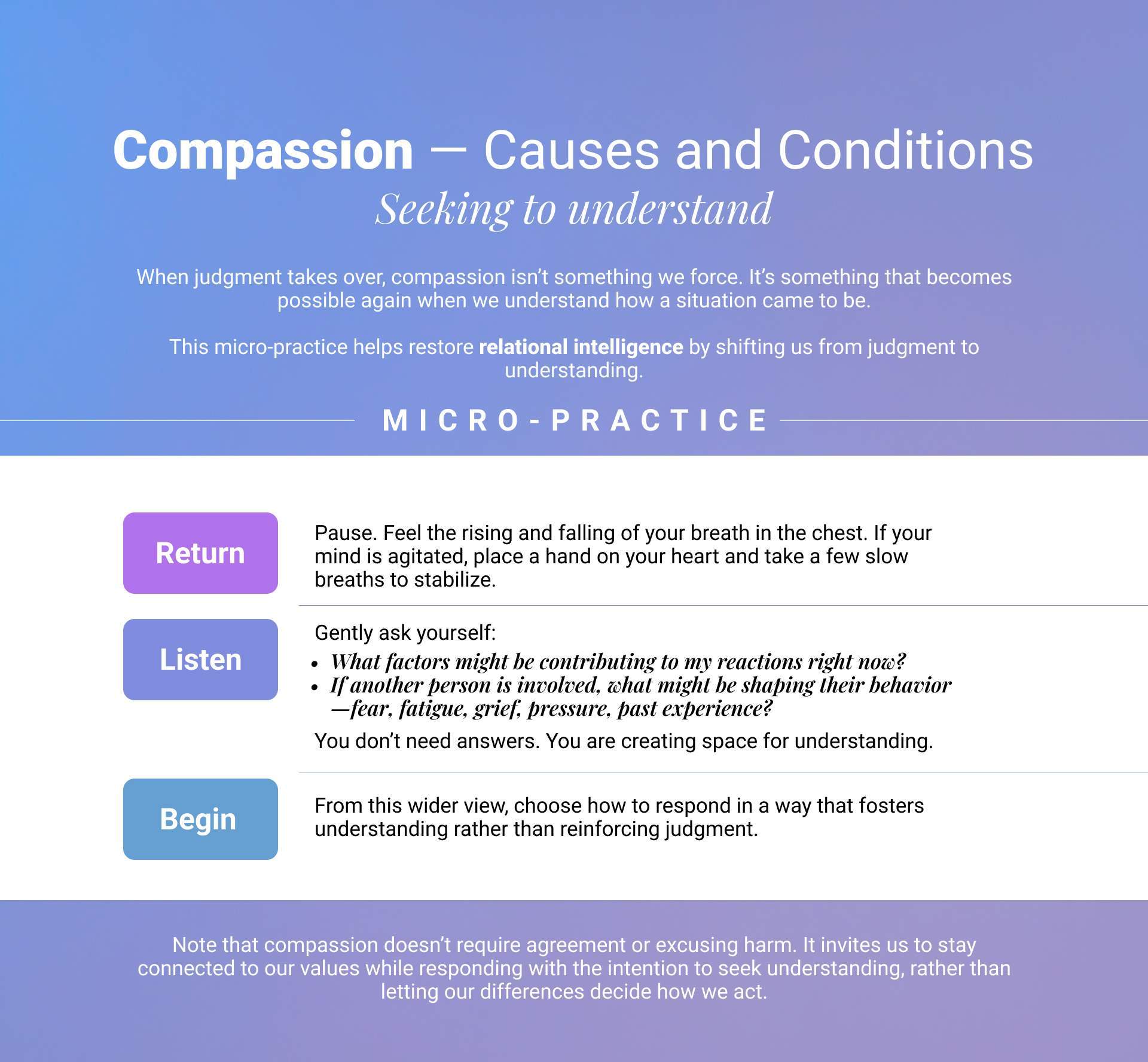
Compassion is our innate ability to feel, understand, and be motivated to alleviate suffering in ourselves and others. It disrupts our tendency to act on our automatic judgments about ourselves and others by seeking to understand.
When we lose compassion, we see enemies instead of fellow humans struggling. We attack allies for not being pure enough. We forget that we, too, are worthy of care. We lose our relational intelligence—the capacity to sense how we are affecting others and how to stay connected across differences.
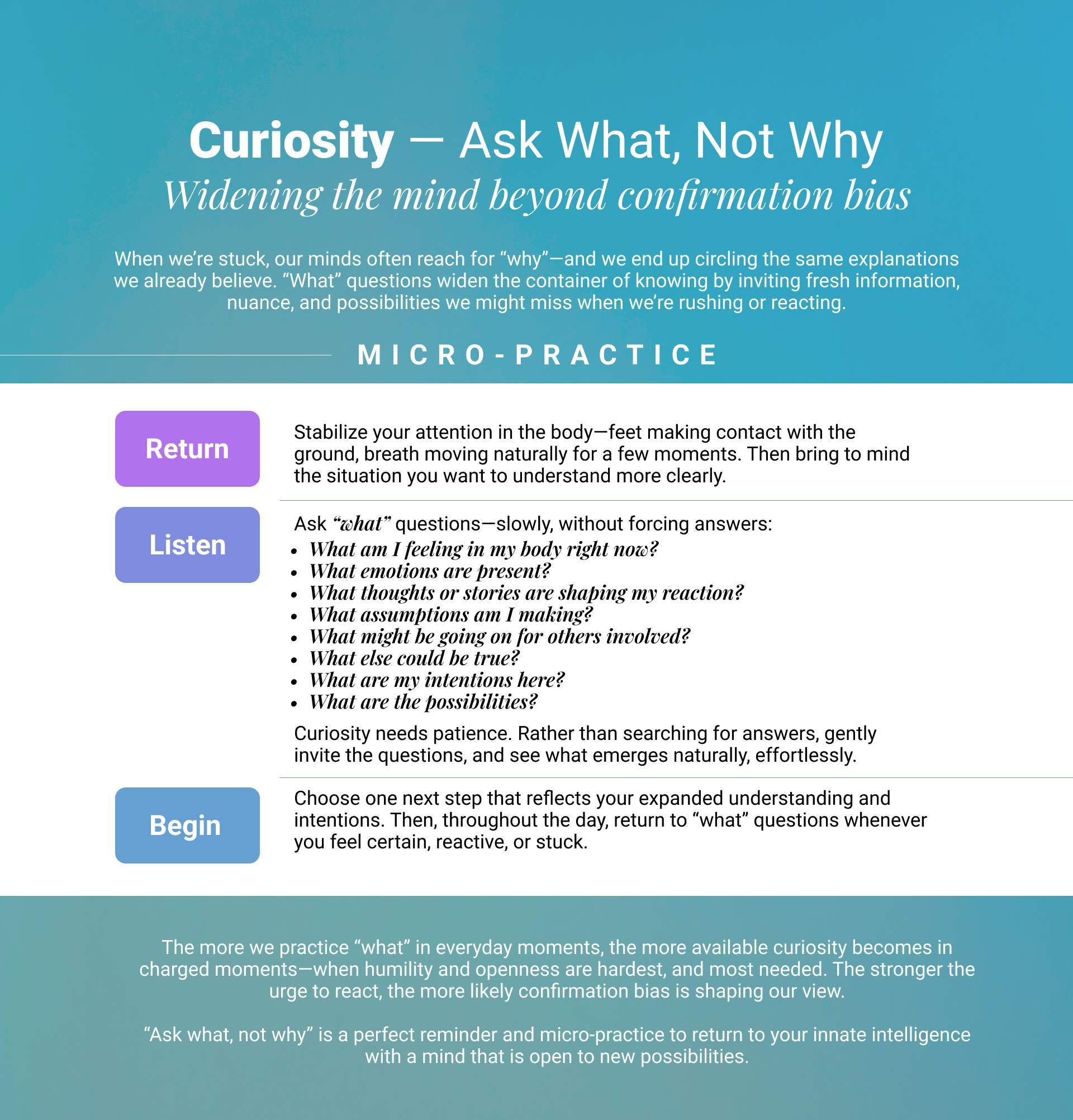
Curiosity — Returning to Creative Capacity
Curiosity is our ability to be genuinely interested and care with the purpose of understanding the situation, even when it’s challenging. It disrupts our confirmation bias by staying open and patient in the face of uncertainty and new information.
Curiosity widens the lens trauma narrows. It restores contact with complexity and helps us sense what might actually help. It’s not about being right. It is about being effective.
Together, these skills interrupt default patterns and reopen the channel between knowing what matters and being able to act on it.
Based on our resources, capacity, and unique gifts, what’s ours to do will be different. There isn’t one right way to meet the darkness. Only many necessary ones.
But here’s what practice has taught me: Skillful response doesn’t look the same for everyone.
Based on our resources, capacity, and unique gifts, what’s ours to do will be different. The parent raising children who can hold complexity. The artist creating work that helps others process grief. The organizer building coalitions. The healer tending to those on the front lines.
There isn’t one right way to meet the darkness. Only many necessary ones.
Reaching to Poetry As Another Anchor
I too have been learning to live with this question—how to stay engaged without collapsing. Sometimes the sifted language of poetry can speak to our deeper needs and longings. This poem by Michael Dubois captures this truth beautifully and resonates deeply.
When Things Feel Dark by Michael Dubois
When things feel dark, remember what the world needs: More healers, more helpers, more hate exorcisers. More artists and poets, more parents ruled by love. More cycle breakers, more radical resters, more warriors of peace. More gardeners who fall deeply in love with the earth beneath their feet. More meditators, more educators, more people willing to use failure as a tool to learn. More thinkers, more thankers, forgivers and apologizers. More builders of bridges and homes with open doors and minds.
The world needs you— because only the ones who see the darkness know the importance of turning on the light.
An Invitation to Practice: 3 Ways to Reconnect
In times like these, practice is an invitation to return to what is already alive in us, and to offer that wisely.
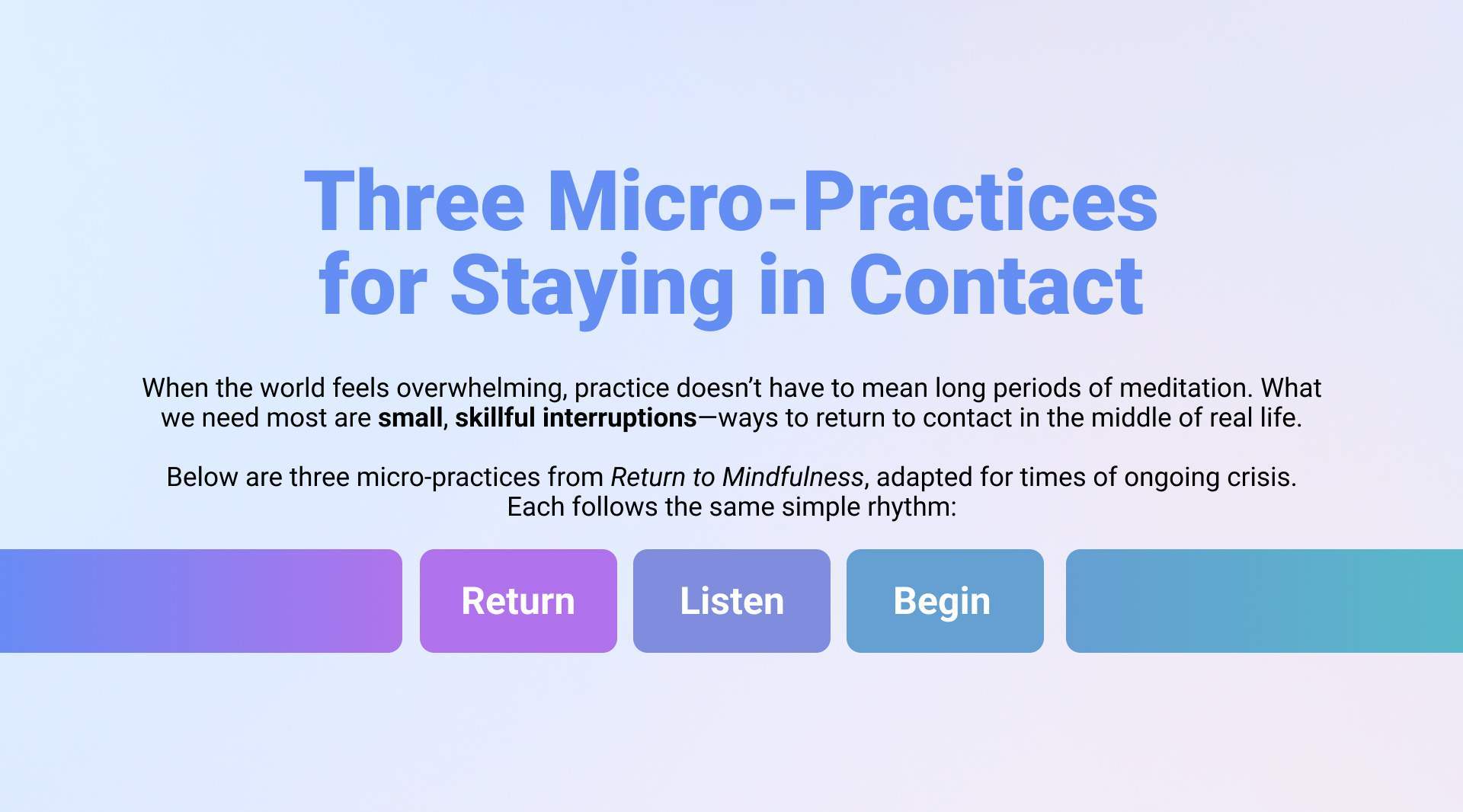
Below are three micro-practices from my book, Return to Mindfulness, to foster inner calm, compassion, and curiosity.
May we have the courage to notice when we’ve lost ourselves—and the skill to return. May we offer what is uniquely ours to give, trusting that the world needs exactly that. May our practice benefit us and all beings.
If you’re burned out, discouraged, and disconnected by all the struggle and suffering in the world, you’re not alone. In times of intense upheaval, mindfulness practice can feel impossible. Try this simple, grounding meditation to pause, reconnect with compassion and clarity, and return to yourself.
Many of us are bearing witness daily to suffering all over the planet. We care about others, and we want desperately to be of use—and seeing the horrors in images and videos and stories every day can be deeply dysregulating to our nervous systems.
When we get overwhelmed by this vicarious trauma, we tend to shut down. We disconnect for ourselves and each other. We’re so spun out in our anxiety, anger, or overwhelm that it can feel impossible to engage in any kind of mindfulness or meditation practice.
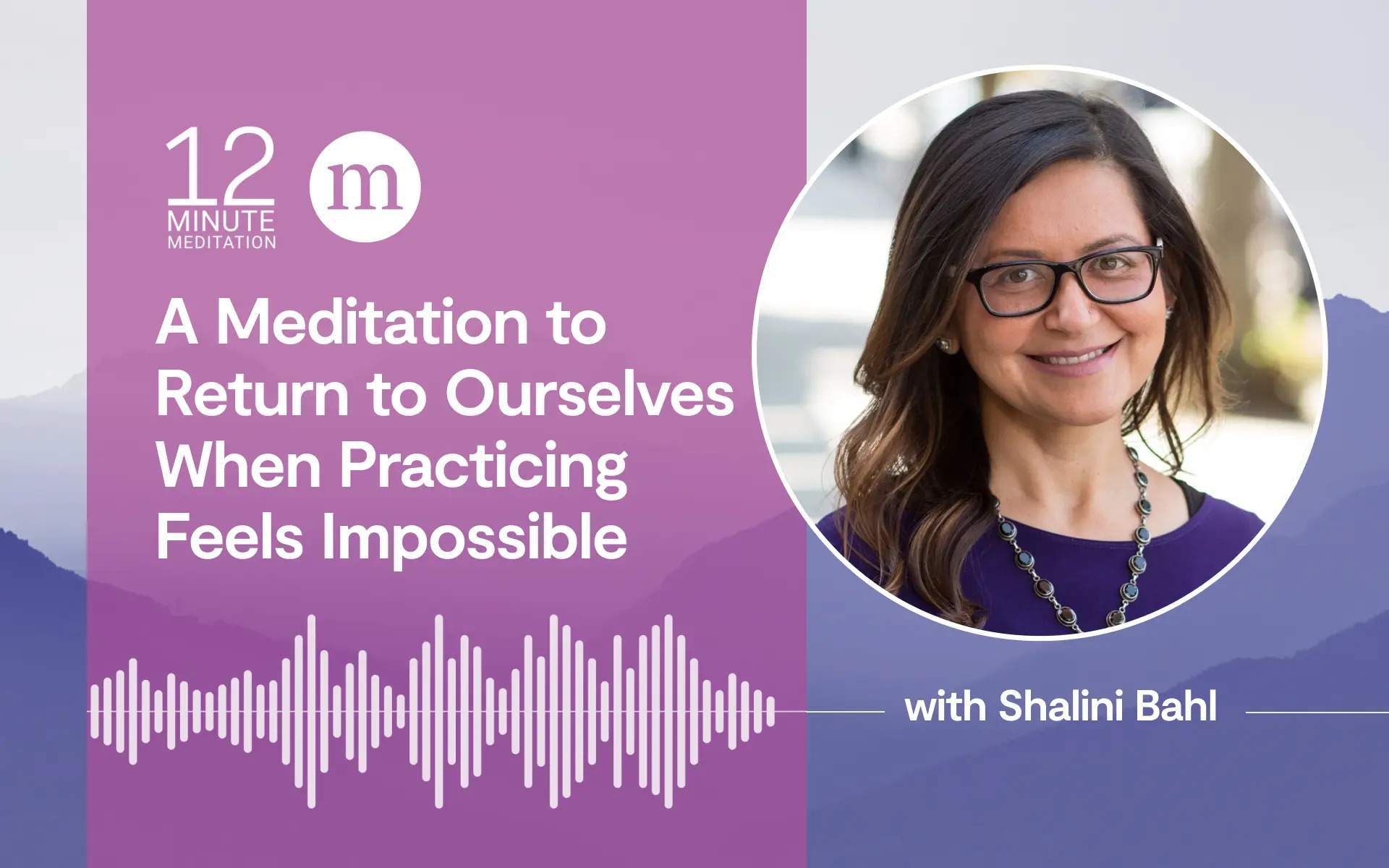
This week, Shalini Bahl offers tender and practical guidance for how to pause, reconnect, and return to ourselves and our essential practice in times of intense internal and external upheaval.
A Meditation to Return to Ourselves When Practicing Feels Impossible
Read and practice the guided meditation script below, pausing after each paragraph. Or listen to the audio practice.
Welcome and thank you for being here, for caring enough to practice despite the gazillion things you could be doing with your time. The world needs people right now who can stay grounded while engaging with the suffering we’re all witnessing with open hearts and minds, people who can act from wisdom rather than overwhelm. People who haven’t lost themselves in the chaos. But we do lose ourselves, all of us.
When we bear witness to crisis after crisis after crisis, our nervous systems dysregulate. We lose contact with our wisdom, our intentions, our sense of what’s actually ours to do. This practice helps us return.
We’ll move through three pathways to return home to ourselves. First, inner calm, where you return to clarity and agency. Then compassion, where we are going to reconnect with our humanity and others. And finally curiosity, where you discover what’s actually yours to do, what’s possible for you to do. If you find one pathway calling to you more than others, feel free to linger there longer. Trust what you most need. So ready to begin?
Come to a posture that feels supported, lying down or seated. Feel the elongation along the back of your spine and neck. Roll your shoulders up, back and down. When you feel ready, lower or close your eyes.
From this place of presence let’s begin by taking three intentional breaths. Breathe in through the nose and exhale slowly through the mouth. If you like, you can make a sighing sound as you exhale.
Now return to your natural rhythm of the breath. Invite your mind to be here with your body, with your breath, resting in your awareness of the direct sensations of breathing in the region of your heart. Settle your attention in that one place in your body, in the region of your heart as you breathe in, perhaps noticing the space that’s created in your chest. And as you exhale the relaxation, letting go just for these few minutes letting go of any rushing, any expectations or judgments.
If you like, place one or both hands on your chest. Especially on days where our minds are busy, we feel fragmented. Placing one or both hands on the chest can really relieve the nervous system. Sense the warmth or coolness of your hands. The rising and falling of your chest under your hands, making contact with your body, sensing the beating heart.
Give your full care and attention to every inhale, to every exhale and resting in the pauses in between. Notice that space when your in-breath turns to an out-breath. And a slight pause before a new breath enters the body.
From time to time, your mind may wander away, and that’s natural. As soon as you notice that, with kindness invite your mind to return to this place of rest and awareness in the region of your heart. Connect with your direct experience of breathing, just the way you are. And notice if there’s any striving here, letting go of any effort to even meditate as the breath moves itself and your awareness. All you’re doing is returning to your awareness of this breath moving effortlessly in and out of your body.
Just for these few moments, allow yourself to rest. To replenish yourself, to feel resourced. And once your mind and body feel stabilized, listening within, ask yourself: What would support you in feeling rested, resourced? What would care for yourself look like in this moment? It might be as simple as turning towards yourself with kindness, appreciating the goodness of your heart and mind. Taking this time to listen within what you need more of, more rest, more movement, connection. Let yourself be held by your own loving kindness.
From this innate capacity for goodness, for compassion, gently note who you might have hardened against today. You don’t need to start with the hardest person, the one whose actions feel unforgivable. Start with someone easier. Maybe someone who said something online that rubbed you the wrong way. Maybe someone doesn’t understand or see you. Maybe a family member, a colleague, a stranger. Or maybe yourself. With kindness, simply notice the hardness. There’s no need to change it or fix it. Just feel the way it lives in your body, in your chest or belly, your throat. Breathe in to make space for it, to make space around it.
Recognize this hardness, its protection. You’ve seen unbearable things. You’ve been hurt. The hardness makes sense. And it’s also disconnection. Disconnection from our relational intelligence, from our capacity to see our shared humanity. And if it’s helpful gently invite this question: What if you had grown up in their circumstances? What if you’d received the same information, the same upbringing, the same experiences? Who would you be? Can you soften just a little when you consider this? That we’re all shaped by causes and conditions, often beyond our control. You may not agree with them or even condone what they’re doing. Can you consider saying this person has suffered just like me? This person also wants to be happy just like me?
Using your breath as an anchor to stay connected with yourself and with your good heart—can you feel that invisible thread connecting you? You’re both breathing the same air, drinking the same water. Living on this one planet we all call home.
Take a few moments to listen within. What shifts when we touch this shared humanity?
From this place of connection with yourself and our shared humanity, let’s explore what’s important to you, what’s possible, and what’s yours to do. So return to our open awareness. What’s most important to you in this moment? Take this time to reconnect with your deepest intentions and values. You might ask questions like: What am I not seeing? What might your body be trying to tell you that your mind is missing?
Without trying to find something special or seeking answers, just staying connected with your body. Trust your inner knowing as you consider the possibilities for actions you can take that are aligned with your intentions, with your unique gifts, with your values. What if there’s something you haven’t tried yet? Some approach you haven’t considered or some alliance you haven’t imagined? Open your mind and heart to new possibilities. Even if you don’t receive specific answers right now, just hold that question, being willing to love the unanswered question and being willing to live the question.
From this place of open curiosity, willing to see what you’ve been missing, ask what’s actually possible here. Not what you’ve always done, not what everyone is doing or telling you to do but what is yours to do and what would actually help If you need more clarity. Try journaling, being in nature and any other activity that supports you in returning to yourself to feel connected, alive, present with the gift of this life at this time on this planet Earth.
Even as we end this practice, remember that you can come back anytime. Every time you notice you’re lost in the scroll, in the rage and the numbness, you can return to your inner calm, your compassion, and your innate capacity for keeping an open and curious mind. This is where clarity, humanity, and creativity live.
Thank you for your practice. May our practice together benefit us and benefit all beings.
A guided meditation to get familiar with our self-judging voice and how we relate to our flaws, so that we can cultivate compassion and recognize our own worthiness.
Mindfulness is about paying attention to our present moment experiences with openness, curiosity, and a willingness to be with what is. Mindfulness is about paying attention to the present moment with openness to things as they really are, as opposed to how we want them to be or how they could be, or wishing that they were different, which we do quite a bit. This includes our uncomfortable experiences—like being with our fear, grief, regret, and that self-judging voice that sometimes makes us feel so small.
Self-compassion is the idea that even with all of our flaws, we can still care about ourselves.
Self-Compassion vs. Self-Esteem
I want to talk about the concept of self-compassion. Self-compassion is different from self-esteem. There seems to be this epidemic of self-judgment in the world, where people are often self-critical and have a lot of self-hating voices in their heads. Self-compassion is not the build up of self-esteem, because the build up of self-esteem tends to lead people to needing a lot of external validation to feel ok. Instead, self-compassion is the idea that even with all of our flaws, we can still care about ourselves, that we can make mistakes, that we can screw up, that we can have problems, but we’re still fundamentally a good human being. We can connect with that understanding and have compassion for ourselves, even with the flaws that we have.
What’s so amazing about mindfulness practice is we can use mindfulness to be aware when we have those self-critical voices, and we can label that voice as “judging”. We can notice when we have those judging voices because we have a mindfulness practice that allows us to have quite a bit more self-awareness, more ability to regulate emotions, and all of the positive things that come with the mindfulness practice. When these thoughts come we can be on top of them and not get so caught up.
I sometimes talk about getting on the train – when you have a really powerful thought and you start thinking about it, and suddenly twenty minutes later you realize you’ve been on this train and were not in the present moment at all. However, the moment you recognize this, you can get off the train. Or, you can recognize this initially and not get on the train in the first place. You can stay at the platform and just let the thoughts go.
A Meditation for Working With Our Self-Judging Voice
Find your seat. Let’s begin by settling back into our comfortable posture, with your body upright but not too rigid or tight. Put your feet on the floor, hands resting on your lap, and your eyes can be closed. Most of us do this practice with our eyes closed but you don’t have to. You can keep them open but not looking all around, just looking downward.
Begin to notice your breathing. Begin with a few deep breaths letting you relax a little bit more. Invite in the possibility of relaxation with each deep breath. For this next period of time, you don’t have all of the worries and concerns. You’ve left them at the door, I hope. They may pop up into your mind but you can remind yourself that you don’t have to get on that train, and just come in to the present moment, feeling, or breath, while being present.
Focus on where you feel the breath most. Bring your attention to your stomach and notice if it’s tight or contracted. Take a deep breath if it is and just let it go. Notice your hands softening, and relax them. Notice your shoulders, jaw, throat, and face, and sense everything that’s obvious to you, maybe on the surface of the skin and maybe more internal. Do this with curiosity and with an eye out to relaxing a little bit.
Let yourself be here right now, in this moment, and see if you can bring your attention to your breathing and to your breath in your body, wherever you feel your breath the clearest within your body. You might notice your abdomen rising and falling, or your chest rising and falling, expanding, and contracting with the breath. You might notice the tingling at your nostrils as air enters and exits. Some people notice the whole torso breathing with the air moving through their body, and that’s fine too.
Shift attention to sounds. Now turn your attention to the sounds around you, just listen to sounds one after the next. Both the sound of silence, and the sounds that come and go. Don’t be lost in a story about the sounds, but just simply listen to them.
Find an object to anchor your attention. Find a focus for your meditation today. It could be your breath in your abdomen, or chest, or nose, or the full body breathing, or it could be listening to the sounds—any of those things work fine. Go to whichever one seems the most interesting to you, there’s no right way to do. If you can’t decide then just pick one, it doesn’t matter too much.
Notice the body breathing. Notice your abdomen moving up and down, chest expanding and contracting, air moving through your nose with each breath, full body breathing, or the sounds around you.
Stay with the sensations of breathing. We begin this mindfulness practice by attending to breath after breath, or sound after sound, staying with it to the best of our abilities, feeling the breath.
When the mind wanders, label your thoughts. At a certain point your attention will wander, and thoughts will come into your consciousness. When you notice that you’re lost in a thought, you can say a soft word like “thinking” or “wondering”, and come back to your main focus. Keep doing that again and again. This is emphasized for today’s practice because we are talking about how mindfulness can help us with self-judgment, and recognizing that you can notice the type of thought you’re having and give it a label.
You can keep an eye out for judging thoughts, and every time you judge you can say in your mind a soft word like “judging”, or “self-judgment”, or “criticism”, or you can find the word that makes sense to you. It will help you to see the way in which the judgments arise. It’s not personal by the way; you didn’t set out to make yourself feel bad. It just happens. “That person is a better meditator than I am”, or “I’ll never get this right”, or “Why did I do that thing yesterday, it was so foolish”. These are the kind of voices that come into our mind for some of us frequently. For others they may be rare; that’s fine too.
Notice self-critical thoughts as they arise. Use mindfulness practice to not judge yourself, to not judge yourself for being judgmental, and just notice judging. If you want to count the occurrences you can; for example “judging 1, judging 2… judging 20.” While you’re noticing these thoughts, you might get drawn to other types of thoughts. If so, you can use other labels like “planning”, “remembering”, “imagining”, and so forth.
Invite self-compassion. As you do this practice, please keep a quality of kindness towards yourself. Be curious. Notice how interesting your mind is without judging yourself. Maintain the spirit of kindness and investigation.
Reflect on the quality of your meditation. For the last few minutes of this meditation, just notice how you are doing with this awareness practice, with the mindfulness of breath, and with mindfulness of the way your thoughts operate. You can ask yourself, “Did I get on the train?”, “Did I get off the train?”, or “Did I stay at the platform maybe once or twice?”
Did you notice many judging thoughts? I’m hoping you brought a kind attitude to yourself for the judging thoughts, if they were present.
Close with kindness. We will do a little bit of kindness meditation to conclude. Notice how you’re feeling, and see if you can also bring to mind someone you love, someone who makes you happy. It could be a dear friend, a child, a pet cat or dog. If you can’t think of anyone, it can be someone you’ve read about who you admire.
Repeat kind phrases. Say these phrases, and repeat them in your mind (or you can come up with your own). May you be safe and protected. May you be happy and peaceful. May you be healthy and strong. May you be at ease.
Send kind phrases to loved ones. Send these words and heartfelt feeling out to this loved one. Notice how it feels inside to make those wishes for them. Imagine that they send it back to you. May you be safe and protected. May you be happy and peaceful. May you be healthy and strong. May you accept yourself, just as you are.
See if you can “take” the kindness. Imagine the kindness moving through your body, wherever you are. Can you bring compassion to yourself exactly where you are, for whatever is happening right now? May I hold this with kindness. May I hold myself with compassion. Take a breath and notice if this is possible, to bring kindness to the best of your abilities wherever you are, however it makes sense to you. May I be with myself exactly as I am.
Open your eyes. When you’re ready you can open your eyes, but take your time.
In this practice, mindful teacher Rose Felix Cratsley invites kids and caregivers to explore henna as an art form and as a gentle mindfulness activity that nurtures stillness, creativity, and cultural appreciation.
A Mindful Ritual at Your Fingertips
Children are naturally drawn to creative expression. The process of making and applying henna slows us down, encouraging presence, sensory awareness, and loving connection through touch and design.
Rooted in South Asian, Middle Eastern, and African cultures, henna (or mehndi) is a sacred ritual of celebration, storytelling, and connection. This practice invites us into mindful moments: as we mix the paste, trace the lines, feel the coolness on our skin, and observe our thoughts. Whether it’s a quiet moment shared between caregiver and child, or at a community gathering rich with color and conversation, henna becomes a living reminder: we are here, together, in this moment.
Henna Mindfulness Practice
1. Begin with Breath
Invite your child or group to take three slow, deep breaths. Feel the belly rise and fall. Notice how your body begins to soften. You might say: “We are here, we are calm, we are ready to create together.”
2. Mix with Intention
Mix 2 tablespoons of natural henna powder with lemon juice until a smooth paste forms. Optionally add a drop of essential oil and a pinch of sugar. Stir slowly and notice the texture and scent. As you mix, set a quiet intention: peace, joy, strength—whatever quality you want to hold in your design.
3. Trace the Moment
Before applying henna on the skin, practice simple shapes on paper. Spirals, dots, leaves, hearts—anything your child imagines. Encourage slowing down:
How does it feel to trace that line?
What happens to your breath as you move your hand?
4. Apply with Care
Using a cone or small brush, apply a simple design to the hand or wrist. Notice the sensation of the cool paste, the stillness of the body, and the breath anchoring the experience.
*Caregivers can gently apply henna to children’s hands, offering this as a moment of love, bonding, and grounding.
5. Rest and Reflect
Once the design is complete, let it dry naturally. Use this time for quiet reflection or journaling. Invite conversation:
What story does your henna design tell?
How did it feel to go slowly and focus?
What do you want to remember and cherish from this moment?
6. Close with Gratitude and intention
As the henna sets and your breath softens, invite a final moment of stillness. You might say together:
“We are present. We are creative. We are calm. We welcome peace.”
Let these words settle into your heart, mind, and body, like the design resting on your skin. This simple affirmation becomes a living mantra, carrying the essence of the practice forward: grounded in mindfulness, rich with cultural meaning, and full of possibility.
While henna fades in time, the peace we create through these practices becomes cherished memories.
Its Significance
Henna, as a mindfulness practice, invites children into their senses, their heritage, their bodies, and their relationships with care. For caregivers, it’s an opportunity to share calm and culture in one breath.
Rooted in tradition and adaptable for all ages, this ritual offers connection across generations—where stories, symbols, and emotions can live on the skin and in the heart.
Anxiety often contributes to keeping us stuck in habits we don’t want. This mindfulness practice lets us soothe racing thoughts by letting us tune in to embodied awareness.
Over the years, as I’ve studied how habits work in the brain and the ways in which mindfulness can help, I’ve found that curiosity is a simple tool that helps people—regardless of language, culture and background—drop directly into their embodied experience. Curiosity lets us tap into our natural capacity for wonder and interest, putting us right in that sweet spot of openness and engagement. From this state of mind, we’re more empowered to help ourselves break old habits and build new ones.
Let me walk you through a simple curiosity exercise. Doing this 2-minute practice can work as a kind of panic button for when anxiety hits.
Step 1:
Find a quiet comfortable place. You can be sitting, lying down or standing up; you just need to be able to concentrate without being distracted.
Step 2:
Recall your most recent run-in or incident with a habit loop, which is any habit you find yourself returning to whenever you’re worried or anxious.
See if you can remember the scene and relive that experience, focusing on what you felt right at the time when you were about to act out your habitual behavior. What did that urge to go ahead and “do it” feel like?
Step 3:
Check in with your body. What sensation can you feel most strongly right now?
Here’s a list of single words or phrases to choose from. Pick only one—the one you feel most strongly:
Tightness
Pressure
Contraction
Restlessness
Shallow breath
Burning
Tension
Clenching
Heat
Pit in stomach
Buzzing/vibration
Step 4:
Notice where this sensation is in your body. Is it more on the right side or the left? In the front, middle, or back of your body? Where do you feel it most strongly?
And was there anything you noticed about being curious about what part of your body you felt the sensation in? Did being a little curious help with getting closer to this sensation?
Step 5:
Explore what else you can feel in your body. If the sensation is still there in your body, see if you can get curious and notice what else is there. Are there other sensations you’re feeling? What happens when you get curious about them? Do they change? What happens when you get really curious about what they feel like?
Step 6:
Follow them over the next 30 seconds—not trying to do anything to or about them—but simply observing them. Do they change at all when you observe them with an attitude of curiosity?
Whenever I do this exercise, I like to use the sound “Hmmmm”—as in, the hmm you naturally emit when you’re curious about something (and not to be confused with the traditional mantra “Om”). I find saying “hmm” to myself gets me out of my head and into a direct experience of being curious. It also allows me to bring a playful, even joyful attitude to what I’m doing; it is hard to take yourself too seriously when you are hmm-ing.
This short exercise is just intended to give you a taste of curiosity and to support your natural capacity to be aware about what is happening in your body and your mind at any moment instead of getting caught up in a habit loop. If you notice that by being curious you gained even a microsecond more of being with your thoughts, emotions and body sensations than you have in the past, then you’ve taken a huge step forward.
Sometimes I get the question “What happens if I’m not curious?” My response is to use the sound of “hmmm” to drop right into your experience. Ask yourself: “Hmm, what does it feel like not to be curious?”
This helps people move from their thinking, fix-it mind state into a curious awareness of their direct sensations and emotions in their bodies and move out of their thinking heads and into their feeling bodies.
Find more information and science-backed practices for working with your anxiety in the Unwinding Anxiety app.
In today’s fast-paced world, maintaining a clutter-free and organized home can be a daunting task. Many of us lead busy lives, juggling work, family, and social commitments, leaving little time for cleaning and organizing. However, research has shown that living in a cluttered and disorganized environment can have a significant impact on our wellbeing, leading to increased stress levels, anxiety, and decreased productivity. In this article, we will explore the benefits of organizing your home and provide practical tips on how to create a calm and peaceful living space.
The Impact of Clutter on Our Wellbeing
Clutter can have a profound impact on our mental and physical health. When our surroundings are cluttered and disorganized, it can lead to feelings of overwhelm, anxiety, and stress. This is because clutter can affect our brain’s ability to focus and process information, leading to mental fatigue and decreased productivity. Furthermore, clutter can also pose health risks, such as tripping hazards, fire hazards, and the accumulation of dust and allergens.
The Benefits of an Organized Home
On the other hand, living in an organized and clutter-free home can have numerous benefits for our wellbeing. Some of the benefits include:
Reduced stress levels: A clutter-free environment can help reduce stress levels and promote relaxation.
Improved focus and productivity: An organized home can help improve focus and productivity, enabling us to accomplish more in less time.
Better sleep: A calm and peaceful living space can promote better sleep quality, leading to improved physical and mental health.
Increased sense of control: An organized home can give us a sense of control and confidence, enabling us to tackle daily tasks with ease.
Practical Tips for Organizing Your Home
Organizing your home may seem like a daunting task, but with a few practical tips, you can create a calm and peaceful living space. Here are some tips to get you started:
Start small: Begin with one area or room at a time, and work your way through the space.
Sort and purge: Sort items into categories, and get rid of anything that is no longer needed or useful.
Assign a home: Assign a home for each item, making it easy to find and put away.
Use storage solutions: Use storage solutions such as baskets, bins, and shelves to keep items organized and out of sight.
Create routines: Create routines and habits to maintain your organized space, such as tidying up daily and scheduling regular cleaning sessions.
Creating a Peaceful Living Space
Creating a peaceful living space is not just about getting rid of clutter, but also about creating an environment that promotes relaxation and calmness. Here are some tips to create a peaceful living space:
Use calming colors: Use calming colors such as blues, greens, and neutral tones to create a soothing atmosphere.
Add plants: Add plants to your space, which can help purify the air and promote relaxation.
Incorporate textures: Incorporate different textures such as soft rugs, throw blankets, and pillows to add depth and warmth to your space.
Consider lighting: Consider the lighting in your space, and use table lamps, floor lamps, or string lights to create a warm and inviting atmosphere.
Maintaining Your Organized Space
Maintaining an organized space requires effort and commitment, but with a few simple habits, you can keep your space clutter-free and peaceful. Here are some tips to maintain your organized space:
Create a maintenance routine: Schedule regular cleaning sessions and tidying up to maintain your space.
Use reminders: Use reminders such as sticky notes or apps to remind you to clean and organize your space.
Involve the family: Involve family members in maintaining the space, assigning tasks and responsibilities to each person.
Be flexible: Be flexible and adapt to changes in your life and space, making adjustments as needed.
Overcoming Obstacles to Organization
Despite the benefits of organization, many of us face obstacles that prevent us from maintaining a clutter-free and peaceful living space. Here are some common obstacles and tips to overcome them:
Lack of time: Schedule organization sessions into your daily or weekly routine, even if it’s just 10-15 minutes a day.
Lack of motivation: Find a friend or family member to work with, or reward yourself after completing organization tasks.
Emotional attachment: Let go of items that no longer serve a purpose or bring you joy, and consider donating or selling items to create space.
Conclusion
Organizing your home can have a significant impact on your wellbeing, reducing stress levels, improving focus and productivity, and promoting relaxation. By following practical tips and creating a peaceful living space, you can maintain a clutter-free and organized home. Remember to start small, sort and purge, assign a home, use storage solutions, and create routines to maintain your space. With commitment and effort, you can create a calm and peaceful living space that promotes wellbeing and happiness.
FAQs
Here are some frequently asked questions about organizing your home and creating a peaceful living space:
Q: How do I get started with organizing my home?
A: Start by choosing one area or room at a time,!nd work your way through the space, sorting and purging items as you go.
Q: What are some common obstacles to organization?
A: Common obstacles to organization include lack of time, lack of motivation, and emotional attachment to items.
Q: How can I maintain my organized space?
A: Maintain your organized space by scheduling regular cleaning sessions, using reminders, involving family members, and being flexible.
Q: What are the benefits of an organized home?
A: The benefits of an organized home include reduced stress levels, improved focus and productivity, better sleep, and increased sense of control.
Q: How can I create a peaceful living space?
A: Create a peaceful living space by using calming colors, adding plants, incorporating textures, and considering lighting.