Tag: Approach

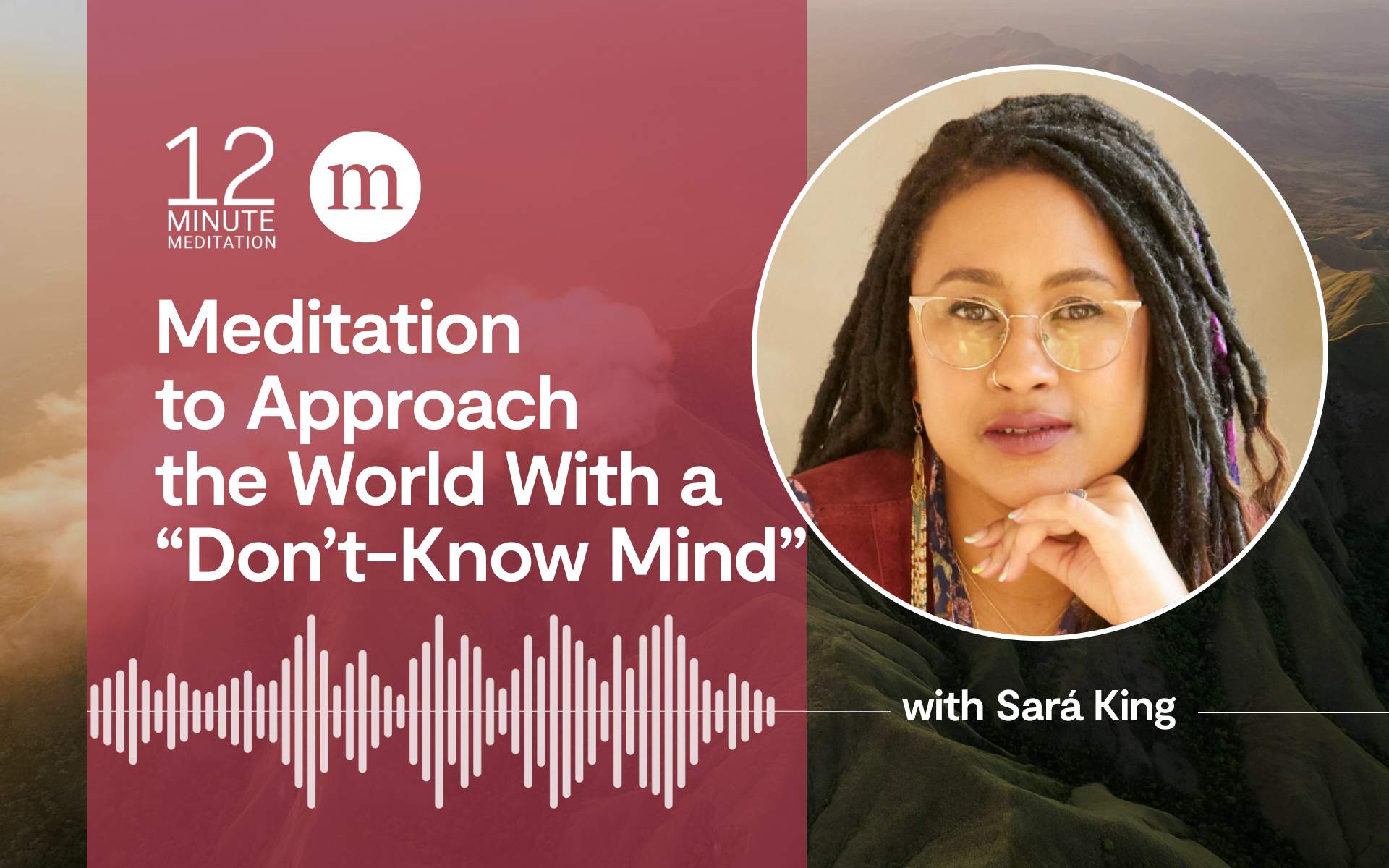
  • A 12-Minute Meditation to Approach the World With a “Don’t-Know Mind”

    A 12-Minute Meditation to Approach the World With a “Don’t-Know Mind”

    We can find strength and resilience in familiarity—and use those feelings to explore the unfamiliar.

    At the beginning of every meditation practice that I teach, I offer up a little bit of instruction for the posture, so that you can experience this practice as being as supportive as possible to your body.

    A Meditation to Approach the World With a “Don’t-Know Mind” 

    1. I would like to invite you to come to a place that is truly comfortable and supportive to your practice. For some of you, this may mean a seated position on a chair, on a sofa, or even on some cushions on the floor. This might mean standing up, if that’s more supportive to your back and your posture. And for some of you, this may mean lying down on the ground. Please take a moment to come to whatever place is going to feel most compassionate to your body.
    2. Some of you may want to fully close your eyes for this meditation practice. And others may want to employ what I like to call a “soft gaze,” which is looking down at the ground about two inches in front of the knees or the feet.
    3. When you’ve settled into a comfortable position, I would love to invite you to take three deep breaths with me. As you’re taking those three deep breaths, you may notice that your body may begin to relax naturally. You may start to feel a little bit more deeply connected to whatever place makes contact with the earth. For some of you that’s going to be your feet, and for others that may be your back. Notice whatever place comes into contact with the earth in this moment.
    4. Begin to draw your attention and awareness to the connection between your body and the earth. It might feel beneficial at this point to take another deep inhale and exhale here. When you’re finished, return your breath back to a natural cadence and rhythm.
    5. You may notice the quality of the sound in the room that you’re in. Maybe there are some ambient noises that are coming from inside of wherever you are, whatever building you’re in. Or maybe there are sounds that are coming from outside. Please feel free to make these a part of your practice.
    6. Begin to draw your awareness to the bottoms of your feet, wherever they are landing on the earth. What do you notice? Does the right foot or the left foot feel slightly heavier than the other? As you notice the difference between the right and the left foot, perhaps you might also become aware of other micro-adjustments inside of your body.
    7. You may notice that the mind continues to produce thoughts, and that’s OK. The point of a meditation practice is not necessarily to stop thinking the thoughts that you are thinking, but rather to just be aware of the thoughts as they flow through the body and the mind. As you draw your awareness to your thoughts, you can also bring your awareness to the rhythm of your breath as it flows in and out of your body.
    8. I would like to invite you to bring your attention to the muscles of the belly and notice if they’ve been drawn in a little bit tightly towards the spine. Is it possible to invite a sense of relaxation, and even vulnerability, to the muscles of the belly by allowing them to be soft? Don’t worry, no one is watching. How does it feel when you invite a sense of softness and relaxation to the belly? How does the rest of the body respond?
    9. While your attention is here, you might begin to imagine a person, place, animal, or object that is deeply familiar to you. Perhaps this animal, person, place, or object reminds you of what it feels like to be home. Can you bring them into the room with you right now?
    10. Notice if that invitation has an impact on your breath, as it rises and falls from your chest. You might even feel a bit more safe in the space of this practice as you invite the image of what reminds you of being home, of being held.
    11. What is familiar to you, deeply familiar, about this person, animal, place, or object, that makes you feel as though you really know them? What is the feeling of knowing? What is the feeling of familiarity, and how does it land inside of the body? The invitation is to bring your attention back to the breath anytime that you notice yourself getting caught up in the story.
    12. Now, bring to mind an image of something that reminds you of what it means to be strong and resilient. Maybe there’s someone who you really look up to, or a place you’ve been that made you feel truly strong and resilient when you were there. Can you bring into your mind’s awareness the embodied sensations of being strong and resilient? Does your body make slight changes and shifts as you recall how this feels?
    13. Now we’re going to do a little bit of experimenting. Hopefully this will be fun. There’s a term called “don’t know mind” that is sometimes used in meditation to invoke a sense of curiosity.
    14. What is it like to approach the world with a “don’t know mind?” You may find that this is a bit of a contrast to the feeling of familiarity that we began to explore in the beginning of this practice. The feeling of familiarity is the feeling of, “Oh yes, I know. I know this person. I know this place. I know this animal or this object. They are deeply familiar to me.” Perhaps the way we view things, which are seemingly familiar to us, can begin to shift and change ever so slightly when we apply the pure curiosity of “don’t know mind.” How does that land in the body? This exploration of not knowing, of not being quite certain?
    15. At this point in your practice, you may notice if there are places in the body that begin to contract when we explore the feeling of “don’t know mind,” and that’s OK. This is the body’s intelligence. Can we unite this exploration of “don’t know mind” with those same sensations of strength and resilience, so that we know that no matter what, when we encounter moments of uncertainty and not-knowing that we have all the strength and resilience inside of our body to meet with that moment? What does it feel like to meet strength and resilience with not-knowing? Can we be truly curious about what arises in our awareness with this practice? Let’s take just a few moments in silence together now and explore the way that this feels.
    16. When you’re ready please bring your entire body into your mind’s eye and notice the difference between the way the body feels now and the way the body felt when you first entered into this space of practice. Take the time to notice the way the feet feel slightly different in the way they connect to the earth.
    17. Let’s all take one more deep breath in here.
    18. When you’re ready, at your own pace and rhythm, please begin to, ever so slowly and gently, open up the eyes, without staring at anything in particular. Allow color and texture to flood back into your mind’s awareness.
       
    19. From here we can begin the process of reorienting to the room that we’re in. Gently begin to turn and rotate the head and the neck, and take in the colors and textures of the space you are in. Notice if there’s anything new or different or alive in the space. What has changed since you started this practice?


    Source link

  • Unlocking the Secrets of Fat Loss: A Scientific Approach to Weight Reduction (Target keywords: fat loss, weight reduction, scientific approach)

    Unlocking the Secrets of Fat Loss: A Scientific Approach to Weight Reduction (Target keywords: fat loss, weight reduction, scientific approach)

    The quest for fat loss and weight reduction has become a ubiquitous goal for many individuals, with numerous approaches and methods being touted as the most effective way to achieve this objective. However, with so much misinformation and pseudoscience surrounding the topic, it can be challenging to discern what truly works and what doesn’t. Fortunately, a scientific approach to fat loss and weight reduction can provide a clear and evidence-based understanding of the underlying mechanisms and most effective strategies.

    Understanding the Fundamentals of Fat Loss

    To unlock the secrets of fat loss, it’s essential to comprehend the fundamental physiological processes that occur within the body. Fat loss, also known as lipolysis, is the process by which the body breaks down stored fat (triglycerides) into fatty acids and glycerol, which can then be utilized as energy. This process is mediated by various hormones, including epinephrine, norepinephrine, and insulin, which play a crucial role in regulating fat metabolism.

    When it comes to fat loss, the concept of energy balance is paramount. The body’s energy balance is determined by the difference between the amount of energy consumed (in the form of calories) and the amount of energy expended (through physical activity, thermogenesis, and other physiological processes). To achieve fat loss, an individual must create a calorie deficit, where the energy expended exceeds the energy consumed. This can be accomplished through a combination of reducing daily caloric intake and increasing physical activity.

    The Science of Weight Reduction

    Weight reduction is a complex process that involves the coordinated effort of multiple physiological systems, including the nervous, endocrine, and digestive systems. From a scientific perspective, weight reduction can be achieved through various mechanisms, including:

    • Reducing energy intake: Decreasing daily caloric consumption can lead to a calorie deficit, resulting in weight reduction.
    • Increasing energy expenditure: Engaging in regular physical activity, such as aerobic exercise, resistance training, and high-intensity interval training (HIIT), can increase energy expenditure and enhance fat loss.
    • Improving insulin sensitivity: Enhancing insulin sensitivity can improve glucose uptake in the muscles, reducing glucose levels in the bloodstream and promoting fat loss.
    • Modulating hormone levels: Hormones such as leptin, ghrelin, and cortisol play a crucial role in regulating energy balance and fat metabolism. Modulating these hormone levels through dietary and lifestyle interventions can facilitate fat loss.

    Dietary Strategies for Fat Loss

    A well-structured diet is essential for achieving and maintaining fat loss. From a scientific perspective, the following dietary strategies can be effective:

    • Macronutrient balance: Ensuring an optimal balance of protein, carbohydrates, and fat can help regulate hunger, satiety, and energy balance.
    • Meal frequency and timing: Eating frequent, balanced meals can help regulate energy balance and support fat loss.
    • Caloric restriction: Reducing daily caloric intake can lead to a calorie deficit, resulting in fat loss.
    • Nutrient-dense foods: Focusing on whole, unprocessed foods, such as fruits, vegetables, whole grains, lean proteins, and healthy fats, can provide essential nutrients while supporting fat loss.

    The Role of Exercise in Fat Loss

    Regular exercise is a crucial component of a comprehensive fat loss program. Exercise can increase energy expenditure, improve insulin sensitivity, and enhance fat oxidation. The following types of exercise can be effective for fat loss:

    • Aerobic exercise: Activities such as brisk walking, jogging, cycling, and swimming can increase energy expenditure and enhance fat loss.
    • Resistance training: Building muscle mass through resistance training can increase resting metabolic rate, enhancing fat loss.
    • High-intensity interval training (HIIT): HIIT involves short bursts of high-intensity exercise followed by brief periods of rest. This type of training can be effective for improving insulin sensitivity and enhancing fat loss.

    Supplements and Fat Loss

    While a well-structured diet and regular exercise should be the primary focus of a fat loss program, certain supplements may be beneficial in supporting this process. Some of the most effective supplements for fat loss include:

    • Protein powder: Increasing protein intake can help regulate hunger, satiety, and energy balance.
    • Conjugated linoleic acid (CLA): CLA, a fatty acid found in meat and dairy products, may help enhance fat loss by increasing fat oxidation and reducing fat storage.
    • Green tea extract: Green tea extract, rich in catechins, may help enhance fat loss by increasing fat oxidation and improving insulin sensitivity.

    Conclusion

    Unlocking the secrets of fat loss requires a comprehensive understanding of the underlying physiological processes and most effective strategies. By adopting a scientific approach to fat loss, individuals can create a personalized program that incorporates dietary, exercise, and lifestyle interventions to achieve and maintain weight reduction. Remember, fat loss is not just about aesthetics; it’s about improving overall health and well-being. By focusing on sustainable, evidence-based strategies, individuals can achieve a healthier, happier life.

    Frequently Asked Questions (FAQs)

    • Q: What is the most effective way to achieve fat loss?
      A: The most effective way to achieve fat loss is through a combination of reducing daily caloric intake, increasing physical activity, and improving insulin sensitivity.
    • Q: How can I ensure I’m getting enough protein to support fat loss?
      A: Aim to consume 1.6-2.2 grams of protein per kilogram of body weight from sources such as lean meats, fish, eggs, dairy, and plant-based options.
    • Q: What is the role of exercise in fat loss?
      A: Exercise can increase energy expenditure, improve insulin sensitivity, and enhance fat oxidation, making it a crucial component of a comprehensive fat loss program.
    • Q: Can supplements really help with fat loss?
      A: While supplements should not replace a well-structured diet and regular exercise, certain supplements such as protein powder, CLA, and green tea extract may be beneficial in supporting fat loss.
    • Q: How long does it take to achieve significant fat loss?
      A: The time it takes to achieve significant fat loss varies depending on individual factors such as starting body composition, diet, and exercise. However, with a consistent and well-structured program, individuals can expect to see noticeable results within 12-24 weeks.

    unlocking-the-secrets-of-fat-loss-a-scientific-approach-to-weight-reduction-target-keywords-fat-loss-weight-reduction-scientific-approach

  • Inside Vinmec’s Approach to Developing Vietnam’s Next Generation of Doctors

    Inside Vinmec’s Approach to Developing Vietnam’s Next Generation of Doctors

    On his first day assisting in a complex orthopedic surgery, Nguyen The Duy, a young Vinmec resident, paused outside the operating room, the fluorescent lights hummed softly overhead as he steadied his breath. The weight of what awaited him on the other side of the doors felt almost physical.

    “I remember my hands were shaking a little,” he recalled. “I kept thinking, What if I make a mistake? What if I can’t keep up?”

    That anxious moment marked the beginning of his transformation – from a trainee unsure of his place to the kind of physician Vinmec strives to cultivate: technically skilled, composed under pressure, and guided by a deep sense of humanity.

    This philosophy begins at the top. Prof. Dr. Tran Trung Dung, who has spent more than 25 years in orthopedics – from complex bone tumor surgery to sports medicine – now leads Vinmec’s national healthcare system. What drives him today isn’t just restoring motion, but mentoring the next generation.

    “Watching my students grow – not only in skill but in compassion – reminds me that I am part of something greater than a profession: a journey of nurturing those who will one day heal others” shared Prof. Dr. Tran Trung Dung, CEO of Vinmec Healthcare System.

    That belief has become the DNA of Vinmec, where every hospital serves as a living classroom, and every patient case becomes a legacy passed down through generations of healthcare professionals.

    Building the Nation’s Healthcare Future

    Amid mounting regional pressure to strengthen healthcare capacity, new models for healthcare workforce development are emerging across Asia. In Vietnam, Vinmec stands out as a pioneer at both national and regional levels. Founded in 2012, it has since evolved into the country’s first private academic healthcare system.

    Operating 9 hospitals and 7 clinics nationwide, Vinmec is the first private healthcare network in Vietnam to fully integrate clinical care, advanced research, and medical education. It is also the only healthcare system in Vietnam with two JCI-accredited hospitals and the home of Asia’s first Cardiology Center of Excellence.

    Vinmec is the only healthcare system in Vietnam with two JCI-accredited hospital.
    Vinmec

    Prof. Dung explained that Vinmec’s talent strategy is built on three pillars: academia, succession, and integration. The goal is to create an ecosystem where doctors not only treat patients, but also teach and conduct research – guided by Vietnam’s “golden generation” of medical experts.

    “We connect globally to create an international academic environment for continuous learning,” he added.

    With a vision to make high-quality care accessible to more people, Vinmec also benefits from its landmark partnership with Cleveland Clinic Connected, becoming the first and only healthcare system in Southeast Asia accepted into the US-based global network..

    Asia’s Doctor and Nurse Shortage: What Can We Do?

    This people-first approach comes at a pivotal time. Asia’s healthcare systems are facing a critical inflection point. By 2030, the World Health Organization warns of a global shortage of 10–11 million health workers, with Southeast Asia alone projected to lack 4.7 million. The gap is not only in numbers, but in workforce readiness.

    As healthcare rapidly evolves with technologies like telemedicine and AI-powered diagnostics, future health professionals must master new skill sets. Yet today, not every clinician is digitally savvy, and experts caution that Asia’s healthcare workforce must urgently strengthen its digital competencies.

    Where Tomorrow’s Vietnamese Healthcare Talent Begins

    “At Vinmec, people are not only the engine of the system – they are its purpose,” Prof. Dung emphasized. The organization embraces a “patient-first, people-centered” leadership philosophy rooted in three core values: talent, ethics, and empathy. Medical leaders are expected not only to guide clinical excellence but to serve as mentors shaping the next generation.

    “When caregivers feel empowered and supported, they naturally deliver better care,” he said. Rather than simply recruiting top talent, Vinmec is committed to building a sustainable internal workforce for the long term.

    That vision is translated into concrete action. In 2024 alone, Vinmec organized 81 national clinical conferences and delivered 9,341 internal training courses to more than 129,000 healthcare professionals. Programs such as the Graduate Nurse Internship and the Management Trainee Program accelerate the development of young professionals and nurture future healthcare leaders.

    What sets Vinmec apart is its seamless integration of clinical research into everyday care.
    Vinmec

    What sets Vinmec apart is the seamless integration of clinical research into daily medical practice. Young physicians actively engage in real-world translational projects – from Vietnam’s first successful CAR-T cell therapy in cancer treatment to the pioneering application of 3D printing technology in complex surgical procedures across Southeast Asia.

    As digital medicine reshapes the future of care, Vinmec is preparing its workforce for what lies ahead. The Vinmec Data Platform provides access to real-world clinical data; AI-powered diagnostic tools enable more precise clinical decision-making; and internal systems such as e-learning platforms, simulation labs, and advanced imaging centers ensure continuous, technology-driven upskilling.

    In every young doctor stepping into the operating room, in every nurse supporting patients through recovery, and in every patient who walks again, Vinmec’s legacy quietly lives on – through the healing hands it continues to nurture.

    Source link

  • The Power of Simple Living: How Minimalists Approach Work, Relationships, and Life

    The Power of Simple Living: How Minimalists Approach Work, Relationships, and Life

    Introduction to Simple Living

    In today’s fast-paced, consumerist society, it’s easy to get caught up in the idea that more is better. We’re constantly bombarded with advertisements telling us that the latest gadget, trendy clothing item, or luxurious vacation is the key to happiness. However, a growing number of people are rejecting this notion and embracing a simpler way of living. This movement, known as minimalism, is about paring down one’s possessions, commitments, and expectations to focus on what truly brings fulfillment and joy. In this article, we’ll explore the power of simple living and how minimalists approach work, relationships, and life.

    Defining Minimalism

    Minimalism is often misunderstood as being about depriving oneself of comforts or living in poverty. However, it’s actually about living intentionally and being mindful of how we spend our time, money, and energy. Minimalists prioritize what’s truly important to them and eliminate or minimize the rest. This can mean different things to different people, but some common practices include decluttering living spaces, reducing waste, and adopting a more frugal lifestyle.

    Minimalist Approach to Work

    For many people, work is a major source of stress and dissatisfaction. We often feel pressured to climb the corporate ladder, work long hours, and constantly be "on" in order to succeed. Minimalists, on the other hand, tend to approach work with a more relaxed and intentional mindset. They may choose to work fewer hours, prioritize meaningful work over high-paying work, or pursue alternative forms of income, such as freelancing or entrepreneurship. By simplifying their work lives, minimalists are able to reduce stress, increase productivity, and focus on what truly brings them fulfillment.

    Minimalist Approach to Relationships

    Minimalists also tend to approach relationships in a more intentional way. They prioritize quality over quantity, focusing on a smaller circle of deep, meaningful relationships rather than trying to maintain a large network of acquaintances. This can mean being more selective about who they spend time with, setting healthy boundaries, and investing in relationships that truly nourish and support them. By simplifying their social lives, minimalists are able to build stronger, more authentic relationships and reduce feelings of overwhelm and burnout.

    Minimalist Approach to Life

    So, what does a minimalist approach to life look like in practice? For some, it might mean living in a small, clutter-free home, cooking simple meals from scratch, and pursuing hobbies that bring joy and fulfillment. For others, it might mean traveling lightly, embracing a vegan or zero-waste lifestyle, or prioritizing mindfulness and self-care. The key is to identify what’s truly important to you and let go of the rest. By simplifying our lives, we can reduce stress, increase productivity, and focus on what truly brings us happiness.

    Benefits of Simple Living

    The benefits of simple living are numerous and well-documented. By adopting a minimalist lifestyle, individuals can experience reduced stress and anxiety, increased productivity and focus, and improved mental and physical health. Simple living can also lead to greater financial freedom, as individuals are no longer tied to the constant pursuit of material possessions and status symbols. Furthermore, minimalist living can have a positive impact on the environment, as individuals reduce their consumption and waste.

    Common Misconceptions About Minimalism

    Despite its many benefits, minimalism is often misunderstood. Some common misconceptions include the idea that minimalism is only for young, single people or that it requires a complete rejection of all material possessions. However, minimalism can be adapted to any lifestyle or circumstances, and it’s not about depriving oneself of comforts or necessities. Rather, it’s about living intentionally and being mindful of how we spend our time, money, and energy.

    Getting Started with Minimalism

    So, how can you get started with minimalism? The first step is to take stock of your current lifestyle and identify areas where you can simplify. This might mean decluttering your living space, canceling subscription services you don’t use, or simplifying your wardrobe. It’s also important to define what minimalism means to you and set clear goals for what you want to achieve. Start small, be patient, and don’t be afraid to make mistakes – the journey to simple living is a process, and it’s okay to take it one step at a time.

    Conclusion

    In conclusion, the power of simple living is a transformative force that can have a profound impact on our work, relationships, and overall well-being. By embracing a minimalist lifestyle, individuals can reduce stress, increase productivity, and focus on what truly brings them fulfillment. Whether you’re looking to simplify your work life, cultivate deeper relationships, or live more intentionally, the principles of minimalism can be applied in a way that’s tailored to your unique needs and circumstances. So why not give it a try? You might be surprised at the freedom, clarity, and joy that simple living can bring.

    FAQs

    Q: What is minimalism, and how does it differ from simplicity?
    A: Minimalism is a lifestyle that emphasizes living with only what is necessary, while simplicity refers to the quality of being uncomplicated or uncluttered. While related, the two concepts are not interchangeable, and minimalism is a more specific and intentional approach to living.

    Q: Do I have to get rid of all my possessions to be a minimalist?
    A: No, minimalism is not about depriving yourself of all material possessions, but rather about living intentionally and being mindful of how you spend your time, money, and energy. It’s about keeping what brings you joy and letting go of the rest.

    Q: Can I still enjoy luxuries and comforts as a minimalist?
    A: Yes, minimalism is not about sacrificing comfort or pleasure, but about being intentional about how you spend your resources. If a luxury or comfort is truly important to you, there’s no reason you can’t enjoy it – just be mindful of how it aligns with your values and priorities.

    Q: How can I apply minimalist principles to my work life?
    A: Start by identifying what’s truly important to you in your work and simplifying your workflow and priorities accordingly. Consider adopting a more flexible or alternative work arrangement, such as freelancing or working remotely, and prioritize self-care and boundaries to reduce stress and burnout.

    Q: Can minimalism be applied to relationships?
    A: Yes, minimalism can be applied to relationships by prioritizing quality over quantity, setting healthy boundaries, and investing in relationships that truly nourish and support you. This might mean being more selective about who you spend time with or letting go of relationships that drain your energy.

  • Why a Platform Approach Outperforms Point Solutions with Pritesh Patel, COO of Andor Health

    Why a Platform Approach Outperforms Point Solutions with Pritesh Patel, COO of Andor Health

    As artificial intelligence (AI) continues to reshape industries, healthcare remains pivotal. While many health systems have attempted to implement AI through point solutions—single-use applications that address specific needs—these fragmented tools often fail to deliver lasting value. The real potential of AI lies in a platform approach, where a unified system can repurpose AI capabilities across multiple functions, streamlining care delivery and operational efficiency at scale.

    At the forefront of this transformation is Andor Health, whose AI-first ThinkAndor® platform eliminates the inefficiencies of point-based AI solutions. According to Pritesh Patel, Chief Operating Officer of Andor Health, by scaling across a healthcare system, ThinkAndor’s® AI enables organisations to extend its benefits beyond single-use cases, unlocking new opportunities in clinical workflow orchestration, ambient documentation and enhanced AI vision capabilities.

    Why Point Solutions Fall Short

    The healthcare industry has seen cycles of adopting and replacing fragmented technologies, which have struggled to provide sustainable ROI. Many health systems initially implemented healthcare applications as a point solution, only to realise that managing disparate systems created more complexity rather than reducing it. The advent of AI-based point solutions puts healthcare organisations in a similar place – implementing singular AI features rather than a platform for the last scale. This approach places systems in the same situation as before.

    A platform approach, on the other hand, allows AI-enhanced use cases to be systematically deployed across an entire health system, creating a framework for scale and innovation. Once AI is approved and implemented at scale, it can be responsibly repurposed for use cases, providing a centralised and unified agent that enhances efficiency across various functions.

    Beyond Single-Use: The Power of AI at Scale

    Rather than being confined to one-off applications, AI-first ThinkAndor® delivers enterprise-wide value by supporting diverse functions across the care continuum.

    Clinical Documentation (AI feature)

    Through automated ambient documentation, ThinkAndor® improves documentation efficiency by 47% across various nursing workflows. For an inpatient admission, the platform also reduces ~200 EHR clicks per patient admission and boosts overall staff productivity by 15%. By tripling nursing capacity, this AI-driven documentation system allows clinicians to spend more time on patient care than administrative tasks.

    Machine Learning & Care Coordination

    Leveraging machine learning, ThinkAndor® supports predictive modelling that goes beyond traditional tools. AI-powered models, such as those used to predict post-operative recovery outcomes (e.g., urinary continence and erectile function following robotic-assisted radical prostatectomy), demonstrate significant potential for personalised patient care without increased administrative burdens. In one study, AI-based ANN models achieved AUCs of 0.74 for potency and 0.68 for continence, outperforming other predictive models. These models provide clinicians with data-driven insights to better manage patient expectations and guide shared decision-making throughout the patient care journey.

    ThinkAndor® also integrates neural vision insights to support ambient observation without requiring health systems to invest in proprietary hardware or edge-based computing. By leveraging existing endpoints, the platform uses AI agents to continuously scan for key conditions such as bed availability, cleaning status, provider identification, hand washing, patient falls, elopement, and more—enabling proactive workflows and improved care team coordination. Furthermore, these use cases can be tethered to ancillary systems (EMR, CRM, HR), automatically allowing the data transfer and action to happen.

    By integrating responsible AI at the enterprise level, Andor Health enables health systems to scale AI adoption efficiently, improving operational effectiveness and patient outcomes.

    Sustainable Healthcare Through AI Innovation

    AI is not just a tool for improving efficiency—it is also a key driver of a sustainable future in healthcare. ThinkAndor® optimises care coordination, reduces administrative burden, and enables data-driven decision-making, all while ensuring compliance with regulatory standards.

    As health systems look to the future, embracing a platform approach over point solutions is critical.

    By leveraging an AI Infrastructure at scale, healthcare organisations can maximise impact, improve workforce efficiency, and ultimately enhance the quality of patient care in a meaningful and sustainable way – not just now but for decades to come.

    Source link

  • New gene therapy approach shows promise for Duchenne muscular dystrophy

    New gene therapy approach shows promise for Duchenne muscular dystrophy

    Indiana University School of Medicine researchers have made a significant breakthrough in developing a new gene therapy approach that restores full-length dystrophin protein, which could lead to new treatments for people with Duchenne muscular dystrophy (DMD).

    The study, recently published in Nature Communications, demonstrates the effectiveness of their novel gene therapy technology in improving muscle tissue and overall strength in mice models with Duchenne muscular dystrophy.

    Duchenne muscular dystrophy is a genetic disorder caused by mutations in the DMD gene, resulting in a lack of the protein dystrophin. This deficiency leads to progressive muscle weakness and loss of muscle tissue over time. Patients with the disease experience impaired mobility, heart and lung problems, and ultimately a shortened life expectancy.

    “Current gene therapy for Duchenne muscular dystrophy utilizes a truncated version of dystrophin,” said Renzhi Han, PhD, senior author of the study and professor of pediatrics at the IU School of Medicine. “Unfortunately, this option doesn’t fully protect the muscles because it lacks many important functional domains of full-length dystrophin.”

    While the U.S. Food and Drug Administration recently approved a micro-dystrophin gene therapy for Duchenne muscular dystrophy, Han said the therapeutic outcomes have been less satisfactory than expected.

    Building on their experience using adeno-associated virus methods to deliver extra-large therapeutic genes into cells, Han and his team at the Herman B Wells Center for Pediatric Research developed a triple-adeno-associated virus vector system to deliver a complete version of the dystrophin protein into the muscles.

    “We optimized and tested our new three-vector system to make sure it produced and assembled the full-length dystrophin protein effectively,” Han said. “Our data confirmed we successfully restored full-length dystrophin in both the skeletal and heart muscles of mice with DMD, leading to significant improvements in their muscle health, strength and function.”

    Han has filed a provisional patent application for his triple-adeno-associated virus vector system and is collaborating with the IU Innovation and Commercialization Office to advance the treatment toward market availability. He is also seeking additional funding so patients with Duchenne muscular dystrophy have access to promising new treatment options.

    “I believe this new gene therapy approach offers significant advantages to patients compared to what they currently have available, and I’m eager to get it into further clinical development,” he said.

    Other IU School of Medicine study authors include Yuan Zhou, Chen Zhang, Weidong Xiao and Roland W. Herzog.

    Source link