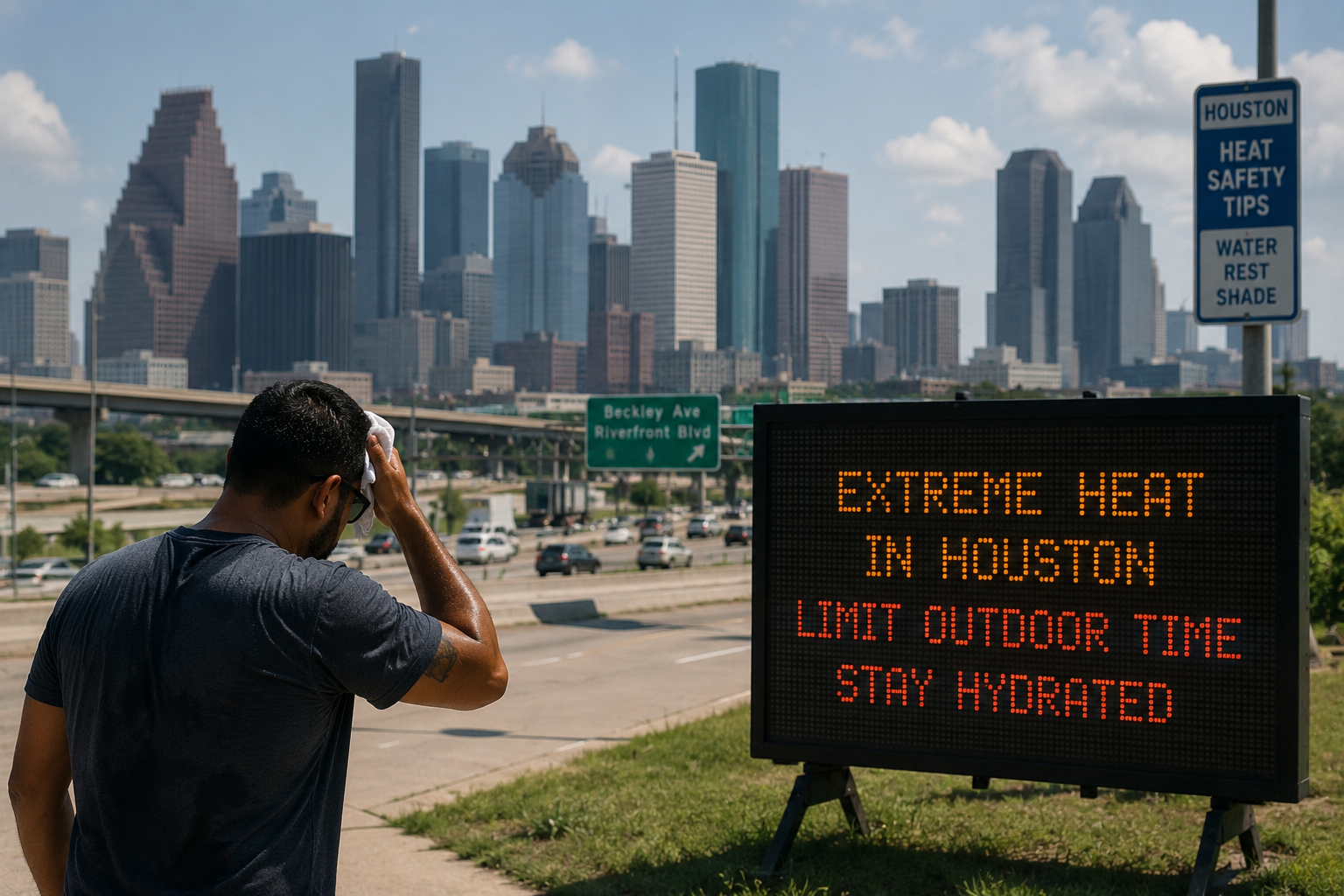
HOUSTON — As the first days of meteorological summer descend on Southeast Texas, the Houston Health Department (HHD) and Harris County Public Health are bracing for what is shaping up to be another potentially lethal heat season. The numbers are stark: heat-related emergency room visits in Harris County have surged 329% between 2019 and 2023, according to a landmark study by Harris County Public Health. With the 2026 summer just beginning, there is no credible reason to believe that trajectory has reversed.
The HHD has activated its annual Summer Surveillance program, an interactive dashboard that tracks heat-related illness (HRI) across Harris, Fort Bend, and Montgomery counties on a weekly basis. The dashboard is designed to identify vulnerable populations and trigger protective interventions — but as public health advocates have repeatedly warned, surveillance is only as valuable as the policy response it generates.
A 329% Increase: What the Data Actually Tells Us
The Harris County Public Health study, covering 2019 through 2023, is not a projection. It is a documented record of real emergency room visits by real Houstonians who required medical care because of the heat. The 329% jump over four years represents a compounding crisis — one that accelerated dramatically in 2024, when Hurricane Beryl knocked out power for up to 2.7 million customers in the middle of a heatwave. Houston-area hospitals reported about twice their normal ER patient load during that period, with more than 320 patients suffering heat-related illness — roughly triple the seasonal norm.
The study found that older adults accounted for 39% of heat-related illness cases — a demographic that is disproportionately likely to live alone, to lack air conditioning, or to be unaware they are overheating until it is too late. Workers who labor outdoors — construction workers, landscapers, delivery drivers — represent another heavily affected group, as do children who may be left in vehicles or who lack access to air-conditioned spaces during the day.
Dr. Jennifer Kiger of Harris County Public Health noted that the correlation between high heat index values — when temperature and humidity combine to reach life-threatening levels — and ER visits is unmistakable. Four of the past five summers in Houston ranked among the top 10 warmest on record. The National Weather Service regularly issues Excessive Heat Warnings for the region when heat indices are expected to exceed 108°F for multiple consecutive days.
West Nile Virus: The Additional Threat
Heat is not the only compounding risk this summer. The Texas Department of State Health Services (DSHS) has already confirmed the state’s first West Nile virus case of 2026 in a Harris County resident — diagnosed with neuroinvasive West Nile disease, the most severe and potentially fatal form of the illness. Neuroinvasive West Nile can cause encephalitis (brain swelling), meningitis, and permanent neurological damage. There is no specific treatment or vaccine.
West Nile spreads through the bite of infected mosquitoes, which thrive in exactly the hot, standing-water conditions that Houston’s summer reliably produces. Flooding from summer storms — a near-annual occurrence — creates breeding grounds for Culex mosquitoes throughout the Houston metro. Public health officials are urging residents to eliminate standing water on their properties, use EPA-registered insect repellents, and wear long sleeves and pants during peak mosquito activity at dusk and dawn.
The Systemic Problem: Heat Undercounting and Infrastructure Gaps
Experts believe Texas is significantly undercounting heat-related deaths. Medical examiners frequently list the immediate physiological cause of death — cardiac arrest, organ failure, respiratory collapse — rather than the underlying heat exposure that triggered the cascade. The CDC uses Maricopa County in Arizona as its national model for heat death investigation methodology; Texas counties vary dramatically in their capacity and willingness to code heat as a contributing cause of death, which means the true toll in Houston and across Texas is almost certainly higher than official figures reflect.
The infrastructure problem is equally acute. After Hurricane Beryl’s 2024 devastation exposed the fragility of CenterPoint Energy’s grid — leaving half a million people without power in triple-digit heat for more than a week — calls for accountability were loud but action was slow. The city’s cooling center network, while improved, remains inadequate for the scale of need: not all centers are open 24 hours, and transportation access to them remains a major barrier for the elderly, the disabled, and the unhoused.
What Houston Residents Must Do This Summer
The Houston Health Department’s advice for the 2026 summer heat season is urgent and practical:
• Never leave children, elderly persons, or pets in parked vehicles — even briefly.
• Check on elderly neighbors, especially those living alone or without air conditioning.
• If your home loses power during a heat event, go to a cooling center immediately. Find locations at the Houston Office of Emergency Management website.
• Drink water consistently throughout the day — do not wait until you feel thirsty, especially during physical activity.
• Know the signs of heat exhaustion (heavy sweating, weakness, cold/pale/clammy skin, weak pulse, nausea) and heat stroke (hot/red/dry skin, rapid/strong pulse, unconsciousness), which is a medical emergency requiring immediate 911 contact.
Monitor the Houston Summer Surveillance dashboard at houstonhealth.org for weekly updates on heat-related illness trends across the region.
Conclusion: Houston Is Running Out of Time to Treat Heat as a Public Health Emergency
A 329% surge in ER visits in four years is not a weather story. It is a public health emergency with a predictable, data-confirmed trajectory. The city of Houston and Harris County have surveillance tools, a published Summer Surveillance program, and years of mortality data. What has been slower to materialize is the political will and the infrastructure investment to match the scale of the crisis — particularly for the city’s most vulnerable residents, who are disproportionately low-income, elderly, or living without stable housing.
As June approaches, the window for preparedness is closing. Houston’s emergency rooms deserve more than a summer of predictable overcrowding. The residents who end up in them deserve more than reactive care after a preventable crisis.
RELATED ON MEDICALDAILY.COM
• Houston’s Deadly Heat Season Is About to Begin — and the City’s ERs Are Already Behind
• Phoenix Heat Deaths: Maricopa County Confirms First Fatality of 2026
• West Nile Virus: What You Need to Know This Summer
• Climate Change and Urban Heat Islands: How American Cities Are Becoming Death Traps