

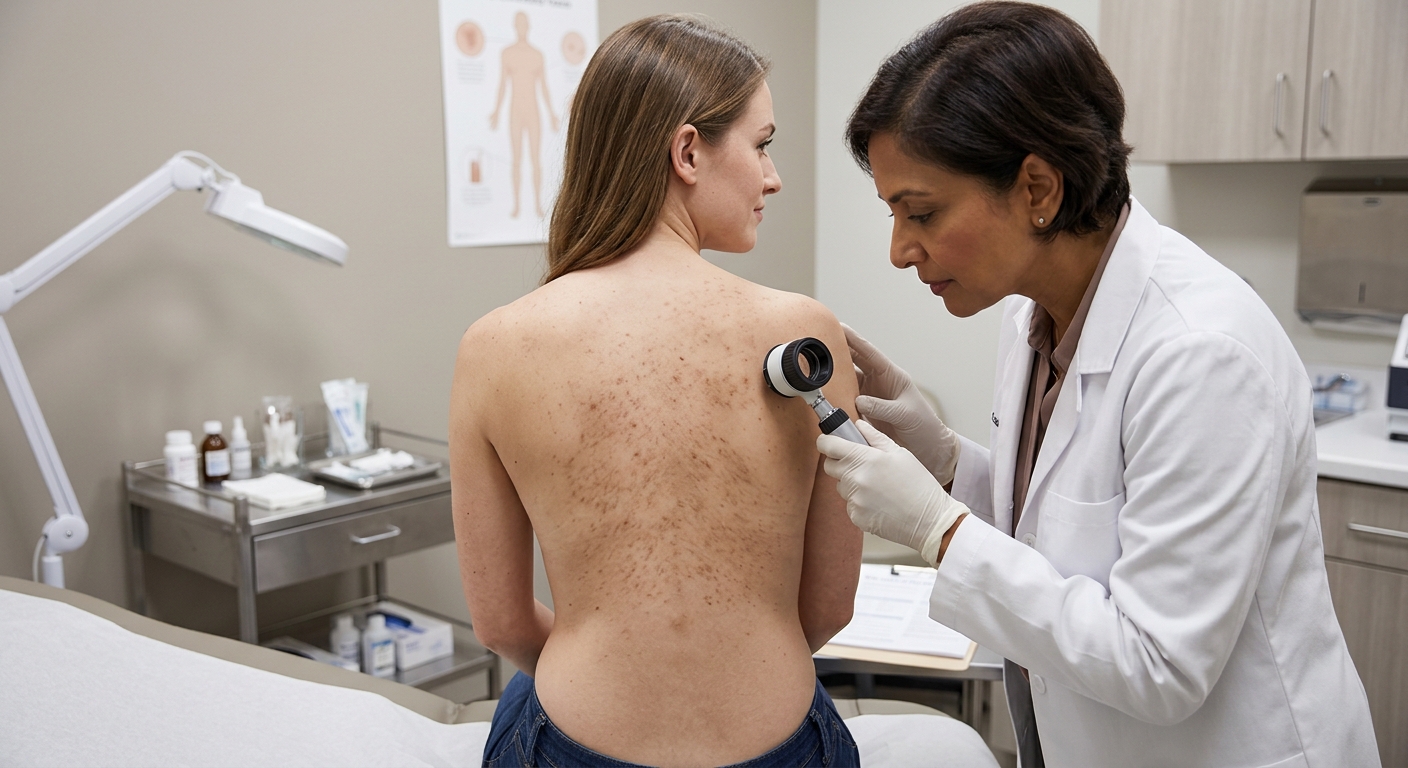
A 27-year-old woman in India came to dermatologists with brownish, rough bumps clustered across her back, chest, and abdomen. Some were centered on hair follicles, and they merged into lacy, netlike plaques. They did not itch or hurt, and they had been there for about two months.
The doctors considered several conditions, including a fungal infection and a rare papillomatosis disorder. Then they wiped the area with an alcohol swab, and the patches came off. The case, published online Sept. 28, 2026, in the Indian Journal of Dermatology, Venereology and Leprology, describes what the authors call a new folliculo-papillomatous variant of terra firma-forme dermatosis.
A Dirt-Like Condition in an Unfamiliar Shape
Terra firma-forme dermatosis is a harmless buildup on the skin that looks like stubborn dirt but does not wash off with soap and water. It was first described in 1987 by Duncan and colleagues in the journal Archives of Dermatology and is sometimes called “Duncan’s dirty dermatosis,” according to a 2025 report in CosmoDerma.
It typically appears as flat, dirt-like brown patches on the neck, face, trunk, ankles or navel, though it can occur anywhere on the body. The new case looked different. The lesions were raised, rough, and follicle-centered, resembling conditions that often lead to longer testing.
The team, from N.K.P. Salve Institute of Medical Sciences and Research Centre and Lata Mangeshkar Hospital in Nagpur, weighed confluent and reticulated papillomatosis, a rare skin disorder with a similar netlike pattern, and pityriasis versicolor, a common yeast infection. A potassium hydroxide test for fungus came back negative. The authors were Aanchal Mittal, Arjun Prakashey, Milind Borkar, Shambhavi Misra and Ruchika Nevse.
Under a dermatoscope, a lighted magnifying tool that reveals patterns invisible to the naked eye, they saw brown clumps around hair follicles, areas where the follicles themselves were spared, and an exaggerated netlike pigment pattern. The alcohol swab then cleared the lesions, confirming the diagnosis.
A Quick Wipe Can Replace a Workup
The defining feature of the condition is that rubbing with 70% isopropyl alcohol removes the patches. The CosmoDerma authors recommend a stepwise approach. First, try soap and water, which clears a related condition called dermatosis neglecta that comes from inadequate cleansing. Then try alcohol. If neither works, doctors should consider other diagnoses.
That simple test can spare patients unnecessary procedures. In a case published in January 2026 in Cureus, a 25-year-old man with a six-month-old, wartlike yellowish plaque on his chest had a punch biopsy before an alcohol wipe produced immediate, near-complete clearing. The biopsy showed thickened, compacted outer skin layers without significant inflammation, findings consistent with the diagnosis. His doctors had considered several other diagnoses, including a late-onset birthmark-like growth called an epidermal nevus and acanthosis nigricans.
The condition is often confused with acanthosis nigricans, a velvety darkening of skin folds, as well as with dermatosis neglecta and “dirty neck” pigmentation, the CosmoDerma authors note.
Not a Hygiene Problem
Despite its name, the condition is not simply a sign of poor washing. The CosmoDerma authors describe it as a keratin-retention disorder linked to abnormal maturation of skin cells. According to DermNet, delayed shedding traps melanin, sebum, and microorganisms in the outer skin layer, producing the dirty-looking patches.
The CosmoDerma authors list several possible contributors, including heavy use of occlusive creams, sun exposure, and colonization by Malassezia yeast. They also suggest a link with atopic dermatitis, since a weakened skin barrier and excessive moisturizing may slow normal shedding of skin cells. Their own patient was a 5-year-old girl with atopic dermatitis who used moisturizer frequently. Her mother reported that soap, water, and topical steroids had not helped.
Likely More Common Than Reported
The Nagpur authors argue the condition is underreported. “TFFD seems to be underreported and more prevalent in practice than cited in literature,” they wrote, describing it as harmless yet frequently misdiagnosed. They also note that atypical versions, including warty, papillomatous, and netlike forms, have been reported before, which makes awareness especially important.
The CosmoDerma authors made a similar point, writing that because the condition is uncommon and resembles other darkening disorders, it is often misdiagnosed and mistreated.
Recognizing unusual forms like the new variant may help doctors reach for the quick alcohol test before ordering more invasive workups. Other recent reports have explored additional tools, including ultraviolet-induced fluorescence dermoscopy, to help identify the condition. In classic cases, dermoscopy may show platelike brown scales arranged in a cobblestone pattern, though the CosmoDerma authors note that sign is not always present.
The research consists of individual case reports, so it cannot establish how often the condition occurs. Dark or changing skin patches can have many causes, including some that need treatment. People should not assume a patch is harmless without an evaluation, and anyone with new, spreading, or changing pigmentation should see a dermatologist or primary care clinician.
Key Questions Answered
What is terra firma-forme dermatosis?
It is a harmless buildup on the skin that looks like dirt but does not come off with soap and water.
What was new about this case?
The patches were raised, rough, and centered on hair follicles, a form the authors describe as a new folliculo-papillomatous variant.
How is it diagnosed?
Doctors typically rule out other causes, then rub the area with 70% isopropyl alcohol. If the patches clear, the diagnosis is confirmed.
Is it caused by poor hygiene?
No. It is thought to result from abnormal skin cell maturation, with possible contributors such as heavy creams, eczema, and yeast colonization.
Should people try an alcohol wipe at home?
Dark skin patches have many causes, some requiring treatment. Anyone with new or changing pigmentation should be evaluated by a clinician.
Published by Medicaldaily.com


