

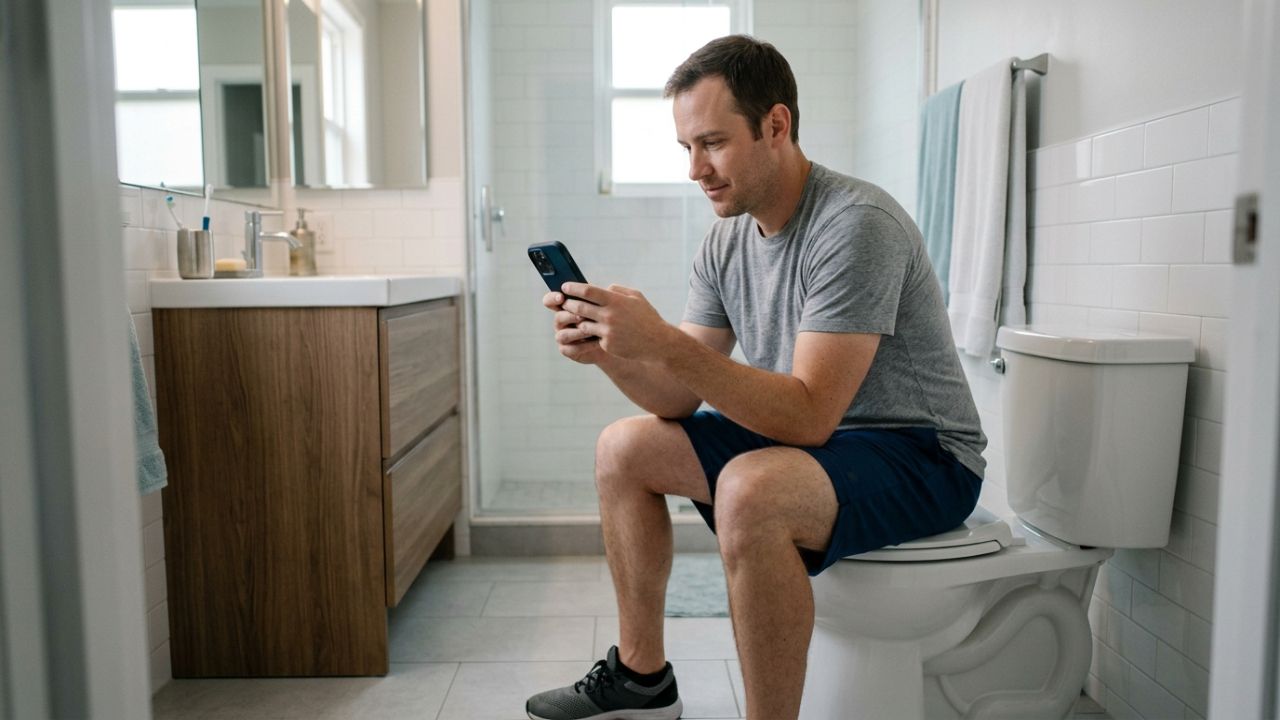
Bringing a phone into the bathroom has become a popular warning sign for hemorrhoids. But a study from Türkiye found the reverse of what that warning would predict: people being treated for hemorrhoids and related anal conditions were less likely than healthy volunteers to scroll on the toilet.
The researchers do not think phones are protective. Their explanation says more about how painful symptoms change people’s habits, and it points back to a factor both studies flagged: how long people stay seated.
The Boston Study That Made Toilet Scrolling a Health Story
The finding most people have heard about came from Beth Israel Deaconess Medical Center in Boston. In a peer-reviewed study published in PLOS One on Sept. 3, 2025, researchers surveyed 125 adults scheduled for screening colonoscopies and then checked their colonoscopy reports for hemorrhoids.
About 43% of participants had hemorrhoids, and 66% said they used smartphones on the toilet. Phone users spent noticeably longer there: 37.3% sat for more than five minutes per visit, compared with 7.1% of people who left their phones elsewhere.
After the team adjusted for age, sex, body mass index, exercise, straining and fiber intake, toilet phone use was associated with a 46% higher risk of hemorrhoids. Straining, long blamed for the condition, did not independently predict hemorrhoids in their analysis.
The phone users were younger on average than non-users, 55.4 versus 62.1 years, and reported less weekly exercise. Reading the news was the most common bathroom activity, cited by 54.3% of phone users, followed by social media at 44.4%. The paper also cites a 1989 letter in The Lancet that tied hemorrhoids to long toilet sessions, such as time spent reading the newspaper.
Many users did not seem to notice the habit. Senior author Trisha Pasricha, a gastroenterologist, told the hospital that only about half of phone users said yes when asked whether their phone kept them on the toilet longer than needed. Still, she stopped short of declaring phones the cause. “We need to study this further, but it’s a safe suggestion to leave the smartphone outside the bathroom when you need to have a bowel movement,” she said in a press release from PLOS.
A Turkish Clinic Saw Fewer Phones Among Patients
In November 2025, surgeons at Muğla Sıtkı Koçman University in Türkiye published a larger comparison in Frontiers in Surgery. They surveyed 211 patients with hemorrhoids, anal fissures or anal fistulas and 369 healthy volunteers between December 2023 and June 2025.
Among patients, 26.1% reported using a smartphone during bowel movements, compared with 37.4% of the healthy group. That gap ran in the opposite direction from the Boston result.
Other habits lined up with long-standing concerns. Patients were far more likely to sit on the toilet for more than 20 minutes (8.1% vs. 0.5%) and to have constipation more than once a week (18.9% vs. 5.7%). In the hemorrhoid subgroup alone, 12.5% reported sessions longer than 20 minutes. Patients were also more likely to wipe back to front (59.2% vs. 45.5%).
The authors called the smartphone result unexpected and noted that it contradicted recent research reporting a 46% higher hemorrhoid risk among phone users, a reference to the Boston study.
Reverse Causation and the Limits of Snapshot Studies
The Turkish team wrote that the phone finding likely reflects reverse causation. People already dealing with pain or urgency may skip distractions so they can finish quickly. In that case, the habit changed because of the disease rather than causing it.
That does not mean phones are off the hook. The authors wrote that the lower phone use among patients “should not divert counselling away from time-on-toilet.”
Both studies share the same core weakness. Each captured behavior at a single point in time, so neither can show whether a habit came before the disease. Both relied on people’s own reports of how long they sat and what they did, which invites recall errors.
The populations also differed. The Boston group included only adults 45 and older who were undergoing screening colonoscopy, and hemorrhoids were noted during the procedure. The Turkish study, from a single hospital, compared people already seeking care for symptoms with healthy volunteers, and its questionnaire was not formally validated. Its patient group was also slightly older (46.0 vs. 42.2 years) and far more heavily male (76.3% vs. 45.0%) than its controls.
The Boston team has called for long-term studies that follow people’s toilet habits over time.
Time on the Seat Connects Both Findings
Where the two studies agree is on sitting time. The Boston researchers proposed that a standard toilet seat offers no support for the pelvic floor, so prolonged sitting may increase pressure on the blood-filled cushions of the anal canal until they swell. The Turkish authors recommended keeping each bathroom session to about three to five minutes or less.
That fits federal guidance. The National Institute of Diabetes and Digestive and Kidney Diseases says certain toilet habits, constipation, a low-fiber diet, and aging may cause hemorrhoids. Its list of habits that may lead to hemorrhoids includes both straining and sitting on the toilet for long periods.
The stakes are not trivial. According to background cited by the Boston team, hemorrhoids account for nearly 4 million office and emergency department visits a year in the United States.
Rectal bleeding is not always caused by hemorrhoids, and some symptoms overlap with other digestive problems. People with bleeding, significant pain, or symptoms that do not improve after about a week of home care should speak with a qualified clinician.
Key Questions Answered
Does using a phone on the toilet cause hemorrhoids?
No study has proved that. A Boston study found an association, while a Turkish study found patients used phones less often. Neither study design can establish cause.
Why would hemorrhoid patients use their phones less?
The Turkish researchers suspect patients changed their habits after symptoms began, skipping distractions to finish faster because of pain or urgency.
What do both studies agree on?
Long stretches on the toilet showed up as a concern in both. The Turkish team suggested keeping sessions to about three to five minutes or less.
Is straining still considered a risk factor?
Yes. Federal health information still lists straining and long toilet sitting as possible causes, though the Boston study did not find that straining independently predicted hemorrhoids in its sample.
When should someone see a doctor about hemorrhoid symptoms?
Anyone with rectal bleeding, significant pain, or symptoms that persist after about a week of home care should contact a clinician, since other conditions can cause similar symptoms.
Published by Medicaldaily.com


