

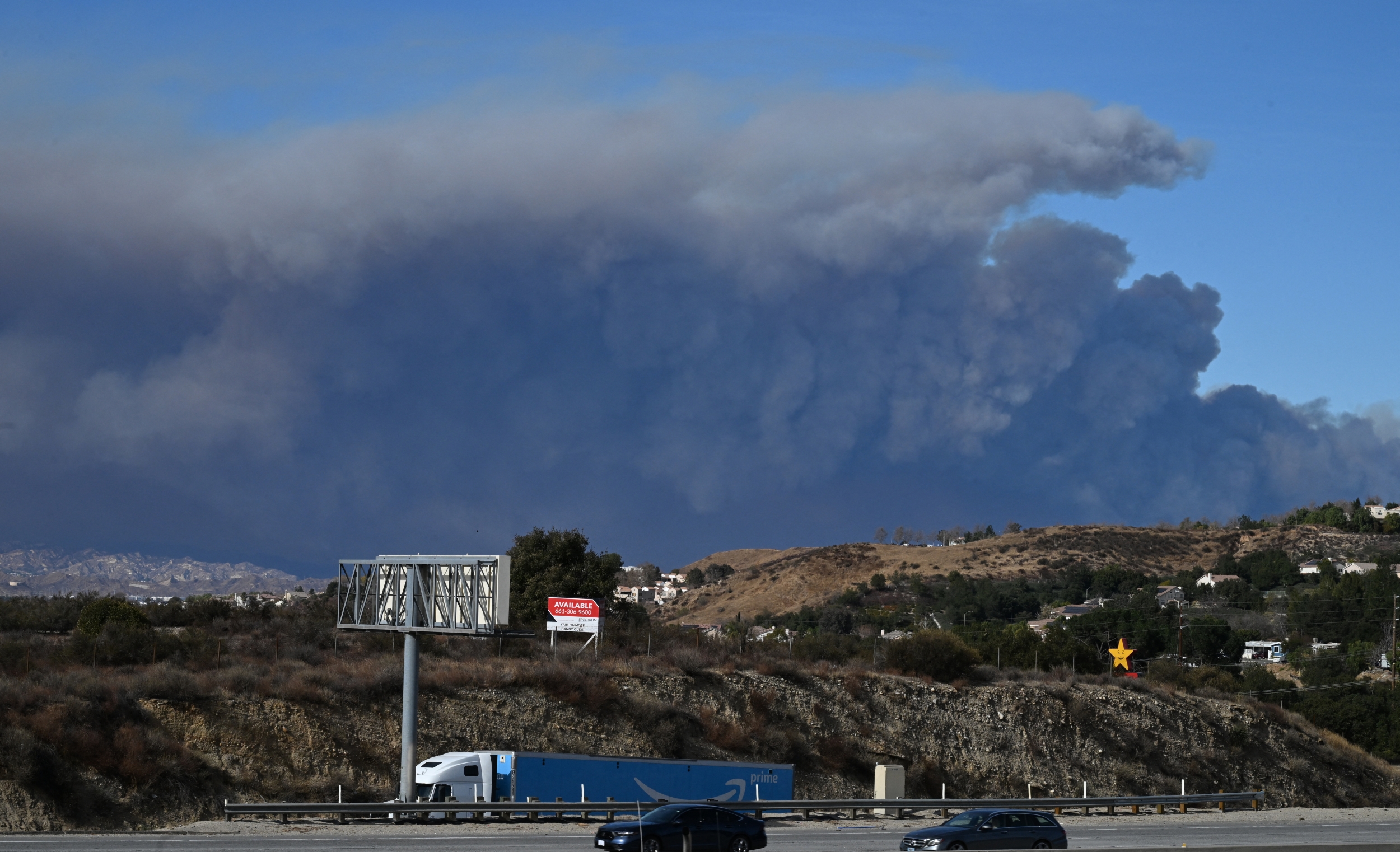
Santa Clarita Valley residents face two health stressors at once. The Bouquet Fire had burned about 1,048 acres in the Angeles National Forest northeast of Santa Clarita as of Sunday, Oct. 4, while a National Weather Service Extreme Heat Warning keeps valley highs near 106 degrees through 8 p.m. Thursday, Oct. 8. For people with asthma, COPD, or heart disease, the overlap matters more than either hazard alone.
The concern is practical. Smoke pushes families to shut windows and stay inside, but extreme heat makes a closed home without air conditioning dangerous. That trade-off falls hardest on older adults, children, pregnant people, and anyone managing a lung or heart condition, the same groups officials flag in both alerts.
Fire and Air Alerts as of Sunday
The fire broke out Saturday afternoon, Oct. 3, along Bouquet Canyon Road. By Sunday morning, it was 40% contained, and crews had reached a knockdown at 2:22 a.m., according to The Signal. Possible explosive ordnance was found at the point of origin, and the cause remains undetermined.
As of Sunday morning, mandatory evacuation orders remained for zones LAC-E018, LAC-E030-B, and LAC-E031-A, with warnings for eight more zones, CBS Los Angeles reported. A shelter opened at the Castaic Sports Complex.
The South Coast AQMD wildfire smoke advisory ran from 8 p.m. Saturday, Oct. 3, to 8 p.m. Sunday, Oct. 4, for the Santa Clarita Valley, the I-5 corridor, and the Angeles National Forest. The district warned that air quality “may reach Unhealthy or higher” levels at times overnight, with the heaviest impacts expected between 11 p.m. Saturday and 7 a.m. Sunday. No extension had been announced as of Monday morning, and later smoke impacts will depend on fire activity.
The heat warning covers the coast and valleys of Los Angeles and Ventura counties, with the National Weather Service forecasting “90 to 100 at the coast and 106 in the valleys.” The Los Angeles County Department of Public Health lists the Santa Clarita Valley among areas under its own heat warning from Oct. 2 through Oct. 8, citing high daytime temperatures and unusually warm overnight conditions.
Lungs and Hearts Under Combined Strain
Wildfire smoke carries fine particles, known as PM2.5, that reach deep into the lungs and trigger inflammation. Heat forces the heart to pump harder and can cause dehydration. Together, they stress the heart and lungs from two directions.
The U.S. Environmental Protection Agency puts it plainly in its fact sheet on smoke and extreme heat: “Recent scientific evidence suggests that exposure to both smoke and extreme heat at the same time may be much worse for your health than exposure to either of them alone.”
Much of that evidence comes from California. A USC study of more than 1.5 million deaths statewide from 2014 to 2019 found that the risk of death rose 6.1% on extreme heat days and 5% on high-pollution days, but 21% on days with both. On combined days, the risk of cardiovascular death rose 29.9% and the risk of respiratory death rose 38%.
“The mortality effect of exposure to both extreme temperatures and extreme pollution is greater than the sum of their individual effects,” said lead author Md Mostafijur Rahman, PhD, in a USC release.
The study has limits. It was observational and measured PM2.5 from all sources, not only wildfire smoke, so it shows an association rather than proof of cause. It does not predict outcomes for this fire, though its findings are consistent with current EPA guidance.
Residents Facing the Greatest Burden
Officials list the highest-risk groups as children, older adults, pregnant people, and people with heart or lung disease. Outdoor workers, people without air conditioning, and people experiencing homelessness also face more exposure. Evacuated families may also be away from their usual medications, inhalers, or home air filters.
Smoke can cause burning eyes, a scratchy throat, headaches, and coughing. People with asthma or heart disease may notice wheezing, chest tightness, or unusual fatigue. Heat illness can bring heavy sweating, dizziness, and nausea.
Some symptoms need immediate help. The CDC lists a body temperature of 103°F or higher, hot and red skin, a fast and strong pulse, confusion, and fainting as signs of heat stroke, which calls for calling 911. Chest pain or an asthma attack that does not respond to a rescue inhaler also warrants emergency care.
Protecting Your Household Through Oct. 8
The EPA’s fact sheet says that for most people, extreme heat is more immediately dangerous than smoke, so cooling comes first. Keep windows closed during hot, smoky daytime hours and run air conditioning with the most efficient filter it can take, ideally MERV 13 or higher. If a home cannot stay cool, go to an air-conditioned space or a cooling center. People with chronic conditions should keep medications handy and talk with a clinician before changing any treatment.
During periods of heavy smoke, the South Coast AQMD recommends avoiding vigorous outdoor activity and notes that a properly fitted N95 or P100 respirator may provide some protection for people who must be outside. The district also advises against swamp coolers and whole-house fans, which bring in outside air. Check on older neighbors living alone.
Cost and access can be barriers. Free cooling centers are listed at ready.lacounty.gov/heat, and residents can call 211, which operates around the clock, for locations and transportation help. Portable air purifiers can be costly, so libraries and public cooling sites are reasonable alternatives.
Fire officials are expected to update containment and repopulation, and the heat warning ends Thursday evening unless it is extended. Live air quality readings are available through the South Coast AQMD.
Key Questions Answered
How large is the Bouquet Fire, and is it contained? As of Sunday morning, Oct. 4, the fire had burned about 1,048 acres and was 40% contained, with crews reporting a knockdown overnight. Officials have not determined the cause.
Are evacuation orders still in effect? As of Sunday morning, orders remained for zones LAC-E018, LAC-E030-B, and LAC-E031-A, with warnings for eight more zones. Residents should check Los Angeles County’s emergency site for current zone status before returning home.
When does the heat warning end? The National Weather Service Extreme Heat Warning for the Los Angeles County coast and valleys runs through 8 p.m. Thursday, Oct. 8, with valley highs forecast near 106 degrees.
Is smoke plus heat worse than either alone? Research suggests so. A USC analysis found the risk of death rose 21% on California days with both extreme heat and high particle pollution, more than on days with either alone, though the study shows association rather than direct cause.
Who should take extra precautions? People with asthma, COPD, or heart disease, older adults, young children, pregnant people, outdoor workers, and anyone without air conditioning face the highest risk.
Should I open windows if my home gets too hot? EPA guidance says cooling takes priority during extreme heat. If you cannot keep indoor air cool and clean, go to an air-conditioned public space or cooling center, which you can find by calling 211.
When should someone seek emergency care? Call 911 for confusion, fainting, chest pain, severe breathing trouble, a body temperature of 103°F or higher, or an asthma attack that does not ease with a rescue inhaler.
Published by Medicaldaily.com


