

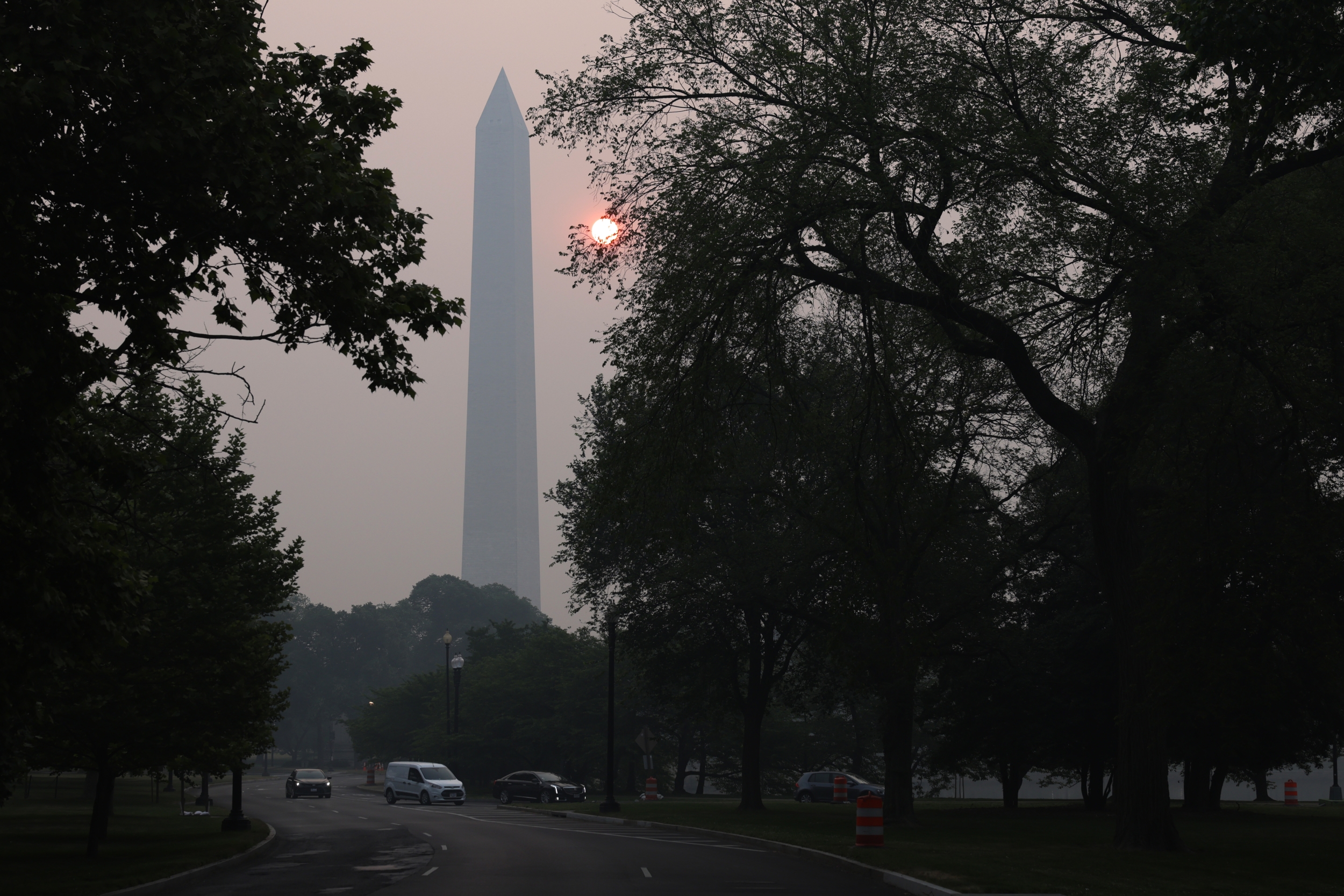
Washington, D.C., residents and the millions of visitors who attended America 250 celebrations on the National Mall have been advised to limit outdoor activity following a rare “Purple” air quality alert — the second-worst category on the federal Air Quality Index — triggered by a convergence of record-breaking heat and smoke from the largest fireworks display in American history.
The Metropolitan Washington Council of Governments issued the purple alert covering Washington, D.C., and parts of northern Virginia. Purple on the EPA’s Air Quality Index represents “Very Unhealthy” conditions — a level at which the EPA recommends that everyone, including healthy adults, reduce prolonged or heavy outdoor exertion.
The heat wave stretched from Wednesday through Saturday, and Washington D.C. hit 102°F on July 3, breaking a record set in 1872. On July 4, the capital reached 101°F or higher — the hottest July 4 in D.C.’s recorded history. The combination of that heat wave with a 40-minute, multi-site fireworks display that launched hundreds of thousands of shells produced post-display particulate matter concentrations that CNN confirmed briefly ranked Washington among the worst air quality of any major city in the world.
Why This Matters
Most Americans are familiar with air quality alerts for “sensitive groups” — adults with asthma, heart disease, or COPD. A Purple alert is categorically different. At this level, the EPA’s guidance extends to the general population: everyone should avoid prolonged or heavy outdoor exertion, not just those with pre-existing conditions.
The biological reason that heat and air pollution compound each other is specific. Heat causes people to breathe more deeply and rapidly — increasing the volume of air (and any particulate matter in it) inhaled per minute. Simultaneously, heat stress places additional burden on the cardiovascular system. Inhaling elevated particulate matter during cardiovascular stress creates a compound physiological challenge that healthy adults can normally tolerate but that at purple AQI levels carries documented risks.
What We Know So Far
The EPA’s AirNow system tracks fine particulate matter (PM2.5) at monitoring stations across the D.C. metro. Following the July 4 fireworks display:
- D.C. July 4 temperature: 101°F or higher — the hottest July 4 in D.C.’s recorded history
- AQI level: Purple — “Very Unhealthy” — the second-highest AQI category after Maroon (“Hazardous”)
- PM2.5 source: Primarily fireworks smoke from the National Mall and nine additional launch sites
- Alert area: Washington, D.C., and parts of northern Virginia
- The AQMD in Southern California had separately issued a “Hazardous” (Maroon) air quality advisory for July 4–5 nationally, confirming the pattern
- D.C.’s post-fireworks conditions briefly registered among the highest air pollution readings of any major global city
Where the Risk Is Highest
The risk is highest in:
- Neighborhoods downwind of the National Mall and the nine additional fireworks launch sites used for the record display
- Indoor spaces without air filtration — where smoke particulates can infiltrate through HVAC systems
- People who remained outdoors after the fireworks ended, when PM2.5 levels were at their peak but the crowd was still dispersing
The alert covered both D.C. proper and northern Virginia — a corridor of 4 million-plus residents.
What the EPA Says and Who Faces the Greatest Risk
At Purple (“Very Unhealthy”) AQI levels, the EPA’s action guidance is:
- Sensitive groups (people with heart or lung disease, older adults, children, people with diabetes): Avoid all physical activity outdoors
- Everyone else: Avoid prolonged or heavy outdoor exertion; consider moving activities indoors or rescheduling
People at the highest risk from the D.C. purple alert:
- Adults with asthma, COPD, or heart disease
- Older adults (65+) who attended National Mall events and spent extended time outdoors
- Children who attended events and are still outdoors
- People who ran, cycled, or engaged in heavy exertion outdoors during or after the alert period
- Anyone with diabetes — air pollution independently worsens glycemic control
Symptoms and Warning Signs to Watch For
Anyone who spent extended time outdoors during the alert period and experiences the following should contact their physician or seek urgent care:
- Unusual shortness of breath
- Chest tightness or discomfort
- Worsening cough or wheezing
- Headache, dizziness, or unusual fatigue following outdoor time
- Worsening asthma or COPD symptoms despite rescue inhaler use
What You Can Do Now
- Check current D.C. area air quality at AirNow.gov by entering your zip code. If the AQI remains elevated, limit outdoor activity.
- Run HVAC on recirculation rather than fresh-air intake to avoid pulling outdoor particulates indoors.
- Use HEPA air purifiers indoors if available — particularly in bedrooms where nighttime air quality matters for recovery.
- If you have asthma or COPD, review your action plan with your physician if symptoms have worsened following the alert period.
- Do not exercise outdoors while the AQI remains in the orange, red, or purple range for your specific neighborhood.
- If you attended National Mall events and feel unwell, contact your physician, particularly if you have cardiovascular or respiratory conditions.
Cost and Access: What Patients Should Know
AirNow.gov provides real-time, zip-code-level air quality data at no cost. The FEMA Wireless Emergency Alert system also broadcasts air quality warnings to mobile phones in affected areas.
For patients experiencing air quality-related asthma exacerbation who do not have insurance, federally qualified health centers in D.C. and northern Virginia provide urgent care services on a sliding-fee basis. For severe respiratory emergencies, call 911.
What Happens Next
The D.C. metro air quality is expected to improve as the fireworks smoke disperses over 48 to 72 hours and as weather systems provide atmospheric mixing. The DOEE (District of Columbia Department of Energy and Environment) updates D.C. air quality data in real time.
MedicalDaily will report on any prolonged air quality advisories or new health guidance from the D.C. health department related to the post-fireworks pollution event.
The Bottom Line
Washington, D.C.’s “Purple” air quality alert — triggered by record heat and the nation’s largest fireworks display — marks one of the most significant post-fireworks air pollution events the city has experienced. At this AQI level, the EPA’s recommendation extends to healthy adults, not just sensitive groups. If you were in the D.C. metro on July 4–5, limit outdoor activity while the AQI remains elevated and watch for respiratory or cardiovascular symptoms.


