Tag: worth

  • Are Potassium Chloride Salt Substitutes Worth Trying?

    Are Potassium Chloride Salt Substitutes Worth Trying?

    Is potassium chloride a win-win by decreasing sodium intake and increasing potassium intake?

    Of all the terrible things about our diets, high dietary sodium intake—high salt intake—is the leading risk. It’s estimated to be causing millions of deaths every year, killing mainly through adverse effects on blood pressure and increased risk of stroke, heart attack, and kidney damage. Hypertension (high blood pressure) is still called the “silent and invisible killer” because it rarely causes symptoms, but it’s one of the most powerful independent predictors of some of our leading causes of death.

    We evolved eating a diet very rich in potassium and low in sodium, but today that pattern has been completely reversed. This flip reflects a shift away from traditional plant-based diets high in potassium and low in sodium—a shift away from fruits, greens, roots, and tubers—and a move towards salty processed foods stripped of potassium, which is considered a “nutrient of public health concern” because 98% of the U.S. population doesn’t even reach the recommended minimum daily intake. As I’ve mentioned previously, low potassium intake itself is implicated in high blood pressure and cardiovascular disease. However, few physicians actually consider telling their patients to eat more potassium-rich foods, like fruits and vegetables, to better control blood pressure, even though several meta-analyses have confirmed that high potassium intake appears to reduce stroke risk.

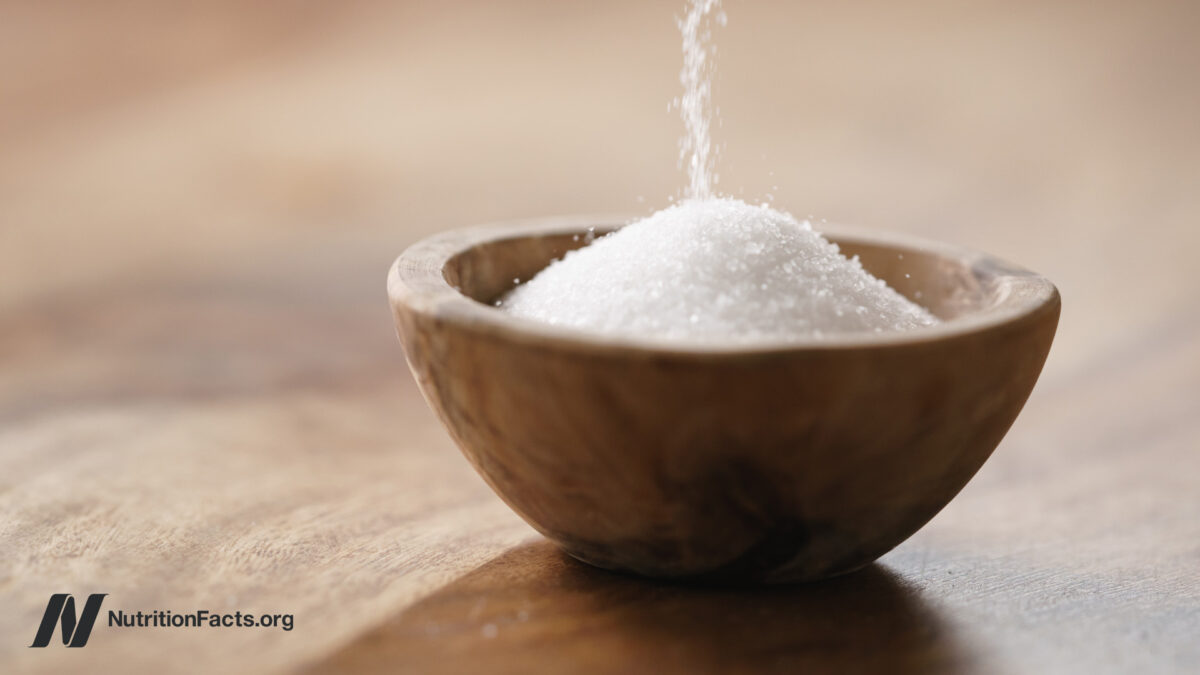
    There is even a reduction in stroke risk independent of blood pressure effects, consistent with other protective effects of potassium, such as reducing clot formation, reducing arterial stiffening, and reducing the generation of free radicals. Higher sodium intake is associated with a 20% increased risk of dying prematurely, while higher potassium intake is associated with a 20% reduced risk of dying prematurely. Since sodium is found in junky processed foods, while potassium is concentrated in healthy foods like beans and greens, could having low sodium intake and high potassium intake just be a marker for a healthier diet—meaning more plant foods and less junk? How do we know sodium is cause-and-effect bad? Because randomized controlled trials show that sodium reduction leads to blood pressure reduction, just like randomized controlled trials show that if people are given extra potassium, their blood pressure can be lowered as well. So, what about using potassium chloride to salt your food, rather than sodium chloride? That’s what’s found in these zero-sodium salt substitutes, which you can see below and at 2:28 in my video Are Potassium Chloride Salt Substitutes Effective?.

    Potassium chloride is considered a naturally occurring mineral salt, obtained in the same way as regular sodium salt. Since we get too much sodium and not enough potassium, this would seem to make potassium chloride a win-win solution.

    Whole healthy plant foods would be the best way to increase potassium intake, especially since fruits and vegetables have all sorts of other good things in them. But we now have 10 studies, comprised of 11 randomized controlled trials, showing that just swapping in some potassium chloride for regular salt can lead to significant reductions in blood pressure in people with hypertension, suggesting that salt substitutes may even help prevent hypertension as well. We know that salt substitutes can lower blood pressure, but does it actually decrease the incidence of hypertension, and more importantly, disease endpoints like stroke and mortality? You don’t know until you put it to the test.

    In a randomized controlled trial, households had their salt replaced with just a quarter potassium chloride. At that level, most people either couldn’t tell the difference or even preferred the salt with the potassium mixed in. But did it actually do any good? The use of even the quarter salt substitute was associated with cutting the risk of developing hypertension in half.

    But what about actually following people out to see if there’s any change in the risk of dying from cardiovascular disease? Five kitchens in a veterans’ retirement home were randomized into two groups for about two and a half years, salting meals with regular salt or, unbeknownst to the cooks and the diners, a 50/50 blend of potassium chloride. Those in the half potassium group cut their risk of dying from cardiovascular disease by about 40% and lived up to nearly a year longer. The life expectancy difference at age 70 was “equivalent to that which would have naturally occurred in 14 [years],” meaning that just switching to half potassium salt appeared to effectively make people more than a decade younger when it came to risk of death. In a recent massive randomized controlled trial in China involving 600 villages and more than 20,000 people over five years, participants received either a salt substitute made of a quarter potassium chloride, or they received regular salt. Not only did the salt substitute reduce strokes, and cardiovascular events in general, but it also reduced the risk of death from all causes put together!

    China is a perfect setting for this study because up to 75% of the population’s sodium intake comes from salt added in the home kitchen or dining room, whereas most sodium in the American diet comes prepackaged in the meat and processed foods we buy, though certainly the food companies could switch over themselves. Why haven’t they? And why haven’t more people embraced these salt substitutes if they work well and can taste just as good? We could be “Achieving the Benefits of a High-Potassium, Paleolithic Diet, Without the Toxicity,” says the title of a Mayo Clinic review. So, “Is Salt Substitution Ready for Prime Time?” a commentary asks. What about safety? There are convincing arguments about the benefits, but what about the risks, like the “inclusion of potentially fatal salt substitutes in the food supply”? Wait, what? We’ll talk about the potential downsides next.

    Doctor’s Note

    This is the second in a three-part series on salt and potassium. If you missed the first video, see The Mineral Intake Recommendations Only 1 in 6,000 U.S. Adults Meet. We finish the series with Are Potassium Chloride Salt Substitutes Safe and Effective?.

    I talk about the randomized controlled trials for sodium in The Evidence That Salt Raises Blood Pressure.



    Source link

  • Is Personalized Genetic Testing Worth It?

    Is Personalized Genetic Testing Worth It?

    Overrated “precision medicine” may just be serving vested interests, and consumer DNA testing can be useless—or even worse.

    Today, you can get your DNA sequenced—the letters of your entire genetic code spelled out—for about a thousand dollars, a bargain compared to the $100 million or so it cost 20 years ago. And for around a hundred dollars, you can get partial DNA sequencing. Direct-to-consumer genetic testing is “only a click away,” like 23andMe, for “ancestry, health, love…and more.” Unfortunately, many tests that are available today haven’t been validated properly. And, as a result, the buyer may be buying something “that is ultimately useless.” Or, results may just be just flat-out wrong.

    There is growing public demand for direct-to-consumer genetic tests, but when put to the test, researchers found an “alarmingly high false-positive rate.” Test results indicated that people carried a high-risk gene, but it simply wasn’t true. And this happened 40% of the time, especially with the BRCA breast cancer gene (the one Angelina Jolie publicly revealed she carries), which you can see below and at 1:08 in my video Should You Get Personalized Genetic Risk Testing?.In addition to the 40% false-positive rate, some variants the tests did identify correctly were misclassified as being high risk when, in actuality, they weren’t high risk at all. You can see how it’s in these companies’ best interest to give scary outlier results, so customers will think the money spent was worth it and maybe even pay for additional testing. But false-positive results and variant misclassification can have serious consequences for a person, including unnecessary stress and even unnecessary medical procedures. What if you got a preventive double mastectomy because you falsely thought you were at high risk when you didn’t even have the BRCA mutation?

    Yes, now, these genome-wide association studies have identified thousands of common genetic variants that affect the risk of complex diseases, as I talked about in my video on personalized nutrition. “Nevertheless, the discovered gene variants do not markedly expand our predictive ability compared with what can be achieved by using only information from long-known traditional risk factors.”

    Take type 2 diabetes, for example. Researchers have identified about 50 genes that are linked to increased diabetes risk, but even when considered collectively, “obese persons with the lowest genetic risk for diabetes were nearly 5 times more likely to develop the disease than normal-weight persons with the highest genetic risk.” In other words, this would send out the wrong message to someone who is obese, giving them a false sense of security. Knowledge about type 2 diabetes genetic susceptibility based on what we know so far has “no implications for decisions about who should be targeted for intensive lifestyle interventions.” Everyone with excessive body fat, regardless of genetics, needs to slim down to reduce the risk of diabetes.

    What about the famous study that purported to show that personally tailored dietary interventions could improve blood sugar responses, to the extent that some commentators said it raised questions about the usefulness of universal dietary recommendations? But if you actually read the study, the results do not show high interpersonal variation in relative blood sugar responses; do not show the model is superior to current methods of detecting high blood sugars; and do not show that personalized nutrition advice is better than standard dietary advice to manage high blood sugar responses after meals.

    But what about personalized genetic risk counseling to at least motivate diabetes prevention? “In a somewhat forlorn bid to regain credibility, ‘knowledge’ of individual genetic risk profile has been touted as effective in motivating test-positive individuals to commit more strenuously to relevant disease prevention efforts….” However, again, available evidence doesn’t support that claim. And indeed, it did not seem to help those at risk for diabetes.

    Researchers randomized people to get genetic tests worth hundreds or thousands of dollars to profile their subtle differences in risk for up to 40 different diseases. In this case, it was Navigenics that described its goal as empowering people with personal genetic insights to help motivate them to improve their health. Yet, it didn’t work. There were no measurable changes in diet or lifestyle, even in the short-term.

    Randomizing people to personalized nutrition insights is like determining who might genetically benefit particularly well from eating more greens or eating to lower their cholesterol, yet when researchers put it to the test, there were no significant changes in diet at month six compared to those who didn’t get that personalized info, or even at month three. So, it’s no surprise there were no differences in weight, belly fat, cholesterol, or any of the other biomarkers.

    Put all the studies together, and what do we find? There are no significant benefits to telling smokers who are at particular risk for lung cancer, or who need to eat especially healthy, or who should be more physically active. The bottom line: Expecting that being aware of DNA-based risk estimates will change behavior is not supported by existing evidence. However, that was the stated reason for the big presidential push for precision medicine in 2015: to empower individuals to take a more active role in their own health.

    It is not surprising that the theme of personal empowerment is invoked. It’s great for marketing, but it’s not particularly empowering. In fact, if anything, it leaves patients even more reliant on authority, and it is not even very personal since the genetic contributions we know of are so small compared to how we actually live our lives. Then why is patient empowerment emphasized as a “cardinal virtue”? Because “it exploits the appeal…to generate political and public support” for an “increasingly industrialized medical-industrial and scientific complex, which moves trillions of dollars around the globe.”

    This isn’t some grand conspiracy theory; it’s just the way the system works. “Healthy living directly threatens many powerful corporations….” Eat less sugar? Eat less meat? Healthier populations, after all, only reduce the demand for doctors and drugs. “Seemingly willfully blind to this evidence, the United States continues to spend its health dollars overwhelmingly on clinical care,” cleaning up our lifestyle-induced messes. So, it’s not surprising that we far outspend other countries while at the same time having worse outcomes. While major new taxpayer gifts were being promised to high-tech medicine about a decade ago, the United States had already sunk to the bottom among comparable countries with respect to disease experience and life expectancy. “Overrated ’precision medicine’ promises may be serving vested interests,…justifying the exorbitant healthcare expenditure in our finance-based medicine.” In lots of ways, the U.S. health care system is the most advanced in the world, but all our “whiz-bang technology just cannot fix what ails us.” “Let’s start with the basics. Eat your broccoli, take the stairs, and don’t worry about whether you have a 5.6 percent or 7.7 percent lifetime risk for a grave disease because either way, a sensible lifestyle is the healthiest choice.”

    Doctor’s Note

    The video I mentioned is Friday Favorites: How Useful Is Personalized Nutrition?.


    Source link

  • Arizona Pastor Accused of Medicaid Fraud After Submitting False Claims Worth Millions: Attorney General

    Arizona Pastor Accused of Medicaid Fraud After Submitting False Claims Worth Millions: Attorney General

    An Arizona pastor has been indicted alongside 16 others in a sweeping Medicaid fraud case, accused of helping funnel millions in state healthcare funds through fake rehab claims and laundering the proceeds through his church, state officials announced.

    A grand jury indicted 17 individuals and two organizations, including Hope of Life International Church and its pastor, Theodore Mucuranyana. Authorities allege that from August 2022 to July 2023, co-defendants Desire Rusingizwa and Fabrice Mvuyekure used their business, Happy House Behavioral Health, to submit more than $60 million in fraudulent Medicaid claims, according to AZ Central.


    Prosecutors allege that the company billed for services to patients who were deceased, incarcerated or hospitalized—and funneled more than $5 million to the church as the investigation loomed.

    Most defendants were scheduled to be arraigned between May 20 and May 27. Mucuranyana and the church face money laundering charges, while Happy House has been suspended from the Arizona Health Care Cost Containment System. Assets including luxury goods and properties are now subject to seizure as part of ongoing investigations.

    The pastor’s lawyer told 12 News that he knew “nothing” about the alleged fraud.

    Since Attorney General Kris Mayes took office in early 2023, over 100 people across 14 cases have been charged following accusations of exploiting the system—largely by billing for nonexistent alcohol and drug rehabilitation services,

    Officials say more indictments could follow as investigations continue into how widespread the misuse of state funds may be.

    Originally published on Latin Times

    Source link