Tag: Walking

  • A Guided Walking Meditation to Notice the Beauty Around Us—Even in the City

    A Guided Walking Meditation to Notice the Beauty Around Us—Even in the City

    This guided walking meditation from Kazumi Igus offers an opportunity to slow down and notice the wonder of the natural world in our urban environments.

    City life can often feel frantic, loud, and cut off from natural beauty. It’s not often we slow down and take in all there is to experience. But even in urban areas, if you pay attention, you can hear the call of a bird, notice your favorite color in shop windows, and look up at the vast sky above. 

    In this guided meditation, we slow our roll and take in the beauty of our surroundings, no matter where we find ourselves.

    A Guided Walking Meditation to Notice the Beauty Around Us—Even in the City

    Read and practice the guided meditation script below, pausing after each paragraph. Or listen to the audio practice.

    1. Let’s start with taking three deep breaths. 
    2. As we begin, I want to bring your attention to how you are moving if you’re walking through the city or trying to get from one place to another. How fast are you moving? How are you walking? What’s your pace? Do you have a destination and a timeframe? Or do you have some space? Wherever you are, slow it down just a little bit. If you can afford to walk really slow and won’t hold up traffic, you’re welcome to. And if you’re not walking and you’re in a wheelchair, you’re welcome to slow down. If you really need to be somewhere, try to relax into this space, whatever it is. Slow and steady, but maybe not too slow depending on where you are. 
    3. Bring your attention to how you are walking—your balance. Are you taking a step? Start to notice the small changes, the muscles involved. And whatever you’re thinking, all of it is OK. You’re just noticing where you are in this space right now. 
    4. Then, acknowledging that our minds sometimes race and we have a lot of things going on in our lives, just take a deep breath and bring your attention back to each step. Start to settle into a rhythm. Notice every muscle that’s involved with creating this locomotion to propel you forward and shift your weight. Maybe if you’re in a wheelchair, you’re using your arms. How are the hands involved? Are you holding something? Maybe a backpack, bag, or someone’s hand. Focus on really being present with your physical space, your physical body. Take a deep breath. As we move through our urban environment, we start to notice other things outside of ourselves. 
    5. The first thing I want you to bring your attention to is the smell around you. Depending on where you are, that can be pleasant or unpleasant. Breathing in, can you identify a particular smell? Maybe you’re getting a lot of smells all at once. Maybe you notice the change in smells as you move past different areas. And as you experience these smells, notice what you’re thinking. Are you creating a story? Are you finding yourself wanting to be near a pleasant smell or maybe pushing away, trying to avoid an unpleasant smell? If that’s the case, that’s all right. All of it is normal. Just experience the smell and label it as pleasant, unpleasant, or neutral. See if you can identify pizza, poop, grass, or whatever it is. 
    6. Then take a deep breath and shift your attention to sights. What can you see? Start by focusing on a color that brings you joy. If it’s a bright color you might notice it in wrappers from candy or chips, maybe in ads, signs, storefront windows that have lots of flyers. If it’s something more earthy, like green or brown, you might start to notice it in nature—the trees and plants. Just pick your color and start noticing it on your journey. Even if the color is on a man-made object like clothing, hats, backpacks, signs, and things like that, that’s a part of the urban environment. If it’s flowers, trees, plants, we’re just noticing the natural portions of the urban environment. Both are necessary. 
    7. Taking another deep breath, we shift to looking at nature. Starting with animals. And for this, let’s maybe not focus on people and their pets. Let’s look for the animals that exist in this environment without being owned by a person. You might notice lizards depending on where you are in the world, cats that don’t have owners, squirrels, insects. 
    8. I’d like to bring your attention to the birds. Birds are what we call an indicator species. They tell you if your environment is healthy. So look up. Look around. Listen. You might even need to stop for a moment. If you can hear birds, start to listen for the variations in their calls, maybe even a different species. If you have mockingbirds, sometimes it’s the same bird making a bunch of different calls. Really stop to listen to it as though they’re telling you something. If the sound of traffic muffles some of the calls, it’s OK. The urban environment is complex. It has both manmade and natural things. If you can see the birds, notice their behaviors, the coloration, and any other details that might pop out at you. And notice your thoughts while seeing or hearing the birds. You might be able to see or hear seagulls if you’re near a coast, rock doves, a.k.a. pigeons, finches, sparrows, chickadees. Notice if you can identify any of these species by site or by call. Take a deep breath, noticing where the birds are. Probably in plants, trees, bushes, or on grass. 
    9. Those of us who live in urban environments often have plant blindness and don’t notice the plants. Take a moment to notice leaves and if you can see any patterns in how those plants are growing. Are there any flowers? Maybe you can recognize a specific species. Can you name it? Take a deep breath. Experience being around plants and animals in nature. 
    10. And as you continue moving keep noticing your color, new plants, new animals. Notice what you’re thinking and if you’re telling yourself a story or if you’re asking a lot of questions. And if you are, take a deep breath and then focus back on the details of the experience—the shape of the leaves, the color of the feathers. As humans, we cannot survive without the natural parts of the environment. So it’s very important for us to be mindful of how our movement through the world affects the nature around us and how the nature around us can affect our experience. Take another deep breath. If there’s a big tree or a squirrel that’s standing there looking at you, or a plant that’s intriguing, take a moment to stop. 
    11. Be grateful for its part of this urban environment. Expressing some gratitude that you are even able to experience it today. Taking a deep breath. Finding your walking rhythm. Slow but steady, or whatever works for you. Continuing to notice your color, plants, the animals. And continuing to take deep breaths. 


    Source link

  • Savor the Day With A Guided Walking Meditation

    Savor the Day With A Guided Walking Meditation

    This short walking meditation from Jon Kabat-Zinn encourages you to embracing mindful awareness with every footfall.

    Walking meditation is not about getting somewhere on foot. Instead, you are being with each step, fully here, where you actually are. You are not trying to get anywhere, even to the next step. There is no arriving, other than continually arriving in the present moment where you can savor the day.

    You are not trying to get anywhere, even to the next step. There is no arriving, other than continually arriving in the present moment.

    With walking, we have the opportunity to be in our bodies in a somewhat different way than when sitting or lying down. We can bring our attention to our feet and feel the contact of the foot with the floor or ground with every step. 

    Walking is a controlled falling forward, a process it took us a long time to master, and one that we often take completely for granted, forgetting just how wondrous and wonderful it is. So when the mind goes off, as it will do in walking meditation just as with any other practice, we take note of where it has gone, of what is presently on our mind, and then gently escort it back to this moment, this breath, and this step.

    Distance: How Long Should I Walk For? 

    Since you are not going anywhere, it is best to minimize opportunities for self-distraction by walking slowly back and forth in a lane, over and over again. The lane doesn’t have to be long. Ten paces one way, ten paces the other way would be fine. In any event, it is not a sightseeing tour of your environment. You keep your eyes soft and the gaze out in front of you. You do not have to look at your feet. They mysteriously know where they are, and awareness can inhabit them and be in touch with every part of the step cycle moment by moment by moment as well as with the whole of the body walking and breathing.

    Speed: How Fast Should I Walk? 

    Walking meditation can be practiced at any number of different speeds, and that gives it lots of applications in daily living. In fact, we can easily go from mindful walking to mindful running, a wonderful practice in its own right. There, of course, we abandon the lane, as we can certainly do for long-distance and faster formal walks. But when we introduce formal mindful walking in Mindfulness-Based Stress Reduction, it is done extremely slowly, to damp down on our impulse to move quickly, as well as to refine our intimacy with the sensory dimensions of the experience of walking and how they are connected with the whole of the body walking and with the breath, to say nothing about having a better sense of what is going on in the mind.

    If you want to try a walking meditation for yourself, try out the guided practice from Jon Kabat-Zinn below.

    A Guided Walking Meditation to Help You Savor the Day

    The above is adapted from Jon Kabat-Zinn’s Guided Mindfulness Meditation Series 3, available here. These guided meditations are designed to accompany Jon Kabat-Zinn’s book Falling Awake and the other three volumes based on Coming to Our Senses.

    Everyday Mindfulness with Jon Kabat-Zinn 

    When he started MBSR, Jon Kabat-Zinn didn’t have a detailed plan—just passion and an inkling that lots of good would come of it. He recently spoke with Mindful about his new MasterClass and shared insights on mindfulness and meditation.
    Read More 

    • Mindful Staff
    • February 1, 2024

    Take Your Mind for a Walk 

    Meditation can seem so meaningful and significant that it becomes a great big chore. In fact, with a slight shift in attitude, it can be as simple as walking the dog.
    Read More 

    • Steven Hickman
    • January 26, 2016


    Source link

  • Pole Walking to Lose Weight? 

    Pole Walking to Lose Weight? 

    Does walking with poles, also known as Nordic pole walking or “exerstriding,” beat out regular walking for depression, sleep quality, and weight loss?

    Exercise recommendations for obesity have been referred to as “the mysterious case of the public health guideline that is (almost) entirely ignored.” Governmental, scientific, and professional organizations call for at least an hour of exercise a day for weight management, but “almost no obese adults meet this target.” As you can see below and at 0:32 in my video Are There Benefits of Pole Walking for Weight Loss?, surveys suggest American men and women watch television ten times more than they exercise. 

    For Americans with obesity, it may be even worse. Only 2 percent reach even 30 minutes a day, as you can see below and at 0:36 in my video, and the percentage exceeding an hour of exercise a day is expected to be close to zero.

    Why don’t individuals with obesity exercise more? Why don’t we just ask them? When questioned, “obese adults typically describe exercise as being unpleasant, uncomfortable and unenjoyable.” How can we break this vicious cycle, where inactivity can lead to weight gain, which can lead to further inactivity and even more weight gain? The first thing to recognize is that “it is normal and natural to be physically lazy.”

    “Nothing in Biology Makes Sense Except in the Light of Evolution” is the title of a famous essay written by a noted geneticist. Laziness is in our genes. We evolved to instinctually avoid unnecessary exertion to conserve energy for survival and reproduction. These days, there’s no shortage of available fuel, yet the hard-wired inertia remains. “The vast majority of people today behave just as their ancestors by exercising only when it is fun (as a form of play) or when necessary.” Just like dietary change for weight control, the only way exercise is going to work long-term is if it becomes “a stable, ideally lifelong, activity habit.” Exercise is only effective if it’s sustainable. So, we need “to restructure our environments to require more physical activity,” like using a treadmill desk, and figure out how to make exercise more enjoyable. It should just be a walk in the park—literally, perhaps!

    Some wise advice from a 1925 medical journal entry: “The best prescription to be written for a walk is to take a dog…and a friend.” Listening to your favorite music might also help. Music has been described as “a legal method” for improving peak performance and, more importantly, enhancing the enjoyment of high-intensity interval training. As you can see below and at 2:37 in my video, listening to a preferred playlist during exercise can significantly reduce your “rate of perceived exertion,” which is how hard you feel your body is working. When severely obese youth got on a treadmill and were told to go until exhaustion, with or without music, those listening to their favorite tunes “ran significantly longer,” tending to go about 5 percent longer. This was chalked up to “attentional distraction”; the music may have helped them keep their mind off feelings of fatigue. If that’s the case, listening to a podcast or audiobook might have a similar effect. 

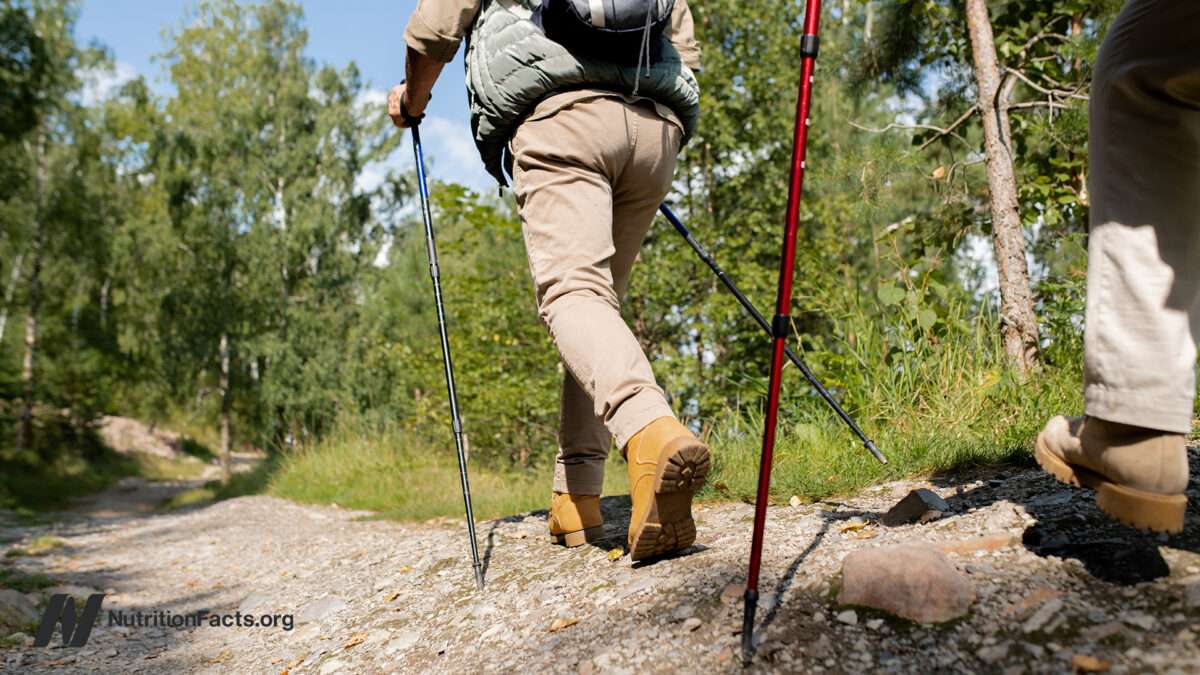
    One way to up your walking game is with walking poles. So-called Nordic walking, also known as exerstriding or Viking hiking, was originally developed in Scandinavia to maintain cross-country ski athletes’ training in the summer. It’s since gained in popularity worldwide as a general fitness activity. The augmented engagement of the upper body musculature may result in an 18 to 22 percent increased calorie expenditure over walking alone (depending, in part, on your pole handling technique). Does that translate into accelerated weight loss?

    Before and after studies demonstrate weight loss with pole walking, compared to a sedentary control, but what about compared to regular walking? Of the four such studies I could locate, comparing thrice weekly 40- to 60-minute sessions of Nordic pole walking to regular walking, every single one found no significant difference in body fat measures after 8 weeks, 12 weeks, another at 12 weeks, or 13 weeks. You can see the last one below and at 4:16 in my video

    There are, however, other benefits over regular walking, such as increased upper body muscle bulk, improved muscular endurance, and increased strength, as seen below and at 4:20 in my video, though not as much as was seen with resistance-band training. But, as I was writing How Not to Diet, there wasn’t any evidence of a weight-loss-enhancing effect, which is why Nordic walking didn’t make the cut. Just as we were going to press, a study was published—the first to combine Nordic walking with diet, compared to the same dietary program with regular walking. And, once again, no significant difference was found in body weight or anything else. There was a hint that those in the pole group enjoyed it more, and, in the end, exercise only works if you do it, so that may be a benefit. 

    There may be other benefits, too. As you can see here and at 5:05 in my video, Nordic walking beat out regular walking in terms of reducing symptoms of depression and improving sleep quality.

    Perhaps this should not be surprising, given the greater exercise intensity of pole walking, even approaching that of jogging at higher speeds, shown below and at 5:15 in my video. And that’s where I see the role of walking poles—to fill the intensity gap between people who are ready to graduate from walking but aren’t ready for more rigorous activities, such as running. The only potential downsides are the added expense and, “reminded of Monty Python’s famous ‘ministry of silly walks’ sketch…‘feeling fairly ridiculous’ when trying Nordic walking for the first time.”  

    However you walk, there are a lot of benefits. Check out my video Longer Life Within Walking Distance.

    Related videos include How Much Exercise to Sustain Weight Loss? and How Much Should You Exercise?.


    Source link

  • Every Extra Hour Of Walking In Your 40’s Adds Time To Lifespan: Study Suggests

    Every Extra Hour Of Walking In Your 40’s Adds Time To Lifespan: Study Suggests

    The secret to longevity lies in the level of physical activity at age 40, a recent study reveals, showing that increased activity at this stage can extend lifespan.

    Americans who increase their physical activity to match the top 25 percent of the population could add five years to their lifespan, the study revealed. Also, the least active individuals might gain nearly 11 years by reaching the activity levels of the most active, according to the study published in the British Journal of Sports Medicine.

    To understand the impact of different levels of increased physical activity on life expectancy, the researchers used a predictive model based on data from the activity tracker from the 2003–06 National Health and Nutritional Examination Survey. Participants were aged 40 and older.

    The study found that the most active 25 percent of Americans in this age group engaged in physical activity equivalent to 160 minutes of walking at a normal pace of 4.8 km (3 miles) per hour daily. The predictive model showed that if all Americans over 40 matched this daily level of physical activity, their average lifespan would increase by over five years. This means that their life expectancy would increase from 78.6 years to around 84 years.

    Meanwhile, when the least active 25 percent of the population matched the activity levels of the most active 25 percent, they could gain nearly 11 additional years of life. However, this would mean they need to add 111 minutes of daily walking at 4.8 km/hour, or an equivalent effort.

    “Our findings suggest that physical activity is associated with substantial gains in life expectancy for individual Americans and for the population. Moving the least active 25% of the population over age 40 to become as active as the top 25% could result in an average life expectancy gain of about 11 years for this group. The greatest gain in lifetime per hour of walking was seen for individuals in the lowest activity quartile where an hour’s walk could add an impressive 6 hours to life,” the researchers wrote.

    While the greatest benefits were notable when there was an increase in physical activity to the least active group, on average, every extra hour of walking adds around 3 hours (169 minutes) to lifespan.

    Since the study is observational and based on a predictive model, there are a few limitations. The researchers caution that there is the possibility that they might have “underestimated or overestimated the benefits of physical activity”.

    Source link

  • Meet Uncertainty with Compassion With Walking Meditation

    Meet Uncertainty with Compassion With Walking Meditation

    Life is inherently changeable and uncertain, and our resilience relies on how we relate to that fact. Mindfulness doesn’t mean everything’s fine or that we’re calm all the time. We aim for patience, clarity, and then—when it’s time—skillful action. 

    Whatever we face, we can meet uncertainty with compassion. This might look like carving out a moment to settle before deciding what comes next. Instead of remaining caught up in reactivity, anger, and fear, it takes effort and training to find a balance between accepting what we cannot change and seeking out where to actively put our effort. 

    The heart of mindfulness means doing our best to navigate our experience, even our crises, with both precision and compassion.

    Take a moment when you’re able to explore that balance. The heart of mindfulness means doing our best to navigate our experience, even our crises, with both precision and compassion. 

    A Mindful Walking Practice to Meet Uncertainty with Compassion

    1. So as you start, focus on what it feels like to walk. Notice the physical sensation of each step. Notice your foot rising, the shift of weight in your body, and then your foot returning to the ground. 

    2. You might label each step as step. Or you might count small runs of steps, perhaps up to 10, and then start again. 

    3. Note your mind’s tendency to add on to your experience, often in ways that complicate even the most challenging moments. Your mind may already be wandering into the future or the past. When you catch yourself lost in thoughts like that, come back again to one step. 

    4. And now, if you’d like, expand your awareness. Notice sounds around you. With a sense of unforced and balanced effort, notice smells, touch, and sights. 

    5. With a sense of strength and perhaps appreciation, immerse yourself in the physical sensation of the walk that you’re taking. 

    6. If a thought or a feeling holds your awareness or becomes a distraction, see if you’re able to practice letting go a little. Notice that sense of getting hooked or tied up in your thoughts and then come back again to that immediate physical sensation of each step. 

    7. Noticing those thoughts, return your attention again to the physical sensation of taking your walk. 

    8. For the last few minutes of the practice, if you’d like, focus on a sense of kindness and compassion. You’re not alone right now. Everyone around the world is struggling to get by. 

    You’re not alone right now. Everyone around the world is struggling to get by. 

    9. So as you walk, taking in your reality, remind yourself: This is what is right now for me. This is where I am—observing my emotional state, my state of mind, and thoughts. 

    10. And then as you walk, wish yourself whatever you would wish for your closest friends right now. 

    May I be happy and at ease. 

    May I recover my sense of resolve and strength. 

    11. If it feels comfortable, you might also expand that. Picture your family and friends in the same way. 

    May we all find our sense of resolve and ease.

    May we all stay healthy and safe.

     12. And if, while you’re walking, you encounter other people or even pass other houses, you may take a moment to offer those strangers the same wishes. Whoever they are, whatever their life experience, everyone has their struggles. So as you pass these other people, or their homes, wish them well.

    May you find health and happiness. 

    13. As we end the formal mindfulness practice, expand your awareness to all beings everywhere—even the ones you find most difficult and challenging. Everyone in some way is driven by a motivation to be free of suffering, to be free of stress, to be healthy, to be happy. 

    May everyone everywhere throughout the world find a sense of resilience, stay healthy, and find happiness. 

    An Election Day Meditation 

    Follow along as Rhonda Magee guides us through a S.T.O.P. practice for focused awareness. The invitation is to be kind to yourself, take a conscious breath, and gently relate to thoughts, emotions, and sensations that arise.
    Read More 

    • Rhonda Magee
    • November 5, 2024


    Source link

  • Connect with Your Senses With A Guided Walking Meditation

    Connect with Your Senses With A Guided Walking Meditation

    We can connect to our senses and nourish our relationship to the peace, pleasure, and technicolor qualities of the present moment, as we walk. Starting your day with an intentional morning walking meditation can be the key to bringing calm awareness, as you very simply pay attention to what the body is experiencing, as you bring your awareness to the physical sensations of feeling your feet as you walk. This walking exercise can be done on the way to your car, in a park, or even as you’re walking down a hallway. All it takes is being awake to what you notice while you’re walking.

    Connect With Your Sense in Walking Meditation

    1. Choose a foot to start with. Pick it up, move it through space, and gently place it on the ground, feeling the sensations of each part of this process from heel to toe. So, picking the foot up, making a choice, picking a foot up, lifting it, moving it through space, feeling it touching down from heel to toe, connecting with your senses.

    2. Walk with intention. We’re so used to walking in what we call automatic pilot, basically being tuned out and just letting the body go. You may notice that this feels a little strange to be so intentional about walking. That’s okay. This intention that you’re bringing is a way for you to reconnect with the present moment and what you’re feeling right now. This intention is what makes this a walking meditation.

    3. Let yourself notice.  Notice as much as you can about the feel of picking your foot up, moving through space, and gently placing it down. I get most of us are so used to walking, when we first bring our attention to it, we might even feel a little wobbly. It’s okay: this is normal, and part of what it feels like to wake up and actively connect with the senses and notice the details of what we are doing.

    We’re so used to walking in what we call automatic pilot, basically being tuned out and just letting the body go. You may notice that this feels a little strange to be so intentional about walking. That’s okay.

    4. Focus your attention. Focus on the feeling of your feet making contact with the ground right now. Can you notice a difference between thinking about your feet and feeling them making contact with the floor or the earth? Can you let yourself experience what it’s like to be grounded and connected as you make a conscious choice to be present for this walking meditation?

    5. Feel your surroundings. If you’ve chosen to walk outside, allow yourself to feel the impact of the air on your skin. What do you notice? Is it warm or cool? Is the air damp or dry? Allow yourself to feel it.

    6. Notice when thoughts take over. You may notice how quickly your attention is drawn to your thoughts, whether it’s thoughts of your day, list making, maybe you’re running an old conversation or story over and over in your mind. Once you notice your thoughts trying to hijack your walk, you may also notice that being lost in thought makes it more difficult to connect with your senses. You probably will notice that you find it harder to hear what’s going on in your environment, harder to smell anything, or taste anything. Thoughts are that powerful. So, when you know the thoughts are pulling you away, just notice that this is what’s happening, smile, and then you can gently and kindly choose to redirect your attention back to connecting with your senses and even more particularly, back to the feeling of your feet walking. Come back to this experience of the senses and the feet over and over throughout your walking meditation.

    Connect with the Present Moment

    7. Let yourself experience your surroundings. What do you notice about the weather? Do you have an opinion about it? What happens if you just experience that weather is here, noticing the qualities of the weather, and how you’re experiencing it on the skin or in the body? What happens when you let yourself notice the sounds around you? What do you notice about the smells around you? Can you experience these sensory qualities as the symphony of the world?

    The smell of the world: noticing pungent, acrid, sweet, sour, fresh, earthy. Maybe you can notice sounds as high-pitched, low hums, loud, or soft. How much can you allow yourself to take in the world in the minutest detail as your senses experience what’s here, without adding the layer of judgment on it about how you feel about it? Just for now, see what you’re able to do as you take in the raw data of the world around you—experience it in this morning walking meditation.

    8. Pause now and then. Another way you might heighten the sensory experience of this walking meditation is, every once in a while, stop right in your tracks if you’re able and it’s appropriate, and notice in a very specific way what it feels like to be grounded as you feel your feet making contact with the earth or the floor. Maybe take a moment to choose a particular thing to experience through the eyes, focusing on color, shape, texture.

    Another way you might heighten the sensory experience of this walk is, every once in a while, stop right in your tracks if you’re able and it’s appropriate, and notice in a very specific way what it feels like to be grounded as you feel your feet making contact with the earth or the floor.

    Let your nose have a big sniff in and intentionally smell the air. Redirect your attention to your ears and hear the world right now. Can you hold everything you’re noticing lightly, and just let it be part of your environment while you experience it? You don’t have to judge it, or change it, or do anything about it. Just be here for you right now and then when you’re ready, make a choice to select which foot you’ll begin with and start your walking meditation again.

    9. Find your pace. Walking, noticing which foot is moving as you pick it up, move it through space, gently place it down feeling the foot making contact with the earth. Although it might help to begin by practicing going slowly, once you have learned to be present to walking in this new way, there’s no reason you can’t move more quickly. Find whatever pace allows you to stay present while you’re experiencing.

    Be Curious and Let Yourself Wander

    10. Try aimless wandering. You might want to use this morning wake-up walk to take you to work, or any particular destination. But if it feels safe to do so, it can also be wonderful to allow yourself to do an aimless walk. Maybe setting a timer, perhaps 15 minutes, and allowing your feet to take you wherever they want to go, staying present to your ever-changing environment without having a goal as your destination, just walking freely. Noticing what it feels like to reconnect to inner instincts that show up as everything starts to quiet a bit, as you heighten your senses with this morning walking meditation. Noticing over and over as the attention is drawn to other things, particularly thinking.

    Bringing your attention back to your feet over and over can be the greatest help to reconnecting with the present moment as you let your felt senses and the feeling of your feet touching the ground bring you back, right here, right now, coming back over and over and over. At the end of your walk, notice how you feel, check in with each one of your senses. What are you aware of right now, having spent this time bringing attention to the sensory experiences? What do you notice now about your mood? Notice what it feels like to inhabit your body and be awake to your precious life.

    While many of us lean on mindfulness to help us through times of inner and outer chaos, we can cultivate the greatest resilience through consistency in our practice, even when it doesn’t feel urgent. Read More 

    • Georgina Miranda
    • July 23, 2024

    While moving through nature, we have the opportunity to enter a state of being, be present with all of our sensations, and awaken gratitude for the Earth that is also part of us. Read More 

    • Georgina Miranda
    • July 16, 2024

    Ruth King guides us in a practice to explore the truth of our interconnectedness. Read More 


    Source link