“I worried that if I stopped tracking macros, I would lose my physique.”
After years of careful macro tracking, Dr. Fundaro finally admitted to herself that the method no longer worked for her. Yet she was afraid to give it up.
If anyone should feel confident in their food choices, it would be Dr. Gabrielle Fundaro. After all, Dr. Fundaro has a PhD in Human Nutrition, a decade-plus of nutrition coaching experience, and six powerlifting competitions under her belt.
Yet, when she was really honest with herself, Dr. Fundaro realized that she felt far from confident around food. For years, she’d used macro counting as a way to stay “on track” with her eating.
And it worked… until it didn’t.
After years of macro tracking, Dr. Fundaro was tired of the whole thing. She was tired of making sure her macros were perfectly in balance. She was sick of not being able to just pick whatever she wanted off a menu and enjoy the meal, trusting that her health and physique wouldn’t go sideways as a result.
Yet the idea of not tracking freaked her out. Every time she quit tracking, she worried:
“What if I don’t eat enough protein, and lose all my muscle?”
“What if I overeat and gain fat?”
“What if I have no idea how to fuel myself without tracking macros? And what does that say about me as an expert in the field of nutrition?”
The more Dr. Fundaro wrestled with macro tracking, the more she wanted to find an alternative.
Something that would support her nutritional goals while also giving her a sense of freedom and peace around food.
Calorie counting wouldn’t do it. That was just as restrictive as counting macros—maybe more.
Intuitive eating didn’t seem like a good fit either. Intuitive eating relies heavily on a person’s ability to tune into internal hunger and fullness cues to guide food choices and amounts. After years of relying on external cues (like her macro targets), Dr. Fundaro didn’t feel trusting enough of her own instincts; she wanted more structure.
Meanwhile, at the gym, Dr. Fundaro began lifting based on the Rate of Perceived Exertion (RPE) scale—a framework that helps individuals quantify the amount of effort they’re putting into a given movement or activity. It’s considered a valuable tool to help people train safely and effectively according to their ability and goals. (More on that soon.)
While using the RPE scale in her training, Dr. Fundaro found she was both getting stronger and recovering better. There was something to this combination of structure and intuition that just worked.
And then, it dawned on Dr. Fundaro like the apple hit Sir Isaac Newton on the head:
If Rate of Perceived Exertion could help her train better, couldn’t a similar framework help her eat better?
With that, the RPE-Eating Scale was born.
Dr. Fundaro has since used this alternative method to help herself and her clients regain confidence and self-trust around food; improve nutritional awareness and competence; and free themselves from food tracking.
(Yup, Dr. Fundaro finally trusts her eating choices—no macro tracker in sight.)
In this article, you’ll learn how she did it, plus:
- What the RPE-Eating scale is
- How to practice RPE-Eating
- How to use RPE-Eating for weight loss or gain
- Whether RPE-Eating is right for you or your clients
- What to keep in mind if you’re skeptical of the concept
What is RPE-Eating?
Invented by Gunnar Borg in the 1960’s, Rate of Perceived Exertion (RPE) is a scale that’s used to measure an individual’s perceived level of effort or exertion during exercise.
Though Borg’s RPE uses a scale that goes from 6 to 20, many modern scales use a 0 to 10 range (which is the range that Dr. Fundaro adapted for her RPE-Eating scale).
Here’s the RPE scale used in fitness.
| Rating |
Perceived Exertion Level |
| 0 |
No exertion, at rest |
| 1 |
Very light |
| 2-3 |
Light |
| 4-5 |
Moderate, somewhat hard |
| 6-7 |
High, vigorous |
| 8-9 |
Very hard |
| 10 |
Maximum effort, highest possible |
Originally used in physiotherapy settings, the scale is now frequently used in fitness training.
For example, powerlifters might use it to choose how heavy they want to go during a training session. Or, pregnant women might use it to ensure they aren’t over-exerting themselves during a fitness class or strength training session.
Because human experience is highly subjective and individual, the scale allows the exerciser to judge how hard they’re working for themselves. A coach can provide a general guideline, such as “aim for a 7/10 this set,” but it’s up to the client to determine exactly what that means for them.
Dr. Fundaro had used the scale many times with herself, and clients. She always appreciated the sense of autonomy it gave her clients, while still providing some structure.
So, she decided to take the same 1-10 scale and its principles, and apply it to eating.
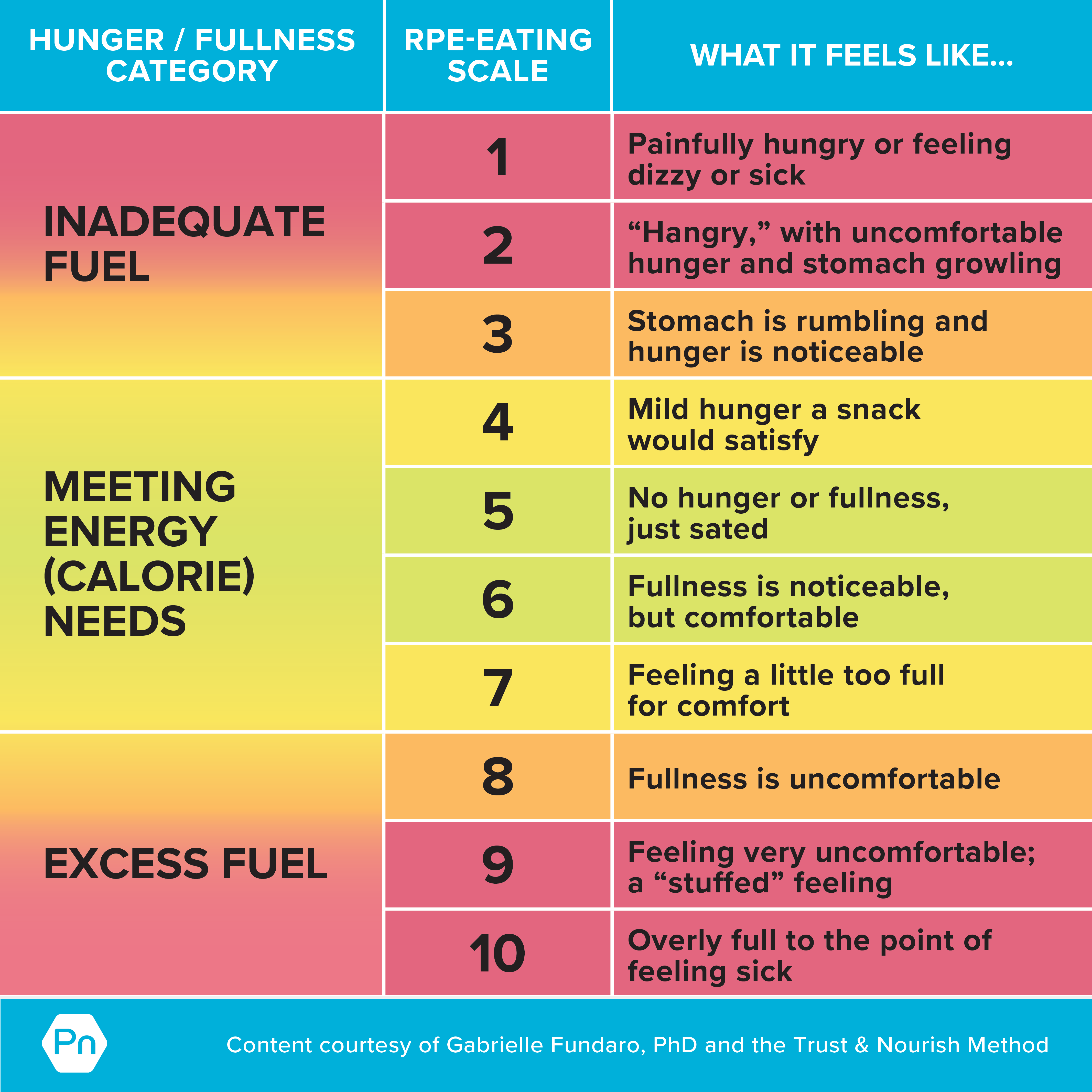
Here’s what the RPE-Eating Scale looks like:

The goal with RPE-Eating is similar to RPE when training: Develop the skills to determine what is sufficient for you, without having to rely on other external metrics (such as apps or trackers).
How to practice RPE-Eating
If you’ve ever practiced RPE-training, you’ll know it takes some time to get used to. RPE-Eating is the same.
Don’t expect to be in lockstep with all of your body’s internal cues at first, especially if you’ve been ignoring them for a long time.
With this in mind, apply the steps below to practice the RPE-Eating process.
Step #1: Get clear on your goals.
RPE-Eating is not just another diet.
“It’s not about aiming to change your body,” Dr. Fundaro explains. “It’s not about feeling more control over your diet. Nor is it about feeling like you’re eating the ‘optimal’ diet.”
If your priority is maintaining a specific physique (such as staying ultra lean) or changing your body (building muscle or losing fat), this method can be adapted for that, though it isn’t the most efficient one to use.
Instead, RPE-Eating is about sensing into what your body needs and giving yourself appropriate nourishment—while building inner trust and confidence along the way.
“You have to trust that you’ll be able to nourish your body, and that you’ll be okay even though things may change in your body,” says Dr. Fundaro.
Admittedly, this can be challenging to do. It can also be difficult to let go of the expectation that you’ll hit the “right” macros at every meal—which RPE-Eating isn’t specifically designed to do.
However, if your goal is to build more self-trust, RPE-Eating can be a great tool to help you do that.
Step #2: Practice identifying your hunger cues
Before we explore this step, let’s distinguish between two motivators for eating.
First, there’s hunger. Hunger occurs when physical cues in your body (like a general sense of emptiness or rumbling in your stomach, or lightheadedness) tells you that you require energy—known to us mortals as food.
Then, there’s appetite. Appetite is our desire or interest in eating. It can stay peaked even after hunger is quelled, especially if something looks or tastes especially delicious—like a warm, gooey cookie offered after dinner that you feel you have to try, even though you’re technically full.
While it’s normal to eat for both hunger and appetite drives, the two can become mixed up. Especially if we have a history of dieting and tracking food.
The RPE-Eating scale helps you tap back into those true physical hunger cues, and learn the difference between hunger and appetite.
To put this in practice, try this before your next meal:
Using the RPE-Eating scale mentioned above, identify your current level of hunger. Record the number on paper or the notes app on your phone.
Then, eat your meal with as much presence as possible. (Note: This in itself takes practice. It can help to limit distractions, such as eating at the table rather than in front of the TV, and focusing on the flavors and textures of the food you’re eating, and how you feel eating it.)
About halfway through the meal, check in again. Based on the scale, how hungry are you now? As before, record the number.
If you’re still hungry, finish your meal. When you’re finished, repeat the same process, writing down where you are on the scale.
Once you’re done, take a minute and tune into what your body feels like. What does it feel like to be full? “Download” that feeling into your mind and internalize it in your body, as if you’re updating your phone with the latest software.
Repeat this for as many meals as you can. Aim to do it for one meal a day for a week or so, or for as long as feels good to you. Don’t worry if you forget: simply repeat the practice when you can.
The more you practice this, the better you’ll become at being attuned with your actual hunger cues. With time, you’ll likely find you develop more trust in your internal compass than what the latest diet tracker says for your needs.
(For more on fully-tuned-in, mindful eating, read: The benefits of slow eating.)
Step #3: Get to know your non-hunger triggers
Have you ever come home after a super stressful day and you’ve basically thrown yourself onto a bag of chips or a carton of ice cream?
We might like to imagine ourselves eating every meal mindfully, using the RPE- Eating system to a tee, but life rarely works like that.
Chances are, there are certain situations that trigger you to eat more quickly, mindlessly, and beyond the point of hunger.
That’s okay.
Dr. Fundaro’s suggestion? Aim to become more aware of the situations that cause you to overeat in the first place.
To do this, you can practice something we use in PN Coaching: Notice and name.
When you find yourself scarfing down food faster than you can blink, simply try to notice what’s going on.
Can you name a feeling—such as anxiety, or sadness?
Can you identify a situation or moment that happened before you started eating—say, an argument with your teenager, or a nasty email from your boss?
Once you’ve identified the feeling, event, or person that’s triggered you to eat compulsively, see if you can also identify what you might really be needing or desiring.
Eating for comfort is normal. However, if it’s the only coping method we have, it can cause more problems than it solves in the long run.
When you find yourself with an urge to eat mindlessly, consider what non-food coping mechanisms might help you feel better. That could be 10 minutes away from your computer to close your eyes and breathe, a walk outside, or a quick call to a friend to rant—or just talk about something completely unrelated.
Getting to know your non-hunger eating triggers—plus widening your repertoire of self-soothing methods—is just as valuable as getting to know your hunger cues. Over time, this awareness will allow you to eat with more intention.
Step #4: Eat for satiety AND satisfaction
Even when you’re “adequately fueled” from a physical perspective, you might still feel unsatisfied from an emotional perspective.
That’s because, according to the RPE-Eating framework, eating should fulfill two criteria:
Satiety describes the physical sensation of being full; your calorie or fuel needs are met.
Satisfaction describes a more holistic feeling of being nourished; your calorie needs are met, but your meal also felt pleasurable.
If you ate to satiety only, your calorie needs might be met and your physical hunger quelled, but you might still feel unsatisfied—maybe because chocolate is on your “don’t” list, and even though you’ve eaten everything else in your kitchen that isn’t chocolate, nothing quite “hit the spot.”
In other words, you can eat to satiety at every meal, yet still be “restricting” foods.
You may not be restricting calories per se, but you may have banned entire food groups—baked goods, pizza, or whatever else curls your toes. This can lead to a feeling of constantly needing to police yourself, and doesn’t leave much room for the flexibility and spontaneity that real-life (enjoyable) eating requires.
(Plus, avoiding particular foods tends to work like a pendulum: restrict now; binge later. If you want to learn how to stop those wild swings, read: How to eat junk food: A guide for conflicted humans)
Satisfaction is a key part of eating.
After all, humans don’t just eat for adequate nutrients and energy. We eat for other reasons too: pleasure, novelty, tradition, community, enjoyment.
So, to take your RPE-Eating to the next level, Dr. Fundaro recommends trying it with meals and foods you genuinely enjoy.
If any foods or meals have been “off-limits,” try eating them using the RPE technique. (Macaroni and cheese, anyone?)
Practice using the scale with a variety of meals (including those you may have restricted previously), and notice how you feel over time.
With experience, you’ll get to know what it feels like to adequately fuel yourself with a variety of foods—including those you genuinely enjoy.
How do I know if RPE-Eating is right for me or my clients?
RPE-Eating isn’t for everyone, but might be a good fit for you (or your clients) if:
You feel dependent on food tracking, but you don’t want to be.
Every time you stop tracking, the loss of perceived control freaks you out and drives you right back to tracking.
You want to stop tracking, but you want to have some type of system or guidance in place.
You’re currently tracking (or considering tracking) your food intake, and you have elevated risk factors for developing an eating disorder such as high body dissatisfaction; a history of yo-yo dieting; a history of disordered eating patterns; and/or participation in weight class sports.
If you’re a coach looking to use this tool with a client, check out Dr. Fundaro’s resources. Remember this tool may not be for everyone, and how you apply it needs to be flexible.
Note: If you or your client struggles with disordered eating, this tool does not replace working with a health professional who specializes in eating disorders, such as a therapist, doctor, or registered dietician.
How to use RPE- Eating for weight loss or weight gain
According to Dr. Fundaro, the best way to use RPE-Eating is in a weight-neutral setting.
While it could be used for weight modification, she doesn’t recommend treating it as another way to hit your macros or “goal weight.”
“I’m not anti-weight modification,” Dr. Fundaro explains. “I’m pro safe weight modification. I compare weight loss to contact sports. There are inherent risks but they can be mitigated through best practices.”
Dr. Fundaro elaborates: “Since RPE-Eating removes macro-tracking, which can increase risk of disordered eating in some people, and relies on biofeedback and non-hunger triggers, RPE-Eating provides a safety net that macro-tracking alone doesn’t provide.”
But if you do want to use RPE-Eating for intentional weight change, what should you do?
Dr. Fundaro recommends aiming to hover around the ranges that support your goal.
(As a reminder, a 1 to 3 on the RPE-Eating scale is categorized as “inadequate fuel; a 4 to 7 is categorized as “adequate fuel”; and a 8 to 10 is categorized as “excess fuel.”)
If the goal is weight gain, you’ll likely aim to eat within the 7 to 8 range for most of your meals.
If the goal is weight loss, you’ll likely aim to eat within the 4 to 5 range for most of your meals.
A key thing to remember is that you would never use RPE-Eating for extreme weight-modification such as for a bodybuilding competition. “That would be like using physio exercises to prepare for a powerlifting competition.” In other words, it’s not the right tool for the job.
Hold up, bro: Isn’t this just feelings over facts?
If you’re skeptical and think this is just eating “based on your feelings,” keep in mind that RPE was once laughed at by lifters, too.
These days, RPE and autoregulation are widely accepted in gym culture and have been studied as a valid method for managing and guiding your training. 1
RPE isn’t perfect, but it’s pretty accurate and incredibly convenient. A lot more convenient than, say, using a velocity loss tracker for every set. 2 3
And while it might seem like it’s all feelings-based, the RPE scale is actually built around practicing the skill of interoceptive awareness—the awareness of internal sensations in your body.
The better you get at the skill of interoceptive awareness, the more you’ll be able to use that awareness to make informed decisions about your training.
RPE-Eating is similar: It builds the skill of sensing into your own body, and lets your internal sensations guide your decisions.
Similar to how the bar slowing down on a squat would indicate you’re getting closer to failure, experiencing the absence of hunger at the end of your meal would indicate you’re closer to being full.
Instead of tracking your glucose levels to validate your perceived hunger, you use internal cues that correlate with lowered blood sugar and coincide with hunger.
And, let’s be real: Being mindful of stomach grumbling or general hunger pangs is much more convenient and accessible than tracking glucose readings.
This process will not be perfect. You may undereat or overeat at first. But over time, with practice, you’ll build the core skills of RPE-Eating.
Are there downsides to RPE-Eating?
While this tool can be helpful, it’s just a tool. A screwdriver is great, but it isn’t useful when you need a hammer.
RPE-Eating can be great for helping you become more aware of your internal hunger cues and build a better relationship with food along the way.
It can also be more laborious. It requires paying real attention to your feelings (physical and emotional), and reflecting on them.
This can be difficult for anyone—but especially people who aren’t able to sit at the table and have a leisurely meal, like parents with small kids, or people with work schedules that require eating on-the-go.
If this is you, just use RPE-Eating when it does work for you—or simply pick and choose specific steps to use in isolation. For example, maybe you try RPE-Eating on the occasional quiet lunch break. Or, maybe you focus solely on developing your awareness of hunger and fullness cues, without trying to change anything else.
If you’ve been tracking macros for a long time, it can be hard to stop.
Tracking macros isn’t inherently bad. It can actually be a helpful tool to teach you more about nutrition. But it’s also not something most people want to do for the rest of their lives.
The problem is, if you’ve depended on tracking your food intake, stopping can feel scary.
In these cases, RPE-Eating can be used as a kind of off-ramp to help transition away from rigid and restrictive macro tracking.
(It can also help loosen the compulsion to “always finish your plate.” Though macros tracking and habitual plate-cleaning may sound different, they’re actually similar: both rely on external cues—such as macro targets or what’s served on your plate—to determine when you’re “done.”)
RPE-Eating won’t take away all the scary feelings that may come with changing ingrained ways of eating.
However, it can provide some structure and language to help you, or your clients, eat with less fear, less stress, and a bit more confidence.
“The goal,” says Dr. Fundaro, “is to know that you’re nourishing yourself—and you don’t need a food tracker to do that.”
jQuery(document).ready(function(){
jQuery(“#references_link”).click(function(){
jQuery(“#references_holder”).show();
jQuery(“#references_link”).parent().hide();
});
});
References
Click here to view the information sources referenced in this article.
1. Helms, Eric R., Kedric Kwan, Colby A. Sousa, John B. Cronin, Adam G. Storey, and Michael C. Zourdos. 2020. Methods for Regulating and Monitoring Resistance Training. Journal of Human Kinetics 74 (1): 23–42.
2. Hackett, Daniel A., Nathan A. Johnson, Mark Halaki, and Chin-Moi Chow. 2012. A Novel Scale to Assess Resistance-Exercise Effort. Journal of Sports Sciences 30 (13): 1405–13.
3. Zourdos, Michael C., Alex Klemp, Chad Dolan, Justin M. Quiles, Kyle A. Schau, Edward Jo, Eric Helms, et al. 2016. Novel Resistance Training-Specific Rating of Perceived Exertion Scale Measuring Repetitions in Reserve. Journal of Strength and Conditioning Research 30 (1): 267–75.
The post How to stop tracking macros and trust yourself around food appeared first on Precision Nutrition.
Source link