Tag: Tap

  • A Meditation to Tap Into Your Agency When Things Are Chaotic & Uncertain

    A Meditation to Tap Into Your Agency When Things Are Chaotic & Uncertain

    Feeling overwhelmed can be so uncomfortable that we often want to rush to make it go away. Here’s a practice to slow down, meet yourself, tap into your agency, and connect with clarity.

    We often treat experiences like restlessness, uncertainty, or the overwhelm of difficult emotions as a problem to be solved. And of course, it’s normal to want relief. So how can you tap into your agency, even when things are swirling around you and you’re not sure how to move forward?

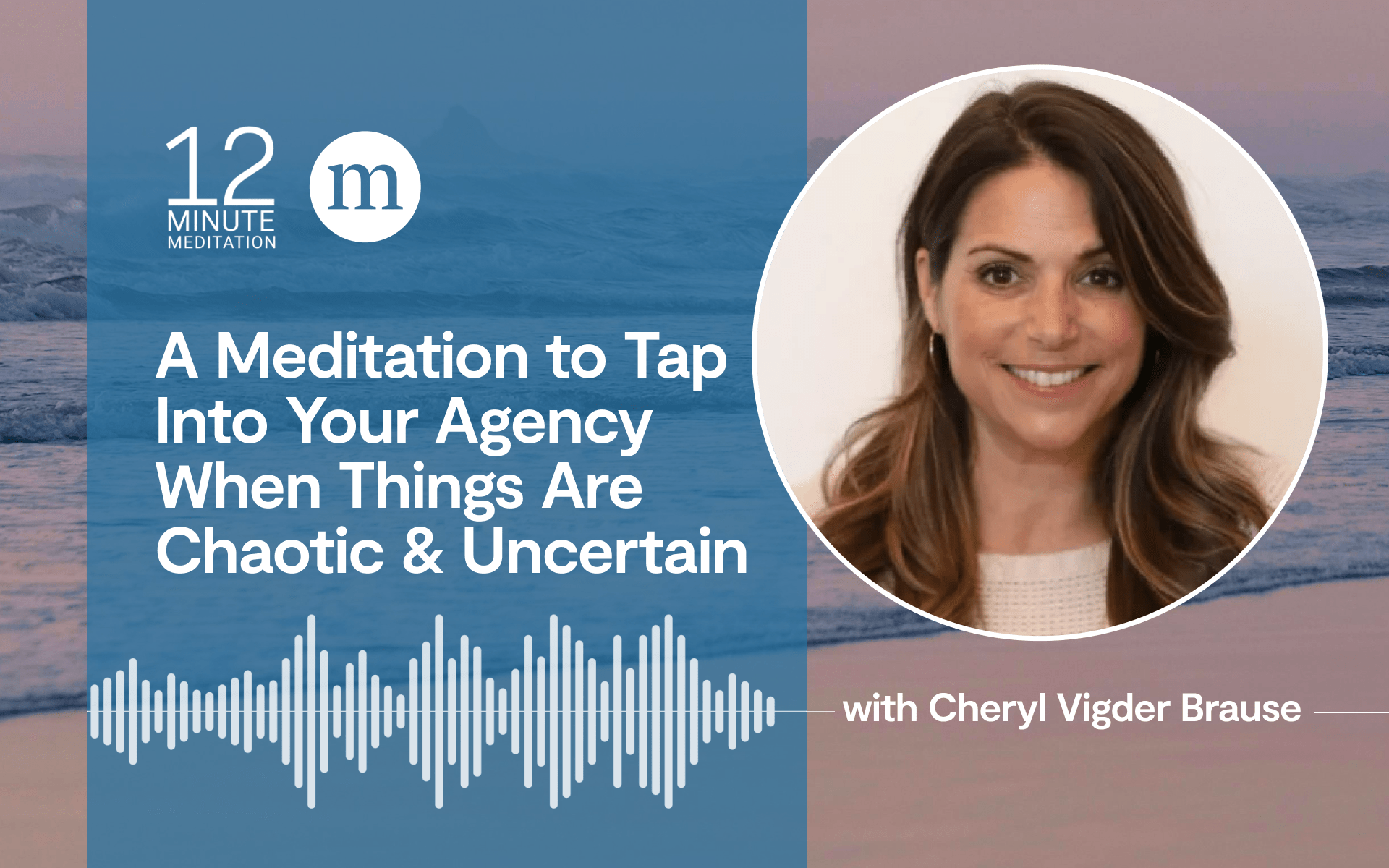
    Today, teacher Chery Vigder Brause leads a guided practice that’s centered around meeting ourselves exactly where we are. In that pause, where we encounter ourselves without trying to fix anything, even if just for a moment, we actually create a space where we can get clarity on how to respond to ourselves, others, and the world.

    Cheryl Vigder Brause is a nationally recognized mindfulness and meditation teacher, writer and speaker, specializing in leading corporate clients, schools, and individuals across the country in programs and meditations on stress management, boosting happiness, and living their best lives. She is the Co-Founder of Pause to be Present, a mindfulness and meditation studio.  To learn more about Pause to be Present’s programs, visit www.pausetobepresent.com.

    A Meditation to Tap Into Your Agency When Things Are Chaotic & Uncertain

    Read and practice the guided meditation script below, pausing after each paragraph. Or listen to the audio practice.

    1. Today we will exercise our power to pause, to take a breath, to down-regulate our nervous system, and to choose how we want to meet this moment. Let’s begin. I invite you to gently arrive in this moment, where so often busy going, doing, and moving, trying to get somewhere else, instead of arriving exactly where we are. 
    2. Arrive fully in this moment. Find a comfortable posture or position with your body. You can be seated or lying down for this meditation. Get comfortable. Feel free to move a bit until you can settle the body into a comfortable and supported posture. If you’d like, you can gently close your eyes or simply lower your gaze. 
    3. Take a slow, deep breath, breathing in through the nose. And a long steady exhale through the mouth. Notice how that feels. Notice how it feels to simply stop all that forward momentum and simply allow yourself to fully arrive in this moment. Again, take a nice slow breath in, feeling that air fill your lungs and torso. And then slowly and fully exhale. Feeling the release of air and the release of tension in the body. One more slow, deep breath together, breathing in fully, and breathing out. 
    4. Remind yourself that in this moment and in this meditation, there is nothing you need to do right now. There’s no way you have to be in this moment and nothing you need to fix or change or accomplish. 
    5. I invite you to simply pause to be. Rest in the fullness of this moment just as you are. Notice how that feels to simply be here. Give yourself permission to simply be present. 
    6. Notice what’s here for you. Are there sounds around you? If so, simply notice them. Can you feel a coolness or a warmth of the air on your skin? Can you notice the contact your body is making with the ground beneath you? Can you notice what is beneath you supporting you? Can you let yourself be supported? 
    7. Now, take a moment to relax the body. Sink into the ground beneath you. Notice if there are any places of tension or tightness in your body. We often hold our stress as tension in the body, in our muscles and our back and neck and face. Become aware of your own body and where you may be holding tension, what feels tight or constricted. 
    8. This is another moment of choice: the power of the pause to simply become aware of how you’re showing up in this moment and then choosing how to be in this movement. Are there areas of tension in the body? And if so, can you breathe into those areas? And as you exhale, can you invite in ease? Can you let go of tension? With each inhale, create spaciousness and openness in any areas of tension or tightness. And with each exhale, a letting go
    9. Often in our busy modern lives, we’re stressed, anxious, tense, or nervous. Another choice we can make each day is to exercise our own ability to pause, to connect inward, and to regulate our own nervous systems. In fact, one of the greatest gifts you can give yourself to improve your wellbeing and health is a regulated nervous system. It not only boosts health, but it aids sleep and digestion, can improve focus and clarity, and can help you make wise choices in navigating life. 
    10. Take another moment to check in. How do you feel? What is your emotional landscape right now? You may feel tired, you may feel excited or nervous or anxious or at ease. Simply notice whatever is happening in your inner experience in this moment. 
    11. Gently bring your attention back to the feel of the breath in the body. Notice where you feel that breath moving in and out. Notice how you can sit and receive the breath. Perhaps you feel your breath in the rise and fall of your chest, or the movement of the belly, or the air passing in and out of your nostrils. Just notice where you feel that breath and just focus your attention there for a few moments. There’s no need to change the breath. Just allow its natural and easy rhythm to move in and out of your body. With each inhale, feel the spaciousness in the torso. With each exhale, imagine the body receiving the message, It’s okay to soften. It’s safe to slow down. You might silently say to yourself, as you breathe in, I calm the body. And as you breathe out, I soften and release. Breathing in, I calm my body. Breathing out, I soften and release
    12. Take a few more slow, deep breaths. With each inhale, create space and openness in the body. With each exhale, there’s an opportunity to relax, to release, to let go. 
    13. Your mind will wander, and that’s okay. This is a moment of mindfulness, a moment of choice. You are noticing that your mind has gone and been distracted, and you are cultivating the power to place your attention where you want it. Gently bring that attention back to your breath without judgment, without criticism and with a gentleness. Each noticing that the mind has wondered is not a failure, it’s a moment of mindfulness, a moment of care, of choice, a moment of gentleness with yourself, an opportunity to exercise that mental power to place your attention where you want it. It’s a beautiful reminder that every moment is an opportunity to begin again. 
    14. Now gently bring your awareness to your whole body. Notice how it feels to sit. See if in the next few moments, you can make the choice to let go of any need to change anything. To let go of any reflexive criticism, of any notion you’re doing this wrong. See if you can hold yourself with gratitude for simply showing up for this meditation with an open heart and an open mind. Notice how that feels. Whatever you experience, see if you can choose to meet your experience and yourself with kindness. This is another choice we have. 
    15. Try this phrase: What if it’s not a problem? What if I’m experiencing discomfort in this moment? And what if it’s not a problem? What if my mind is busy in this movement? And what it’s not a problem. What if i’m feeling restless in this moments? And what is it’s is not a problems? This is a choice we can make each day. Seeing life’s challenges not as a problem to fix or a signal that something is wrong, but instead choosing to meet our experience with curiosity and as an opportunity to learn and grow and navigate what’s happening in this moment with more ease, less resistance. 
    16. If you like, place a hand on the heart. Feel the warmth of your own touch, and silently offer yourself these few gentle phrases, allowing them to and in the mind and heart. May I be kind to myself in this moment. May I meet myself with tenderness just as I am. May I know that in each moment I have the power to pause and to choose how to meet myself, how to meet others and how to meet this world with care and tenderness. 
    17. Let’s take a breath together, a nice inhale, breathing in. And a beautiful exhale, breathing out. Begin to sense the whole body grounded, supported at ease. 
    18. As we come toward the close of this meditation, reflect for a moment on the idea that this moment and every moment you can practice mindfulness, awareness, and choice. Every moment is a fresh opportunity to practice, a new beginning. As this new year begins, know that you can return to this place of presence, tenderness, beingness and choice again and again. 
    19. When you’re ready, slowly bring your awareness back to the room you’re in. You can wiggle your fingers and toes. And when it feels right, I invite you to softly raise up your gaze or open your eyes. Thank you so much for practicing with me. 


    Source link

  • Tap Into Ease with This Guided Meditation for Holiday Stress

    Tap Into Ease with This Guided Meditation for Holiday Stress

    Get the latest on everything mindfulness


    Our free newsletter delivers updates on the science of mindfulness, guided mindfulness meditation practices from leading teachers, special offers, and rich content to support your mindful growth.


    Source link

  • The Art of Creativity: How to Tap into Your Imagination and Bring Your Ideas to Life

    The Art of Creativity: How to Tap into Your Imagination and Bring Your Ideas to Life

    The Art of Creativity: How to Tap into Your Imagination and Bring Your Ideas to Life

    Creativity is a buzzword in today’s fast-paced world. Everyone wants to be creative, to think outside the box, to come up with innovative ideas that can revolutionize industries. But what is creativity, and how can we tap into it? In this article, we’ll delve into the world of creativity and explore the art of bringing your ideas to life.

    Understanding Creativity

    Creativity is often associated with being artistic, but it’s so much more than that. Creativity is about finding new solutions to old problems, thinking outside the box, and pushing boundaries. It’s about being open to new ideas, taking risks, and embracing failure. But, how can we tap into this creative potential?

    1. Cultivating Curiosity

    The first step in tapping into your creativity is to cultivate curiosity. This means being open to new experiences, asking questions, and seeking out new perspectives. Curiosity is the spark that ignites the creative process, and it’s essential for fostering a creative mindset.

    2. Practicing Mindfulness

    Mindfulness is the practice of being present in the moment, without judgment. When we’re mindful, we’re able to tune into our surroundings, let go of distractions, and access our full potential. Mindfulness is essential for cultivating creativity, as it allows us to tap into our inner world and access our imagination.

    3. Embracing Failure

    Embracing failure is a difficult but essential part of the creative process. We all make mistakes, and it’s how we learn and grow. By embracing failure, we can take risks, try new things, and push ourselves beyond our comfort zones.

    The Creative Process

    The creative process is a mysterious and often frustrating experience. It’s a journey of self-discovery, intuition, and experimentation. Here are some essential steps to help you navigate the creative process:

    1. Incubation

    The first step is to let your ideas incubate. This means allowing yourself time to reflect, think, and let your subconscious mind work its magic.

    2. Illumination

    The second step is to have a moment of illumination, where the ideas and insights start to flow. This is often a euphoric experience, but it’s also a challenging one.

    3. Verification

    The final step is to verify your ideas, to test and refine them. This is where the real work begins, as you refine and perfect your ideas.

    Resources for the Creative Journey

    1. Journaling: Journaling is a powerful tool for tapping into your creativity. By recording your thoughts, ideas, and insights, you can track your progress, reflect on your experiences, and gain valuable insights.
    2. Meditation and Mindfulness: Meditation and mindfulness practices can help you access your inner world, tap into your imagination, and cultivate a creative mindset.
    3. Collaboration: Collaborating with others is a great way to tap into new ideas, perspectives, and skills. It’s also a powerful way to build relationships and create something new.
    4. Inspiration: Inspiration can come from the most unlikely sources. Keep your eyes and ears open, and be willing to explore new ideas and perspectives.

    Conclusion

    Tapping into your creativity is a journey, not a destination. It requires practice, patience, and persistence. By cultivating curiosity, practicing mindfulness, and embracing failure, you can unlock your full potential and bring your ideas to life. Remember, creativity is a muscle that can be developed, and with the right tools, resources, and mindset, you can tap into your imagination and bring your ideas to life.

    FAQs

    Q: How do I overcome creative blocks?

    A: Overcoming creative blocks requires patience, persistence, and a willingness to take risks. Try changing your environment, taking a break, or seeking out new inspiration.

    Q: What are some effective ways to generate new ideas?

    A: Try brainstorming with others, mind mapping, or using free writing to generate new ideas. You can also use online tools, such as mind mapping software or idea generation apps, to help spark your creativity.

    Q: How do I stay motivated and inspired?

    A: Staying motivated and inspired requires a combination of self-care, goal setting, and celebration. Make time for activities that bring you joy, set small goals, and celebrate your accomplishments. You can also seek out new inspiration by reading, taking a class, or exploring a new hobby.

    Q: What are some common creative blocks?

    A: Common creative blocks include self-doubt, fear of failure, and pressure to perform. Other blocks include lack of inspiration, limited resources, and conflicting priorities. By recognizing and addressing these blocks, you can overcome them and tap into your full creative potential.

    Q: How do I measure the success of my creative project?

    A: Measuring the success of your creative project is a subjective and ongoing process. Try tracking your progress, gathering feedback, and reflecting on your experiences. You can also use metrics, such as website analytics or social media engagement, to track your project’s success. Ultimately, the key to measuring success is to define what success means to you and track your progress accordingly.

  • New Chemical Identified In U.S. Tap Water, Scientists Urge Investigation Into Its Toxicity

    New Chemical Identified In U.S. Tap Water, Scientists Urge Investigation Into Its Toxicity

    Scientists have identified a new chemical byproduct in tap water consumed by millions of Americans, solving a decades-long mystery. This compound, formed during water purification with chloramine, raises health concerns for roughly 113 million people and warrants further investigation into its potential toxicity.

    Chloramine is a disinfectant created by combining chlorine with ammonia. It is preferred over chlorine in many water treatment systems due to its greater stability, which results in lower levels of disinfectant byproducts compared to chlorine.

    Although researchers first noted the unidentified chemical byproduct in tap water treated with chloramine nearly 40 years ago, its exact details were not known. In a recent study published in Science, scientists used advanced analytical methods to uncover its structure, which is now officially named chloronitramide anion.

    The researchers detected chloronitramide anion in all 40 samples taken from 10 drinking water systems located in seven states. It was not seen in ultrapure water, or drinking water treated without chlorine-based disinfectants.

    “It’s well recognized that when we disinfect drinking water, there is some toxicity that’s created. Chronic toxicity, really. A certain number of people may get cancer from drinking water over several decades. But we haven’t identified what chemicals are driving that toxicity. A major goal of our work is to identify these chemicals and the reaction pathways through which they form,” Julian Fairey, first co-author on the paper said in a news release.

    The study represents a significant breakthrough, as it successfully identified chloronitramide anion and determined its structure.

    “It’s a very stable chemical with a low molecular weight. It’s a very difficult chemical to find. The hardest part was identifying it and proving it was the structure we were saying it was,” Fairey noted.

    Although the toxicity of chloronitramide anion remains uncertain, researchers have raised concerns due to its widespread presence and structural similarities to other toxic compounds. They stress the need for further investigation by academics and regulatory agencies, such as the U.S. Environmental Protection Agency.

    “Even if it is not toxic, finding it can help us understand the pathways for how other compounds are formed, including toxins. If we know how something is formed, we can potentially control it,” Fairey added.

    Source link