Tag: suffering

  • You Don’t Have to Shut Down or Burn Out When You Care This Much. Do This Instead.

    You Don’t Have to Shut Down or Burn Out When You Care This Much. Do This Instead.

    Three weeks ago, I ended up in the emergency room convinced I was having a heart attack.

    The chest pain had started days earlier—a tightness that wouldn’t release, difficulty taking a full breath, pain radiating down my left shoulder. I told myself it was nothing. Maybe I’d overdone it at the gym. Maybe I’d slept wrong.

    I kept meditating.
    I kept teaching.
    I kept holding space for others.

    I tried to breathe my way through it, the way I’ve taught thousands of people to do. But on Sunday, when my doctor’s office was closed and the pain refused to let up, my husband said gently but firmly, We’re going to the ER.

    After five hours of tests and long stretches of waiting, the cardiologist came back with relief in his voice: my heart was fine.

    I should have felt grateful—and I did.
    But I was also confused.

    If my heart was healthy, what was my body trying to tell me?

    Recognition: The Role of Vicarious Trauma In Bearing Witness Without Choice

    If you have been paying attention to the world around you over the past months, you may be carrying more than you realize.

    Images of devastation in Gaza.
    Israeli families living with constant fear of attack.
    Political violence and ICE shootings at home.
    Rising Islamophobia and antisemitism fracturing communities, relationships, and public life.
    The countless Black, Indigenous, and other people of color whose deaths rarely make headlines, whose names we never learn.
    And the ongoing humanitarian crises in places like Sudan, Yemen, and Iran—where suffering continues largely outside the frame of sustained media attention.

    If you find yourself feeling unusually tense, exhausted, reactive, numb, or unable to turn away—even when you want to—it may not be a personal failing. It may be a natural response to prolonged exposure to suffering.

    For many of us, this witnessing is relentless. Each morning brings new stories, new images, new reasons to feel alarmed or heartbroken. Even when we are not directly affected, our nervous systems are taking it in.

    If you find yourself feeling unusually tense, exhausted, reactive, numb, or unable to turn away—even when you want to—it may not be a personal failing. It may be a natural response to prolonged exposure to suffering.

    There is a name for this: vicarious trauma.

    Vicarious trauma refers to the psychological and physiological impact of sustained empathic engagement with others’ pain. Our bodies and minds do not clearly distinguish between what we experience directly and what we absorb through continuous media exposure, graphic imagery, and ongoing moral urgency.

    Staying informed matters.
    Bearing witness matters.

    But exposure without the capacity to process what we are taking in carries consequences—often beneath our awareness.

    Photo by Tony Lam Hoang on Unsplash

    Withdrawal: When Turning Away Feels Necessary

    For others, the constant stream of suffering can feel overwhelming or futile, leading to disengagement instead. We scroll past headlines, turn off the news, or tell ourselves we need to focus on our own lives. At times, this discernment is necessary. Rest, boundaries, and self-care matter. But when disconnection becomes our primary response to vicarious trauma, something else quietly erodes.

    Many people turn away not because they don’t care, but because they feel powerless. What difference could I possibly make? In the face of global crises, individual action can seem insignificant, even naïve. Shutting down can feel like the only way to survive.

    Yet we live in an interconnected world where complete disconnection is an illusion. And when we disengage for too long, we don’t just lose information—we lose contact. Contact with what is happening. Contact with our own values. Contact with the small but meaningful ways care can move through us. What begins as self-protection can quietly become a loss of agency and connection.

    Vicarious trauma doesn’t just make us sad or tired. It reshapes how we see the world.

    Research shows that it disrupts core beliefs about safety, trust, control, intimacy, and meaning. It shows up cognitively, emotionally, physically, and behaviorally.

    People experiencing vicarious trauma often report:

    • Brain fog and difficulty concentrating
    • Heightened anger, anxiety, or emotional numbness
    • Sleep disturbances and chronic exhaustion
    • Hypervigilance—always bracing for the next blow
    • Physical symptoms like headaches, gastrointestinal issues, and chest pain

    And yes—ER visits.

    But there is something more essential that is lost when we burn out or shut down. 

    Vicarious trauma explains the cost to our nervous systems. But underneath that is something more subtle—and more consequential: a loss of contact with our capacity to respond.

    What gets lost when we engage on default—whether by over-consuming information about suffering or withdrawing from it—is not just nervous system regulation.

    We lose contact.

    Contact with the body as a source of intelligence.
    Contact with our felt sense of what is actually needed now.
    Contact with our agency, beyond outrage or withdrawal.
    Contact with our capacity to sense where our care is most skillful.
    Contact with our ability to stay human without hardening.

    This isn’t just trauma.

    It’s a disconnect from our humanness.

    Oppressive systems don’t need to silence us when exhaustion and reactivity will do the job for them.

    We find ourselves caught in cycles of constant witnessing or reactive outrage, or else turning away and numbing out.

    And when contact is lost, connection suffers.

    Connection with others.
    Connection with purpose.
    Connection with the part of ourselves that knows how to respond wisely.

    Vicarious trauma explains the cost to our nervous systems. But underneath that is something more subtle—and more consequential: a loss of contact with our capacity to respond.

    When we’re dysregulated:

    • We confuse intensity with impact
    • We lose the ability to imagine creative responses
    • We default to attack, despair, or withdrawal

    What’s at stake isn’t just our well-being. It’s our capacity to imagine—and enact—responses that actually reduce suffering.

    Oppressive systems don’t need to silence us when exhaustion and reactivity will do the job for them.

    Collective Capacity: How Not to Lose Each Other

    When this loss of contact happens at scale, movements fracture. Allies turn on one another. Nuance feels like betrayal. Strategic thinking gives way to moral reflex. The very capacities required for sustained change—discernment, patience, relational trust—begin to erode.

    When we are no longer in touch with our discernment, everyone can start to look like a threat. The act of listening itself can feel like moral failure. We confuse intensity with impact, and urgency with wisdom.

    This loss of contact doesn’t just exhaust us personally. It diminishes our ability to work together.

    When we are no longer in touch with our discernment, everyone can start to look like a threat. The act of listening itself can feel like moral failure. We confuse intensity with impact, and urgency with wisdom.

    I’ve seen this up close.

    At one point, someone was publicly attacking me online—not because we disagreed about the need to end suffering, but because I was trying to hold complexity rather than take a single side. I was called complicit. My integrity was questioned. Moral failure was assumed.

    Instead of reacting, I practiced inner calm, compassion, and equanimity—not to bypass harm, but to stay in contact with my own values of deep listening and seeking to understand. The next day, that same person reached out to say: “I’m sorry to have misjudged you so harshly. I’ve been exhausted, and I lashed out.”

    This person wasn’t malicious. They were overwhelmed. I recognized that feeling immediately—that same overwhelm is what had landed me in the ER. The suffering they had been witnessing was real. The vicarious trauma is real. Without tools to return to contact, that pain had nowhere to go but outward.

    I’ve witnessed this pattern repeatedly.

    When I had tried to draft a Town Council resolution that called for ending violence while also acknowledging security concerns on all sides, it was rejected—not because people disagreed with the facts, but because in the midst of collective disconnection, holding both-and felt impossible.

    This is how movements lose their strength—not through genuine disagreement about goals, but through operating from disconnection rather than from our deepest wisdom that comes from listening with care and seeking solutions that include all.

    Sustained change requires more than passion. It requires capacity: the ability to engage and retreat, to stay open without collapsing, to remain connected to one another even when the work is hard.

    When we lose that capacity, we don’t just lose effectiveness. We lose each other.

    People sharing a cheese platter, fruit, and wine around a candle-lit table, finding comfort after a day marked by vicarious trauma.
    Photo by The Cheeserom on Unsplash

    Rest: The Ground That Makes Practice Possible

    Recently, I was invited to a friend’s house for dinner. Simple food. Easy conversation. Board games. And yet, as I sat there, I felt a wave of guilt. How could I be laughing when so many are suffering? I noticed a flash of irritation toward the others at the table—why didn’t they seem as affected as I was? Didn’t they care?

    Then I caught myself.

    This guilt, this judgment—it wasn’t skillful. It wasn’t making me more effective or more compassionate. It was simply isolating me, pulling me away from the people right in front of me.

    Rest is not what we do when the work is finished. It is what makes sustained engagement possible. When we gather, we are restoring contact with the aliveness that oppressive systems rely on extinguishing.

    So I made a choice. I allowed myself to be there. To taste the food. To play the game badly and laugh at myself. To let the warmth of friendship soften something that had gone rigid inside me.

    It was quietly liberating.

    The next day, I returned to my work with more energy, clarity, and steadiness—not because anything had been solved, but because I had remembered what it feels like to be human alongside other humans.

    This is not escape.
    This is restoration.

    Rest is not what we do when the work is finished. It is what makes sustained engagement possible. When we gather with like-minded people—not to organize or persuade, but simply to cook together, laugh, play, or enjoy one another’s company—we are not avoiding the work. We are restoring contact with the aliveness that oppressive systems rely on extinguishing.

    Sometimes, what returns us to contact isn’t a formal practice at all. It’s a shared meal. Music, art, or movement that reminds us we are alive. A walk where we remember that trees still grow and birds still sing—even now.

    These moments are not indulgent.
    They are essential.

    From this restored place, certain skills can help us stay in contact when we re-engage with difficulty.

    Skills: Returning to Contact in Real Life

    Over years of teaching and research, I came to see that mindfulness as it’s often taught—focusing primarily on meditation and non-judging awareness—is necessary but insufficient for times like these.

    Calming the nervous system with meditation is only the first step. Once we re-engage, our default habits return. Without skill, we slide back into reactivity. Even if we can return to a calm, non-judging awareness, it is not enough to navigate nuanced, complex situations, often involving competing needs and worldviews. 

    Through my study of early Buddhist teachings and contemporary psychology, I began to understand mindfulness as a set of trainable skills—skills that help us stay in contact with what’s alive, even in the midst of suffering. They disrupt our default reactions and help us discern what is needed to respond skillfully.

    Three skills become especially essential when we are bearing witness to ongoing crisis:

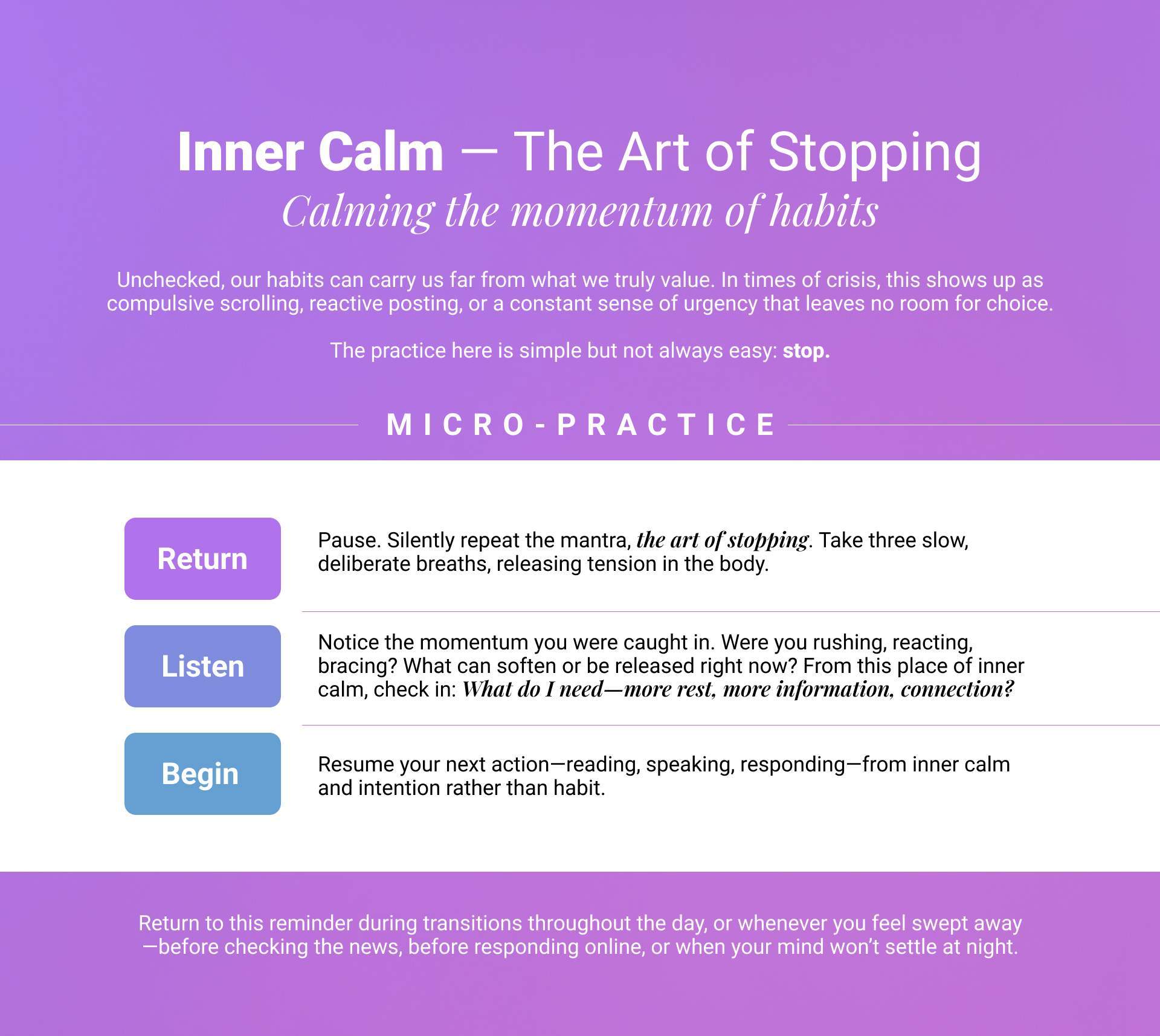
    Inner Calm — Creating Space Without Disengaging

    Inner calm is the art of stopping, looking, and letting go for purposes of healing and clarity. It softens the grip of our attachments to habitual hurrying, beliefs, and expectations that hinder our inner equilibrium.

    Inner calm involves physical composure and mental tranquility, bringing ease to body and mind alike. In the body, composure is experienced in the muscles and as an overall feeling of ease. In the mind, inner calm creates the space to hold everything without attachment and resistance. 

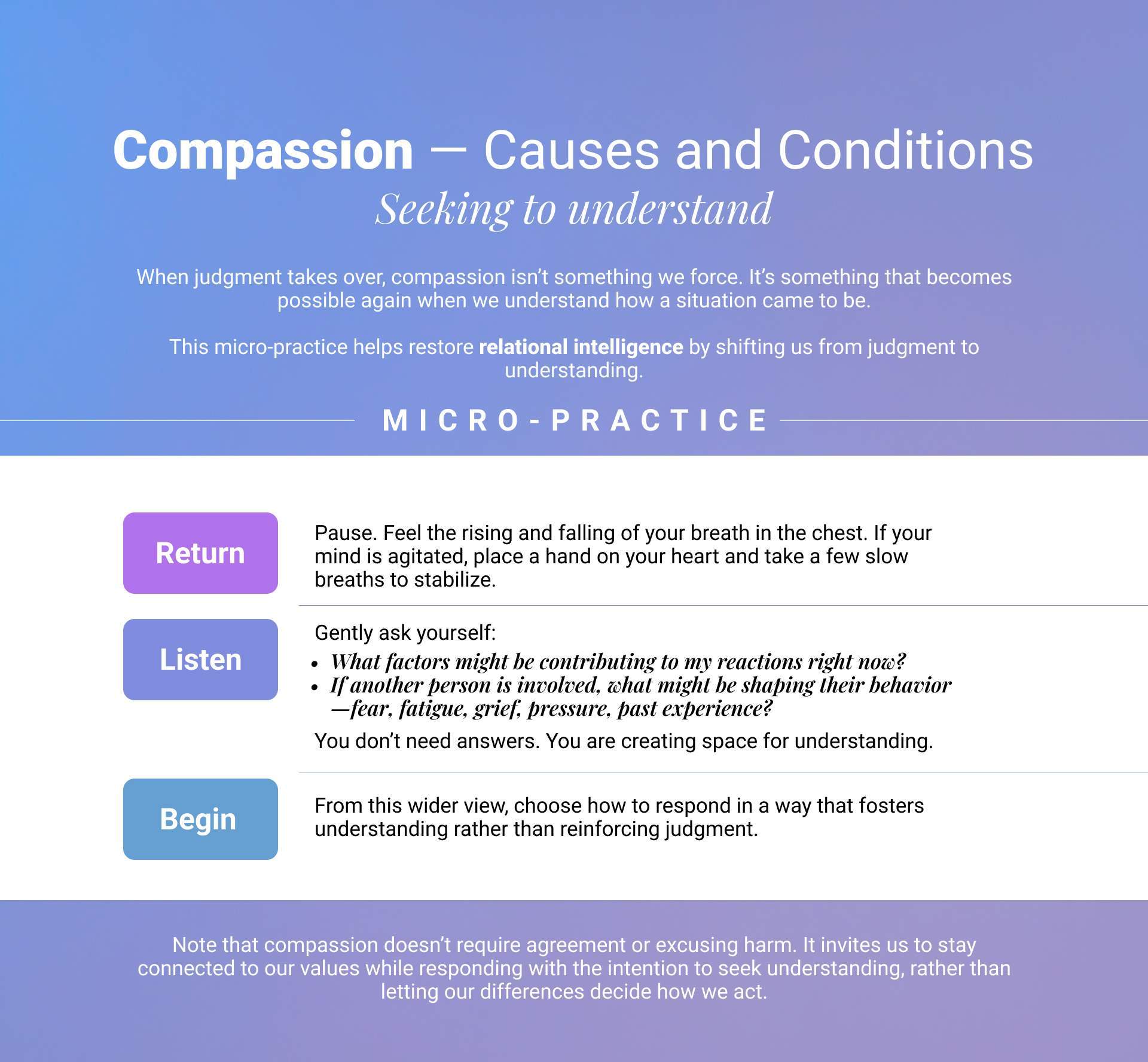
    Compassion — Seeking to Understand

    Compassion is our innate ability to feel, understand, and be motivated to alleviate suffering in ourselves and others. It disrupts our tendency to act on our automatic judgments about ourselves and others by seeking to understand.

    When we lose compassion, we see enemies instead of fellow humans struggling. We attack allies for not being pure enough. We forget that we, too, are worthy of care. We lose our relational intelligence—the capacity to sense how we are affecting others and how to stay connected across differences.

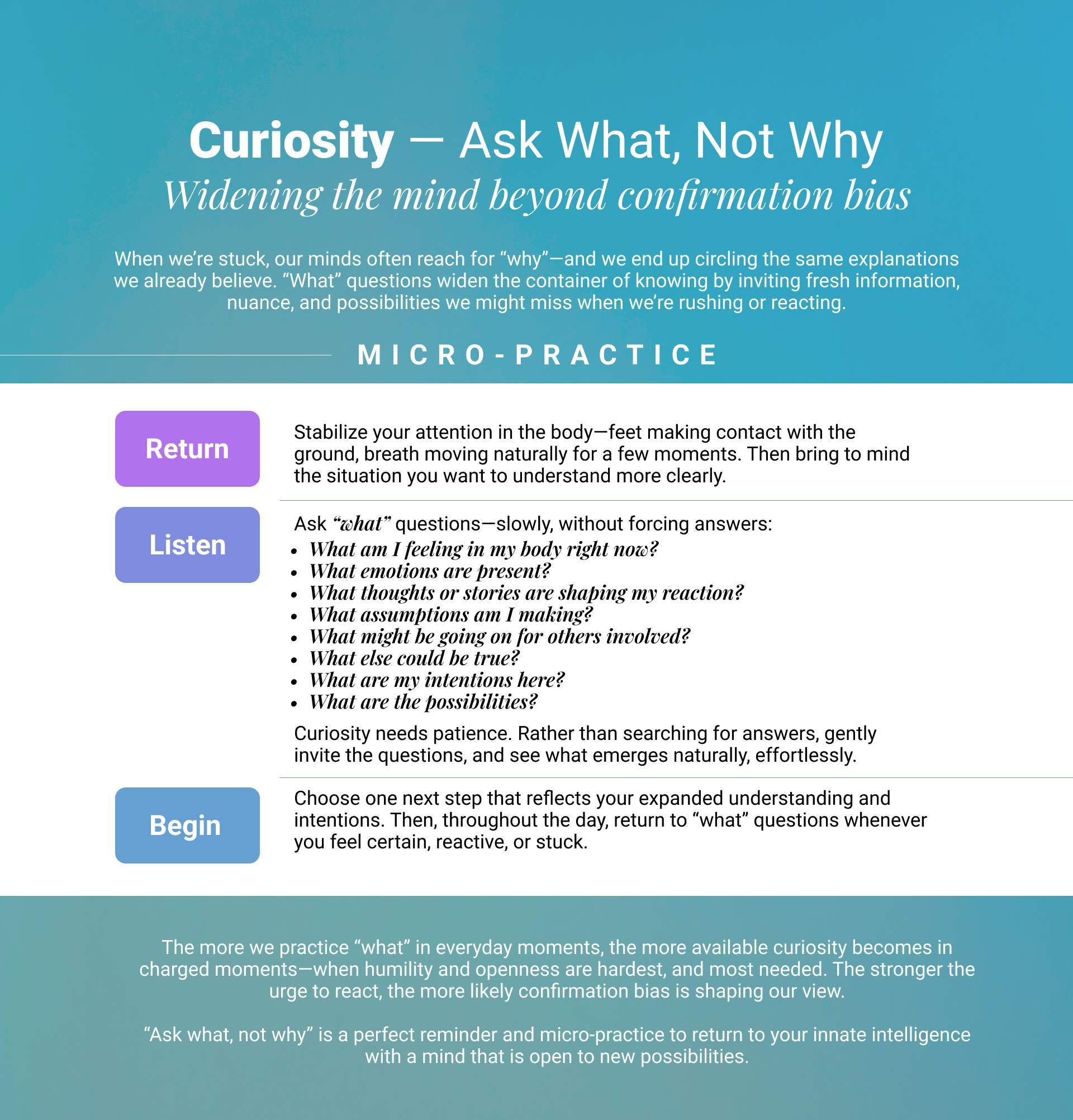
    Curiosity — Returning to Creative Capacity

    Curiosity is our ability to be genuinely interested and care with the purpose of understanding the situation, even when it’s challenging. It disrupts our confirmation bias by staying open and patient in the face of uncertainty and new information.

    Curiosity widens the lens trauma narrows. It restores contact with complexity and helps us sense what might actually help. It’s not about being right. It is about being effective.

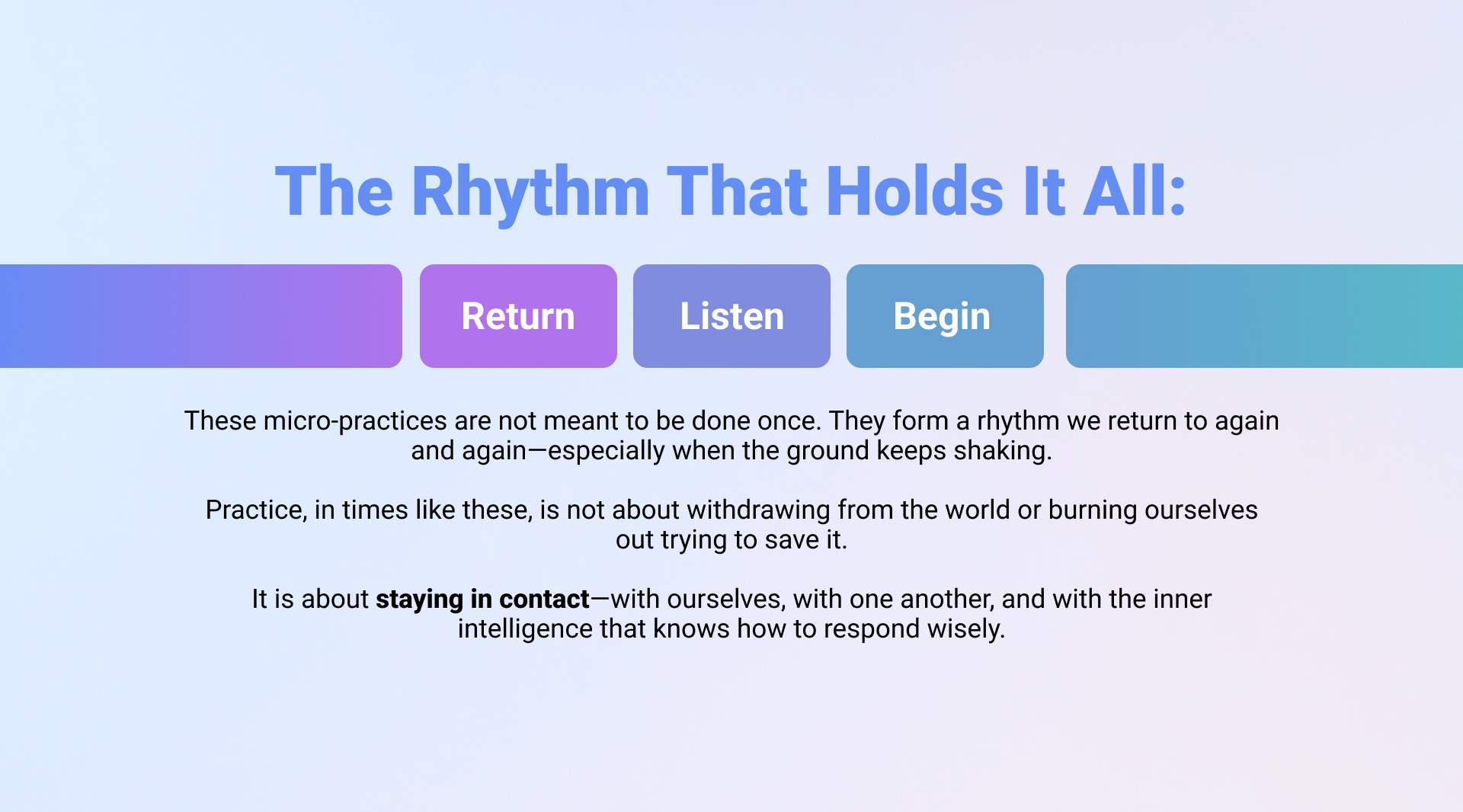
    Together, these skills interrupt default patterns and reopen the channel between knowing what matters and being able to act on it.

    Based on our resources, capacity, and unique gifts, what’s ours to do will be different. There isn’t one right way to meet the darkness. Only many necessary ones.

    But here’s what practice has taught me: Skillful response doesn’t look the same for everyone.

    Based on our resources, capacity, and unique gifts, what’s ours to do will be different. The parent raising children who can hold complexity. The artist creating work that helps others process grief. The organizer building coalitions. The healer tending to those on the front lines.

    There isn’t one right way to meet the darkness. Only many necessary ones.

    Reaching to Poetry As Another Anchor

    I too have been learning to live with this question—how to stay engaged without collapsing. Sometimes the sifted language of poetry can speak to our deeper needs and longings. This poem by Michael Dubois captures this truth beautifully and resonates deeply.

    When Things Feel Dark
    by Michael Dubois

    When things feel dark, remember what the world needs:
    More healers, more helpers, more hate exorcisers.
    More artists and poets, more parents ruled by love.
    More cycle breakers, more radical resters,
    more warriors of peace.
    More gardeners who fall deeply in love
    with the earth beneath their feet.
    More meditators, more educators,
    more people willing to use failure as a tool to learn.
    More thinkers, more thankers, forgivers and apologizers.
    More builders of bridges and homes
    with open doors and minds.

    The world needs you—
    because only the ones who see the darkness
    know the importance of turning on the light.

    An Invitation to Practice: 3 Ways to Reconnect

    In times like these, practice is an invitation to return to what is already alive in us, and to offer that wisely.

    Below are three micro-practices from my book, Return to Mindfulness, to foster inner calm, compassion, and curiosity.

    May we have the courage to notice when we’ve lost ourselves—and the skill to return.
    May we offer what is uniquely ours to give, trusting that the world needs exactly that.
    May our practice benefit us and all beings.
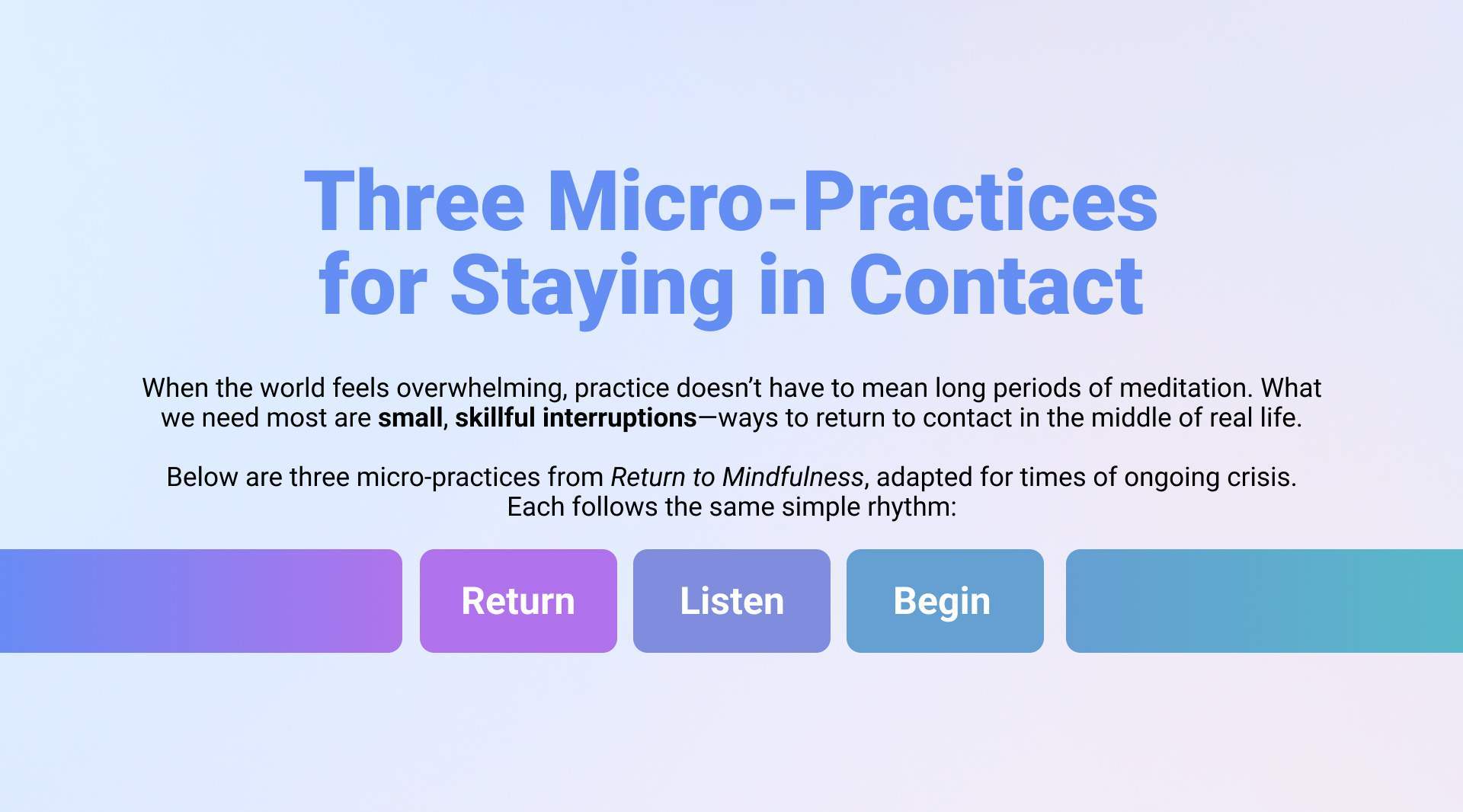
    Text graphic titled Three Micro-Practices for Staying in Contact with ourselves: Return, Listen, Begin.
    Purple infographic titled Inner Calm, explaining a three-step habit practice for managing vicarious trauma: Return, Listen, and Respond.
    Blue infographic explaining a compassion micro-practice to address overwhelm with steps: Return, Listen, and Begin for understanding others.
    Blue infographic titled Curiosity—Ask What, Not Why, sharing a mindfulness micro-practice to help manage emotional burnout: Begin, Return, Select.
    A graphic titled The Rhythm That Holds It All addresses key steps with buttons: Notice, Return, Listen, Begin, on a gradient background.


    Source link

  • A Meditation to Return to Ourselves When Practicing Feels Impossible

    A Meditation to Return to Ourselves When Practicing Feels Impossible

    If you’re burned out, discouraged, and disconnected by all the struggle and suffering in the world, you’re not alone. In times of intense upheaval, mindfulness practice can feel impossible. Try this simple, grounding meditation to pause, reconnect with compassion and clarity, and return to yourself.

    Many of us are bearing witness daily to suffering all over the planet. We care about others, and we want desperately to be of use—and seeing the horrors in images and videos and stories every day can be deeply dysregulating to our nervous systems. 

    When we get overwhelmed by this vicarious trauma, we tend to shut down. We disconnect for ourselves and each other. We’re so spun out in our anxiety, anger, or overwhelm that it can feel impossible to engage in any kind of mindfulness or meditation practice. 

    This week, Shalini Bahl offers tender and practical guidance for how to pause, reconnect, and return to ourselves and our essential practice in times of intense internal and external upheaval. 

    A Meditation to Return to Ourselves When Practicing Feels Impossible

    Read and practice the guided meditation script below, pausing after each paragraph. Or listen to the audio practice.

    1. Welcome and thank you for being here, for caring enough to practice despite the gazillion things you could be doing with your time. The world needs people right now who can stay grounded while engaging with the suffering we’re all witnessing with open hearts and minds, people who can act from wisdom rather than overwhelm. People who haven’t lost themselves in the chaos. But we do lose ourselves, all of us. 
    2. When we bear witness to crisis after crisis after crisis, our nervous systems dysregulate. We lose contact with our wisdom, our intentions, our sense of what’s actually ours to do. This practice helps us return. 
    3. We’ll move through three pathways to return home to ourselves. First, inner calm, where you return to clarity and agency. Then compassion, where we are going to reconnect with our humanity and others. And finally curiosity, where you discover what’s actually yours to do, what’s possible for you to do. If you find one pathway calling to you more than others, feel free to linger there longer. Trust what you most need. So ready to begin? 
    4. Come to a posture that feels supported, lying down or seated. Feel the elongation along the back of your spine and neck. Roll your shoulders up, back and down. When you feel ready, lower or close your eyes. 
    5. From this place of presence let’s begin by taking three intentional breaths. Breathe in through the nose and exhale slowly through the mouth. If you like, you can make a sighing sound as you exhale. 
    6. Now return to your natural rhythm of the breath. Invite your mind to be here with your body, with your breath, resting in your awareness of the direct sensations of breathing in the region of your heart. Settle your attention in that one place in your body, in the region of your heart as you breathe in, perhaps noticing the space that’s created in your chest. And as you exhale the relaxation, letting go just for these few minutes letting go of any rushing, any expectations or judgments. 
    7. If you like, place one or both hands on your chest. Especially on days where our minds are busy, we feel fragmented. Placing one or both hands on the chest can really relieve the nervous system. Sense the warmth or coolness of your hands. The rising and falling of your chest under your hands, making contact with your body, sensing the beating heart. 
    8. Give your full care and attention to every inhale, to every exhale and resting in the pauses in between. Notice that space when your in-breath turns to an out-breath. And a slight pause before a new breath enters the body. 
    9. From time to time, your mind may wander away, and that’s natural. As soon as you notice that, with kindness invite your mind to return to this place of rest and awareness in the region of your heart. Connect with your direct experience of breathing, just the way you are. And notice if there’s any striving here, letting go of any effort to even meditate as the breath moves itself and your awareness. All you’re doing is returning to your awareness of this breath moving effortlessly in and out of your body. 
    10. Just for these few moments, allow yourself to rest. To replenish yourself, to feel resourced. And once your mind and body feel stabilized, listening within, ask yourself: What would support you in feeling rested, resourced? What would care for yourself look like in this moment? It might be as simple as turning towards yourself with kindness, appreciating the goodness of your heart and mind. Taking this time to listen within what you need more of, more rest, more movement, connection. Let yourself be held by your own loving kindness. 
    11. From this innate capacity for goodness, for compassion, gently note who you might have hardened against today. You don’t need to start with the hardest person, the one whose actions feel unforgivable. Start with someone easier. Maybe someone who said something online that rubbed you the wrong way. Maybe someone doesn’t understand or see you. Maybe a family member, a colleague, a stranger. Or maybe yourself. With kindness, simply notice the hardness. There’s no need to change it or fix it. Just feel the way it lives in your body, in your chest or belly, your throat. Breathe in to make space for it, to make space around it. 
    12. Recognize this hardness, its protection. You’ve seen unbearable things. You’ve been hurt. The hardness makes sense. And it’s also disconnection. Disconnection from our relational intelligence, from our capacity to see our shared humanity. And if it’s helpful gently invite this question: What if you had grown up in their circumstances? What if you’d received the same information, the same upbringing, the same experiences? Who would you be? Can you soften just a little when you consider this? That we’re all shaped by causes and conditions, often beyond our control. You may not agree with them or even condone what they’re doing. Can you consider saying this person has suffered just like me? This person also wants to be happy just like me? 
    13. Using your breath as an anchor to stay connected with yourself and with your good heart—can you feel that invisible thread connecting you? You’re both breathing the same air, drinking the same water. Living on this one planet we all call home. 
    14. Take a few moments to listen within. What shifts when we touch this shared humanity? 
    15. From this place of connection with yourself and our shared humanity, let’s explore what’s important to you, what’s possible, and what’s yours to do. So return to our open awareness. What’s most important to you in this moment? Take this time to reconnect with your deepest intentions and values. You might ask questions like: What am I not seeing? What might your body be trying to tell you that your mind is missing? 
    16. Without trying to find something special or seeking answers, just staying connected with your body. Trust your inner knowing as you consider the possibilities for actions you can take that are aligned with your intentions, with your unique gifts, with your values. What if there’s something you haven’t tried yet? Some approach you haven’t considered or some alliance you haven’t imagined? Open your mind and heart to new possibilities. Even if you don’t receive specific answers right now, just hold that question, being willing to love the unanswered question and being willing to live the question. 
    17. From this place of  open curiosity, willing to see what you’ve been missing, ask what’s actually possible here. Not what you’ve always done, not what everyone is doing or telling you to do but what is yours to do and what would actually help If you need more clarity. Try journaling, being in nature and any other activity that supports you in returning to yourself to feel connected, alive, present with the gift of this life at this time on this planet Earth. 
    18. Even as we end this practice, remember that you can come back anytime. Every time you notice you’re lost in the scroll, in the rage and the numbness, you can return to your inner calm, your compassion, and your innate capacity for keeping an open and curious mind. This is where clarity, humanity, and creativity live. 

    Thank you for your practice. May our practice together benefit us and benefit all beings.


    Source link

  • A Meditation For When the Suffering In the World Feels Heavy

    A Meditation For When the Suffering In the World Feels Heavy

    If you’re feeling overwhelmed by the pain, uncertainty, and suffering in the world right now, here is a practice to find courage, peace, acceptance, and connection.

    Many of us are carrying the weight of the world’s suffering right now. How can we acknowledge the immense suffering in the world, including our own—and still tend to our hearts, minds, and bodies in a way that keeps us grounded and able to take compassionate action?

    This week, mindfulness teacher and author Wendy O’Leary shares a guided practice that offers refuge and reminds us of our real and loving connection to one another.

    There are three main parts of the practice. First, stabilizing or grounding. Second, settling back, softening, and soothing. And third, the one for me, one for you practice, which is based on the giving and receiving compassion practice from the Mindful Self-Compassion Program.

    A Meditation For When the Suffering In the World Feels Heavy

    Read and practice the guided meditation script below, pausing after each paragraph. Or listen to the audio practice.

    1. I invite you to get into a comfortable seated position. You can close your eyes or gently look down and soften your gaze. Whatever works best for you.
    2. Begin by directing your attention into your body, allowing it to gently move in and drift down as it drops all the way down to your feeling the connection of your feet on the floor. If your feet aren’t on the floor, simply notice wherever the feet are connected. That experience of contact and pressure. Or you might feel the contact and pressure of the backs of your legs on the chair or cushion. Connecting with this felt experience of being grounded and rooted, supported and held here on earth. As you feel the somatic experience of those contact points, the feet or the seat. Rooted, grounded, steady and stable. Connected and supported by the earth.
    3. From this place of steadiness and stability, bring to mind someone you know who’s having a hard time. It could be someone you know personally or more generally someone or a group of people you are aware of who are struggling at this time. On a scale of one to 10, choose an example of someone who is somewhere in the middle. So not the most difficult situation.
    4. As you allow them to more fully enter your awareness, check in with your body. Often, when we’re focused on difficulty, ours or others’, there can be a habitual tendency to contract, to tighten, and to even lean forward. Check it out to see if this is true for you. Counteract this tendency. I invite you to gently lean back, physically or even energetically, just a little. Settle back.
    5. Now, invite the body to soften and even widen, creating space to hold whatever is there. So we aren’t forcing anything here. It’s a very gentle invitation to settle back and soften. If it feels supportive for you, you can place your hand on your heart center as a way to care for and soothe the body, heart, and mind. Settle back, soften, soothe.
    6. Now begin to gently direct your attention to rest with the breath, feeling the flow of the breath moving in and out of the body. Just this in-breath. And just this out breath. Connecting with this experience of the breath, moving through the body like a wave moves through the ocean. And bringing back to mind this person or group of people whom you know are suffering.
    7. Check in with yourself to see what would best support you in being with their struggles. So that could be, for example, patience or calm, strength, acceptance. Whatever you feel would best support you. On the in-breath, offering that to yourself, and then gently releasing on the out-breath. If no word comes to mind, that’s totally fine. You can simply think to yourself, one for me on the inhale, and gently release on the exhale. One for me, and gently release.
    8. If it feels right for you, you can now consider what it is that they most need. It may be the same thing you need, or it could be something different. And again, if a word doesn’t come to you, you could think, one for you.
    9. Continue to take in for yourself what you need on the inhale, and offer them what they need on the exhale. Taking in one for me on the in-breath and one for you on the out-breath. One for me. And one for you.
    10. As you feel ready, open your eyes or look up as we close this practice. As we practice this more formally, it becomes accessible to us in our daily life, more available for us to use these practices when we come in contact with suffering in our lives. 

    Thank you for practicing with me and may our practice benefit all beings.


    Source link

  • Foster Forgiveness With This 10-Minute Guided Meditation

    Foster Forgiveness With This 10-Minute Guided Meditation

    Explore this mindfulness practice to foster forgiveness and let go of the tendency to add to suffering during challenging situations.

    Two monks are walking down the road. They arrive at a muddy stream crossing, and a well-dressed woman declares without introduction, “Don’t just stand there. Someone carry me across this mess.

    Without pause, the older monk lifts her across. She says nothing, not even a thank you.

    The two monks walk all day. The whole time, the younger one stews in his mind—How could he pick her up? We’re not supposed to touch women, or even talk to them. And she was so rude, someone should say something to her, she didn’t deserve our help.

    Finally, arriving at the inn for dinner, he can’t hold himself back. “What were you thinking?” he asks his friend. “She was nasty, and you broke the rules, and she didn’t even say thank you.”

    The older monk smiles gently and replies. “Wow, I put that woman down hours ago, but you’ve been carrying her all this time!”

    Why We Carry Anger and Resentment

    So what does that mean in real life? We make mistakes. Other people make mistakes. We do things to others. Others do things to us. There’s an actual experience that can be trivial or even traumatic. We add to the suffering with judgment, anger, and blame. It’s sometimes referred to as adding a second arrow after being struck by a first. Something unpleasant happens, but then we add more to the experience.

    With forgiveness, we make amends when needed but let go of the extra baggage. We give ourselves the same benefit of the doubt we’d offer a close friend.

    Forgiveness isn’t the same as condoning ourselves or anyone else for misbehavior. But we so easily hold ourselves infinitely responsible, often for experiences utterly out of our control or from decades past. With forgiveness, we make amends when needed but let go of the extra baggage. We give ourselves the same benefit of the doubt we’d offer a close friend.

    On the other hand, we sometimes allow someone else to influence our lives long after they’ve gone in a similar fashion. Another driver cuts us off in traffic, putting us in danger, and then speeds off. The driver arrives at brunch and relaxes, but we make our own coffee break bitter dwelling in our own anger. It’s a concept that holds across larger situations too. Anger and resentment simmer and grow, while compassionate resolve allows us to address what needs addressing without slinging additional arrows.

    A Forgiveness Meditation to Let Go of Added Suffering

    1. Find yourself a comfortable posture, or take a moment lying on the floor, or a bed.
    2. Bring your attention to the physical sensation of breathing, noting whatever is grabbing your attention, or whatever you’re feeling now, and without judgment, bringing your attention back to the rising and falling of your breath.
    3. Picture something that comes to mind that you judge yourself for. Maybe you feel regret, or irritation, or sadness. Notice how it feels even bringing it to mind. Then focus on these three phrases, not forcing anything but setting an intention: I forgive myself for not understanding. I forgive myself for making mistakes. I forgive myself for causing pain and suffering to myself and others.
    4. Bring your attention back again and repeat the phrases. For a few moments instead of the breath using these phrases as a focus for your attention. This type of practice may become too painful. At any time, without judging yourself, come back and focus on the breath. Allow yourself to settle and return when you’re ready, now or maybe some time in the future.
    5. Our mind naturally holds onto instances where we feel mistreated by others. There may be experiences that were entirely wrong or traumatic or that concretely require our attention or action. At the same time, we can practice avoiding the second arrow. I forgive you for not understanding. I forgive you for making mistakes. I forgive you for causing pain and suffering to me and to others. Letting go of the tendency to add resentment and judgment and everything related to challenging and unpleasant situations. Again, if it’s too much to consider, return to breathing, or if you prefer, focusing on compassion for yourself instead.
    6. Practices of this kind can be quite challenging, so in these last few moments, on each in-breath, noticing and accepting whatever you feel right now. On each out-breath, as you would for a close friend, offering yourself relief, or freedom, or strength, or whatever first comes to mind.

    Forgiveness doesn’t mean being passive or not taking action. It doesn’t mean standing down when we need to protect ourselves or someone else from harm. Do what needs to be done—that might mean taking a pause, settling the mind, and trying to see things as clearly as possible before taking skillful action. Continue to practice forgiveness, over and over again, letting go of whatever holds you back.


    Source link

  • Where To Start When There Is So Much Suffering

    Where To Start When There Is So Much Suffering

    Let’s face it: Things feel incredibly hard right now. Of course, there are always difficulties and challenges, but particularly at this moment, I find myself heartbroken, overwhelmed, and angry more often than usual. Maybe you can relate?

    Perhaps like you, I am at a loss for what to do to address the suffering around me at this time. There is heartbreak, struggle, anger, fear, and despair in our homes, communities, and on the news and social media. Though there are some things we can do and action we can take, often much of this suffering is beyond our capacity to control.

    Self-Compassion Works for Collective Pain, Too

    When it starts to feel like too much to bear, I find myself wondering how to be with it all. How to be with the heartbreak, the suffering, the difficulties inherent in life. In my experience and work, I have found that one of the most helpful ways to navigate these challenges is through self-compassion. 

    Of course, self-compassion is a powerful ally when we are personally experiencing a difficulty. But self-compassion is also a powerful internal resource we can draw on in response to the suffering of others. Even if it is someone we don’t know, our hearts are touched when others are struggling. That is why it is essential to start with ourselves so that we can respond from a place of love and care, rather than fear, despair, frustration, or anger.

    So, what is self-compassion? Imagine if a dear friend was struggling with something, and then consider how you would respond to them. Now, gently turn that care, warmth, and kindness toward yourself; that is self-compassion.

    In the research, self-compassion is shown to have many benefits, including increasing resilience and optimism as well as decreasing anxiety and depression. It helps us hold suffering, both our own and that of others, more spaciously and with tenderness and warmth. The ability to offer ourselves compassion helps buffer the emotional distress that can accompany the empathetic response.

    Though self-compassion doesn’t necessarily fix the problem, it does invite a deeper calm and clarity as we approach it, because we tend to make wiser choices when we feel cared for. Caring for ourselves, especially when things are hard, enhances our capacity to navigate those difficulties and is a skill that we can learn and access readily.

    Practices You Can Try Today

    These practices work to strengthen our awareness and compassion, which can  help us avoid the extremes of being either overwhelmed or numbing out.

    One For Me And One For You:

    Based on the giving and receiving compassion practice from the Mindful Self-Compassion Program, the “one for me and one for you” practice can be tremendously helpful when we are feeling overwhelmed by the suffering of others. With a little repetition, it can even be accessible in the moment when encountering someone who is struggling.

    Bring to mind someone, even a group of people, who you know are suffering. This could be someone you know personally or hear about on the news. Now, check in with yourself and see what would best support you in being with their struggles as much as possible. It could, for example, be patience, calm, strength, or acceptance. Bring your attention to your breath and consciously offer that to yourself on the inhale and gently release on the exhale.

    After a few rounds, and if it feels right for you, you may now consider what they most need—they may have even voiced this need. It may be the same thing you need or something different. Continue to take in for yourself what you need on the inhale and offer them what they need as you exhale. You can even let go of the specific words and simply say to yourself, “One for me, and one for you,” as you continue to focus on your breathing.

    Kind Touch:

    Offering yourself a tender and gentle touch is one of the easiest ways to access self-compassion. Try putting a hand on your heart, holding your own hand, gently touching your cheek, or rubbing your arms like a gentle self-hug. Though it may initially feel awkward, research shows the benefits of this practice. Just as we might reach out to hug a friend or gently touch the arm of someone in need, we can also offer this loving, caring touch to ourselves. This kind touch releases the chemicals that support comfort, care, and connection, giving our body the message that we are safe and cared for in the moment.

    Of Course…Honey Practice:

    This phrase integrates the three aspects of self-compassion—mindfulness, common humanity, and self-kindness—used in the Mindful Self-Compassion Program. When you are struggling with something, you can say to yourself, “Of course, this is hard, honey,” or “Of course, you are scared, honey,” or “Of course you feel sad (angry, overwhelmed…), honey.” Saying the words “of course” as part of this phrase acknowledges our common humanity, that anyone in our circumstances could feel this way. Feeling like this is simply part of being human. Naming the emotion is the mindfulness aspect of the phrase, and using the term ‘honey’ (or another term of endearment) is an expression of self-kindness. I often use this phrase, usually with my hand on my heart, and have found it to be invaluable, especially when caught in a moment of intense reactivity.

    Start Where You Are, and Go From There

    If you are feeling heartbreak, fear, outrage or anything else in response to the depth and breadth of suffering in the world (or in your own life), start right where you are. Take a moment to care for your own heart and mind before responding to the world, which so desperately needs our loving presence.


    Source link

  • Influencer Urges Parents to Give Kids Bleach to Treat Autism Despite Reports of Vomiting, Suffering Seizures: Report

    Influencer Urges Parents to Give Kids Bleach to Treat Autism Despite Reports of Vomiting, Suffering Seizures: Report

    A social media influencer is under fire for promoting a dangerous and discredited chemical as a so-called “autism cure,” despite alarming reports of serious harm to children.

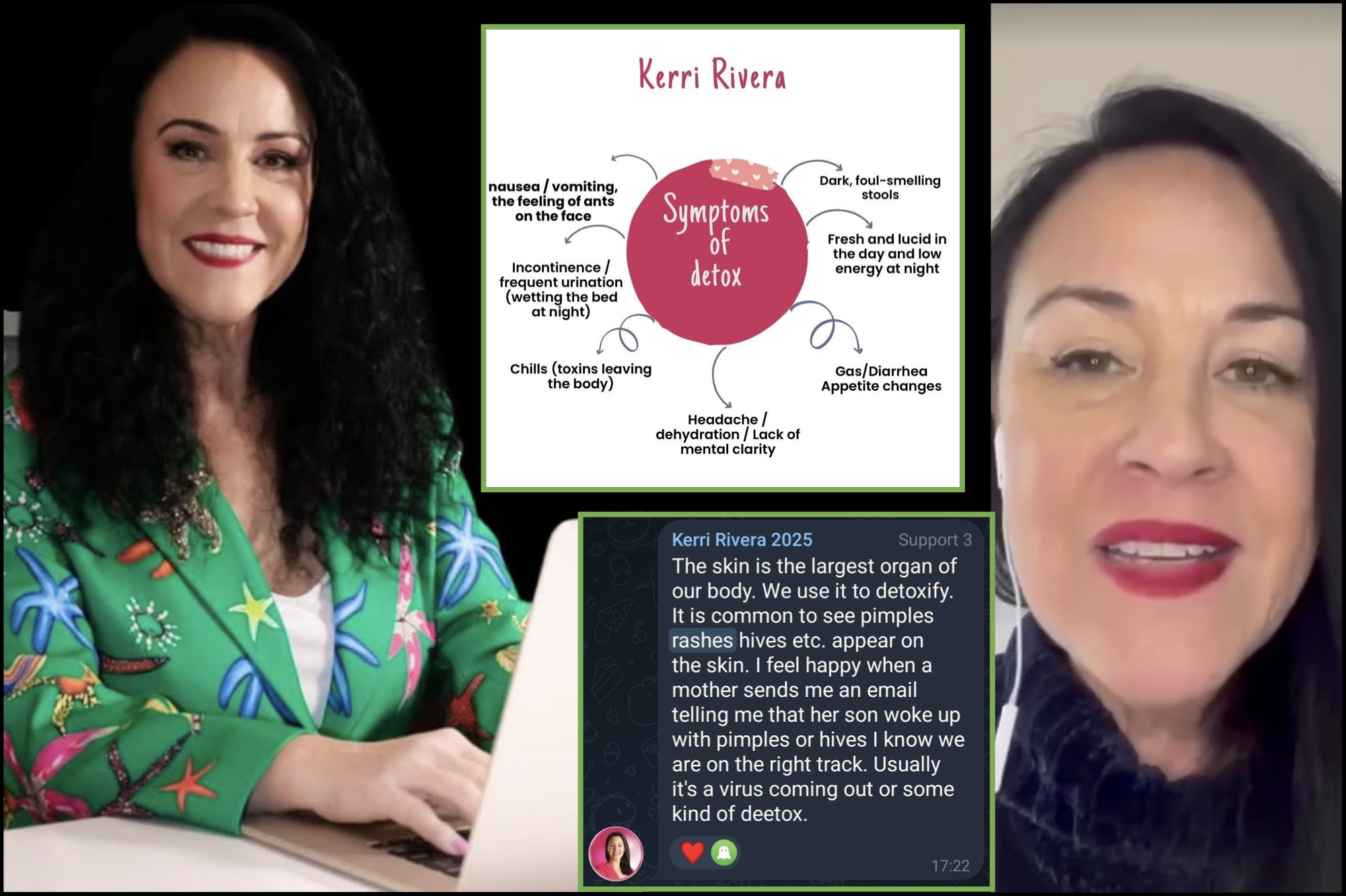
    Kerri Rivera, who has over 17,000 followers on Instagram, encourages parents to administer chlorine dioxide (CD)—an industrial bleach used in textile manufacturing and disinfection—orally and by enema to their autistic children. Rivera falsely claims this “protocol” rids the body of parasites she believes cause autism.

    Messages from Rivera’s private support group show parents reporting disturbing side effects, including vomiting, rashes, seizures, and chemical-smelling urine. Despite these symptoms, Rivera routinely reassures followers that these are signs the bleach is “working” and the body is “detoxifying.”

    Ingesting chlorine dioxide can result in severe vomiting, liver failure, respiratory problems, developmental delays and death.

    Tim Nicholls of the National Autistic Society called Rivera’s claims “sickening.”

    “This information is wrong, dangerous and harmful to autistic people and their families,” Nicholls told The Independent.

    “No autistic person, parent or carer should be told to ‘cure’ their child by administering a dangerous, potentially life-threatening chemical,” he continued. “Autism is a lifelong neurodivergence and disability, it is not a disease that can be ‘treated’ or ‘cured.’”

    TikTok has removed Rivera’s account, and Amazon removed her storefront where she earned commission on products she recommended to administer “protocols.” Her Instagram remains active.

    Advocacy groups are urging social media platforms and government agencies to take stronger action against the promotion of toxic treatments and to encourage parents to seek advice from trusted medical professionals.

    Rivera has not responded to the growing backlash.

    Originally published on Latin Times


    Source link