Tag: Stress

  • Feeling Like a Fraud in Your Own Mindfulness Practice

    Feeling Like a Fraud in Your Own Mindfulness Practice

    Over the years, I’ve worked closely with many meditation practitioners and Buddhist authors, some of whom have been clients, and my own practice has grown alongside those relationships. Being surrounded by people with such depth of experience can be inspiring, but it can also quietly raise the bar for where you think you should be in your ability to navigate life’s difficulties.

    One of the most humbling moments for me came during a trip to the emergency room related to complications from my autoimmune disease. I was in excruciating pain when a close friend, who also has a long meditation practice, asked, half joking, “Are you able to outsmart your pain?”

    We both laughed. The joke landed because another friend of mine, physician and meditation teacher Dr. Christiane Wolf, is a colleague and former client who has written about working with chronic pain through mindfulness in her book Outsmart Your Pain.

    I remember telling her at one point, almost defensively, that I meditate every single day. I had this quiet, competitive edge about it. I did not want to miss a day, even in the hospital. Missing a day felt like a failure.

    I remember telling her at one point, almost defensively, that I meditate every single day. I had this quiet, competitive edge about it. I did not want to miss a day, even in the hospital. Missing a day felt like a failure. In hindsight, that belief feels a little ridiculous, but at the time, it carried real weight.

    At that moment, I was not able to outsmart my pain.

    My response was immediate: “No. I’m not able. I’d like the pain meds.”

    Even as I said it, a small part of me felt inadequate. I was feeling like a fraud. If I had spent years around mindfulness practitioners and teachings about working skillfully with pain, shouldn’t I be better at this?

    Health challenges have given me many moments like that, moments when I questioned my ability to navigate difficulty in the way I believed I should.

    What I didn’t understand at the time was that practice does not always show up in the exact moment of distress. Sometimes it shows up in how we move through the experience afterward.

    Christiane later offered a perspective that shifted something for me.

    “Angela,” she said, “if you’re not meditating when you’re hospitalized, it doesn’t make you a failure. Your practice to date has prepared you to navigate these moments. That’s what the practice is for.”

    “Angela,” she said, “if you’re not meditating when you’re hospitalized, it doesn’t make you a failure. Your practice to date has prepared you to navigate these moments. That’s what the practice is for.”

    It was a simple reminder, but an important one. I realized how quickly I had turned a moment of human vulnerability into a judgment about whether I was doing the practice “well enough.”

    Around the same time, I was helping a menopause telehealth company develop educational content and share mindfulness practices for women navigating perimenopause and menopause. I had no trouble guiding others through meditation or creating resources that helped people access the practice.

    Yet privately, I sometimes struggled to apply the same steadiness to my own life.

    That tension, between helping others access mindfulness and questioning my own ability to embody it, was incredibly revealing. It showed me how quickly self-judgment can creep in, and how easily I hold myself to impossible standards. More importantly, it helped me see where I still have work to do, on the cushion and off.

    Naming the Experience

    As months passed, I became more curious about what might be happening beneath the surface of my experience. I understood the stress and anxiety tied to my health challenges. Those had been part of my life for years. But this felt deeper.

    I began to question my beliefs about how I was supposed to handle difficulty. Clearly, I had internalized an idea of what this should look and feel like, especially for someone with as much mindfulness experience as I had. After more than 15 years working in this space, I had unconsciously decided that I should not be struggling at all.

    I began to question my beliefs about how I was supposed to handle difficulty. Clearly, I had internalized an idea of what this should look and feel like, especially for someone with as much mindfulness experience as I had. After more than 15 years working in this space, I had unconsciously decided that I should not be struggling at all.

    Psychologists have a term for a similar pattern in professional life. The impostor phenomenon, first described by Pauline Clance and Suzanne Imes in 1978, refers to the persistent feeling that we are falling short of a role we are supposed to inhabit, even when there is ample evidence that we belong there.

    While this concept is often discussed in career settings, a similar dynamic can arise in contemplative practice.

    Experienced practitioners are still human. We can be just as overwhelmed by everyday stressors as anyone else, and often, the mind is quick to judge that experience. Mine tends to sound like, If you were truly a mindfulness practitioner, you wouldn’t be feeling this way.

    In those moments, the mind takes a very human experience and reframes it as failure. You’re an impostor.

    Part of what makes this so challenging is that we begin looking for evidence to support that belief, convincing ourselves we are failing at something we were never meant to perfect.

    Part of what makes this so challenging is that we begin looking for evidence to support that belief, convincing ourselves we are failing at something we were never meant to perfect.

    What About Stress?

    To be alive in these times is to experience sustained levels of stress. It does not take much, turning on the news, scrolling through headlines, or navigating daily responsibilities, to feel the weight of political unrest, global uncertainty, financial pressure, social division, and personal strain.

    The nervous system absorbs all of it.

    So how do we regulate ourselves in the midst of this? And what does this have to do with mindfulness impostor syndrome?

    Research in stress physiology shows that when the brain perceives a threat, the body shifts into survival mode. Heart rate increases, breathing changes, and attention narrows toward potential danger.

    In these states of activation, it can feel much harder to access the awareness we have worked so hard to cultivate. This can create a confusing internal signal: If I have these tools, why can’t I use them right now?

    For mindfulness practitioners, this can easily be misinterpreted as a failure of practice.

    But the nervous system is not malfunctioning in these moments. It is responding exactly as it was designed to.

    This misunderstanding is where self-doubt can quietly take hold.

    Clear Seeing

    One of the most widely cited insights from psychiatrist Carl Jung is, “Until you make the unconscious conscious, it will direct your life and you will call it fate.”

    As mindfulness practice deepens, awareness expands. We become more attuned to our internal landscape, our thoughts, emotions, and reactions. As a result, we often begin to notice reactivity more clearly than we did before. What can feel like regression may actually be increased awareness.

    As mindfulness practice deepens, awareness expands. We become more attuned to our internal landscape, our thoughts, emotions, and reactions.

    As a result, we often begin to notice reactivity more clearly than we did before.

    What can feel like regression may actually be increased awareness.

    You might notice yourself getting triggered in situations where, in the past, you would have reacted automatically without even realizing it. Now, there is a pause. A recognition. A moment of seeing what is happening.

    That shift can feel uncomfortable, not because something is going wrong, but because something is being revealed.

    Research on mindfulness suggests that practice strengthens meta-awareness, our ability to observe our own mental and emotional states.

    The reactions themselves may not be new.

    What is new is our ability to see them.

    Expectations and Shame Are Here!

    Most of us carry an internal narrative, one that quietly projects expectations onto our daily lives. In mindfulness practice, this often takes the form of how we think we should feel when we sit.

    Calm. Patient. Equanimous. Grateful.

    We tend to measure success by the presence of these states, while overlooking the full range of human emotion, fear, anger, grief, uncertainty, that are equally part of our experience.

    We tend to measure success by the presence of these states, while overlooking the full range of human emotion, fear, anger, grief, uncertainty, that are equally part of our experience.

    When our lived reality does not match that internal expectation, shame can arise.

    During the months leading up to menopause, I found myself navigating unfamiliar sensations in my body. Many of my tools seemed to disappear. I felt reactive, scared, and uncertain about what was happening.

    And the narrative that followed was harsh:

    You should be handling this better.

    Who are you to guide others if you cannot manage this yourself?

    Instead of simply noticing stress, I added another layer: self- judgment.

    At times, mindfulness concepts themselves can become a form of pressure. Psychotherapist John Welwood described this dynamic as “spiritual bypassing,” using spiritual ideas to avoid or override difficult emotional realities.

    In practice, this can show up in subtle ways, but the result is often the same. We begin to feel guilt or shame about what we are experiencing.

    Dealing with Dysregulation

    Our ideas about mindfulness can sometimes work against us. If we believe the practice should make us calm and less reactive at all times, we set ourselves up for disappointment.

    Mindfulness is not about performing calmness.

    Mindfulness is not about performing calmness.

    As Allen Ginsberg once said, the task is simply to “notice what you notice.”

    When we cultivate awareness, we begin to see our reactions as they arise. Maybe you notice yourself getting triggered in a conversation. Maybe you pause instead of immediately reacting. Maybe you recognize, even afterward, that you were overwhelmed.

    These moments matter.

    Mindfulness meets us exactly where we are.

    It does not require that we arrive in a particular state.

    It asks us to meet whatever state we are in with a bit more awareness, and when possible, a bit more kindness.

    Research on self-compassion suggests that responding to difficult emotions with care rather than criticism supports emotional resilience and regulation.

    When we approach our experience this way, the narrative of failure begins to soften.

    Anyone who has spent time meditating knows that emotions will always arise. What changes is not the presence of emotion, but our relationship to it.

    Instead of asking, Why am I still reacting like this?

    We might ask:

    What is happening in the body right now?

    What is this reaction trying to tell me?

    These questions reopen the possibility of practice, even in the middle of difficulty.

    Anyone who has spent time meditating knows that emotions will always arise. What changes is not the presence of emotion, but our relationship to it.

    Moments of reactivity do not disqualify us from the practice.

    They remind us why we practice. Awareness is not something we perfect. It is something we return to, again and again.



    Source link

  • How Slow Can You Go?

    How Slow Can You Go?

    Going slow has always been accompanied by an air of wisdom. “Adopt the pace of nature,” advised Ralph Waldo Emerson. “Her secret is patience.” A couple millennia and change before that, Lao Tzu said something similar: “Nature does not hurry, yet everything is accomplished.”

    Yet these days, paeans to slowness have taken on a slightly more urgent tone. “We are on a bus speeding faster and faster toward a cliff, and we celebrate every added mile per hour as progress,” wrote the French economist Timothée Parrique in Slow Down or Die, published last May. “It’s madness. Maximizing growth is like stepping on the accelerator with the absolute certainty of dying in a social and ecological collapse.”

    The Japanese philosopher and economist Kohei Saito covered similar territory in Slow Down, his 2024 degrowth manifesto. Our obsession with GDPs is contributing not only to our collective suffering but to our eventual demise. After all, economic growth might be seen as the societal manifestation of individual craving—we want, therefore we buy.

    “We live in a cult of terminal velocity,” wrote the psychotherapist and author Francis Weller in In the Absence of the Ordinary: Soul Work for Times of Uncertainty, a collection of essays. “A type of mania that consumes us with constant motion. Much is lost in this frenzied fidelity to speed.”

    In the age of AI, when the average person consumes more information in a day than someone in the 15th century would have in their entire lifetime, one can see why slowness feels essential. People are caught up in the rat race, leading stressful, overly connected lives. Yet it is one thing to slow down at a systemic level, and quite another to slow down as an individual.

    In the age of AI, when the average person consumes more information in a day than someone in the 15th century would have in their entire lifetime, one can see why slowness feels essential.

    Can mindfulness help us take our foot off the accelerator? And can a personal practice have a meaningful impact on the speed at which society moves?

    Doing Mode to Being Mode

    “Mindfulness practice is certainly a tangible way of slowing down,” says mindfulness scholar Andrew Olendzki. “If only for a brief session, one deliberately drops out of ‘doing’ mode to linger in ‘being’ mode.”

    Lingering in being mode has a tangible impact on our internal speedometer. “Mindfulness practice is a way of re-training oneself to slow down in every way, and the rate of breathing is the most accessible way of doing this,” says Olendzki.

    Indeed, research shows that long-term meditators display slower respiratory rates than non-meditators. Being able to slow down physiologically when one is operating at a higher register might bring a degree of deliberateness to “fast-paced” endeavors. It can help us embody the tortoise despite the prevalence of so many hares.

    Being able to slow down physiologically when one is operating at a higher register might bring a degree of deliberateness to “fast-paced” endeavors. It can help us embody the tortoise despite the prevalence of so many hares.

    When this deliberateness pervades the body, it can extend to the mind, providing a countercurrent to the speed at which modern life moves. It can teach us not just to slow down during common contemplative practices, like meditation or journaling or yoga, but to access a lower gear in the midst of the everyday, which is when we most feel the pressure to maintain forward momentum.

    “For most people today, the speed comes from external engagements: busy schedules, phones set to notify every incoming message, and the basic tendency to ‘do a lot’ in the modern lifestyle,” says Olendzki. “I think the pace at which one lives one’s life is a matter of habit, and like all habits is learned. Much in our society encourages moving fast, and I like to think we still have some choice in how much we participate in this.”

    Unlearning Our Addiction to Speed

    In some respects, then, slowing down involves a type of unlearning. We are so used to moving at the speed of information that we don’t realize that we don’t have to respond to every notification that vibrates in our pockets. The anthropologist Thomas Hylland Eriksen distinguished between “fast time”—writing an email or completing a report, and “slow time”—leisure activities like creating art or sitting still. He noted that when fast time and slow time meet—deadline pressure versus writing poetry—fast time always wins. But when we notice this imbalance we can choose to prioritize slow time.

    Mindfulness might support our efforts to slow down insofar as it reorients us toward the rhythm of the breath, the pace of nature, and the workability of the mind. 

    We may need support in making this choice. Perhaps this is why the past couple of years have seen books about Slow Birding, Slow Productivity, Slow Pleasure, and Slow Seasons—a guide to reconnecting with nature. In an age of abundance those of us in privileged positions are not thirsty for more but for less.

    In this sense, Lao Tzu, Emerson, and Weller may be on to something when they advise us to take a cue from natural rhythms. In his book Weller recalled his mentor, Clarke Berry, placing his hand on a rock and indicating that he operates at geologic speed:

    Geologic speed—the rhythm of eons, of millennia—is etched deep in our bones. When we grant ourselves the time and pace of stone, we come into a deep memory of who we are, where we belong and what is sacred. We remember the values associated with this ancient cadence, among them patience, restraint, and reciprocity.

    Mindfulness might support our efforts to slow down insofar as it reorients us toward the rhythm of the breath, the pace of nature, and the workability of the mind. Whether or not that can address the political and economic issues that plague society is questionable, but individuals that can achieve respite may help shape systems that prioritize it. After all, mindfulness isn’t about getting anywhere, or getting ahead, or even getting it.

    “Be as mindful as you can of the pace you inhabit in any given day,” wrote Weller. “Try to notice what happens when you slow down and enter the stream of connection with the daylight, the wind, the sounds of the city, birdsong, cricket, or silence.”

    Life may be terminal, but our velocity doesn’t have to be.


    Source link

  • Inner Calm: The Key is Letting Go

    Inner Calm: The Key is Letting Go

    We often hear about inner calm, but it can be so much more than a fleeting moment of peace after yoga or the perfect massage. Inner calm is actually our ability to let go of attachments and reactions to life’s events, resulting in ease and clarity.

    As a mindfulness skill, inner calm is the ability to let go of attachments and reactivity based on an understanding of impermanence—the changing nature of our thoughts, emotions, and desires. When we find ourselves rushing and reacting, we can remind ourselves, This too shall pass. The purpose is not to negate what we’re feeling but to put brakes on accelerated feelings. Once we return to our inner stillness, we can look at the source of our reactivity, intimately seeing its changing nature: This right here is what frees us.

    Once we return to our inner stillness, we can look at the source of our reactivity, intimately seeing its changing nature: This right here is what frees us.

    As a practice, inner calm is the art of stopping, looking and letting go for purposes of healing and clarity. It involves physical composure and mental tranquility. It can be seen as the ultimate balm for your soul—like a cool breeze on a hot day. Inner calm brings ease to body and mind alike. In the body, composure is experienced in the muscles and as an overall feeling of ease. In the mind, inner calm creates the space to hold everything without attachment and resistance. Conversely, the absence of inner calm may show up as restlessness in the body and agitation or reactivity in the mind.

    Seeking inner calm can often leave us wanting more, but it’s ironic that true inner calm is achieved when we let go of our desires, even the desire for inner calm itself—a catch-22 if there ever was one. This paradox becomes evident when we consider the case of a client dealing with anxiety who turned to meditation as a way to ease his mind. Surprisingly, he found himself even more anxious post-meditation. He had hoped that meditation would improve his sleep, but he was left frustrated when he observed his restlessness during a body scan meditation, which only seemed to worsen his sleep problems.

    The moral here? To find peace, he had to let go first of his expectations around finding peace. In order to let go, he learned to see the three hindrances to his achieving mindfulness: running in circles (a restless mind), pulling (striving to sleep), and pushing (frustrated with his restlessness). With practice, he learned to accept his restless mind, which softened the striving and frustration, and he was able to find ease, even when he couldn’t sleep, which ultimately allowed him to sleep.

    Letting go of attachments to certain outcomes doesn’t, however, mean that we’re suppressing or evading challenging situations. Instead, this release occurs organically when we comprehend that emotions arise and dissolve—all within ninety seconds.

    The Ninety-Second Rule

    Inner calm is not about suppressing, denying, or avoiding our emotions. When we don’t give in to the urge to react, we’re cultivating the ability to stay with unpleasantness (knowing that emotions are physiological responses in the body that will arise and dissolve). Just as happiness triggered by external events doesn’t last, negative emotions also don’t last. Have you heard of the ninety-second rule? Neuroscientist Jill Bolte Taylor reveals in her book My Stroke of Insight: A Brain Scientist’s Personal Journey that all emotions have a beginning, middle, and end—all within ninety seconds from when they first arise.

    The reason we continue to experience negative emotions, sometimes for days, weeks, and even years, is that we continue to fuel these feelings with our narratives. Instead, if we stop and let the emotion move through our body, we’ll create space in our minds to better understand what they are trying to tell us. Rather than suppressing or using positive thinking to bypass our experience, we can form an alliance with our feelings. By doing this, we can uncover how they’re trying to protect us, address our unmet needs, or draw our attention to new information in the environment.

    The ninety-second rule is a helpful reminder to ride the waves of our emotions, but emotions can sometimes be so powerful that they hijack our rational thought processes. It’s helpful in these situations to remember where those emotions come from—deep in the past, when we were hunter-gatherers facing real tigers!

    How Inner Calm Supports Resilience

    So much of our lives are marked by perceived threats to our identity, career, or relationships. Our primal reactions—fight-flight-freeze—can be unhelpful when it comes to navigating these everyday psychological and social stressors. What’s needed to resolve problems common to the modern world is clarity and creativity, but our reaction is the opposite—to fight, flee, or freeze. This evolutionary response to any threat is automatic and unconscious.

    What’s needed to resolve problems common to the modern world is clarity and creativity, but our reaction is the opposite—to fight, flee, or freeze.

    When our emotions are triggered such that we can’t think or see clearly, it’s called an “amygdala hijack”—a term popularized by emotional intelligence expert Daniel Goleman. The amygdala is the emotional center of the brain. One of its functions is to scan the environment for threats and prepare the body for an emergency response. When it perceives a threat, such as a tiger lurking in the bushes, it sends an immediate signal to release stress hormones—adrenaline and cortisol—that ramp up an emergency response. Blood stops flowing to the organs and instead floods into the limbs to prepare us for fight or flight. Meanwhile, the prefrontal cortex (which is responsible for thinking and executive decision-making) shuts down because there is no time to think and analyze when we’re facing what the brain perceives as a life-threatening situation.

    During an amygdala hijack, it is said that our IQ temporarily drops by ten to fifteen points. Maybe this explains that feeling after we’ve reacted to a verbal trigger: What was I thinking when I said that? That’s exactly the point. We stop thinking rationally. It also compromises memory, which is why we can’t remember a single good thing about a person with whom we have a conflict or why we can’t find our keys in the middle of a panic attack. Being in a continuous state of fight or flight from modern threats also compromises the integrity of other systems, like immunity and digestion.

    Cultivating inner calm is an important step in avoiding the amygdala hijack so we can think clearly even in highly charged situations. Using practices to promote inner calm—like breath awareness—helps slow our escalating emotions and allows the parasympathetic nervous system to kick back in so we can once again think clearly. Another activity that nudges the prefrontal cortex to start thinking again is “noting” or “labeling.” The act of noting or labeling our emotions gets the prefrontal cortex to regain healthy communication with the amygdala and avoids the hijack. Inner calm offers opportunities to learn and improve or for us to provide a deeper understanding of the “what” and the “why” behind our actions. We can replace tension and misunderstanding with harmony and understanding. Inner calm is key for resilience in relationships and life in general.

    Where Are You on the Inner Calm Continuum?

    You can strengthen your ability for inner calm, regardless of your circumstances. First, pay attention to when you’re calm and when you’re not. Next, notice the causes and conditions that promote calm and what stops you from being calm. By cultivating a habit of calming the mind and body, you’ll develop the ability to access this place more quickly and easily.

    Daily Practice: One-Minute Rest

    Rested, we care again for the right things and
    the right people in the right way.
    —David Whyte

    Take time in your day, several times a day, if possible, to empty your cup and make space for what matters. You can do this very quickly by checking in with your body.

    1. Any tension or tightness in the body is a clue that you’re holding on to something that needs your loving attention. You can’t let go without knowing what it is you’re trying to let go. Just turning your attention to places you’re holding tension can help you uncover the emotions and thoughts associated with that tension.
    2. Once you can see the cause of your tension, you can figure out the solution. It’s also clarifying to realign with your intentions as you’re emptying your cup—what is it you’re clearing the space for?
    3. Return. Take a one-minute rest and return to your body. Rub the palms of your hand and place them on your eyes, allowing them to rest. Move your hands to your jawline, neck, shoulders, chest, or wherever feels good in your body.
    4. Listen. Listen within. What can you let go of at this moment to make room for what matters?
    5. Begin. Begin your activities with a relaxed body and mind aligned with what matters.

    Try practicing and playing with this reminder with your family, with team members, and in your community before beginning a meeting or activity together.

    Excerpted from the book Return to Mindfulness: Disrupting Default Habits for Personal Fulfillment, Effective Leadership, and Global Impact by Shalini Bahl Milne. Copyright © 2024 Shalini Bahl Milne. Republished with permission from the author. Return to Mindfulness will be available on Amazon on January 18, 2024.


    Source link

  • Self-Compassion for Nervous System Reset

    Self-Compassion for Nervous System Reset

    If you find yourself stuck in a stress cycle, try this gentle practice to pause, calm your nervous system, and reset.

    It’s not always an instinctual go-to for us, but self-compassion is one of the most powerful forms of healing and restoration for our mental and physical well-being. 

    In this meditation, mindfulness teacher Shamash Alidina offers three ways to show compassion for yourself when you’re stressed and need a reset. 

    Shamash Alidina has been practising mindfulness since 1998 and runs his own successful training organisation. He is the author of Mindfulness For Dummies and most recently, The Mindful Way Through Stress. He frequently pops up in newspapers, magazines and on radio shows. Based in London, he runs online trainings and speaks at conferences all over the world. He’s been teaching mindfulness full-time since 2010.

    Self-Compassion for Nervous System Reset

    Read and practice the guided meditation script below, pausing after each paragraph. Or listen to the audio practice.

    1. Let’s take these 12 minutes for a nervous system reset—to step out the doing mode and into the being mode. Start by finding a posture that feels like a hug for your body, whether you’re sitting or lying down. See if you can be one or two percent more comfortable. Maybe that means a cushion behind your back or unclenching your jaw just a fraction.
    2. Now let’s take a deep slow breath in. And as you exhale, imagine you’re letting go of the days to-do list. Just let it drop to the floor for now. It’ll still be there later, if you really want it, but for now, you’re off duty.
    3. What is the state of your nervous system? Is it buzzing? Is it tight? See if you can greet it with a bit of curiosity rather than judgment. Instead of saying, I shouldn’t feel stressed, try saying Oh, that’s interesting. Stress is visiting me right now. That’s okay. It’ll pass in time.
    4. Now let’s bring some kindness to the physical body. Our nervous systems often get stuck in high alert because they’re trying to protect us. Let’s send a signal that it’s safe to rest.
    5. Begin by bringing awareness to your lower abdomen. Invite it to soften. So as you breathe in, it gently expand. And as you breathe out, it gently contracts. If it feels okay with you, placing a hand over your heart. Or if you prefer, cradling one hand in the other. Feel the warmth and the gentle pressure. This isn’t just a gesture, it actually releases oxytocin. The body’s natural soothing chemical.
    6. As you gently bring awareness to your breath, there’s no need to breathe “perfectly.” Just feel the breath moving in and out, like the tide of the ocean. Each inhale is a gift of energy. And each exhale is an opportunity to release.
    7. You could say, breathing in, I know that I’m breathing in. Breathing out, I gently smile to my nervous system. When we’re overwhelmed, we tend to isolate.
    8. Let’s practice the three steps of self-compassion together. Step 1: Mindfulness. Acknowledge any struggle that you’re going through right now. Silently say to yourself, This is a moment of suffering or this is really tough right now. You’re not trying to minimize it. You’re validating your own experience.
    9. Step 2: Common humanity. Remind yourself that you aren’t alone. Thousands of people will feel exactly like this, right now. This buzzing feeling or heaviness feeling is part of being human. You’re part of the big, messy, beautiful club. The Club of Humanity.
    10. Now Step 3: Self-kindness. Ask yourself the magic question. How can I be kind to myself right now? Maybe you need to hear the words, It’s going to be okay. You’re doing the best you can. Say these words to yourself, with the warmth you’d use for a dear friend. Or perhaps to a little puppy that’s struggling.
    11. Now, just sit in this stillness for a moment for a bit. If your mind wonders, which it will, because that’s what minds do, just gently, playfully invite it back. Imagine a golden light of kindness radiating from your heart, filling up your chest, your limbs. And there’s space around you, creating a buffer zone of peace. The nervous system is gently recalibrating. Shifting from fight or flight to rest and digest and restore. You don’t have to earn this rest. You deserve it simply because you exist.
    12. When you’re ready, as we gradually come to the end of this short journey, give your fingers and toes a little wiggle. Try to carry this kindness muscle with you into the rest of your day. Things get hectic later, remember you can always come back to that soft lower abdomen or that gentle hand on your heart. Thank yourself for taking this time. It’s a radical act of kindness to stop and breathe. When you’re ready, slowly open your eyes. Do a good stretch. And perhaps give yourself a little smile.


    Source link

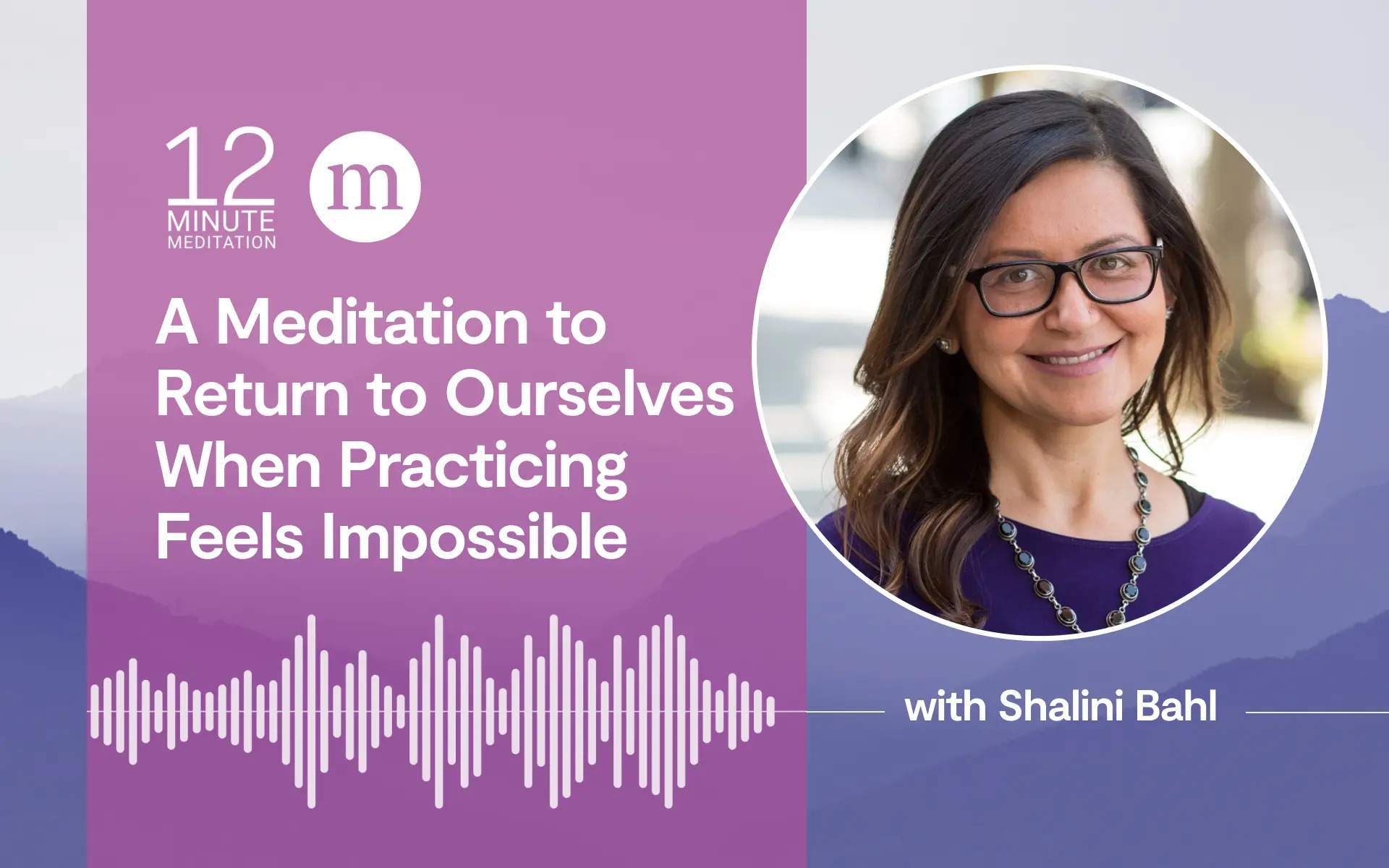
  • A Meditation to Return to Ourselves When Practicing Feels Impossible

    A Meditation to Return to Ourselves When Practicing Feels Impossible

    If you’re burned out, discouraged, and disconnected by all the struggle and suffering in the world, you’re not alone. In times of intense upheaval, mindfulness practice can feel impossible. Try this simple, grounding meditation to pause, reconnect with compassion and clarity, and return to yourself.

    Many of us are bearing witness daily to suffering all over the planet. We care about others, and we want desperately to be of use—and seeing the horrors in images and videos and stories every day can be deeply dysregulating to our nervous systems. 

    When we get overwhelmed by this vicarious trauma, we tend to shut down. We disconnect for ourselves and each other. We’re so spun out in our anxiety, anger, or overwhelm that it can feel impossible to engage in any kind of mindfulness or meditation practice. 

    This week, Shalini Bahl offers tender and practical guidance for how to pause, reconnect, and return to ourselves and our essential practice in times of intense internal and external upheaval. 

    A Meditation to Return to Ourselves When Practicing Feels Impossible

    Read and practice the guided meditation script below, pausing after each paragraph. Or listen to the audio practice.

    1. Welcome and thank you for being here, for caring enough to practice despite the gazillion things you could be doing with your time. The world needs people right now who can stay grounded while engaging with the suffering we’re all witnessing with open hearts and minds, people who can act from wisdom rather than overwhelm. People who haven’t lost themselves in the chaos. But we do lose ourselves, all of us. 
    2. When we bear witness to crisis after crisis after crisis, our nervous systems dysregulate. We lose contact with our wisdom, our intentions, our sense of what’s actually ours to do. This practice helps us return. 
    3. We’ll move through three pathways to return home to ourselves. First, inner calm, where you return to clarity and agency. Then compassion, where we are going to reconnect with our humanity and others. And finally curiosity, where you discover what’s actually yours to do, what’s possible for you to do. If you find one pathway calling to you more than others, feel free to linger there longer. Trust what you most need. So ready to begin? 
    4. Come to a posture that feels supported, lying down or seated. Feel the elongation along the back of your spine and neck. Roll your shoulders up, back and down. When you feel ready, lower or close your eyes. 
    5. From this place of presence let’s begin by taking three intentional breaths. Breathe in through the nose and exhale slowly through the mouth. If you like, you can make a sighing sound as you exhale. 
    6. Now return to your natural rhythm of the breath. Invite your mind to be here with your body, with your breath, resting in your awareness of the direct sensations of breathing in the region of your heart. Settle your attention in that one place in your body, in the region of your heart as you breathe in, perhaps noticing the space that’s created in your chest. And as you exhale the relaxation, letting go just for these few minutes letting go of any rushing, any expectations or judgments. 
    7. If you like, place one or both hands on your chest. Especially on days where our minds are busy, we feel fragmented. Placing one or both hands on the chest can really relieve the nervous system. Sense the warmth or coolness of your hands. The rising and falling of your chest under your hands, making contact with your body, sensing the beating heart. 
    8. Give your full care and attention to every inhale, to every exhale and resting in the pauses in between. Notice that space when your in-breath turns to an out-breath. And a slight pause before a new breath enters the body. 
    9. From time to time, your mind may wander away, and that’s natural. As soon as you notice that, with kindness invite your mind to return to this place of rest and awareness in the region of your heart. Connect with your direct experience of breathing, just the way you are. And notice if there’s any striving here, letting go of any effort to even meditate as the breath moves itself and your awareness. All you’re doing is returning to your awareness of this breath moving effortlessly in and out of your body. 
    10. Just for these few moments, allow yourself to rest. To replenish yourself, to feel resourced. And once your mind and body feel stabilized, listening within, ask yourself: What would support you in feeling rested, resourced? What would care for yourself look like in this moment? It might be as simple as turning towards yourself with kindness, appreciating the goodness of your heart and mind. Taking this time to listen within what you need more of, more rest, more movement, connection. Let yourself be held by your own loving kindness. 
    11. From this innate capacity for goodness, for compassion, gently note who you might have hardened against today. You don’t need to start with the hardest person, the one whose actions feel unforgivable. Start with someone easier. Maybe someone who said something online that rubbed you the wrong way. Maybe someone doesn’t understand or see you. Maybe a family member, a colleague, a stranger. Or maybe yourself. With kindness, simply notice the hardness. There’s no need to change it or fix it. Just feel the way it lives in your body, in your chest or belly, your throat. Breathe in to make space for it, to make space around it. 
    12. Recognize this hardness, its protection. You’ve seen unbearable things. You’ve been hurt. The hardness makes sense. And it’s also disconnection. Disconnection from our relational intelligence, from our capacity to see our shared humanity. And if it’s helpful gently invite this question: What if you had grown up in their circumstances? What if you’d received the same information, the same upbringing, the same experiences? Who would you be? Can you soften just a little when you consider this? That we’re all shaped by causes and conditions, often beyond our control. You may not agree with them or even condone what they’re doing. Can you consider saying this person has suffered just like me? This person also wants to be happy just like me? 
    13. Using your breath as an anchor to stay connected with yourself and with your good heart—can you feel that invisible thread connecting you? You’re both breathing the same air, drinking the same water. Living on this one planet we all call home. 
    14. Take a few moments to listen within. What shifts when we touch this shared humanity? 
    15. From this place of connection with yourself and our shared humanity, let’s explore what’s important to you, what’s possible, and what’s yours to do. So return to our open awareness. What’s most important to you in this moment? Take this time to reconnect with your deepest intentions and values. You might ask questions like: What am I not seeing? What might your body be trying to tell you that your mind is missing? 
    16. Without trying to find something special or seeking answers, just staying connected with your body. Trust your inner knowing as you consider the possibilities for actions you can take that are aligned with your intentions, with your unique gifts, with your values. What if there’s something you haven’t tried yet? Some approach you haven’t considered or some alliance you haven’t imagined? Open your mind and heart to new possibilities. Even if you don’t receive specific answers right now, just hold that question, being willing to love the unanswered question and being willing to live the question. 
    17. From this place of  open curiosity, willing to see what you’ve been missing, ask what’s actually possible here. Not what you’ve always done, not what everyone is doing or telling you to do but what is yours to do and what would actually help If you need more clarity. Try journaling, being in nature and any other activity that supports you in returning to yourself to feel connected, alive, present with the gift of this life at this time on this planet Earth. 
    18. Even as we end this practice, remember that you can come back anytime. Every time you notice you’re lost in the scroll, in the rage and the numbness, you can return to your inner calm, your compassion, and your innate capacity for keeping an open and curious mind. This is where clarity, humanity, and creativity live. 

    Thank you for your practice. May our practice together benefit us and benefit all beings.


    Source link

  • From Stress to Serenity: How Gratitude Practice Can Reduce Anxiety and Burnout

    From Stress to Serenity: How Gratitude Practice Can Reduce Anxiety and Burnout

    Introduction to Gratitude Practice

    In today’s fast-paced world, stress and anxiety have become an unfortunate norm for many individuals. The constant pressure to perform, the fear of not meeting expectations, and the overwhelming amount of information we are exposed to daily can lead to feelings of burnout and exhaustion. However, there is a powerful tool that can help alleviate these negative emotions and cultivate a sense of serenity: gratitude practice. By focusing on the things we are thankful for, we can shift our perspective, calm our minds, and improve our overall well-being.

    The Science Behind Gratitude

    Gratitude is more than just a feeling; it’s a practice that can have a profound impact on our mental and physical health. Research has shown that practicing gratitude can increase the production of neurotransmitters such as dopamine, serotonin, and endorphins, which are associated with feelings of happiness, relaxation, and reduced stress. Additionally, gratitude has been linked to lower levels of cortisol, the hormone responsible for stress and anxiety. By incorporating gratitude into our daily routine, we can literally change our brain chemistry and develop a more positive outlook on life.

    How Gratitude Reduces Anxiety and Burnout

    So, how exactly does gratitude practice reduce anxiety and burnout? When we focus on the things we are grateful for, we begin to shift our attention away from negative thoughts and worries. This helps to calm the mind and reduce rumination, which is a common symptom of anxiety. By acknowledging the good things in our lives, we also begin to develop a sense of perspective, realizing that our problems are not the only things that exist. This can help us feel more grounded and centered, even in the midst of chaos. Furthermore, gratitude practice can help us develop a sense of resilience, allowing us to bounce back from adversity and navigate challenging situations with greater ease.

    Simple Ways to Incorporate Gratitude into Your Daily Life

    Incorporating gratitude into your daily life is easier than you think. Here are a few simple ways to get started:

    • Keep a gratitude journal: Take a few minutes each day to write down three things you are thankful for.
    • Share gratitude with a friend or family member: Express your appreciation for someone in your life, whether it’s a kind word, a text message, or a small gift.
    • Practice mindfulness: Take a few minutes each day to focus on the present moment, without judgment, and acknowledge the good things that are happening right now.
    • Create a gratitude ritual: Develop a daily or weekly ritual, such as lighting a candle or saying a prayer, to help you focus on the things you are grateful for.

    The Benefits of Gratitude Practice

    The benefits of gratitude practice are numerous and well-documented. Some of the most significant advantages include:

    • Improved mental health: Gratitude has been shown to reduce symptoms of anxiety and depression, and even help alleviate symptoms of post-traumatic stress disorder (PTSD).
    • Better sleep: Practicing gratitude before bed can help improve sleep quality and duration.
    • Stronger relationships: Expressing gratitude towards others can strengthen relationships and build stronger bonds.
    • Increased resilience: Gratitude can help us develop a sense of resilience, allowing us to navigate challenging situations with greater ease.
    • Improved physical health: Studies have shown that gratitude is linked to lower blood pressure, a healthier weight, and a stronger immune system.

    Overcoming Obstacles to Gratitude Practice

    While gratitude practice can be incredibly beneficial, it’s not always easy to get started. Here are a few common obstacles to gratitude practice, and some tips for overcoming them:

    • Difficulty finding things to be grateful for: Start small, and focus on the little things, such as a good cup of coffee or a beautiful sunset.
    • Feeling like you don’t have time: Incorporate gratitude into your daily routine, such as right before bed or during your morning commute.
    • Struggling with negative thoughts: Practice mindfulness and acknowledge your negative thoughts, but also make an effort to focus on the positive aspects of your life.

    Gratitude in the Workplace

    Gratitude is not just limited to our personal lives; it can also have a profound impact on our professional well-being. When we practice gratitude in the workplace, we can:

    • Improve our relationships with colleagues and supervisors
    • Increase our sense of job satisfaction and engagement
    • Develop a more positive and resilient attitude towards challenges and setbacks
    • Improve our communication and collaboration skills
    • Enhance our overall well-being and reduce burnout

    Cultivating Gratitude in Children

    Teaching children the practice of gratitude can have a lasting impact on their mental and emotional well-being. Here are a few ways to cultivate gratitude in children:

    • Model gratitude yourself: Children learn by example, so make sure to express gratitude in front of them.
    • Create a gratitude ritual: Develop a daily or weekly ritual, such as sharing three things you are grateful for at dinner time.
    • Encourage gratitude journaling: Help your child start a gratitude journal, and encourage them to write or draw something they are thankful for each day.
    • Practice mindfulness: Teach your child mindfulness techniques, such as deep breathing and meditation, to help them focus on the present moment.

    Conclusion

    In conclusion, gratitude practice is a powerful tool that can help reduce anxiety and burnout, and cultivate a sense of serenity in our lives. By incorporating gratitude into our daily routine, we can shift our perspective, calm our minds, and improve our overall well-being. Whether it’s through journaling, mindfulness, or simply sharing gratitude with others, there are many ways to make gratitude a part of our lives. So why not give it a try? Take a few minutes each day to focus on the things you are thankful for, and watch your life transform in amazing ways.

    FAQs

    Q: What is gratitude practice, and how does it work?
    A: Gratitude practice is the act of focusing on the things you are thankful for, and it can have a profound impact on our mental and physical health. By practicing gratitude, we can shift our perspective, calm our minds, and improve our overall well-being.
    Q: How can I incorporate gratitude into my daily life?
    A: There are many ways to incorporate gratitude into your daily life, including keeping a gratitude journal, sharing gratitude with a friend or family member, practicing mindfulness, and creating a gratitude ritual.
    Q: What are the benefits of gratitude practice?
    A: The benefits of gratitude practice include improved mental health, better sleep, stronger relationships, increased resilience, and improved physical health.
    Q: Can gratitude practice really reduce anxiety and burnout?
    A: Yes, gratitude practice has been shown to reduce symptoms of anxiety and depression, and even help alleviate symptoms of post-traumatic stress disorder (PTSD).
    Q: How can I teach my child to practice gratitude?
    A: You can teach your child to practice gratitude by modeling gratitude yourself, creating a gratitude ritual, encouraging gratitude journaling, and practicing mindfulness.
    Q: Is gratitude practice a replacement for therapy or medication?
    A: No, gratitude practice is not a replacement for therapy or medication. While it can be a powerful tool for improving mental health, it should be used in conjunction with other forms of treatment, under the guidance of a healthcare professional.

  • From Stress to Serenity: How Journaling Can Help You Manage Anxiety

    From Stress to Serenity: How Journaling Can Help You Manage Anxiety

    Introduction to Journaling and Stress Management

    In today’s fast-paced world, stress and anxiety have become ubiquitous companions for many of us. The pressures of work, family, and social obligations can leave us feeling overwhelmed and drained. However, there are effective tools that can help manage these feelings and lead us towards a path of serenity. One such powerful tool is journaling. The act of putting your thoughts and feelings down on paper can be incredibly cathartic, allowing you to process your emotions, gain clarity, and develop a greater understanding of yourself. In this article, we will explore how journaling can be a pivotal practice in transitioning from stress to serenity, helping to manage anxiety and cultivate a more peaceful, balanced life.

    Understanding Stress and Anxiety

    Before diving into the benefits of journaling, it’s essential to understand the nature of stress and anxiety. Stress is the body’s natural response to a perceived threat or pressure. It’s what prepares your body to either face the situation head-on (fight) or flee from it (flight). While stress can sometimes motivate us to take action, chronic stress can lead to anxiety, which is a persistent and excessive worry about everyday things, even when there’s no apparent reason to worry. Anxiety can interfere with daily life, causing difficulties in relationships, work, and overall well-being.

    How Journaling Helps

    Journaling is a simple yet powerful technique that involves writing down your thoughts, feelings, and experiences. By committing these to paper, you begin to externalize your internal world, which can offer several benefits in managing stress and anxiety:

    • Clarification of Thoughts and Feelings: Journaling helps you identify and understand your thoughts and emotions better. Often, when we’re stressed or anxious, our thoughts can be muddled and overwhelming. Writing them down allows you to untangle them, making it easier to pinpoint the sources of your stress and anxiety.
    • Emotional Release: The act of journaling can be therapeutic, providing a safe space to express and release pent-up emotions. By putting your feelings into words, you can begin to let go of them, which can be particularly helpful for those dealing with anxiety.
    • Reflection and Insight: Regular journaling encourages reflection on your experiences, helping you to identify patterns and gain insights into your behaviors and emotions. This increased self-awareness can be instrumental in making positive changes and developing coping strategies for stress and anxiety.
    • Mindfulness: The practice of journaling can foster mindfulness, encouraging you to stay present and aware of your current thoughts and feelings, rather than worrying about the future or past.

    Effective Journaling Techniques for Stress and Anxiety

    While journaling can be incredibly beneficial, incorporating certain techniques can enhance its effectiveness in managing stress and anxiety:

    • Morning Pages: Starting your day by writing down your thoughts without editing or censoring yourself can clear your mind and set a positive tone for the day.
    • Gratitude Journaling: Focusing on the things you’re grateful for can help shift your perspective, making you more appreciative and less worried about negative aspects of your life.
    • Prompt-Based Journaling: Using specific prompts related to your anxiety and stress can guide your reflections and help you delve deeper into the root causes of your feelings.
    • Mindfulness Journaling: Combining journaling with mindfulness practices, such as meditation or deep breathing, can enhance the calming effects and promote a greater sense of serenity.

    Overcoming Barriers to Journaling

    Some people may find it challenging to start or maintain a journaling practice due to various barriers:

    • Lack of Time: Finding even a few minutes each day can be challenging, but journaling doesn’t have to be time-consuming. Even a brief reflection can be beneficial.
    • Self-Criticism: The fear of not writing “well” or the belief that your thoughts aren’t worth writing down can be daunting. However, journaling is for your eyes only, and its value lies in the process, not the product.
    • Privacy Concerns: If you live with others, finding a private space to journal might be difficult. Consider using a lockable journal or finding an outdoor spot where you can write undisturbed.

    Real-Life Examples and Testimonials

    Many individuals have found solace and relief from stress and anxiety through journaling. Personal stories and testimonials often highlight the profound impact journaling can have on mental health, showcasing how it can be a turning point in managing anxiety and finding calm in chaotic times.

    Conclusion

    Journaling is a versatile and accessible tool that can be a companion on your journey from stress to serenity. By providing a space to express emotions, clarify thoughts, and gain insights, journaling helps in effectively managing anxiety and cultivating a more peaceful life. It’s a practice that complements other stress management techniques, such as meditation and therapy, and can be tailored to suit individual needs and preferences. Whether you’re dealing with chronic anxiety or occasional stress, incorporating journaling into your daily routine can be a significant step towards a more balanced and serene you.

    FAQs

    • Q: Do I need to write in my journal every day?
      A: While consistency can be beneficial, it’s not necessary to write every day. Even journaling a few times a week can have positive effects on your mental health.
    • Q: What if I don’t know what to write about?
      A: Starting with prompts or simply writing about your day can help. As you continue journaling, you’ll find your own rhythm and topics to explore.
    • Q: Is journaling only for people with severe anxiety or stress?
      A: No, journaling can benefit anyone looking to improve their mental health, whether they’re dealing with anxiety, stress, or just seeking a tool for self-reflection and growth.
    • Q: Can I journal digitally, or do I need to use a physical journal?
      A: Both physical and digital journaling have their benefits. Physical journals can offer a tactile experience, while digital journals provide convenience and accessibility. Choose the method that works best for you.
  • The Impact of Financial Stress on Mental Health: How to Cope and Thrive

    The Impact of Financial Stress on Mental Health: How to Cope and Thrive

    Introduction

    Financial stress is a pervasive and insidious force that can have a profound impact on an individual’s mental health. The pressure to make ends meet, pay bills, and save for the future can be overwhelming, leading to feelings of anxiety, depression, and hopelessness. The consequences of financial stress can be far-reaching, affecting not only an individual’s mental well-being but also their relationships, physical health, and overall quality of life. In this article, we will explore the impact of financial stress on mental health, discuss coping strategies, and provide tips for thriving in the face of financial uncertainty.

    The Impact of Financial Stress on Mental Health

    Financial stress can have a significant impact on mental health, leading to a range of negative emotions and outcomes. Some of the common effects of financial stress on mental health include:

    • Anxiety and worry: The pressure to pay bills, debt, and financial obligations can lead to feelings of anxiety and worry, making it difficult to relax and enjoy life.
    • Depression: Prolonged financial stress can lead to feelings of hopelessness and despair, contributing to the development of depression.
    • Sleep disturbances: Financial stress can disrupt sleep patterns, leading to insomnia, sleep deprivation, and other sleep-related problems.
    • Relationship problems: Financial stress can put a strain on relationships, leading to conflict, communication problems, and intimacy issues.
    • Physical health problems: Chronic financial stress can lead to physical health problems, such as headaches, digestive issues, and a weakened immune system.

    Causes of Financial Stress

    Financial stress can be caused by a range of factors, including:

    • Low income: Living on a low income or having a limited budget can lead to financial stress, making it difficult to make ends meet.
    • Debt: High levels of debt, particularly credit card debt, can lead to financial stress and anxiety.
    • Unemployment or underemployment: Losing a job or being underemployed can lead to financial stress, particularly if there is no safety net or support system in place.
    • Medical expenses: Unexpected medical expenses or chronic health conditions can lead to financial stress, particularly if there is no health insurance or inadequate coverage.
    • Financial insecurity: Feeling insecure about one’s financial future, such as not having enough savings or retirement funds, can lead to financial stress and anxiety.

    Coping with Financial Stress

    While financial stress can be overwhelming, there are several coping strategies that can help individuals manage their finances and reduce stress. Some of these strategies include:

    • Creating a budget: Developing a budget can help individuals track their income and expenses, identify areas for reduction, and make informed financial decisions.
    • Prioritizing expenses: Prioritizing essential expenses, such as rent/mortgage, utilities, and food, can help individuals manage their finances and reduce stress.
    • Building an emergency fund: Having a safety net or emergency fund in place can provide peace of mind and reduce financial stress.
    • Seeking support: Talking to a financial advisor, therapist, or support group can provide emotional support and help individuals develop coping strategies.
    • Practicing self-care: Engaging in self-care activities, such as exercise, meditation, or hobbies, can help reduce stress and improve overall well-being.

    Managing Debt

    Debt can be a significant contributor to financial stress, but there are several strategies for managing debt and reducing financial stress. Some of these strategies include:

    • Consolidating debt: Consolidating debt into a single loan or credit card can simplify payments and reduce interest rates.
    • Creating a debt repayment plan: Developing a plan to pay off debt, such as the snowball method or avalanche method, can help individuals stay on track and reduce debt.
    • Negotiating with creditors: Negotiating with creditors, such as credit card companies or lenders, can help individuals reduce interest rates, fees, or payments.
    • Seeking debt counseling: Working with a debt counselor or credit counselor can provide guidance and support in managing debt and developing a plan to become debt-free.

    Building Financial Resilience

    Building financial resilience can help individuals cope with financial stress and thrive in the face of uncertainty. Some strategies for building financial resilience include:

    • Diversifying income: Having multiple sources of income, such as a side hustle or investments, can provide a financial safety net and reduce reliance on a single income source.
    • Building an emergency fund: Having a cushion of savings can provide peace of mind and reduce financial stress.
    • Investing in oneself: Investing in education, skills, or personal development can increase earning potential and improve financial stability.
    • Practicing financial mindfulness: Being mindful of spending habits, financial goals, and values can help individuals make informed financial decisions and reduce financial stress.

    Conclusion

    Financial stress can have a profound impact on mental health, leading to anxiety, depression, and other negative outcomes. However, by understanding the causes of financial stress, developing coping strategies, and building financial resilience, individuals can reduce financial stress and thrive in the face of uncertainty. By prioritizing financial wellness, seeking support, and practicing self-care, individuals can improve their overall well-being and achieve financial stability.

    FAQs

    Q: What are the common causes of financial stress?
    A: Common causes of financial stress include low income, debt, unemployment or underemployment, medical expenses, and financial insecurity.
    Q: How can I cope with financial stress?
    A: Coping strategies for financial stress include creating a budget, prioritizing expenses, building an emergency fund, seeking support, and practicing self-care.
    Q: What is the impact of financial stress on mental health?
    A: Financial stress can lead to anxiety, depression, sleep disturbances, relationship problems, and physical health problems.
    Q: How can I manage debt?
    A: Strategies for managing debt include consolidating debt, creating a debt repayment plan, negotiating with creditors, and seeking debt counseling.
    Q: What is financial resilience, and how can I build it?
    A: Financial resilience refers to the ability to cope with financial stress and uncertainty. Strategies for building financial resilience include diversifying income, building an emergency fund, investing in oneself, and practicing financial mindfulness.
    Q: Where can I seek support for financial stress?
    A: Individuals can seek support from financial advisors, therapists, support groups, or online resources, such as financial counseling services or mental health hotlines.

  • Tap Into Ease with This Guided Meditation for Holiday Stress

    Tap Into Ease with This Guided Meditation for Holiday Stress

    Get the latest on everything mindfulness


    Our free newsletter delivers updates on the science of mindfulness, guided mindfulness meditation practices from leading teachers, special offers, and rich content to support your mindful growth.


    Source link

  • Why We Wake Up At Night and How Mindfulness Helps Us Sleep Again

    Why We Wake Up At Night and How Mindfulness Helps Us Sleep Again

    You’re awake, and the time on your nightstand shows 3:33 a.m. There’s no reason to be awake, but your mind has other ideas. Some nights it could be an overactive mind; other times, you’re fighting a hot flash or the urge to scroll on your phone, hoping to fall back asleep.

    Regardless of what’s calling to you in the middle of the night, the message you really need to hear: You’re not alone.

    Nearly 18% of U.S. adults report trouble staying asleep, and 30–50% experience insomnia symptoms, including difficulty falling or staying asleep. And yet, our initial response to waking in the middle of the night tends to lean toward frustration or anger rather than curiosity.

    Dr. Jessica Shepherd asks her readers to be curious about the patterns and symptoms we experience around wakefulness instead of moving towards “fixing” our sleep problem.

    What would happen if we chose to investigate our feelings around wakefulness with self-compassion and mindfulness, instead of pushing against our own discomfort with what’s unwanted? Understanding more about why we wake up at night can help.

    The Nervous System and Sleep Disruption

    When did 3 a.m. become the new wake-up call?  If you’ve slept soundly for most of your life, only to be suddenly confronted with a nightly routine that involves struggling to get back to sleep, know you’re in good company. These “wakeups” happen across ages, genders, and all life stages. Some of us (ahhem, menopause ladies, we see you) begin having some of these issues as a result of hormone shifts (we’ll get into that later).

    What you need to know is that waking in the night is not a personal failure.  Oftentimes, your nervous system responds to cues your body sends, both internal and external. Here are a few reasons why we wake up at night, and why your sleep may be feeling more fragmented:

    • Hyperarousal: Stress hormones like cortisol and adrenaline can trigger micro-awakenings. Even while asleep, your brain is scanning for potential threats.
    • Racing or overloaded mind: Daytime to-do lists, worries, or plans can linger into the night, keeping your brain alert.
    • Environmental triggers: Neighborhood noise, light, temperature swings, or even screens can subtly wake the brain.
    • Aging sleep architecture: As we age, our sleep naturally becomes lighter and more fragmented.
    • Hormonal shifts: As I mentioned above, if you’re in perimenopause or menopause, changes in estrogen, testosterone, and progesterone can significantly affect your sleep cycles. They can disrupt sleep when you’re experiencing hormone imbalances. Still, these shifts are a small part of the overall picture when we consider why many people experience nighttime wakefulness.

    Why starting with curiosity helps

    OB-GYN and author of Generation M, Dr. Jessica Shepherd, asks her readers to be curious about the patterns and symptoms we experience around wakefulness instead of moving towards “fixing” our sleep problem. Here are four questions she poses to help guide reflection: 

    • Is this wake-up due to hot flashes or night sweats?
    • Am I waking repeatedly or having trouble breathing?
    • Is my mind racing too much to fall asleep or fall back asleep?
    • Do I need to use the bathroom frequently at night?

    While Dr. Shepherd is a go-to source for menopausal struggles and solutions, these questions can be used to assess your symptoms, regardless of your age. Typically, mid-morning wakeup calls fall into one of these four categories:  mental overactivity, changes in body or room temperature, repeated environmental disruptions, or physical cues. When we understand the causes and conditions for our experience, we can cultivate a mindful response.

    Why Are My Thoughts Awake at 3 a.m.?

    The main culprit for middle-of-the-night wakefulness can vary from person to person. No matter what time you’re waking up, if it’s before your alarm clock goes off, it’s likely to feel unsettling.

    For those of you in perimenopause or menopause, the shift of our hormones (feeling hot flashes/night sweats) can make us feel very stressed out. As our stress levels rise, so do our cortisol levels. Typically, this stress hormone rises around 3 a.m. to prepare us for waking, but if our stress levels are too high, it can shift that baseline and cause us to wake up earlier than usual.

    Mindfulness offers a different way to approach these interruptions. It nudges us first to accept what’s happening in the present moment, and then to gently turn towards curiosity and self-compassion.

    For those of you who have surpassed that hurdle of menopause or generally have trouble falling asleep or staying asleep, this time of night can feel so much louder than usual. When we’re alone with our thoughts in the middle of the night, our fears can feel heightened. Sleep deprivation heightens amygdala reactivity, making even small anxieties feel intense. Mindfulness can help settle our nervous system by guiding us towards practical tools that help us eliminate spiraling narratives.

    So, how can you shift your perspective when it comes to that mid-morning wake-up? Mindfulness offers a different way to approach these interruptions. 

    We’ve all heard the phrase, What you resist, persists, and you likely know from experience that it doesn’t work to fight sleeplessness or try to force yourself to go back to sleep. 

    Mindfulness nudges us first to accept what’s happening in the present moment, and then to gently turn towards curiosity and self-compassion. So perhaps the questions and phrases we could be engaging with might sound more like, “How can I offer myself compassion when sleeplessness makes itself known?” or, “What is this experience trying to show me?”

    Look for clues in your daily routines

    Sleep expert and author of Powerful Sleep, Shawna Robins, encourages people who have trouble navigating the “wide-awake” brain by taking a look at what they’re doing during the day.

    She emphasizes laying the groundwork for a healthy routine (meals, exercise, self-care) that supports hormone balance and your nervous system. For Robins, that begins with stress management, proper nutrition, and some form of physical activity. When we do these things, sleeping, and specifically “falling asleep” or returning to sleep after that three o’clock wake-up, can get much easier. Robins says, “Healthy sleep starts during the daytime with healthier habits. It’s not just about what happens when you get into bed at night.”

    Mindful Sleep Strategy

    What does a mindfulness strategy look like for cultivating good sleep? Think about all the tools you’ve developed over the course of your mindfulness journey and start putting them to use.

    Sleep supports the choices we make before bed.

    That means journaling, sitting regularly, mindfully eating and noticing the times you’re eating. It can also involve checking in with your physical body (think body-scan meditation or breathwork), coupled with daytime routines (yoga/gym workout, exercises you can do throughout the day at work/your desk, etc.) that will help create a stable space for you to reset your energy and recalibrate your nervous system. Sleep supports the choices we make before bed.

    If you find yourself up in the middle of the night and can’t get back to sleep, here are some different ways you can try to help yourself. 

    1.  30-Second Body Scan
      Redirect attention from racing thoughts to physical sensations, noticing each part of the body without judgment.
    2. Lengthened Exhale Breathing (4–6 breaths)
      Extending the exhale calms the parasympathetic nervous system, signaling the body that it is safe to rest.
    3. Thought Noting
      Label thoughts gently (“I’m worrying,” “I’m planning”) to create mental distance.
    4. Journaling
      Keep a notepad by the bed to externalize racing thoughts and reduce cognitive load.
    5. Gentle Somatic Grounding
      Release tension in the jaw, shoulders, or belly to help the body signal safety.

    Nighttime wakefulness often coincides with vivid or emotionally charged dreams. Sansan Fibri, founder of the app Wakefully.io, describes dreams as “our subconscious screenplay, where hidden narratives sometimes replay on repeat.”

    Wakefully is an AI-driven dream-analysis and journaling app that allows users to examine dream themes and emotions or reframe dreams with evidence-based techniques. For those who wake at night due to intense dreams or lingering emotional tension, incorporating tools like Wakefully alongside your mindfulness practice can help shift into a more reflective space, calming a reactive mind. With curiosity, gentle awareness, and practical tools, you can transform these moments into opportunities for connection with your body and mind.

    When we approach sleep with mindfulness,  we can meet moments of wakefulness with curiosity instead of frustration, helping us meet them in the middle of the night with presence and ultimately a sense of well-being.


    Source link