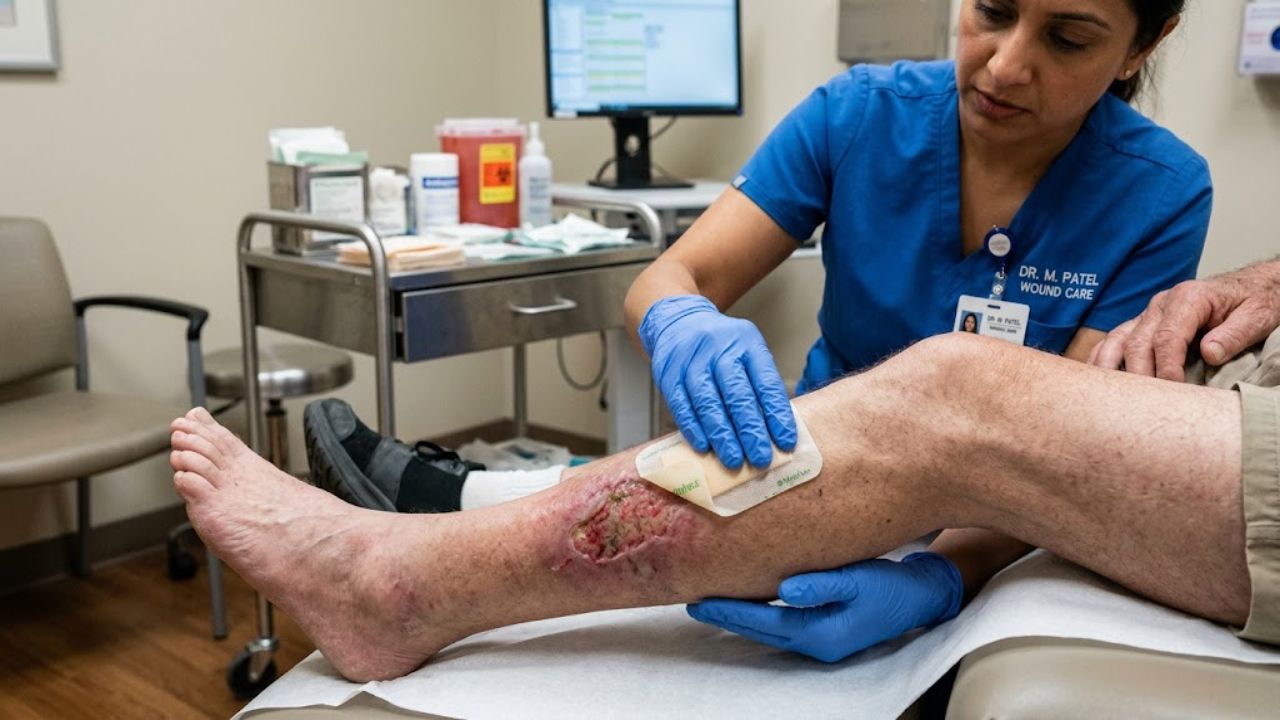
Most wound treatments that use growth factors work by flooding the area and hoping for the best. Large doses of manufactured protein go on as a spray or cream, and most of it degrades or drifts away before reaching the cells that need it.
Researchers at Imperial College London built something that inverts the logic. Their dressing carries no drug at all. Instead, it grabs the growth factors the wound is already producing, holds onto them, and lets go only when a repair cell physically pulls on the material.
The cell’s own tugging is the release mechanism. Published in Nature Materials in late July, the work is the first demonstration of this mechanism operating in living, repairing tissue.
A Molecular Lock Only the Right Cells Can Open
The platform uses aptamers, short nucleic acid sequences folded into shapes that bind specific proteins. Here, they latch onto growth factors circulating in the wound and hold them in place, which also shields them from the enzymes that would otherwise break them down.
Cells migrating into a wound do not glide. They grip their surroundings and pull, generating traction forces as they crawl. When a repair cell pulls on an aptamer holding a growth factor, the aptamer loosens its grip and releases its cargo directly to that cell.
The system can be tuned so that only forces from specific cell types trigger release, meaning the signal arrives at the right cell at the moment it is doing the work. The team calls the approach traction-force-activated payloads, and Ben Almquist’s group first described the underlying chemistry in 2019, inspired by how cells crawling through natural collagen scaffolds activate healing proteins already embedded within them. What is new is that it shows it drives repair in living tissue rather than in simple cell culture.
“What particularly stands out with this research is that the patient’s own body becomes the pharmacy,” said Almquist, associate professor of bioengineering and senior author, in an Imperial College announcement. He described the design as capturing what the body is already making and returning it to the cells that need it.
Doses Thousands of Times Smaller
The efficiency numbers are the most striking part of the report.
Because the growth factors are delivered precisely where and when repair is happening, the system works at doses hundreds to thousands of times lower than conventional growth-factor delivery approaches and more than 2,000 times lower than a growth-factor product already in clinical use.
That gap matters for reasons beyond cost. High-dose growth factor therapy has a complicated safety profile, and reducing the required dose by three orders of magnitude considerably changes the risk calculation.
The researchers also raise another possibility: that repair molecules could be harvested directly from a patient’s own wound fluid or blood, thereby eliminating dependence on manufactured proteins.
Growth factors are the proteins that instruct cells to migrate, multiply, build blood vessels and rebuild tissue. In wounds that will not close, those instructions are typically too weak, badly timed, or degraded before the job is finished.
Rats, Mice and Living Human Skin
The team tested the platform across several models, beginning with rodents. As The Scientist reported, collagen sponges carrying the platform improved blood vessel formation in a rat bone injury model and reduced wound size in mice with skin wounds.
The more informative result came from human tissue. In laboratory experiments using living human skin, the dressings improved tissue repair, and researchers could watch repair cells migrating into the material.
“What excites me most is that this works in living human skin. We can see repair cells migrating into the wound dressing and confirm the material is engaging with human biology,” said lead author Magdalene Ho of Imperial’s Department of Bioengineering. She said the result makes her optimistic about a clinical future for the approach.
The target conditions are substantial. Imperial puts the global burden of diabetic foot ulcers alone at roughly 18.6 million people a year, with serious complications common, and burns and traumatic injuries add many more.
The Gap Between Human Skin and a Patient
Living human skin in a laboratory is a meaningfully better model than a mouse. It is still not a person.
Skin explants lack a functioning immune system, circulation, and the systemic conditions that make chronic wounds chronic in the first place. Diabetic foot ulcers do not persist because skin cells have forgotten how to migrate; they persist due to neuropathy, impaired blood flow, infection, and sustained inflammation. A dressing that improves repair in healthy human tissue has not been shown to overcome any of that.
There is no clinical trial in patients, no regulatory submission, and nothing available to buy. The wound care field also has a long record of promising materials that performed well in preclinical studies but failed to outperform standard care in clinical trials.
One disclosure belongs in the record. The research is being developed as an Imperial spinout, Traxion Biotech, led by Ho and Almquist, with surgeon Shehan Hettiaratchy as medical adviser. The team is in discussions with partners about routes to clinical use. That does not undermine the science, but readers should know the investigators have a commercial stake.
People managing chronic wounds should continue with their wound care team. Anyone with a wound that is not healing or showing signs of infection should be seen rather than waiting for new technology.
Key Questions Answered
How does the dressing work? It uses aptamers, short nucleic acid sequences, to trap growth factors already present in the wound. When repair cells crawl into the material and pull on it, the aptamers release the growth factors to those cells.
Why is that better than applying growth factors directly? Applied proteins degrade quickly and drift away. Force-triggered release delivers them to the right place at the right time, at doses hundreds to thousands of times lower.
What was tested? A rat bone injury model; mouse skin wounds that closed faster; and living human skin in the laboratory, where tissue repair improved and repair cells were seen migrating into the dressing.
Is this available to patients? No. The work is preclinical. There is no clinical trial in patients and no regulatory approval.
What conditions could it eventually help? Researchers point to diabetic foot ulcers, burns and traumatic injuries, where wounds often fail to close.
Are there commercial interests? Yes. The technology is being developed as an Imperial spinout, Traxion Biotech, led by the study’s lead and senior authors.