Tag: Staying

  • Stay Fit on the Go: 10 Expert Tips for Staying Active While Traveling (Target keywords: stay active while traveling, fitness tips for travel)

    Stay Fit on the Go: 10 Expert Tips for Staying Active While Traveling (Target keywords: stay active while traveling, fitness tips for travel)

    Staying active while traveling can be a challenge, but it’s definitely possible with the right mindset and strategies. Many people struggle to stay active while traveling, but with a little creativity and planning, it’s easy to incorporate physical activity into even the most packed itinerary. In this article, we’ll explore 10 expert tips for staying active while traveling, so you can stay fit and healthy on the go.

    Getting Started: Why Staying Active Matters
    When we travel, it’s easy to get caught up in the excitement of exploring new places and trying new foods. However, neglecting our physical health can have serious consequences, from weight gain to decreased energy levels. Fitness tips for travel can help you stay on track, even when you’re on the move. By incorporating physical activity into your travel routine, you can boost your mood, increase your energy levels, and even improve your overall health.

    Tip #1: Pack Smart
    The first step to staying active while traveling is to pack smart. This means bringing a few essential items that will help you stay active, such as a good pair of walking shoes, a yoga mat, or a resistance band. Don’t forget to check the weather forecast for your destination and pack accordingly. If you’re planning to hike or engage in outdoor activities, be sure to bring the necessary gear, such as a backpack, water bottle, and sunscreen.

    Tip #2: Choose Active Transportation
    One of the best ways to stay active while traveling is to choose active transportation. Instead of taking a taxi or Uber, try walking or biking to your destination. Not only will you get some exercise, but you’ll also get to see more of the local scenery. Many cities also offer bike-sharing programs or walking tours, which can be a great way to explore a new place while getting some exercise.

    Tip #3: Find Local Gyms or Fitness Studios
    If you’re a gym rat, don’t worry – you can still get your fitness fix while traveling. Look for local gyms or fitness studios that offer day passes or drop-in classes. Many gyms also offer virtual classes or online workouts, which can be a great option if you’re short on time. Some popular fitness chains also offer free trials or guest passes, so be sure to check their websites before your trip.

    Tip #4: Try Bodyweight Exercises
    Bodyweight exercises are a great way to stay active while traveling, as they require no equipment and can be done anywhere. Try doing push-ups, squats, or lunges in your hotel room or at a local park. You can also find plenty of free workout videos online that cater to all fitness levels. Some popular bodyweight exercises include burpees, mountain climbers, and planks.

    Tip #5: Take the Stairs
    One of the simplest ways to stay active while traveling is to take the stairs. Instead of taking the elevator, try taking the stairs to your hotel room or to the top of a landmark. Not only will you get some exercise, but you’ll also get to enjoy the views from a different perspective. This is especially true in cities with historic buildings or skyscrapers, where the views from the top can be breathtaking.

    Tip #6: Explore Local Parks and Trails
    Exploring local parks and trails is a great way to stay active while traveling and get some fresh air. Look for local hiking trails, parks, or nature reserves, and spend the day exploring. Many cities also offer guided tours or self-guided walking tours, which can be a great way to learn about the local flora and fauna. Don’t forget to bring plenty of water and snacks, as well as a map or GPS device.

    Tip #7: Try Active Tours
    Active tours are a great way to stay active while traveling and experience the local culture. Look for tours that involve hiking, biking, or kayaking, and spend the day exploring the local scenery. Many tour companies also offer fitness-focused tours, such as yoga or Pilates retreats. These tours can be a great way to meet like-minded travelers and learn new skills.

    Tip #8: Use Fitness Apps
    Fitness apps are a great way to stay active while traveling, as they offer a variety of workouts and exercises that can be done anywhere. Try apps like Nike Training Club, JEFIT, or Yoga Studio, which offer a range of workouts and exercises that cater to all fitness levels. Many apps also offer virtual coaching or personalized workouts, which can be a great way to stay motivated.

    Tip #9: Make Time for Rest and Recovery
    Finally, don’t forget to make time for rest and recovery while traveling. It’s easy to get caught up in the excitement of exploring a new place, but neglecting your rest and recovery can have serious consequences. Make sure to get plenty of sleep, eat a balanced diet, and take breaks when you need them. This is especially true if you’re engaging in high-intensity activities or traveling to high-altitude destinations.

    Tip #10: Stay Hydrated
    Staying hydrated is essential for staying active while traveling, as it helps to prevent dehydration and maintain energy levels. Make sure to drink plenty of water throughout the day, and avoid sugary drinks or caffeine. You can also bring a refillable water bottle with you, which can be a great way to reduce waste and save money.

    In conclusion, staying active while traveling is easier than you think. By incorporating a few simple tips and strategies into your travel routine, you can stay fit and healthy on the go. Whether you’re a seasoned athlete or just starting out, there are plenty of ways to stay active while traveling. So next time you’re planning a trip, don’t forget to pack your workout shoes and get ready to explore.

    Frequently Asked Questions

    Q: How can I stay active while traveling if I have a busy schedule?
    A: Try incorporating short workouts into your daily routine, such as a 10-minute yoga routine or a quick jog around the block. You can also try scheduling workouts into your daily planner or setting reminders on your phone.

    Q: What are some good fitness apps for travelers?
    A: Some popular fitness apps for travelers include Nike Training Club, JEFIT, and Yoga Studio. These apps offer a range of workouts and exercises that cater to all fitness levels and can be done anywhere.

    Q: How can I stay motivated to work out while traveling?
    A: Try finding a workout buddy or accountability partner, or scheduling workouts into your daily routine. You can also try tracking your progress or setting fitness goals for your trip.

    Q: What are some good ways to stay active while traveling with kids?
    A: Try incorporating family-friendly activities, such as hiking or biking, into your travel routine. You can also try scheduling kid-friendly workouts, such as yoga or dance classes, into your daily routine.

    Q: How can I stay active while traveling if I have limited mobility or health issues?
    A: Try incorporating low-impact activities, such as swimming or chair yoga, into your travel routine. You can also try scheduling workouts with a personal trainer or fitness coach who can cater to your needs and abilities.

    stay-fit-on-the-go-10-expert-tips-for-staying-active-while-traveling-target-keywords-stay-active-while-traveling-fitness-tips-for-travel

  • The Science and Practice of Staying Present Through Difficult Times

    The Science and Practice of Staying Present Through Difficult Times

    Research suggests that when we turn towards pain and discomfort, we can experience less of it. Plus, Ed Halliwell offers a guided meditation for being mindful when things get tough.

    Research into mindfulness has shown the benefits of staying present, and of gently turning towards difficulty. Mindfulness-based relapse prevention (MBRP) trains people with addictive habits to manage their cravings mindfully by staying present to the sensations of craving, rather than trying to distract from them, avoid them or defeat them.

    The Science of Staying Present

    In a large trial of MBRP, mindfulness-trained patients drank and used drugs significantly less than those who were treated with cognitive-behavioural approaches, and a control group who attended twelve-step and psycho-education groups. The authors of the study conclude that mindfulness was the most successful approach, especially over the longer term, because it enabled patients to “monitor and skilfully cope with discomfort associated with craving or negative affect.” A similar study with smokers found that mindfulness training was more than five times as effective as a standard smoking cessation programme, as measured by abstinence from cigarettes after four months (31 per cent compared to 6 per cent). Another study has suggested that mindful people are more able to tolerate their own distress, rather than react in harmful ways.

    There are benefits to staying present with physical, as well as emotional, discomfort. Fadel Zeidan and colleagues suggest that meditation practice is associated with brain changes that indicate and reflect shifts in people’s experience of, and relationship with, pain. Meditators show decreased activity in the primary somatosensory cortex (an area of the brain involved in registering pain) and increased activity in three areas involved in the regulation of pain—the anterior insula, the anterior cingulate cortex and the pre-frontal cortex. When gently turning towards pain, people report that they experience less of it, and their resistance usually decreases. They may not get so caught up in the negative stories and evasive reactions that tend to accompany pain but do nothing to stop it (and, indeed, may increase the mind’s perception of it). This may be why people with chronic conditions have reported reductions in pain after training in mindfulness, even though they still suffer from the illness.

    When gently turning towards pain, people report that they experience less of it, and their resistance usually decreases.

    As far back as 1971, Robert Wallace and Herbert Benson found that meditation reduced activity in the sympathetic nervous system, which controls the “fight or flight” reaction. More recently, attending a mindfulness course has been shown to reduce activity and grey matter volume in the amygdala—a key indicator of how strongly this reaction is triggered. With mindfulness training also comes a thickening in parts of the pre-frontal cortex—the region directly behind the forehead—which may be connected to a strengthening of the body’s capacity to regulate stress. Connections between the amygdala and other parts of the brain weaken after mindfulness training.

    One part of the pre-frontal cortex associated with stress regulation is the anterior cingulate cortex (ACC). Poor ACC function tends to correlate with impulsive behaviour and mental inflexibility—which are both common among people who are under stress. Experienced meditators display more activity in the ACC, and better stress regulation. The capacity to self- manage during difficult situations may be trainable at a very young age. One study that tracked a group of pre-school children who attended a mindfulness programme over six months found that they were less impulsive (more able to regulate) than a group of children who did not receive the training.

    The Benefits of Leaning Into Discomfort

    Just the act of describing unpleasant experiences mindfully can have a positive effect on stress levels. In one study, people with a fear of spiders were asked to walk towards and try to touch a live tarantula. Some were invited to reassure themselves as they approached the spider, while others were advised to distract themselves from what they were trying to do. A third group was encouraged to acknowledge and turn towards their fear, saying something like: “I am frightened by the big ugly spider.” The members of this third group—those who openly stayed present to their fear— got closest to the tarantula, felt least upset by the experience, and had the least sweaty palms.

    Staying present to difficulties seems to have a significant impact on well-being. In Matt Killingsworth’s studies of wandering minds, he has found that people are less happy when their minds are distracted, even when they are engaged in an activity that we would usually describe as unpleasant. So, for instance, even though most people are not keen on commuting, they tend to be happier if their minds turn towards the experience of the journey rather than wander away from it. Other studies have suggested that setting oneself the goal of avoiding stress increases the long-term risk of depression. By contrast, if we view stress as a normal, helpful indicator—something we can handle and from which we can learn—rather than as something to eliminate, we are more likely to experience good health and emotional well-being.

    Try This 15-Minute Guided Mindfulness Meditation

    When you’ve established a stable foundation with mindfulness of breath and body you can experiment with turning towards difficulty.

    Sometimes our experience is painful and difficult. And there may be little or nothing we can do about the arising of the pain or difficulty. In these cases, we may be able to work with what’s happening skillfully by exploring our relationship to it. Most of us have a habitual pattern of turning away from problems or trying to get rid of unpleasant events. Unfortunately this often seems to increase our sense of stress, because if pain is already present, you can’t get rid of it by trying to run away from it. In mindfulness practice we gently experiment with reversing this habit by turning gently towards difficult experiences that come up in our meditation.

    This practice is usually best done in small doses at first. Preferably working with difficulties that aren’t likely to be overwhelming. It’s important to remember that you’re in charge of how you undertake this experiment. You can return to mindfulness of breathing as an anchor at any time or let go of this practice for a while if you need to, being kind to yourself.

    Note that this practice includes longer pauses of complete silence for reflection and presence. If you want more time, feel free to pause the recording as you go.

    1. Begin by settling into a dignified sitting posture. Upright, steady, grounded. Feeling the feet on the floor, bottom on the chair, spine erect shoulders dropped. Feel a sense of openness at the chest, muscles un-tensed, centered, feeling the breath in the belly. Attuning attention to sensations of the breath as it moves in and out. Being with the breath. Being in the body.
    2. And now expanding awareness to experience throughout the body. Being in the present moment with the body. Noticing what you find and allowing what’s here to be here. Especially noticing sensations in the body that are more unpleasant and difficult to be with. Maybe there’s an aching, throbbing, churning, or a tightening somewhere. There may be a physical or a more emotional tone to the sensations. If it feels helpful to label this for yourself, you could mentally say some words describing the experience: anger, pain, or restlessness, for example. Perhaps also noticing where in the body you’re feeling these tones of sensation and emotion.
    3. Now inviting you to experiment with gently taking your attention towards a region of more intense sensation. Turning towards the intensity. Being interested in the qualities of and changes in sensation from moment to moment. What increases or decreases in intensity are there? What shifts in location or texture? As best you can, staying with the direct experience of sensation and letting any thoughts about what’s happening or urges and impulses to react be held in kindly awareness in the background of the mind. Letting go of any need to try and get any kind of result here or for anything to have to change. Just gently turning towards what’s going on. And noticing what happens without an agenda. Riding the waves of experience, moment by moment.
    4. If you like you could offer a sense of breathing with the sensations, feeling them together with the rising and falling of the breath. Breathing in with sensations, breathing out with sensations.
    5. Noticing: are there any impulses to resist or pull away? Perhaps you find your attention drawn into thoughts. Rumination maybe or distraction. Maybe you find your thoughts trying to make sense of the difficulty or problem solving it or judge the success or failure of the practice by whether the intensity decreases or changes. As best you can, seeing if you can include these reactions in your noticing, allowing space for them to be experienced along with the sensations themselves—without having to buy into them or reject them.
    6. If it feels too much to be doing this it’s always okay to continue with or return to mindfulness of breathing or body or to stop practicing for a time. Gentleness is paramount here and there are no right or wrong things to happen when you try this. Just being interested in what does happen when you take your attention into a region of difficulty, moving towards it, letting the experience be observed and awareness without needing to do anything else.
    7. And experimenting now if this feels okay for you with breathing into the region of intensity. Opening further to the sensations on the in-breath and having a sense of softening on the out-breath, of letting go. This isn’t to try and change what’s happening but rather to offer a skillful relationship to it. Flowing with it. Offering space to it, allowing it. Breathing into the sensations on the in-breath, breathing out from them on the out-breath, softening, letting be, allowing.
    8. Staying present with the intensity only for as long as feels manageable for you right now. If you like you can gently move your attention away from and then back towards the intensity noticing what happens each time you work with redirecting your attention in and out. Inviting you to be like a scientist undertaking a laboratory experiment. Being interested in what happens rather than seeking a particular outcome. Coming back to mindfulness of breath or body as and when that feels right for you.
    This post was adapted from Into The Heart of Mindfulness, by Ed Halliwell, published by Piatkus). Download a set of 14 guided audio meditation practices from Ed’s books here.


    Source link

  • Mindful On Set: The Righteous Gemstones’ Kerstin Schulze on Playing Sola and Staying Grounded

    Mindful On Set: The Righteous Gemstones’ Kerstin Schulze on Playing Sola and Staying Grounded

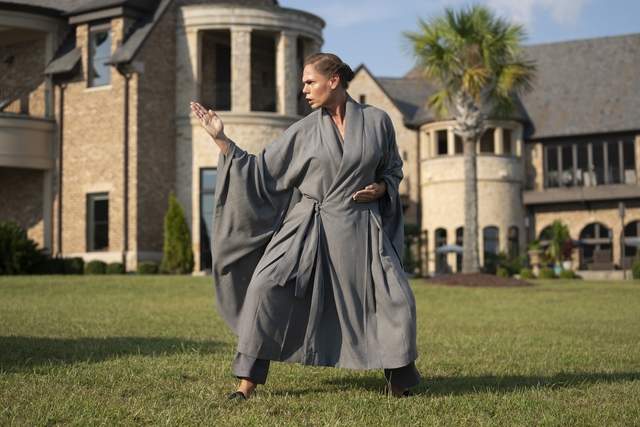
    Kerstin Schulze is a force of nature—an actor, elite fitness trainer, and founder of a performance-focused wellness company whose approach to movement is as intentional as it is powerful. Best known for her role as Sola, the mysterious German nanny with a surprising kung fu twist on HBO comedy The Righteous Gemstones, Schulze brings a unique blend of physical discipline and grounded presence to every role she inhabits (a range that also encompasses “Workout Tina” Fey for Booking.com and a killer clown on American Horror Story: Roanoke).

    In this conversation, we explore how mindfulness manifests in her training, acting process, and daily life and what it takes to stay centered while navigating high-performance environments both on screen and off.

    Angela Stubbs: You play Sola, a German nanny and kung-fu practitioner on the most recent season of The Righteous Gemstones.  Can you discuss what initially drew you to the character Sola, which characteristics you share with her, and how your day-to-day personality differs from hers?

    Kerstin Schulze: When I first received the script and audition notice for Sola, the description called for a tall, German or Scandinavian woman who could do kung fu and was very centered. And immediately, I thought—this is me. I felt such a strong connection to the character; I didn’t have to imagine how she might feel because, in so many ways, I’ve lived her experience. I’ve always been a caretaker and a nurturer at heart. Physically, I’m strong, and with over 30 years spent helping people feel better about themselves, I understood Sola’s mission on a deep level. She’s all about helping others—and that resonated with me completely.

    What I loved about Sola is that she’s grounded and nurturing, yet tough. When I built her backstory, I imagined she came from a wealthy European family where, despite having everything, she felt emotionally neglected. That gave her a purpose: to work with families, not for money, but to help children find stability and bring broken homes back together. That motivation shaped how I played her.

    I understood Sola’s mission on a deep level. She’s all about helping others—and that resonated with me completely.

    I also had a very specific vision for her look. I drew inspiration from Mrs. Bower in Frankenstein—very German, very stern, always put together. The show actually used that exact look in the final version, which I loved.

    The range they gave her made the role special—from the intense fight scenes to her emotional connection with Baby Billy in the end. That moment where she tells him, “They need you,” was so powerful. And her bond with Tiffany, this sweet, pure soul, felt incredibly meaningful. Tiffany’s innocence and sincerity brought out the protector in Sola, and I connected to the purity and depth of that relationship.

    Sola feels like such a grounded and self-aware character, and it struck me that to portray someone like her convincingly, an actor has to bring a real depth of presence and awareness. That kind of groundedness can come from life experience, mindfulness, or even physical practices like kung fu, which plays a key role in who Sola is.

    This has me wondering about the duality of preparing for the physical demands of kung fu while cultivating the inner awareness and emotional depth needed to embody Sola on set, especially amid the chaos and energy of filming.

    Even before I got the role, I was deeply involved in martial arts and mindfulness practices like meditation. I meditate daily—it’s a non-negotiable part of my life. I use it to ground myself, and I really believe in the power of positive affirmations. When my mind starts drifting into negative thoughts, I try to redirect them. That daily practice of mindfulness helped me stay centered not just in life, but especially on set, where there’s so much chaos happening around you.

    When you’re filming, there are hundreds of people on set—cameras, directors, crew—so having those tools came in handy. I could focus, block out all the distractions, and just be present in Sola’s world. It allowed me to connect deeply with who she is and to respond authentically, especially in scenes with Baby Billy. The groundedness people see in Sola on screen is the groundedness I’ve worked hard to cultivate in myself.

    That daily practice of mindfulness helped me stay centered not just in life, but especially on set, where there’s so much chaos happening around you.

    But I didn’t always have that. It started after my divorce, when I was 40. That was a turning point for me. I went to therapy, I committed to meditation, and I did a lot of inner work to understand myself more clearly. I had to ask hard questions, like why I chose a relationship that was so negative. That journey toward self-awareness changed everything for me. And now, 10 years later, I feel like the universe brought me this role because it reflects precisely where I am in life. Sola is grounded, purposeful, and strong—and so am I.

    Kerstin Schulze on Fitness and Being a Kung-Fu Nanny

    It sounds like your mindfulness and martial arts practices helped you meet Sola with a deep sense of presence, both physically and emotionally. You mentioned how much focus this role required—not just in the fight scenes but also in staying grounded amid the chaos on set. This reminds me of The Body Keeps the Score by Bessel van der Kolk, which explores how our bodies hold onto experience and how that mind-body connection is key to healing and awareness.

    So I’m curious: Do you feel like your ability to stay grounded on set and fully embody Sola came from that long-term mind-body work you’ve done? And how has that awareness shaped the way you approach acting in general?

    Our cells hold everything—our thoughts, our emotions—they live our experiences. I’ve always been a tough woman. I had to fight to survive. So the toughness in Sola came naturally to me. What I had to work on more deeply was her softness—that quiet strength. As women, I think we’re still learning how to be both soft and strong, and how to find balance between the two.

    With Sola, she didn’t say much, but her presence spoke volumes. Her body language carried the message. I think that’s true for all of us—we can walk into a room and say so much without speaking a word. It all comes down to how grounded, mindful, and self-aware we are. And when you know who you are, you can show up authentically—you can truly listen without being in your head, already preparing your response.

    The kung-fu nanny is the brain-child of Danny McBride because, of course it is! But let’s talk about the kung fu. A lot of people meeting you for the first time might not realize you have a long background as an athlete, going all the way back to childhood. Do you feel that background made it easier to step into the physicality of Sola—especially the kung fu aspects? Or were there new challenges that came with learning and embodying that particular discipline?

    I’ve been an athlete for as long as I can remember—I competed in the Junior Olympics in Berlin when I was 12—so that background definitely helped. When I got the role, they wanted Sola to know kata (a detailed sequence of movements in karate, performed as an exercise), which I wasn’t trained in. I had done martial arts, kickboxing, weapons work with sticks and knives, but not kata specifically. So I found a kata master and trained every single day. I’m a very visual learner, so I’d study his movements, then drill them until it looked and felt authentic.

    Because of my athletic training, I pick things up quickly, and I took this seriously—knowing millions of people would see it, I wanted it to be right. I trained everywhere: in the pool, in hotel rooms, at home. Then, on set, they switched the camera angles last minute, which meant I had to improvise and adjust on the spot. Knowing the purpose behind each kata movement helped me stay grounded and adapt.

    I trained everywhere: in the pool, in hotel rooms, at home. Then, on set, they switched the camera angles last minute. Knowing the purpose behind each kata movement helped me stay grounded and adapt.

    The fight scenes were intense—we only saw a fraction of what was filmed. I had to pick up and throw someone, smash a vase on a head (fiberglass, thankfully), pull someone off a pool table, slam a head on a piano. It was all very physical. I did about 95% of my own stunts because I wanted it to feel real. All my years of strength and martial arts training really came into play.

    How many takes did you do for all of the kung fu scenes?

    The kata scene by the water was intense—it was scorching hot, and I probably ran through the routine at least 10 times just for my solo shots. Then we filmed from multiple angles, which took about half a day.

    The fight scenes were a full-day shoot. We repeated them over and over. I worked closely with the stunt coordinators—I even had to pick someone up and flip them. The only part I didn’t do myself was the final throw. I asked my stunt double to do that one because I didn’t want to risk injuring anyone. I wasn’t confident I could safely execute that move.

    You mentioned training every day for this role, but outside of acting, you also work as a trainer with everyone from actors to older adults, and you’ve developed your own program, Fitness for the Busy Lifestyle. Can you talk about how body awareness shapes the way you design workouts, and what inspired you to create something specifically for people with limited time or unique physical needs?

    Fitness for the Busy Lifestyle started from my own life—being a single mom, training clients all day, and still finding time to stay fit. I created efficient 30-minute workouts (or even 5-10 minute routines) that work for busy people, travelers, and those with injuries or stress. It’s all about working smarter, staying consistent, and building strength to support your body long-term.

    There’s a saying—everyone should meditate for 10 minutes a day, and if you don’t have 10 minutes, you should meditate for an hour. The point is, the busier or more stressed you are, the more you probably need that pause. And I think the same applies to movement. Sure, there are days when injuries or time constraints make it hard, but that doesn’t mean doing nothing. Even a few minutes of mindful movement—like leg lifts in the kitchen or squats at your desk—can make a difference.

    The same is true for meditation. People often feel that if they don’t have 30 minutes, it’s not worth it. But even one minute of conscious breathing can shift your state. Just paying attention to the breath—how it feels coming in and going out—grounds you.

    How you start the day is everything, but most people underestimate it. I always tell my clients to be grateful before they even get out of bed. Be grateful that you woke up, that you can walk, open your fridge, and step outside. Just those small moments of mindfulness can completely shift your mindset.

    Starting your day with gratitude grounds you. That’s what meditation is—coming back to what matters. Breathing. Being alive.

    Starting your day with gratitude grounds you. That’s what meditation is—coming back to what matters—breathing, being alive. Everything else—goals, money, pressure—is just noise. Life is fragile. We forget that. We chase so much, but real peace comes from connection, presence, and treating our bodies and minds with care.

    So why wouldn’t we take five minutes to speak kindly to ourselves? To move? You don’t need a gym. You can do curls sitting down or glute work while folding laundry. It’s all in how you choose to see it.

    Choosing Growth Over Fear

    On a bigger-picture level, when it comes to memorizing lines, do you have any mindfulness practices or physical habits that help you stay grounded? Are you someone who struggles with memorization, or do you have any go-to tips or tricks for running lines—especially if you’re feeling stuck or under pressure?

    The best way I learn lines is through mindful movement—I walk or exercise while running them. On set, you’re never just sitting still delivering a line; you’re always doing something. So learning lines while moving helps make it feel more natural in performance.

    Another big part of it is understanding the meaning behind the words. Even if I don’t remember every word exactly, if I know what I’m trying to say and what I’m trying to get from the other person in the scene, it comes through. It’s all about the objective—why am I in this scene, what’s my character trying to accomplish, and how does that move the story forward? When you’re clear on that, and the writing is strong, the lines tend to flow naturally.

    That said, I also record my lines and listen to them on repeat, like music—sometimes even while I sleep. And I read the script over and over until it’s just in me. The repetition helps it feel authentic, like second nature.

    A big breakthrough for me was realizing it’s not just about learning lines, but truly understanding what I’m saying, just like in meditation, where slowing down forces you to hear yourself, which can be scary for some.

    Fear of being alone with our thoughts is real. The mind doesn’t just slow down because we want it to—and we can’t turn it off. But instead of attaching to every thought or emotion, we can observe them, name them, and let them pass like weather, creating distance between us and the story we tell ourselves.

    No, the mind never fully shuts off—absolutely. I always say 10% is what happens to us, and 90% is how we respond. Our mind might stay busy, but our awareness—our conscious state—decides what we do with that. So if I feel anxious, I’ll ask myself: Why? Maybe I have too much on my plate. Then I know I need to breathe, talk to someone, or take a step back.

    When I created Sola and then found myself on set with all these A-list stars, there were definitely moments of impostor syndrome. But I’ve realized that those feelings tend to come right before growth.

    Same with sadness. Instead of labeling it as negative, I allow it. I ask myself: What’s behind this feeling? And I give myself a 10-minute pity party if I need to—but then I move on.

    The last thing I want to ask is: If you could share one mindful insight that’s helped you bring Sola to life, or one that’s guiding you in your own life right now, what would it be?

    Through Sola, I’ve learned that when we feel that overwhelming imposter syndrome, it often just means we’re leveling up.

    When I created Sola and then found myself on set with all these A-list stars, there were definitely moments of impostor syndrome. But I’ve realized that those feelings tend to come right before growth. Every time I’ve felt that doubt, it’s actually been a sign I’m stepping into something bigger.

    So now, instead of resisting it, I embrace it. I remind myself: I can do this. I was just offered another role in a feature film, and in the past, I might have second-guessed myself. But now, I approach it with gratitude and without judgment.

    I think we grow into our next chapters by stepping into the unknown. And that unknown can be beautiful—because you learn, you stretch, and you evolve.

    With Sola, some parts felt familiar, but others were totally new. I’ve never been a nanny or a kung fu master, and I’ve never had to deal with someone like Baby Billy! But I embraced it. And that’s the biggest lesson: Embrace what comes, learn from it, and don’t judge yourself along the way.

    Source link