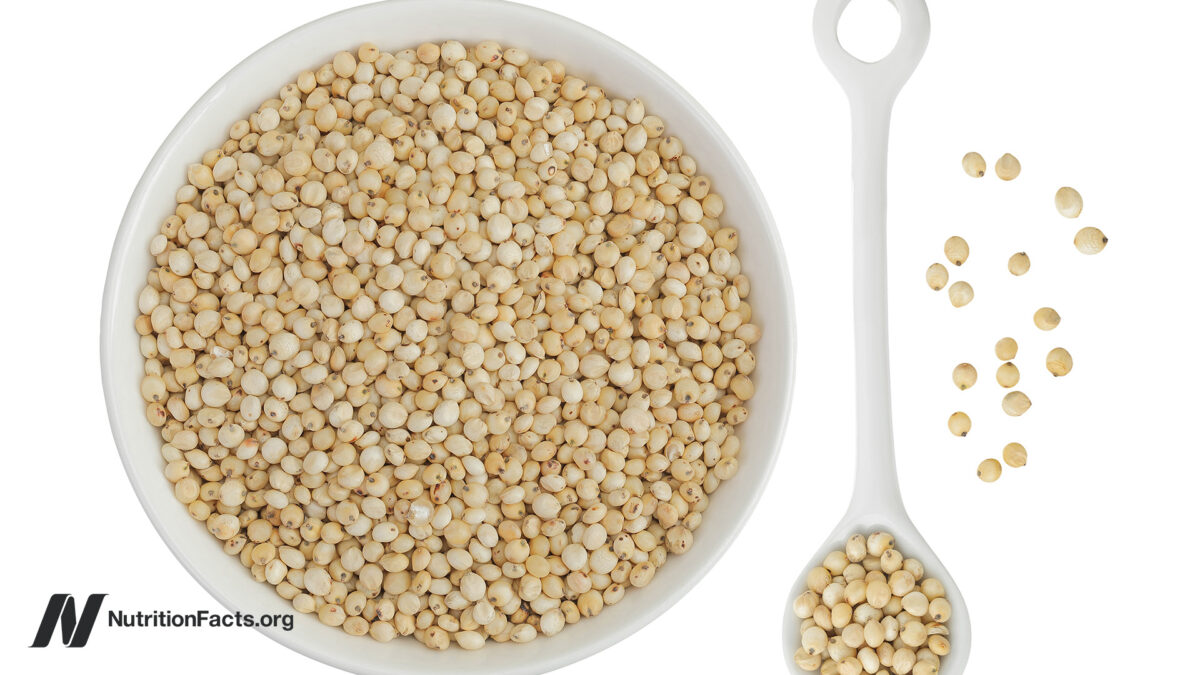
Tag: Sorghum

  • Why Is Sorghum One of My New Favorite Grains? 

    Why Is Sorghum One of My New Favorite Grains? 

    Learn why sorghum is one of my favorite new grains.

    “Despite playing a significant role in Africa and Asia as a staple grain, sorghum has only recently emerged as a potential human food source in the developed world.” And it isn’t just a principal grain in many parts of the world, but it’s “critical in folk medicine” traditions, too. What might its health benefits be? There are some in vitro data from test tubes and petri dishes, as well as in vivo data, meaning “within the living” in laboratory animals, but only in the last decade have we started seeing human trials.

    In one study, participants were asked to eat sorghum pancakes or corn pancakes for supper every day for three weeks. Both groups saw significant, 20 to 30 percent drops in their cholesterol, but all participants were also “requested not to consume eggs and other cholesterol-boosting foodstuff,” so that may very well have played a role.

    Another study used biscuits. Those eating sorghum biscuits said they felt more satiated than when they ate wheat biscuits, but that “did not translate to differences in intake at the subsequent ad-libitum [all-you-can-eat] meal.” So, does it matter that they subjectively felt more satiated if that did not cause them to eat any less? Unsurprisingly, when put to the test, those eating sorghum versus wheat biscuits didn’t lose any weight, though the data are a bit mixed. A recent study concluded that “sorghum can be an important strategy for weight loss in humans.” However, those in the sorghum group didn’t actually lose more weight. They did eat hundreds more calories a day, though, and they still lost more body fat, as you can see below and at 1:41 in my video The Health Benefits of Sorghum

    This may be because of their greater fiber consumption or intake of other goodies, like the resistant starch in sorghum. The vehicle the researchers used was an artificially flavored, colored, and sweetened powdered drink mixture of water, milk powder, and either sorghum or wheat flour. That may be good for a study since you can make a blinded control, but it leaves you wondering what would happen if you actually ate the whole food.

    The resistant starch is exciting, though. Most of the starch in sorghum is either slow-starch—that is, slowly digestible—or fully resistant to digestion in the small intestine, which offers a banquet bounty of prebiotics for our good gut flora down in our colon. Evidently, it isn’t the sorghum starch itself, but interactions with the proteins and other compounds that effectively act as starch blockers, inhibiting our starch-munching enzymes. Sorghum ends up with “the lowest starch digestibility” among grains, which is why, traditionally, it was considered to be an “inferior” grain—but inferior in the sense of not providing as many calories. (That’s a good thing in the age of epidemic obesity.) 

    When study participants were given either a whole-wheat muffin (the control) or a sorghum muffin, with both containing the same amount of starch, researchers saw significantly higher blood sugars 45 minutes to two hours after subjects ate the wheat muffin, as shown below and at 2:58 in my video.

    They also saw a higher insulin spike, starting almost immediately after consuming the wheat muffin, as seen below, and at 3:03.

    Overall, after consumption of the sorghum muffin, researchers found a 25 percent lower blood sugar response, and the participants’ bodies had to release less than half the insulin to deal with it, as seen here and at 3:11 in my video

    The same type of results were found with people with diabetes. Researchers saw a lower blood sugar spike with sorghum porridge compared to grits, and the participants’ bodies could deal with it with a fraction of the insulin. 

    So, we need to educate people on how healthy sorghum is—and, some suggest, “develop products that are…healthy, convenient to use, and tasty.” No need! Sorghum is already healthy, convenient, and tasty just the way it is. I just press a single button on my electric pressure cooker with two parts water and one part sorghum, and it’s ready in 20 minutes. You can make a big batch and use it all week just like you would rice. 

    Of course, there isn’t big money for the food industry when people eat the intact, whole grain. Instead, the industry is looking at sorghum for its “enormous potential for exploitation” in creating “functional foods and food additives.” (Did you know that adding sorghum to pork or turkey patties can decrease their “cardboardy flavor”? Why eat sorghum when you can instead use it to make gluten-free beer?) 

    It’s funny. When I wrote in How Not to Diet about taxpayer subsidies going to the sugar, corn syrup, oil, and livestock industries to subsidize cheap animal feed to help make Dollar Menu meat, I jokingly asked, “When was the last time you sat down to some sorghum?” Now that we know how good it is for us, maybe we should be taking advantage of the quarter billion dollars the United States is spending to prop up the sorghum industry and sit down to some sorghum after all.

    If you missed the previous video, check out Is Sorghum a Healthy Grain?

    My How Not to Diet Cookbook is full of delicious and healthful grain recipes. Check it out here.

    “Resistant starch”? Learn more about Resistant Starch and Colon Cancer and Getting Starch to Take the Path of Most Resistance

    For more on the benefits of different grains, see related posts below.


    Source link

  • Is Sorghum a Healthy Grain? 

    Is Sorghum a Healthy Grain? 

    How does sorghum compare with other grains in terms of protein, antioxidants, and micronutrients? And the benefits of red sorghum compared to black and white varieties?

    Sorghum is “the Forgotten Grain.” The United States is the top producer of sorghum, “but it is typically not used to produce food for American consumers.” Instead, it’s used mainly “to produce livestock feed, pet foods, household building materials…but it is a preferred grain for human diets in other parts of the world, such as Africa and Asia.” There, it’s been a staple and eaten for thousands of years, making it currently the fifth most popular grain grown after wheat, corn, rice, and barley, beating out oats and rye.

    Because sorghum is gluten-free and “can be definitively considered safe for consumption by people with celiac disease,” we’re starting to see it “increasingly used” as actual human food in the United States, so I decided to look into just how healthy it might be. As you can see below and at 0:59 in my video Is Sorghum a Healthy Grain?, it is comparable to other grains when it comes to protein. 

    Since when do we have to worry about getting enough protein, though? Fiber is what Americans are desperately deficient in, and sorghum does pull towards the front of the pack, as seen here and at 1:06 in my video.

    The micronutrient composition is relatively “unremarkable, relative to other cereal grains.” As shown below and at 1:15 in my video, you can see how it rates on minerals, for example. 

    Where sorghum shines is its polyphenol content. Polyphenols are plant compounds and “their regular consumption has been associated with a reduced risk of a number of chronic diseases, including cancer, cardiovascular disease (CVD), and neurodegenerative disorders.” It’s also been shown to have “a protective effect…on all-cause mortality.” If you compare different grains, sorghum really does pull ahead, helping to explain why its antioxidant power is so much higher, as seen here and at 1:40 in my video

    Now, sorghum gets its grainy butt kicked by fruits and vegetables, but when compared to other grains, a sorghum-based breakfast cereal, for example, might have about eight times the antioxidants than a whole wheat-based one. What we care about, though, isn’t antioxidant activity in a test tube, but antioxidant activity within our body.

    If you measure the antioxidant capacity of your blood after eating regular pasta, it goes up a little. If you replace 30 percent of the wheat flour with sorghum flour, it doesn’t go up much higher. But, if you eat 30 percent red sorghum flour pasta, the antioxidant capacity in your bloodstream shoots up about 15-fold, as seen below and at 2:22 in my video

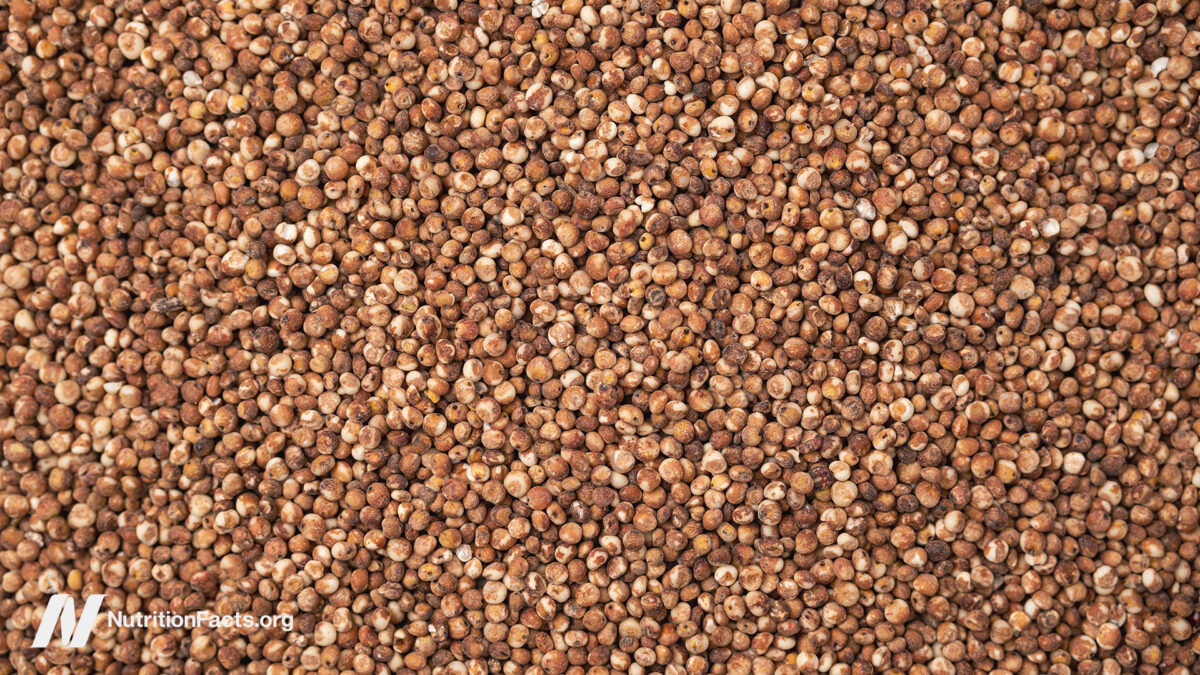
    Red sorghum? Yes. In fact, there are multiple types of sorghum—such as black sorghum, white sorghum, and red sorghum. Below and at 2:31 in my video is how they look in grain form (including yellow sorghum). 

    Red sorghum and especially black sorghum have extremely high antioxidant activity, comparable to fruits and vegetables, as seen here and at 2:41. 

    The problem is I can’t find any of the colored sorghum varieties. I can go online and buy red or black rice, purple, blue, or red popping corn, and purple or black barley, but red or black sorghum can be harder to find. White sorghum is widely available for about four dollars a pound, though. Does it have any “unique nutritional and health-promoting attributes”? It’s promoted as “An Underutilized Cereal Whole Grain with the Potential to Assist in the Prevention of Chronic Disease,” according to a study title, but what is the “effect of sorghum consumption on health outcomes”?

    As you can see below and at 3:20 in my video, an epidemiological study in China found lower esophageal cancer mortality rates in areas where more millet and sorghum were eaten, compared to corn and wheat, but that may have been due more to avoiding fungal contamination of corn than from any benefit of sorghum itself. Though, it’s possible. “Oats are the only source of avenanthramides,” which give oats some unique health benefits. Similarly, sorghum, even white sorghum, contains unique pigments known as 3-deoxyanthocyanins, which are strong inducers of some of the detoxifying enzymes in our liver and can inhibit the growth of human cancer cells growing in a petri dish, compared to red cabbage, for instance, which just has regular anthocyanin pigments. White sorghum didn’t do much worse than red or black varieties, which have way more of the unique 3-deoxyanthocyanins, so it may just be a general sorghum effect. You don’t know until you put it to the test.

    Researchers found that sorghum suppresses tumor growth and metastasis in human breast cancer xenografts. What does that mean? They concluded that sorghum could be used as “an inexpensive natural cancer therapy, without any side effects. We strongly recommend the use of [sorghum] as an edible therapeutic agent as it possesses tumor suppression, migration inhibition, and anti-metastatic effects on breast cancer” for humans. However, xenograft means human breast cancer implanted in a mouse. Yes, the human tumors grew more slowly in the mice-fed sorghum extracts and blocked metastasis to the lung. Yes, sorghum did the same for human colon cancer that, again, was in mice, but that can’t necessarily be translated to how human cancers would grow in humans, since not only do these mice not have a human immune system, they hardly have any immune system at all. They’re bred without a thymus gland, which is where cancer-fighting immunity largely originates. I mean, how else could you keep the mouse’s immune system from rejecting the human tissue outright? But this immunosuppression makes these kinds of mouse models that much more artificial—and that much more difficult to extrapolate to humans.

    And that’s a lot of what we see in the sorghum literature—in vitro data from test tubes and petri dishes, and data from rats and mice. There has been “a critical missing piece of the puzzle” needed to link laboratory data to actual benefits in humans. Missing, that is, until now. Thankfully, we now have human interventional studies, which we’ll explore next.

    Stay tuned for The Health Benefits of Sorghum.

    Should we all be seeking gluten-free grains? See related posts below. 


    Source link