Summary
What Is a Body Scan Meditation? A guided practice where attention is systematically moved through different parts of the body to release tension and increase awareness.
Benefits for Sleep:
- Improves sleep quality, especially among those with sleep disturbances
- Reduces physical tension that may prevent falling asleep
- Calms the nervous system and reduces stress
- Helps disconnect from mental activity that keeps the mind active
Research Findings: Clinical trials from UCLA found that mindfulness meditation improves sleep quality among older adults with sleep disturbances.
Practice Application: Can be done lying down in bed as preparation for sleep, helping transition from wakefulness to restfulness.
The Science of Sleeping Better with Mindfulness
A good night’s sleep has a significant impact on our health—helping us feel more energized, less stressed, and able to perform better mentally. Unfortunately, according to a 2024 poll, many people struggle to get a full night’s rest, with 57% of Americans reporting that they would feel better if they got more sleep.
If you’re the kind of person who finds themselves wide awake at 3 a.m. contemplating the shadows on their ceiling, practicing mindfulness may offer the secret to sleeping better. A randomized clinical trial from UCLA found that mindfulness meditation improves sleep quality among older adults with sleep disturbances. The following guided meditation was used in that study to help people fall asleep. May it do the same for you.
We’ll be noticing these sensations without trying to change them or make them different, simply bringing a mindful attention of curiosity and openness to the present moment.
During this guided body scan meditation you may find yourself drifting off to sleep. This is fine, so you can allow the meditation to turn off on its own. If you notice thoughts such as worries or concerns arising that take your attention away from the meditation, this is also normal. See if you can redirect your attention back to the body scan, gently letting go of these thoughts.
If it’s possible, we’ll be noticing our body lying down on the bed. We’ll be feeling the body’s sensations that are present, scanning the body for any kinds of obvious sensations like vibrations, tingling sensations, heaviness, pressure, movement, heat, coolness. We’ll be noticing these sensations without trying to change them or make them different, simply bringing a mindful attention of curiosity and openness to the present moment. If you notice yourself starting to think about the sensation or think about something else, see if you can simply come back to the feelings and sensations present in your body.
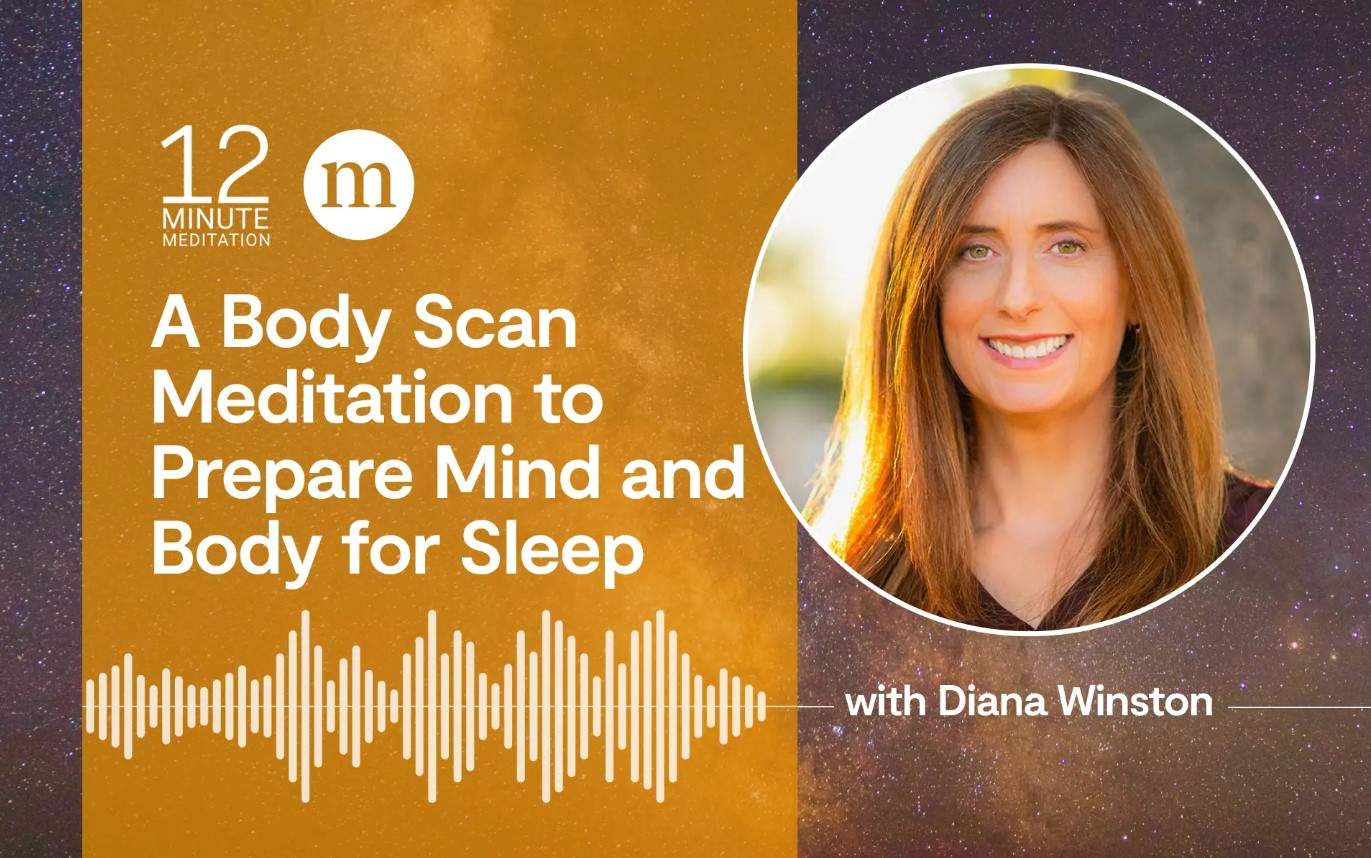
A Body Scan Meditation to Prepare Mind and Body for Sleep
1. Begin the meditation by noticing the sensations at the top of your head. Simply note what you feel. You might notice vibration or pressure.
2. Focus your attention on your skull as it makes contact with the bed or the pillow. There might be a sense of pressure or other sensations. Simply be curious about these sensations.
3. If you can, allow any tension you feel to gently release. If that doesn’t seem possible, simply notice what it is that you feel.
4. Scan your face area, forehead, eyes, and nose. Notice your cheeks and mouth. There may be sensations of tingling, temperature, tightness; let it all be there. Be curious about your experience, and begin to notice the sensations in your throat.
5. Now bring your attention to the sensations present in your shoulder area. Notice any tension arising. Sometimes in the act of noticing tension, you may find yourself relaxing. If that’s not possible, you can breathe gently, directing the breath to your shoulders.
6. Notice the sensations in your left shoulder, and then bring your attention down your arm. Notice any vibration, tingling, coolness, pressure, or movement in your elbow, your lower arm, and then your hand. Be curious and open to the sensations that are present in your hands and fingers. Allow your hands to soften and relax.
7. Now, bring your attention up to your right shoulder, noticing any sensations that might be present. Start to scan your right arm for vibration, tingling, or movement. Notice your elbow, your forearm, your hands, and fingers. A lot of sensations are usually present in the hands and fingers. But if at any point there’s no sensation, just notice the absence of sensation.
8. Let your attention go to the top of your shoulders and to your back. Imagine a zigzag sensation or an up-and-down movement across your back. Can you be open and curious to whatever the experience is? Be kind to yourself no matter what comes up.
9. Notice your upper back, your mid-back, and the sensations in your lower back. If thoughts arise as you’re doing this—worries, concerns—see if you can let them go. Let them be like clouds floating in the sky, moving across your mind. Or, come back to my words and this body scan.
10. Bring your attention to the top of the chest area. Gently scan your chest, your rib cage, and your stomach. See if you can soften your stomach. Breathe deeply while directing the breath to that area—allowing it to soften and relax.
11. Now, notice your pelvic area and the places where your body has contact with the bed. Feel whatever sensations are present. Gently bring your attention to your left hip and down your left leg. Notice the sensations in your thigh.
12. Bring this kind and curious attention to your leg, your knee, and your left calf. Notice whatever sensations are present: vibration, tingling, itching, warmth, coolness, heaviness. Then bring your attention to your ankle, left foot, and toes.
13. Now, notice the sensations in your right hip. And again, bring your attention down to your right thigh. You can circle your attention on your right leg or notice it in any other way that makes sense to you. Feel any vibration, tingling, temperature, heaviness, or movement in your knee and calf. Scan your leg down to your right ankle and toes.
14. Now that you’ve scanned your body, you’re welcome to start again. This time, you can start at your feet and go back up through your body until you get to the top of your head. Feel free to scan your body up and down as many times as it is helpful to you.
The Ultimate Guide to Mindfulness for Sleep
Sufficient sleep heals our bodies and minds, but for many reasons sleep doesn’t always come easily. Mindfulness practices and habits can help us fall asleep and stay asleep. Consult our guide to find tips for meditation, movement, and mindfulness practices to ease into sleep.
Read More