Sometimes happiness might seem like a stretch—for us and even for our children. The stresses of daily life, getting out the door in the morning, managing a household, coordinating schedules, as well as the bigger issues, including concern about the struggles in the world, can all take a toll on us as adults. Given the increasing issues with children’s mental health, we know it’s taking a toll on our children as well.
And yet, amid difficulties, happiness is still attainable and essential to well-being and resilience. Research on adult well-being shows that there are specific steps we can take to develop and nurture happiness.
As James Baraz writes, joy is “a general feeling of aliveness and well-being that is characterized by meeting ups and downs in life with authenticity and perspective.”
Based on our work with children, we know this is true for them, as well. It can be as simple as enjoying a hug, being mesmerized by a ladybug, or giggling at the shape of a cloud. These simple pleasures can be little moments of joy for our children and for us—and they can be a part of raising happy children who are resilient, even in the middle of normal ups and downs.
Not Denying Difficulty, But Opening to Possibility
When we talk about raising happy children, we are not talking about “happiness” as the fleeting emotion that is a response to good or fun things. We are not suggesting pushing difficulties aside, but instead developing the capacity to hold them alongside our well-being. As James Baraz writes in Awakening Joy, joy is “a general feeling of aliveness and well-being that is characterized by meeting ups and downs in life with authenticity and perspective.”
We envision a happy child as one with a developing sense of ease with themselves, one who often sees and enjoys the good around them and within themselves.
Happiness is not a destination or something to be achieved, but rather what Chang Meng Tan, author of Search Inside Yourself, defines as “a deep sense of flourishing that arises from an exceptionally healthy mind.”
We envision a happy child as one with a developing sense of ease with themselves, one who often sees and enjoys the good around them and within themselves.
Research by the Center for Healthy Minds shows that well-being is a learnable skill. There are multiple evidence-based perspectives offering practical ideas for cultivating happiness.
In particular, The Resilience Project by Hugh Van Cuylenburg focuses on gratitude, empathy, and mindfulness to support resilience and happiness. The Action for Happiness Project has a similar focus and lists mindfulness, gratitude, and kindness as core skills. In Hardwiring Happiness, Rick Hanson adds to this list and stresses the importance of inclining the mind, or being on the lookout, for happiness and then taking it in.
Raising Happy Children Starts by Building Well-Being Skills Together
Here are three fun activities based on these frameworks to try with your child.
Inclining The Mind And Taking It In Practice: Glimmer Wand
Glimmers, coined by Deb Dana, are little moments of peace, safety, and happiness.
Cut out, decorate, and glue a star on top of a popsicle or other stick. You can write “catching glimmers” on the star. Share about glimmers and use the wand to “cast a spell” to notice and enjoy glimmers that day. You can also wave it overhead as people share their glimmers and how they make them feel.
The brain has a negativity bias. By pausing to seek out glimmers, we can train our brains to notice and savor delight more often.
Gratitude Practice: Gratitude Sandwich
Children can draw and cut out pictures of five things or people they are grateful for as their sandwich fillings.
Cut two pieces of paper for the sandwich bread.
Glue one piece of the “bread“ to the top and one to the bottom of a poster.
Paste the fillings between the bread (or Velcro so it’s interchangeable).
Write Gratitude Sandwich and “I am grateful for…” on the “bread.”
Leave the sandwich somewhere visible and use it as a conversation starter about gratitude.
Dr. Robert Emmons at UC Davis found that feeling gratitude can move our nervous system out of the stress response. Giving children a visual link to things that foster feelings of gratitude can help strengthen the body-brain connection and develop positive neural pathways.
Cultivating happiness can be quite simple if we focus on it, even when things are hard. Pausing to notice and take in the good, feeling gratitude, and connecting with others with empathy and kindness in the tiny moments of our day can make a genuine difference.
Connection Practice: Links of Love
Have the child think about five people who make them feel loved or happy.
String a bead for each person onto a pipe cleaner.
Twist the ends together so the beads don’t fall off. These are links of love.
Have them touch one bead at a time and remember the special person.
Take a breath in, taking in their love, and out, offering love back to them.
Encourage them to notice how they feel. The links of love can be attached to a backpack, worn around a wrist, or left in a visible location.
Especially when a child feels lonely or insecure, having a physical anchor can remind them that they are worthy and loved.
Tuning Attention Towards Happiness
Cultivating happiness can be quite simple if we focus on it, even when things are hard. Pausing to notice and take in the good, feeling gratitude, and connecting with others with empathy and kindness in the tiny moments of our day can make a genuine difference.
Fun, hands-on activities, like those above, can help both adults and children lean into happiness and create space for more joy in our lives.
Would you like more support building habits of well-being and resilience in your child? Try our new card deck, available April 21. Let’s Grow Happiness includes 50 activity cards to help kids build gratitude, self-compassion, and emotional regulation skills.
While the challenges of mindfulness practices are real, research confirms that mindfulness can also be helpful in preventing relapses into depression and reduce healthcare visits.
The challenges of mindfulness are real. The truth is, meditation is not all calm and peace. Mental material can come up that can be uncomfortable or need to be addressed.
Britton spoke generally with Mindful about how mindfulness has been marketed in this country as a “warm bath,” when in actuality, you have to deal with whatever comes up in the mind.
“A lot of psychological material is going to come up and be processed. Old resentments, wounds, that kind of thing,” says Britton, “But also some traumatic material if people have a trauma history, it can come up and need additional support or even therapy.”
Halliwell asks: “Does something beneficial have to be delivered perfectly—and to bring about a perfect world—before we will accept it as worthwhile?”
Ed Halliwell, mindfulness teacher and author of The Mindful Manifesto, admits that meditation can be an emotional rollercoaster. “Mindfulness has a great many benefits,” Halliwell writes, but he takes issue with mindfulness being touted as a cure-all. At the same time, there’s an all-or-nothing mentality brewing around the adoption of mindfulness practices, and Halliwell asks: “Does something beneficial have to be delivered perfectly—and to bring about a perfect world—before we will accept it as worthwhile?”
Elisha Goldstein, clinical psychologist and mindfulness teacher, noted that it’s not a question of whether mindfulness is harmful or not. When we’re assessing the challenges of mindfulness practices, the better question is where you’re getting that mindfulness training from. “It comes down to an education on mindfulness (and a variety of factors that it represents) and finding an experienced teacher as a guide to meet the practitioner where they are at.”
Research is ongoing
Research on mindfulness and depression is still preliminary, but there are promising indicators.
Scientific Americansurveyed findings and some of the key controversies regarding the application of mindfulness for depression and anxiety, and concluded:
When it comes to treating diagnosed mental disorders, the evidence that mindfulness helps is mixed, with the strongest data pointing toward its ability to reduce clinical depression and prevent relapses.
In particular, new research has emerged indicating that an 8-week mindfulness-based cognitive therapy (MBCT) program might reduce the risk of relapses into depression. Study authors identified that mindfulness helped in the following ways:
MBCT allowed people to be more intentionally aware of the present moment, which gave them space to pause before reacting automatically to others.
Bringing mindful awareness to uncomfortable experiences helped people to approach situations that they would previously avoid, which fostered self-confidence and assertiveness.
Study participants also described having more energy, feeling less overwhelmed by negative emotion, and being in a better position to cope with and support others.
Another piece of research reported that frequent health service users who received MBCT therapy showed a significant reduction in non-mental health care visits over a one-year period.
“We speculate that mindfulness-based cognitive therapy has elements that could help people who are high health-care utilizers manage their distress without needing to go to a doctor,” says Dr. Paul Kurdyak, lead author and Director of Health Systems Research at Centre for Addiction and Mental Health (CAMH) and Lead of the Mental Health and Addictions Research Program at the Institute for Clinical Evaluative Sciences (ICES).
You’re sitting around the dinner table with your family after a long day. Homework is scattered across one end, someone’s still chewing the last bite of dinner, and you ask the question…
Without even looking up, your oldest mumbles something about video games. Your youngest shrugs. The silence stretches just long enough to feel awkward before someone asks to be excused.
Children need to see gratitude in action to really grasp the idea. They need to experience it with us. Only then does gratitude become realfor our kids—when we live it together.
We can’t expect our children to understand gratitude just because we ask them about it. The question itself falls flat because it’s abstract and repetitive. Kids end up saying the same things over and over (“my family,” “our house,” and “my dog”), and what could be a meaningful practice becomes just another item to check off before leaving the table.
Children need to see gratitude in action to really grasp the idea. They need to experience it with us. Only then does gratitude become realfor our kids—when we live it together.
Why Starting Family Gratitude Practices Early Matters
There’s something powerful about introducing gratitude when children are young. Their minds are like sponges, absorbing everything around them—the good, the challenging, and everything in between. When we weave gratitude into their early years, we’re creating neural pathways that support resilience and emotional well-being throughout their lives.
Early gratitude practice can shape how children see the world. It teaches them to notice the good alongside the hard, to appreciate the helpers in their lives, and to find joy in small moments. Research shows that gratitude contributes substantially to individual well-being, strengthens relationships, and helps people navigate adversity with greater resilience.
And children are naturally receptive to new practices. While adults might struggle to shift ingrained patterns of thinking, kids can more easily develop habits that become second nature, especially when those activities are fun, engaging, and done together as a family.
The Power of Practicing Gratitude Together
Kids learn by watching us. When we model appreciation (not just talking about it but actually living it) our children see what gratitude looks like in real life. Practicing gratitude together means actively engaging with each other, noticing the good in our lives, and celebrating it as a family.
By doing so, we’re building individual resilience in each family member while simultaneously deepening our relationships with one another. We develop a shared language of appreciation that helps our family navigate challenges, stress, and uncertainty as a team.
The good news? This change doesn’t require hours of practice or complicated strategies. It just requires showing up together with intention and a willingness to notice the good.
7 Creative Family Gratitude Practices
So how do we move beyond the abstract question of “What are you grateful for?”and into practices that actually resonate with kids? The key is making gratitude something families do together rather than just talk about.
Look for practices that are:
Part of daily life: Focus on real people, moments, and experiences that fill your days.
Concrete and tangible: Kids can see, touch, or create something related to their gratitude.
Fun and engaging: When practices feel playful, children (and parents!) want to do them.
Quick and simple: Keep it to five minutes or less, because who has endless time?
Varied and interesting: Different practices keep gratitude fresh and exciting.
Each of the following seven practices focus on a different aspect of appreciation, from celebrating the people in our lives to noticing everyday comforts we often overlook. Try one that resonates with your family or rotate through them to mix things up!
1. Family Appreciation Photo Walk
Take a brief weekly walk together where each family member takes “mental photos” of things that remind them of someone they love. Maybe a certain flower reminds your daughter of Grandma’s garden, or a basketball hoop makes your son think of his best friend. As you walk, use your hands like a camera viewfinder and say, “Click!” to capture the moment in your mind. When you return home or gather for dinner, share your mental photos and explain the connections.
Tip: Want to extend the practice? Bring a real camera along so you can capture and share actual photos later, talking about why each image reminded you of someone special.
2. Helper Hero Cards
Invite your kids to create simple thank-you cards for people who helped them during the week. These might be teachers, bus drivers, siblings, neighbors, or anyone who lent a hand. Include drawings, stickers, or just a few heartfelt words. Then deliver them together. This practice makes gratitude tangible and teaches children to notice helpful actions in their daily lives.
Tip: Keep a stack of blank cards or paper readily available so kids can create these spontaneously in the moment when a feeling of gratitude strikes.
3. Mirror Moments
This thirty-second daily practice is simple but powerful. Have your child look in the mirror and say one thing they’re proud of about themselves. It might be, “I was kind to my sister today” or, “I tried really hard in soccer practice.” The key? Parents should model this, too. Kids love (and need) to see adults appreciate themselves. This builds self-compassion, self-esteem, and confidence—for the whole family.
Tip: Make it part of your family’s routine by doing it right before or after everyone brushes their teeth in the morning or at bedtime.
4. Memory Jar Magic
Keep a jar in a common area of your home along with small pieces of paper and pens. Encourage family members to write down a favorite moment and drop it in the jar each day. These might be big moments (“Dad came to my recital!”) or tiny ones (“The dog made a funny face”). On tough weeks or at the end of each month, read them together and re-live the joy. This creates anticipation for good moments and helps families hold on to happiness during stressful times.
Tip: Decorate your jar together to make it special or use different colored papers for each family member.
Make it a family practice to genuinely acknowledge and thank the community helpers you encounter during your regular routines. When you’re out running errands together, pause to thank the grocery store cashier, wave to the mail carrier, or say good morning to the crossing guard. The key is doing this together as a family so kids see you modeling appreciation and learn that gratitude can be woven into everyday moments. At dinner, share who you thanked that day and why their work matters.
Tip: Challenge younger kids to remember one helper they want to thank on your next outing. Make it a game to spot and appreciate people who make your community work.
6. Nature Gratitude Ritual
Step outside together into your backyard or a nearby park, or even just look out a window. Each person should try to find one thing in nature they appreciate right now. Maybe it’s the way sunlight filters through leaves, a bird’s song, or the smell of fresh air. Share your discoveries without phones or distractions. Stay fully present with each other and the natural world. This practice works in any season and any weather!
Tip: Younger children might enjoy collecting their gratitude finds (a special rock, interesting leaf, or pinecone) to keep as a reminder of their appreciation for nature.
7. Gratitude Detective Game
Turn gratitude into a playful detective game where everyone searches for everyday things we usually overlook. Challenge your family: “I spy with my grateful eye… something that keeps us warm!” (blankets, the heater, or cozy sweaters). Take turns being the detective who gives clues about everyday comforts while others guess. Play during dinner, car rides, or before bed. This helps families appreciate the invisible infrastructure of daily life, such as running water, electricity, safe roads, and working appliances—in a fun, engaging way.
Tip: Keep score if your kids are competitive or make it collaborative by seeing how many “gratitude clues” your family can come up with together in five minutes.
Starting Your Family’s Gratitude Journey
Building gratitude practices when children are young gives them tools for lifelong resilience and emotional well-being. It shows them how to notice goodness even during challenging times, how to appreciate the people and moments that make life rich, and how to stay connected to what matters most.
When families practice gratitude together, we create shared experiences that strengthen our bonds and help us navigate life’s inevitable ups and downs as a team. Remember, the goal here is connection, not perfection. You don’t need to do all seven practices, or even multiple practices. Even one practice done regularly makes a real difference.
Start with whichever one resonates most with your family right now. Try it for a week or two and see what happens! Through this simple act of practicing gratitude together, you’re shaping how your children see the world. That perspective will serve them throughout their entire lives!
1) Begin with Gratitude for Your Body—Elaine Smookler
Some days I wake up and notice that my spring has already sprung and each movement has a kind of creaking quality. After years of practicing mindfulness, it makes me smile. Whatever experience I’m having—good, bad, pleasant, unpleasant—I will never pass this way again.
This is an invitation to explore the experience of the present moment in all its gory glory. You can do this practice sitting, standing, upside down or whatever way you find the present moment.
Let’s start by taking three nice big breaths. Breathe in for a count of three and out for a count of five. Do you notice? You’re alive. It’s actually kind of amazing. Can you bring your attention to the jaw-dropping wonder that is the human body?
Let’s start with the toes, bringing attention to your feet touching the ground. You may be amazed by how many sensations there are to experience, whether it’s tingling, pulsing, restlessness, hot, cool, moist, dry, ticklish, itchy, numb, neutral. What do you notice about paying attention to these small experiences? Is it possible that they could help you cultivate gratitude for this body that’s going to accompany you through your life?
As you move up the legs, what do you feel? Whenever I feel anything uncomfortable, I notice how much I want to make meaning out of it. Instead, I invite us all to just feel what’s here without making any meaning of it at all. It’s all so interesting. So this is what’s happening now.
Moving up the land of pelvis, I notice clenching the moment I go to explore sensations in my bladder. Do I dare? Again, reminding myself that it’s not about trying to relax or make anything easier or better. I use these moments of awareness to widen the palette of colors available to experience what it is to be a human. When you do this, what do you notice?
Continuing the journey up the body, eventually we encounter the beautiful belly filled with so many stories. Loss, longing, yearning, wanting. Can you be grateful for all that it’s experienced and send it love and appreciation?
Moving up through the torso, this luscious landscape which houses heart and lungs, you may picture an inner river pumping and flowing, bringing juicy life through the body.
When you reach your shoulders, you can lay gentle hands on yourself, massaging some of the day’s stress away. Taking a moment to be grateful for all that our shoulders shoulder. Swooping down through arms to fingers, I thank them for allowing me to be independent in so many ways. Can you offer appreciation to your hands and arms that work so hard?
We visit the neck and face. Are lips dry or moist? Are your teeth clenched? What about the jaw? Can you feel the air moving in and out of your nostrils? Can you notice your eyeballs, top of head, back of head, side of head, and ears?
On an out-breath, let go of focused awareness. On an in-breath, expand your attention around the entire body, noticing all the sensations reminding you that you are alive right now. What do you notice when you bring the spirit of gratitude into every precious moment that you and your body share together?
2) Allow Gratitude to Connect You to All Living Things—Shauna Shapiro
Mindfulness, self-compassion, gratitude, and the practices that emerge from them help free us from the prison of isolation and the delusion of separation. These practices open our minds, awaken our hearts, and deepen our sense of connection with ourselves, each other, and our world. We begin to realize that we are never just practicing for ourselves. Transforming ourselves creates echoes in the universe, because as we heal ourselves, we heal each other, and our world. As renowned author Arianna Huffington beautifully puts it, “Living in a state of gratitude is the gateway to grace.”
Begin by settling the mind and body, taking a seat on a chair, on the floor, or wherever you can sit comfortably upright. Allow a soft smile to rest on your lips, not as a way to paper over how you are feeling, but simply to invite in rest and ease.
Bring your awareness to the simple sensations of breathing. Feel how the breath is supporting you, oxygenating the body with each inhale, releasing stress and toxins with each exhale. Begin to sense the beating of your heart. Become aware of how the heart is supporting you, sending blood carrying oxygen and nutrients to all the trillions of cells in your body. Invite in a feeling of gratitude and kindness toward your breath, your heart, your body.
Begin to feel your body in your seat, and let your awareness expand to include the earth below you, supporting you. Allow yourself to rest into the Earth, to feel held by the Earth. Feel how there is nothing more you need to do in this moment.
Reflect on how the Earth is supporting all beings equally, and that gravity is keeping all beings tethered to the Earth. Reflect on how this planet is connected to a solar system and a vast universe. And that all things—all humans, all animals, the Earth, the sun, and the stars—are composed of the same matter, the same basic particles. We are literally all made of stardust.
Feel the web of life into which we are born, from which we can never fall. Feel how you are part of this web. Nothing is separate.
Feel yourself resting with gratitude in the heart of the universe. Begin to send your good wishes to all beings, gently and silently repeating, “May all beings be peaceful. May all beings be safe and protected. May all beings be happy. May all beings be filled with love and kindness.”
And then recognize that you are contained within the good wishes for all beings. Rest your attention once again on this one being sitting here, and silently direct the good wishes to yourself: “May I be peaceful. May I be safe and protected. May I be happy. May I be filled with love and kindness.”
As you breathe in, you are breathing in this loving-kindness, and as you breathe out, you are sending this loving-kindness out. May all beings here and everywhere dwell with peace. May the Earth dwell in peace. And close by offering: May this practice be of benefit for all beings.
3) Awaken the Flow of Gratitude in Nature—Georgina Miranda
Regardless of where I am experiencing nature—at a local city park, perched up high on mountain tops, or swimming in the sea—I’ve found it is always a good time to pause and be present with the gratitude I feel for our inherent connectedness to nature. Our breath is an anchor that can always bring us home. A few deep breaths, connecting with the space we are in, bring home a knowing that there is no separation between us. We need our Grand Mother, the Earth—her air to fill our lungs, her living things to feed us, her awe to keep our souls warm. She needs us too—to look after her, to shift our day-to-day ways of living, to treat her as one of our dearest friends.
Next time you are in nature, see if you can shift from a state of doing into a state of being. The key difference between exercise and movement is that when you move with the intention of exercise, you quickly enter a state of doing. Movement is free-flowing and allows you to enter a state of being. The benefits are vast when you allow yourself to be one with the nature you choose, connecting and moving with gratitude.
Give yourself permission to be. Go into nature without an agenda or expectations and just to be with it and move with it. If you are struggling with stress, anxiety, depression, or sluggishness, let movement outside help ignite an internal shift.
Breathe and pay attention. Bring all the attention to your breath, its rhythm, its ability to inspire a reset with each inhale and exhale. Notice the air you are breathing in, the smells, the temperature, the freshness. Let each inhale be an opportunity to connect you deeper with the nature you are in. Let each exhale be an opportunity to let go of anything that is not needed at this moment.
Breathe and feel deeper. When you’re connected to your breath, what else do you feel? As you take each step, what flows through your body? How does the sun, wind, snow, or rain feel on your skin? What can you hear? While you notice each breath you take, can you start to unite with the space you are in, versus be separate from it? Can you notice you are one with the earth, the air, the water, around you?
Breathe and open up to gratitude. Look around, and while staying connected to your breath, let your heart open to any gratitude that’s arising in this moment. Gratitude for the pause in the busyness of life and existence…to your body for its willingness to move freely…to this natural setting and the natural gifts from Mother Earth to you…for this moment of well-being…for knowing that this type of movement, state of awareness, and pause all in one is always available to you.
Surrender. Surrender completely with the help of the beautiful nature around you. Become one with it, one with your breath. Just be and soak in the feeling of liberation that can come from the present moment.
4) Counteract Resentment—Barry Boyce
To begin this gratitude practice, I’d like to start by considering one of the biggest obstacles to gratitude: resentment. We can dress up our resentment with a sophisticated storyline about how others—one, or many, or multitudes—are doing us wrong, but what it simply boils down to is being upset because we’re not getting what we want.
The world is too complex and multifaceted for us to continually get our way. It’s good to aspire for the best for ourselves and others, while nonetheless remaining committed to the journey more than the satisfaction of achieving a fixed outcome. If everyone gets their way, we can’t have a cooperative world. From time to time, we need to undercut our own perspective and see things from the other side—maybe even from all sides. Gratitude is a practice that can work with the tendency to cling to fixed outcomes and to feel resentful when we don’t get our way.
Bring to mind something that seems unlikely to change and that you do not accept. Perhaps it’s something that’s happened to you or it’s something that’s going on with a loved one or in the world at large. It can be big or small.
Counter-intuitively say thank you for that. You’re not being thankful for the thing itself, you’re being thankful for the opportunity to let go. To accept how things unfold doesn’t mean we condone bad behavior or indulge in pessimism or martyrdom. Rather, the point is to use gratitude to undercut our resistance to working creatively with difficult situations.
For about 3 minutes, keep imagining things you resent, that you’re irritated about, things that you have trouble accepting or allowing.Try having an attitude that says, “Thank you for the opportunity to work with this.” When we open to deep gratitude for the opportunity to let go of our grasping to outcomes, we can foster a kind of embryonic openness that can lead to other more outward kinds of gratitude.
In this next step, let’s be grateful in concentric circles, moving out from our immediate situation, with prompts like the following: I’m grateful to have the necessities of life. I’m grateful to have people to love and to share love with. I’m grateful for friends and the companionship they offer. I’m grateful for the people who serve my needs, who pick up the garbage, take care of the roads, or fix my bicycle. I’m grateful for the people who provide energy and take care of the vast infrastructure that supports society and life. Thank you to the people who sell me food. I’m grateful to health care workers. I’m grateful to the people who are dedicated to keeping me safe. Finally, I’m grateful for the need to encounter those who mean harm, who are tormented by mental and physical pain that causes them to act badly or even violently. While I do not condone purposefully harmful actions, I am grateful that there is a spark of compassion available for those who do harm, and for all of us when we do harm, and the possibility of beneficial change emerging in time. Thank you very much. I’m grateful to share this with you.
5) Nurture a Felt Sense of Gratitude—Gina Rollo White
In this practice, we will be connecting ideas and thoughts with bodily sensations. I’ll walk you through all of it. Follow along and do what works for you.
Choose a posture that’s comfortable for you: standing, sitting, or lying down. If you want to close your eyes, you can. Know that at any point, if you feel uncomfortable, you can always open them. If you are standing, sometimes closing your eyes can make you a little wobbly, so you can open them, adjust, and close them again.
Before we begin, take a nice big inhale. So inhale…and exhale. In this practice, we will be connecting ideas and thoughts with bodily sensations. I’ll walk you through all of it. Follow along and do what works for you.
Begin by noticing the length of your body. Just noticing the entire length of your body, from your feet all the way up to the top of your head. And bring to mind this idea of length, but also this idea of strength and pride. Feel yourself, standing tall or lengthening long, and connect with the sensation of your feet all the way up to the top of your head, so the entire length of your body is connected with the idea of strength and pride and length.
Now we’ll move to the back of our body. See if you can imagine what the back of your body looks like—the back of your head, your back, your seat, the back of your feet—and connect that with the idea of the past. Everything that’s behind you, your entire past, is connected with the backs of your shoulder blades, your seat. Maybe you can notice the space in between your shirt and your body, or the space in between your shoulder blades. Just bring to mind the back of your body, and connect it with the past.
Next, we move to the sides of our body. See if you can imagine the sides of your body from shoulder to shoulder, hip to hip, outside edges of your feet, maybe ear to ear. Think of that as connecting with the outside world, connecting with community. Even raise your arms up and see if you can create a little circle around yourself. Connect the sides of your body with this idea of protecting yourself, so you can create boundaries. But also, if you can, open up and reach your arms really wide, reaching out to your community, to those around you. Notice how you can reach really far and feel connected with those around you, but also create the safety of boundaries, connecting with the sides of your body, your shoulders, your hips, the outside of your feet.
Take a moment to continue connecting with community by sending thoughts of love and kindness and gratitude toward others. Bring to mind someone or something, maybe a pet, that you have an uncomplicated relationship with, who you feel safe with. As you bring to mind someone who creates safety or something that creates safety, imagine sending these words to them: May you feel love and kindness. May you feel safe and secure. May you feel healthy and strong.
And now, broaden those kind thoughts to your inner circle or your local community or neighborhood. Bringing to mind your community, send thoughts of love and gratitude: May you feel love and kindness. Imagining. All those people. May you feel safe and secure.
Continue opening your arms and your circle of love and gratitude. Broadening your arms even more, maybe continuing it out to your nation, to your continent. Imagine all the people and beings on your continent, and then even further out, to the entire world: May you all feel love and kindness. May everyone, every being, every animal feel safe and secure. May you all feel healthy and strong.
And now, bring your arms in closer to your body. Making that circle smaller and smaller, you can come back to our neighborhood, your community, all the way back to that first person or animal that makes you feel safe and secure. Connect with the outside of your body, the outside of your feet, your hips and shoulders.
Bring your focus now to your internal world. What’s occurring inside of your body? Notice your heartbeat, your stomach digesting, your lungs as you inhale and exhale. Connect that with the idea of present-moment awareness. What’s occurring right now, in this moment? Your breath. Your heartbeat. And also yourself, connecting your awareness with all that you are. Take a moment to send yourself gratitude and love and kindness. If it’s available to you, put your hands over your heart.
Think to yourself as you’re standing here in this present moment: May I feel love and kindness. May I feel safe and secure. May I be healthy and strong. May I be happy. Place your hands by your side, and move from the internal once again to the external. From the front of your body, the tips of your toes to your belly, to the outside of your chest, the outside of your shoulders, your face. Connect the front of your body with the idea of forward movement, and with the idea of all that is before you.
Picture your entire body, connecting all the parts. The front of your body, the sides of your body, the back of your body, internal head to toe. Bringing it all into one thought, one image, and take a moment to send yourself some gratitude. You might say to yourself, Great job. Great job for practicing today. Maybe even put your hands over your heart again and saying, Thank you.
Place your arms by your side, and then if you can, as you inhale, reach your arms up really high, all the way up. As you exhale, lower your arms. If your eyes were closed, you can open them. Just take a moment to look around and take in the colors, the sights, maybe even the sounds.
Get curious about what you feel right now. What is the quality you feel right now? And then as you close this practice, give yourself one final moment of gratitude, saying to yourself, Thank you. Great job.
Practicing gratitude has incredible effects, from improving our mental health to boosting our relationships with others. Explore ways you can be more appreciative in our mindful guide to gratitude. Read More
Research shows gratitude isn’t just a pleasant feeling—being grateful can also support greater health, happiness, and wisdom in ourselves and our communities. Read More
Shift from a “fix it” mindset to more kindness and acceptance with these practices to get back in touch with your body.
One thing I’ve noticed in my classes and retreats recently is people are struggling—not just with their minds during meditation, but their bodies. It’s a conflicted relationship.
Mindfulness teaches us to keep coming back to the present moment as we experience it in the body, like the breath in the mindfulness of breathing meditation. It’s good to remember that the body is always in the present moment.
In a recent yoga class I attended, the teacher, when she moved us through the poses, used the term “today’s body.” She didn’t’ say your body or even the body, but today’s body. I liked the unexpected playfulness of that expression. Immediately it made my body feel more acceptable, less personal, and at the same time more connected with the other people in the room—and their bodies. We all have a “today’s body.”
So many of us struggle with our body: the way it looks, the way it is built, the way it “performs,”—or doesn’t. I see that all the time in the classes I teach. “I’m not flexible” or “I’m too fat”, “I’m too old,” “too sick,” “too ugly” “too clumsy,” “too messed up,” “too…”. We are not doing so great with appreciating—or at least accepting—the body.
Let Go of the Inner Critic
When we give up the identification of “I, me, mine” with our body for even just moments at a time, something miraculous can happen. We can relax. We can ease up. If the body is not personal, not “mine,” then I can release the idea that it’s entirely in my hands to change what I don’t like about it. Then my body is not “my fault” and I can release for a moment the felt responsibility to fix it. As soon as I can let go of that, I can open up and my body awareness and perception can change significantly.
But, you might say, the term “today’s body” is too impersonal and makes the body into an object. Don’t we want to try to love our body more and be more in tandem with this body?
Yes, absolutely. And yes, the idea of “today’s body” is impersonal. That is actually the point. Think about it this way: What happens to my experience when I take it so personally? If I love my body, that’s not really an issue. But what if I don’t? That can make me feel like a failure, that I can’t change whatever is bothersome in this moment. It can be as simple as not being able to do a forward bend in a way that the other people in the class can do or as difficult as having a chronic health challenge or simply hating one’s body or certain body parts.
Even if my body hasn’t changed one bit by tomorrow, the flow of body sensations and my mood will have. They never stay exactly the same.
I can take care of “today’s body” with a lot more tenderness and forgiveness. Or at the very least I can tolerate it being the way it is. And since it’s only “today’s body” and not “forever’s body” I can practice just for today. I can practice body awareness just for this moment and not worry so much about how it might be tomorrow or next week or what my mind happens to think about my “forever body.”
When we use the element of time in our experience we open up to the truth that perceptions change. The way I feel right now is probably not the same as I felt yesterday or I will feel tomorrow. Maybe not even like I felt 10 minutes ago. Even if my body hasn’t changed one bit by tomorrow, the flow of body sensations and my mood will have. They never stay exactly the same.
As we practice mindfully with the idea of today’s body we can see more clearly that everybody has “today’s body.” We all share that. And that might make us feel more connected with the other people around us.
Mindfulness Practices for Loving Your Body
You can do these practices for “today’s body” sitting or lying in a relaxed way or as part of your regular meditation. These practices can greatly change the way you experience your body and may even lead to serious body love. Give it a try!
Awareness: This is “today’s body.” Feel into the body as it is right now. What’s that like?
Reflection: Every human being has a body (and so does every animal). This is what it feels like to have a human body. Or a male or female body. Or a gender fluid body.
Loving-Kindness: Use a sentence or two that resonate with you. For example: “May this body be happy and at ease” or “May these legs be happy and at ease”.
Gentle touch: Try touching the body with kindness, like simply putting a hand on the body part you are practicing with. We are hard-wired for supportive touch and often that can get the message of kindness and support over like nothing else.
During the summer mindfulness can become an invitation to savor things more completely.
Rather than only appreciating the best experiences, savoring every aspect of life allows us to discover the gifts that often hide within unwelcome or challenging moments.
Savor the summer with a free collection of 6 guided meditations from expert mindfulness teachers.
The word “savoring” crops up a lot in instructions for mindful eating, but why stop there? Inspired by that notion, I decided to challenge myself to a week of savoring things. As I started out, I began to see that I was automatically leaving lots of things out—things that were, well, unsavory—so the challenge had to undergo some immediate reengineering. It would have to become about savoring everything. Yikes.
If I was going to savor the unsavory I would have to be thankful somehow for whatever came my way.
That immediately led me to the understanding that if I was going to savor the unsavory I would have to be thankful somehow for whatever came my way. I would have to embrace the artificially sweetened (but still valuable) “attitude of gratitude.” It was a bit of a revelation. What I was prepared for was taking time to really enjoy things, in the present moment. What I wasn’t prepared for was how much it would challenge underlying attitudes and assumptions. When the week was over, I came to some conclusions about how savoring can reach into every area of life.
6 Ways to Savor the Moment
By Barry Boyce
1) When things are good…savor the joy
When things are good, it should be easy to savor them. But it took more effort to savor something I already appreciated than I would have imagined. Joy came in the sudden realization that the body is always in the present, no matter where my thoughts take me, and I can always return to that.
2) When it’s every kind of bad…savor the resilience
I can glimpse the fact that pain, whether physical or emotional, is something that lets us know we are alive. And as we try to manage it as best we can, we are humbled, we are vulnerable, we seek help. We find a way. We bounce back. And, as we savor the equanimity, we learn to take the good and the bad.
3) When it’s boring…savor the freedom
As we all keep discovering in meditation, we don’t really need to keep ourselves occupied with extra thoughts. It’s peaceful to take a break from that. My savoring challenge helped me learn (once again) to savor the freedom from the need to entertain myself every minute of the day.
4) When it’s unwieldy…savor the laughter
When things go haywire, the same tendency we have with hassles—to indulge in some “why me?” time—can easily take over. But, I’m starting to really appreciate the antidote that a meditation teacher friend of mine told me about: Just say “Why not me?”
5) When you’re alone…savor the space
In the right doses, being by ourselves can be deeply restorative. It can help us discover a deep reservoir of contentment that does not need to be chased after. That kind of space—a space of awe and wonder and simplicity—is well worth savoring. It may be the most savory treat of all.
6) When you’re with others…savor the companionship
The sheer joy of a shared laugh. The moments of listening when you need to be heard. The shoulder to cry on. Someone to share ups and downs, without caring which it is. I’m blessed with friends all over the world, people I can connect with within minutes no matter how long it’s been. Other human beings…what’s not to savor?
Summer Meditation Retreat: 6 Mindfulness Practices for Self-Care
Day 1: Connect With Presence
By Sharon Salzberg
If we can practice savoring the present moment when we’re sitting in formal meditation, we can also practice while standing in line at the grocery store, sitting anxiously in a doctor’s waiting room, or sitting down for a meal in good company. A portable exercise in meditation is focusing on the sensations of the in- and out-breath. If the breath is not a comfortable place for you, choose another object of attention like the sensation of your hands touching your knees.
A 10-Minute Breathing Meditation
This variation of breath meditation can be especially supportive if you feel restless or bored. Savor the freedom to simply let your mind be. It doesn’t matter how many times your attention wanders or how long you may dwell in distraction during this summer meditation. The practice is gently letting go and, with kindness toward yourself, beginning again.
Sit comfortably and relax. Let your attention settle on the feeling of the breath at the nostrils, chest, or abdomen. As you breathe in make the silent mental note “in,” and as you breathe out you can count “one.” This becomes inhale “in,” exhale “one,” inhale “in,” exhale “two,” all the way up to ten. When you get to ten you can begin again.
If your mind becomes distracted, and you lose touch with the breath—that’s OK. You can begin again. Stay connected to the rhythm of the breath with the mental note and the number.
See if your awareness of the breath can be full and complete. Your attention is wholehearted with “in, five,” “in, six,” “in, seven,” all the way through to ten. Each breath is full and complete on its own—with the counting there to support you.
When you feel ready, you can move into the rest of your day.
A 7-Minute Meditation to Rest Your Attention
Our habitual tendency is to grasp a thought or a feeling, to build an entire world around it, or push it away and struggle against it. It can be helpful to instead note what is painful, pleasant, or otherwise. Here we stay even, balanced, and calm, as we recognize what arises and bring our attention back, one breath at a time.
Sit comfortably or lie down. Settle in to a comfortable position.
Center your attention on the sensations of the in- and out-breath, at the nostrils, chest, or abdomen. As you feel the sensations of the breath, you can make a mental note of “breath” with the in-breath and then again with the out-breath.
When a thought or feeling arises that’s strong enough to take your attention away from the breath, note it silently as “not breath.” You don’t have to judge yourself; you don’t have to get lost in a thought or elaborate it. Recognize that it’s simply not the breath.
Bring your attention back to the sensations of the breath. Some of your thoughts or feelings may be tender, caring, cruel, or hurtful, but they’re not the breath. You can recognize them, let them go, and bring your attention back to the sensations of the breath.
When you feel ready, come back to your surroundings.
Day 2: Connect With Yourself
By Sebene Selassie
Belonging is the sense of ease and joy we can savor when we are truly present. Often we don’t feel like we belong because we’re caught in feelings of loneliness, anxiety, and doubt. Feelings of not belonging are learned over time and lead us to think that there’s something wrong with us, that we’re not enough, that we don’t belong—but we do. By the very nature of our existence, we belong. Mindfulness helps us remember this by allowing us to experience belonging in any moment.
A 9-Minute Meditation to Listen to Your Body
Meditation can help us be more present to life, and mindfulness of body and breath help ground that presence. It’s only when we’re present with each moment that we can savor our experience. This summer meditation invites you to try grounding yourself throughout the day, feeling the body and using the inquiry, “What’s happening in my body right now?”
Find a comfortable posture. You don’t have to do anything special, just make sure that you’re relaxed and alert. Lower your gaze and give yourself the opportunity to go inward.
Bring awareness to the sensations you notice while sitting. It can take some time and practice to feel sensations in the body rather than think about them. Is there a sensation in the body that’s particularly strong or clamoring for attention? It’s OK if you don’t notice anything. Just recognize your experience as it is and see if you can bring a sense of curiosity to it. You can ask yourself, “What’s happening in my body right now?”
Whatever is happening, continue this inquiry. Notice the sensations that are present. When the mind starts to wander, gently bring your awareness back to the body. Again, ask yourself, “What’s happening in my body right now?”
Bring the same curiosity to your breath. If the breath is not a comfortable place for you, continue grounding in sensations of the body. Otherwise, take a moment to connect to the natural rhythm of your breath. Notice your belly rising and falling. You can always ask yourself, “What’s happening in my body right now?”
Know that you can come back to the body at any moment, as you come back to the space around you.
A 7-Minute Meditation to Welcome Open Awareness
Open awareness meditation is often associated with the metaphor of the mind being like an open sky. We can observe thoughts, sensations, sounds, but they simply pass like clouds in the sky, or they can flow like a river savor the space between you and what drifts past. The sky is not bothered, the river is not changed, everything is carried by the current of awareness.
Find a comfortable posture. If you like you can gaze down softly at a point in front of you. Allow your body to soften and rest. Feel the connection between your body and the floor or the chair beneath you.
Bring your awareness to the sensations of being right here, right now. Begin to listen to the play of sounds around you. You can notice sounds that are loud or soft, far or near—just listening. You don’t need to name the sound, or follow the sound, just listen in a relaxed and open way. Notice how all sounds arise and vanish as you listen.
Sense that your awareness is expanding to be like the sky—open, clear, vast. Allow your awareness to extend in every direction. Sounds come and go, moving through the sky of your awareness, appearing and disappearing as you rest in this open awareness. You might notice that thoughts and images also arise and vanish. You can let them come and go without resistance or grasping.
Allow the breath or sensations in the body to move like a breeze in this open sky of awareness. Notice that this awareness is naturally clear and spacious. Allow all sounds, thoughts, and sensations, feeling that spaciousness.
As you lift your gaze, pause for a moment to reorient to the space around you.
Day 3: Connect With Everything
By Jessica Morey
We tend to focus our minds on what is wrong or threatening or what could harm us so that we might be better protected through the vagaries of life. But if we allow that bias to run rampant, we risk missing out on what’s beautiful, joyful, and nourishing in our lives. Not to mention, we grow less equipped to cultivate beauty and joy and nourishment in ourselves.
A 14-Minute Summer Meditation to Appreciate Joy
Perhaps it seems strange to investigate what we consider to be a positive emotion, but we often miss joy. We don’t pay a lot of attention to it and let it slip by without much notice. The good news is, there are practices to cultivate joy. It can be sparked by something enjoyable, or we can attend to and support joy in our felt experience. One of the great ways to do that is to savor—really stop and savor—what’s beautiful and good in life.
Take a seat or lie down if you’re in a place where you can do that. Take a few deep breaths, lengthening your inhale and your exhale. During these opening breaths, notice how you’re feeling. If you’re feeling tired or drowsy, emphasize the inhale. If you’re feeling agitated or restless, emphasize the exhale. Then allow your breath to come to its natural rhythm.
Now bring to mind recent joyful moments. Alternatively, you could reflect on things you’re grateful for in your life. Choose a few moments of joy and gratitude to focus on.
Reflect on receiving the joy of these experiences. Bring your attention into your body. Notice how you experience joy in this moment. Where do you feel it in your body? The chest, the belly, the throat, the face? What do you notice? Is there a temperature to the joy? Is there a flow or movement to the energy of joy in your body?
If you lose that felt sense of connection, just recall the images, people, or situations that bring you joy. Then return to savoring the felt sense of joy in your body. Breathe into it.
Take a moment to reflect on the people, places, or situations that bring you joy. What were the things that really inspired a felt sense of joy for you? How can you bring more of that into your life?
When you’re ready, bring your attention back to your environment. Take a deep breath. Orient yourself to the space around you and notice how you feel right now.
A 14-Minute Meditation to Explore What’s True
Longing is a vulnerable emotion, but it’s also very important. It directs us toward what we want in the world—where we want to go, what we value, what we want to create. When we can stay with the emotion and get to know it on a deeper level, there’s a great deal of wisdom at our disposal. If we can feel into it, be with it, and notice what’s underneath and inside of it, we can then better decide how we want to respond next.
Settle into a comfortable position. You may be seated, or you’re welcome to lie down. Wherever you are, take a few deep breaths. You can cast your gaze down and ahead.
Feel into your body and ask yourself: Is there anything I need right now? Is there anything I’m longing for in this moment? You may want something to be different, or you may be longing for a particular experience. Ask yourself: What do I want? What do I need?
If nothing is emerging for you, bring to mind a recent experience when you really wanted something. Maybe you wanted to be seen or acknowledged; maybe you wanted to connect with a certain person, or you wanted someone to call you or attend to you. Identify a recent experience you had of longing and consider the situation, the people, the place.
Turn your attention toward the felt sense of the wanting. Hold this feeling of wanting, and as you do, see if you can identify what it is that you want—below the particularities. What universal need are you touching upon? Maybe you want respect, ease, joy, or connection.
Consider this question: How could I meet this need? Take a few moments to explore the creative ways this need could be met.
Take a few deep breaths. Feel your body on the chair or on the ground. When you’re ready, lift your gaze.
Behind every successful medical practice or aesthetic clinic making waves in the industry, there’s often a powerhouse working tirelessly behind the scenes. For almost two decades, that powerhouse has been Robyn Bordes, CEO of Illumination PR. Known for her innovative approach to healthcare public relations, Robyn has earned her reputation as the go-to expert for aesthetic clinics and medical groups looking to grow, scale, and thrive in an increasingly competitive market.
From managing over 40+ doctors nationwide to helping aesthetic practices achieve multi-million-dollar valuations and sales to venture capital firms, Robyn’s work is transforming the way healthcare professionals approach branding, growth, and long-term success.
Elevating the Aesthetic Industry
The aesthetic industry is one of the fastest-growing segments in healthcare, with patients seeking more than just medical expertise—they’re searching for trust, transparency, and a brand that resonates. Robyn Bordes recognized this shift early on and built Illumination PR to help aesthetic clinics thrive in this environment.
Robyn’s strategy goes beyond traditional PR. She and her team focus on building authentic stories around the clinics they represent, spotlighting their expertise and highlighting the patient experience. This approach has helped countless aesthetic practices stand out in a crowded market and attract the attention of strategic buyers, venture capital firms, and group practices.
“It’s not just about getting press,” Robyn explains. “It’s about creating a brand that patients trust and investors value. When you can do both, you unlock incredible opportunities for growth.”
One of Illumination PR’s standout achievements was working with an aesthetic practice that was looking to scale. Through strategic media placements, digital branding, and patient engagement strategies, Robyn helped the practice grow its revenue significantly, ultimately leading to a multi-million-dollar sale to a venture capital firm.
Managing 40+ Doctors Nationwide
While Robyn’s work in the aesthetic space is impressive, it’s only one piece of the puzzle. Illumination PR also manages public relations for more than 40 doctors in medical groups across the country, providing tailored solutions for each practice’s unique needs.
“Managing PR for a single doctor is one thing, but managing it for a group of 40-plus doctors spread across the nation is an entirely different challenge,” Robyn says. “It requires a deep understanding of healthcare, communication, and the ability to adapt to each doctor’s individual goals.”
Robyn’s team handles everything from building personal brands for individual physicians to creating unified marketing strategies for entire medical groups. Their work ensures that each doctor’s expertise is highlighted while maintaining a cohesive message for the group as a whole.
This approach has led to measurable results, including increased patient retention, improved online reputations, and a stronger presence in the healthcare community.
The Power of Strategic Storytelling
At the heart of Robyn’s success is her ability to tell powerful stories. Whether she’s working with an aesthetic clinic preparing for a sale or a medical group looking to attract new patients, Robyn focuses on crafting narratives that resonate with audiences.
“Patients want to know the story behind their doctor,” Robyn explains. “They want to understand why you do what you do and what makes you different. That’s what builds trust.”
This emphasis on storytelling has been a game-changer for Robyn’s clients. By showcasing the human side of healthcare, she helps doctors connect with their patients on a deeper level, leading to stronger relationships and long-term loyalty.
Creating Value for Venture Capital Firms
Robyn’s knack for creating value doesn’t just benefit her clients—it also catches the attention of venture capital firms and group practices looking for investment opportunities.
Her ability to position aesthetic clinics as market leaders has led to several high-profile sales, including multi-million-dollar deals that have redefined the financial futures of her clients. These successes aren’t just about numbers—they’re about creating sustainable growth and ensuring that practices are well-positioned for long-term success under new ownership.
“When venture capital firms invest in a practice, they’re not just buying a business—they’re buying a brand, a reputation, and a promise of future growth,” Robyn explains. “Our job is to make sure those elements are in place and ready to scale.”
What Sets Robyn Apart
Robyn’s dedication to her clients is unmatched. She doesn’t just deliver PR campaigns—she becomes a partner in their growth. Her ability to navigate the complexities of healthcare, combined with her strategic mindset and relentless work ethic, makes her a force to be reckoned with in the industry.
“She has an incredible ability to see the bigger picture while still focusing on the details that matter,” says one of her long-time clients, a physician who credits Robyn with helping his practice achieve record growth.
Her leadership style is grounded in collaboration and a commitment to excellence. Robyn’s team of experts shares her vision, working tirelessly to ensure that every campaign delivers measurable results.
The Future of Illumination PR
As the aesthetic industry continues to grow and evolve, Robyn Bordes and Illumination PR are poised to remain at the forefront. Their work in helping practices scale, attract investment, and build lasting relationships with patients is setting new standards in healthcare public relations.
For Robyn, the focus is always on creating value—whether that’s for patients, doctors, or investors. Her ability to combine strategic thinking with authentic storytelling has made Illumination PR the go-to partner for medical professionals looking to achieve their full potential.
“The work we do isn’t just about PR—it’s about transformation,” Robyn says. “We help practices grow, connect, and thrive in ways they never thought possible. That’s what drives me every day.”
Relationships of all kinds are dynamic. There are ups and downs, seasons of flourishing, and seasons that feel frustrating and dry. Whether romantic, familial, or platonic, they all require care, attention, and intention to thrive.
Our days are so filled with obligations, pressures, and distractions. It’s easy to slip into autopilot, where communication becomes transactional, and moments of connection feel few and far between.
Before we know it, we’re just not connecting in the ways we need the most. Communication might feel tense or rushed. Resentment can build up. Where we long to feel trust and easy intimacy, we might feel distance.
When connection feels thin, there’s usually a main culprit: We’ve forgotten how to be fully present with this person we care about so much. If we’re wrapped up in the past, holding on to frustrations or grievances, we’re more likely to miss moments of potential gratitude, closeness, and support. If we’re caught up in worry about the future, we’re more likely to miss the goodness that abounds in the here and now.
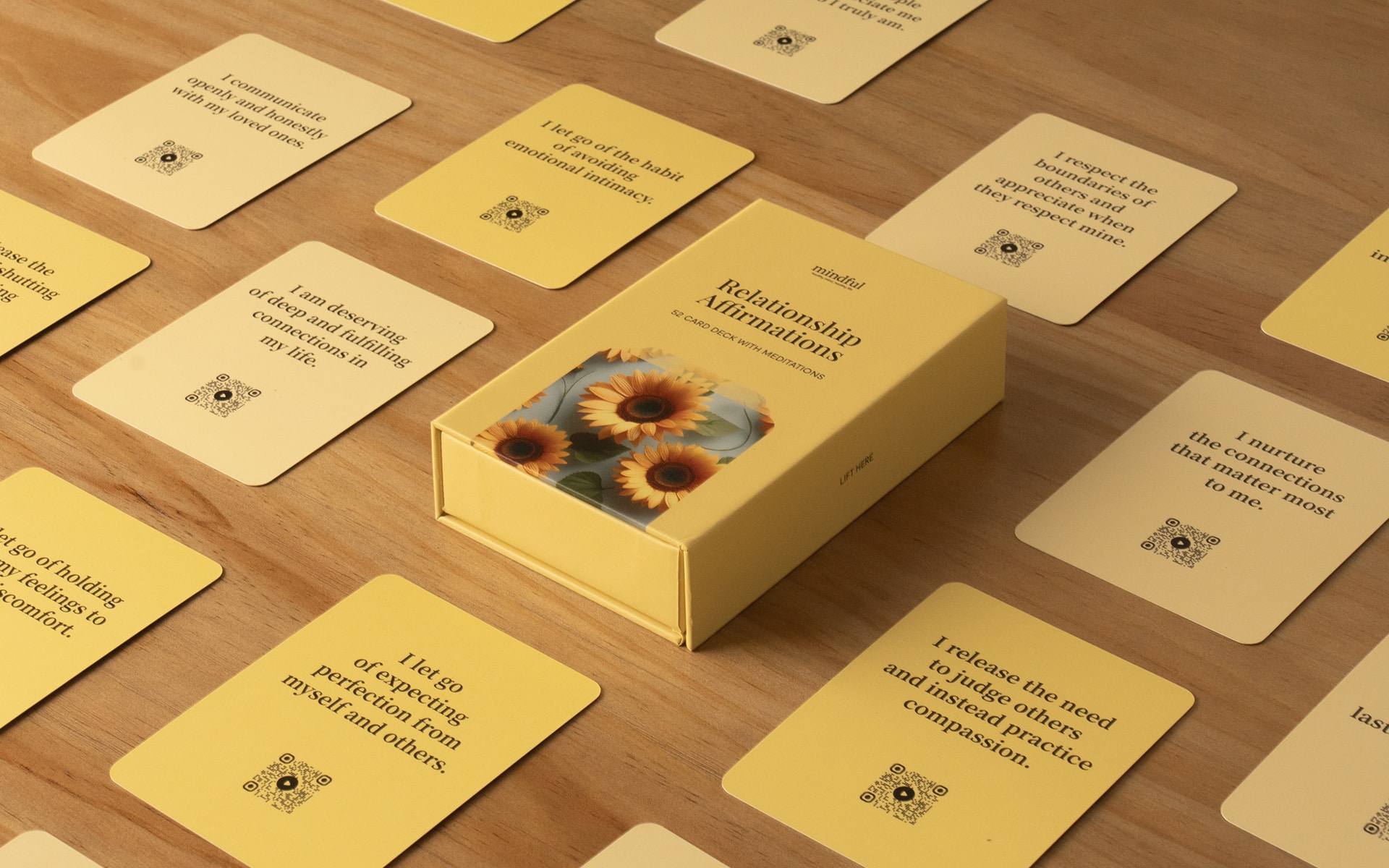
The newly launched Relationship Affirmations Deck explores the many ways in which mindfulness offers a powerful antidote to this disconnect. By incorporating mindfulness into our relationships, we can cultivate deeper understanding, empathy, playfulness, and appreciation for those we hold dear.
4 Simple, Mindful Practices to Nourish Relationships
Whether you’re looking to reconnect after a period of distance, or you just want to build on what you already have, mindful relationship practices can help. Let’s look at four mindful ways to nourish connection in your relationships, helping them grow stronger and more fulfilling over time.
1. Practice Active Listening
Here’s a question to gently ask yourself: How often do I truly listen to others without planning a response, letting my thoughts wander, or interrupting? It’s more challenging than you might think.
Active listening is a cornerstone of mindfulness in relationships, requiring full presence and an open heart.
What is active listening?
Active listening involves giving your undivided attention to the speaker, genuinely seeking to understand their perspective. This means suspending judgment, refraining from offering solutions unless asked, and showing that you value their words.
How to incorporate active listening into your relationship
Here are three ways you can boost your active listening skills.
Don’t let distraction get the upper hand. Put away devices like phones or laptops. Face the person you’re speaking with, maintain eye contact, and let them know they have your attention.
Use verbal and nonverbal cues. Nod, lean in, smile, or say things like, “I hear you,” or “Tell me more.” These small gestures show engagement and encouragement.
Reflect and validate. When your conversation partner is done talking, it can help to summarize what they’ve said to confirm you understand. For example: “It sounds like you felt hurt when that happened. Is that right?” Remember, validation doesn’t mean agreeing; it simply acknowledges their feelings as real and understandable.
By practicing active listening, you create a reliable space for your partner or loved one to share openly, which strengthens trust and intimacy.
2. Be Intentional About Gratitude and Appreciation
In long-term relationships, it’s easy to take the other person for granted. Over time, we may focus more on what’s lacking or on minor annoyances than on the things we admire about our partner, family members, or close friends.
Why gratitude matters in relationships
Gratitude shifts attention to the positive aspects of your relationship, reminding you of the qualities and experiences you cherish. When expressed regularly, appreciation fosters feelings of being seen, valued, and loved.
At first it can feel awkward to be intentional about gratitude. Calling out specific examples might even feel a little silly. But this practice has been shown again and again to shift our perspective, to sharpen our awareness of all the goodness around us and all the ways we’re held up and supported. All of this makes us better friends, partners, parents, and co-workers, deepening the bonds we share.
How to practice gratitude together
If you want to boost your experience of gratitude and aren’t sure where to begin, here are three simple strategies that can get you started.
Start a daily gratitude practice. This does not have to be complicated or drawn out! Each day, share one thing you’re grateful for about your partner or your relationship. It could be something small, like how they made you coffee, or something significant, like their support during a tough time.
Write thank-you or love notes. Leave a heartfelt note expressing appreciation for something specific they’ve done. Over time, these little gestures build a reservoir of positive feelings.
Celebrate the small wins. Acknowledge and celebrate each other’s achievements, no matter how minor. Recognizing effort strengthens your bond and boosts mutual respect.
When gratitude becomes a habit, it acts as a glue that holds your relationship together through ups and downs. Over time, noticing what’s working becomes the default. When frustrations or disappointments occur—which they inevitably will in our imperfect human relationships—you’ll have this large bank of truthful, positive reminders to draw from.
3. Be Present for Shared Experiences
Relationships thrive on shared experiences, but the depth of connection depends on how present you are in those moments. Whether it’s a dinner date, a weekend hike, or simply watching a movie together, mindfulness can transform routine activities into meaningful bonding opportunities.
What is shared presence and why does it matter?
It’s easy to assume that spending time together automatically equals connection. But proximity isn’t the same as presence. You can sit next to someone for hours and still feel a million miles apart. What transforms time into connection is being fully there.
“Being present” is a phrase you’ll see a lot in mindful spaces. While it can sound a little vague and New Agey, in reality, it’s a very practical approach to investing in our ordinary, everyday lives.
When we talk about being fully present, what we mean is that we’re marshaling our attention on purpose. That looks like putting our focus on the person we’re with, opening our ears and our hearts to them. It also involves being in our bodies—noticing sights, sounds, smells, and sensations—instead of always stuck in our heads and the stories we get hooked on. We’re not getting caught up in something that happened earlier or something that’s going to happen later. When our attention drifts, which it will, we just gently bring it back.
When you’re fully present, even mundane moments become an opportunity for connection. Presence fosters intimacy, as it shows the person you’re with that they are worth your undivided attention.
Ideas for mindful shared experiences
There are so many fun and creative ways to build shared experiences. Here are just a few ideas you can try:
Mindful meals. Shared meals used to be a cornerstone of cultural connection, and in some places, people are trying to bring them back to combat the epidemic of loneliness that has seeped into Western culture. A mindful meal is simply a meal without distractions. It doesn’t have to be fancy at all. The focus is on savoring the flavors, enjoying the ambiance, and engaging in conversation.
Digital detox dates. Set aside time to disconnect from screens and connect with each other. Use this time to talk, play a game, or try something new together.
Explore something new. Novelty and spontaneity strengthen bonds by creating new, positive associations. Take a dance class, cook a new recipe, or visit a place neither of you has been before.
Practice mindfulness together. Meditate, do yoga, or simply sit quietly and breathe together. Shared mindfulness practices can deepen your emotional connection and align your energies.
One additional benefit of intentional presence? We remember things more vividly. By being fully present during shared experiences, you create memories that are rich in connection and joy.
4. Practice Compassion and Forgiveness
No relationship is immune to conflict or mistakes. In these moments, the way we respond determines whether we drift apart or grow closer. Practicing compassion and forgiveness is a mindful approach to navigating challenges while strengthening the bond between you.
Why compassion and forgiveness are so crucial to connection
Compassion involves understanding and caring for your partner’s feelings, even when you disagree or feel hurt. It’s about recognizing their humanity and approaching difficulties with kindness rather than judgment.
Forgiveness is an emotionally-complicated and often-misunderstood concept. People sometimes fear that forgiveness is the same as saying what happened was okay, or that it means we “forget” or pretend it never happened. That isn’t the case with healthy forgiveness.
Holding onto resentment creates barriers to intimacy. Forgiveness doesn’t mean condoning hurtful behavior, but rather letting go of the emotional weight it carries, so you can move forward together.
How to practice compassion and forgiveness
Studies have shown that a regular mindfulness practice makes forgiveness easier, in part because it expands our compassion and makes seeing another perspective less difficult. Here are five habits that foster real, healthy compassion and forgiveness.
Pause before reacting. When emotions flare, take a breath. That pause can be the difference between a response that builds connection and one that tears it down.
Include yourself. Often the person we are hardest on is ourselves. The more we practice taming our ferocious inner critic, the more likely we are to be able to extend that same grace to others.
Seek understanding. Ask yourself: What might they be feeling or fearing? What’s beneath their words or actions?
Apologize and accept apologies. A sincere “I’m sorry” can be healing. So can saying, “I forgive you.” Neither one erases the hurt, but both open the door to repair.
Let go of what no longer serves you. Resentment is heavy. Releasing it—through mindfulness, journaling, or therapy—creates space for something lighter.
Compassion and forgiveness aren’t always easy. Some might say that these can be the most challenging part of a mindfulness journey, but they are what allows relationships to grow through challenges rather than crumble beneath them.
Building a Relationship That Feels Alive
Mindfulness in relationships isn’t about perfection. It’s about presence—about showing up, over and over, in small but meaningful ways. When we listen deeply, express gratitude, share moments with presence, and choose compassion, we create a relationship that feels alive, tender, and worth tending to.
And here’s the beautiful thing: every moment is a chance to begin again. So, whether you’re navigating a tough season or just looking to strengthen what’s already good, start small. Start today. The relationships that matter most are worth it.
Put the Focus Back On Connection with Relationship Affirmations
If you’re looking for a wonderful companion product that can support your journey to mindful, meaningful connection, you’ll love our new Relationship Affirmations card deck.
52 beautifully designed, high-quality cards, each featuring a unique mindful phrase.
A simple wooden holder to display each day’s card. A QR code on the back of each card that links to 25 bonus premium digital practices, like coaching and guided meditations.
This deck provides a simple reminder that brings your attention back to gratitude, compassion, honest communication, and healthy interactions. Whether used alone or with a loved one, these cards can provide the gentle structure and support to help you grow your relationships with care and intention.
How often have you rushed out the door and into your day without even thinking about how you’d like things to go? Before you know it, something or someone has rubbed you the wrong way, and you’ve reacted automatically with frustration, impatience, or rage—in other words, you’ve found yourself acting in a way you never intended.
You don’t have to be stuck in these patterns. Pausing to practice mindfulness for just a few minutes at different times during the day can help your days be better, more in line with how you’d like them to be.
Explore these five simple mindfulness practices for daily life:
Marta Locklear/Stocksy
1) Mindful Wakeup: Start with a Purpose
Intention refers to the underlying motivation for everything we think, say, or do. From the brain’s perspective, when we act in unintended ways, there’s a disconnect between the faster, unconscious impulses of the lower brain centers and the slower, conscious, wiser abilities of the higher centers like the pre-frontal cortex.
Given that the unconscious brain is in charge of most of our decision-making and behaviors, this practice can help you align your conscious thinking with a primal emotional drive that the lower centers care about. Beyond safety, these include motivations like reward, connection, purpose, self-identity and core values.
Setting an intention—keeping those primal motivations in mind—helps strengthen this connection between the lower and higher centers. Doing so can change your day, making it more likely that your words, actions and responses— especially during moments of difficulty—will be more mindful and compassionate.
This mindfulness exercise is best done first thing in the morning, before checking phones or email.
1. On waking, sit in your bed or a chair in a comfortable position. Close your eyes and connect with the sensations of your seated body. Make sure your spine is straight, but not rigid.
2. Take three long, deep, nourishing breaths—breathing in through your nose and out through your mouth. Then let your breath settle into its own rhythm, as you simply follow it in and out, noticing the rise and fall of your chest and belly as you breathe. If you find that you have a wandering mind or negative thoughts, simply return to the breath.
3. Ask yourself: “What is my intention for today?” Use these prompts to help answer that question, as you think about the people and activities you will face. Ask yourself:
How might I show up today to have the best impact?
What quality of mind do I want to strengthen and develop?
What do I need to take better care of myself?
During difficult moments, how might I be more compassionate to others and myself?
How might I feel more connected and fulfilled?
4. Set your intention for the day. For example, “Today, I will be kind to myself; be patient with others; give generously; stay grounded; persevere; have fun; eat well,” or anything else you feel is important.
5. Throughout the day, check in with yourself. Pause, take a breath, and revisit your intention. Simply observe, as you become more and more conscious of your intentions for each day, how the quality of your communications, relationships, and mood shifts.
PlainPicture/Lubitz+Dorner
2) Mindful Eating: Enjoy Every Mouthful
It’s easy enough to reduce eating to a sensation of bite, chew, and swallow. Who hasn’t eaten a plateful of food without noticing what they’re doing? Yet eating is one of the most pleasurable experiences we engage in as human beings, and doing it mindfully can turn eating into a far richer experience, satisfying not just the need for nutrition, but more subtle senses and needs. When we bring our full attention to our bodies and what we are truly hungry for, we can nourish all our hungers. Try this:
1. Breathe before eating. We often move from one task right to the other without pausing or taking a breath. By pausing, we slow down and allow for a more calm transition to our meals. Bring your attention inward by closing your eyes, and begin to breathe slowly in and out of your belly for eight to 10 deep breaths before you start your meal.
2. Listen to your body. After breathing, bring your awareness to the physical sensations in your belly. On a scale of 1 to 10, 1 being that you don’t feel any physical sensation of hunger and 10 being that you feel very hungry, ask yourself “How hungry am I?” Pay attention to what bodily sensations tell you that you are hungry or not hungry (emptiness in stomach, shakiness, no desire to eat, stomach growling, etc.). Try not to think about when you last ate or what time it is, and really listen to your body, not your thoughts.
3. Eat according to your hunger. Now that you are more in touch with how hungry you are, you can more mindfully choose what to eat, when to eat, and how much to eat. This simple practice of self awareness can help you tune in to your real needs.
4. Practice peaceful eating. At your next meal, slow down and continue to breathe deeply as you eat. It’s not easy to digest or savor your food if you aren’t relaxed.
5. If you don’t love it, don’t eat it. Take your first three bites mindfully, experience the taste, flavors, textures, and how much enjoyment you are receiving from a certain food. Make a mindful choice about what to eat based on what you really enjoy.
PlainPicture/Mira
3) Mindful Pause: Rewire Your Brain
It’s estimated that 95% of our behavior runs on autopilot—something I call “fast brain.” That’s because neural networks underlie all of our habits, reducing our millions of sensory inputs per second into manageable shortcuts so we can function in this crazy world. These default brain signals are like signaling superhighways, so efficient that they often cause us to relapse into old behaviors before we remember what we meant to do instead.
Mindfulness is the exact opposite of these processes; it’s slow brain. It’s executive control rather than autopilot, and enables intentional actions, willpower, and decisions. But that takes some practice. The more we activate the slow brain, the stronger it gets. Every time we do something deliberate and new, we stimulate neuroplasticity, activating our grey matter, which is full of newly sprouted neurons that have not yet been groomed for the fast brain.
But here’s the problem. While my slow brain knows what is best for me, my fast brain is causing me to shortcut my way through life. So how can we trigger ourselves to be mindful when we need it most? This is where the notion of “behavior design” comes in. It’s a way to put your slow brain in the driver’s seat. There are two ways to do that—first, slowing down the fast brain by putting obstacles in its way, and second, removing obstacles in the path of the slow brain, so it can gain control.
Shifting the balance to give your slow brain more power takes some work, though. Here are some ways to get started and cultivate more mindfulness.
1. Trip over what you want to do. If you intend to do some yoga or to meditate, put your yoga mat or your meditation cushion in the middle of your floor so you can’t miss it as you walk by.
2. Refresh your triggers regularly. Say you decide to use sticky notes to remind yourself of a new intention. That might work for about a week, but then your fast brain and old habits take over again. Try writing new notes to yourself; add variety or make them funny so they stick with you longer.
3. Create new patterns. You could try a series of “If this, then that” messages to create easy reminders to shift into slow brain. For instance, you might come up with, “If office door, then deep breath,” as a way to shift into mindfulness as you are about to start your workday. Or, “If phone rings, take a breath before answering.” Each intentional action to shift into mindfulness will strengthen your slow brain.
Female athlete tying her shoes. Shot from above in sunset light. Shot in 50 megapixel resolution.
4) Mindful Workout: Activate Your Mind and Your Muscles
Riding a bike, lifting weights, sweating it out on a treadmill—what do such exercises have in common? For one thing, each can be a mindfulness practice. Whatever the physical activity—dancing the Tango, taking a swim—instead of simply working out to burn calories, master a skill, or improve condition, you can move and breathe in a way that not only gets your blood pumping and invigorates every cell in your body, but also shifts you from feeling busy and distracted to feeling strong and capable.
Ready? The following steps, good for any activity, will help you synchronize body, mind, and nervous system. As you do, you will strengthen your capacity to bring all of your energy to the task at hand and reduce stress.
1. Be clear about your aim. As you tie your laces or pull on your gardening gloves, bring purpose to your activity by consciously envisioning how you want your guide your session. As you climb on your bike you might say, “I am going to breathe deeply and notice the sensation of the breeze and the sun and the passing scenery.” As you enter the pool, you might say, “I’m going to pay attention to each stroke, and the sound and feel of the water surrounding me.”
2. Warm up (5 minutes). Try any simple moves—jumping jacks, stretching—and concentrate on matching the rhythm of your breath to your movement. By moving rhythmically in this quick exercise, your brain activity, heart rate, and nervous system begin to align and stabilize.
3. Settle into a rhythm (10 to 15 minutes). Pick up the intensity, but continue to coordinate your breath and movement. If you have trouble doing this, then simply focus on your breathing for a few minutes. Eventually you’ll find your groove.
4. Challenge yourself (10 to 15 minutes). Try faster speed, more repetitions, or heavier weights, depending on what you are doing. Notice how alert and alive you feel when pushing yourself.
5. Cool down (5 minutes). Steadily slow down your pace until you come to a standstill. Notice the way your body feels. Drink in your surroundings.
6. Rest (5 minutes). Quietly recognize the symphony of sensations flowing in and around you. Practice naming what you feel and sense. Chances are you’ll feel awake and alive from head to toe.
Plainpicture/Johner/Peter Carlsson
5) Mindful Driving: Drive Yourself Calm, Not Crazy
There’s nothing like heavy traffic and impatient drivers to trigger the “fight or flight” response. That’s why road rage erupts and stress levels soar, while reason is overrun. The worse the traffic, the worse the stress. Los Angeles, where I live, has some of the worst traffic around, and some of the most unserene drivers. Emotions run high, tempers flare, tires squeal.
But it doesn’t have to be like that. In fact, the snarliest traffic jam can provide an excellent opportunity to build your mindfulness muscle, increase your sense of connection to others, and restore some balance and perspective.
Here are the steps to a simple behind-the-wheel practice I’ve been doing for a while. I’ve found it can work wonders.
1. First, take a deep breath. This simple, yet profound advice helps bring more oxygen into your body and widens the space between the stimulus of the traffic and your heightened stress reaction. In this space lies perspective and choice.
2. Ask yourself what you need. It may be in that moment that you need to feel safe, at ease or you just need some relief. Understanding what you need will bring balance.
3. Give yourself what you need. If ease is what you need, you can scan your body for any tension (not a bad thing to do while driving in any case) and soften any tension or adjust your body as needed. You can sprinkle in some phrases of self-compassion, such as, “May I be at ease, may I feel safe, may I be happy.” If your mind wanders, simply come back to the practice.
4. Look around and recognize that all the other drivers are just like you. Everyone on the road wants the same thing you do—to feel safe, have a sense of ease, and to be happy. Chances are you’ll see a number of fellow drivers who look a bit agitated, but you might also catch that one who is singing or actually smiling, and this will dissipate some of your own stress immediately. You can apply to all of them what you just offered to yourself, saying, “May you be at ease, may you feel safe, may you be happy.”
5. Take another deep breath. In 15 seconds or less, you can turn around your mood by applying these simple tips. When you feel the frustration of traffic rising, choose whatever you need to work on, and offer that condition to others. If you need to feel safe, say, “May I be safe, may you be safe, may we all be safe.” Breathe in, breathe out, you’ve sowed a seed of happiness.