Tag: peace

  • You Don’t Have to Shut Down or Burn Out When You Care This Much. Do This Instead.

    You Don’t Have to Shut Down or Burn Out When You Care This Much. Do This Instead.

    Three weeks ago, I ended up in the emergency room convinced I was having a heart attack.

    The chest pain had started days earlier—a tightness that wouldn’t release, difficulty taking a full breath, pain radiating down my left shoulder. I told myself it was nothing. Maybe I’d overdone it at the gym. Maybe I’d slept wrong.

    I kept meditating.
    I kept teaching.
    I kept holding space for others.

    I tried to breathe my way through it, the way I’ve taught thousands of people to do. But on Sunday, when my doctor’s office was closed and the pain refused to let up, my husband said gently but firmly, We’re going to the ER.

    After five hours of tests and long stretches of waiting, the cardiologist came back with relief in his voice: my heart was fine.

    I should have felt grateful—and I did.
    But I was also confused.

    If my heart was healthy, what was my body trying to tell me?

    Recognition: The Role of Vicarious Trauma In Bearing Witness Without Choice

    If you have been paying attention to the world around you over the past months, you may be carrying more than you realize.

    Images of devastation in Gaza.
    Israeli families living with constant fear of attack.
    Political violence and ICE shootings at home.
    Rising Islamophobia and antisemitism fracturing communities, relationships, and public life.
    The countless Black, Indigenous, and other people of color whose deaths rarely make headlines, whose names we never learn.
    And the ongoing humanitarian crises in places like Sudan, Yemen, and Iran—where suffering continues largely outside the frame of sustained media attention.

    If you find yourself feeling unusually tense, exhausted, reactive, numb, or unable to turn away—even when you want to—it may not be a personal failing. It may be a natural response to prolonged exposure to suffering.

    For many of us, this witnessing is relentless. Each morning brings new stories, new images, new reasons to feel alarmed or heartbroken. Even when we are not directly affected, our nervous systems are taking it in.

    If you find yourself feeling unusually tense, exhausted, reactive, numb, or unable to turn away—even when you want to—it may not be a personal failing. It may be a natural response to prolonged exposure to suffering.

    There is a name for this: vicarious trauma.

    Vicarious trauma refers to the psychological and physiological impact of sustained empathic engagement with others’ pain. Our bodies and minds do not clearly distinguish between what we experience directly and what we absorb through continuous media exposure, graphic imagery, and ongoing moral urgency.

    Staying informed matters.
    Bearing witness matters.

    But exposure without the capacity to process what we are taking in carries consequences—often beneath our awareness.

    Photo by Tony Lam Hoang on Unsplash

    Withdrawal: When Turning Away Feels Necessary

    For others, the constant stream of suffering can feel overwhelming or futile, leading to disengagement instead. We scroll past headlines, turn off the news, or tell ourselves we need to focus on our own lives. At times, this discernment is necessary. Rest, boundaries, and self-care matter. But when disconnection becomes our primary response to vicarious trauma, something else quietly erodes.

    Many people turn away not because they don’t care, but because they feel powerless. What difference could I possibly make? In the face of global crises, individual action can seem insignificant, even naïve. Shutting down can feel like the only way to survive.

    Yet we live in an interconnected world where complete disconnection is an illusion. And when we disengage for too long, we don’t just lose information—we lose contact. Contact with what is happening. Contact with our own values. Contact with the small but meaningful ways care can move through us. What begins as self-protection can quietly become a loss of agency and connection.

    Vicarious trauma doesn’t just make us sad or tired. It reshapes how we see the world.

    Research shows that it disrupts core beliefs about safety, trust, control, intimacy, and meaning. It shows up cognitively, emotionally, physically, and behaviorally.

    People experiencing vicarious trauma often report:

    • Brain fog and difficulty concentrating
    • Heightened anger, anxiety, or emotional numbness
    • Sleep disturbances and chronic exhaustion
    • Hypervigilance—always bracing for the next blow
    • Physical symptoms like headaches, gastrointestinal issues, and chest pain

    And yes—ER visits.

    But there is something more essential that is lost when we burn out or shut down. 

    Vicarious trauma explains the cost to our nervous systems. But underneath that is something more subtle—and more consequential: a loss of contact with our capacity to respond.

    What gets lost when we engage on default—whether by over-consuming information about suffering or withdrawing from it—is not just nervous system regulation.

    We lose contact.

    Contact with the body as a source of intelligence.
    Contact with our felt sense of what is actually needed now.
    Contact with our agency, beyond outrage or withdrawal.
    Contact with our capacity to sense where our care is most skillful.
    Contact with our ability to stay human without hardening.

    This isn’t just trauma.

    It’s a disconnect from our humanness.

    Oppressive systems don’t need to silence us when exhaustion and reactivity will do the job for them.

    We find ourselves caught in cycles of constant witnessing or reactive outrage, or else turning away and numbing out.

    And when contact is lost, connection suffers.

    Connection with others.
    Connection with purpose.
    Connection with the part of ourselves that knows how to respond wisely.

    Vicarious trauma explains the cost to our nervous systems. But underneath that is something more subtle—and more consequential: a loss of contact with our capacity to respond.

    When we’re dysregulated:

    • We confuse intensity with impact
    • We lose the ability to imagine creative responses
    • We default to attack, despair, or withdrawal

    What’s at stake isn’t just our well-being. It’s our capacity to imagine—and enact—responses that actually reduce suffering.

    Oppressive systems don’t need to silence us when exhaustion and reactivity will do the job for them.

    Collective Capacity: How Not to Lose Each Other

    When this loss of contact happens at scale, movements fracture. Allies turn on one another. Nuance feels like betrayal. Strategic thinking gives way to moral reflex. The very capacities required for sustained change—discernment, patience, relational trust—begin to erode.

    When we are no longer in touch with our discernment, everyone can start to look like a threat. The act of listening itself can feel like moral failure. We confuse intensity with impact, and urgency with wisdom.

    This loss of contact doesn’t just exhaust us personally. It diminishes our ability to work together.

    When we are no longer in touch with our discernment, everyone can start to look like a threat. The act of listening itself can feel like moral failure. We confuse intensity with impact, and urgency with wisdom.

    I’ve seen this up close.

    At one point, someone was publicly attacking me online—not because we disagreed about the need to end suffering, but because I was trying to hold complexity rather than take a single side. I was called complicit. My integrity was questioned. Moral failure was assumed.

    Instead of reacting, I practiced inner calm, compassion, and equanimity—not to bypass harm, but to stay in contact with my own values of deep listening and seeking to understand. The next day, that same person reached out to say: “I’m sorry to have misjudged you so harshly. I’ve been exhausted, and I lashed out.”

    This person wasn’t malicious. They were overwhelmed. I recognized that feeling immediately—that same overwhelm is what had landed me in the ER. The suffering they had been witnessing was real. The vicarious trauma is real. Without tools to return to contact, that pain had nowhere to go but outward.

    I’ve witnessed this pattern repeatedly.

    When I had tried to draft a Town Council resolution that called for ending violence while also acknowledging security concerns on all sides, it was rejected—not because people disagreed with the facts, but because in the midst of collective disconnection, holding both-and felt impossible.

    This is how movements lose their strength—not through genuine disagreement about goals, but through operating from disconnection rather than from our deepest wisdom that comes from listening with care and seeking solutions that include all.

    Sustained change requires more than passion. It requires capacity: the ability to engage and retreat, to stay open without collapsing, to remain connected to one another even when the work is hard.

    When we lose that capacity, we don’t just lose effectiveness. We lose each other.
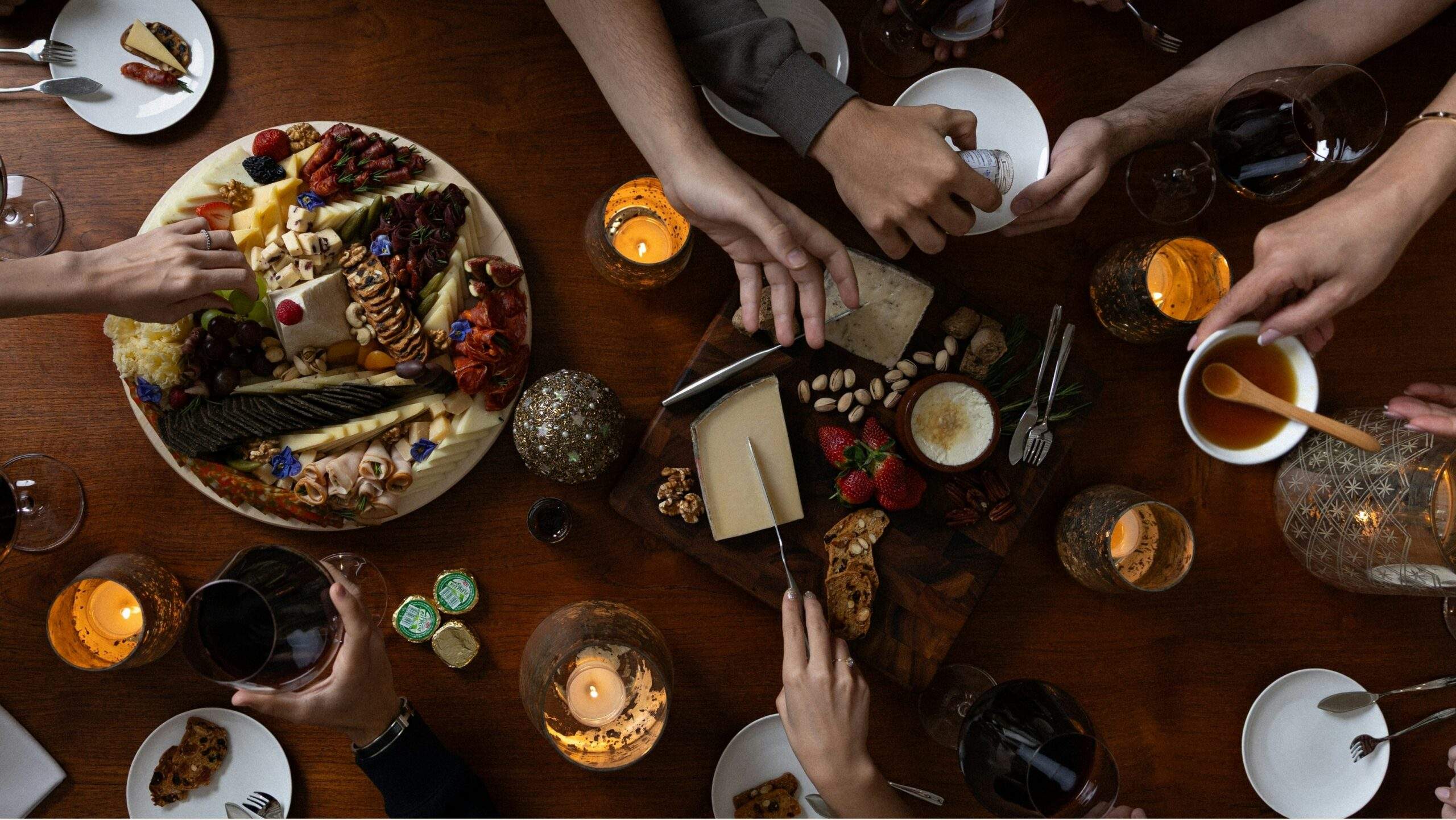
    People sharing a cheese platter, fruit, and wine around a candle-lit table, finding comfort after a day marked by vicarious trauma.
    Photo by The Cheeserom on Unsplash

    Rest: The Ground That Makes Practice Possible

    Recently, I was invited to a friend’s house for dinner. Simple food. Easy conversation. Board games. And yet, as I sat there, I felt a wave of guilt. How could I be laughing when so many are suffering? I noticed a flash of irritation toward the others at the table—why didn’t they seem as affected as I was? Didn’t they care?

    Then I caught myself.

    This guilt, this judgment—it wasn’t skillful. It wasn’t making me more effective or more compassionate. It was simply isolating me, pulling me away from the people right in front of me.

    Rest is not what we do when the work is finished. It is what makes sustained engagement possible. When we gather, we are restoring contact with the aliveness that oppressive systems rely on extinguishing.

    So I made a choice. I allowed myself to be there. To taste the food. To play the game badly and laugh at myself. To let the warmth of friendship soften something that had gone rigid inside me.

    It was quietly liberating.

    The next day, I returned to my work with more energy, clarity, and steadiness—not because anything had been solved, but because I had remembered what it feels like to be human alongside other humans.

    This is not escape.
    This is restoration.

    Rest is not what we do when the work is finished. It is what makes sustained engagement possible. When we gather with like-minded people—not to organize or persuade, but simply to cook together, laugh, play, or enjoy one another’s company—we are not avoiding the work. We are restoring contact with the aliveness that oppressive systems rely on extinguishing.

    Sometimes, what returns us to contact isn’t a formal practice at all. It’s a shared meal. Music, art, or movement that reminds us we are alive. A walk where we remember that trees still grow and birds still sing—even now.

    These moments are not indulgent.
    They are essential.

    From this restored place, certain skills can help us stay in contact when we re-engage with difficulty.

    Skills: Returning to Contact in Real Life

    Over years of teaching and research, I came to see that mindfulness as it’s often taught—focusing primarily on meditation and non-judging awareness—is necessary but insufficient for times like these.

    Calming the nervous system with meditation is only the first step. Once we re-engage, our default habits return. Without skill, we slide back into reactivity. Even if we can return to a calm, non-judging awareness, it is not enough to navigate nuanced, complex situations, often involving competing needs and worldviews. 

    Through my study of early Buddhist teachings and contemporary psychology, I began to understand mindfulness as a set of trainable skills—skills that help us stay in contact with what’s alive, even in the midst of suffering. They disrupt our default reactions and help us discern what is needed to respond skillfully.

    Three skills become especially essential when we are bearing witness to ongoing crisis:

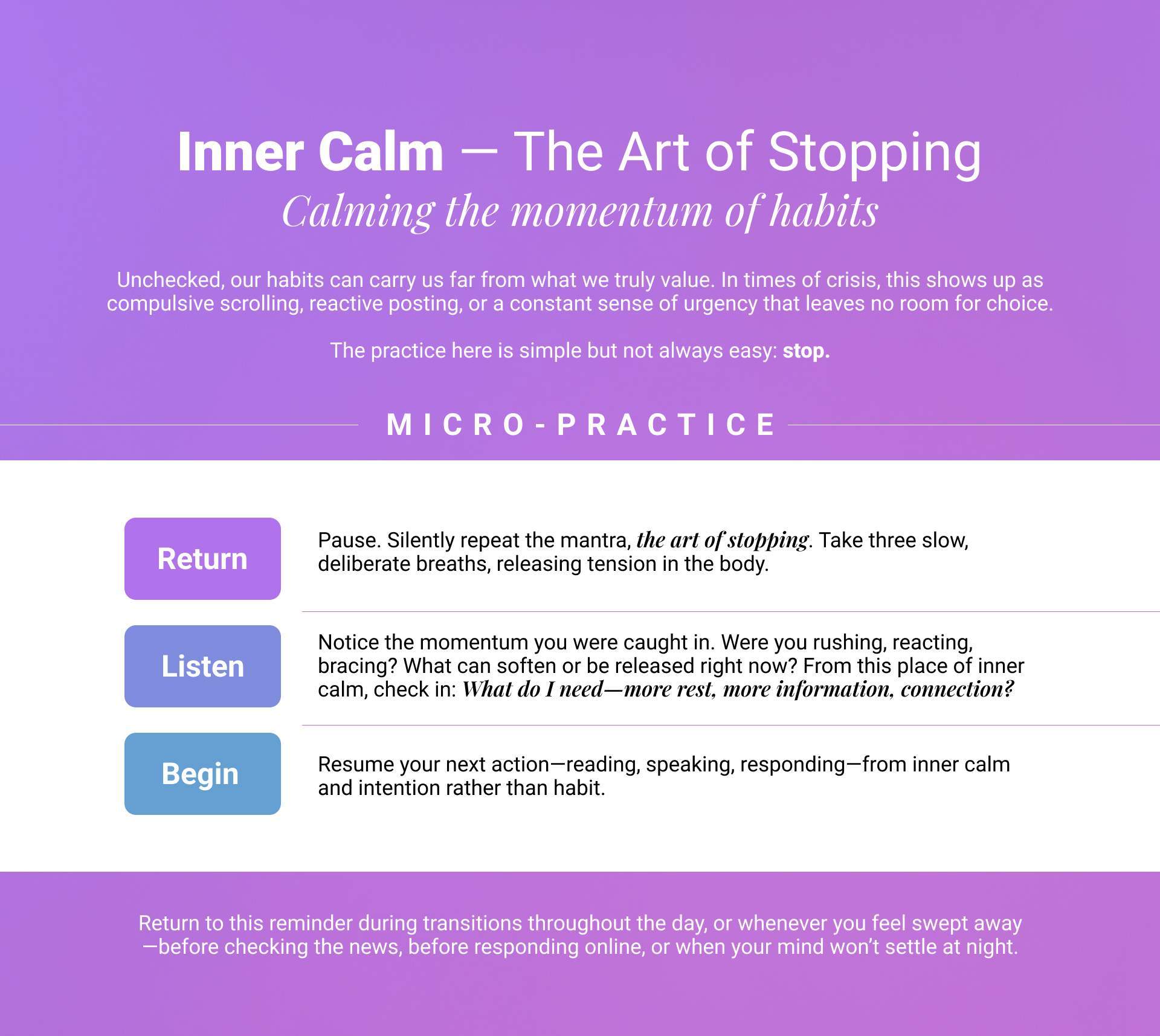
    Inner Calm — Creating Space Without Disengaging

    Inner calm is the art of stopping, looking, and letting go for purposes of healing and clarity. It softens the grip of our attachments to habitual hurrying, beliefs, and expectations that hinder our inner equilibrium.

    Inner calm involves physical composure and mental tranquility, bringing ease to body and mind alike. In the body, composure is experienced in the muscles and as an overall feeling of ease. In the mind, inner calm creates the space to hold everything without attachment and resistance. 

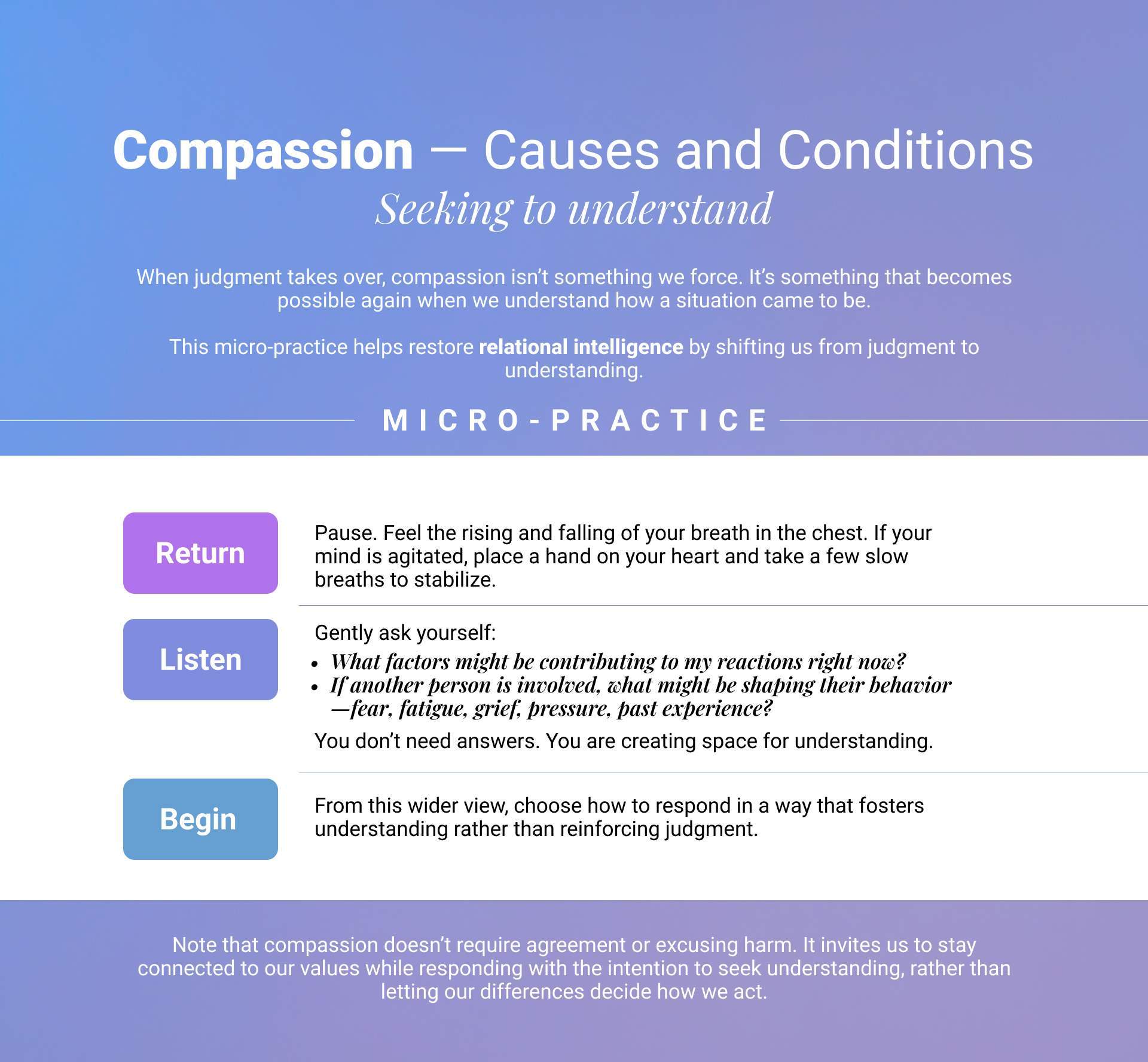
    Compassion — Seeking to Understand

    Compassion is our innate ability to feel, understand, and be motivated to alleviate suffering in ourselves and others. It disrupts our tendency to act on our automatic judgments about ourselves and others by seeking to understand.

    When we lose compassion, we see enemies instead of fellow humans struggling. We attack allies for not being pure enough. We forget that we, too, are worthy of care. We lose our relational intelligence—the capacity to sense how we are affecting others and how to stay connected across differences.

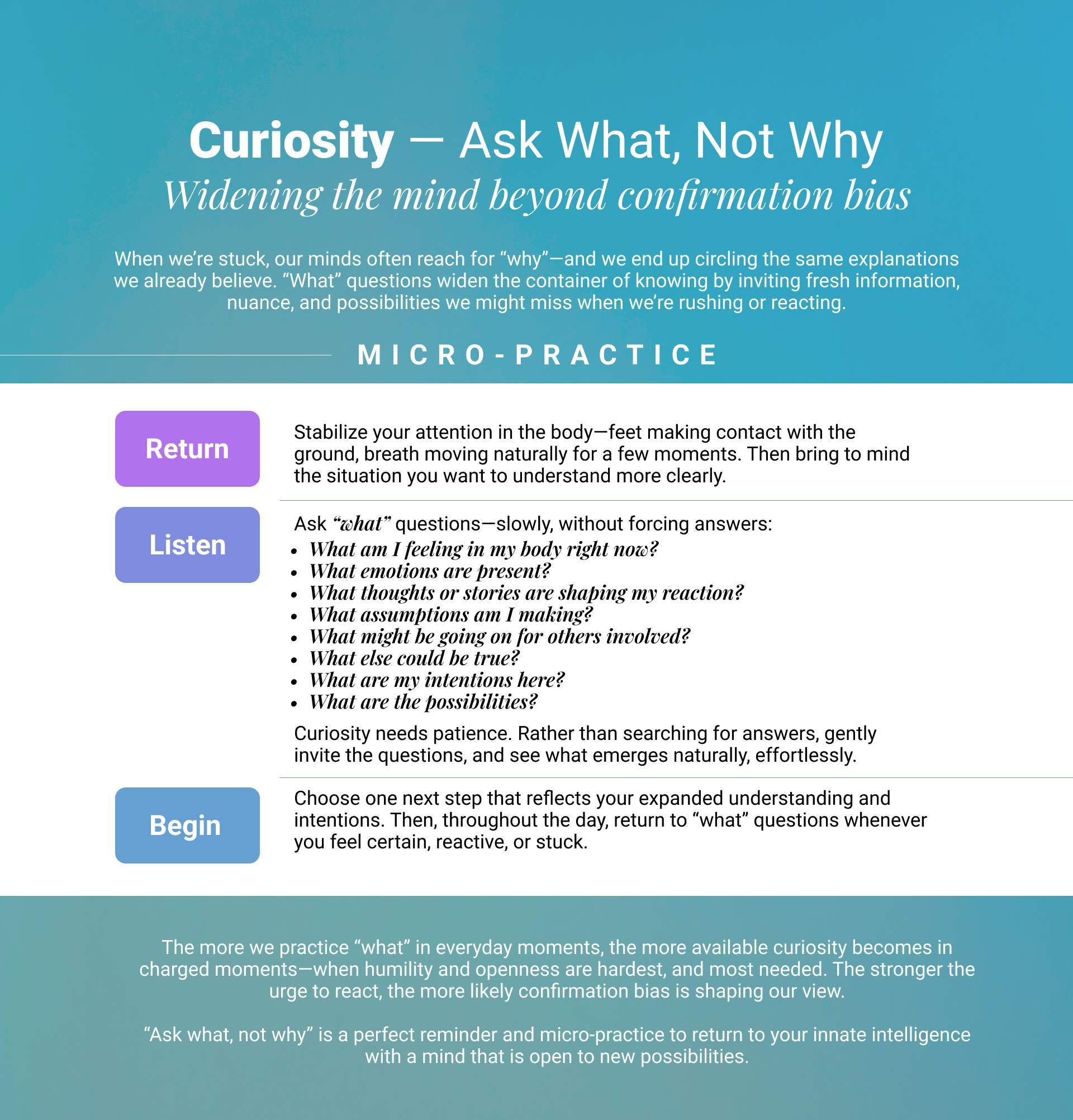
    Curiosity — Returning to Creative Capacity

    Curiosity is our ability to be genuinely interested and care with the purpose of understanding the situation, even when it’s challenging. It disrupts our confirmation bias by staying open and patient in the face of uncertainty and new information.

    Curiosity widens the lens trauma narrows. It restores contact with complexity and helps us sense what might actually help. It’s not about being right. It is about being effective.

    Together, these skills interrupt default patterns and reopen the channel between knowing what matters and being able to act on it.

    Based on our resources, capacity, and unique gifts, what’s ours to do will be different. There isn’t one right way to meet the darkness. Only many necessary ones.

    But here’s what practice has taught me: Skillful response doesn’t look the same for everyone.

    Based on our resources, capacity, and unique gifts, what’s ours to do will be different. The parent raising children who can hold complexity. The artist creating work that helps others process grief. The organizer building coalitions. The healer tending to those on the front lines.

    There isn’t one right way to meet the darkness. Only many necessary ones.

    Reaching to Poetry As Another Anchor

    I too have been learning to live with this question—how to stay engaged without collapsing. Sometimes the sifted language of poetry can speak to our deeper needs and longings. This poem by Michael Dubois captures this truth beautifully and resonates deeply.

    When Things Feel Dark
    by Michael Dubois

    When things feel dark, remember what the world needs:
    More healers, more helpers, more hate exorcisers.
    More artists and poets, more parents ruled by love.
    More cycle breakers, more radical resters,
    more warriors of peace.
    More gardeners who fall deeply in love
    with the earth beneath their feet.
    More meditators, more educators,
    more people willing to use failure as a tool to learn.
    More thinkers, more thankers, forgivers and apologizers.
    More builders of bridges and homes
    with open doors and minds.

    The world needs you—
    because only the ones who see the darkness
    know the importance of turning on the light.

    An Invitation to Practice: 3 Ways to Reconnect

    In times like these, practice is an invitation to return to what is already alive in us, and to offer that wisely.

    Below are three micro-practices from my book, Return to Mindfulness, to foster inner calm, compassion, and curiosity.

    May we have the courage to notice when we’ve lost ourselves—and the skill to return.
    May we offer what is uniquely ours to give, trusting that the world needs exactly that.
    May our practice benefit us and all beings.
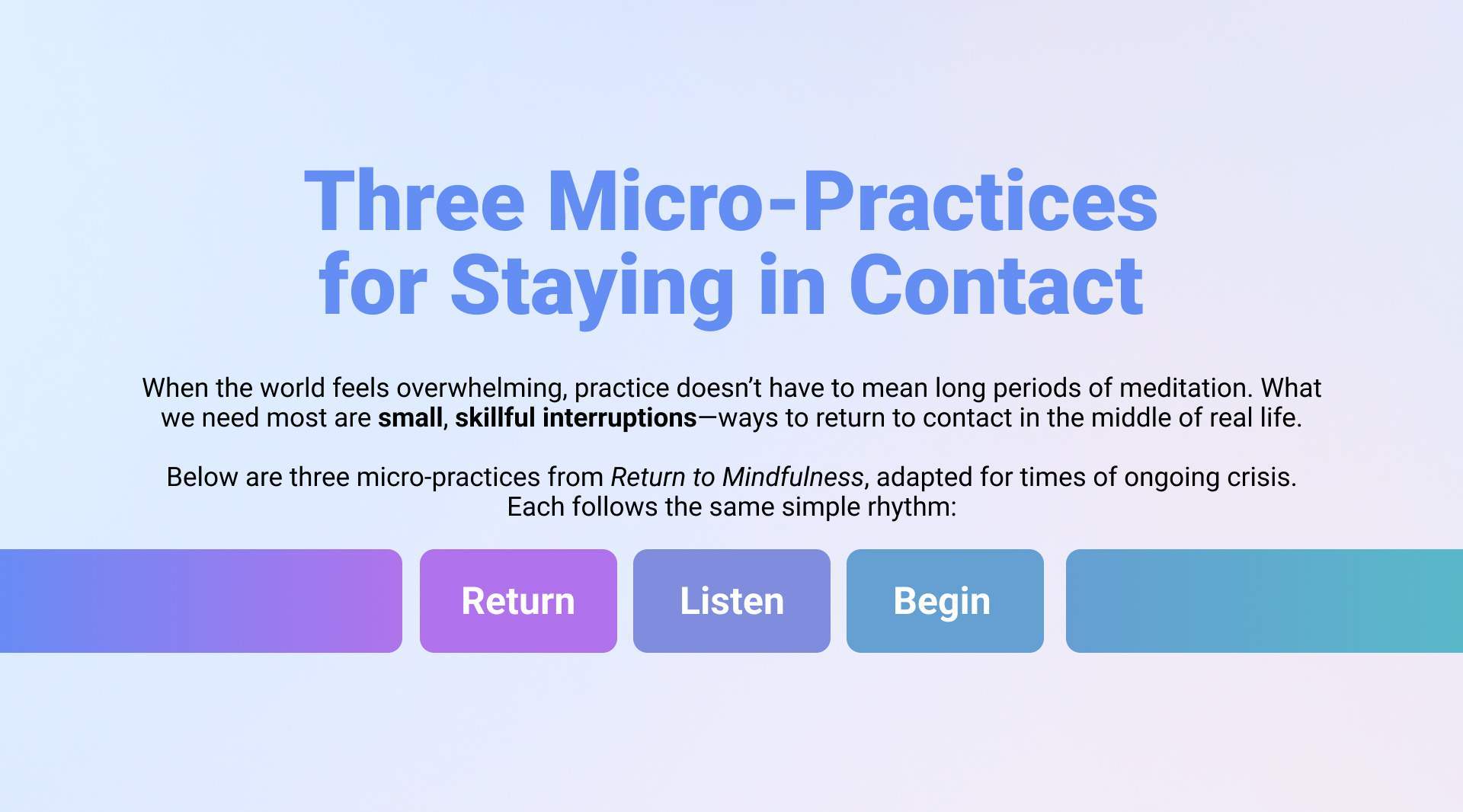
    Text graphic titled Three Micro-Practices for Staying in Contact with ourselves: Return, Listen, Begin.
    Purple infographic titled Inner Calm, explaining a three-step habit practice for managing vicarious trauma: Return, Listen, and Respond.
    Blue infographic explaining a compassion micro-practice to address overwhelm with steps: Return, Listen, and Begin for understanding others.
    Blue infographic titled Curiosity—Ask What, Not Why, sharing a mindfulness micro-practice to help manage emotional burnout: Begin, Return, Select.
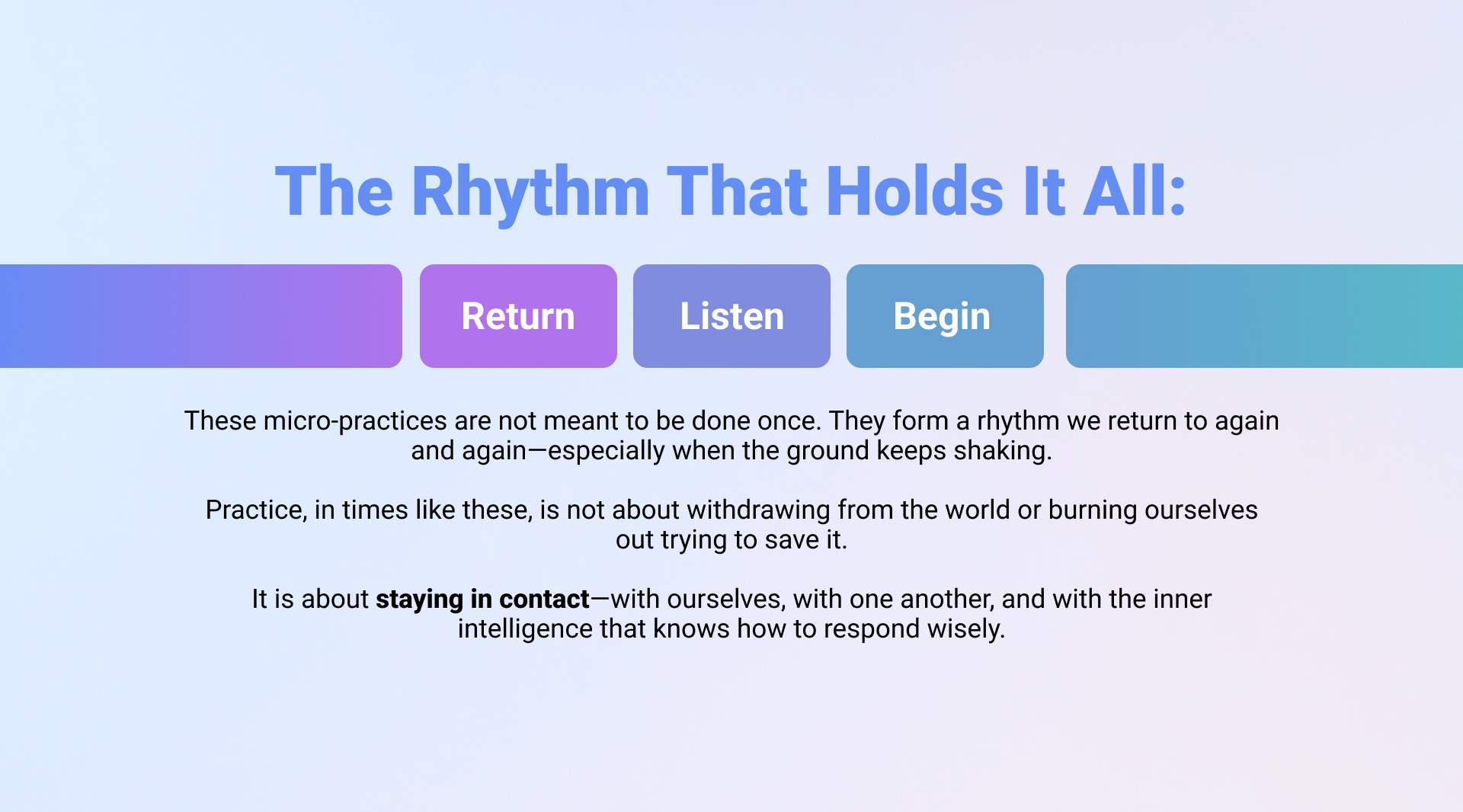
    A graphic titled The Rhythm That Holds It All addresses key steps with buttons: Notice, Return, Listen, Begin, on a gradient background.


    Source link

  • The Walk for Peace: An Invitation to Reimagine Where Peace Begins

    The Walk for Peace: An Invitation to Reimagine Where Peace Begins

    The Walk for Peace has been, in many ways, easy to miss. There are no slogans, no signs held up, no calls to action. 

    Instead, there is just walking. One step, then another. Breath moving in and out. Bodies moving steadily through places designed for speed.

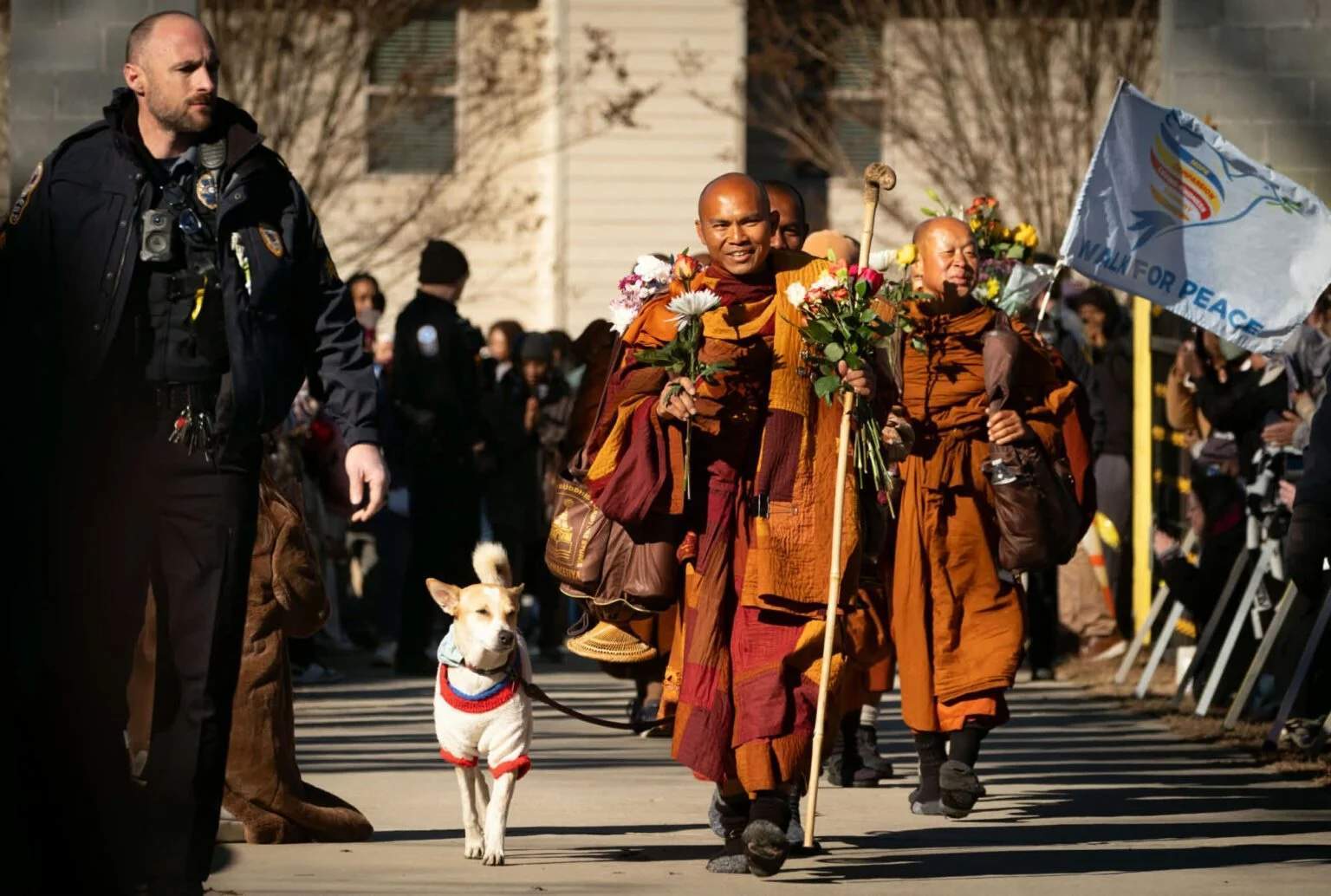
    After 108 days and over 2,300 miles, the Buddhist monks and their beloved dog Aloka have arrived at their destination in Washington, D.C. On February 11, 2026—Day 109—they will host a global loving-kindness meditation at 4:30pm EST. 

    Our current culture is shaped by loud, frantic things: urgency, outrage, and constant stimulation. This long-distance pilgrimage across the United States offers something distinctly countercultural. It is quiet, steady, unassuming, and attentive.

    It’s a (sometimes uncomfortable) reminder that our ideas about peace are often future-oriented and externalized. We imagine a time that’s not-now, where the horrors that plague us are gone, and we can finally feel okay. 

    I live in Minneapolis, right in the city. It is not peaceful here right now. We’re surrounded daily by realities that are destabilizing, uncertain, and frightening. Smack in the middle of that, people here are also quietly nurturing a web of care that extends to neighbors and strangers alike, that is stubbornly insistent on the possibility that we belong to each other.

    What I notice is that we are starved for gentleness in a world that glorifies dominance and control. We ache for compassion in a world that keeps telling us that softness makes us weak and defective.

    This past month, I’ve found myself multiple times a week checking in with the Walk for Peace. I watch videos of such tender interactions as people go to watch these monks pass by, sometimes offering flowers or just an encouraging hello. They spontaneously weep, and I do, too. 

    What I notice is that we are starved for gentleness in a world that glorifies dominance and control. We ache for compassion in a world that keeps telling us that softness makes us weak and defective.

    It’s difficult, but also strangely empowering, to sit with the truth that the monks are embodying. Something shifts in me when I begin to think of peace, not as something “out there,” but  as a thing that starts as a tiny kernel in each of us—something we tend like an ember, ignite with our own breath and attention, and then intentionally carry and share with others—moment by moment, step by step.

    What Is the Walk for Peace?

    The Walk for Peace is a long-distance walking journey across the United States, led by a small group of Buddhist monks and supported by volunteers and community members along the way. The route of the walk has stretched over 2,000 miles, beginning in Fort Worth, Texas, and ending in Washington, D.C., crossing ten states along the way.

    While it draws from contemplative Buddhist traditions, the walk itself is not a religious event. It is a lived experiment in mindfulness, compassion, and nonviolence—expressed through the simple act of walking.

    At its core, the walk is a moving mindfulness practice. The participants walk attentively, often in silence, allowing each step to re-anchor them to the present moment. For observers and those who join briefly, the experience can feel unexpectedly grounding. There is nothing to argue with, nothing to agree or disagree with. It’s just people moving through space with care, which is on the surface completely unremarkable—but somehow it feels like the most revolutionary thing.

    By walking attentively through public spaces, the participants model an alternative way of being—one that does not require agreement, belief, or affiliation. With each step, they seem to be simply saying, Notice your breath, notice your pace, notice the people around you. 

    Unlike marches designed to persuade or protest—and of course those also have their place—the Walk for Peace makes no demands. It invites reflection rather than reaction. Many who encounter it describe a sense of calm or curiosity. It’s a noteworthy pause in the usual mental clutter of daily life.

    Rather than addressing specific political outcomes, the walk focuses on something more foundational: how people relate to themselves and one another in everyday life.

    As an intentional mindfulness practice, the walk has highlighted several key principles:

    • Slowing down in a culture that rewards speed
    • Embodied awareness, using movement as an anchor to the present moment in a culture that often uses distraction and numbing
    • Compassion, practiced through respectful presence rather than persuasion
    • Nonviolence, not only as the absence of harm, but as an intentional orientation toward care

    By walking attentively through public spaces, the participants model an alternative way of being—one that does not require agreement, belief, or affiliation. With each step, they seem to be simply saying, Notice your breath, notice your pace, notice the people around you. 

    Peace, in this context, is not an end point, but a capacity that grows with practice.

    The monks have been accompanied by Aloka, a stray who found them in India on another peace pilgrimage. Photo credit: Aloka the Peace Dog

    The First Steps

    Walking has long been associated with reflection and insight. It naturally regulates the nervous system, invites awareness of breath and sensation, and brings attention out of abstraction and into the body. By choosing walking as their medium, the organizers grounded their response in something universally human.

    The Walk for Peace began with a simple question: How do we respond to a world marked by division, stress, and suffering without adding more noise?

    In an informational ecosystem shaped by influencers and social media, we’re accustomed to slogans and sound bites, having people talk at us, trying to shape our thinking and feeling. But these monks aren’t delivering a message to people; they’re living out a practice among them.

    Instead of issuing statements or organizing events, they chose to walk—slowly, visibly, and consistently—through the very communities shaped by the pressures and pains of modern life.

    Portions of the walk, through places like Selma and Montgomery, Alabama, were tracing steps taken by leaders of the Civil Rights movement.

    What is it like for us, generations on, to watch humble people radiating compassion and healing over so much painful ground, to watch them bear witness to realities and tend to wounds that we, collectively, still haven’t fully contended with?

    The steady gaze, pace, and breath of people like the monks remind me [that] no one person is bearing all of this alone. They’re carrying and surrendering, rejoicing and connecting, witnessing and walking, together.

    I drive through Minneapolis and see in real time the trauma of racialized violence: weary but resolute people holding signs on street corners, begging for mercy and humanity; “closed” signs in business windows where workers have been taken; a car parked askew on the road, driver’s side window smashed, door still open. Did someone see it happen at least so that the owner’s loved ones can be notified?

    It is so painful to witness, to look this moment in the eyes. I want to turn away. In my chest, it feels like I’m drowning. But the steady gaze, pace, and breath of people like the monks remind me of two important things.

    First, the longer we resist offering our attention to these unhealed places, the more we will keep living through the reverberating echoes of those same wounds over and over and over again. Different possible futures are only made possible by first giving our loving awareness to what’s happening right now—even (maybe especially) when it surfaces sorrow, hopelessness, or anger that we’re not sure we can handle in the moment.

    Second, no one person is bearing all of this alone. There’s no hero doing all the work. They’re carrying and surrendering, rejoicing and connecting, witnessing and walking, together.

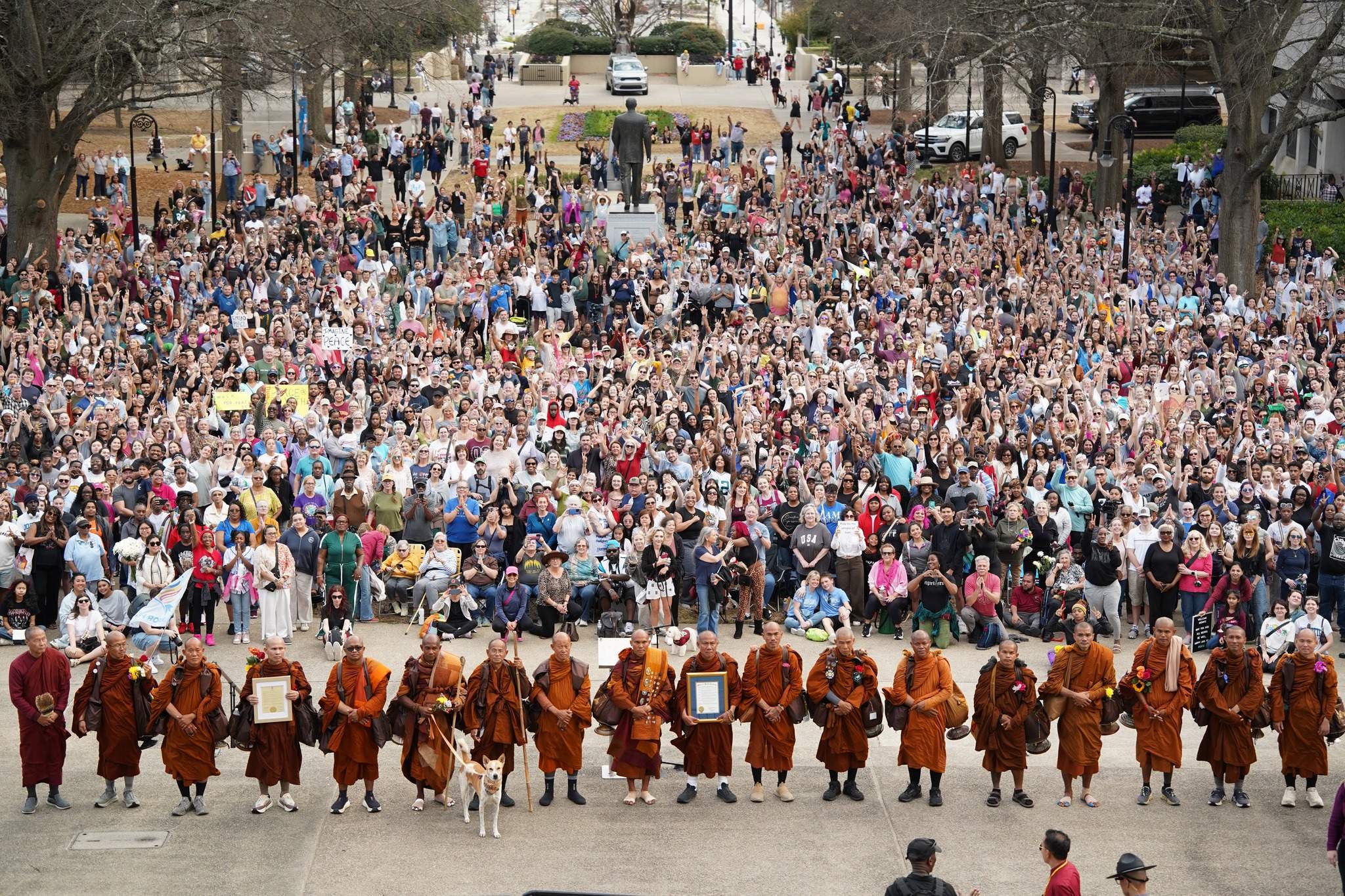
    A large crowd gathers behind monks in orange robes at a Walk for Peace outdoor event, united to reimagine peace together.
    A crowd gathers in South Carolina. Credit: Walk for Peace Facebook page

    How Do People Respond? 

    In many communities, people have gathered along the route—sometimes in the hundreds, sometimes in the thousands—drawn less by promotion than by word of mouth and curiosity. 

    Some offer food or encouragement. Some walk quietly for a stretch, or just stand and watch.

    Online, the walk has attracted millions of followers. Photos and short videos of monks walking through rain, heat, and traffic circulate widely, often accompanied by comments describing a sense of calm or inspiration. 

    Some people express skepticism, questioning whether walking can have any real impact in a world facing complex systemic challenges.  

    This tension is familiar within mindfulness circles, as well. Practices that emphasize inner awareness are sometimes dismissed as passive or insufficient. I understand that skepticism, even as research and lived experience increasingly suggest that attention, regulation, and compassion are not luxuries—they are necessary for wise action.

    Many people who encounter the walk haven’t reported dramatic transformations. They describe something smaller and maybe more sustainable—a softened interaction, an experience of being deeply seen, a reminder to slow down. Again: we so often come looking for drama because we’re conditioned for it—but perhaps what heals us shows up in a thousand quiet, un-social-media-worthy moments.

    Being Peace When Peace Feels Absent

    The Walk for Peace does not claim to solve global problems. It does not promise immediate results. 

    What it offers instead is a living question: What changes when we choose to move through the world with awareness and care?

    Peace is not something we wait for, hoping for external conditions to improve, but something we practice within the conditions we have. 

    Mindfulness practice is rooted in such elemental things—the breath, the body, the next moment. The mind wanders, as it always does, to other things. I think these days of my neighbors, my friends, my worry and anger, the work that needs to be done, what will become of my city, my country. 

    My practice has never been fancy, and even over years now, I have always been more earnest than skilled. Tears sometimes spill over, and my practice is like a cool hand on my forehead, like a reassuring mother, calling me home. 

    The walk has embodied this return home on a collective scale. It suggests that peace is not something we wait for, hoping for external conditions to improve, but something we practice within the conditions we have. 

    I know the walk is coming to its end. In all honesty, I’m going to miss the images and the videos. They have been a kind of nourishment over these long, dark weeks.

    I also know that something real has passed between real people. Maybe for the first time in a long while, we’ve had a glimpse of what happens when we just stop, even for a few moments, and notice one another. On the surface, it’s so tiny it’s almost nothing, just a breath or a blink or a step—but I swear I can sense that spark of compassion leap from one person to another. I’ve felt it here, and I know it matters.


    Source link

  • Finding Peace in Challenging Times with Sharon Salzberg

    Finding Peace in Challenging Times with Sharon Salzberg

    Get the latest on everything mindfulness


    Our free newsletter delivers updates on the science of mindfulness, guided mindfulness meditation practices from leading teachers, special offers, and rich content to support your mindful growth.


    Source link

  • Unlock Your Inner Peace: A Comprehensive Guide to the 10 Main Types of Yoga (Target keywords: types of yoga, yoga guide)

    Unlock Your Inner Peace: A Comprehensive Guide to the 10 Main Types of Yoga (Target keywords: types of yoga, yoga guide)

    As she delves into the world of yoga, she discovers that there’s more to it than just downward-facing dog and warrior poses. With numerous types of yoga to choose from, it can be overwhelming to decide which one suits her best. In this comprehensive guide, she’ll explore the 10 main types of yoga, each with its unique benefits, styles, and levels of intensity. Whether she’s a beginner or an experienced yogi, this guide will help her unlock her inner peace and find the perfect yoga practice to suit her needs.

    Introduction to the World of Yoga
    Yoga is an ancient practice that originated in India over 5,000 years ago. The word “yoga” comes from the Sanskrit word “yuj,” meaning “to unite” or “to join.” It’s a holistic practice that combines physical postures, breathing techniques, and meditation to unite the body, mind, and spirit. With its numerous benefits, including reduced stress, improved flexibility, and increased strength, it’s no wonder why yoga has become a popular practice worldwide. As she explores the different types of yoga, she’ll discover that each style has its unique approach to achieving inner peace and overall well-being.

    1. Hatha Yoga: The Traditional Approach
    Hatha yoga is one of the oldest and most traditional forms of yoga. It’s a slow-paced and gentle practice that focuses on physical postures (asanas) and breathing techniques (pranayama). Hatha yoga is perfect for beginners, as it provides a solid foundation for understanding the basics of yoga. This type of yoga guide is ideal for those who want to focus on the physical aspects of yoga and build a strong foundation for their practice.

    2. Vinyasa Yoga: The Flowing Style
    Vinyasa yoga, also known as flow yoga, is a dynamic and flowing style that links movement with breath. This type of yoga involves synchronizing breath with movement, creating a flowing sequence of postures. Vinyasa yoga is perfect for those who enjoy movement and want to challenge themselves physically. As she practices vinyasa yoga, she’ll experience a sense of fluidity and connection with her body.

    3. Ashtanga Yoga: The Intensive Practice
    Ashtanga yoga is a fast-paced and physically demanding style that involves a set sequence of postures. This type of yoga is perfect for those who enjoy a challenging practice and want to improve their strength, flexibility, and endurance. Ashtanga yoga is not for beginners, as it requires a certain level of physical fitness and yoga experience.

    4. Iyengar Yoga: The Precise Approach
    Iyengar yoga is a style that focuses on precise alignment and the use of props. This type of yoga is perfect for those who want to improve their alignment, balance, and overall understanding of yoga postures. Iyengar yoga is also ideal for those who are recovering from injuries or have physical limitations.

    5. Kundalini Yoga: The Spiritual Practice
    Kundalini yoga is a spiritual style that focuses on the release of energy in the body. This type of yoga involves postures, breathing techniques, and meditation to awaken the kundalini energy (a supposed spiritual energy that lies dormant at the base of the spine). Kundalini yoga is perfect for those who want to explore the spiritual aspects of yoga and experience a deeper sense of connection with their inner self.

    6. Bikram Yoga: The Hot and Sweaty Practice
    Bikram yoga, also known as hot yoga, is a style that involves practicing in a heated room. This type of yoga is perfect for those who enjoy a challenging and intense practice. The heat helps to detoxify the body and improve circulation, making it an ideal practice for those who want to sweat and purify their body.

    7. Yin Yoga: The Meditative Practice
    Yin yoga is a slow-paced and meditative style that targets the deeper tissues of the body, such as the connective tissues. This type of yoga involves holding postures for extended periods, allowing for a deeper release of tension and stress. Yin yoga is perfect for those who want to cultivate a sense of inner peace and calmness.

    8. Restorative Yoga: The Relaxing Practice
    Restorative yoga is a gentle and relaxing style that involves using props to support the body in relaxing postures. This type of yoga is perfect for those who want to unwind and rejuvenate their body and mind. Restorative yoga is ideal for those who are stressed, fatigued, or recovering from injuries.

    9. Power Yoga: The Energetic Practice
    Power yoga is a fast-paced and energetic style that involves a flowing sequence of postures. This type of yoga is perfect for those who enjoy a challenging and physically demanding practice. Power yoga is ideal for those who want to improve their strength, flexibility, and endurance.

    10. Sivananda Yoga: The Classical Approach
    Sivananda yoga is a classical style that involves a set sequence of postures, breathing techniques, and relaxation. This type of yoga is perfect for those who want to experience a traditional and holistic practice. Sivananda yoga is ideal for those who want to cultivate a sense of inner peace and well-being.

    Conclusion
    As she explores the different types of yoga, she discovers that each style has its unique benefits and approaches to achieving inner peace. Whether she’s a beginner or an experienced yogi, there’s a type of yoga that suits her needs and preferences. By incorporating yoga into her daily routine, she’ll experience a sense of calmness, clarity, and overall well-being. As she unlocks her inner peace, she’ll discover a deeper connection with her body, mind, and spirit.

    Frequently Asked Questions (FAQs)
    Q: What type of yoga is best for beginners?
    A: Hatha yoga, Vinyasa yoga, and Yin yoga are great for beginners, as they provide a solid foundation for understanding the basics of yoga.
    Q: What type of yoga is best for weight loss?
    A: Vinyasa yoga, Power yoga, and Ashtanga yoga are great for weight loss, as they involve a flowing sequence of postures that can help burn calories and improve cardiovascular health.
    Q: What type of yoga is best for stress relief?
    A: Yin yoga, Restorative yoga, and Sivananda yoga are great for stress relief, as they involve relaxing postures, breathing techniques, and meditation

    unlock-your-inner-peace-a-comprehensive-guide-to-the-10-main-types-of-yoga-target-keywords-types-of-yoga-yoga-guide

  • Meditation to Be At Peace With How Things Are

    Meditation to Be At Peace With How Things Are

    How can we be at peace with how things are right now? In this week’s guided meditation, Dr. Mark Bertin offers a practice to help us be gently aware of sensations, feelings, and thoughts that come up in practice, building presence in the rest of life.

    This is a practice that is both concrete and compassionate. Dr. Bertin guides us to take note of our tendency to either deny or try and “fix” what’s going on in our lives, and then find a third way—one where we aim to see things as clearly as possible, so that our decisions are filled with awareness, skill, and care for everyone involved.

    A Meditation to Be At Peace With How Things Are

    Read and practice the guided meditation script below, pausing after each paragraph. Or listen to the audio practice.

    1. Start with finding a comfortable posture that you’ll be able to sustain for these few minutes of practice. Bring a sense of kind and patient awareness to our body first. Notice how you’re sitting. Make adjustments so that you feel awake and alert. Notice areas of tension, and see if you’re able to release them a little bit, gathering your awareness and bringing it to the sensation of breathing.
    2. Let go of any need to do anything or make anything happen right now. You can reframe moments where you become distracted from the breath as a success. The mind always stays busy. Things happen that draw our attention and awareness away throughout the day, and each moment you come to the breath is a moment of awareness, a moment of intention. When you get distracted, just remember this sense of intention with clarity. You can say to yourself, Oh, my mind is busy —and then let go and simply come back to the next breath.
    3. Next, expand your awareness to the entirety of your body. Most of us live with experiences of pleasure, and also moments of discomfort or pain at times. And if something definitively needs adjustment to relieve you of some physical pain right now, that’s always okay. But for anything else that’s either comfortable for you to work with or unchangeable in this moment, see if you can simply notice it, and then come back to the breath.  
    4. Now, continue to use your breath lightly as an anchor, shifting your awareness to notice your emotional state. Emotions are part of our experience. They’re there whether we acknowledge them or not. They tend to influence how we think and how we interact with the world, so it’s empowering to cultivate a sense of open and caring awareness. Living peacefully with our emotions as they arise and pass is core to living at peace in the world. It’s also core to staying in touch with our best intentions, as emotions tend to drive the bus if we’re not paying attention to them.  
    5. See if you can give yourself permission for these next few minutes to stay aware of your emotions. Offer care if they’re difficult. Offer compassion and give yourself permission to experience them at all. Let go of any need to fix or change them. Right now I’m experiencing happiness, or Right now I am experiencing sadness, or whatever emotions come to mind. Can you bring to this part of the practice a sense of compassion, too? Lean toward the intention to treat yourself as you would a young child or a close friend.
    6. Remember, if your mind gets distracted, there’s always the option of coming back to following the breath again.
    7. Now, let’s shift our awareness to thoughts. Thoughts can feel so all-consuming, and even through meditation, we can’t make them stop. That’s never the point. Rather, we’re asking if we can live more at peace with this part of our experience, recognizing we each have our own habits. We each make up stories, stories that try to make sense of our past or that project into the future. Problems can feel sticky and all-consuming and ruminative. So for these few minutes of practice, can we note thoughts simply as thoughts? Fears simply as fears. Fantasies simply as fantasies. Observe them like clouds passing in the sky, and also with a sense of peace and care. My mind is in an agitated state right now. This is really exhausting. Or at a different time maybe we experience a quieter mind, a simpler mind, noticing the thoughts as they arrive with more ease. But through the practice, simply noticing and naming: Oh, there is that thought, and then coming back to the breath again.
    8. The intention and perspective we bring to the practice is fundamental to the practice itself. Through the practice, we can aim to live life—even during exceedingly difficult times—with more awareness and compassion and self-care. This leads to a better ability to stay in touch with our own best intentions when we need to act precisely or communicate well. So when we practice, whatever happens will happen. But can we do our best to stay aware, to stay clear of thought, and to stay kind. 
    9. As we bring our practice to a close, settle back into the breath for a moment. Then, perhaps set the intention to continue this sense of compassionate and kind awareness as you move on into the rest of your day. 

    Looking for mindfulness-based tools to live better with ADHD?

    Together with ADHD Life Coach and Certified ADHD Educator Dana Crews, Dr. Bertin is leading a retreat October 10-12, 2025, to support adults navigating life with ADHD. Hosted at the Menla Retreat Center nestled in the serene Catskill Mountains, Held and Whole is a restorative and educational three-day ADHD retreat that will offer practical, mindfulness-based tools to strengthen emotional regulation, deepen self-awareness, and foster authenticity. 

    You can get more information and reserve your spot here. Plus, listeners to this podcast can claim a limited-time 15% early bird discount when they enter code “Mindful” at checkout. Spots are limited!   


    Source link

  • 10 Best Yoga Poses for Stress Relief: Reduce Anxiety and Find Inner Peace (Target keywords: yoga poses for stress relief, reduce anxiety)

    10 Best Yoga Poses for Stress Relief: Reduce Anxiety and Find Inner Peace (Target keywords: yoga poses for stress relief, reduce anxiety)

    Stress and anxiety have become an integral part of modern life, affecting millions of people worldwide. The constant pressure to perform, the strain of daily responsibilities, and the uncertainty of the future can all take a toll on one’s mental and emotional well-being. Fortunately, there are many effective ways to manage stress and anxiety, and one of the most popular and beneficial methods is practicing yoga. Yoga poses for stress relief have been shown to reduce anxiety, promote relaxation, and improve overall mental health. In this article, we will explore the 10 best yoga poses for stress relief, and provide tips on how to incorporate them into your daily routine.

    Understanding the Benefits of Yoga Poses for Stress Relief

    Yoga is a ancient practice that combines physical postures, breathing techniques, and meditation to promote physical, mental, and emotional well-being. When it comes to reducing anxiety and stress, yoga poses for stress relief can be particularly effective. By practicing these poses, individuals can experience a range of benefits, including reduced muscle tension, improved mood, and enhanced cognitive function. Additionally, yoga poses for stress relief can help to slow down the heart rate, lower blood pressure, and promote relaxation, all of which can contribute to a sense of inner peace and calm.

    Top 10 Yoga Poses for Stress Relief

    1. Child’s Pose (Balasana): This pose is a great starting point for anyone looking to reduce anxiety and stress. By kneeling on the mat and stretching the arms out in front, individuals can release tension in the neck and back, and promote a sense of relaxation.
    2. Downward-Facing Dog (Adho Mukha Svanasana): This pose is a staple of yoga practice, and can help to reduce stress and anxiety by stretching the entire body, from the shoulders to the toes.
    3. Cobra Pose (Bhujangasana): This pose is a great way to open up the chest and shoulders, and can help to reduce tension and stress in the upper body.
    4. Cat-Cow Pose (Marjaryasana-Bitilasana): This pose is a gentle and flowing movement that can help to loosen up the spine and neck, and promote relaxation.
    5. Seated Forward Fold (Paschimottanasana): This pose is a great way to stretch the entire back side of the body, from the shoulders to the heels, and can help to reduce stress and anxiety.
    6. Plank Pose (Phalakasana): This pose is a great core strengthener, and can help to reduce stress and anxiety by engaging the entire body and promoting a sense of focus.
    7. Tree Pose (Vrksasana): This pose is a great way to improve balance and stability, and can help to reduce stress and anxiety by promoting a sense of grounding and calm.
    8. Seated Twist (Bharadvajasana): This pose is a great way to release tension in the spine and torso, and can help to reduce stress and anxiety by promoting a sense of relaxation.
    9. Legs Up The Wall Pose (Viparita Karani): This pose is a great way to invert the body and promote relaxation, and can help to reduce stress and anxiety by slowing down the heart rate and promoting a sense of calm.
    10. Savasana (Corpse Pose): This pose is a great way to end a yoga practice, and can help to reduce stress and anxiety by promoting a sense of deep relaxation and inner peace.

    Tips for Practicing Yoga Poses for Stress Relief

    When practicing yoga poses for stress relief, there are several tips to keep in mind. Firstly, it’s essential to listen to your body and only go as far as feels comfortable. secondly, try to focus on your breath and let go of any distracting thoughts or worries. thirdly, practice regularly, ideally at the same time each day, to experience the full benefits of yoga poses for stress relief. Lastly, consider incorporating other stress-reducing techniques, such as meditation or deep breathing, into your yoga practice to enhance the benefits.

    Reducing Anxiety with Yoga Poses for Stress Relief

    In addition to reducing stress, yoga poses for stress relief can also be highly effective in reducing anxiety. By practicing these poses, individuals can experience a range of benefits, including reduced symptoms of anxiety, improved mood, and enhanced cognitive function. Some of the most effective yoga poses for anxiety include Child’s Pose, Downward-Facing Dog, and Savasana, all of which can help to promote relaxation and reduce feelings of anxiety.

    Conclusion

    Yoga poses for stress relief are a powerful tool for reducing anxiety and promoting relaxation. By incorporating these poses into your daily routine, individuals can experience a range of benefits, including reduced muscle tension, improved mood, and enhanced cognitive function. Remember to listen to your body, focus on your breath, and practice regularly to experience the full benefits of yoga poses for stress relief. Whether you’re a beginner or an experienced yogi, these poses can help you to reduce anxiety, find inner peace, and improve your overall mental health.

    Frequently Asked Questions

    Q: What are the best yoga poses for stress relief?
    A: The 10 yoga poses outlined in this article, including Child’s Pose, Downward-Facing Dog, and Savasana, are all highly effective in reducing stress and anxiety.

    Q: How often should I practice yoga poses for stress relief?
    A: Ideally, practice yoga poses for stress relief at the same time each day, ideally 2-3 times per week, to experience the full benefits.

    Q: Can yoga poses for stress relief help with anxiety?
    A: Yes, yoga poses for stress relief can be highly effective in reducing anxiety, and can help to promote relaxation, improve mood, and enhance cognitive function.

    Q: Do I need to be flexible to practice yoga poses for stress relief?
    A: No, you don’t need to be flexible to practice yoga poses for stress relief. These poses are designed to be accessible to everyone, regardless of age or ability.

    Q: How long should I hold each pose?
    A: Hold each pose for 3-5 breaths, or as long as feels comfortable, to experience the full benefits of yoga poses for stress relief.

    Q: Can I practice yoga poses for stress relief at home?
    A: Yes, you can practice yoga poses for stress relief at home, using online tutorials or following along with a yoga video. However, it’s recommended to practice with a qualified yoga instructor to ensure proper alignment and technique.

    10-best-yoga-poses-for-stress-relief-reduce-anxiety-and-find-inner-peace-target-keywords-yoga-poses-for-stress-relief-reduce-anxiety

  • Filling the Body With Light: 12 Minute Meditation

    Filling the Body With Light: 12 Minute Meditation

    Vidyamala Burch guides us through a calming body scan meditation that focuses on bringing light and ease into the body.

    This guided body scan for filling the body with light invites you to imagine a soft, soothing sensation radiating throughout your body, helping to ease any tension and cultivate a sense of relaxation. As you move through this meditation, you’ll have the opportunity to release stress and connect deeply with a feeling of inner peace, bringing lightness into your body and mind.

    A Guided Meditation for Filling the Body with Light

    1. Begin by lying down. If this is uncomfortable for any reason, then of course, adopt another posture. 
    2. Allow your awareness to settle down into the body. Take a deep breath in and then on the outbreath, give the weight up to gravity. Drop awareness into the points of contact between the body and the surface it’s resting upon. 
    3. Allow the breathing to settle and to find its own natural rhythm. Sense the swelling on the in breath and subsiding on the out breath in the whole body. 
    4. Let your awareness flow down through the body, down through the legs all the way into the toes, feeling any sensations in the toes. If you can’t feel anything for any reason, that’s fine. Just see if you can be aware of the toes of inhabiting the toes with awareness
    5. Imagine that the toes are filled with light, with spaciousness, with ease. Let the sense flow down into the feet, the tops, the ankles. Imagine the feet drenched in light, drenched in radiance, drenched and open in their softness.
    6. Next, allow the sense to pour up through the ankles into the lower legs. Let this quality of light of radiance overflow and pour into the knees, filling into the shape of the knees, whatever position they’re in. Visualize it pulling up and saturating the thighs, the big muscles of the thighs, the bones, the thighs full of this radiant awareness. 
    7. If you’ve got any discomfort anywhere in the legs of the feet, see if it can be soothed and softened by this quality of light and radiance. Next, envision it pouring up through the hips and the buttocks. Let the buttocks be soft, whether you’re lying down or sitting. Full of life, full of radiance. 
    8. Next, allow this quality to pour up and to fill the abdomen, the belly. Feel it deep inside the body, noticing the way the abdomen swells a little bit on the end breath and subsides on the outbreath, being careful not to force or strain, letting this be the natural breath with receptive awareness. Now allow this quality of light to pour up into the whole chest area, the ribs and the lungs filled with the rhythm of breathing. 
    9. Feel the breath expanding the face on the in breath and subsiding the face on the outbreath. Be aware of the whole front of the torso, the abdomen and the chest full of light. Allow awareness to rest in the rhythm of breathing. Expanding. Subsiding. Expanding. Subsiding. 
    10. Now allow your awareness to flow all the way down to the buttocks and the back of the body. Let this quality of light pour up into the lower back. Can you feel breathing expressing itself in the lower back in any way? Perhaps an expanding and a subsiding. Maybe the angle or the shape is changing a little bit with each in and out breath. If there’s any discomfort, see if you can let it be soothed and softened by this quality of light, radiance, and the rhythm of breathing. 
    11. Now imagine this quality pouring up through the whole back of the body, the middle back and the upper back, the length of the spine, the breadth of the back. Notice the rhythm of breathing, expressing itself in the whole back of the body. Opening, subsiding, opening, subsiding, filling the whole torso, the front, the back, the sides, the inside, the surface. Feel the soothing, gentle lights and the rhythm of breathing and the whole torso soothing any hard edges, softening any contraction. 
    12. Let this quality pour through the shoulders, all the way down to the very tips of the fingers. Envision the shoulders, the arms, the hands, the fingers all becoming drenched and saturated and light. Feel the gentle, soothing quality, letting the hands rest in gravity. Let the shoulders fall away from the midline of the body as the arms rest in gravity. 
    13. Now allow your awareness to flow up into the neck and the head. If you’re lying down, make sure you’re giving the weight of the head up to the pillow with the cushion fully. If you’re sitting, have the head poised on the top of the neck as best you can. Allow this quality of light and radiance to completely saturate the whole head, even the brain. Even the brain can rest in this quality of brightness! Feel it moving through your whole face: forehead, eyes, cheeks, nose, lips, jaw, tongue, mouth. Imagine them all full of softness, full of light. 
    14. Finally, let’s expand awareness to the whole body: the legs, the torso, the arms, neck, head, face. Rest your awareness very deeply inside this quality of the whole body being filled with light, filled with ease, or the possibility of ease, and breathing. Any hard edges, any contraction soothed and eased by breath by light, by this quality of resting here moment by moment. 
    15. As we begin to prepare to bring this meditation to a close, see how it feels to form an intention to take this quality with you into your day, if you’re doing this during the day, or into your sleep, if you’re doing it in the evening. This quality of rest is light, brightness, and softness. When it comes time to move, do it gently and carefully as you prepare to engage with whatever you’re going to do next. Thank you so much for practicing with me today. 


    Source link

  • Mountain-Climbing Mindfulness: The Power of 10 Deep Breaths

    Mountain-Climbing Mindfulness: The Power of 10 Deep Breaths

    For the past four decades, I’d gazed out of my grandparents’ home window at the Criou mountain. It stands majestically, a proud presence towering over the valley—a real landmark for hikers, birds, and paragliders.

    Nestled in the French Alps, amidst renowned summits and tales of nighttime expeditions with crampons and ice picks, the Criou may not fit the typical alpine mountain archetype. Nevertheless, in this part of France, she reigns as a true queen, and most of my memories with my grandparents feature glimpses of her.

    Yet, over those fortyish years, somehow I’d never climbed the Criou.

    Let’s rewind for a moment. Here’s some context: I am French-American, born and raised in San Francisco, yet I’ve spent every summer since birth with my grandparents in a quaint alpine village in Haute-Savoie. It’s indeed a privilege to shuttle between these two gems.

    Moreover, spending time with my grandparents was always incredibly enriching, as their lives and stories could easily inspire books and movies. My grandfather, a true local legend, not only survived a work camp in Austria during World War II but also played diverse roles post-war. He became the 11th guide on the “French national high mountain guide registry,” directed alpine centers, created the local radio station, and relished conversation—a crucial aspect of his personality. At heart, he was a teacher and an exceptional storyteller. He would often declare, “Watch this, I’m going to talk for 45 minutes, and no one is going to interrupt me.” Then, he’d launch into captivating discussions about how he’d worked to democratize access to the mountains, on ski expeditions and rescue parties. He’d weave together a myriad of facts, and he was right—no one interrupted him.

    My summers in the Alps left an indelible mark on me. Growing up hearing stories about summiting peaks, rescuing people in snowstorms, or casually beating the Austrian ski team in Chamonix, it’s no surprise I fell in love with someone who appreciated high-intensity nature moments. One of my greatest joys is that my husband spent significant time with my grandfather before he passed away at the age of 90.

    Despite my grandfather’s mountain escapades stealing the spotlight with tales of skiing,
    mountain climbing, hiking, rescues, and community living, none of his stories involved the Criou. To him, it was a mountain of little interest, home to only a few snakes and cows. So, even though it was ever-present in our gaze, I relegated it to a somewhat lower position in my mental mountain hierarchy—until my husband came into the picture.

    Embracing the Adventure

    We got together when I was 25, and for the next 15 years, whenever we were in France, I’d hear my husband leave at 5 a.m. to hike to the top of the Criou. It would take him anywhere from five to seven hours, and he always returned exhausted and exhilarated, usually after trying to beat his best time.

    Strangely, for years, I never even considered accompanying him, which is slightly out of character because I also love hiking and the outdoors. Maybe it was the 5 a.m. wake-up call (I’m just not a morning person) or some strange leftover notion that the Criou wasn’t a good enough peak to bag. Whatever the case, it wasn’t until we moved to the French village of Samoëns in the summer of 2019 that I decided to go for it.

    That year, we’d taken a sabbatical from our teaching jobs in San Francisco and moved our family to my grandparents’ home to live with my mom. My grandparents had both passed away, but my mom inherited their home, and it continued to be our summer escape from the fog.

    At the end of that summer, we decided to hike to the top of the mountain during the first day of the new school year. Our plan: We’d drop the girls off, and then do a roundtrip hike before swooping them up for their chocolate croissant goûter. Already, I liked that it wasn’t starting at 5 a.m. and that it was ending with pastries.

    So, we dropped them off for their first day at the small village school and drove to the base of the Criou. All of this was totally new to me, but my husband had already done it several times. I didn’t question anything that much because we’ve gone on countless hikes together and I really wasn’t expecting anything out of the ordinary. Oh, how wrong one can be.

    I really wasn’t expecting anything out of the ordinary. Oh, how wrong one can be.

    For the next two-plus hours, we zigzagged on a path in the forest, climbing steadily, our heads covered by so many trees. One hour into it, I was starting to wonder about the trail, and when we might finally emerge from this tree-covered situation. Two hours into the hike later, I was quite relieved by a change in scenery.

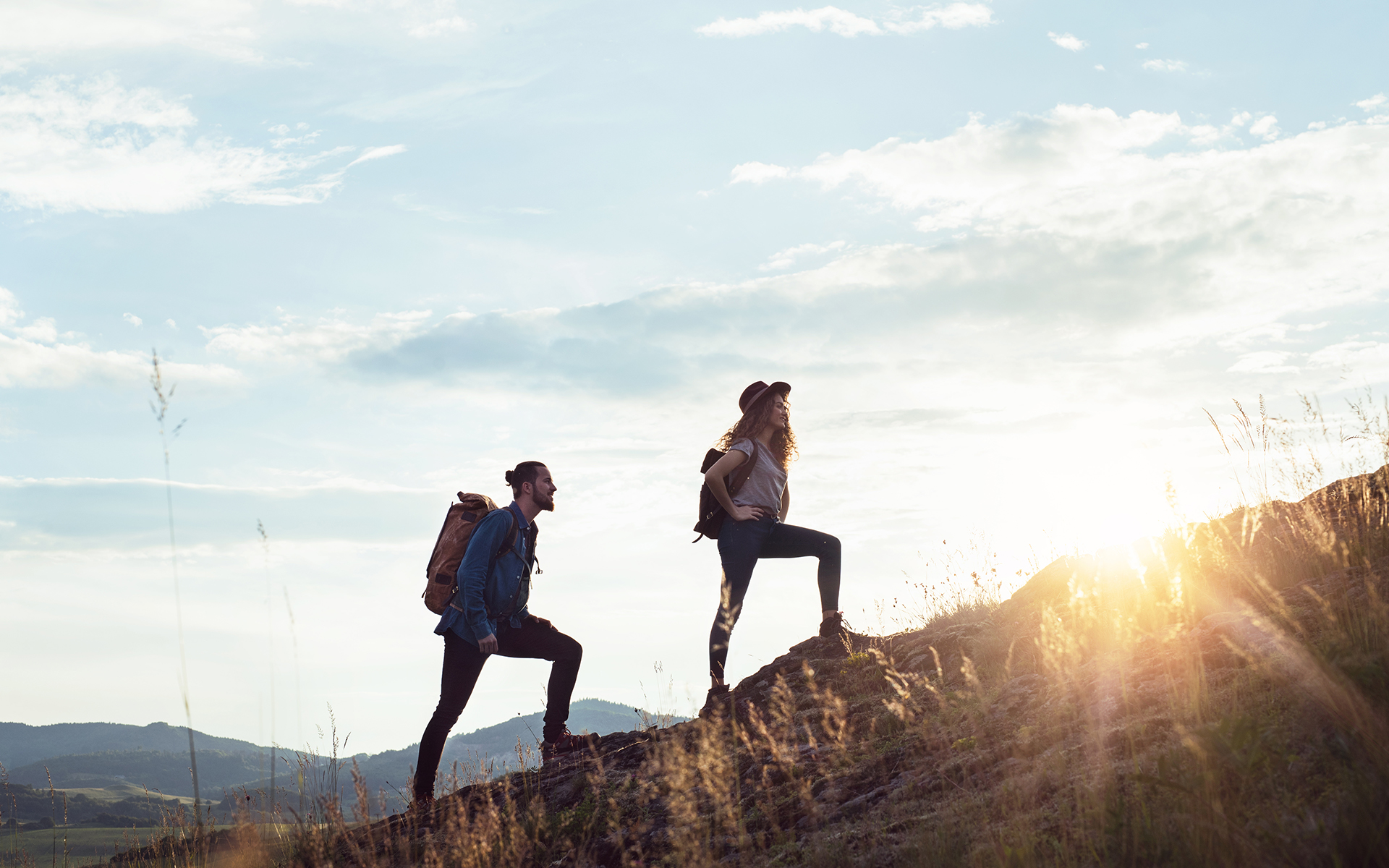
    So far, this hike was leaving much to be desired, but as we emerged above the tree line, I stopped in my tracks. The view was glorious, overlooking the entire valley, with Switzerland and Italy a stone’s throw away. We were so high up, and could see so far. It was stunning to stand there above the trees, the sun streaming down, and to be at eye level with some hawks.

    Plus, there were a couple of paragliders in the air, and I later found out that one of them was Tom Cruise! (Yes, we were on a mountain with Tom Cruise. How many people can say that?) While he was prepping stunt scenes for the next Mission Impossible movie, we were just trying to make it to the top by foot. Everyone’s on their own journey.

    For the next 30 minutes, I was in pure bliss. We traversed in the grass, passed by cows, and ran into a few other people, all the while overlooking villages and seeing the paragliders go down and then get helicoptered back up. It was all amazing, as well as peaceful, sunny, and relaxing. I felt proud of having slogged it uphill under a canopy of trees and was enjoying the reward of the views, thinking we just had a little bit longer to go before reaching the giant cross at the peak.

    But then, at the last section of the hike—the final 35 minutes—the trail became more vertical than horizontal. Though I considered myself in good shape, I was astounded at how hard it was.

    A Grandmother’s Wisdom

    As we started our ascent, this is where I slowly began to crumble, shrinking into a smaller and smaller version of myself with each step. Meanwhile, my husband, who hikes more than I do, was pulling ahead, and the gap between us was widening.

    Were blisters popping up? I don’t really know, because I couldn’t concentrate on anything other than barely putting one foot in front of the other, which I was doing an awful job at. My usual go-to techniques of meditation and breathwork, which typically keep me calm during tough moments, completely failed me. Suddenly, my entire body was in total freak-out mode and I was shutting down. Just me, having a mental breakdown on top of a mountain.

    With 15 minutes left to the top, I stopped. More like, I grunted, then angrily plopped down. I couldn’t believe how hard it was: to lift my foot and place it down again, to keep breathing, and to do it alone, because my husband was already at the top.

    I had a private tantrum, cursing the Criou, my husband for abandoning me, and myself for not being strong enough to make it. As I sat there, I made the decision to not continue, to stay where I was sitting and wait for him to come back down. I refused to go on any longer. Like I said, I was having a real private tantrum.

    That is, until I heard something that made me turn my head. And there she was, a grandmother, walking past me with her adult son. She paused, smiled, shared how they were from Nepal and loved living in the French alps. And then she continued on her way.

    I looked at this old woman, with her kind face, deeply wrinkled eyes, her very slow but steady gait, and felt a moment of gratitude for this reminder to appreciate the present. Watching her pass me as she continued to climb up the mountain inspired me to stand back up. This wasn’t a race; I could do this, and I would be proud of finishing this journey with my partner.

    With each breath, I felt my shoulders unwind, my frustration subside, and my mood lift.

    Her gentleness and perseverance reminded me of my own grandparents. I was raised on their stories about their upbringing, the hardships they’d endured during World War II, and the hope and joy they’d found by choosing a life filled with exercise, connection, and education in the mountains. They had worked hard to create the life of their dreams, which involved sharing their passion for a mindful way of life with others, and watching this grandmother reminded me so much of them. I wanted to be like them, like her!

    So, I closed my eyes and pictured my favorite bedroom in my grandparents’ chalet, where I could see the Criou through the window. I took ten long, deep breaths, inhaling deeply through my nose and exhaling slowly through my mouth. With each breath, I felt my shoulders unwind, my frustration subside, and my mood lift. I don’t know why I couldn’t do this before on my own, but something about seeing this grandmother on the mountain gave me the mental strength I needed to dig deep.

    Feeling stronger, I stood up and followed in her footsteps, and made it to the top, where my husband was waiting, with his hand outstretched, holding a huge ham-and-cheese baguette sandwich for me. Was this heaven?

    Finding Peace at the Peak

    As I sat there next to him, feeling like I was at the top of the world, I took a moment to acknowledge what had just happened inside of me, in the hopes that the next time I was doing something hard and felt like I couldn’t handle it anymore, I would recall that beautiful smiling grandmother and hit the pause button. I’d been so impatient to be at the top already, I nearly forgot to breathe through hard things, to try and find peace in the present moment, and to sometimes just slow down.

    I’ve never hiked the Criou again, but that day remains forever etched into my mind as a beautiful life lesson that I can embrace the adventure of life, try new things, test myself, and keep going. Taking 10 long, slow deep breaths is what helped change the energy in my body that day and gave me the extra push to keep going.

    Since then, I’ve rededicated myself to my meditation and breathwork practice. That moment on the mountain transformed me into someone who meditates twice daily, breathes intentionally throughout the day, and even teaches these techniques to both kids and adults. I look forward to facing the Criou again someday, with a huge ham-and-cheese sandwich by my side. Fingers crossed that Tom Cruise might be there too.


    Source link

  • 15 Proven Yoga Poses for Stress Relief: Find Calm and Peace

    As we navigate the chaotic landscape of modern life, it’s no secret that stress can creep up on us like a thief in the night. The relentless pressures of work, relationships, and social expectations can leave us feeling frazzled, anxious, and utterly spent. Fortunately, there’s a tried and true antidote to this stress epidemic, one that’s been practiced for centuries with incredible efficacy: yoga.

    The ancient art of yoga is often misunderstood as a mere exercise or physical activity, but in reality, it’s a holistic practice that weaves together breathwork, movement, and mindfulness to yield profound benefits for both body and mind. At its core, yoga is about cultivating inner peace, calm, and relaxation, allowing us to better cope with life’s trials and tribulations.

    If you’re looking to harness the stress-relieving powers of yoga, you’ve come to the right place. In this comprehensive guide, we’ll delve into 15 expert-backed yoga poses that will leave you feeling tranquil, centered, and fully at peace. So, take a deep breath, and let’s dive into the wonderful world of yoga for stress relief!

    The Importance of Breathing in Yoga for Stress Relief

    Before we dive into the poses themselves, it’s essential to acknowledge the crucial role of breathwork in yoga. When we’re feeling stressed, our breathing becomes rapid and shallow, leading to a perpetual state of hypervigilation. This tension can radiate throughout the entire body, exacerbating feelings of anxiety and agitation.

    In yoga, breath is considered the bridge between body and mind, allowing us to shift into a state of relaxation and receptivity. By focusing on the breath, we can quiet the mind, calm the nervous system, and create a sense of stability. This, in turn, can dramatically reduce stress levels and promote an overall sense of well-being.

    Top 15 Yoga Poses for Stress Relief

    1. Child’s Pose (Balasana): This gentle, restorative pose allows for a full-body stretch and relaxation, calming the mind and soothing the nervous system.

    Inhale, kneel, and sit back onto heels, with arms extended in front and head resting on the ground.

    • Benefits: Reduces stress, relaxes the neck and shoulders, improves posture.

    1. Downward-Facing Dog (Adho Mukha Svanasana): This inverted V shape stretches and calms the entire body, helping to release tension and promote relaxation.

    From Plank Pose, bend hips, straighten arms, and press forehead to the ground.

    • Benefits: Relaxes the shoulders, hips, and hamstrings, calms the mind, stretches the spine.

    1. Tree Pose (Vrksasana): This balancing pose enhances focus, calmness, and centering, allowing us to more easily navigate life’s challenges.

    Stand tall, with one foot lifted and placed gently on the inner thigh. Hands on hips, gaze forward.

    • Benefits: Improves balance, strength, and flexibility, reduces anxiety.

    1. Seated Forward Fold (Paschimottanasana): This pose stretches and lengthens the entire backside, reducing physical tension and promoting relaxation.

    Sitting with legs extended, keep your back straight, and slowly reach for your toes or shins. Hold.

    • Benefits: Relaxes the neck, shoulders, and hamstrings, stretches the spine, calms the mind.

    1. Bridge Pose (Setu Bandha Sarvangasana): This inverted pose strengthens the back muscles, hips, and glutes, while also calming the mind.

    Lie on your back, arms extended overhead, and slowly lift the hips off the ground. Keep shoulders on the ground.

    • Benefits: Stabilizes the spine, strengthens the glutes, relaxes the shoulders and hamstrings.

    1. Seated Spinal Twist (Bharadvajasana): This gentle twist stretches and releases the entire spine, hips, and torso, relieving tension and promoting relaxation.

    Sitting with legs crossed, inhale, twist torso to the right, and gaze over the left shoulder.

    • Benefits: Relaxes the spine, shoulders, and hips, calms the mind.

    1. Plank Pose (Phalakasana): This foundational pose strengthens the arms, shoulders, and core, while also promoting mental focus and stability.

    Start in a high plank position, with hands shoulder-width apart, gaze down, and engage core.

    • Benefits: Strengthens the arms and core, improves posture, reduces stress and anxiety.

    1. Warrior II (Virabhadrasana II): This powerful pose strengthens the legs and core, while also promoting mental focus, energy, and calmness.

    Stand wide apart, with front foot turned inward and back foot outward, arms extended and gaze forward.

    • Benefits: Strengthens the legs, glutes, and core, improves focus, calmness, and confidence.

    1. Pigeon Pose (Eka Pada Rajakapotasana): This restorative pose stretches and calms the hips, glutes, and legs, promoting relaxation and ease.

    Start in Table Top Pose, lift right foot forward, and rest forehead on the ground.

    • Benefits: Relaxes the hips and glutes, stretches the front and side of the legs, calms the mind.

    1. Reclined Pigeon Pose (Supta Eka Pada Rajakapotasana): This gentle, restorative pose deepens the stretch and relaxation benefits of Pigeon Pose, melting tension and promoting restfulness.

    Lie on your back, inhale, and bring right leg back to the left hip. Rest hands by the sides, and gaze upwards.

    • Benefits: Relaxes the hips and glutes, stretches the front and side of the legs, calms the mind, improves sleep.

    1. Crow Pose (Bakasana): This balancing pose enhances mental clarity, focus, and calmness, promoting greater confidence and poise.

    Kneel, spread the knees wide, and reach up with the hands. Lift onto toes, keeping core engaged, and balance.

    • Benefits: Strengthens the arms, shoulders, and core, improves focus, calmness, and balance.

    1. Sphinx Pose (Salamba Bhujangasana): This gentle, reclined pose strengthens and opens the chest, shoulders, and entire torso, promoting relaxation and calmness.

    Lie on your stomach, inhale, and press palms into the ground. Keep head, shoulders, and torso relaxed, with gaze forward.

    • Benefits: Relaxes the neck, shoulders, and chest, calms the mind, stretches the entire back.

    1. Seated Butterfly Pose (Baddha Konasana): This gentle stretch targets the hips, glutes, and thighs, calming the mind and promoting relaxation.

    Sitting with legs extended, wrap ankles together, and gently press into the ground with hands. Rest hands on knees, and gaze downward.

    • Benefits: Relaxes the hips, glutes, and thighs, calms the mind, stretches the inner thighs and groins.

    1. Head-to-Knee Pose (Janu Sirsasana): This gentle, stretching pose calms the mind and stretches the entire backside, promoting relaxation and relief.

    Sitting with legs extended, bend right knee, rest ankle on the ground, and grasp hand to ankle. Gently lower forehead to the ground, relaxing.

    • Benefits: Relaxes the shoulders, neck, and hamstrings, stretches the entire back, calms the mind.

    1. Legs Up The Wall Pose (Viparita Karani): This restorative pose is a ultimate relaxation, calming the entire body, reducing inflammation, and promoting deep relaxation and restfulness.

    Sit with your back to a wall, inhale, and lift legs up against the wall, straightening knees. Let your head, shoulders, and arms relax.

    • Benefits: Relaxes the entire body, reduces inflammation, calms the mind, promotes deep relaxation.

    Conclusion:

    Incorporating yoga into your daily routine can be incredibly effective in reducing stress, promoting calmness, and improving overall well-being. The 15 poses outlined above offer a powerful blend of physical, mental, and breath-focused practices to help you find calm, clarity, and peace. Remember to start slowly, listen to your body, and make modifications as needed. With consistent practice and dedication, you’ll be well on your way to mastering these stress-relieving yoga poses. So, take a deep breath, quiet your mind, and let the transformative powers of yoga guide you towards a more balanced, radiant, and peaceful you.

    15-proven-yoga-poses-for-stress-relief-find-calm-and-peace