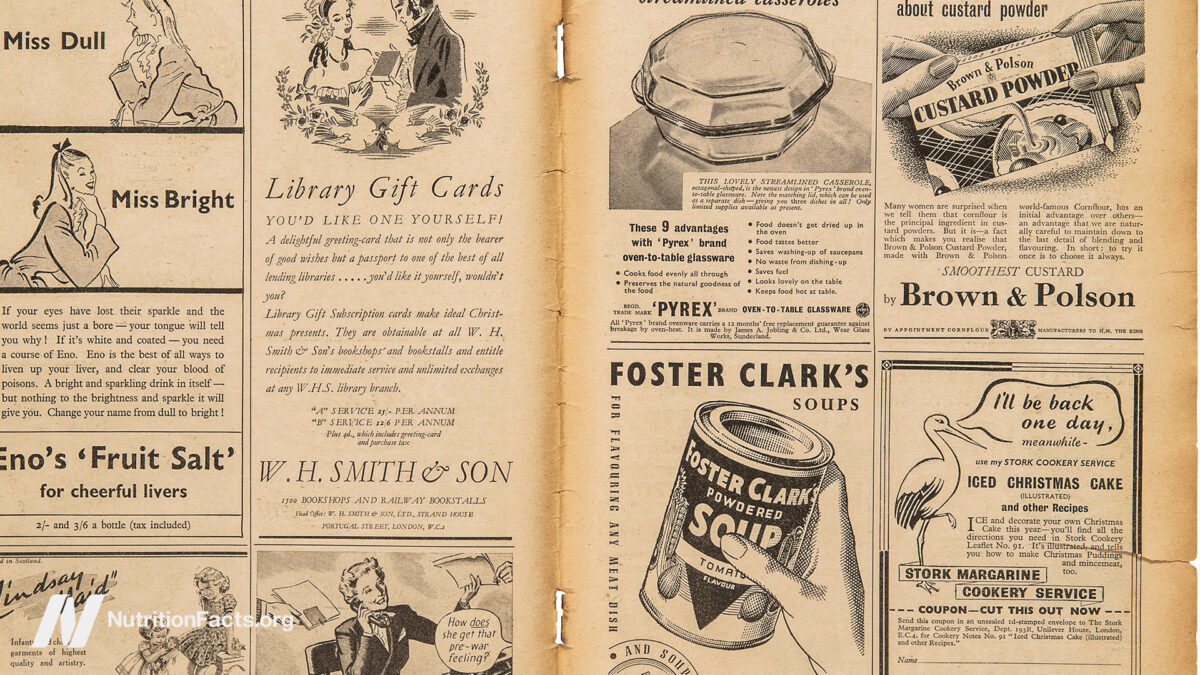
We all like to think we make important life decisions, like what to eat, consciously and rationally, but if that were the case, we wouldn’t be in the midst of an obesity epidemic.
The opening words of the Institute of Medicine’s report on the potential threat posed by food ads were: “Marketing works.” Certainly, there is a “large number of well-conducted randomized experiments” I could go through with you that “have shown that exposure to marketing—especially, but not only, advertising—changes people’s eating behavior. Marketing causes people to choose to eat more.” But, what do you need to know beyond the fact that the industry spends tens of billions of dollars a year on it? To get people to drink its brown sugar water, do you think Coca-Cola would spend a penny more than it thought it had to? It’s like when my medical colleagues accept “drug lunches” from pharmaceutical representatives and take offense that I would suggest it might affect their prescribing practices. Do they really think drug companies are in the business of giving away free money for nothing? They wouldn’t do it if it didn’t work.
To give you a sense of marketing’s insidious nature, let me share an interesting piece of research published in the world’s leading scientific journal: “In-Store Music Affects Product Choice” documented an experiment in which French accordion music or German Bierkeller music was played on alternate days in the wine section of a grocery store. As you can see below and at 1:27 in my video The Role of Food Advertisements in the Obesity Epidemic, on the days the French music played in the background, people were three times more likely to buy French wine, and on German music days, shoppers were about three times more likely to buy German wine. And it wasn’t a difference of just a few percent; it was a complete three-fold reversal. Despite the dramatic effect, when shoppers were approached afterward, the vast majority of them denied the music had influence on their choice.

Most of our day-to-day behavior does not appear to be dictated by careful, considered deliberations, even if we’d like to think that were the case. Rather, we tend to make more automatic, impulsive decisions triggered by unconscious cues or habitual patterns, especially when we are “under stress, tired, or preoccupied. This unconscious part of our brain is estimated to function and guide our behaviors at least 95% of the time.” This is the arena where marketing manipulations do most of their dirty work.
The part of our brain that governs conscious awareness may only be able to process about 50 bits of information per second, which is roughly equivalent to a short tweet. Our entire cognitive capacity, on the other hand, is estimated to process more than 10 million bits per second. Because we’re only able to purposefully process a limited amount of information at a time, if we’re distracted or otherwise unable to concentrate, our decisions can become even more impulsive. An elegant illustration of this “cognitive overload” effect was provided from an experiment involving fruit salad and chocolate cake.
Before calls could be made at the touch of a button or the sound of our voice, the seven-digit span of phone numbers in the United States was based in part on the longest sequence most people can recall on the fly. We only seem to be able to hold about seven chunks of information (plus or minus two) in our immediate short-term memory. The study’s setup: Randomize people to memorize either a seven-digit number or a two-digit number to be recalled in another room down the hall. On the way, offer them the choice of a fruit salad or a piece of chocolate cake. Memorizing a two-digit number is easy and presumably takes few cognitive resources. As you can see in the graph below and at 3:52 in my video, under the two-digit condition, most study participants chose fruit salad. Faced with the same decision, most of those trying to keep seven digits in their heads just went for the cake.
This can play out in the real world by potentiating the effect of advertising. Have people watch a TV show with commercials for unhealthy snacks, and, no surprise, they eat more unhealthy snacks compared to those exposed to non-food ads. Or maybe that is a surprise. We all like to think we’re in control and not so easily manipulated. The kicker, though, is that we may be even more susceptible the less we pay attention. Randomize people to the same two-digit or seven-digit memorization task during the TV show, and the snack-attack effect was magnified among those who were more preoccupied. How many of us have the TV on in the background or multi-task during commercial breaks? Research suggests that may make us even more impressionable to the subversion of our better judgment.
There’s an irony in all of this. Calls for restrictions on marketing are often resisted by invoking the banner of freedom. What does that even mean in this context, when research shows how easily our free choices can be influenced without our conscious control? A senior policy researcher at the RAND Corporation even went as far as to suggest that, given the dire health consequences of our unhealthy eating habits, “the marketing techniques of which we are unaware should be considered in the same light as the invisible carcinogens and toxins in the air and water that can poison us without our awareness.”
Given the role marketing can play even when we least suspect it, what is the role of personal responsibility in the obesity epidemic? That’s the subject of my next video.
We are winding down this series on obesity, with three videos remaining:
If you missed any of the previous videos, see the related posts below.