Tag: nuts

  • Are Nuts and Peanut Butter Linked to a Longer Life?

    Are Nuts and Peanut Butter Linked to a Longer Life?

    Why are nuts associated with decreased mortality, but not peanut butter?

    According to the largest study of risk factors for death in human history, a poor diet causes more deaths than anything. Cigarettes only kill about 8 million people a year, whereas humanity’s diet kills millions more, as you can see below and at 0:20 in my video Do the Health Benefits of Peanut Butter Include Longevity?.What are the worst aspects of our diet? Processed meat? Twinkies? Soda? No, the five deadliest things about our diet are: not enough fruit, not enough whole grains, not enough vegetables, too much salt, and not enough nuts and seeds, as shown here and at 0:42 in my video.

    Nuts should come as no surprise since interventional trials have shown that eating nuts improves artery function, and arterial diseases like heart disease are among our leading killers. But that’s not all nuts can do. They may also improve blood sugar control, lower cholesterol, suppress inflammation, reduce oxidative stress, and feed our friendly gut flora. Do all nuts do that, or just tree nuts?

    What about peanuts and peanut butter? About half of peanut consumption in the United States is from peanut butter, but the link between peanut butter consumption and mortality has not been evaluated thoroughly. To get that specific, we can call on the National Institutes of Health-AARP study, the largest prospective health and diet study in history that followed more than half a million people since the 1990s.

    Researchers found that nut consumption in general appeared to protect against all-cause mortality, meaning nut-eaters live—on average—longer lives. Specifically, they are less likely to die from cancer, cardiovascular disease, liver disease, respiratory disease, kidney disease, and infectious causes (so, maybe nuts help immunity as well). However, no such associations were found for peanut butter. So, when it comes to living longer, peanut butter doesn’t seem to count. Why?

    Well, we know peanut butter consumers tend to eat more meat, smoke cigarettes, and are less likely to exercise, but the researchers controlled for all those factors, as well as their alcohol consumption, fruit and veggie intake, education, and more. So, it’s not like the peanut butter eaters were just eating more white bread sandwiches or something. (The researchers didn’t control for sugar, though, so it’s possible they could have been eating more sugary jelly.)

    Another explanation: It could be the processing that goes into making peanut butter—the added trans fat, oil, salt, and sugar. But regular nuts are also often eaten with added oil, sugar, and salt.

    Could it just be the peanuts themselves? Technically, they aren’t nuts, so maybe they don’t have the same benefits. But no, a meta-analysis of all such studies found the same nut-like benefits for whole peanuts, but not peanut butter.

    Well, one thing missing from even no-salt, oil-free, sugar-free nut and seed butters is intact cellular structure. As I noted in How Not to Diet, no matter how well we chew whole or chopped nuts, some of the nutrients remain trapped in tiny particles that deliver a bounty of prebiotic goodness to our friendly gut flora. That makes me wonder if there would have been any difference between chunky and smooth peanut butter.

    Meanwhile, there is “compelling evidence” to recommend eating nuts (preferably raw nuts over salted or toasted, and whole or chopped nuts rather than nut butters) at least three times a week to maximize our chance of living a longer and healthier life.

    Doctor’s Note

    The healthiest nut may be walnuts. See Walnuts and Artery Function.

    Won’t nuts make you fat, though? See Nuts and Obesity: The Weight of Evidence.

    I mentioned my book, How Not to Diet, which you can read more about here. (All proceeds from my books are donated to charity.)

    Source link

  • Nuts, Sperm, and Sex: The Surprising Connection

    Nuts, Sperm, and Sex: The Surprising Connection

    Walnuts, almonds, and hazelnuts are put to the test for erectile and sexual function, sperm count, and semen quality.

    In 2013, I posted a video based on a study that found that men with erectile dysfunction who ate 100 grams of pistachios (a little more than three handsful) a day for three weeks had “a significant improvement in erectile function.” It’s always nice to see a whole-food intervention have clinical effects, and I was curious to revisit the topic and see what’s been published since.

    Even if you ignore all the lab animal studies on hazelnuts improving the function of rat testicles—really, there’s a study titled “Hazelnut Consumption Improves Testicular Antioxidant Function and Semen Quality in Young and Old Male Rats”—you still never know what you’ll find searching the medical literature for nuts and sexual function. I found “a case of penile strangulation with a metal hex nut” in which someone put one on his penis “for sexual pleasure” but couldn’t remove it. (I guess some kinds of nuts can sometimes make things worse.) They tried the Dundee technique, which involves creating 20 puncture holes to relieve the pressure, but that didn’t work, so then they tried a diamond disk cutter. It slipped a few times, but the hex nut was successfully removed. All’s well that ends well.

    That got me curious. Evidently, penile entrapment is so common that there is an entire grading system that emergency room doctors can use, as you can see here and at 1:21 in my video Mixed Nuts Put to the Test for Erectile Dysfunction. If a drill isn’t available, the surgeons advised, “a hammer and chisel may be used to remove nuts.”

    A drill? Oh, they mean a dental drill. Doctors describing one case bragged about the “precisely cut edges,” but it looks pretty jagged to me. You can see for yourself below and at 1:38 in my video.

    To “preserve the penis from fatal outcomes” (that’s a strange way to put it), urologists should be aware of all the available tools and approaches, and if you don’t know how to operate the saw, you can always call in the local blacksmith—but only if “special consent [is] taken from the patient”!

    But how are you going to remove an iron barbell or steel sledgehammer head? “With a heavy-duty air grinder provided by the fire department,” requiring six hours of cutting and fire coats to protect the patient from the sparks. Use whatever it takes—hack saw, “cement eater.” You can even use the silk winding method pioneered by Dong et al.

    Back to the task at hand! Consuming “at least one serving of vegetables a day and more than two servings of nuts a week was associated with a more than 50% decrease in the probability of ED” [erectile dysfunction] in a snapshot-in-time cross-sectional study. But such observational studies can’t prove cause and effect. It’s like finding that men who eat healthier have better sperm motility. Maybe men who eat nuts are just health nuts, and the improvement is due to some other factor, like exercise. What we need is an interventional trial.

    And there is one: a randomized controlled trial studied the “effect of nut consumption on semen quality and functionality.” Healthy men were fed the standard American diet with or without a mixture of nuts—a handful (30 grams) of walnuts and half a handful (15 grams) each of almonds and hazelnuts. Individuals in the nut group experienced significant improvements in their total sperm count, vitality, motility, and shape, perhaps because those “in the nut group showed a significant reduction in SDF”—sperm DNA fragmentation. The nuts appeared to protect their sperm DNA. It’s too bad that the researchers didn’t measure the men’s erectile and sexual dysfunction while they were at it. Oh, but they did!

    What is the effect of nut consumption on erectile and sexual function from that same study? The researchers report that those in the nut group saw a significant increase in orgasmic function and sexual desire, but what about erectile function? Any time you see this kind of selective glass-half-full reporting, you suspect some kind of industry funding, and, indeed, that was the case here; the study was partially funded by the International Nut and Dried Fruit Council. Yes, there was a marginal increase in orgasmic function and sexual desire of questionable clinical significance, but there was no improvement in erectile function, intercourse satisfaction, or overall satisfaction. As with so many comparisons, even the so-called significant findings may not even be statistically significant.

    But why did the pistachios I talked about back in 2013 work, while these other nuts didn’t? Well, the original study was done on men mostly in their 40s and 50s who already had chronic erectile dysfunction for at least one year, whereas the average age of participants in the newer study was 24. So, the individuals in the later study may have started out with near-maximum circulation, not leaving much room for the nuts to work any magic.

    Doctor’s Note

    Sorry for that crazy tangent! I just wanted to give people a taste of what it can be like when you dive deep into the medical literature.

    The 2013 video I mentioned is Pistachio Nuts for Erectile Dysfunction.

    What about walnuts for arterial blood flow? See Walnuts and Artery Function.

    More on fertility and sexual function in the related posts below.

    Source link

  • How Healthy Are Baruka Nuts?

    How Healthy Are Baruka Nuts?

    How do barukas, also known as baru almonds, compare with other nuts?

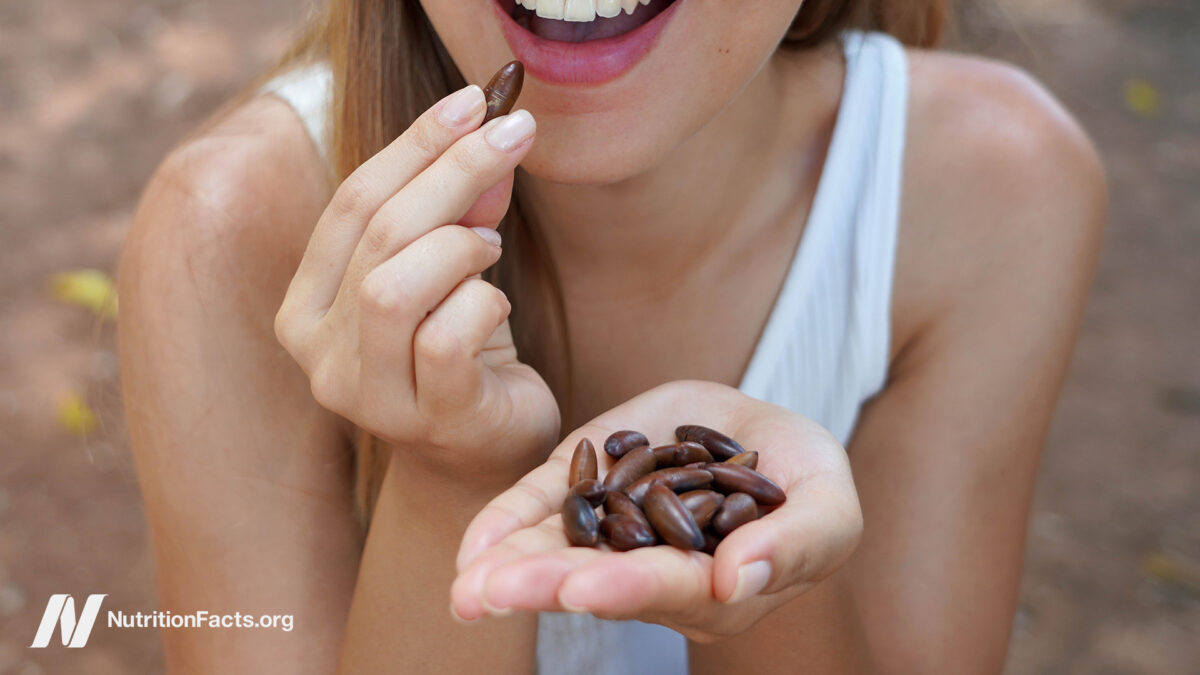
    There is a new nut on the market called baru almonds, branded as “barukas” or baru nuts. Technically, it isn’t a nut but a seed native to the Brazilian Savannah, known as the Cerrado, which is now among the most threatened ecosystems on the planet. Over the last 30 years, much of the Cerrado’s ecosystem has been destroyed by extensive cattle ranching and feed crop production to fatten said cattle. If it were profitable not to cut down the native trees and instead sell baru nuts, for example, that could be good for the ecosystem’s health. But what about our health?

    “Although baru nuts are popular and widely consumed, few studies report on their biological properties.” They do have a lot of polyphenol phytonutrients, presumably accounting for their high antioxidant activity. (About 90% of their phytonutrients are present in the peel.) Are they nutritious? Yes, but do they have any special health benefits—beyond treating chubby mice?

    Researchers found that individuals fed baru nuts showed lower cholesterol, supposedly indicating the nuts “have great potential for dietary use” in preventing and controlling cholesterol problems. But the individuals were rats, not humans, and the baru nuts were compared to lard. Pretty much everything lowers cholesterol compared to lard. Nevertheless, there haven’t been any reports about the effect of baru nut consumption on human health, until this: A randomized, controlled study of humans found that eating less than an ounce a day for six weeks led to a 9% drop in LDL cholesterol. Twenty grams would be about 15 nuts or a palmful.

    Like many other nut studies, even though the research subjects were told to add nuts to their regular diets, there was no weight gain, presumably because nuts are so filling that we inadvertently cut down on other foods throughout the day. How good is a 9.4% drop in LDL? It’s the kind of drop we can get from regular almonds, though macadamias and pistachios may work even better, but those were at much higher doses. It appears that 20 grams of baru nuts work as well as 73 grams of almonds. So, on a per-serving basis or a per-calorie basis, baru nuts really did seem to be special.

    There are lower-dose nut studies that show similar or even better results. In this one, for instance, people were given 25 grams of almonds for just four weeks and got about a 6% drop in their LDL cholesterol. In another study, after consuming just 10 grams of almonds a day, or just seven individual almonds a day, study participants got more like a 30% drop in LDL during the same time frame as the baru nuts. Three times better LDL at half the dose with regular almonds, as you can see below and at 2:47 in my video Are Baruka Nuts the Healthiest Nut?.

    The biggest reason we are more confident in regular almonds than baru almonds is that studies have been done over and over in more than a dozen randomized controlled trials, whereas in the only other cholesterol trial of baru nuts, researchers found no significant benefit for LDL cholesterol, even at the same 20-gram dose given for even longer—a period of eight weeks.

    That’s disappointing, but it isn’t the primary reason I would suggest choosing other nuts instead of baru nuts. I would do so because we can’t get raw baru nuts. They contain certain compounds that must be inactivated by heat before we can eat them. The reason raw nuts are preferable is because of advanced glycation end-products (AGEs), so-called glycotoxins, which are known to contribute to increased oxidative stress and inflammation.

    Glycotoxins are naturally present in uncooked animal-derived foods, and dry-heat cooking like grilling can make things worse. The three highest recorded levels have been in bacon, broiled hot dogs, and roasted barbecued chicken skin—nothing even comes close to that, not even Chicken McNuggets, as you can see below and at 3:50 in my video.

    However, any foods high in fat and protein can create AGEs at high enough temperatures. So, although plant foods tend to “contain relatively few AGEs, even after cooking,” there are some high-fat, high-protein plant foods. But, again, AGEs aren’t a problem at all with most plant foods. See the AGE content in boiled tofu (in a soup, for instance), broiled tofu, a raw apple, a baked apple, a veggie burger—I was surprised that veggie burgers are so low in AGEs, even when baked or fried—and nuts and seeds, which are up in tofu territory, especially when roasted, which is why I would recommend raw nuts and seeds and nut and seed butters whenever you have a choice. See below and at 4:33 in my video.

    Doctor’s Note

    In my Daily Dozen checklist, I recommend eating a quarter cup of nuts or seeds or two tablespoons of nut or seed butter each day. Why? See related posts below. 

    For those unfamiliar with advanced glycation end-products (AGEs), check out the first two videos I did on them way back when: Glycotoxins and Avoiding Glycotoxins in Food.


    Source link