Tag: Nature

  • Jane Fonda at Spirit Rock: Mindfulness, Climate Action, and Community

    Jane Fonda at Spirit Rock: Mindfulness, Climate Action, and Community

    Jane Fonda did not come to Spirit Rock to offer comfort.

    She came to invite attention toward what we’re inheriting, what we’re losing, and what we still have to protect.

    For different generations, Jane Fonda has arrived in various forms. Some of us know her as an Oscar-winning actress whose early roles challenged cultural norms in films like Klute and Coming Home; others might remember her from her iconic fitness workouts in the early 80s (if you know, you know.)

    But Jane Fonda doesn’t just redefine herself decade after decade, she reframes and rebuilds the very structures and movements she’s a part of. Whether that’s turning fitness into accessible self-care for women, relaunching the Committee for the First Amendment (free speech, anyone?), taking on the climate crisis by starting the Jane Fonda Climate PAC, or redefining vitality for anyone later in life through her role on the beloved show Grace and Frankie. These chapters, however, only hint at a deeper through-line.

    Jane Fonda models a form of mindful leadership rooted not in legacy, but in invitation, showing how presence, curiosity, and connection can awaken action in every generation.

    For decades, Fonda has leveraged her visibility as a platform, founding media outlets, funding grassroots organizing, lending her body to protests, and repeatedly engaging in uncomfortable conversations in service of collective change. Today, she directs that same attention toward the climate crisis, whether by forging relationships with younger artists like Maggie Rogers, who went on to more openly use her platform for climate and social advocacy after connecting with Fonda, or by studying with Roshi Joan Halifax to deepen her meditation practice and the way she shows up in the world.

    One thing is for sure: Jane Fonda models a form of mindful leadership rooted not in legacy, but in invitation, showing how presence, curiosity, and connection can awaken action in every generation.

    Mindfulness As Training, Not Escape

    Fonda recently spoke as part of Spirit Rock’s EcoDharma & Transformational Culture Program (ETCP), a three-year initiative launched in January 2025 that explores how mindfulness and contemplative practices can support more intentional responses to climate change. While this program draws on Buddhist teachings, it is intentionally inclusive, inviting participants from diverse faiths and backgrounds.

    In ETCP’s context, “spiritual” refers to practices that help cultivate awareness, compassion, and resilience—tools for understanding and responding to climate-related stress. The program addresses the intersection of mindfulness, ecological issues, and the urgent need for thoughtful, effective action.

    For many readers of Mindful, meditation may feel like refuge, a place to step away from the unrelenting churn of news cycles, politics, and ecological grief. What this gathering at Spirit Rock made clear is that mindfulness was never meant to be an escape hatch. It was meant to be training. 

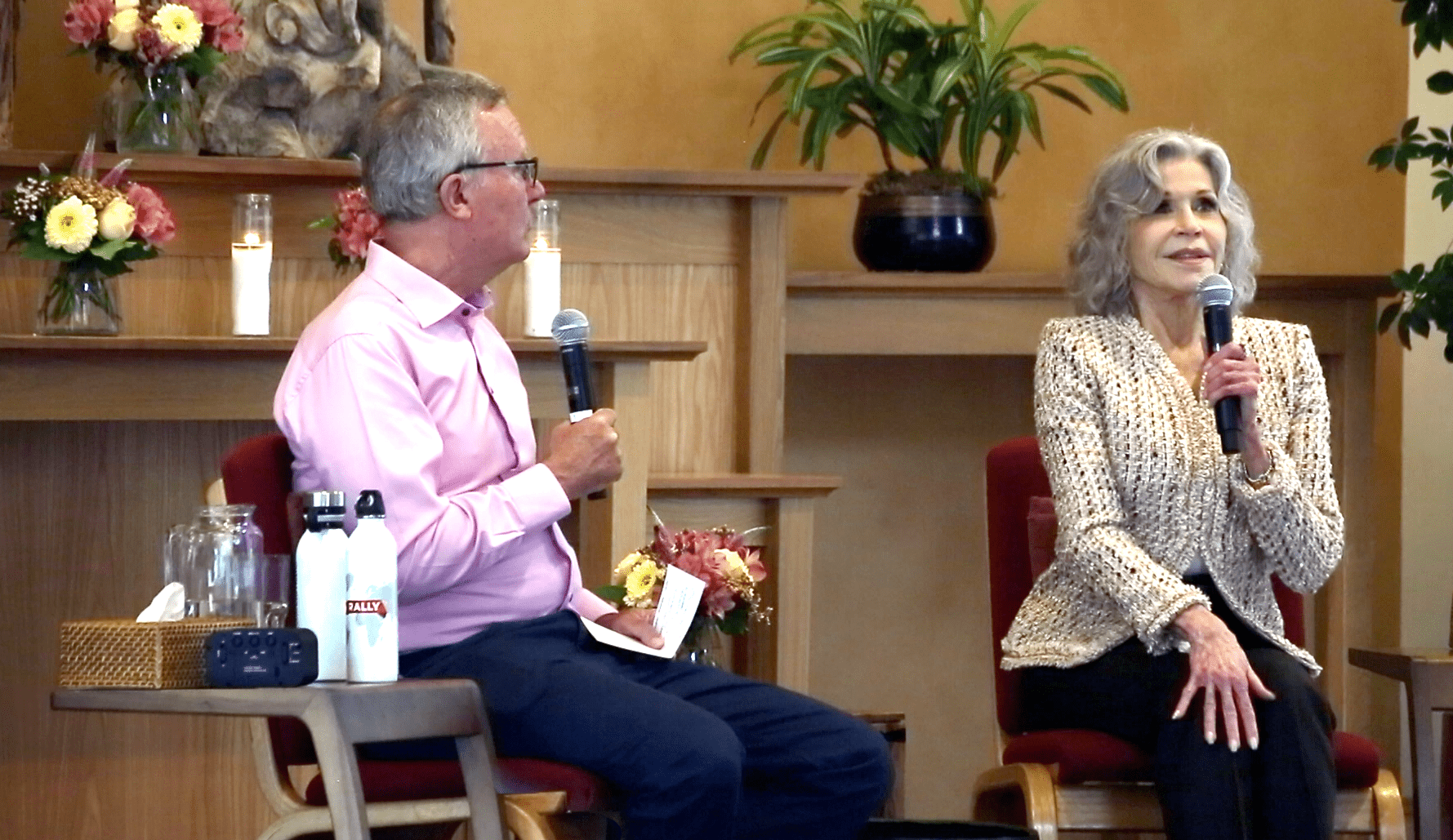
    At a moment when the climate crisis feels simultaneously overwhelming and dangerously normalized, Fonda’s presence at Spirit Rock Meditation Center landed with the weight of lived experience—decades of activism, moral reckoning, and an unshakeable belief that we cannot separate inner work from outer action. Her conversation with climate journalist Greg Dalton functioned as a deeply reflective inquiry into what it means to stay awake, empathetic, and engaged as time runs out.

    For many readers of Mindful, meditation may feel like refuge, a place to step away from the unrelenting churn of news cycles, politics, and ecological grief. What this gathering at Spirit Rock made clear is that mindfulness was never meant to be an escape hatch. It was meant to be training.

    Freepik.com | DC Studio

    Urgent & Hopeful

    Fonda spoke with respect to urgency, but not from a place of hopelessness. Instead, she framed this moment as one that demands both honesty and courage. “This is a moment when we have to bring our empathy to the fore,” she said, speaking to the deep divisions defining public life. Empathy, for her, is not a passive feeling—it is an active discipline, one she traces directly to her life in the arts.

    “Acting is a profession of empathy,” Fonda explained. “We have to enter the skin of another human being and understand them … You can’t do that without empathy. And you have to have empathy even for somebody that you don’t like.”

    That capacity, to stay open rather than armored, has helped to shape her activism as much as her performances. Fonda spoke candidly about how long it took her to soften what she called an “armored heart,” and how belonging to movements, rather than acting alone, made vulnerability possible. “There can come a moment in life when you enter a situation and, you know, this is where I’m supposed to be,” she said. “If you’re not alone, if you’re part of a movement, that sense allows you to become vulnerable and to open your heart.”

    This insistence on collective action, grounded in relationship rather than righteousness, ran through the entire conversation.

    ETCP’s mission is twofold: to support interfaith leaders and activists in meeting climate trauma with resilience and joy, and to empower a new generation of global citizens.

    Over the next three years, ETCP will offer online lectures, class series, in-person retreats, and training programs designed to support communities engaging with climate change not only as a scientific or political issue, but also as a profoundly emotional and spiritual one. The program is guided by a core planning team of respected teachers and leaders, including Ayya Santacitta, Bonnie Duran, Carol Cano, James Baraz, Kirsten Rudestam, Kristin Barker, Mark Coleman, and Yong Oh, in collaboration with partners such as One Earth Sangha, Braided Wisdom, Aloka Earth Room, and Awake in the Wild.

    Its mission is twofold: to support interfaith leaders and activists in meeting climate trauma with resilience and joy, and to empower a new generation of global citizens. At its heart is a radical proposition—that joy, mindfulness, and love for the Earth are not distractions from climate action, though essential to sustaining it.

    When Mindfulness Meets the Climate Crisis

    For many meditators, the connection between mindfulness and climate change is not apparent. Sitting quietly with the breath can feel worlds away from melting ice caps, polluted water systems, or data centers sprawling across the landscape.

    Fonda expressed concern about AI and the rapid speed of technological advancement. “I’m horrified by it,” she admitted, acknowledging her own complicated relationship with technology. “I have ChatGPT on my phone. I feel guilty… I don’t understand it well enough to know how to combat it.”

    Rather than offering easy answers, Fonda modeled something rarer: the willingness to stay with not-knowing without disengaging. Climate action, she suggested, does not begin with mastery; it starts with attention.

    Her reflections on Indigenous knowledge underscored what has been lost through disconnection. Recalling time spent learning about the Ecuadorian rainforest, she talked about communities that live in conjunction with the land. “They showed us which plants heal which diseases,” she said. “We once knew how to listen to plants. We’ve forgotten how.”

    Mindful engagement does not mean doing everything. It means doing something with intention, alongside others.

    EcoDharma, as Spirit Rock frames it, is precisely this remembering—not as nostalgia, but as practice. And the key part of practice, when we hold both the Dharma and the environment front and center in our minds, is to understand that we all have something to do, no matter how small the task or step may be. As ETCP leaders emphasize, mindful engagement does not mean doing everything. It means doing something with intention, alongside others.

    Identifying Our Unique Role to Play

    A recurring question throughout the retreat was one many people quietly carry: What can I do?

    Fonda’s answer was pragmatic and unsentimental. After years of protest through Fire Drill Fridays, she and a small group of collaborators recognized a gap between public pressure and policy change. “We haven’t got the legislation that’s commensurate with what science is saying we have to have,” she said. “The reason is that so many elected officials take money from the fossil fuel and petrochemical industries.”

    That realization led to the creation of Jane Fonda Climate Pac, a political action committee focused on down-ballot races and state and local positions that often receive little attention but wield enormous influence over climate outcomes. “Public utilities, school boards, city councils, state legislatures, attorneys general,” Fonda noted. “All these people have huge power.”

    The results have been striking: hundreds of climate champions elected, many of them women and women of color, willing to stand up publicly for environmental rights. “It’s working,” she said.

    Alternate Entry Points to Climate Action

    For those wary of politics, Spirit Rock’s EcoDharma program offers additional entry points and ways to engage, with an emphasis on joy-based action, interconnection, and resilience. This programming is designed precisely for people who feel overwhelmed, polarized, or exhausted by climate discourse.

    Perhaps the most resonant moment of listening to Fonda speak was when she was asked about courage—how she continues to speak so openly, without becoming defensive, after decades in the public eye.

    “It has been a process,” she said. “It took me a long, long time to open my heart.” What changed was not confidence, but belonging. “Being part of a movement… allows you to become vulnerable.”

    She spoke about care—sleep, community, working with people she admires—as essential, not indulgent. “I’m a late bloomer,” she said with a smile. “But being a late bloomer is okay as long as you don’t miss the flower show. And I’m in the midst of a flower show.”

    EcoDharma does not ask practitioners to abandon stillness. It asks them to let stillness inform their response. To allow mindfulness to widen into care, and care into action.

    In that image, flowers blooming against the odds was a quiet invitation. EcoDharma does not ask practitioners to abandon stillness. It asks them to let stillness inform their response. To allow mindfulness to widen into care, and care into action.

    As Fonda reminded the room, hope is not something we wait for.
    It is something we practice—together.

    For more ways to connect, here’s a mindful action guide to use & share. Links are also provided below.
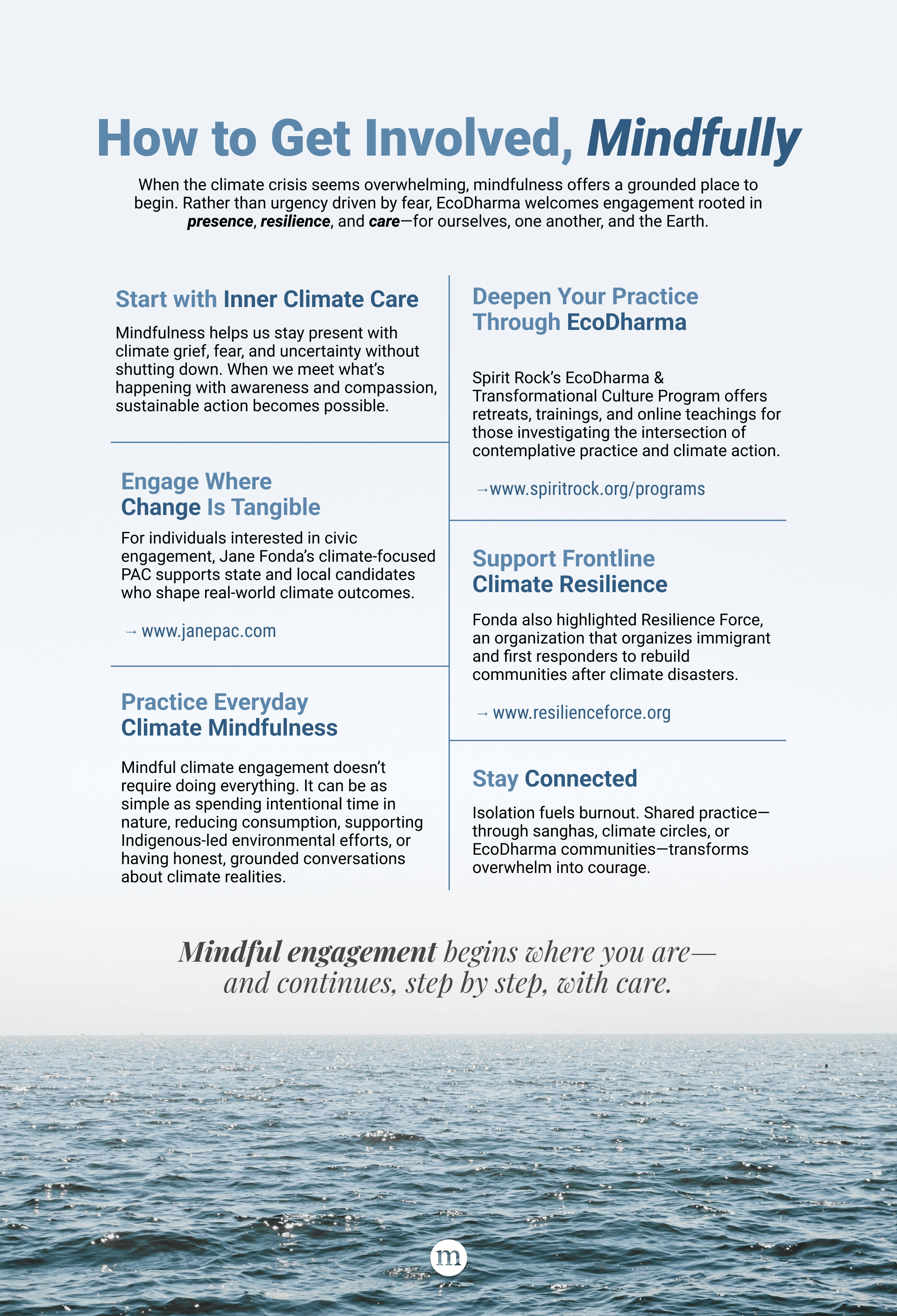

    A mindfulness infographic over ocean water, inspired by Jane Fonda, lists ways to get involved in climate action with care and presence.


    Source link

  • Thanksgiving All Year Long: 5 Simple Gratitude Practices for Daily Life

    Thanksgiving All Year Long: 5 Simple Gratitude Practices for Daily Life

    5 Simple Gratitude Practices for Daily Life

    1) Begin with Gratitude for Your Body—Elaine Smookler

    Some days I wake up and notice that my spring has already sprung and each movement has a kind of creaking quality. After years of practicing mindfulness, it makes me smile. Whatever experience I’m having—good, bad, pleasant, unpleasant—I will never pass this way again. 

    This is an invitation to explore the experience of the present moment in all its gory glory. You can do this practice sitting, standing, upside down or whatever way you find the present moment. 

    1. Let’s start by taking three nice big breaths. Breathe in for a count of three and out for a count of five. Do you notice? You’re alive. It’s actually kind of amazing. Can you bring your attention to the jaw-dropping wonder that is the human body?
    2. Let’s start with the toes, bringing attention to your feet touching the ground. You may be amazed by how many sensations there are to experience, whether it’s tingling, pulsing, restlessness, hot, cool, moist, dry, ticklish, itchy, numb, neutral. What do you notice about paying attention to these small experiences? Is it possible that they could help you cultivate gratitude for this body that’s going to accompany you through your life?
    3. As you move up the legs, what do you feel? Whenever I feel anything uncomfortable, I notice how much I want to make meaning out of it. Instead, I invite us all to just feel what’s here without making any meaning of it at all. It’s all so interesting. So this is what’s happening now
    4. Moving up the land of pelvis, I notice clenching the moment I go to explore sensations in my bladder. Do I dare? Again, reminding myself that it’s not about trying to relax or make anything easier or better. I use these moments of awareness to widen the palette of colors available to experience what it is to be a human. When you do this, what do you notice? 
    5. Continuing the journey up the body, eventually we encounter the beautiful belly filled with so many stories. Loss, longing, yearning, wanting. Can you be grateful for all that it’s experienced and send it love and appreciation? 
    6. Moving up through the torso, this luscious landscape which houses heart and lungs, you may picture an inner river pumping and flowing, bringing juicy life through the body.
    7. When you reach your shoulders, you can lay gentle hands on yourself, massaging some of the day’s stress away. Taking a moment to be grateful for all that our shoulders shoulder. Swooping down through arms to fingers, I thank them for allowing me to be independent in so many ways. Can you offer appreciation to your hands and arms that work so hard? 
    8. We visit the neck and face. Are lips dry or moist? Are your teeth clenched? What about the jaw? Can you feel the air moving in and out of your nostrils? Can you notice your eyeballs, top of head, back of head, side of head, and ears?
    9. On an out-breath, let go of focused awareness. On an in-breath, expand your attention around the entire body, noticing all the sensations reminding you that you are alive right now. What do you notice when you bring the spirit of gratitude into every precious moment that you and your body share together?

    2) Allow Gratitude to Connect You to All Living Things—Shauna Shapiro

    Mindfulness, self-compassion, gratitude, and the practices that emerge from them help free us from the prison of isolation and the delusion of separation. These practices open our minds, awaken our hearts, and deepen our sense of connection with ourselves, each other, and our world. We begin to realize that we are never just practicing for ourselves. Transforming ourselves creates echoes in the universe, because as we heal ourselves, we heal each other, and our world. As renowned author Arianna Huffington beautifully puts it, “Living in a state of gratitude is the gateway to grace.” 

    1. Begin by settling the mind and body, taking a seat on a chair, on the floor, or wherever you can sit comfortably upright. Allow a soft smile to rest on your lips, not as a way to paper over how you are feeling, but simply to invite in rest and ease.
    1. Bring your awareness to the simple sensations of breathing. Feel how the breath is supporting you, oxygenating the body with each inhale, releasing stress and toxins with each exhale. Begin to sense the beating of your heart. Become aware of how the heart is supporting you, sending blood carrying oxygen and nutrients to all the trillions of cells in your body. Invite in a feeling of gratitude and kindness toward your breath, your heart, your body.
    1. Begin to feel your body in your seat, and let your awareness expand to include the earth below you, supporting you. Allow yourself to rest into the Earth, to feel held by the Earth. Feel how there is nothing more you need to do in this moment.
    1. Reflect on how the Earth is supporting all beings equally, and that gravity is keeping all beings tethered to the Earth. Reflect on how this planet is connected to a solar system and a vast universe. And that all things—all humans, all animals, the Earth, the sun, and the stars—are composed of the same matter, the same basic particles. We are literally all made of stardust.
    1. Feel the web of life into which we are born, from which we can never fall. Feel how you are part of this web. Nothing is separate.
    1. Feel yourself resting with gratitude in the heart of the universe. Begin to send your good wishes to all beings, gently and silently repeating, “May all beings be peaceful. May all beings be safe and protected. May all beings be happy. May all beings be filled with love and kindness.”
    1. And then recognize that you are contained within the good wishes for all beings. Rest your attention once again on this one being sitting here, and silently direct the good wishes to yourself: “May I be peaceful. May I be safe and protected. May I be happy. May I be filled with love and kindness.”
    1. As you breathe in, you are breathing in this loving-kindness, and as you breathe out, you are sending this loving-kindness out. May all beings here and everywhere dwell with peace. May the Earth dwell in peace. And close by offering: May this practice be of benefit for all beings.

    Excerpted from Good Morning, I Love You:  Mindfulness and Self-Compassion Practices to Rewire Your Brain for Calm, Clarity and Joy by Shauna Shapiro, PhD. Sounds True, June 2022.  Reprinted with permission.

    3) Awaken the Flow of Gratitude in Nature—Georgina Miranda

    Regardless of where I am experiencing nature—at a local city park, perched up high on mountain tops, or swimming in the sea—I’ve found it is always a good time to pause and be present with the gratitude I feel for our inherent connectedness to nature. Our breath is an anchor that can always bring us home. A few deep breaths, connecting with the space we are in, bring home a knowing that there is no separation between us. We need our Grand Mother, the Earth—her air to fill our lungs, her living things to feed us, her awe to keep our souls warm. She needs us too—to look after her, to shift our day-to-day ways of living, to treat her as one of our dearest friends.

    Next time you are in nature, see if you can shift from a state of doing into a state of being. The key difference between exercise and movement is that when you move with the intention of exercise, you quickly enter a state of doing. Movement is free-flowing and allows you to enter a state of being. The benefits are vast when you allow yourself to be one with the nature you choose, connecting and moving with gratitude.

    1. Give yourself permission to be. Go into nature without an agenda or expectations and just to be with it and move with it. If you are struggling with stress, anxiety, depression, or sluggishness, let movement outside help ignite an internal shift. 
    1. Breathe and pay attention. Bring all the attention to your breath, its rhythm, its ability to inspire a reset with each inhale and exhale. Notice the air you are breathing in, the smells, the temperature, the freshness. Let each inhale be an opportunity to connect you deeper with the nature you are in. Let each exhale be an opportunity to let go of anything that is not needed at this moment. 
    1. Breathe and feel deeper. When you’re connected to your breath, what else do you feel? As you take each step, what flows through your body? How does the sun, wind, snow, or rain feel on your skin? What can you hear? While you notice each breath you take, can you start to unite with the space you are in, versus be separate from it? Can you notice you are one with the earth, the air, the water, around you? 
    1. Breathe and open up to gratitude. Look around, and while staying connected to your breath, let your heart open to any gratitude that’s arising in this moment. Gratitude for the pause in the busyness of life and existence…to your body for its willingness to move freely…to this natural setting and the natural gifts from Mother Earth to you…for this moment of well-being…for knowing that this type of movement, state of awareness, and pause all in one is always available to you. 
    1. Surrender. Surrender completely with the help of the beautiful nature around you. Become one with it, one with your breath. Just be and soak in the feeling of liberation that can come from the present moment. 

    4) Counteract Resentment—Barry Boyce

    To begin this gratitude practice, I’d like to start by considering one of the biggest obstacles to gratitude: resentment. We can dress up our resentment with a sophisticated storyline about how others—one, or many, or multitudes—are doing us wrong, but what it simply boils down to is being upset because we’re not getting what we want.

    The world is too complex and multifaceted for us to continually get our way. It’s good to aspire for the best for ourselves and others, while nonetheless remaining committed to the journey more than the satisfaction of achieving a fixed outcome. If everyone gets their way, we can’t have a cooperative world. From time to time, we need to undercut our own perspective and see things from the other side—maybe even from all sides. Gratitude is a practice that can work with the tendency to cling to fixed outcomes and to feel resentful when we don’t get our way. 

    1. Bring to mind something that seems unlikely to change and that you do not accept. Perhaps it’s something that’s happened to you or it’s something that’s going on with a loved one or in the world at large. It can be big or small.
    2. Counter-intuitively say thank you for that. You’re not being thankful for the thing itself, you’re being thankful for the opportunity to let go. To accept how things unfold doesn’t mean we condone bad behavior or indulge in pessimism or martyrdom. Rather, the point is to use gratitude to undercut our resistance to working creatively with difficult situations. 
    3. For about 3 minutes, keep imagining things you resent, that you’re irritated about, things that you have trouble accepting or allowing.Try having an attitude that says, “Thank you for the opportunity to work with this.” When we open to deep gratitude for the opportunity to let go of our grasping to outcomes, we can foster a kind of embryonic openness that can lead to other more outward kinds of gratitude. 
    4. In this next step, let’s be grateful in concentric circles, moving out from our immediate situation, with prompts like the following: I’m grateful to have the necessities of life. I’m grateful to have people to love and to share love with. I’m grateful for friends and the companionship they offer. I’m grateful for the people who serve my needs, who pick up the garbage, take care of the roads, or fix my bicycle. I’m grateful for the people who provide energy and take care of the vast infrastructure that supports society and life. Thank you to the people who sell me food. I’m grateful to health care workers. I’m grateful to the people who are dedicated to keeping me safe. Finally, I’m grateful for the need to encounter those who mean harm, who are tormented by mental and physical pain that causes them to act badly or even violently. While I do not condone purposefully harmful actions, I am grateful that there is a spark of compassion available for those who do harm, and for all of us when we do harm, and the possibility of beneficial change emerging in time. Thank you very much. I’m grateful to share this with you.

    5) Nurture a Felt Sense of Gratitude—Gina Rollo White

    In this practice, we will be connecting ideas and thoughts with bodily sensations. I’ll walk you through all of it. Follow along and do what works for you.

    1. Choose a posture that’s comfortable for you: standing, sitting, or lying down. If you want to close your eyes, you can. Know that at any point, if you feel uncomfortable, you can always open them. If you are standing, sometimes closing your eyes can make you a little wobbly, so you can open them, adjust, and close them again. 
    1. Before we begin, take a nice big inhale. So inhale…and exhale. In this practice, we will be connecting ideas and thoughts with bodily sensations. I’ll walk you through all of it. Follow along and do what works for you. 
    1. Begin by noticing the length of your body. Just noticing the entire length of your body, from your feet all the way up to the top of your head. And bring to mind this idea of length, but also this idea of strength and pride. Feel yourself, standing tall or lengthening long, and connect with the sensation of your feet all the way up to the top of your head, so the entire length of your body is connected with the idea of strength and pride and length. 
    1. Now we’ll move to the back of our body. See if you can imagine what the back of your body looks like—the back of your head, your back, your seat, the back of your feet—and connect that with the idea of the past. Everything that’s behind you, your entire past, is connected with the backs of your shoulder blades, your seat. Maybe you can notice the space in between your shirt and your body, or the space in between your shoulder blades. Just bring to mind the back of your body, and connect it with the past. 
    1. Next, we move to the sides of our body. See if you can imagine the sides of your body from shoulder to shoulder, hip to hip, outside edges of your feet, maybe ear to ear. Think of that as connecting with the outside world, connecting with community. Even raise your arms up and see if you can create a little circle around yourself. Connect the sides of your body with this idea of protecting yourself, so you can create boundaries. But also, if you can, open up and reach your arms really wide, reaching out to your community, to those around you. Notice how you can reach really far and feel connected with those around you, but also create the safety of boundaries, connecting with the sides of your body, your shoulders, your hips, the outside of your feet. 
    1. Take a moment to continue connecting with community by sending thoughts of love and kindness and gratitude toward others. Bring to mind someone or something, maybe a pet, that you have an uncomplicated relationship with, who you feel safe with. As you bring to mind someone who creates safety or something that creates safety, imagine sending these words to them: May you feel love and kindness. May you feel safe and secure. May you feel healthy and strong. 
    1. And now, broaden those kind thoughts to your inner circle or your local community or neighborhood. Bringing to mind your community, send thoughts of love and gratitude: May you feel love and kindness. Imagining. All those people. May you feel safe and secure. 
    1. Continue opening your arms and your circle of love and gratitude. Broadening your arms even more, maybe continuing it out to your nation, to your continent. Imagine all the people and beings on your continent, and then even further out, to the entire world: May you all feel love and kindness. May everyone, every being, every animal feel safe and secure. May you all feel healthy and strong. 
    1. And now, bring your arms in closer to your body. Making that circle smaller and smaller, you can come back to our neighborhood, your community, all the way back to that first person or animal that makes you feel safe and secure. Connect with the outside of your body, the outside of your feet, your hips and shoulders. 
    1. Bring your focus now to your internal world. What’s occurring inside of your body? Notice your heartbeat, your stomach digesting, your lungs as you inhale and exhale. Connect that with the idea of present-moment awareness. What’s occurring right now, in this moment? Your breath. Your heartbeat. And also yourself, connecting your awareness with all that you are. Take a moment to send yourself gratitude and love and kindness. If it’s available to you, put your hands over your heart. 
    1. Think to yourself as you’re standing here in this present moment: May I feel love and kindness. May I feel safe and secure. May I be healthy and strong. May I be happy. Place your hands by your side, and move from the internal once again to the external. From the front of your body, the tips of your toes to your belly, to the outside of your chest, the outside of your shoulders, your face. Connect the front of your body with the idea of forward movement, and with the idea of all that is before you. 
    1. Picture your entire body, connecting all the parts. The front of your body, the sides of your body, the back of your body, internal head to toe. Bringing it all into one thought, one image, and take a moment to send yourself some gratitude. You might say to yourself, Great job. Great job for practicing today. Maybe even put your hands over your heart again and saying, Thank you.
    1. Place your arms by your side, and then if you can, as you inhale, reach your arms up really high, all the way up. As you exhale, lower your arms. If your eyes were closed, you can open them. Just take a moment to look around and take in the colors, the sights, maybe even the sounds. 
    1. Get curious about what you feel right now. What is the quality you feel right now? And then as you close this practice, give yourself one final moment of gratitude, saying to yourself, Thank you. Great job.
    How to Practice Gratitude 

    Practicing gratitude has incredible effects, from improving our mental health to boosting our relationships with others. Explore ways you can be more appreciative in our mindful guide to gratitude.
    Read More 

    • Mindful Staff
    • September 21, 2023

    The Science of Gratitude 

    Research shows gratitude isn’t just a pleasant feeling—being grateful can also support greater health, happiness, and wisdom in ourselves and our communities.
    Read More 

    • Misty Pratt
    • February 17, 2022


    Source link

  • The Nature Remedy: Find Freedom from Tech Overload

    The Nature Remedy: Find Freedom from Tech Overload

    In the summer of 2014, I participated in the first-ever digital detox retreat, Camp Grounded in Northern California.

    My camp name was Momma Zen. Each morning, I led mindfulness practice to ease the adult campers’ edgy tech cravings, guiding them through simple breath work to settle their restless minds.

    I had also joined a songwriting “play-shop.” I’d never written a song, but how hard could it be?

    Under a majestic canopy of towering redwoods, I was awkwardly front and center on the roughly hewn wooden stage, moments from belting out my just-written song “Digital Distraction Brings NO Satisfaction.” (Yes, inspired by the Stones’ classic.)

    On that last night, everyone was gathered beneath those grand old trees for our closing celebration. Unexpectedly, the young crowd of Silicon Valley techies stamped their feet loudly and cheered wildly.

    I mumbled to the musicians, “Can you play some slow funk?” Honestly, I had no idea what that was. Fortunately, they did. Then we all sang together, belting out the words:

    Digital Distraction Brings … NO Satisfaction

    Why does life often feel so empty
    When your digital feed never ends?
    Why is the night so long and lonely
    When you’ve got five thousand “friends”?

    Isolated inside children; families gone astray
    All sadly disconnected
    Forgotten how to play

    Selfies, trolling, swiping, scrolling
    Hey my friends, hear what I say
    Endless digital distraction
    Brings NO true satisfaction.

    We are living, breathing humans
    Who long to be seen
    Truly connected … heart to heart
    Face to face … not on a screen!

    Here in the redwoods, happy just to be
    Playing like kids again
    Joyously screen-free!

    That night we celebrated being free from all those notifications, the pinging and buzzing of digital demands. We were simply present. And it was glorious.

    The Lure of Digital Distraction

    You’ve probably felt that pull, too, right?—the urge to check your phone, the compulsion to scroll endlessly, the creeping exhaustion that comes from too many hours in front of a screen. Digital overload is real, and it’s quietly seeping into every corner of our lives.

    Here’s some good news: If you are already a meditator, or interested in mindfulness, you have a distinct advantage in finding freedom from tech overload.

    Dr. Michael Rich is author of The Mediatrician’s Guide and a Harvard University pediatrician who directs the Digital Wellness Lab at Boston Children’s Hospital. He has spent years studying the effects of digital media on our well-being (and is a major contributor to my book, Less Screen More Green). Threaded through all of his robust research are two major recommendations.

    Digital overload is real, and it’s quietly seeping into every corner of our lives.

    Here’s some good news: If you are already a meditator, or interested in mindfulness, you have a distinct advantage in finding freedom from tech overload.

    Make Friends With Boredom

    Dr. Rich advises not to fill most of our waking hours with digital media:

    Bring back boredom! Perhaps the most difficult challenge to overcome in finding healthier alternatives to screens is our cultural aversion to boredom. Locked in our downward gaze, we no longer look at the world around us, or talk to each other. It’s easier to absorb the continuous feed of stimulus on our phones.”

    Balance screentime with more greentime

    “For many of us, our focus on screens has distanced us from the natural world. Albert Einstein said it well: ‘Look deep, deep into nature, and you will understand everything better.’ Time in nature is often prescribed by physicians aware of the many benefits to human health, and breaking free from tech overload. Research shows that even modest steps to spend more time outdoors can make a difference in our media use, and in our health and well-being.”

    When we keep these two maxims in mind—more boredom, more greentime—it’s easier to guide our choices as we take steps to bring more balance and sanity to our tech usage.

    Digital Detox, Made Fun: 4 Steps to Mindful Tech Use

    Dr. Rich offers four simple reminders for those moments when the pull of digital consumption feels intense or overwhelming:

    Be mindful. Use our powerful digital tools for what they do well and turn them off when they are not the best tool for the activity.

    Be balanced. Intentionally balance your screen use and non-screen activities.

    Be bored. Shake off the tendency to default to a screen and use the discomfort of nothing to do and the available space in your attentive mind to imagine the new.

    Be present. Consciously put down your devices so their near-infinite connectivity with strangers does not undermine our deep and sustaining connectedness with those we love.

    4 Practical Techniques for Freedom From Tech Overload

    1. Recognize the Early Warning Cues

    Just like we recognize hunger or thirst, we can learn to recognize the subtle (or not-so-subtle) signs of tech fatigue:

    • Eyes feeling dry or strained?
    • Headaches creeping in?
    • A vague sense of restlessness or irritability?
    • That odd, disoriented feeling when you finally look up from your screen?

    These are your body’s way of whispering, “Hey, I need a break.” Listen.

    2. Try the 20-20-20 Remedy

    One simple way to protect your eyes and refocus your mind is the 20-20-20 rule:

    Every 20 minutes, look at something 20 feet away for 20 seconds.

    Your eyes will thank you, and so will your nervous system.

    3. Savor the Nature Remedy

    If you take away nothing else from this article, take this: Less screen, more green.

    Even if you live in the middle of a bustling city, find ways to step outside.

    • Drink your morning tea on the balcony.
    • Walk to a park on your lunch break.
    • Sit under a tree and just be.

    There’s something about fresh air, the movement of leaves, the simple act of looking at the sky—it resets us in a way that no digital escape ever can.

    4. Create Your Tech-Free Sanctuary

    Choose one place in your home to be completely screen-free. Maybe it’s your bedroom. Maybe it’s the dinner table. Maybe it’s that cozy corner where you like to read or meditate.

    Guard this space like a sacred garden, a refuge from the endless digital noise.

    Your Invitation to Healthier Tech Habits

    This isn’t about guilt. It’s not about demonizing technology or vowing to live like your great-grandparents. It’s about finding balance.

    Pick one of these steps and try it today. Just one.

    • Set a timer for the 20-20-20 rule.
    • Take five minutes to step outside.
    • Decide that, tonight, the phone stays out of the bedroom.

    And then, notice. Notice how you feel. Notice if you breathe a little easier. Notice if you see the people around you just a little more clearly.

    Notice how you feel. Notice if you breathe a little easier. Notice if you see the people around you just a little more clearly.

    If you do, I’d love to hear about it. Share your experience with us: What’s the hardest part of unplugging for you? What little changes have helped? Let’s start the conversation.

    And stay tuned for Part Two, where we’ll explore how to bring mindful tech habits into your workplace. Because if there’s one thing I know for sure, it’s that we can find freedom from tech overload. And it begins—always—with awareness.

    Excerpted with permission of the author from Less Screen More Green: Finding Freedom with The Mindful Tech Plans™ by Kerry Crofton, PhD. Revised and updated second edition (2025).


    Source link

  • Tech is Human Nature: Reframing Your Relationship With Technology

    Tech is Human Nature: Reframing Your Relationship With Technology

    Key Points:

    • Technology is disruptive and distracting, yet it also has many useful roles in our life.
    • Instead of feeling guilty or ashamed for relying on technology, accept tech and learn to use it well.
    • Technology isn’t separate from human nature—it is part of our nature.
    • Clarifying why you want a healthier relationship with tech can help you shift your habits.

    When I first started meditating, I was banging my head against the wall, trying to silence my mind. I was so harsh with myself because I was desperate. I was numb and lost, and I thought that if only I could stop thinking, everything would be bliss. So I gritted my teeth and tried to force my mind to shut up.

    My practice opened up when I gave up on trying so hard to clear my mind. I learned to embrace thoughts as a natural and expected part of the human experience, because they are. Sometimes challenging, sometimes useful, sometimes silly—I accept my thoughts. I let them come and go as if they were clouds passing in the sky. Turns out the idea that thinking is a problem was just another passing thought.

    Many of us get caught in a similar pattern with our tech. In the modern world, trying to completely stop using technology feels a lot like trying to stop thinking. Some inspirational quote from a yoga teacher on social media tells you to “clear your mind,” and not only is that impossible, but it also generates a ton of unnecessary guilt and shame. When more thoughts inevitably come, you beat yourself up for failing. You start to think you’re broken.

    There are technologies out there that respect your attention, and even some that restore it, but they are certainly not the norm. We’re mostly swimming in a cornucopia of mindless, triggering tech that narrows our awareness and erodes our patience.

    The more tech disrupts our lives, the more we blame it for everything. We get desperate for freedom and try to disconnect. But tech is so integrated into modern life that it’s not long before we need to reconnect. The pendulum swings back and forth as we spiral into shame and self-judgment for being so attached to the very devices we depend on.

    Mindfulness is a way out, and acceptance is the first step. 

    A Middle Way with Tech

    Blaming technology for all our problems is the same mistake we make when we try to force ourselves to stop thinking. In the same way meditators learn to befriend their thoughts, we can work gently and gradually toward finding a middle way with technology. It won’t necessarily be easy, but awareness is mysterious, powerful, and always present. Tap into it directly and you just might be able to conquer a few tugs from devious little apps that are trying to manipulate you. If that feels impossible, you may need formal meditation to train up in meta-awareness. If even that feels impossible, it might be time to set boundaries or delete a few apps.

    Certainly, corporations need to design more ethically, scientists need to continue researching the impact on mental health and well-being, and lawmakers need to consider if regulation can help. But in the meantime, you are not powerless. Right here, right now, you can stand up for your right to point your mind in whichever direction you damn well please. Pessimists who claim we are all victims of forces larger than ourselves love to convince everyone they’re realists, but this is a battle being waged in the mundane moments of everyday life. You have choice. Even if you don’t have the power to influence your family, community, organization, or lawmakers, you don’t have to give up on your own mind.

    Whether you choose to put the devices away today, or whether you choose to spend the whole day in front of a screen, there’s nothing to be ashamed of. A little bit of guilt can help you stick to your intentions, but if you’re constantly feeling bad about yourself, there are better ways. It’s easy to drown in guilt when you wake up from a digital trance and realize you’ve spent the whole day online. It’s just as easy to feel guilty for disconnecting, missing messages, or falling behind on social media and news.

    Blaming technology for all our problems is the same mistake we make when we try to force ourselves to stop thinking.

    Is there ever a moment to just . . . not feel guilty? Even when glued to a screen, you are worthy just as you are. No shame necessary. No need to beat up on yourself. Accept the part of you that loves tech and the part that wants to lock it away. While you’re at it, accept your loved ones, even when they ignore you for their screens. No need to harshly punish your kids, or shame other people just for living a modern life. Accept people both younger and older, even if their relationship with tech looks alien to you.

    From this foundation of acceptance, pay close attention to how tech shapes you. Forgive yourself when it captures you, because it most definitely will. See clearly how it happened, and you can get better at seamlessly moving between offline and online worlds without getting stuck. It is possible to live a mindful digital life.

    You don’t have to retreat to the mountains or switch to a dumbphone to find balance. By all means, take an offline day when you need it. Or head off to a retreat center. Hell, go to India and find yourself. I certainly got a lot out of retreating over the years. Time apart from your everyday routine can help you break compulsive habits and find new perspectives. But don’t let the benefits of a temporary digital detox distract you from learning how to use tech well in everyday life.

    What We Forget About Nature

    When we get overwhelmed, we often say we want to “get out in nature” or go on a “nature walk,” but we are just as natural as the birds and the trees. So is the fly buzzing around your garbage can and the mold growing on old fruit. Nature is not somewhere out there. It’s everywhere. So where exactly are we trying to go?

    When we get overwhelmed, we often say we want to “get out in nature” or go on a “nature walk,” but we are just as natural as the birds and the trees. So is the fly buzzing around your garbage can and the mold growing on old fruit. Nature is not somewhere out there. It’s everywhere. So where exactly are we trying to go?

    We think of our modern lives as artificial, but is that really true? For the past two years, in the spring, a robin has built a nest on top of the light fixture beside my front door. Every time we step out of our home, she squawks to protect her hatchlings. My little boy and I love keeping tabs on Mrs. Robinson.

    Inside the house holding up that nest, my family and I cook in a sophisticated kitchen and fiddle with temperature controls. We watch TV, use social media, play video games, and work on laptops. It all feels very different from a nest, but the way we source materials from our natural environment to build these modern lives is not so different from a bird gathering sticks, though certainly on a different scale.

    We think of our modern lives as artificial, but is that really true?

    It can be useful to reframe our technological wonders as natural. We imagine our civilization as somehow removed from the wild world. We love to think we’re special, but you probably accept that you are a part of nature. So why wouldn’t your nest be natural too, just like Mrs. Robinson’s?

    If this feels off, you might be idealizing Mother Nature. Remember, she can be just as destructive as she can be harmonious. There is infinite wonder in the ocean, trees, and skies, but there are also viral infections, natural disasters, and predators killing their prey. When I describe our tech as natural, I’m certainly not saying it’s all good.

    These days, we yell at our kids to put away their phones while lost in our own. We glance to check a text and end up scrolling for hours. We go down rabbit holes on social until we feel inadequate. We skim polarizing headlines until it feels like the world is on fire. We compulsively reply to work emails on our day off.

    Some days we feel more used than user.

    But tech is also beautiful, wonderful, and awe-inspiring. It connects us in ways previously thought impossible. It can bring us so much joy. It can help us be productive and organized. We can express ourselves like never before. I use it to stay in touch and collaborate with people across the planet. I use it to listen to and make music. And yes, I even use it to meditate.

    Tech as Human Nature

    You might love smartphones and the social internet. If that’s you, it can be hard to admit to the problems without getting defensive. Or you might be someone who hates the way your devices interfere with every moment. You might feel like they’re running your life—or worse, ruining your life. You might even notice how they’re causing harm to people you care about. If you’re the type who wants to escape and live on a mountain somewhere, it can be hard to admit how amazing technology can be.

    Accepting tech as part of who we are means acknowledging that it’s not some foreign, alien invader. It’s neither good nor evil. It’s us. Even the AIs that seem more independent than ever before depend on the text and images we feed them. They don’t exist without us. The internet is a powerful extension of our minds. It amplifies our flaws as much as our strengths. To have a better relationship with technology, we need a better relationship with ourselves.

    Accepting tech as part of who we are means acknowledging that it’s not some foreign, alien invader. It’s neither good nor evil. It’s us.

    This is where the issue becomes spiritual.

    Tech isn’t just nature, it’s human nature. And these days, it’s getting exhausting. With our minds constantly plugged in to amplifiers, it’s never been more important to find balance. Our tech mirrors our own values back at us in a distorted way, often causing the opposite effect of what we intend. It isolates us as much as it connects us. It numbs us as much as it inspires us. It bores us as much as it entertains us.

    Sometimes we just want to run away from all the emails, feeds, and desperate pleas to like and subscribe. We want to escape the news. And social media. And online shopping and porn and video games and those group chats where everyone keeps misunderstanding each other. When we say we want to “get out in nature,” what we really mean is that we want to get away from human nature. We want to escape who we are.

    Understandable. Our brains are plugged in to a billion other brains, each having tens of thousands of thoughts per day. Many organize to profit from all this, designing greedy, distracting, stressful apps—weapons of mass distraction. On the other hand, many also work to make the hive mind useful, fun, and powerful. Unfortunately, both sides produce a ton of unintended consequences.

    You Always Have a Choice

    Experts are studying technology’s effects on our mind, trying to regulate its use and establish standards for designing ethical, humane tech. Where does that leave the rest of us? What if you’re not a decision-maker? What if you don’t have any influence on science, government, media, or tech? Do you just have to sit and wait, hoping they figure it out? Of course not.

    Our job is to become aware of how tech affects us and those we care about. We can choose to be better users of technology in everyday life. We can become more discerning about the tech we pay attention to, setting boundaries around apps that exploit us, but also unapologetically delighting in the experiences that bring us joy, improve our lives, and transform us for the better.

    It feels like a big job, especially when compulsive screen time can feel completely out of our control. Tech companies can be manipulative. Unethical decision-makers need to face consequences. Still, there’s no need to give up and wait for someone to save you. With tech constantly demanding our attention and overwhelming us, your well-being is becoming more and more dependent on the quality of your relationship with it. If mindfulness has taught me anything, it’s that you always have a choice in how you relate to whatever you experience.

    A Practice for Tuning In to the Joy of Tech

    When you’ve got a moment to explore, try fully enjoying a technology that makes you happy. It’s so easy to get wrapped up in the idea of what you should and shouldn’t be doing. This little practice is an antidote to that. Let yourself enjoy something!

    1. Choose a technology that brings you joy. It can be hard to stay present with something that changes a lot, so ideally, choose something with a slower pace. For example, if you love stand-up comedy, find a video of a longer performance instead of a bunch of short clips.
    2. Put away all your distractions. Set up your experience by queuing up the tech and putting away anything that might distract you. So if you’re watching a TV show, put your phone and tablet away, and maybe even ask anyone you live with for some privacy.
    3. Enjoy the experience fully. If you want, you can start with a few deep breaths, maybe even with your eyes closed. When you’re ready, start interacting with the tech and see if you can stay present with how it makes you feel. It helps to take it slow. For example, if you’re playing a video game, take your time and notice any feelings, thoughts, or impulses that might arise as you play.
    4. Let go of shame, guilt, and doubt. If any thoughts or feelings come up about how you might be wasting your time, how weird this practice feels, or even your ability to stay aware, let that come and go. No need to resist it, but don’t dive into it either. Stay with your moment-to-moment experience of the technology.
    5. Let positive emotions flow. If any positive thoughts or feelings come up, pay close attention to them and let them flower. So for example, if you’re listening to a podcast and someone says something funny, see if you can fully enjoy that without reservation.
    6. Stop when you’re ready, but no sooner. Some experiences have a natural end, like a TV show. Others you might need to find your own end for, such as browsing a social media feed. In any case, avoid ending the practice at the first moment of resistance. See if you can give it time to run its course. Ride a few ups and downs. When you’re done, turn off your tech and take a moment to breathe, reflect, or meditate before moving on.

    Excerpt from RECLAIM YOUR MIND: Seven Strategies to Enjoy Tech Mindfully by Jay Vidyarthi, published by Still Ape Press (February 2025). Copyright © 2025 by Jay Vidyarthi. Reprinted with the permission of the author.


    Source link

  • Spend Time in Nature for Your Health? 

    Spend Time in Nature for Your Health? 

    For perhaps 99.99 percent of our time as a species on Earth, we lived outdoors in the natural environment. Might there be a health benefit to returning now and again, and surrounding ourselves with nature? That’s a question that urban planners have asked. “Are people living in greener areas healthier than people living in less green areas?” Should we put it in a park or another car park?

    “In a greener environment, people report fewer symptoms of illness and have better perceived general health. Also, people’s mental health appears to be better”—and by a considerable amount. Indeed, “assuming a causal relation between greenspace and health, 10% more greenspace in the living environment leads to a decrease in the number of symptoms that is comparable with a decrease in age by 5 years.” That is a big assumption, though.

    Still, you could imagine some potential mechanisms of why it could be. It could mean less air pollution, and air pollution is no joke. It is the fifth leading cause of death on our planet, killing about five million people a year. Though, of course, our number one risk factor is our diet, which kills twice as many individuals, as you can see below and at 1:18 in my video Are There Health Benefits of Spending Time in Nature?.

    So, it could be an antipollution effect, or maybe there’s something special about experiencing greenspaces beyond them just offering more opportunities to exercise. The simplest explanation is probably that a natural setting “simply promotes health-enhancing behavior rather than having specific and direct benefits for health.” It’s harder to go jogging in the park when there is no park. Ironically, it seems that even when people have access to nature, they don’t necessarily take advantage of it. And, even if there were a link, “a question remains about the possibility of a ‘self-selection’ phenomenon: do natural environments elicit increased physical activity and well-being, or do physically active individuals choose to live in areas with more opportunities for physical activity?” What I wanted to know is, “apart from the promotion of physical activity,” are there “added benefits to health of exposure to natural environments”?

    Now certainly, just being exposed to sunlight can treat things like seasonal affective disorder and provide vitamin D, the sunshine vitamin, but are there any other inherent benefits? You don’t know until you put it to the test. Some of the studies are just silly, though. Consider “Relationships Between Vegetation in Student Environments and Academic Achievement Across the Continental U.S.” At first, I thought the study was about academic achievement and vegetarianism, but no—it’s about vegetation. Researchers found a “positive relationship between non-forest vegetation and graduation rates for schools.” Maybe the Ivy League’s edge is from the ivy?

    The study entitled “View Through a Window May Influence Recovery from Surgery” starts to make things more interesting. As you can see below and at 3:04 in my video, some patient rooms at a suburban hospital looked out at trees, while others to a brick wall. “Twenty-three surgical patients assigned to rooms with windows looking out on a natural scene had shorter postoperative hospital stays…and took fewer potent analgesics [painkillers] than 23 matched patients in similar rooms with windows facing a brick building wall.” You can’t chalk that up to a vitamin D effect.

    What could it be about just looking at trees? Maybe it is the “vitamin G”—just the color of green. We know how healthy it is to eat our greens. What about just looking at them? Researchers had people exercise while watching a video simulating going through a natural, green-colored setting, the same video in black and white, or everything tinted red, and no differences were noted (with the exception that red made people feel angry), as you can see below and at 3:46 in my video.

    The most interesting mechanism that has been suggested that I’ve run across is fractals. Have you ever noticed that “for example, in a tree, all the branches—from big to small—are scaled-down versions of the entire tree”? Each branch has a shape similar to the whole tree itself. Fractal patterns are found throughout nature, where you see “a cascade of self-similar patterns over a range of magnification scales, building visual stimuli that are inherently complex.” And, as you can see when you’re hooked up to an EEG, our brain seems to like them, too.

    Regardless of the mechanism, if you compile all the controlled studies on using nature as a health promotion intervention, you tend to see mostly psychological benefits, whereas the findings related to physical outcomes were less consistent. “The most common type of study outcome was self-reported measures of different emotions.” For instance, what makes you feel better: staring at a kiwifruit orchard or a building? (See below and 4:41 in my video.) Awkwardly described, thanks presumably to the language barrier, as a comparison of “synthetic versus organic stimulation.”

    As you can see below and at 5:00 in my video, natural settings may make people more attentive and less sad, but when it comes to some objective measures like blood pressure, no significant effect was found. People who exercise outdoors often say they feel great, “suggesting that green exercise activities can increase…various psychological subscales,” such as “mood, focus, and energy”—within just five or so minutes of being out in the woods.

    Yet these studies tended not to be randomized trials. Researchers just asked people who already sought out nature what they thought about nature, so it’s no wonder they like it—otherwise, they wouldn’t be out there. But nature-based interventions are low-cost, often free, in fact, and non-invasive (unless you count the mosquitoes). So, if you want “a natural high,” I say go for it, whatever makes you happy. (Not all green exercisers like trees. Golfers just viewed them as obstacles.)

    For more on air pollution, see my videos Best Food to Counter the Effects of Air Pollution and The Role of Pesticides and Pollution in Autism.

    Of course, there are benefits to any kind of exercise indoors or out. Check out the related posts below.


    Source link