Tag: Mindfulness

  • Mindfulness and the Rise of Analog Living

    Mindfulness and the Rise of Analog Living

    I recently walked into an abstract art class for the first time. I’m not a painter. I had no idea what I was doing. I stood in front of a blank canvas with a brush in my hand and a small, anxious voice in my head asking, What now?

    With encouragement from the passionate teacher, I dipped the brush in the paint, touched it to the canvas, and watched a streak of colour appear. The voice in my head got a little softer. The studio smelled of turpentine and quiet joy. I could hear the bristles dragging across the surface. There was no algorithm telling me what to do next. No notification. No metric of success for once. Just the paint, the canvas and whatever was about to happen.

    I left that first painting class feeling something I hadn’t felt in a while: fully engaged. Not because I’d done nothing, but because, for three whole hours, there had been nowhere else to be.

    I left that first class feeling something I hadn’t felt in a while: fully engaged. Not because I’d done nothing, but because, for three whole hours, there had been nowhere else to be.

    It turns out I’m not the only one feeling this. Quietly, all around us, something is shifting.

    Revisiting analog living: a cultural turn

    People are buying film cameras again—not because they can’t afford digital, but because they actually want the grain. They want the uncertainty of not knowing how the photo turns out. They’re filling their bags with paper journals and puzzle books and leaving their phones in their pockets. Searches for analog hobbies have surged. Sales of film photography equipment have more than doubled since 2020. Craft kits are flying off the shelves. There’s even a viral trend called the Analog Bag—a curated little collection of essentials (a journal, a puzzle book, a film camera, a magazine) so that when your hand reaches for something to occupy itself, it finds something other than your phone.

    Forbes has called this the year of Analog Living. Design platforms are calling it the year of imperfect visuals: grain, hand-drawn lines, messy textures. Interior designers have moved from sterile minimalism to what they call dopamine decor: bold colours, personal heirlooms, physical collections that make a room feel something rather than merely photograph well.

    A phrase that caught my attention recently is brain wealth. This is the idea that mental longevity comes from slow, attentive activities: long-form reading, writing by hand, making something with your hands. One survey found that around a quarter of Brits are actively looking for creative, non-digital hobbies specifically to help them switch off after work.

    That’s a quarter of a country quietly raising its hand and saying, Something isn’t quite right with the way I’m living.

    Why a brush in your hand changes things

    Here’s what struck me in the abstract art class. The information available to me was, in one sense, far less than what’s available on my phone. There’s no infinite scroll. I won’t find tutorials autoplaying. There’s an obvious absence of comments and likes. And yet I felt more, not less. More awake. More here.

    Every piece of digital technology we use has been brilliantly, expertly designed to remove friction. To make things faster, smoother, more seamless. You don’t have to wait or be patient. You don’t have to sit with uncertainty. On the surface, that sounds wonderful.

    But here’s the thing: some friction is the point.

    Why does holding a physical book feel different from reading the same words on a screen? Why does a handwritten letter land differently than an email of identical content? Why does a grainy, slightly imperfect photograph feel more alive than a flawless high-resolution image?

    I think one answer is friction.

    Every piece of digital technology we use has been brilliantly, expertly designed to remove friction. To make things faster, smoother, more seamless. You don’t have to wait or be patient. You don’t have to sit with uncertainty. On the surface, that sounds wonderful.

    But here’s the thing: some friction is the point.

    When you wind a film camera, you only have thirty-six photos. That constraint forces you to actually look before you press the shutter. When you write by hand, you can’t type as fast as you can think—so you slow down, choose your words, dwell in a thought rather than blasting through it. When you stand in front of a canvas with a brush in your hand, the paint doesn’t care that you’re running late or that your inbox is full. It simply is what it is, and it asks for your full attention.

    In mindfulness, we sometimes call this beginner’s mind. The quality of meeting something freshly, without the overlay of habit or expectation. Analog activities seem to invite beginner’s mind almost by default. There’s no algorithm predicting what comes next. There is only this moment, and what you do with it.

    The deeper question to hold in our awareness

    Now, I could stop here and tell you to go and buy a film camera or sign up for a pottery class. And that wouldn’t be bad advice! But I want to go a layer deeper, because I think this cultural shift is pointing at something that no number of analog hobbies can fully resolve on its own.

    Here’s the question I keep returning to:

    Who is the one who wants to switch off?

    We talk about digital overwhelm as if it’s a problem out there—the apps, the notifications, the powerful and persuasive algorithms. And those things are real. But the deeper discomfort, the thing that makes someone reach for the puzzle book or the film camera, isn’t really coming from the phone. It’s coming from inside.

    It’s restlessness. A constant low-level mental buzz. A sense that you’re never quite here, because some part of your mind is always somewhere else—planning, comparing, scrolling, performing.

    The phone made the restlessness visible. It gave the restless mind somewhere to go, constantly, without relief.

    The phone made the restlessness visible. It gave the restless mind somewhere to go, constantly, without relief.

    So when people say they want to switch off, what they’re really saying, I think, is: I want a break from being so relentlessly me. From the constant commentary. The self-monitoring. The performing. The quiet undercurrent of not-good-enough.

    That’s the beginning of an inquiry that meditators and contemplatives have been pointing at not just for decades, but for centuries. No phones around then!

    The self is exhausting. And somewhere, on a level we don’t usually put into words, we know it.

    Why craft is therapeutic—and where it leads

    When your hands are full, literally full of clay, or yarn, or paint, the chattering mind gets a little quieter. Its attention has been absorbed somewhere more immediate.

    These activities work with the mind’s natural tendency to rest in sensory experience. They give the thinking mind something to do that doesn’t feed the anxiety loop.

    This is why craft is therapeutic. Why gardening is meditative. Why cooking from scratch feels centring in a way ordering delivery never does. These activities work with the mind’s natural tendency to rest in sensory experience. They give the thinking mind something to do that doesn’t feed the anxiety loop.

    In my abstract art class, I notice this every time. There’s a moment, usually about twenty minutes in, when something settles. I’m no longer thinking about whether the painting is good. I’m just there, with the colour, with the canvas, with whatever wants to emerge. It’s not unlike the moment in meditation when the breath stops being an object you’re observing and just becomes something happening, here, now.

    But—and this is the gentle but—analog hobbies are the doorway, not necessarily the destination. Because after the painting class, the restlessness comes back. After the lovely walk without headphones, you get home and the self returns. The deeper practice that mindfulness points towards isn’t to keep busy enough that the restlessness can’t find you. It’s to learn to meet it. To get curious about it. To eventually ask, gently, without demanding an answer: Who is this restless one?

    That inquiry is where analog living and deep mindfulness practice can become something far more profound than a passing trend.

    How to connect to this analog living moment more mindfully

    If any of this lands with you, here are a few suggestions.

    Choose friction on purpose. Pick one activity each week where you deliberately use the slower version. Write a card by hand instead of sending a message. Read a chapter of a physical book instead of an article on your phone. Cook something from scratch that you’d normally order in. The point isn’t efficiency. The point is the friction itself.

    Let the activity be the meditation. When you do your analog thing, resist the urge to put a podcast on in the background. Let it be the only thing happening. Notice the sensations:  the weight of the pen, the smell of the paint, the sound of the page turning. This is mindfulness in plain clothes.

    Don’t pick the impressive one. People often assume the analog hobby has to be photogenic like pottery, calligraphy, vinyl records. It doesn’t. Making a slow cup of tea counts. Folding laundry without a screen counts. Walking somewhere without headphones counts. The hobby is not the point. Presence is the point.

    Pick the activity your hands already want. Notice what your hands do when you’re idle. Some people, like me, doodle. Some people fiddle with objects. Some people are always tidying. Some people are drawn to texture—fabric, wood, soil. Your hands have already been telling you, for years, what kind of analog activity would suit you. Listen to them.

    Pick what your inner critic dismisses. I almost didn’t go to the abstract art class because a voice in my head said, But you’re not an artist. That voice is often a useful clue. The thing it tries to talk you out of That’s silly, that’s frivolous, that’s not productive—is frequently the thing your nervous system most needs.

    Pair the activity with one quiet question. While you’re doing your analog thing, gently hold one question in the back of your mind: Who is the one noticing this? You don’t need to answer it. In fact, the not-answering is the whole point. Just hold it lightly. That question, if you let it, is a thread that leads somewhere extraordinary.

    Let it be imperfect. The grain on the photograph. The wobble in the handwriting. The stripe of colour you didn’t plan in the painting. These are not flaws to be edited out. They are the signature of something real having actually happened. A life that has been touched leaves marks. Let it.

    Walking through the door

    The analog movement is giving millions of people a small, daily taste of presence. A moment of real, embodied, here-ness. That taste is the beginning. That’s the door.

    Mindfulness is what teaches you to walk through it.

    So this week, pick one analog thing. Make it small. Make it ordinary. And while you’re doing it, instead of just doing it, get a little curious. Notice the quality of attention that arises. Notice the way the mind settles. And then, very gently, notice the one who is noticing.

    That noticing—that quiet, unhurried looking—is where this all leads. Not back to a romanticised past, but forward, into a life that is actually being lived.

    May you find at least one moment this week that is beautifully, imperfectly analog.


    Join Us: The Seven Strengths Global Event

    Looking for more ways to slow down and anchor in an interior calm—even (or maybe especially) when the world feels so frantic and uncertain?

    From May 13–19, 2026, I’ll be joining some of the most respected teachers alive – including Sharon Salzberg, Rick Hanson, Kristen Neff, Tami Simon, Mamphela Ramphele, and Melli O’Brien – for a free, seven-day online global event called The Seven Strengths.

    The event is hosted by Mindfulness.com in collaboration with Sounds True and DailyOM, and all proceeds support the Global Compassion Coalition’s work to build a more compassionate, resilient world. That means joining is both an act of personal growth and an act of collective generosity.

    Part of this resurgence in interest in analog living is that we are all intuiting something vital: the world doesn’t need more anxious, exhausted people trying to hold everything together. It needs calmer, wiser, more compassionate human beings choosing to show up, day after day, from a place of genuine inner strength.


    Source link

  • Democracy Does Not Work Without Mindfulness

    Democracy Does Not Work Without Mindfulness

    When I speak about “democracy” here, please make a distinction in your mind between what democracy once aspired to be and what it has become. Real democracy is not a political war, and it is not something we do only on election days. It is not focused solely, or chiefly, on winning expensive political campaigns.

    True democracy is how people like you and me work together across disagreements and divisions to care for ourselves, for each other, and for the life we share.

    True democracy is how people like you and me work together across disagreements and divisions to care for ourselves, for each other, and for the life we share.

    And true democracy does not work without mindfulness.

    Democracy demands the skills we learn by practicing mindfulness: paying attention, slowing down, listening carefully, looking deeply, pausing judgment, sitting with strong emotions.

    Mindfulness is how we keep from being overwhelmed, or at least from feeling overwhelmed about being overwhelmed. Practicing mindfulness, we learn how to respond to life, not just react to it.

    Mindfulness is how we reclaim the ability to make deliberate, considered choices about how we engage with life and with challenges. Mindfulness is how we recover our agency as human beings—and this is another reason why democracy does not work without mindfulness.

    An Unrecognized Foundation of Democracy

    Years of studying democracy as a scholar, and of teaching university students to be citizens and civic leaders, has convinced me that mindfulness is the foundation of civic education. In my new book On Mindful Democracy (Parallax, 2026), I argue that for democracy to regain its power to change lives and worlds, we the people must learn to live more mindfully.

    We must learn to practice “mindful democracy.”

    Start With Attention

    Mindfulness begins as a practice of learning to pay attention to whatever is happening in this moment. 

    It’s hard to enjoy life, or to effect any kind of real change, if we’re unable to focus on what is happening. Practicing mindfulness builds the power of concentration, something that eludes many of us in the attention economy of social media. Without this foundational power of attention, democracy does not work.

    Slow Down

    Once we have trained ourselves to pay attention, the practice of mindfulness turns toward slowing down and looking deeply. A distracted mind is like a lake on a windy day—the waves roar, churning up the muck and making it impossible to see to the bottom of things. 

    By focusing and stilling the mind, it becomes possible to look deeply and gain new insights into ourselves and this life.

    We Love Independence. What About Interdependence?

    One profound insight of mindfulness practice is that everything is interconnected in a web of cause and effect. The world is constantly changing, and it is changing together in an intricate dance of individuals and ensembles. Everything that exists is contingent upon an infinity of other things for its existence; change one thing, and everything else changes, too. Nothing, and no one, is truly apart. 

    The man that introduced many people in North America and Europe to mindfulness, Thich Nhat Hanh, coined the term “interbeing” to describe this reality. Interbeing means “this is because that is.” This implies that every “I” is also a “We,” every life an example of cooperation. In the words of the great poet of democracy, Walt Whitman, “I am large, I contain multitudes.” 

    All being is interbeing. All independence is also interdependence.

    All being is interbeing. All independence is also interdependence.

    Mindfulness and Re-Imagining Us vs. Them

    Most of us have been conditioned since childhood to see the world in terms of what I call “enemyship”: friends vs. enemies. 

    In the process, we’ve lost track of how deeply interconnected we truly are. A jewel of mindfulness practice is that it wakes us up to our interdependence, potentially correcting one of our culture’s greatest blind spots. 

    It’s not enough to simply understand interdependence on an intellectual level. Mindfulness opens us to experiencing interdependence in an embodied way. Yes, we understand in our minds that our fates are bound, but we also feel it in our hearts, see it in our breath, and hear it in our words. We recognize that life is not a zero-sum game in which your joy somehow diminishes mine, and that happiness is not an apple pie with a limited number of slices.

    Mindfulness shows us that, at our core, we are not opposed. This is an essential realization for democracy, which requires learning to disagree—and still work together to reduce suffering—without turning each other into enemies. 

    Mindfulness shows us that, at our core, we are not opposed. This is an essential realization for democracy, which requires learning to disagree—and still work together to reduce suffering—without turning each other into enemies. 

    In the real world, this mindful concept of connection has profound implications for our individual and collective lives: If you suffer less, I will suffer less, for you will be less likely to inflict your suffering on me. And if we suffer less, all of us suffer less, for we will be less likely to inflict our suffering on the world. All of us benefit when there is less suffering, and more joy, in the world: which, of course, is a foundational goal of democracy. 

    We live in a culture that seems determined to get us down—on ourselves and on each other. Hope is in short supply. But even in moments of conflict, division, and great suffering, like this one, the conditions for transformation are also present. 

    We already have the things we most need to build a more loving and compassionate world: we have each other, and we have our mindfulness practice.


    Source link

  • Feeling Like a Fraud in Your Own Mindfulness Practice

    Feeling Like a Fraud in Your Own Mindfulness Practice

    Over the years, I’ve worked closely with many meditation practitioners and Buddhist authors, some of whom have been clients, and my own practice has grown alongside those relationships. Being surrounded by people with such depth of experience can be inspiring, but it can also quietly raise the bar for where you think you should be in your ability to navigate life’s difficulties.

    One of the most humbling moments for me came during a trip to the emergency room related to complications from my autoimmune disease. I was in excruciating pain when a close friend, who also has a long meditation practice, asked, half joking, “Are you able to outsmart your pain?”

    We both laughed. The joke landed because another friend of mine, physician and meditation teacher Dr. Christiane Wolf, is a colleague and former client who has written about working with chronic pain through mindfulness in her book Outsmart Your Pain.

    I remember telling her at one point, almost defensively, that I meditate every single day. I had this quiet, competitive edge about it. I did not want to miss a day, even in the hospital. Missing a day felt like a failure.

    I remember telling her at one point, almost defensively, that I meditate every single day. I had this quiet, competitive edge about it. I did not want to miss a day, even in the hospital. Missing a day felt like a failure. In hindsight, that belief feels a little ridiculous, but at the time, it carried real weight.

    At that moment, I was not able to outsmart my pain.

    My response was immediate: “No. I’m not able. I’d like the pain meds.”

    Even as I said it, a small part of me felt inadequate. I was feeling like a fraud. If I had spent years around mindfulness practitioners and teachings about working skillfully with pain, shouldn’t I be better at this?

    Health challenges have given me many moments like that, moments when I questioned my ability to navigate difficulty in the way I believed I should.

    What I didn’t understand at the time was that practice does not always show up in the exact moment of distress. Sometimes it shows up in how we move through the experience afterward.

    Christiane later offered a perspective that shifted something for me.

    “Angela,” she said, “if you’re not meditating when you’re hospitalized, it doesn’t make you a failure. Your practice to date has prepared you to navigate these moments. That’s what the practice is for.”

    “Angela,” she said, “if you’re not meditating when you’re hospitalized, it doesn’t make you a failure. Your practice to date has prepared you to navigate these moments. That’s what the practice is for.”

    It was a simple reminder, but an important one. I realized how quickly I had turned a moment of human vulnerability into a judgment about whether I was doing the practice “well enough.”

    Around the same time, I was helping a menopause telehealth company develop educational content and share mindfulness practices for women navigating perimenopause and menopause. I had no trouble guiding others through meditation or creating resources that helped people access the practice.

    Yet privately, I sometimes struggled to apply the same steadiness to my own life.

    That tension, between helping others access mindfulness and questioning my own ability to embody it, was incredibly revealing. It showed me how quickly self-judgment can creep in, and how easily I hold myself to impossible standards. More importantly, it helped me see where I still have work to do, on the cushion and off.

    Naming the Experience

    As months passed, I became more curious about what might be happening beneath the surface of my experience. I understood the stress and anxiety tied to my health challenges. Those had been part of my life for years. But this felt deeper.

    I began to question my beliefs about how I was supposed to handle difficulty. Clearly, I had internalized an idea of what this should look and feel like, especially for someone with as much mindfulness experience as I had. After more than 15 years working in this space, I had unconsciously decided that I should not be struggling at all.

    I began to question my beliefs about how I was supposed to handle difficulty. Clearly, I had internalized an idea of what this should look and feel like, especially for someone with as much mindfulness experience as I had. After more than 15 years working in this space, I had unconsciously decided that I should not be struggling at all.

    Psychologists have a term for a similar pattern in professional life. The impostor phenomenon, first described by Pauline Clance and Suzanne Imes in 1978, refers to the persistent feeling that we are falling short of a role we are supposed to inhabit, even when there is ample evidence that we belong there.

    While this concept is often discussed in career settings, a similar dynamic can arise in contemplative practice.

    Experienced practitioners are still human. We can be just as overwhelmed by everyday stressors as anyone else, and often, the mind is quick to judge that experience. Mine tends to sound like, If you were truly a mindfulness practitioner, you wouldn’t be feeling this way.

    In those moments, the mind takes a very human experience and reframes it as failure. You’re an impostor.

    Part of what makes this so challenging is that we begin looking for evidence to support that belief, convincing ourselves we are failing at something we were never meant to perfect.

    Part of what makes this so challenging is that we begin looking for evidence to support that belief, convincing ourselves we are failing at something we were never meant to perfect.

    What About Stress?

    To be alive in these times is to experience sustained levels of stress. It does not take much, turning on the news, scrolling through headlines, or navigating daily responsibilities, to feel the weight of political unrest, global uncertainty, financial pressure, social division, and personal strain.

    The nervous system absorbs all of it.

    So how do we regulate ourselves in the midst of this? And what does this have to do with mindfulness impostor syndrome?

    Research in stress physiology shows that when the brain perceives a threat, the body shifts into survival mode. Heart rate increases, breathing changes, and attention narrows toward potential danger.

    In these states of activation, it can feel much harder to access the awareness we have worked so hard to cultivate. This can create a confusing internal signal: If I have these tools, why can’t I use them right now?

    For mindfulness practitioners, this can easily be misinterpreted as a failure of practice.

    But the nervous system is not malfunctioning in these moments. It is responding exactly as it was designed to.

    This misunderstanding is where self-doubt can quietly take hold.

    Clear Seeing

    One of the most widely cited insights from psychiatrist Carl Jung is, “Until you make the unconscious conscious, it will direct your life and you will call it fate.”

    As mindfulness practice deepens, awareness expands. We become more attuned to our internal landscape, our thoughts, emotions, and reactions. As a result, we often begin to notice reactivity more clearly than we did before. What can feel like regression may actually be increased awareness.

    As mindfulness practice deepens, awareness expands. We become more attuned to our internal landscape, our thoughts, emotions, and reactions.

    As a result, we often begin to notice reactivity more clearly than we did before.

    What can feel like regression may actually be increased awareness.

    You might notice yourself getting triggered in situations where, in the past, you would have reacted automatically without even realizing it. Now, there is a pause. A recognition. A moment of seeing what is happening.

    That shift can feel uncomfortable, not because something is going wrong, but because something is being revealed.

    Research on mindfulness suggests that practice strengthens meta-awareness, our ability to observe our own mental and emotional states.

    The reactions themselves may not be new.

    What is new is our ability to see them.

    Expectations and Shame Are Here!

    Most of us carry an internal narrative, one that quietly projects expectations onto our daily lives. In mindfulness practice, this often takes the form of how we think we should feel when we sit.

    Calm. Patient. Equanimous. Grateful.

    We tend to measure success by the presence of these states, while overlooking the full range of human emotion, fear, anger, grief, uncertainty, that are equally part of our experience.

    We tend to measure success by the presence of these states, while overlooking the full range of human emotion, fear, anger, grief, uncertainty, that are equally part of our experience.

    When our lived reality does not match that internal expectation, shame can arise.

    During the months leading up to menopause, I found myself navigating unfamiliar sensations in my body. Many of my tools seemed to disappear. I felt reactive, scared, and uncertain about what was happening.

    And the narrative that followed was harsh:

    You should be handling this better.

    Who are you to guide others if you cannot manage this yourself?

    Instead of simply noticing stress, I added another layer: self- judgment.

    At times, mindfulness concepts themselves can become a form of pressure. Psychotherapist John Welwood described this dynamic as “spiritual bypassing,” using spiritual ideas to avoid or override difficult emotional realities.

    In practice, this can show up in subtle ways, but the result is often the same. We begin to feel guilt or shame about what we are experiencing.

    Dealing with Dysregulation

    Our ideas about mindfulness can sometimes work against us. If we believe the practice should make us calm and less reactive at all times, we set ourselves up for disappointment.

    Mindfulness is not about performing calmness.

    Mindfulness is not about performing calmness.

    As Allen Ginsberg once said, the task is simply to “notice what you notice.”

    When we cultivate awareness, we begin to see our reactions as they arise. Maybe you notice yourself getting triggered in a conversation. Maybe you pause instead of immediately reacting. Maybe you recognize, even afterward, that you were overwhelmed.

    These moments matter.

    Mindfulness meets us exactly where we are.

    It does not require that we arrive in a particular state.

    It asks us to meet whatever state we are in with a bit more awareness, and when possible, a bit more kindness.

    Research on self-compassion suggests that responding to difficult emotions with care rather than criticism supports emotional resilience and regulation.

    When we approach our experience this way, the narrative of failure begins to soften.

    Anyone who has spent time meditating knows that emotions will always arise. What changes is not the presence of emotion, but our relationship to it.

    Instead of asking, Why am I still reacting like this?

    We might ask:

    What is happening in the body right now?

    What is this reaction trying to tell me?

    These questions reopen the possibility of practice, even in the middle of difficulty.

    Anyone who has spent time meditating knows that emotions will always arise. What changes is not the presence of emotion, but our relationship to it.

    Moments of reactivity do not disqualify us from the practice.

    They remind us why we practice. Awareness is not something we perfect. It is something we return to, again and again.


    Source link

  • Clothing Designer Eileen Fisher Models Mindfulness

    Clothing Designer Eileen Fisher Models Mindfulness

    In honor of the power of mindful women leaders, a look back at our 2013 cover story on clothing designer Eileen Fisher. 

    I’ve known for some time that Eileen Fisher is a person who brings strong values to her business ventures, but she really caught our attention in 2012 during Hurricane Sandy, when her company’s headquarters in Irvington, New York, were flooded, putting a serious crimp in their year-end business shipments.

    Despite having to haul a dozen dumpster-loads of damaged goods out of the offices and the nearby Lab Store, to the tune of $1.5 million, Eileen said at the time, “It was just stuff.”

    You can only imagine the emotions that might arise in a chief executive if they saw their sewage-soaked products floating by. Eileen and her staff did not linger there. They mobilized quickly—organizing carpools, impromptu meeting spaces, and arranging interest-free loans for staff needing cash during the crisis. That kind of resilience and caring told us this was a company with a human face.

    Mindful Leadership Matters

    A year after Sandy, I was at the (partially) restored Eileen Fisher HQ, learning about the kind of care the company takes with its clothing: from helping a Chinese silk dyer use fewer chemicals and less water, to launching a recycled clothing program, where customers return garments they no longer use, with the proceeds going to an initiative that helps improve the lives of woman and girls. There is a yoga/meditation room. In another room, young women are cutting pictures out of magazines and learning about the stories they are told about themselves through the media—an exercise in the Eileen Fisher Leadership Institute.

    In an industry where fleeting trends and heavily marked-up products manufactured in overseas sweatshops are the norm, Eileen Fisher is paying attention to the life cycle of a garment, from cradle to grave, as well as the future of the people who wear them and the people who create them.


    Source link

  • Does Mindfulness Make You Kinder? Key Studies On What We Know (and Don’t Know Yet).

    Does Mindfulness Make You Kinder? Key Studies On What We Know (and Don’t Know Yet).

    Do mindful people feel better in their own bodies? Does mindfulness make you kinder? Researchers are diving into these questions and uncovering the benefits of mindfulness.

    People come to mindfulness practice for many reasons. They might need support dealing with stress, or want a go-to way to help improve their sleep. There are plenty of questions, too, like: What does the research say about mindfulness and physical health? Does it really matter how often you meditate? Does mindfulness make you kinder for real, or is that mostly just what people just say?

    While studies are numerous and ongoing, and of course not every question can be answered definitively—we can look at some research gathered from Greater Good Science Center at UC Berkeley, Center for Healthy Minds at University of Wisconsin–Madison, Center for Mindfulness at UMass Medical School, and American Mindfulness Research Association, to help explore some of these questions more deeply.

    Feeling good in your own skin

    Do mindful people feel better about their bodies? Researchers asked 115 female college students about their level of mindfulness, body responsiveness, body shame, and overall health. Women who reported greater awareness and who tended to be nonjudgmental and nonreactive—key mindfulness skills—had less body shame, were more attuned to their bodies, and were healthier overall. The researchers say it’s not yet clear whether mindfulness increases body satisfaction, or vice versa. 

    Building your meditation muscle 

    In a comparison of adults who listened to either a guided meditation or a podcast daily for 13 minutes, researchers found that meditators reaped more benefits. For instance, after eight weeks meditators felt less anxiety and reported fewer negative mood states. And their performance on a set of computerized tests showed that they’d developed better attention and memory skills than podcast listeners. 

    The brain networks that work to keep us in the present moment and remember information are like mental muscles: They need exercise to keep them sharp and well-functioning, and meditation may provide that workout. The study also found that people in the meditation group were better at regulating their emotions, which was tied to having fewer negative moods. 

    But before you think this was a quick fix, think again. When the researchers checked to see if these benefits could be detected after four weeks, they came up empty-handed. Most of the gains didn’t show up until after eight weeks of steady practice. As with exercising a physical muscle, it takes time, patience, and repetition for change to take effect. 

    Does mindfulness make you kinder to yourself and others?

    Self-compassion may make aging easier. A review of the research showed that adults over 65 who practiced self-compassion tended to be less anxious and depressed, and felt a greater sense of well-being, than those who didn’t. (Tip: It probably doesn’t hurt to start practicing when you’re young.) 

    Mindful menopause

    Researchers at the Mayo Clinic in Minnesota surveyed nearly 1800 women aged 40 to 65 to see if those with a more mindful disposition might experience fewer menopausal difficulties. In fact, those with higher mindfulness scores were less stressed and had fewer symptoms like mood swings, hot flashes, insomnia, and fatigue—encouraging results for the millions of women experiencing this midlife passage.

    Mindful ripples 

    Does mindfulness make you kinder? That’s the question researchers asked when reviewing 31 studies on mindfulness and prosocial behavior. They found that dispositionally mindful people and those who completed some form of mindfulness training tended to be more compassionate and helpful. Being nonjudgmental, empathic, having a positive outlook on life, and knowing how to regulate emotions also increased behavior that benefitted others. 

    There were a few catches. Adults tended to be more prosocial than teenagers, and people who rated themselves higher in mindfulness were more helpful to people they knew than to strangers. 

    This didn’t apply to those who’d attended formal mindfulness training, though. They were just as kind to people they didn’t know as to those familiar to them. One big surprise was that people who’d received mindful awareness training and those who’d had compassion-focused instruction were equally prosocial, debunking the myth that the benefits of mindfulness are only limited to the individual. In other words, just being mindful may be enough to up your kindness quotient. 


    Source link

  • The Fine Art Of “Failing With Presence”

    The Fine Art Of “Failing With Presence”

    When I was 23 and just starting out in journalism, I made an awful mistake. While covering a high-profile trial in San Jose, California, I wrote that a woman who hadn’t been charged with any crime had plotted a murder.

    The woman I’d wrongly incriminated sued me and my newspaper for libel, demanding $11 million. Had she won, it would have killed my career and financially damaged my employer.

    Alas, this wasn’t my first reporting error.

    In the preceding weeks I’d made a series of smaller mistakes, mostly getting names and dates wrong, although once I’d quoted a rancher as telling me he had to leave to “shoot a horse” when he’d really said “shoe” a horse. He called the news desk the morning that story appeared to demand a correction, saying his sister worked for the Humane Society and had given him hell.

    As these errors piled up, I feared my days at the newspaper were numbered. But I still couldn’t seem to slow down and take the time to check my work. Instead, whenever possible, I blamed the flubs on others. The rancher had mumbled. The copy editor hadn’t done his job. My editors were overworking me and I was tired.

    By the time of the libel lawsuit, I’d run out of excuses. But surprisingly, instead of firing me, the paper’s managing editor—a tough-on-the- outside Lou Grant type who until then had been my biggest fan—suspended me for three days, giving me just one more chance. He also bluntly suggested I use the time to get professional help.

    “You’re sabotaging yourself,” he warned.

    I had no choice but to change: to stop looking for excuses, and to do the hard work to become the kind of person I’d long wanted to be.

    I took his advice and, even before I left the newsroom that day, tracked down a psychiatrist to make my first appointment. I couldn’t bear the thought of losing a job that was then my whole identity, and understood in that moment that I had no choice but to change: to stop looking for excuses, and to do the hard work to become the kind of person I’d long wanted to be—both more competent and more trustworthy. In other words, I had to start being more accountable. The main problem was, I still had so little faith that I could make such a big change.

    Slow Down to Speed Up

    This was (ugh, how time flies!) 1981. Mindfulness wasn’t a mainstream thing yet. But Freudian psychoanalysis, couch and all, was available for those who had really good insurance or could otherwise find the money to pay. My psychiatrist was still in training, reporting to a supervisor. He offered me a hefty discount that made it just affordable.

    His mantra was, “Mistrust your sense of urgency,” which was at once the most helpful thing I’ve ever heard and the most difficult thing I’ve ever done. Again and again, he urged me to sit still and experience my feelings, rather than doing what I most yearned to do, which was to run from them, in any way I could. It’s embarrassing to look back on all the hours I wasted in ridiculous debates with him about whether I really needed therapy at all, and in trying to change the subject, and in throwing myself harder into work and pleading exhaustion as a reason to cancel appointments.

    But at last something shifted and I managed to face my all-but-overwhelming shame at having screwed up so repeatedly—and, more deeply, in believing I was destined to keep screwing up. Only then could I see how much shame had determined my behavior until then, particularly in my insistence on looking for other things and people to blame for my own mistakes. My editor was right—I had been sabotaging myself, for reasons that would take a long time to understand. Four years, to be precise.

    A couple of decades later, when I was bringing up my kids, a wise swim coach observed my eldest son’s fast but awkward freestyle and told him, “You’ve got to slow down to speed up.” Sparing the grisly details, my own speed, just as clumsy, had some roots in childhood events that had conditioned me to tune out whenever I was stressed. Sticking with the therapy helped me first slow down enough to bring my brain’s pilot back into the cabin and stop making those mistakes, and then to patiently learn why I’d been making them. As time went on, my psychiatrist also helped me stop playing the victim whenever I was challenged. He insisted that I behave with integrity, beginning by charging for missed appointments whenever I canceled without a good reason.

    Eventually, this practice—although it still wasn’t popularly called that—of learning to be aware of when I felt like outrunning my feelings and then patiently returning to face them would help make me not only a more careful journalist, but also a better listener. That, in turn, helped me be a better friend, wife, daughter, and mother than I otherwise ever could have been. I’m not suggesting that four years of therapy is the best solution for anyone making errors at work. But for me, slow accountability saved my life.

    Working with the Shame Response

    Once you stop to notice, you may be surprised by the prevalence, variety, and depth of human error. From the simple fender-bender on your way to work to immensely more devastating plane crashes, botched surgeries, and downright horrific cases of parents leaving babies in hot cars, we constantly, mysteriously, act against our own self-interest.

    Once you stop to notice, you may be surprised by the prevalence, variety, and depth of human error.

    My own experience with a far less consequential but still potentially devastating error early in my life has made me obsessed by human error, and particularly how people recover from the shame of seemingly incomprehensible mistakes. Mitch Abblett, a clinical psychologist and former executive director of the nonprofit Institute for Meditation and Psychotherapy, shares this interest, writing powerfully about the way shame can paralyze us.

    “The shame response is very old and comes from a primal part of the brain,” he told me in a recent interview. “As a psychologist I think of our evolutionary biology: Tens of thousands of years ago, if we did something that caused us to feel shame, it was related to our very survival, to fear that we’d be rejected from our social group and die.”

    Abblett says a mindfulness practice can help people move past seemingly intolerable shame, as they ride out the physical sensations arising from shame and the “indignant arrogance” he says often accompanies it to arrive at regret, an emotion that more easily allows us room to make wiser choices—and to be more accountable. He gave the example of the 2007 documentary film, The Dhamma Brothers, which followed four convicted murderers on a 10-day meditation retreat in an Alabama prison. The prisoners said it was agonizing at first to sit still with the awareness of what they’d done to others and what others had done to them. But once they stuck with it, it was also liberating.

    Taking Accountability for Failure

    It’s interesting to contrast the Dhamma Brothers’ experience with the movement, over the last several years, to destigmatize failure in a hurry. “Fail fast, fail often!” and “Move fast and break things!” are the relentlessly cheery slogans of Silicon Valley, a place in which three-fourths of startups go bust. The archives of the TED Talks—the Valley’s influential e-sermons—include more than a dozen presentations about failure, many of which tout its “surprising” benefits. A paean to “celebrating failure” by Astro Teller, the “Captain of Moonshots” at Google’s idea factory, X, has been viewed more than 2.6 million times.

    In 2009, the same ethos inspired a popular program called “Fuckup Nights,” in which entrepreneurs take the stage to talk about their business disasters. The Mexican entrepreneur Leticia Gasca founded the project after her startup, a philanthropic effort to help Native women sell their handicrafts, went bust. Since then, “Fuckup Nights” have been held in more than 250 cities in 80 countries. Gasca’s organization also offers workshops to businesses to help “create a culture that celebrates trying, rather than stigmatizing failure,” according to their website. Using storytelling and a Q&A session, the workshops aim to “eliminate shame to turn it into accountability and autonomy.” FailCon, a similarly themed day-long conference, was founded around the same time by Palo Alto software designer Cassandra Phillips and has also gone global.

    My reporting errors were in another class than the Silicon Valley sorts of failures, which mostly involve mistaken strategies and decisions. But both kinds of blunders share two important things: the potential to harm other people—say, when livelihoods are lost after businesses go bankrupt—and the corresponding need for someone to take responsibility and make changes. Both, in other words, demand accountability. And that might require something more mindful and systematic than just sharing stories of failure.

    Sam Silverstein agrees. A former manufacturing business owner and author of several books about accountability, Silverstein’s main point, which he stresses repeatedly, is that accountability never happens in isolation. “It’s always a matter of being accountable to someone,” he told me. “Accountability is keeping your commitments to people. We’re responsible for things, but we’re accountable to people.”

    I thought back on my tough-love treatment by the managing editor, and how much I’d wanted to redeem myself in his eyes. I also remembered the bond I’d established with my psychiatrist, who so skillfully, over months and years, had gained my trust and respect. It made sense that accountability depends on these kinds of strong relationships, which require long and steady investments of time. Still, I don’t believe you can achieve it without also devoting a lot of individual effort.

    As I recalled all that work with the psychiatrist, predating the mindfulness movement, it felt as if he’d helped me build up my muscles to face down shame on my own the next time it emerged. At the end of our time together, it was up to me to keep those muscles in shape, by honestly questioning my behavior and, importantly, by making sure I always had other relationships in my life—both in and out of work—that would help hold me accountable.

    Failing With Presence Is Slow, Daily Work

    My slow accountability practice has helped me in my marriage and in deepening friendships, but it’s probably helped the most in my relationships with my children. I grew up with the notion—handed down from my own mother—that mothers should be perfect, that we’re older and thus wiser and our mandates shouldn’t ever be challenged. But times have changed, and I do believe that even as parents should set limits for our children, we should also model virtues, including being humble and owning up to our mistakes. So even though my first instinct, after forgetting, for instance, to pick them up from Hebrew School (leaving them waiting an extra 20 minutes) was to deny it ever happened or to make an excuse, I instead took a breath, took the hit, and apologized (sincerely but not excessively) for losing track of time. One of the greatest and also most painful things about having children is they inevitably give us so many opportunities for humility, as long as we’re willing to recognize them and not get defensive or play the victim.

    That kind of accountability happens over time, and because of deep relationships. Contrast that with Fuckup Nights, which offer the hope of a quick catharsis: a funny, self-deprecating story in the spotlight and you’re done. But the more I thought about them, the more they seemed like just another version of running away.

    In fact, the slapdash Silicon Valley approach to failure has been getting some pushback from the people you might least expect. “Every time I listen to Silicon Valley types or students bragging about failing fast and often like it’s no big deal, I cringe,” Gasca said in her own TED Talk last year. She was now extolling the notion of failing “mindfully,” which she described as being aware of the consequences of what you’ve done and the lessons learned—and the responsibility to share those lessons with the world. In other words: failing with presence.

    Somewhat similarly, Phillips, the FailCon founder, told me she’d recently abandoned that effort out of frustration. “I was tired of people not discussing the actual takeaways, the next steps, and taking ownership for what really happened,” Phillips wrote me in an email. Something like that would demand regular, smaller conversations over time, she explained—something she wasn’t then interested in doing. But I understood her point. Genuine accountability depends, as Silverstein told me, on relationships of trust, which take time to develop, as well as on each of us building the habit of rigorous introspection.

    Any way you look at it, it’s not a speedy process.

    Why Our Brain Thrives on Mistakes 

    A slowly growing body of research suggests that our common aversion to failure is itself a failed strategy. Being curious about our mistakes is the royal road to learning. And mindful techniques can help. Read More 


    Source link

  • Jane Fonda at Spirit Rock: Mindfulness, Climate Action, and Community

    Jane Fonda at Spirit Rock: Mindfulness, Climate Action, and Community

    Jane Fonda did not come to Spirit Rock to offer comfort.

    She came to invite attention toward what we’re inheriting, what we’re losing, and what we still have to protect.

    For different generations, Jane Fonda has arrived in various forms. Some of us know her as an Oscar-winning actress whose early roles challenged cultural norms in films like Klute and Coming Home; others might remember her from her iconic fitness workouts in the early 80s (if you know, you know.)

    But Jane Fonda doesn’t just redefine herself decade after decade, she reframes and rebuilds the very structures and movements she’s a part of. Whether that’s turning fitness into accessible self-care for women, relaunching the Committee for the First Amendment (free speech, anyone?), taking on the climate crisis by starting the Jane Fonda Climate PAC, or redefining vitality for anyone later in life through her role on the beloved show Grace and Frankie. These chapters, however, only hint at a deeper through-line.

    Jane Fonda models a form of mindful leadership rooted not in legacy, but in invitation, showing how presence, curiosity, and connection can awaken action in every generation.

    For decades, Fonda has leveraged her visibility as a platform, founding media outlets, funding grassroots organizing, lending her body to protests, and repeatedly engaging in uncomfortable conversations in service of collective change. Today, she directs that same attention toward the climate crisis, whether by forging relationships with younger artists like Maggie Rogers, who went on to more openly use her platform for climate and social advocacy after connecting with Fonda, or by studying with Roshi Joan Halifax to deepen her meditation practice and the way she shows up in the world.

    One thing is for sure: Jane Fonda models a form of mindful leadership rooted not in legacy, but in invitation, showing how presence, curiosity, and connection can awaken action in every generation.

    Mindfulness As Training, Not Escape

    Fonda recently spoke as part of Spirit Rock’s EcoDharma & Transformational Culture Program (ETCP), a three-year initiative launched in January 2025 that explores how mindfulness and contemplative practices can support more intentional responses to climate change. While this program draws on Buddhist teachings, it is intentionally inclusive, inviting participants from diverse faiths and backgrounds.

    In ETCP’s context, “spiritual” refers to practices that help cultivate awareness, compassion, and resilience—tools for understanding and responding to climate-related stress. The program addresses the intersection of mindfulness, ecological issues, and the urgent need for thoughtful, effective action.

    For many readers of Mindful, meditation may feel like refuge, a place to step away from the unrelenting churn of news cycles, politics, and ecological grief. What this gathering at Spirit Rock made clear is that mindfulness was never meant to be an escape hatch. It was meant to be training. 

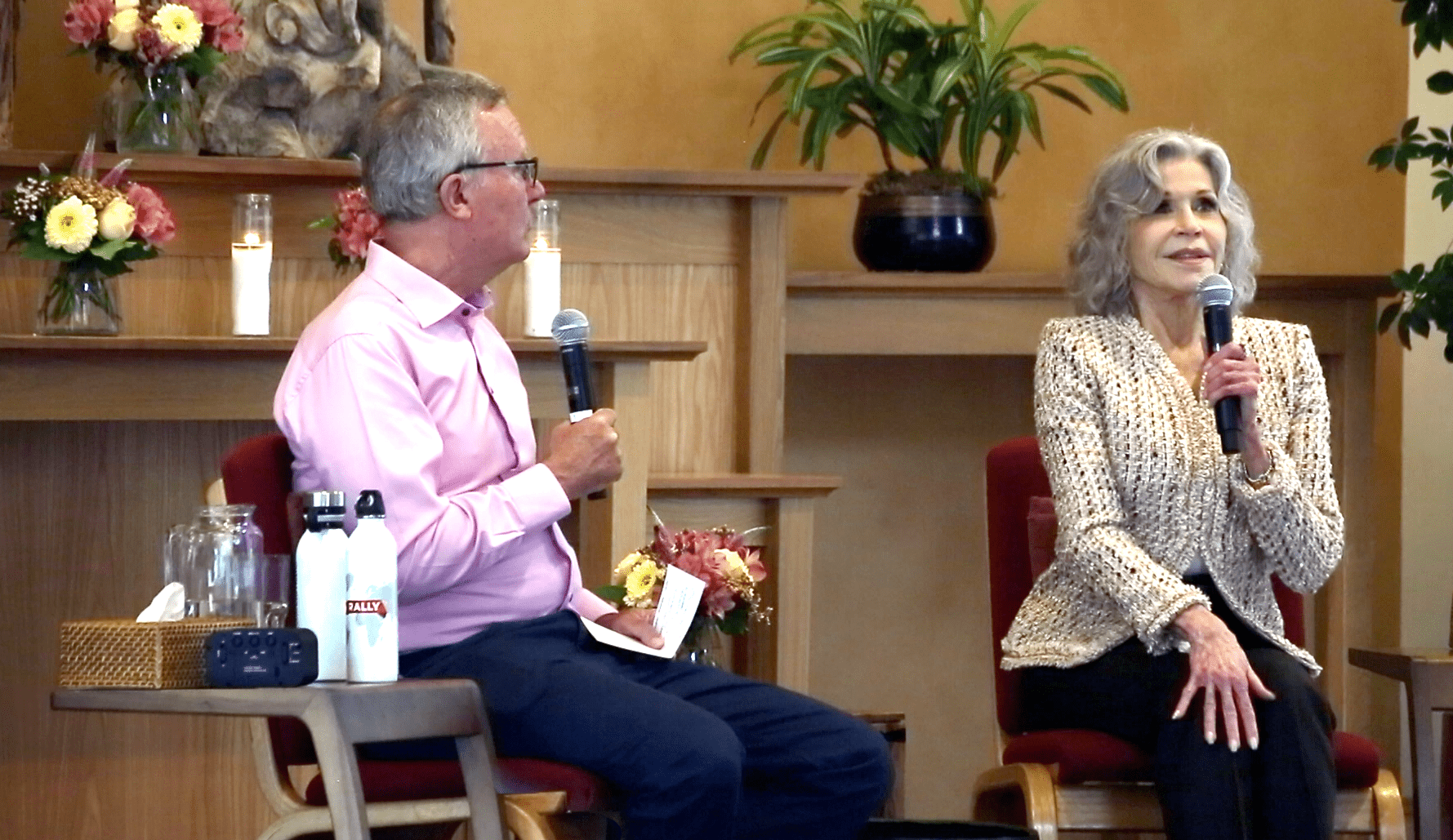
    At a moment when the climate crisis feels simultaneously overwhelming and dangerously normalized, Fonda’s presence at Spirit Rock Meditation Center landed with the weight of lived experience—decades of activism, moral reckoning, and an unshakeable belief that we cannot separate inner work from outer action. Her conversation with climate journalist Greg Dalton functioned as a deeply reflective inquiry into what it means to stay awake, empathetic, and engaged as time runs out.

    For many readers of Mindful, meditation may feel like refuge, a place to step away from the unrelenting churn of news cycles, politics, and ecological grief. What this gathering at Spirit Rock made clear is that mindfulness was never meant to be an escape hatch. It was meant to be training.

    Freepik.com | DC Studio

    Urgent & Hopeful

    Fonda spoke with respect to urgency, but not from a place of hopelessness. Instead, she framed this moment as one that demands both honesty and courage. “This is a moment when we have to bring our empathy to the fore,” she said, speaking to the deep divisions defining public life. Empathy, for her, is not a passive feeling—it is an active discipline, one she traces directly to her life in the arts.

    “Acting is a profession of empathy,” Fonda explained. “We have to enter the skin of another human being and understand them … You can’t do that without empathy. And you have to have empathy even for somebody that you don’t like.”

    That capacity, to stay open rather than armored, has helped to shape her activism as much as her performances. Fonda spoke candidly about how long it took her to soften what she called an “armored heart,” and how belonging to movements, rather than acting alone, made vulnerability possible. “There can come a moment in life when you enter a situation and, you know, this is where I’m supposed to be,” she said. “If you’re not alone, if you’re part of a movement, that sense allows you to become vulnerable and to open your heart.”

    This insistence on collective action, grounded in relationship rather than righteousness, ran through the entire conversation.

    ETCP’s mission is twofold: to support interfaith leaders and activists in meeting climate trauma with resilience and joy, and to empower a new generation of global citizens.

    Over the next three years, ETCP will offer online lectures, class series, in-person retreats, and training programs designed to support communities engaging with climate change not only as a scientific or political issue, but also as a profoundly emotional and spiritual one. The program is guided by a core planning team of respected teachers and leaders, including Ayya Santacitta, Bonnie Duran, Carol Cano, James Baraz, Kirsten Rudestam, Kristin Barker, Mark Coleman, and Yong Oh, in collaboration with partners such as One Earth Sangha, Braided Wisdom, Aloka Earth Room, and Awake in the Wild.

    Its mission is twofold: to support interfaith leaders and activists in meeting climate trauma with resilience and joy, and to empower a new generation of global citizens. At its heart is a radical proposition—that joy, mindfulness, and love for the Earth are not distractions from climate action, though essential to sustaining it.

    When Mindfulness Meets the Climate Crisis

    For many meditators, the connection between mindfulness and climate change is not apparent. Sitting quietly with the breath can feel worlds away from melting ice caps, polluted water systems, or data centers sprawling across the landscape.

    Fonda expressed concern about AI and the rapid speed of technological advancement. “I’m horrified by it,” she admitted, acknowledging her own complicated relationship with technology. “I have ChatGPT on my phone. I feel guilty… I don’t understand it well enough to know how to combat it.”

    Rather than offering easy answers, Fonda modeled something rarer: the willingness to stay with not-knowing without disengaging. Climate action, she suggested, does not begin with mastery; it starts with attention.

    Her reflections on Indigenous knowledge underscored what has been lost through disconnection. Recalling time spent learning about the Ecuadorian rainforest, she talked about communities that live in conjunction with the land. “They showed us which plants heal which diseases,” she said. “We once knew how to listen to plants. We’ve forgotten how.”

    Mindful engagement does not mean doing everything. It means doing something with intention, alongside others.

    EcoDharma, as Spirit Rock frames it, is precisely this remembering—not as nostalgia, but as practice. And the key part of practice, when we hold both the Dharma and the environment front and center in our minds, is to understand that we all have something to do, no matter how small the task or step may be. As ETCP leaders emphasize, mindful engagement does not mean doing everything. It means doing something with intention, alongside others.

    Identifying Our Unique Role to Play

    A recurring question throughout the retreat was one many people quietly carry: What can I do?

    Fonda’s answer was pragmatic and unsentimental. After years of protest through Fire Drill Fridays, she and a small group of collaborators recognized a gap between public pressure and policy change. “We haven’t got the legislation that’s commensurate with what science is saying we have to have,” she said. “The reason is that so many elected officials take money from the fossil fuel and petrochemical industries.”

    That realization led to the creation of Jane Fonda Climate Pac, a political action committee focused on down-ballot races and state and local positions that often receive little attention but wield enormous influence over climate outcomes. “Public utilities, school boards, city councils, state legislatures, attorneys general,” Fonda noted. “All these people have huge power.”

    The results have been striking: hundreds of climate champions elected, many of them women and women of color, willing to stand up publicly for environmental rights. “It’s working,” she said.

    Alternate Entry Points to Climate Action

    For those wary of politics, Spirit Rock’s EcoDharma program offers additional entry points and ways to engage, with an emphasis on joy-based action, interconnection, and resilience. This programming is designed precisely for people who feel overwhelmed, polarized, or exhausted by climate discourse.

    Perhaps the most resonant moment of listening to Fonda speak was when she was asked about courage—how she continues to speak so openly, without becoming defensive, after decades in the public eye.

    “It has been a process,” she said. “It took me a long, long time to open my heart.” What changed was not confidence, but belonging. “Being part of a movement… allows you to become vulnerable.”

    She spoke about care—sleep, community, working with people she admires—as essential, not indulgent. “I’m a late bloomer,” she said with a smile. “But being a late bloomer is okay as long as you don’t miss the flower show. And I’m in the midst of a flower show.”

    EcoDharma does not ask practitioners to abandon stillness. It asks them to let stillness inform their response. To allow mindfulness to widen into care, and care into action.

    In that image, flowers blooming against the odds was a quiet invitation. EcoDharma does not ask practitioners to abandon stillness. It asks them to let stillness inform their response. To allow mindfulness to widen into care, and care into action.

    As Fonda reminded the room, hope is not something we wait for.
    It is something we practice—together.

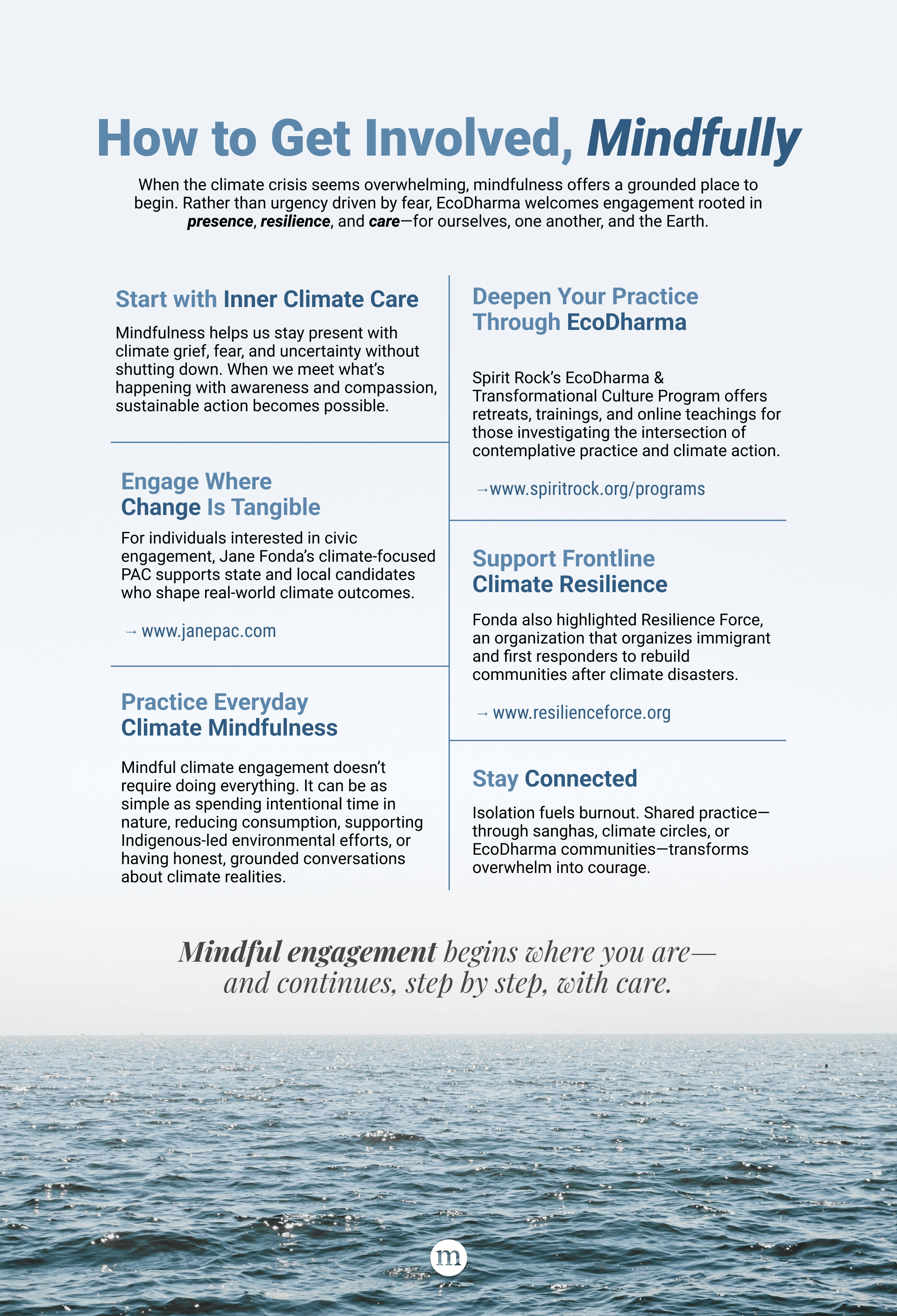
    For more ways to connect, here’s a mindful action guide to use & share. Links are also provided below.

    A mindfulness infographic over ocean water, inspired by Jane Fonda, lists ways to get involved in climate action with care and presence.


    Source link

  • Looking Honestly at the Challenges of Mindfulness Practices

    Looking Honestly at the Challenges of Mindfulness Practices

    While the challenges of mindfulness practices are real, research confirms that mindfulness can also be helpful in preventing relapses into depression and reduce healthcare visits.

    Willoughby Britton, a psychiatrist and mindfulness practitioner, has researched what he terms the “difficult or challenging mind states” among advanced meditators and scholars that can occur as a result of intense meditation practice.

    The challenges of mindfulness are real. The truth is, meditation is not all calm and peace. Mental material can come up that can be uncomfortable or need to be addressed.

    Britton spoke generally with Mindful about how mindfulness has been marketed in this country as a “warm bath,” when in actuality, you have to deal with whatever comes up in the mind.

    “A lot of psychological material is going to come up and be processed. Old resentments, wounds, that kind of thing,” says Britton, “But also some traumatic material if people have a trauma history, it can come up and need additional support or even therapy.”

    Halliwell asks: “Does something beneficial have to be delivered perfectly—and to bring about a perfect world—before we will accept it as worthwhile?”

    Ed Halliwell, mindfulness teacher and author of The Mindful Manifesto, admits that meditation can be an emotional rollercoaster. “Mindfulness has a great many benefits,” Halliwell writes, but he takes issue with mindfulness being touted as a cure-all. At the same time, there’s an all-or-nothing mentality brewing around the adoption of mindfulness practices, and Halliwell asks: “Does something beneficial have to be delivered perfectly—and to bring about a perfect world—before we will accept it as worthwhile?”

    Elisha Goldstein, clinical psychologist and mindfulness teacher, noted that it’s not a question of whether mindfulness is harmful or not. When we’re assessing the challenges of mindfulness practices, the better question is where you’re getting that mindfulness training from. “It comes down to an education on mindfulness (and a variety of factors that it represents) and finding an experienced teacher as a guide to meet the practitioner where they are at.”

    Research is ongoing

    Research on mindfulness and depression is still preliminary, but there are promising indicators.

    Scientific American surveyed findings and some of the key controversies regarding the application of mindfulness for depression and anxiety, and concluded:

    When it comes to treating diagnosed mental disorders, the evidence that mindfulness helps is mixed, with the strongest data pointing toward its ability to reduce clinical depression and prevent relapses.

    In particular, new research has emerged indicating that an 8-week mindfulness-based cognitive therapy (MBCT) program might reduce the risk of relapses into depression. Study authors identified that mindfulness helped in the following ways:

    • MBCT allowed people to be more intentionally aware of the present moment, which gave them space to pause before reacting automatically to others.
    • Bringing mindful awareness to uncomfortable experiences helped people to approach situations that they would previously avoid, which fostered self-confidence and assertiveness.
    • Study participants also described having more energy, feeling less overwhelmed by negative emotion, and being in a better position to cope with and support others.

    Another piece of research reported that frequent health service users who received MBCT therapy showed a significant reduction in non-mental health care visits over a one-year period.

    “We speculate that mindfulness-based cognitive therapy has elements that could help people who are high health-care utilizers manage their distress without needing to go to a doctor,” says Dr. Paul Kurdyak, lead author and Director of Health Systems Research at Centre for Addiction and Mental Health (CAMH) and Lead of the Mental Health and Addictions Research Program at the Institute for Clinical Evaluative Sciences (ICES).


    Source link

  • Addiction, Trauma, and the Problem of Being Present

    Addiction, Trauma, and the Problem of Being Present

    The Power of Then

    I remember one day in rehab, after a particularly gruelling day of group therapy, the facilitator decided to end with a mindfulness meditation. Feeling exhausted and overstimulated, I welcomed the chance to close my eyes and shut out the world for a little while.

    But as she guided our awareness through the body, I became painfully aware of what was happening inside mine—the tightness in my jaw and throat, my heart pounding, the knot of fear twisting in my stomach. My body didn’t feel like a safe place to be; it felt like a war zone.

    When the meditation ended, she reminded us of how important it is in recovery to live in the now.” And that left me with a burning question that I didn’t dare ask: What if my now feels unbearable?

    When the meditation ended, she reminded us of how important it is in recovery to live in the now.” And that left me with a burning question that I didn’t dare ask: What if my now feels unbearable?

    For many people in recovery, being in the body can feel like stepping onto enemy territory. It’s where we hold the emotional pain, unresolved trauma, and survival responses we’ve spent years trying not to feel. Mindfulness invites us to tune in—to become aware of our bodies and minds, to sit with our emotions and thoughts. 

    To many people, this is a neutral concept. However, for the addict in recovery, it’s also being asked to return to the danger our addiction once protected us from.

    I once heard someone say, “You can’t feel the power of now until you’ve healed the power of then.” That statement really stuck with me. 

    When the nervous system is carrying trauma—when we’re dysregulated, overwhelmed, or trapped in a state of fight/flight/freeze—mindfulness doesn’t always feel supportive. Sometimes it simply heightens our awareness of the pain and discomfort within, without giving us the resources to cope.

    The Root of Addiction

    Many experts in the trauma and addiction field believe trauma sits at the root of addiction. Gabor Mate, one of the most influential voices in this work, invites us to shift the question from, Why the addiction? to, Why the pain? 

    Many of us are working from an outdated idea of what trauma actually is. Trauma isn’t defined by the event. It’s defined by what happens inside of us as a result of the event, the imprint it leaves on our body and mind.

    That reframing, turning the attention toward the suffering beneath the behavior, was one of the most powerful turning points in my recovery.

    You might be reading this and thinking, “This doesn’t apply to me. I don’t have trauma.” Yet many of us are working from an outdated idea of what trauma actually is. Trauma isn’t defined by the event. It’s defined by what happens inside of us as a result of the event, the imprint it leaves on our body and mind.

    Trauma expert Pat Ogden describes trauma as “any threatening, overwhelming experience that we cannot integrate.” When understood this way, it becomes more relatable. It’s not limited to catastrophic events; it also includes the undigested life experiences most of us carry in varying degrees—the moments that shape how safe we feel in the world, in our relationships, and in our own bodies.

    If substances became a way to soothe, regulate, or find relief from the imprint of those experiences, that is the link between trauma and addiction. Addiction doesn’t manifest without reason. It’s your body and nervous system attempting to restore balance—to escape an unbearable now—when nothing else seems to work.

    The Challenges Mindfulness Presents

    Mindfulness isn’t inherently problematic for everyone living with trauma; for some, it’s deeply supportive. The difficulty for some people living with symptoms of trauma is that mindfulness can sometimes intensify those symptoms, and in some cases even cause re-traumatisation.

    Mindfulness eventually became one of my greatest resources. But in the early days, before I was trauma informed, I often pushed through discomfort, believing that was part of the practice. I remember one meditation in particular where I forced myself to sit with an increasingly uncomfortable sensation in the pit of my stomach. I was convinced that if I just stayed with it long enough, I’d eventually reach some blissful state of transcendence. Instead, it sent me into an intense dissociative state which lasted for weeks—something I later learned is not uncommon for trauma survivors. 

    This is why it’s important to understand the potential challenges of mindfulness for some—so that if you do encounter problems, you know it’s not a sign of failure. It’s simply a signal from your nervous system that more safety is needed.

    Here are some primary signals to pay attention to: 

    Focusing on the body or breath can be activating

    Trauma lives in the body as physical sensations, constriction, tension, and survival responses. When we bring awareness to the breath, or to areas that hold this survival energy—the chest, throat, belly—these sensations can feel overwhelming.

    Mindfulness can trigger traumatic memories or flashbacks

    Turning inward creates space for memories, images, or emotions that were previously suppressed to rise to the surface. When they do, the body and mind may react as if the past is happening again. In other words, we start experiencing the power of then.

    Stillness can feel threatening to a dysregulated nervous system.

    For someone who is used to living in a state of fight, flight, or chronic hypervigilance, stillness can feel unfamiliar and unsafe. Even the feeling of calm can feel threatening when the body is used to scanning for danger.

    Self-observation can activate shame or self-judgement

    Turning attention inward can make self-critical thoughts louder, especially for someone whose trauma involved blame, guilt, or a loss of self-worth.

    None of this means mindfulness should be avoided. Far from it. It simply means the practice may need to be approached differently: with more pacing, choice, and with safety at its core.

    Practising Mindfulness Safely

    Safety is the foundation of trauma recovery and one of the cornerstones of trauma-informed mindfulness. David Treleaven, founder of Trauma-Sensitive Mindfulness, emphasises that mindfulness for trauma survivors must be flexible, and adapted to suit an individual’s nervous system and needs. Instead of pushing through discomfort, this approach supports choice, regulation, and autonomy.

    Here are some adjustments you can make to your mindfulness practice when you start to feel activated: 

    1. Start outward. For many people, beginning with external anchors feels more supportive than turning the attention inward. Noticing sounds, feeling your feet on the floor, or gently orienting to your surroundings can help settle the nervous system.
    2. Switch it up. Once a sense of grounding is established, you can then gently approach your inner experience. It can help to move between inner and outer awareness, so that if anything becomes too intense, you can shift your focus back outward, adjust your posture or pause completely. Having a reliable anchor, something that feels supportive to return to, can be especially helpful.
    3. Get mobile. Movement can also be a powerful bridge to presence. Walking, stretching, or gentle swaying may feel more accessible when stillness feels too threatening. You don’t have to sit motionless in a lotus position to be mindful. 
    4. Open your eyes. For some people, closing their eyes means they can’t scan for danger. As people are learning to find safety, practising with eyes open, or with a soft gaze, can also reduce the vulnerability that may come with closing the eyes.
    5. Be gentle with a noisy mind. It’s also worth noting that the mind—even when busy or critical—can feel safer than the body. Understanding this can help reduce frustration when the mind doesn’t quieten in the way we might expect.

    One of the most important things to remember with trauma-sensitive mindfulness is that you have choice and autonomy. Treleaven says, “We want them to know that in every moment of practice they are in control.” So, if things become too much, return to what feels safe. Stay within your window of tolerance, which allows for some discomfort, but not to where it’s overwhelming.

    When practiced with care, mindfulness can be one of the greatest tools for trauma healing and addiction recovery. For me, the benefits were profound, so much so that I wrote a book about it. But the greatest benefit was reconnecting with that part of myself that addiction and trauma never touched: the part that was always there, quietly watching, peaceful and still. My true self!

    Mindfulness doesn’t rewrite the past, but when we can embody a sense of safety, it helps us to hold it differently. So that the power of then no longer overshadows the power of now.


    Source link

  • What’s Good About Being You: How Mindfulness Helps You Get to Know Yourself

    What’s Good About Being You: How Mindfulness Helps You Get to Know Yourself

    The Connection Between Presence and Knowing

    The sitting practice of meditation is a powerful means to get to know yourself, to introduce yourself to yourself. Meditation is a discipline, a technique to transcend technique. You sit down on a cushion or a chair and simply experience yourself: your body, your breath, and your thoughts. You just be there, very simply.

    There are several aspects to meditation that are part of establishing friendship with yourself. One is mindfulness. Mindfulness is keeping track, or keeping a pulse, of being here, in a nonjudgmental way. There is no good or bad. Everything is allowed to be. Among other things, mindfulness is a stabilizing or pacifying influence. The panic of everyday life and every expectation laid on life can subside. This is a huge relief. It is called the discovery of peace.

    Awareness is being in a bigger space, recognizing that there is always an environment around our thoughts and feelings. When you begin to sense that atmosphere, there is both intelligence, or sharpness, and relaxation.

    Finding peace in the practice of meditation involves slowing down. Physically, you call a halt. You park your body somewhere, and you stay put. Your mind may continue to race for a while, maybe for a long time, but you become aware of the mind racing. Awareness is being in a bigger space, recognizing that there is always an environment around our thoughts and feelings. When you begin to sense that atmosphere, there is both intelligence, or sharpness, and relaxation. You begin to see things much more precisely and your native intelligence begins to awaken.

    The Courage to Be Aware

    Becoming more aware is a very courageous thing to do. You allow yourself to look honestly at your experience. And that solid sense of self—of who you are—is revealed as being not so solid. You begin to experience gaps, holes in your suit of armor. You realize that you are really more like Swiss cheese than Cheddar.

    When you are there, just there, without trying to hold everything solidly together, you also begin to find that you don’t need to sustain a storyline about yourself and your life. Who is it for anyway?

    When you are there, just there, without trying to hold everything solidly together, you also begin to find that you don’t need to sustain a storyline about yourself and your life. Who is it for anyway? You can afford to relax with yourself, get to know yourself. You don’t have to put on makeup for yourself; you don’t have to put on a smile. You can leave the mental toupee on the shelf and like yourself just as you are.

    There is something genuinely good about being you. You may not like every little thing about yourself, but overall you have an honest heart and you can connect with it through the practice of meditation. You have the courage to face yourself. From that connection with yourself and from actually liking yourself without conditions, you begin to see how brilliant and available life can be when it is without preconceptions or adornments.

    As you open yourself to yourself, you become more aware of the world you’re living in. The development of awareness here is a bit like having cataracts removed, or getting a hearing aid: you didn’t know your vision was so obscured until you finally see a brilliant yellow daffodil in the field. You couldn’t hear the first bird of spring singing in the meadow. You couldn’t taste the bitter onion flavor of chives by the stream. You didn’t see the face of your beloved, until you ran right into him. Then suddenly you begin to feel your world. You begin to understand love in an entirely new way.

    Noticing the Hall of Mirrors

    At that point, as you become more open, you also may begin to see where you’re stuck, how you’re often living in a hall of mirrors that you create for yourself. You see your speed and how that has produced panic. We may actually recognize and experience ourselves as the monkey bouncing off the walls in our house of mirrors. What you’re bouncing off of is often simply the reflections that you project. When you bounce off yourself, this can take the form of self-hatred or it can be twisted into some kind of false arrogance and pride. Unfortunately, your dearest friends, lovers, relatives, and partners are often the mirrors you project your reflections onto most intensely.

    We demand a lot from intimacy, often more than it can possibly deliver. We ask ourselves and our closest friends to confirm us by reflecting some things and not others. Essentially, we ask, “Mirror, mirror, on the wall, who’s the fairest one of all?” And we expect the answer, “You, my love!” This a burden to others and to us, and ultimately it doesn’t work. The mirrors crack.

    If you want to live in a hall of mirrors, this is a disaster. If you’re willing to find a true relationship with yourself and others, this is welcome relief from your self-imposed isolation. It reveals the tremendous space that is there when the myth of satisfaction is seen to be a fraud.

    Facing reality is not creating something new. It’s allowing a barrier to dissolve.

    Over the course of time, if we are committed to meditation as an ongoing practice, then it can provide us with this honest feedback. Although we might try to filter information, if we sit long enough, reality wells up in us and breaks through. This is inevitable, because it is just discovering what is there and we can’t block what is there forever. Facing reality is not creating something new. It’s allowing a barrier to dissolve. It unlocks in us the power of loving-kindness and is the beginning of real warmth toward ourselves and others.


    Source link