If meditation is feeling just one more thing on your to-do list, try this intention practice to connect with why you meditate.
Sometimes, we can start out a mindfulness practice with lots of energy, but after a while, that commitment fizzles. The key in meditation is to take time to get in touch with what you want, what you value most. Understanding why you meditate can feed your passion and motivation and help you to make a habit of your regular practice.
1. Feel the Body
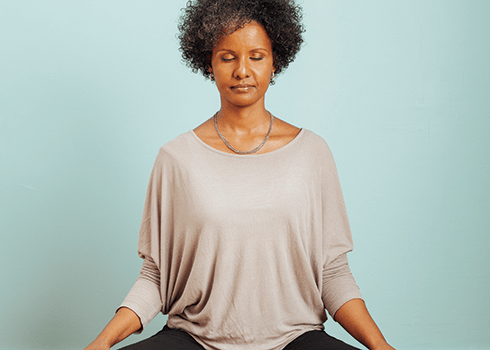
Begin by feeling your body, connecting with both feet, your legs, your seat, hips, tailbone. Sensing your spine, straight and upright, relax the shoulders down and allow your awareness to travel down through both arms and to the palms of the hands and fingers. Bring the awareness into the belly, the chest, the throat, and then resting your awareness on your face, release any tension in your jaw, eyes, forehead. Sense the whole body as you sit here. And feel the breath moving through the entire volume of the body. And from this place of connection and presence, inquire into why you are meditating. What is your hope, vision, intention?
Tip: Don’t worry if your intention is fuzzy—you can choose to simply pay attention to whatever thoughts or sensations arise.
2. Listen Closely
Listen deeply. Thoughts will arise. Note them, and let them go. Listen deeper still. What feels most compelling, most true in your body? Try not to think about your intention, or to analyze or cognitively discern it. Instead, see if you can listen from a deeper place, a still abiding awareness that is always already there. Listen with your body, with your whole being.
3. Note the Intention
Perhaps, for now, there is no clear answer, and your intention is simply to be present, to stay open, to be curious, allowing whatever arises to be here. Or perhaps a clear felt sense of your intention arises. Either way, hold your intention clearly in your consciousness, regardless of whether it is strong and clearly formed or amorphous and tentative.
4. Let Your Intention Go
Silently repeat your intention, anchor it in your mind and body. And once you feel that it is clear and stable, let it go. And rest back into the body, into the awareness that is enveloping you. The intention simply guides, it is not a goal that we fixate on, but a direction we incline our heart and mind to follow.
Shift from a “fix it” mindset to more kindness and acceptance with these practices to get back in touch with your body.
One thing I’ve noticed in my classes and retreats recently is people are struggling—not just with their minds during meditation, but their bodies. It’s a conflicted relationship.
Mindfulness teaches us to keep coming back to the present moment as we experience it in the body, like the breath in the mindfulness of breathing meditation. It’s good to remember that the body is always in the present moment.
In a recent yoga class I attended, the teacher, when she moved us through the poses, used the term “today’s body.” She didn’t’ say your body or even the body, but today’s body. I liked the unexpected playfulness of that expression. Immediately it made my body feel more acceptable, less personal, and at the same time more connected with the other people in the room—and their bodies. We all have a “today’s body.”
So many of us struggle with our body: the way it looks, the way it is built, the way it “performs,”—or doesn’t. I see that all the time in the classes I teach. “I’m not flexible” or “I’m too fat”, “I’m too old,” “too sick,” “too ugly” “too clumsy,” “too messed up,” “too…”. We are not doing so great with appreciating—or at least accepting—the body.
Let Go of the Inner Critic
When we give up the identification of “I, me, mine” with our body for even just moments at a time, something miraculous can happen. We can relax. We can ease up. If the body is not personal, not “mine,” then I can release the idea that it’s entirely in my hands to change what I don’t like about it. Then my body is not “my fault” and I can release for a moment the felt responsibility to fix it. As soon as I can let go of that, I can open up and my body awareness and perception can change significantly.
But, you might say, the term “today’s body” is too impersonal and makes the body into an object. Don’t we want to try to love our body more and be more in tandem with this body?
Yes, absolutely. And yes, the idea of “today’s body” is impersonal. That is actually the point. Think about it this way: What happens to my experience when I take it so personally? If I love my body, that’s not really an issue. But what if I don’t? That can make me feel like a failure, that I can’t change whatever is bothersome in this moment. It can be as simple as not being able to do a forward bend in a way that the other people in the class can do or as difficult as having a chronic health challenge or simply hating one’s body or certain body parts.
Even if my body hasn’t changed one bit by tomorrow, the flow of body sensations and my mood will have. They never stay exactly the same.
I can take care of “today’s body” with a lot more tenderness and forgiveness. Or at the very least I can tolerate it being the way it is. And since it’s only “today’s body” and not “forever’s body” I can practice just for today. I can practice body awareness just for this moment and not worry so much about how it might be tomorrow or next week or what my mind happens to think about my “forever body.”
When we use the element of time in our experience we open up to the truth that perceptions change. The way I feel right now is probably not the same as I felt yesterday or I will feel tomorrow. Maybe not even like I felt 10 minutes ago. Even if my body hasn’t changed one bit by tomorrow, the flow of body sensations and my mood will have. They never stay exactly the same.
As we practice mindfully with the idea of today’s body we can see more clearly that everybody has “today’s body.” We all share that. And that might make us feel more connected with the other people around us.
Mindfulness Practices for Loving Your Body
You can do these practices for “today’s body” sitting or lying in a relaxed way or as part of your regular meditation. These practices can greatly change the way you experience your body and may even lead to serious body love. Give it a try!
Awareness: This is “today’s body.” Feel into the body as it is right now. What’s that like?
Reflection: Every human being has a body (and so does every animal). This is what it feels like to have a human body. Or a male or female body. Or a gender fluid body.
Loving-Kindness: Use a sentence or two that resonate with you. For example: “May this body be happy and at ease” or “May these legs be happy and at ease”.
Gentle touch: Try touching the body with kindness, like simply putting a hand on the body part you are practicing with. We are hard-wired for supportive touch and often that can get the message of kindness and support over like nothing else.
Close your eyes. Sit comfortably with your feet flat on the floor and your spine straight. Relax your whole body. Keep your eyes closed throughout the whole visualization and bring your awareness inward. Without straining or concentrating, just relax and gently follow the instructions.
Take a deep breath in. And breathe out.
Bring Your Attention To The Warmth of Your Heart
Keeping your eyes closed, think of a person close to you who loves you very much. It could be someone from the past or the present; someone still in life or who has passed; it could be a spiritual teacher or guide. Imagine that person standing on your right side, sending you their love. That person is sending you wishes for your safety, for your well-being and happiness. Feel the warm wishes and love coming from that person towards you.
Now bring to mind the same person or another person who cherishes you deeply. Imagine that person standing on your left side, sending you wishes for your wellness, for your health and happiness. Feel the kindness and warmth coming to you from that person.
Now imagine that you are surrounded on all sides by all the people who love you and have loved you. Picture all of your friends and loved ones surrounding you. They are standing sending you wishes for your happiness, well-being, and health. Bask in the warm wishes and love coming from all sides. You are filled, and overflowing with warmth and love.
Send Loving-Kindness to Loved Ones
Now bring your awareness back to the person standing on your right side. Begin to send the love that you feel back to that person. You and this person are similar. Just like you, this person wishes to be happy. Send all your love and warm wishes to that person.
Repeat the following phrases, silently:
May you live with ease, may you be happy, may you be free from pain. May you live with ease, may you be happy, may you be free from pain. May you live with ease, may you be happy, may you be free from pain.
Now focus your awareness on the person standing on your left side. Begin to direct the love within you to that person. Send all your love and warmth to that person. That person and you are alike. Just like you, that person wishes to have a good life.
Repeat the following phrases, silently:
Just as I wish to, may you be safe, may you be healthy, may you live with ease and happiness. Just as I wish to, may you be safe, may you be healthy, may you live with ease and happiness. Just as I wish to, may you be safe, may you be healthy, may you live with ease and happiness.
Now picture another person that you love, perhaps a relative or a friend. This person, like you, wishes to have a happy life. Send warm wishes to that person.
Repeat the following phrases, silently:
May your life be filled with happiness, health, and well-being. May your life be filled with happiness, health, and well-being. May your life be filled with happiness, health, and well-being.
Send Loving-Kindness to Neutral People
Now think of an acquaintance, someone you don’t know very well and toward whom you do not have any particular feeling. You and this person are alike in your wish to have a good life.
Send all your wishes for well-being to that person, repeating the following phrases, silently:
Just as I wish to, may you also live with ease and happiness. Just as I wish to, may you also live with ease and happiness. Just as I wish to, may you also live with ease and happiness.
Now bring to mind another acquaintance toward whom you feel neutral. It could be a neighbor, or a colleague, or someone else that you see around but do not know very well. Like you, this person wishes to experience joy and well-being in his or her life.
Send all your good wishes to that person, repeating the following phrases, silently:
May you be happy, may you be healthy, may you be free from all pain. May you be happy, may you be healthy, may you be free from all pain. May you be happy, may you be healthy, may you be free from all pain.
Send Loving-Kindness to All Living Beings
Now expand your awareness and picture the whole globe in front of you as a little ball.
Send warm wishes to all living beings on the globe, who, like you, want to be happy:
Just as I wish to, may you live with ease, happiness, and good health. Just as I wish to, may you live with ease, happiness, and good health. Just as I wish to, may you live with ease, happiness, and good health.
Take a deep breath in. And breathe out. And another deep breath in and let it go. Notice the state of your mind and how you feel after this meditation.
Are you getting enough healthy sleep? If you’re like many of us, your answer is no. All day it’s go, go, go, then at night, when we mean to shut down, it’s not so easy. Eventually, the paradox of sleep worry kicks in: Thinking about sleep gets in the way of sleep. And not getting the rest we crave can be quite painful and can exacerbate other health problems.
As with pretty much anything health-related, we may know better, but we don’t stick to what we’d tell our best friend: Keep to a regular bedtime and a consistent routine, and avoid whatever disrupts sleep, like caffeine, alcohol, and screens. Not that complicated, but what’s often hardest is what’s frustratingly out of our full control. Even following solid advice, sometimes we suffer through rotten nights, feeling anxious or struggling to settle ourselves.
We have nothing but empathy for a friend with insomnia, yet as we lie awake in the dark we may not give ourselves the same degree of care. A good place to start, then, might be an adapted version of Kristin Neff’s self-compassion practice: Breathing in, say to yourself, My trouble falling asleep is a moment of suffering. Breathing out, All people have moments of suffering. And then, This is how things are right now. May I find peace and ease and a night’s rest.
Since staying awake while we’re meditating is often a big challenge, it’s no surprise that mindfulness has been shown to promote healthy sleep.
Since staying awake while we’re meditating is often a big challenge, it’s no surprise that mindfulness has been shown to promote healthy sleep. It’s not all that exciting to sit quietly and breathe. It can be downright boring, not to mention calming. But that’s not the whole story. Mindfulness practice encourages nonjudgmental awareness—seeing things exactly as they are, with openness and curiosity. If we accept the basic facts outlined above about what tends to lead to healthy sleep, and it contradicts how we live, it might be time to patiently explore what stands between us and change. With sleep, as with meditation practice, intentions are easier said than done. Here’s a little reflection and inventory list that may help.
4 Sleep Routine Questions to Ask Yourself:
1) Objectively consider your pre-bedtime routine—anything to change? A consistent bedtime, a quiet room, and a focus on settling down go a long way toward better sleep.
2) Is it time to see a doctor? It may be unsettling visiting a doctor to find out if you have a sleep disorder, but it’s a good idea. For example, any amount of chronic snoring can disrupt sleep. Aging affects sleep too, which may be worth discussing with your physician.
3) Are there routines other than bedtime that may help you settle? Notice your habits with screens, alcohol, or caffeine. How do you manage stress? How consistently do you exercise? Remember to have self-compassion: Don’t judge yourself for your habits, but take firm action when ready.
4) Are you pushing yourself too hard and taking that into bed? Consider practicing non-striving while in bed. By not trying to sleep, sleep quite often arrives. Focus on the breath or the body. Notice the thoughts swirling: It’s happening again; if I don’t fall asleep soon I’ll be so tired tomorrow. Notice it all, and breathe. Maybe there’s nothing at all to do tonight except that, and to gently let go of thinking about (the) rest.
Neither sleep routines nor mindfulness practice responds well to a heavy hand. If you set out to force yourself into sleep, you’re less likely to get a healthy sleep. If you strain for some picture-perfect mindset when meditating, you’ll create more stress and uncertainty. If you set yourself up with clear-sighted planning and patient resolve— intentionally but unforced—healthy sleep and mindfulness are both more to likely follow.
A Guided Meditation for Healthy Sleep
To allow you to fully experience this meditation, we recommend that you listen to the audio version. However, you can also simply read the text below. If you choose to do so, read through the entire script first to familiarize yourself with the practice, then do the practice, referring back to the text as needed and pausing briefly after each paragraph. Take about twenty minutes for the practice. You can do this practice in a seated position.
In considering any meditation related to sleep, recognize that there’s nothing to force, and nothing to make happen. Since striving makes healthy sleep more challenging, set out to practice without specific expectations or goals. We cannot make ourselves sleep, but perhaps, by aiming to stay settled and getting less caught up in our thoughts, we fall asleep anyway.
For the meditation that follows, there will be no ending bell or instruction. At the end, continue to practice if you like, or hopefully enjoy a good night’s rest instead.
Start while lying down, allowing your legs to rest in a comfortable posture, hip-width apart. You can place your arms by your side or your hands on your belly.
Begin by noticing your breath. Pay attention, as best as you’re able to the physical movement related to breathing, such as your belly rising and falling. Or, if you prefer, focus your attention more closely on the air moving in and out of your nose and mouth.
It’s normal, expected even, to have thoughts — lots of them. Your mind rehashes the day or gets caught up in worrying about tomorrow. Recognize those habits, and then practice letting them be. Label whatever grabs your attention, and come back again to noticing the breath. Breathing in… and breathing out.
Notice if you get caught up in effort, or frustration, or fear, with compassion for yourself. Catch thoughts of self-criticism or frustration, and come back to just one breath, one more time. Thoughts are only thoughts. Breathing in… breathing out. There’s nothing you need to fix or change right now in this moment. Notice where your thoughts go, and label them “thoughts.” Come back to one next breath, over, and over again.
Shift attention to sensations in your body. Start by moving your awareness to physical sensations in your feet. You don’t need to wiggle your toes or move your feet, just notice them — the temperature or the pressure of your heel against the blanket or the mat beneath you.
From your feet, move your attention into your lower legs, noticing whatever there is to see. Letting go of a sense of effort or needing to make anything happen. And then from your lower legs, through your knees, and into your upper legs. If you feel any sense of stress or tension, aim to relax and let go.
Then through your buttocks and pelvis, and into your belly and abdomen. You might notice a sense of your breath moving up and down, or other physical sensations, or sometimes even reflection of emotion (perhaps an emotion like fear or anger reflects in the stomach in the form of tension or tightness). And as you move from your belly and now into your chest, note each time your mind gets caught up in thoughts of discomfort or distraction. And then gently and with patience, guiding it back one more time.
Move around into your back, certainly a place many of us hold tension in different ways, relaxing your muscles as best as you’re able, lowering your shoulders from your ears. If you feel a need to make an adjustment, allow that to happen with intention, pausing and choosing your next action. Shift your attention into your hands and lower arms, again without actively needing to move or change anything, observing and letting go.
Then moving through your neck and into the muscles of your face, perhaps noticing any locations of tightness or pinching, and then with gentleness, as best as you’re able, relaxing those muscles. And then for a few moments, have a general awareness of physical sensations throughout your body.
And now, if you’re still awake, bring your attention back to the breath, each time the mind wanders into the past or into the future, or wherever it chooses to go. If it’s a useful anchor for your attention, you can count breaths, breathing in, one, breathing out, one, breathing in, two, breathing out, two… When you reach ten, start at one again.
If counting becomes a distraction, then just stay with the sensation of breathing — wherever you feel the breath entering or leaving your body, or the rising or falling of your belly and chest. Continue on your own now, counting breaths up to ten, patiently returning your attention whenever you become distracted. If you lose track of counting, that’s fine. Start over wherever you last remember.
Sufficient sleep heals our bodies and minds, but for many reasons sleep doesn’t always come easily. Mindfulness practices and habits can help us fall asleep and stay asleep. Consult our guide to find tips for meditation, movement, and mindfulness practices to ease into sleep. Read More