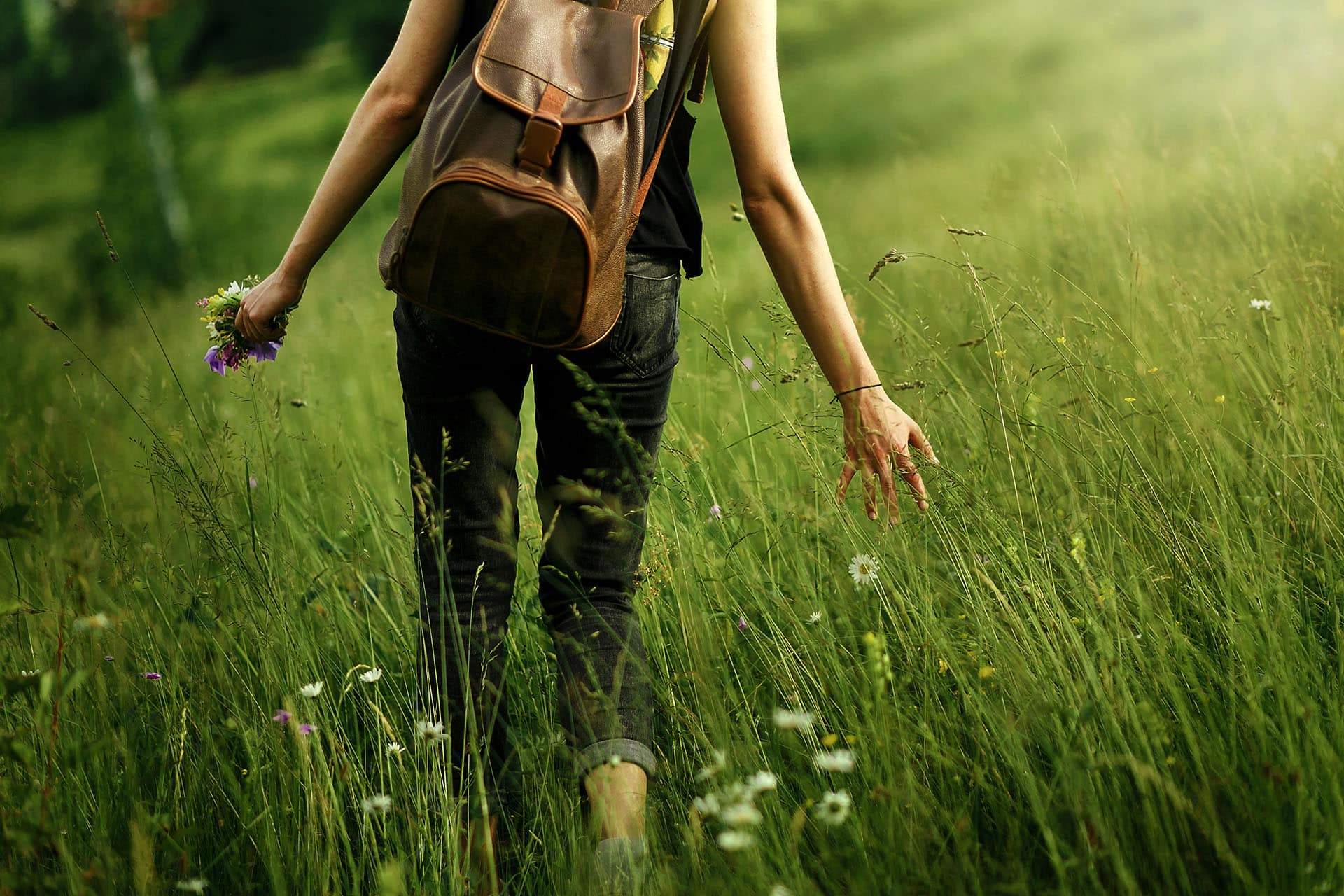
Whatever the season, spending time in nature happily coincides with one of my favorite mindfulness practices: outdoor walking meditation, or mindful walking. Focusing while our body remains still presents a challenge for many of us, from the easily triggered to the anxious to the attention deficient, which is why contemplative movement—be it ritual dance, sport, martial arts, or something else—exists in so many cultures. In fact, mindful walking practice is often what people describe as their favorite practice after they’ve taken a mindfulness course, and the one they are most likely to continue to practice. It’s the best reminder that mindfulness does not have to be a still, solitary, indoor activity.
Walking is a movement we do every day, and like breathing, is usually something we do without much thought. Getting outside to walk deliberately in nature can open our eyes, offering new perspectives different from those we encounter indoors or inside our digital devices. Author Richard Louv, among others, writes about “nature-deficit disorder” and how it affects our physical and emotional well-being, suggesting even just a little exposure to green spaces boosts happiness and attention. The Japanese practice of “forest bathing,” with its research-backed benefits to the mind and body, has been trending around the world. Trends aside, many of us have experienced the power of nature, be it mountains or beaches, forests or gardens, to soothe our most turbulent emotions. The natural world is full of lessons to be learned and metaphors to be explored.
Getting outside to walk deliberately in nature can open our eyes, offering new perspectives different from those we encounter indoors or inside our digital devices.
Integrating mindfulness into movement has the added benefit of combining mental exercise with physical exercise. Studies abound showing that light walking for 20 minutes can help mild depression, anxiety, and attention, not to mention our physical wellness. Getting outside and taking care of our mental health is always important, especially if we’re having a stressful day.
With that in mind, here are six ways to get the most out of your next walk.
How to Get Started with Mindful Walking Outdoors
1. Basic Mindful Walking Meditation
A basic mindful walking meditation is pretty simple. All you need to do is notice yourself walking as you walk, making your body sensations the anchor of the meditation. To break out of the autopilot we are often in, you might ask yourself, “How do I know I am walking?” and then check in with your senses.
It also may help to bring awareness to certain aspects of walking. For example, you can bring mindfulness to your body as you notice the sensation of your feet on the ground or the movement of your muscles, especially as you encounter different surfaces beneath you. Notice not just what your legs are doing, but also your arms, torsos, spine, and head as you walk. You might be able to detect subtle shifts in your pulse, body temperature, or breathing rate before, during, and after you begin moving. You can also focus on the gentle rocking motion of your weight shifting.
Sometimes in sitting practice we use our breath as our anchor and focus on the point between the in-breath and the out-breath, where there is a moment of stillness. Likewise, in mindful walking practice, we can notice the points of stillness where the right step becomes the left step and the left step becomes the right step.
2. Adding Words or Phrases
One simple way to focus your attention is to bring words or phrases to your steps. For one, you can count in rhythm with your steps. Whenever your mind wanders off and you lose count, simply notice where your mind has wandered, and return the count to one again. The key is to do this without judging yourself, and your wandering mind.
It may also help to have something to say along with the movements. You can, for example, say thank you and send gratitude or compassion to your feet and body as you move—a practice from Christopher Germer and Kristin Neff’s program Mindful Self-Compassion. Or, you can quietly or internally repeat reminder phrases to yourself.
You might enjoy repeating the following phrases, suggested by mindfulness teacher Thich Nhat Hanh, with each step:
I have arrived, I am home, in the here, in the now.
I also heard some other wonderful phrases once from a friend, saying for each footstep:
Nowhere to go. Nothing to do. No one to be.
Experiment with any or all of these on your next walk, or come up with your own phrases that resonate for you next time you are out.
3. Sensory Walking
This adaptation for the mindful walking meditation is simple, and just involves really tuning into our five senses as we move through space. As we get into the moment with our senses, we can really savor the precious moments we do have to be outside and moving, and all that is around us. Our senses keep us grounded in the moment while our thoughts drift to the past or future.
First, walk while keeping your eyes still and watching the view change as shapes and objects shift in and out of your line of vision.
Next, focus just on the soles of your feet, aware of different sensations there as the surface changes.
Then, focus on sounds. Those of your own footsteps, as well as the changing sounds in the world around you as you move.
Lastly, focus on smells and tastes in the air, and how they change depending on where you are.
4. Body Awareness Walking
Another practice I’ve been playing with recently is walking as I focus my awareness on parts of the body, almost like a body scan in motion.
As you walk, begin by just resting your awareness in your feet, bringing attention to the soles of your feet.
After about twenty steps, or maybe one block or 5 minutes, shift your awareness to your ankles and calves.
After a few minutes of your attention there, just rest attention on the bending of your knees.
Then focus your awareness on the sensations and movement of your hips.
After some time focused on your hips, shift awareness to your hands and arms, falling naturally or swinging at your sides.
You might then shift to awareness of sensations in your torso, including inside your body with your heart and lungs, maybe seeing if they’ve changed.
After a few moments of attention in your torso, turn your attention to your neck and shoulders.
Lastly, notice your head, as it shifts and moves slightly up and down with each footstep.
Continue to scan your body as you walk, noting how sensations change over the course of your walk.
5. Appreciative Walking
Bringing attention to the beauty of our surroundings is another way to bring deliberate awareness to mindful walking, and to actually shift our perception of the world out of the “negativity bias” or inherent pessimism wired into us, toward the positive and beautiful. Various experiments have found that focusing on the beauty around us as we walk tends to have a lasting effect on our mood long after we rest, similar to the way other gratitude and appreciation practices work.
This research is the inspiration for another mindful walking practice: to simply notice the beauty in the world around us as we walk. It may be a tree beginning to blossom, a particularly beautiful shaft of light, a house or car painted a favorite color. On your walk, make a regular practice of noticing one positive thing—something beautiful, something funny, or perhaps even an act of kindness—along the way. Note these to yourself in a journal or share them with family when you return, or share with others online.
You might also, if you take the same route each day, choose to focus on the changes that you encounter. Notice each day as the seasons gradually change, how the sights, sensations and even smells and sounds also change. What’s one new thing that you find, each day on your walk? How about at different times of day, or weekends compared to weekdays?
6. Observational Walking
You can also bring awareness to your own emotional experience of walking. Notice your emotional reactions to everything (and everyone) around you, especially as people and things get close to your personal space. This might bring up small feelings of self-consciousness as you pass others, or a slight pleasure when you step into sunshine, followed by a slight dread as a small hill approaches.
The inverse way to explore our emotions is by noticing how our emotions affect our walking and observations, and vice versa. How does your emotional state change your movement, what you see, or how you respond, depending on whether you are happy or sad, calm or anxious, frustrated or relaxed?
You can even do this on purpose: Change gears and try walking like you are fearful or anxious. Then walk as if loaded down by shame, or as if you are distracted. Try walking confidently after that, and then shifting back into your own rhythm and gait, if you can still find it. Reflect on all of these, noticing where on the spectrum of moods and emotions your regular pace of walking takes you.
You might notice that how you walked affected how you perceived the environment around you. When you walked with sadness, for example, you likely saw less as your eyes were downcast. Or perhaps you noticed that when you walked with confidence, you actually felt more confident, which you probably did if you know about the research of Amy Cuddy and the science of “power poses”.
Through mindful walking, we can take time to deepen our intimacy with our homes and neighborhoods. Mindfulness is about the here and now, and the state of the world presents a great opportunity to explore and appreciate the outdoors as social distancing continues. Plus, getting outside presents an opportunity to care for our mental health and perspective. If you need a few more ways to bring more awareness to your route, I hope I’ve offered you a few for the coming months.
Our bodies come in all varieties, and we all have different interests, skill, and abilities. But as today’s teacher Cara Bradley observes, movement of any kind—from the slightest glance to the most intense exercise—can be mindful.
This simple meditation helps you celebrate your physicality with practices to connect with your breath and your body, expand your awareness, and appreciate the gift of being alive.
A Meditation to Make Movement Mindful
Read and practice the guided meditation script below, pausing after each paragraph. Or listen to the audio practice.
The intention behind this practice today is to stabilize our bodies and minds, to synchronize our breath and movement, and to energize all over physical, emotional, and mental well-being. What’s important to remember from this all is that when our bodies are calm, our minds get calm. And when our bodies feel stable and steady, our minds feel stable and steady. What’s happening physically also reflects mentally. In fact, in many ways, our nervous system is a reflection of what’s happened in our mind. So if you’re feeling really crazy-busy, I’m going to encourage you to look at your nervous system first with some of the tools that I’m going to teach you here in this meditation.
We are going to be moving and breathing in rhythm. This helps us to facilitate what’s called coherence. Coherence is a way of harmonizing our nervous system, our heart rate, our brain waves. Research shows that when we’re in coherence or in a coherent state, we feel better. We feel calmer, more clear. We feel more energized. And our minds are more quiet. The best way to find coherence is by finding your breath and breathing in rhythm.
Don’t worry about perfect, it doesn’t exist. Don’t worry about big or small or advanced or beginner, it’s not about that at all. This is a mindful movement practice, so this is your practice to cultivate awareness of both mind and body. We’ll be moving for maybe six to seven minutes, real simple movements that everybody can do, and then we’ll be taking rest. Now I encourage you to give yourself the time to take a minute or two rest. It’s when we start to integrate. It’s where we integrate and really allow ourselves the opportunity to experience ourselves in that coherence. In a more settled and stable state of being. You’re worth it and your life is worth it.
Place your feet hip-width distance, get a comfortable stance, and here we go. Let’s just find that rhythm. Inhale, reach your arms forward and up. Spin your palms open, exhale arms out and down. Inhale, reach forward and up. Spin palms open, exhale out and down. One more time. Inhale, reach forward and up. Spin palms, exhale out and down.
Next is what I call Sinking Body and Mind. Exhale, reach over to your left. Inhale, rise back up to center. Exhale, sway to your right. Inhale, reach up. So we’re moving slowly on purpose, everyone. Exhale, reach left. Inhale, reach up. Exhale, reach to the right. One more time, inhale up. Exhale, laugh. Inhale up. Exhale right. Inhale, reach back up. Exhale to your left, we’re going to hold, bring your hand to your hip. Breathe in, reach, exhale. So just following breath, inhale nice and deep. Reach, exhale, press your hips to the right, breathe in. Breathe out. Just one more, inhale.
If you can, reach a little further. Inhale, reach both arms up. Exhale, sway to your right. Inhale. Exhale, reach. Just stay on breath. Inhale. Exhale, reach. Great side stretch here, inhale. Exhale, last one, inhale, exhale, reach, hold, inhale, reach both arms up.
Now, place your hands on your knees like you’re a baseball player. With straight arms, pull your bum back, now reach your arms back. On your inhale, reach arms forward, up, look up, exhale arms back and down, inhale reach up, give them a swing, exhale back. Inhale, reach up, exhale back. One more time. Inhale, reached up. Exhale back. Reach your arms all the way up, this time interlock your fingers behind your head. Send your hips forward and just lay your head back for a moment here.
Now, root through your feet and send your hips forward. Can you really let your head go on your hands? What does that feel like? Open your elbows up just a little wider, one more breath, inhale, big stretch your lungs. Exhale, reach both arms up overhead. One more time, hands to your knees like a baseball player. This time drop your elbows to your knees if you can. If you have some low back stuff, stay right here. Otherwise you can drop elbows right here and look down, nice forward flexion.
Let’s take three breaths here. Inhale, pull your hips back, exhale. Again, finding breath. Inhale, hips back. Exhale. One more time, breathe in, sink your hips a little lower. Little dynamic movement, inhale, straighten legs. Exhale, bend your knees. So they don’t have to straighten completely. Inhale, straighten, matching movement and breath. Exhale, bent. Three more, inhale. Go find that breath, that’s the coherent breath. Exhale, nice and deep and rhythmic. Inhale. Exhale. This is it. Last one. Inhale. Exhale, bend deep and hold.
While we’re here, let’s take it to the floor. Come all the way down onto your belly. Dynamic backbend, so reach your arms out to the side legs together. On your inhale, lift up. Exhale, lower halfway. Inhale, lift, up. Exhale, low. So this is so healthy for our spines, everyone. Inhale, and lift up, Exhale, lower. Last one. Inhale, lift up, hold. Hold, reach. Reach through your fingers. Lift your chest, lift your legs, and release down.
We’ll take it onto our backs to finish up. So roll onto your back, straighten both legs out, and again, working dynamically. Pull your right knee in, give yourself a good hug here, good squeeze. Really helpful for your hips. Now breathe in, breathe out, switch your legs, left knee in, inhale. Exhale, switch your legs, inhale. Exhale. One more time, switch, inhale, squeeze, exhale. Bring both knees in, just give yourself a squeeze, and I’ll bring your knees to 90 degrees. Take your arms out to the side.
Take our final spinal twist here, our final movement. On your inhale, lower knees to your right. Look to your left. Exhale, lift to center. So they don’t need to touch. Inhale to your lift, good twist for your spine. Exhale, center. Following breath and movement, inhale, right. Exhale, center, inhale, left. Exhale, center. One more time. Inhale, right. Exhale center, inhale left. Exhale center. Now place your feet to the floor, straighten your legs, separate your feet everybody, spin your palms up so you’re like a snow angel, big and wide, and just close your eyes here and allow yourself these next few minutes to really connect into your body.
As you lay here in stillness, notice any sensations, any sense of coolness or heat. Maybe something’s tingling. Our body speaks to us through the language of sensation. And by connecting body and mind through breath and movement, our awareness is heightened.
We start to become more fluent in that language of sensations. So what are you feeling in your body? And finally, notice your breath. Just notice how your body is breathing, what it feels like to be inhaling, what changes in your ribs, around your back, and what happens when you exhale. Just noting, using your body, your breath, your pulsing, your sensations as anchors for your awareness in this mindfulness practice.
Now just open your eyes and notice what it feels like to be you right now in this moment. Do you feel more clear and calm? Or stable, or at ease. Maybe you feel more energized and ready for your day. Pull your knees to your chest and just roll over to one side. And roll on up, have a seat for one more moment. With your chin up and your gaze up. Thank yourself for making it through this practice. Thank yourself for giving yourself this gift of movement, of deep, coherent breathing, and of some stillness and silence.
This guided walking meditation from Kazumi Igus offers an opportunity to slow down and notice the wonder of the natural world in our urban environments.
City life can often feel frantic, loud, and cut off from natural beauty. It’s not often we slow down and take in all there is to experience. But even in urban areas, if you pay attention, you can hear the call of a bird, notice your favorite color in shop windows, and look up at the vast sky above.
In this guided meditation, we slow our roll and take in the beauty of our surroundings, no matter where we find ourselves.
A Guided Walking Meditation to Notice the Beauty Around Us—Even in the City
Read and practice the guided meditation script below, pausing after each paragraph. Or listen to the audio practice.
Let’s start with taking three deep breaths.
As we begin, I want to bring your attention to how you are moving if you’re walking through the city or trying to get from one place to another. How fast are you moving? How are you walking? What’s your pace? Do you have a destination and a timeframe? Or do you have some space? Wherever you are, slow it down just a little bit. If you can afford to walk really slow and won’t hold up traffic, you’re welcome to. And if you’re not walking and you’re in a wheelchair, you’re welcome to slow down. If you really need to be somewhere, try to relax into this space, whatever it is. Slow and steady, but maybe not too slow depending on where you are.
Bring your attention to how you are walking—your balance. Are you taking a step? Start to notice the small changes, the muscles involved. And whatever you’re thinking, all of it is OK. You’re just noticing where you are in this space right now.
Then, acknowledging that our minds sometimes race and we have a lot of things going on in our lives, just take a deep breath and bring your attention back to each step. Start to settle into a rhythm. Notice every muscle that’s involved with creating this locomotion to propel you forward and shift your weight. Maybe if you’re in a wheelchair, you’re using your arms. How are the hands involved? Are you holding something? Maybe a backpack, bag, or someone’s hand. Focus on really being present with your physical space, your physical body. Take a deep breath. As we move through our urban environment, we start to notice other things outside of ourselves.
The first thing I want you to bring your attention to is the smell around you. Depending on where you are, that can be pleasant or unpleasant. Breathing in, can you identify a particular smell? Maybe you’re getting a lot of smells all at once. Maybe you notice the change in smells as you move past different areas. And as you experience these smells, notice what you’re thinking. Are you creating a story? Are you finding yourself wanting to be near a pleasant smell or maybe pushing away, trying to avoid an unpleasant smell? If that’s the case, that’s all right. All of it is normal. Just experience the smell and label it as pleasant, unpleasant, or neutral. See if you can identify pizza, poop, grass, or whatever it is.
Then take a deep breath and shift your attention to sights. What can you see? Start by focusing on a color that brings you joy. If it’s a bright color you might notice it in wrappers from candy or chips, maybe in ads, signs, storefront windows that have lots of flyers. If it’s something more earthy, like green or brown, you might start to notice it in nature—the trees and plants. Just pick your color and start noticing it on your journey. Even if the color is on a man-made object like clothing, hats, backpacks, signs, and things like that, that’s a part of the urban environment. If it’s flowers, trees, plants, we’re just noticing the natural portions of the urban environment. Both are necessary.
Taking another deep breath, we shift to looking at nature. Starting with animals. And for this, let’s maybe not focus on people and their pets. Let’s look for the animals that exist in this environment without being owned by a person. You might notice lizards depending on where you are in the world, cats that don’t have owners, squirrels, insects.
I’d like to bring your attention to the birds. Birds are what we call an indicator species. They tell you if your environment is healthy. So look up. Look around. Listen. You might even need to stop for a moment. If you can hear birds, start to listen for the variations in their calls, maybe even a different species. If you have mockingbirds, sometimes it’s the same bird making a bunch of different calls. Really stop to listen to it as though they’re telling you something. If the sound of traffic muffles some of the calls, it’s OK. The urban environment is complex. It has both manmade and natural things. If you can see the birds, notice their behaviors, the coloration, and any other details that might pop out at you. And notice your thoughts while seeing or hearing the birds. You might be able to see or hear seagulls if you’re near a coast, rock doves, a.k.a. pigeons, finches, sparrows, chickadees. Notice if you can identify any of these species by site or by call. Take a deep breath, noticing where the birds are. Probably in plants, trees, bushes, or on grass.
Those of us who live in urban environments often have plant blindness and don’t notice the plants. Take a moment to notice leaves and if you can see any patterns in how those plants are growing. Are there any flowers? Maybe you can recognize a specific species. Can you name it? Take a deep breath. Experience being around plants and animals in nature.
And as you continue moving keep noticing your color, new plants, new animals. Notice what you’re thinking and if you’re telling yourself a story or if you’re asking a lot of questions. And if you are, take a deep breath and then focus back on the details of the experience—the shape of the leaves, the color of the feathers. As humans, we cannot survive without the natural parts of the environment. So it’s very important for us to be mindful of how our movement through the world affects the nature around us and how the nature around us can affect our experience. Take another deep breath. If there’s a big tree or a squirrel that’s standing there looking at you, or a plant that’s intriguing, take a moment to stop.
Be grateful for its part of this urban environment. Expressing some gratitude that you are even able to experience it today. Taking a deep breath. Finding your walking rhythm. Slow but steady, or whatever works for you. Continuing to notice your color, plants, the animals. And continuing to take deep breaths.
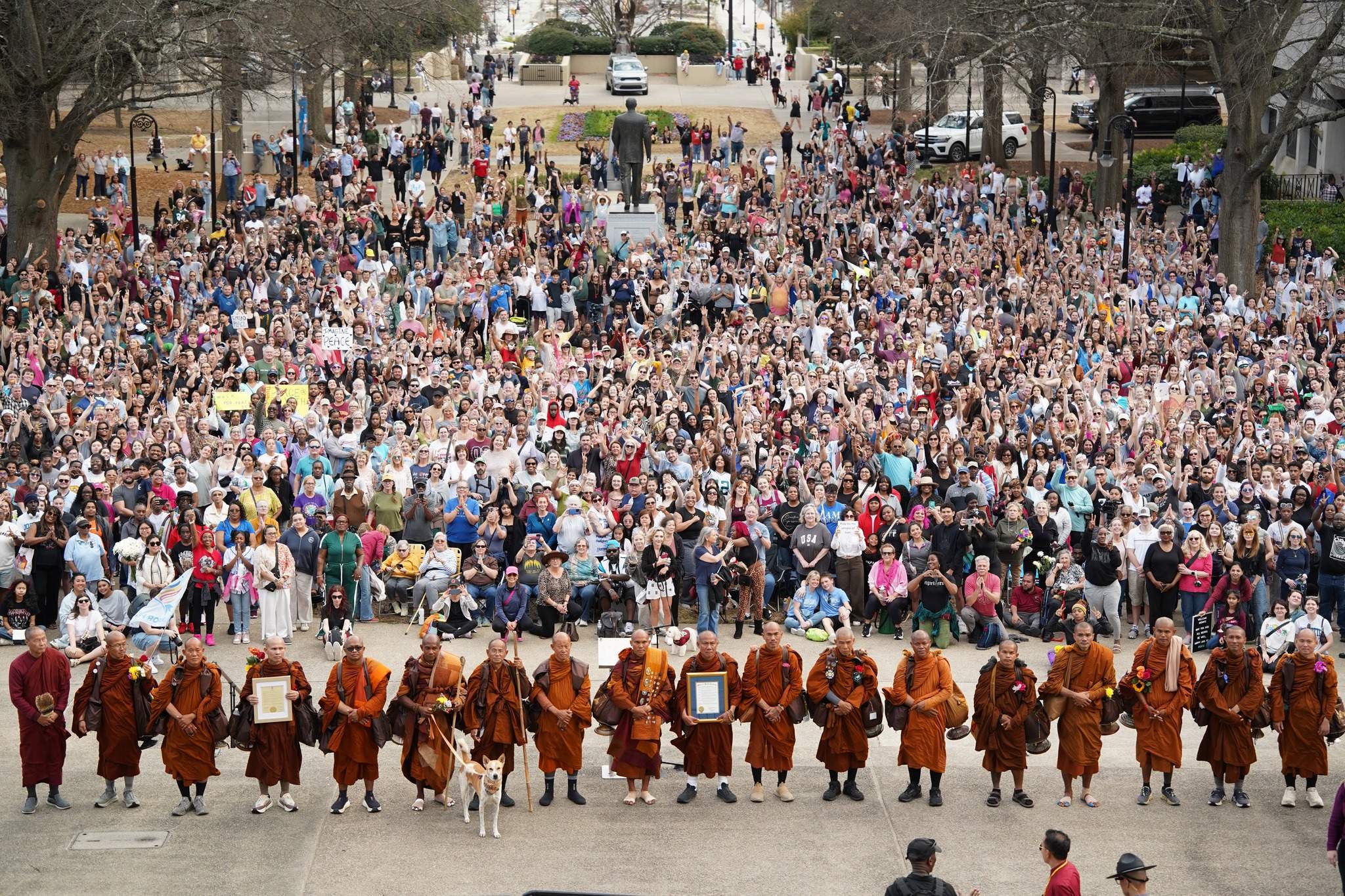
The Walk for Peace has been, in many ways, easy to miss. There are no slogans, no signs held up, no calls to action.
Instead, there is just walking. One step, then another. Breath moving in and out. Bodies moving steadily through places designed for speed.
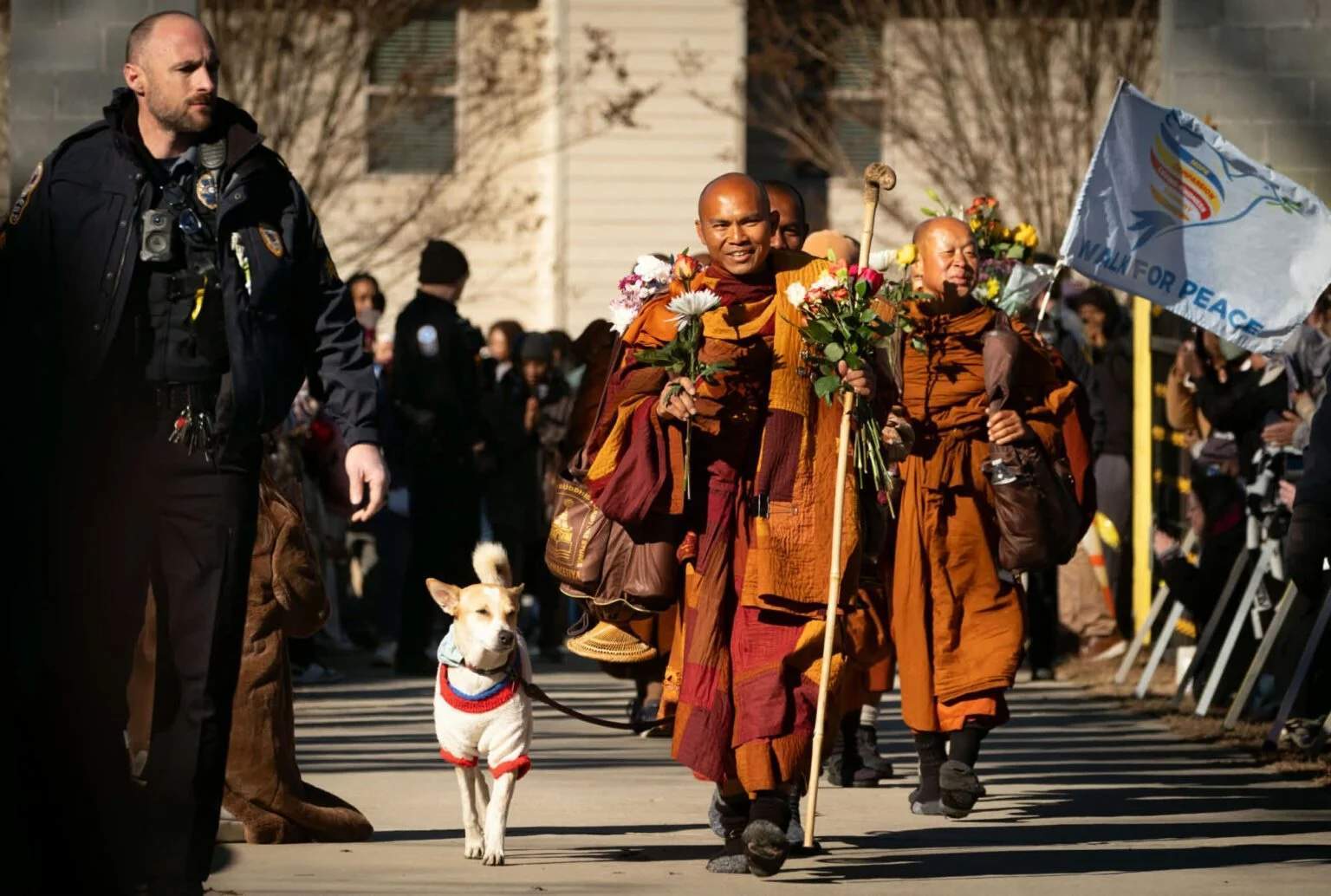
After 108 days and over 2,300 miles, the Buddhist monks and their beloved dog Aloka have arrived at their destination in Washington, D.C. On February 11, 2026—Day 109—they will host a global loving-kindness meditation at 4:30pm EST.
Our current culture is shaped by loud, frantic things: urgency, outrage, and constant stimulation. This long-distance pilgrimage across the United States offers something distinctly countercultural. It is quiet, steady, unassuming, and attentive.
It’s a (sometimes uncomfortable) reminder that our ideas about peace are often future-oriented and externalized. We imagine a time that’s not-now, where the horrors that plague us are gone, and we can finally feel okay.
I live in Minneapolis, right in the city. It is not peaceful here right now. We’re surrounded daily by realities that are destabilizing, uncertain, and frightening. Smack in the middle of that, people here are also quietly nurturing a web of care that extends to neighbors and strangers alike, that is stubbornly insistent on the possibility that we belong to each other.
What I notice is that we are starved for gentleness in a world that glorifies dominance and control. We ache for compassion in a world that keeps telling us that softness makes us weak and defective.
This past month, I’ve found myself multiple times a week checking in with the Walk for Peace. I watch videos of such tender interactions as people go to watch these monks pass by, sometimes offering flowers or just an encouraging hello. They spontaneously weep, and I do, too.
What I notice is that we are starved for gentleness in a world that glorifies dominance and control. We ache for compassion in a world that keeps telling us that softness makes us weak and defective.
It’s difficult, but also strangely empowering, to sit with the truth that the monks are embodying. Something shifts in me when I begin to think of peace, not as something “out there,” but as a thing that starts as a tiny kernel in each of us—something we tend like an ember, ignite with our own breath and attention, and then intentionally carry and share with others—moment by moment, step by step.
What Is the Walk for Peace?
The Walk for Peace is a long-distance walking journey across the United States, led by a small group of Buddhist monks and supported by volunteers and community members along the way. The route of the walk has stretched over 2,000 miles, beginning in Fort Worth, Texas, and ending in Washington, D.C., crossing ten states along the way.
While it draws from contemplative Buddhist traditions, the walk itself is not a religious event. It is a lived experiment in mindfulness, compassion, and nonviolence—expressed through the simple act of walking.
At its core, the walk is a moving mindfulness practice. The participants walk attentively, often in silence, allowing each step to re-anchor them to the present moment. For observers and those who join briefly, the experience can feel unexpectedly grounding. There is nothing to argue with, nothing to agree or disagree with. It’s just people moving through space with care, which is on the surface completely unremarkable—but somehow it feels like the most revolutionary thing.
By walking attentively through public spaces, the participants model an alternative way of being—one that does not require agreement, belief, or affiliation. With each step, they seem to be simply saying, Notice your breath, notice your pace, notice the people around you.
Unlike marches designed to persuade or protest—and of course those also have their place—the Walk for Peace makes no demands. It invites reflection rather than reaction. Many who encounter it describe a sense of calm or curiosity. It’s a noteworthy pause in the usual mental clutter of daily life.
Rather than addressing specific political outcomes, the walk focuses on something more foundational: how people relate to themselves and one another in everyday life.
As an intentional mindfulness practice, the walk has highlighted several key principles:
Slowing down in a culture that rewards speed
Embodied awareness, using movement as an anchor to the present moment in a culture that often uses distraction and numbing
Compassion, practiced through respectful presence rather than persuasion
Nonviolence, not only as the absence of harm, but as an intentional orientation toward care
By walking attentively through public spaces, the participants model an alternative way of being—one that does not require agreement, belief, or affiliation. With each step, they seem to be simply saying, Notice your breath, notice your pace, notice the people around you.
Peace, in this context, is not an end point, but a capacity that grows with practice.
The monks have been accompanied by Aloka, a stray who found them in India on another peace pilgrimage. Photo credit: Aloka the Peace Dog
The First Steps
Walking has long been associated with reflection and insight. It naturally regulates the nervous system, invites awareness of breath and sensation, and brings attention out of abstraction and into the body. By choosing walking as their medium, the organizers grounded their response in something universally human.
The Walk for Peace began with a simple question: How do we respond to a world marked by division, stress, and suffering without adding more noise?
In an informational ecosystem shaped by influencers and social media, we’re accustomed to slogans and sound bites, having people talk at us, trying to shape our thinking and feeling. But these monks aren’t delivering a message to people; they’re living out a practice among them.
Instead of issuing statements or organizing events, they chose to walk—slowly, visibly, and consistently—through the very communities shaped by the pressures and pains of modern life.
Portions of the walk, through places like Selma and Montgomery, Alabama, were tracing steps taken by leaders of the Civil Rights movement.
What is it like for us, generations on, to watch humble people radiating compassion and healing over so much painful ground, to watch them bear witness to realities and tend to wounds that we, collectively, still haven’t fully contended with?
The steady gaze, pace, and breath of people like the monks remind me [that] no one person is bearing all of this alone. They’re carrying and surrendering, rejoicing and connecting, witnessing and walking, together.
I drive through Minneapolis and see in real time the trauma of racialized violence: weary but resolute people holding signs on street corners, begging for mercy and humanity; “closed” signs in business windows where workers have been taken; a car parked askew on the road, driver’s side window smashed, door still open. Did someone see it happen at least so that the owner’s loved ones can be notified?
It is so painful to witness, to look this moment in the eyes. I want to turn away. In my chest, it feels like I’m drowning. But the steady gaze, pace, and breath of people like the monks remind me of two important things.
First, the longer we resist offering our attention to these unhealed places, the more we will keep living through the reverberating echoes of those same wounds over and over and over again. Different possible futures are only made possible by first giving our loving awareness to what’s happening right now—even (maybe especially) when it surfaces sorrow, hopelessness, or anger that we’re not sure we can handle in the moment.
Second, no one person is bearing all of this alone. There’s no hero doing all the work. They’re carrying and surrendering, rejoicing and connecting, witnessing and walking, together.
In many communities, people have gathered along the route—sometimes in the hundreds, sometimes in the thousands—drawn less by promotion than by word of mouth and curiosity.
Some offer food or encouragement. Some walk quietly for a stretch, or just stand and watch.
Online, the walk has attracted millions of followers. Photos and short videos of monks walking through rain, heat, and traffic circulate widely, often accompanied by comments describing a sense of calm or inspiration.
Some people express skepticism, questioning whether walking can have any real impact in a world facing complex systemic challenges.
This tension is familiar within mindfulness circles, as well. Practices that emphasize inner awareness are sometimes dismissed as passive or insufficient. I understand that skepticism, even as research and lived experience increasingly suggest that attention, regulation, and compassion are not luxuries—they are necessary for wise action.
Many people who encounter the walk haven’t reported dramatic transformations. They describe something smaller and maybe more sustainable—a softened interaction, an experience of being deeply seen, a reminder to slow down. Again: we so often come looking for drama because we’re conditioned for it—but perhaps what heals us shows up in a thousand quiet, un-social-media-worthy moments.
Being Peace When Peace Feels Absent
The Walk for Peace does not claim to solve global problems. It does not promise immediate results.
What it offers instead is a living question: What changes when we choose to move through the world with awareness and care?
Peace is not something we wait for, hoping for external conditions to improve, but something we practice within the conditions we have.
Mindfulness practice is rooted in such elemental things—the breath, the body, the next moment. The mind wanders, as it always does, to other things. I think these days of my neighbors, my friends, my worry and anger, the work that needs to be done, what will become of my city, my country.
My practice has never been fancy, and even over years now, I have always been more earnest than skilled. Tears sometimes spill over, and my practice is like a cool hand on my forehead, like a reassuring mother, calling me home.
The walk has embodied this return home on a collective scale. It suggests that peace is not something we wait for, hoping for external conditions to improve, but something we practice within the conditions we have.
I know the walk is coming to its end. In all honesty, I’m going to miss the images and the videos. They have been a kind of nourishment over these long, dark weeks.
I also know that something real has passed between real people. Maybe for the first time in a long while, we’ve had a glimpse of what happens when we just stop, even for a few moments, and notice one another. On the surface, it’s so tiny it’s almost nothing, just a breath or a blink or a step—but I swear I can sense that spark of compassion leap from one person to another. I’ve felt it here, and I know it matters.
In the chronically-online world of 2025, it’s almost impossible to avoid the saturating presence of podcasters, pundits, and social-media influencers in the “manosphere”—people who promise men admiration, health, and success, but who often have ideas of masculinity that leave men feeling even more wounded and isolated. Jon Macaskill and Will Schneider from Men Talking Mindfulness are devoting themselves to reaching men where they are, in their struggle, confusion, and longing for a life of meaning and connection. In this wide-ranging conversation with former Mindful editor Amber Tucker, Macaskill and Schneider offer a perspective on what mindfulness for men can provide in a world that needs authentic men more than ever. And they share a vision of what it is to be a man that’s less about the performance of manliness and more about being genuinely resilient, wise, and connected.
Two Paths to Discovering Mindfulness
Amber: I would love to start by asking about each of your paths to mindfulness. Jon, I know that you’re a retired US Navy SEAL Commander, and Will came from being a yoga teacher and a coach—two paths that a lot of people wouldn’t see as meshing naturally together. How did you personally discover mindfulness, and what did it take to integrate mindfulness into your lives?
Jon: My path to mindfulness, and I think Will and I have this in common, is that it kind of came out of necessity. I had struggled with some anxiety, with survivor’s guilt, depression, and then over and above that, as a SEAL, you’re trained to push through pain—I would love to say ignore stress, but I think sometimes we even bring stress onto ourselves and then just keep going.
But eventually, you know, that approach broke me. I wasn’t able to handle it anymore, physically, mentally, and emotionally. When I got to a point where all that was at a height—where I was struggling with the post-traumatic stress and sleepless nights—I had mindfulness introduced to me by a counselor. I first laughed at him because I thought that, being a special operator, I didn’t need mindfulness and meditation. He kind of flipped the script on me and he said, “Well, what if I had a pill that I could give to you that would change your performance?” As special operators, we’re always looking for something that’s going to improve our performance. And as you could guess, that pill wasn’t a pill at all. It was mindfulness and meditation.
So, because it was sold to me as a “performance enhancement,” then I tried it. And long story short, I tried for several months, and it did help me to handle the stress and anxiety better. I got that performance improvement that he had promised me, but I also was able to manage stress. At first I didn’t trust it, but it gave me a real shot at not just slowing down, but also being present. What I had perceived as a kind of weakness, practicing mindfulness and meditation, wasn’t that at all. It was a strength, and it gave me these tools to face what I’d been avoiding. It gave me the tools to regulate my emotions better. I wouldn’t say that I’m an expert on regulating my emotions, but I’m better. And then to reconnect: reconnect with my family, reconnect with friends. I think most importantly, the ability to truly connect with my authentic self.
To integrate that into my life, it took some discipline to do consistently. It’s easy to do mindfulness or to be mindful and practice meditation once or twice and then maybe a couple of days in a row and then drop off. But by staying consistent, making it a daily practice, it’s changed how I lead, how I father, and ultimately how I live.
Will: I really found meditation first, even before yoga, back around 2006. I was at a point in my life where I just moved to New York City, and I was pursuing life as an actor here in the city: auditioning, training, doing a lot of theater, I started doing television. I just wanted to be more present, and I also needed to manage the anxiety that comes with performance. I started with Transcendental Meditation (TM) and it started to help. Honestly, it was challenging to sit and meditate twice a day for 20 minutes with the TM on my own, not having a group that I’m meditating with, or not having the online opportunities like we do nowadays. It was very frustrating in the beginning. I’m having all these different experiences, my mind just keeps wandering, and I don’t feel like I’m doing anything. Then about a year and a half later, after the sputtering starts with trying to work with meditation, then I really became more consistent. It helped when I found yoga around the same time, especially yoga asana practice. There was this whole mindful movement inside of me, trying to take care of my mind. At the same time, I was taking care of my body. It felt like, This is my practice. It’s been an incredible benefit to me. It still is, every day that I practice. Now I’ve been with the [Men Talking Mindfulness] show, and the work that I do with coaching, and I incorporate all of these skills into what I’m teaching here now.
Starting the Men Talking Mindfulness Podcast
Amber: Let’s talk about Men Talking Mindfulness, the podcast that you co-host. It’s described as tackling difficult subjects like loneliness, trauma, addiction, the unhealthy elements of masculinity. Could you talk a little bit about some of the most transformative conversations that you’ve had? How have your guests or listeners highlighted the power of mindfulness and addressing those kinds of challenges?
Will: We’ve really “attacked” mindfulness from so many different angles! And with Jon and I both being practitioners, we have a lot of great authors that come on the show. The whole show has impacted my life, because I’m a student first—the expert, if you will, of mindfulness who’s always learning. For me, some of the ones that really stick out were No More Mr. Nice Guy with Dr. Robert Glover. Reading his book and seeing what the whole “nice guy” thing is, and then deconstructing why this whole nice-guy approach to life is not the way to fully embrace all the power of your masculinity, was really profound for me.
And then we had Jon Eldredge on the show, New York Times bestseller. I loved his book, Wild at Heart. That conversation with him included understanding the three core principles that live in the soul of masculinity: always having a sense of adventure, having that relationship in your life, and having a battle to fight, having your mission. I just came back from a two-week trip to Peru, which is quite an adventure. I’m still working on the relationship part, but I definitely have the other two pretty synced up. I keep all the books that I’ve read for the show! One after the other of our guests have just been so helpful. A lot of them come back to the core principles of mindfulness, being present, allowing that presence to light up your biology, and the good biology that we have that really makes us, like, these wonderful human beings that we can be if we let go of the stress and anxiety.
Jon: One conversation that’s jumping to mind right now is our conversation with the two Eds, Dr. Ed Adams and Ed Frauenheim. They co-wrote Reinventing Masculinity, where they challenged the idea that men have to fit into this rigid mold that you’re either tough or you’re not a man. That stood out to me, and it struck a chord with our audience because we heard from men who said things like, “I thought I was broken because I didn’t fit the stereotype,” or “Now I realize there’s strength in being authentic and being who I am.”
We also had Jocko Willink on, fellow retired Navy SEAL. There were a couple of powerful moments in that talk about balancing intensity and presence. There’s a lot of people who think you can’t be intense and present simultaneously, and how mindfulness can actually make you a stronger leader. We’ve had Dr. Mark Gordon on. And Mark shared about all these different kinds of groundbreaking insights on the brain-body connection. He’s a neuroendocrinologist. We’ve had Dr. Rob Kelly come on three times. And he’s talked about purpose and recovering from addiction. We’ve had multi-time Olympic champion, Apolo Ono, come on to reflect about how mindfulness shaped his Olympic career and then his transition afterward. We just had Dan Millman on to explain The Way of the Peaceful Warrior, his book.
We’ve even had Congressman Tim Ryan on to talk about bringing mindfulness into politics. We’ve had Steven Kotler on to share how flow science connects directly to performance and presence, and how that is all underpinned by mindfulness. So sorry, a lot of name drop in there, but like Will said, this show has changed the lives of many of our audience, but it’s also changed our lives. We have learned so much about mindfulness, how it’s tied into leadership, how it’s tied into wealth, how it is tied into health, how it is tied into just about everything that we do and it’s changed us for the better. It’s my spiel.
Will: Yeah, we’re like the little guinea pigs for the show. We just try stuff on, talk about it. So it’s been quite fun to be the students and the teachers in what we’ve created.
Where to Start If You’re Curious About Mindfulness
Amber: That’s incredible. Thank you so much for both sharing some of the breadth of different voices and backgrounds and areas of expertise that you have on the podcast. Definitely many familiar names there for the Mindful reading audience, and also a lot of new names. So I think that’s pretty exciting. You were just touching on… what listeners have shared with you about how the podcast has helped them to discover mindfulness—maybe support for the first time, start to build a daily practice, strengthen relationships, even help to save marriages and a lot of other results that I’m sure you’ve heard from people. I wonder: Why do you think the practice of mindfulness is resonating so strongly with so many men, particularly in this moment in time?
Jon: I’ll go on that one first, Will, if you’re cool with that. What I find interesting is that mindfulness, if you really go back in history, it resonated with men. We had the monks who brought it into the world in multiple different ways, but we also had warriors, these warriors that men today read about.
We read about the Spartans, we read about samurai, and in some way they practiced meditation before they went on the battlefield so that they could be present, so that they could be calm. Rather than bumping chests and smelling these smelling salts before they went out, they calmed themselves down.
I think men are realizing that this playbook of suck it up or man up, it doesn’t work anymore. And men are realizing that we can show vulnerability and authenticity because suck it up or man up leads to broken marriages. It leads to mental health problems or challenges, and it leaves a lot of men suffering in silence.
I think mindfulness resonates because it doesn’t ask you to give up toughness. A lot of people think that if you practice mindfulness, that you’re giving up toughness, and you don’t. I think it truly helps you to redefine what toughness looks like. It takes real strength to be present, to feel your emotions and to regulate those emotions. I don’t want to “control them,” but regulate them. And then it also takes real strength and courage to face your challenges without numbing out, without alcohol, without drugs. If you continually numb these challenges, then you’re not going to come out of them. And that’s why I think guys like the names that I mentioned before, like Jaco, Olympians like Apollo, these big-time thought leaders like Steven Kotler, and then congressmen like Tim Ryan—I think that’s what they’re finding value in this right now.
Will: I think the world is just experiencing a level of chaos that it’s not used to, because what I’m seeing, I’m sure we’re all feeling it, is because of the infiltration of technology in our lives, like everywhere, with social media, with the rate of messaging that you get through, whether it’s text or email or Instagram or whatever platform you’re on, it’s just like message, message, and message. There seems to be a greater demand for our attention in so many different places.
Mindfulness is this natural balance that’s coming into society, because everything has its opposite. If chaos is happening, then what’s the equalizer? I feel for human beings, a lot of it is mindfulness. How do we become not so easily triggered? How do we manage our feelings? And mindfulness is helping us to do that.
I think also for men in particular, the way that we’ve worked traditionally since the industrial revolution has changed dramatically, as well. It requires a whole other set of skills that we didn’t need to activate if we were just doing a regular nine-to-five in the factory. Also the roles in the family have changed. The family dynamics have changed. We have two working parents very often, and what does that require? That requires a lot more communication. How are we communicating? Mindfulness for men is helping men to understand themselves on a more deep emotional level. So they’re not a slave to their emotions, not so easily frustrated or anxious or stressed out, and really being more effective in whatever environment they’re in, whether it’s the family, whether it is work, whether it was with their kids, whether it is some sort of community event. So mindfulness is helping the world in so many ways, but men for sure, because these are skills that were not taught in school. I mean, some of them are now, but nobody over 20 years old or 25 has really been taught these skills in school, and people are looking for this place to learn these tools. That’s one thing that we’re doing, and it’s one thing that all the mindfulness teachers out there are doing—helping people to integrate these tools in their lives so they can deal with this new society that we’re in.
Amber: I really appreciate both of you speaking to that, especially with the predominance of tools like mindfulness and meditation seeming to be marketed toward women in this day and age. It’s good to have a reminder that that hasn’t always been the case. And actually mindfulness is a tool that’s for everybody, regardless of how we’ve been trained, our gender, or anything like that. It can benefit all of us.
Jon: I just want to jump in just with one thing. I’m glad you said that piece. Because the guests that we mentioned are all men. I think every single one of them that we’ve mentioned were all men and even more specifically, white men. We also have had a lot of women and folks of color on. Theresa Larson is a good friend of ours. We’ve had her on to talk about being a mindful mother, which doesn’t sound like something that would go on a men’s show, but we need men to understand what a mother is going through. We’ve had Ali and Atman Smith and Andrés González from the Holistic Life Foundation. We’ve had Uma Naidu to come on and talk about mindful eating. She’s a nutritionist. So I do want to make sure that we capture that the show is a men’s show, but we have a lot of women listeners, and we have a lot of women guests, as well.
Amber: Yeah, thank you for that. You’ve had Amishi Jha as well, I think, right?
Will: Oh, yeah. They spoke so clearly, and it’s awesome to have such a decorated general, like really being a huge advocate for mindfulness, because it affects anything you do, regardless of what you’re trying to do with it, it has an incredible impact. And I’m glad more and more people are waking up to this.
Many Different Ways to Approach Mindfulness for Men
Amber: Yeah, bringing it into these contexts like the military where people both really need it for performance, and also just for mental health and all the other good things that mindfulness can help with. You’ve had a wide range of very influential guests, best-selling authors, Olympians, huge business leaders, politicians, many other people. And how do you think that these diverse voices are contributing to your mission of changing the narrative around masculinity and mental health for men? Some of the people that you talked with on your show may not be mindfulness teachers as such, but they’re still promoting knowledge and perspectives that could fit under the umbrella of mindfulness. Is that an accurate way of characterizing them?
Will: Yeah, I think the way we’ve approached the show is that there are so many different angles you can approach mindfulness. We bring on experts to help us solve a particular problem, or give us some insight into something, or to bring awareness to something that can be beneficial in our lives.
From the masculinity point of view, we’re taught by our fathers, our coaches, our uncles, our brothers, just to be tough. But the 21st century is demanding greater skills, and really that big skill is being more emotionally intelligent. So we’re trying to open that conversation and show how incredibly powerful it is when you become more aware of that whole, your mind, your emotions and your actions, how you can really start to change things. It just takes a little bit of practice. The goal for us is just for men to have happier, healthier, more peaceful lives because of what they’re learning from our show.
Jon: Yeah, and I’ll add to that in…we’ve got this swath of different guests coming to talk about different approaches. I think men often look at these guys, or maybe they look at me and Will and other men that they look up to, and they say, This guy has it all together. What’s wrong with me? And then they hear these high achievers admit that they struggle, too. It normalizes the conversation, shows that mindfulness is for everyone. No matter your background, no matter your definition of success, we’re all human beings and we all have struggles. And no matter what your struggle is, mindfulness is not necessarily going to relieve that struggle, but it’s going to help in managing it.
Will: I mean, one of the principles of compassion is common humanity. We create a space for common humanity so people can connect to other human beings that have been struggling, as well. One thing I’ve seen with all the great leaders we’ve had on the show is that in order to access that greatness, vulnerability and authenticity are essential. You have to take a true inventory of yourself in order to access and unleash that next level of greatness.
What’s Ahead?
Amber: If we look ahead, what do you hope that the long-term impact of Men Talking Mindfulness will be?
Jon: My hope that we help to shift the culture so people see vulnerability, presence, and compassion as strengths, not weaknesses. Let’s say in 10 years, more people are teaching their kids mindfulness. More leaders are leading with that emotional intelligence. Maybe companies are hiring more people based on their emotional intelligence and not just their resume. And then fewer people are suffering in silence. Then I feel that we’ve done our job. Every person who listens and changes, even in a small way, impacts their family, their workplace, their community. Over time, those ripples add up to maybe changing a society, maybe changing the nation, changing the world.
Will: I don’t have much more to say than what Jon has said. It’s exciting to see the impact we’re already having. If we’re able to have this kind of ubiquitous impact with the men that are plugging in now, it’s exciting to see where it can go. It’s just a matter of amplifying this platform and sharing our platform for other people to plug in. We’re just still holding space for people to travel through, get what they need and go out there and be more mindful and live more compassionately and be better leaders and be responsible for how they’re showing up in the world. I see my relationships in my immediate family and my immediate friends changing. I think we have something to do with that, it’s nice to see that impact.
Amber: Well, I think if you’re actually starting to change minds and lives within your circles and your family, that’s almost as big as changing the world, really. In my view, that’s deep change. Those are people who wouldn’t fake changing in front of you.
Will: Yeah, that’s true.
Amber: I think it’s really powerful and really valuable how much you’ve grown what you’re doing and all the people that you’re reaching. So thank you for all the work that you do. I’d love to finish off on a note of helping maybe a few more people, a few more men to discover mindfulness. When you’re talking with other men who might be new to mindfulness, might wanna give it a try, is there a number one practice that you have, like a type of practice or an exercise that you recommend just to give them a first taste of what that feels like and help them get started?
Will: Yeah, we’ve been leading this meditation course through Men Talking Mindfulness for the last year and a half. We’re actually gonna launch a new course coming soon. What we’ve seen from all the stuff that we studied from men is the first thing that you can really do to help or have a significant impact on your life is finding your breath and slowing down your breath and getting to know your breath. I cannot believe the incredible impact in just a few weeks of getting to know your breath and working with your breath a little bit through different breathing practices. The light bulbs start going off, because when you get calm and you begin to use your breath as a tool to get calm, you start to see: Oh my God, that’s anxiety. Why do I have so many expectations? Oh my God, I’m a perfectionist. The whole world starts to change.
We talk about the biological impacts all the time about mindfulness, but getting to calm drops us into who we are, our biology, the moment, and then we can start to find a new path forward. And it’s simple and it’s free, and you can do it all the time in as little as 30 seconds or a minute, or you can do it for an hour.
Jon: I would add on with the breath—absolutely fully believe that’s a great place to start—but I will say, with his yoga classes, and men will come in there and they want to be perfect on day one. And I think a lot of men do the same thing with meditation. I did the same. You have to start simple. One of the biggest mistakes men make is thinking that they need to meditate for an hour a day on day one, or have some perfect setup, right? But taking just five slow conscious breaths, like Will said, whenever you feel stressed out or overwhelmed, that can help you to get to calm. That alone can shift your nervous system from that fight-or-flight into that calm and clarity. Then from there, you can explore longer, more in-depth meditations. And we’ve shared some of those on our show. We have some on our YouTube channel. But start small and then stay consistent. It’s very much like the gym. If you go into the gym, and you crush a two-hour workout and then you don’t work out again for two weeks, that two-hours workout was for naught. If you sit down and meditate and you meditate for an hour and then don’t meditate again for weeks, that meditation was for naught. You stay dedicated and you do 10 minutes, even five minutes a day. You stay consistent with it. You’re gonna get more from that. So I say start small, start simple, and then stay consistent.
Will: We talk about change and transformation, and the C word comes up every single time. Every guest says: Be consistent. Pick one thing. And repeat that thing for weeks. Get the confidence and the courage. It’s been a lot of fun to be able to do that and be able do it effectively and see lives transform.
The MTM Origin Story + Final Thoughts
Amber: Is there anything else that you wanted to say or just briefly talk about that I didn’t mention before we close things up here?
Will: I think to help anybody that’s like reading this article and wants to start somewhere or has been mindfulness-curious for a while, or maybe they’ve tried and dabbled and struggled. I want to say: Get around other people that are doing it or join a group. That group energy around mindfulness is very powerful and very encouraging and you’re more likely to show up. Again, that common humanity is very helpful for people because you don’t feel so alone. You don’t feel stupid or unaccomplished or unsuccessful. You’re like, Oh, well, you’re struggling with that, too. Okay, this is just how it is sometimes. So I think that’s one thing I think people should know as they go on this adventure.
Jon: I’ll throw in there just kind of the origin story of the show. We have a mutual friend, a military member who introduced us to one another. He heard that I was into the mindfulness space, and he had just done a retreat with Will. What was it done in Peru, Will? I don’t know.
Will: No, I was in Bermuda, his name is Scott Tucker. We got to give a little shout out to Scott Tucker but yeah, we’re in Bremuda, but go ahead, Jon.
Jon: Okay, so Scott had just finished this retreat in Bermuda, comes back, he’s like, Hey, you’ve got to meet this guy Will, introduces us. I’m going through my military transition, so I’m getting introduced to a whole lot of people in different industries. Scott introduces me to Will, and I have a phone call with him and at the end of the conversation, Will says, Okay, well, when are we going to talk next? And every time we spoke, Will would say, Hey, when are we going to talk next? So we were having these phone calls once a month about mindfulness and meditation, talking about our revelations, our challenges, new practices that we’ve found, whatever, and then COVID hit. I was watching Will on Instagram, and because Will is a yoga instructor, a lot of his work had to go virtual. So I reached out to Will, I was like, Hey, man, what if we started a meditation and mindfulness Instagram Live where we basically just have those same phone calls that we were having, but we have them on Instagram Live? So we tried it, and we had like, six people tune in for the first few shows. Then we figured out how to rip the Instagram Live audio off and create the podcast. We thought maybe we’d get more listeners as a podcast. So if your readers go back and listen to some of our first shows, you will hear that the audio is way worse. Now we record with professional mics and headphones and somewhat of a studio. Our rooms are set up like studios, but it started really rough. It started as an idea that spawned from COVID essentially and has been going on for five years since then. It’s gone through multiple iterations of different audio software and producers and different video software. But we’ve come a long way, and in and of itself, the show is a mindfulness practice. We pay attention to changes. So that’s a quick down and dirty dump of our origin story, if you will, if you want it to include the story at all.
Amber: Thank you for filling in that gap, Jon. I think there were thousands of podcasts born during the pandemic, and you’re one of the ones that has survived, and I’m sure that all of the mindfulness that goes into it is a big factor in that.
Will: Yeah, and I think it’s also one thing that’s really helped us keep the torch lit is us working together. I don’t know if this would be tough to do alone, because it’s a long haul to get where we are. Jon and I inspire each other, keep each other in the arena. Now we are five years later having a broader impact. We have a team that’s helping us to grow, as well. So it’s just awesome to see where it is today.
Jon: According to Feed Spot, which is a ranking of types of podcasts in the category of mindfulness for 2025, we were ranked number three in the world by iHeartRadio. We were listed as one of the top 10 mindfulness podcasts in the country. And then globally, we are in the top 1.5% of podcasts worldwide. So pretty proud of that. We’ve come a long way, and we haven’t arrived. We’re gonna continue to press.
Will: Yeah, thank you so much, for real. It’s a big help to get this out there.
Amber: Thank you both. It’s been so wonderful to collaborate, wherever we can over the last couple of years. I’ve really enjoyed it and appreciated it when we get to do things together. I can’t wait to see what’s next for each of you and for Men Talking Mindfulness.
This short walking meditation from Jon Kabat-Zinn encourages you to embracing mindful awareness with every footfall.
Walking meditation is not about getting somewhere on foot. Instead, you are being with each step, fully here, where you actually are. You are not trying to get anywhere, even to the next step. There is no arriving, other than continually arriving in the present moment where you can savor the day.
You are not trying to get anywhere, even to the next step. There is no arriving, other than continually arriving in the present moment.
With walking, we have the opportunity to be in our bodies in a somewhat different way than when sitting or lying down. We can bring our attention to our feet and feel the contact of the foot with the floor or ground with every step.
Walking is a controlled falling forward, a process it took us a long time to master, and one that we often take completely for granted, forgetting just how wondrous and wonderful it is. So when the mind goes off, as it will do in walking meditation just as with any other practice, we take note of where it has gone, of what is presently on our mind, and then gently escort it back to this moment, this breath, and this step.
Distance: How Long Should I Walk For?
Since you are not going anywhere, it is best to minimize opportunities for self-distraction by walking slowly back and forth in a lane, over and over again. The lane doesn’t have to be long. Ten paces one way, ten paces the other way would be fine. In any event, it is not a sightseeing tour of your environment. You keep your eyes soft and the gaze out in front of you. You do not have to look at your feet. They mysteriously know where they are, and awareness can inhabit them and be in touch with every part of the step cycle moment by moment by moment as well as with the whole of the body walking and breathing.
Speed: How Fast Should I Walk?
Walking meditation can be practiced at any number of different speeds, and that gives it lots of applications in daily living. In fact, we can easily go from mindful walking to mindful running, a wonderful practice in its own right. There, of course, we abandon the lane, as we can certainly do for long-distance and faster formal walks. But when we introduce formal mindful walking in Mindfulness-Based Stress Reduction, it is done extremely slowly, to damp down on our impulse to move quickly, as well as to refine our intimacy with the sensory dimensions of the experience of walking and how they are connected with the whole of the body walking and with the breath, to say nothing about having a better sense of what is going on in the mind.
If you want to try a walking meditation for yourself, try out the guided practice from Jon Kabat-Zinn below.
A Guided Walking Meditation to Help You Savor the Day
The above is adapted from Jon Kabat-Zinn’s Guided Mindfulness Meditation Series 3, available here. These guided meditations are designed to accompany Jon Kabat-Zinn’s book Falling Awake and the other three volumes based on Coming to Our Senses.
When he started MBSR, Jon Kabat-Zinn didn’t have a detailed plan—just passion and an inkling that lots of good would come of it. He recently spoke with Mindful about his new MasterClass and shared insights on mindfulness and meditation. Read More
Meditation can seem so meaningful and significant that it becomes a great big chore. In fact, with a slight shift in attitude, it can be as simple as walking the dog. Read More
Exercise feels monotonous and boring, and it’s the last thing I want to do with my free time.
Sound familiar? Believe us, you’re not alone if you feel this way. It’s hard to drum up motivation when you think something is boring. Nobody wants to spend their free time doing monotonous and tedious tasks! So, how can we make movement less tedious and more enjoyable—something you look forward to?
Savoring is a psychological tool that can help with changing our perspective. Let’s unpack this to transform “Exercise is boring” into “I’m motivated to do this!”
How to Make Exercise Enjoyable
Exercise can often feel more like a “should” than a want. You know it’s good for you in the long term, but you don’t want to invest the time right now. Temptation bundling is pairing something that has delayed rewards (exercise, in this case) with something that is pleasurable in the short term. In a large research study with over 6,000 participants, when subjects were told to pair their session with a pleasurable audiobook they only listened to when they exercised, it boosted their likelihood of doing a weekly workout by 10–14%. Why? When you temptation bundle exercise, it’s instantly less boring and more gratifying.
Being with friends can turn into a pickleball meetup. Your love for coffee can turn into a walk to the local café to grab a cup. Stretching your hips or being active in the garden can pair nicely with listening to your favorite podcast. To shift your perspective on exercise monotony, think about the type of exercise you’re trying to motivate yourself to do, then come up with some fun, enjoyable activities you can do or environments you can create at the same time. You can try some of these ideas:
Take a walk at the farmers’ market.
Call your sister while walking.
Watch your favorite show at the gym (and only at the gym!).
Wear your most comfy exercise clothes while you move.
Bike along the prettiest streets.
Book a class with your favorite instructor.
I (Diana) temptation bundle by stretching while watching our favorite family show, The Amazing Race. Teams are racing around the world, and I send my foot around in circles, or take a figure four stretch to work on my hips, or practice doing headstands with my kids. My body thanks me for it, and it feels better to move while watching people sprint to the finish line.
With temptation bundling, it’s pretty simple: to make your movement less monotonous, pair it with something else you love.
I (Katy) love rocking out to music, but between work and family time, I struggle to find time to blast what I want to hear. So for me, heading out for a walk is just as much about a chance to listen to music uninterrupted as it is the exercise of taking a walk. Looking forward to picking out my own music is often what motivates me at the end of the day.
With temptation bundling, it’s pretty simple: to make your movement less monotonous, pair it with something else you love. And be present while you do it (don’t worry, we’re about to teach you how!).
How to Savor Exercise
You can make movement less boring by bringing awareness to the full experience of moving your body…and savoring it. Savoring is the act of intentionally paying attention to, appreciating, and enhancing the positive aspects of an experience. When you savor your experience, it increases your positive emotions, helps with stress reduction, and can turn even the most mundane experiences into pleasurable ones.
The key here is to be fully present with pleasurable aspects of what you are doing—flexibly shining your attention spotlight on the good stuff. This doesn’t mean ignoring discomfort; it’s more about attentional shift—which involves perspective-taking and being present. You get to choose where you place your attention.
Try this right now:
Let your chin drop toward your chest, then gently bring your right ear toward your right shoulder, then slowly take your left ear to your left shoulder.
Notice: Where is the movement restricted? Where is it easy?
Linger on the spots that could use a little extra love. Breathe into and around the areas that are tight and relax your shoulders. Close your eyes and luxuriate in the chance to rest your mind as you roll.
Have gratitude for this moment to be with your body. Even the most monotonous things can become interesting when you are present for them and savor them.
There are five ways to savor an experience, according to Erika Miyakawa, a Japanese psychologist who researches savoring: thanksgiving, basking, marveling, luxuriating, and knowing. They all involve being fully present with your experience. Let’s explore how you can apply each of these to your movement or exercise.
5 Ways to Savor
Pick a physical activity that you usually find tedious or repetitive (for me, Diana, this is walking in circles around the airport while waiting to board, or waiting during my son’s baseball practice while he’s doing drills). Now try to apply each of these types of savoring to it. Notice how it changes your experience.
Thanksgiving: Appreciate the opportunity to move your body. Feel gratitude for this chance to move. Appreciate the place, people, and activities you get to engage with by moving your body.
Basking: Take in feelings of pride at growing stronger in your body with movement. Feel the accomplishment of living out your values, finishing a challenging workout, or meeting movement goals.
Marveling: Let yourself feel awe through movement. Be amazed by the beauty of nature, surprising sights, and the capabilities of your human body.
Luxuriating: Enjoy the physical and sensory pleasures of movement. Enjoy the good feeling of stretching your muscles, the release of tension and stress, the flow of your body, or the creativity of movement.
Knowing: Savor the wisdom that comes through moving your body—the knowledge you gain from interacting with new places, fresh faces, experiences, and challenges, or the knowledge gained by learning about yourself and your capacities.
The next time you find exercise a drag, dear reader, try this savoring skill and focus your attention on the positive aspects of movement. The most important factor is being fully present—shifting your attention to here and now, and the good that can come with moving your body.
Rethinking Movement: Make It Playful
Exercise often has to be slotted into our free time, where it’s competing with all the other things we enjoy doing. For many, exercise can feel like a chore: boring! Counting reps or laps, monitoring intensity, and paying attention to other metrics is the opposite of play, and when it comes to motivating ourselves to pick movement, we might need to boost the fun factor.
Think about the physical activities you loved as a kid, back before you thought about them being good for you and instead just thought they were fun.
Any movement can become playful—play has more to do with your attitude than the specific activity—and playful activities can be easier to stick to. Sports and physical games, like pickleball and Kubb (a backyard throwing game) count, but it’s also playful to get a weighted hoop going around your midsection for fifteen minutes while you’re standing in the living room. Reroute your daily walk past a playground, where you can go across the monkey bars, ride the slide, and hop on the swings to challenge your vestibular/balance system. Put on your favorite dance music and boogie. I (Diana) keep a big open space in our living room solely for the purpose of fun movement. Over the years we’ve played balloon volleyball and Twister, and made forts together there. Open spaces are great invitations for the whole family to move.
Think about the physical activities you loved as a kid, back before you thought about them being good for you and instead just thought they were fun. For me (Katy), some playful activities were “being a mermaid” in the pool for hours, riding bikes with my sister around our neighborhood until dark, and hitting tennis balls against the side of the house by myself. When you’re looking to add movement, there’s no need to pick from a list of activities you find boring. Find exercise that closely resembles your “play” list so it’s easier to choose.
It’s tempting to put off self-care to the New Year. Explore these three practices to help you build resilience during this busy time of year.
When did December 1st become a finish line? Get your presents wrapped, house ready, parties lined up. This quick mindfulness practice—moving, breathing, and sitting—helps you to shift your state to less stressed and more calm, especially in the next few weeks, as things can get a bit ridiculous. What can you do about this time of the year, about our cultural conditioning, that has us running all over the place?
We can do daily short daily practices to help us manage the overwhelm and shift ourselves into a place of feeling more clear and awake yet also relaxed and at ease.
We can do short daily practices to help us manage the overwhelm and shift ourselves into a place of feeling more clear and awake yet also relaxed and at ease. Being mindful doesn’t mean being so chilled out all the time that nothing fazes you. This sense of “being mindful” is about being clear and alert in life and also calm and at ease so when we meet someone in the street in the hustle and bustle of December, you actually pause to look them in the eyes and ask, “How are you doing? How is your mom?”
Build Resilience over the Holidays with this Mindful Movement Sequence
1. Dynamic Mountain
Stand with your feet hip-width distance apart and your arms hanging loose down by your sides, palms forward. As you inhale, extend your arms forward and up toward the ceiling. Exhale, and spin your palms open as you reach out and down. Repeat for 3-5 breaths.
2. Side Sways
Now, inhale and reach your arms forward and up toward the ceiling and exhale toward your right side, tilting gently with your left arm overheard. On an inhale, come back to center, with both arms overhead. Exhale, sway to your left, allowing your left arm to reach down by your side with your right arm overhead. Repeat for 3-5 breaths.
3. Side Bends
Bend your knees and bring your hands on your knees like a baseball player. On the inhale, reach up to the ceiling, bringing your arms up and return to a standing position. Repeat 3-5 times.
4. Twist
Inhale, reach up again toward the ceiling and twist from your ribs toward the right, keeping your hips as square to the front as you can. As you twist, exhale, reach your arms out and let them fall to the sides. As you return to center, lift your arms back up and twist to the left. Inhale and “windmill” back to the right side. Repeat 3-5 times.
5. Seated Meditation
Take a seat, either on the floor in front of you on or a chair if that’s more comfortable. Place your feet on the floor and your hands on your knees and just notice your body for a moment. Notice any tingling or other sensations that surface. Now, shift your attention to your breathing. Inhale for a count of four, and exhale for a count of four. Do this counting for a minute or two. Rest your attention on the rhythm of breathing, the experience of breathing.
Meditating through exercise isn’t complicated: You can train the mind and body with the breath as part of any exercise that you already do.
“Nothing ever becomes real till it is experienced.” —John Keats, poet
The revelation that mindfulness can happen with movement is often profound for people—especially those who have resisted meditation because they don’t like to sit still. If you’re committed to morning workout sessions and enjoy the boost that physical movement can bring, you can try turning your activity into a mindfulness meditation.
Runner Ashley Hicks described it to Krista Tippett in a July 2017 On Being podcast this way: “I don’t run with music, headphones, anything—I call myself a true minimalist runner. Literally, it’s just me and my running clothes . . . it’s just the idea of allowing myself to settle into the run, settle in and to feel the road beneath your feet, settle in and really acknowledge your surroundings. When I run, it’s this idea of really being present and acknowledging where I am and what I’m doing and the purpose.”
For devoted and aspiring exercisers, here is some good news. Research suggests that those who intentionally focus on the feeling of moving and deliberately take in their surroundings enjoy exercise more. After tracking how much people exercised, how mindful they were while doing it, and how satisfied they were with their workouts overall, scientists at Utrecht University in the Netherlands suggest “mindfulness may amplify satisfaction, because one is satisfied when positive experiences with physical activity become prominent.” What that means for your daily routine is that being mindful can support your exercising habits, and vice versa.
What exactly does mindful exercise involve? You’re paying attention to your body: your muscles, pace, breathing, resistance, and tension. How does it feel to get out of your comfort zone and twist and stretch beyond your usual seated or standing positions? How do you feel emotionally? Are you energized and determined, or are you feeling depleted, maybe needing a minute to refresh? Listen to your needs, and push or protect yourself accordingly. Be mindful of your thoughts too. Do you have a drill sergeant in your head? Are you comparing yourself to the person doing yoga next to you, or do you bring a curious, kind attention to how your workout is going?
When you meditate through exercise, you’re also taking time to notice what’s around—whether it’s the rhythms of the gym or the changing scenery of an outdoor jog. Although music can be a great motivator, and the built-in TV screen on the elliptical machine is nice entertainment, try unplugging for at least part of your workout to truly meditate.
Harmonizing your mind and body is powerful. You’re making strides—figuratively and literally—for your physical and mental health.
Any activity can work for mindful meditation, and you can find anchors for your attention in the motions: Maybe it’s the point when your right hand enters the water while you swim (my go-to), or the contact of your feet on the pavement as you run. Weight lifters might use the up-and-down repetition of a barbell. Or, you could stick with the one anchor that is always available to you: your breath, in and out. Notice as it quickens or slows, and return to it whenever you find your mind drifting to a thought about that text message you forgot to answer, or the milk you accidentally left on the countertop.
Harmonizing your mind and body is powerful. You’re making strides—figuratively and literally—for your physical and mental health. And, if the research holds, you’re enjoying it more. With that reward potential, a sweaty mindfulness session might be easier to put permanently on the calendar.
8 Ways to Meditate Through Your Exercise Routine
Pause and consider your purpose. Remember why you want to meditate. Is it to train your mind to focus and sustain attention? To learn to navigate emotions? Consider your intention for exercise, too. Is it to live longer, lose weight, or have more energy for your kids? This twofold motivation can help get you up and out, and keep you going.
Unplug. To meditate through exercise, don’t listen to your favorite playlist, talk on the phone, read a magazine, or watch TV. Be fully present where you are: in the woods, on the sidewalk, or on the treadmill.
Tap into body sensations. Bring your attention to your physical experience. Are there any parts of your body that are working extra hard? Does your body feel different today than it did yesterday? When I swim, I focus on the water gliding over my body, the muscles in my arms, and the sensation of my torso rotating with each breath.
Use your breath as a cue to challenge yourself more or ease up as necessary. As you learned with mindful breathing, your inhale or exhale can be an anchor of attention while exercising. If your mind wanders, noticing a new “For Sale” sign in the neighborhood while you run or recalling an email you forgot to return, just notice the thought and reconnect with your breath. Observe the tempo of your breath as you work harder and as you cool down.
Play with different anchors of attention. Experiment with attentional focal points other than your breath: each full rotation of your bike pedals, the up and down of a lunge. You can switch anchors as you vary your exercise, but stay focused on the rhythm of your anchor, returning to it when your mind wanders.
Note your surroundings. There are two aspects of directing attention—focused attention and open awareness—and you can practice both while exercising. To tap into the latter, check out what’s around you. How is the air? Temperature? What are you hearing?
Renew your resolve — burning hamstrings and all. One of the attitudes of mindfulness is acceptance—not wishing the present moment to be different than it is. A brilliant time to practice this is when you’re meditating through exercise. Do you notice any resistance to the workout experience—perhaps wishing you were almost done, or that the pain in your right foot would go away? Commit to your workout time, remember your reasons for being there, and try to stay present from start to finish.
Exercise kindness. Notice the quality of your thinking during workouts: Can you appreciate your current ability, speed, and endurance just as they are? If you work out in a group, can you let go of the “comparing mind” and instead thank yourself for showing up for this healthy activity, and then go at the pace that’s just right for you?