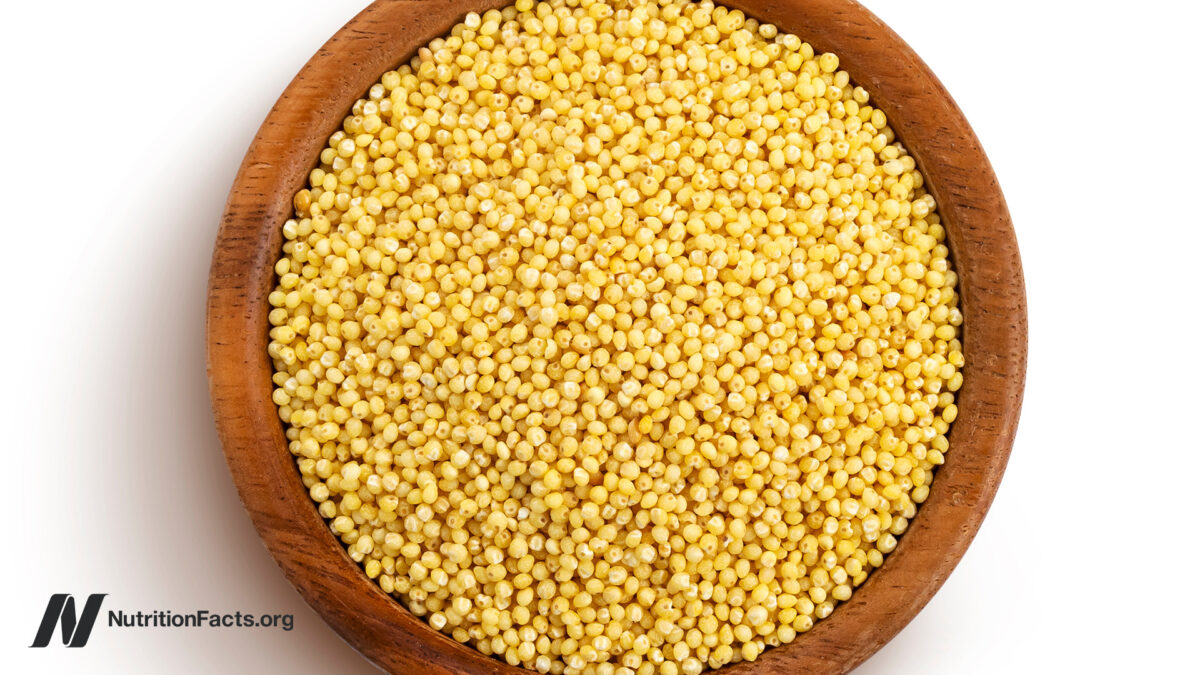
Tag: Millet

  • What About Millet and Diabetes? 

    What About Millet and Diabetes? 

    What were the remarkable results of a crossover study randomizing hundreds of people with diabetes to one and a third cups of millet every day? 

    How does millet come to the help of people with diabetes? A substantial portion of the starch in millet is resistant starch, meaning it’s resistant to digestion in our small intestine so it provides a bounty for the good bugs in our colon. Below and at 0:28 in my video The Benefits of Millet for Diabetes is a table showing how the various millets do. As you can see, they’re all much higher in resistant starch than more common grains, like rice or wheat, but proso and kodo millets lead the pack. 

    What’s going on? The protein matrix in millet not only acts as a physical barrier but also partially sequesters our starch-munching enzyme, and the polyphenols in millet can also act as starch blockers themselves.

    Millet has markedly slower stomach emptying times than other starchy foods, too. When we eat white rice, boiled potatoes, or pasta, our stomach takes about an hour to digest it, before it begins to slowly release it into our intestines, and it takes about two or three hours to empty about halfway. When we eat sorghum or millet, though, stomach emptying doesn’t even start for two or three hours and it may take five hours to empty just halfway, as you can see below and at 1:22 in my video

    Note that this was the case with both a thick millet porridge and a millet couscous. “The non-viscous millet couscous meal was also equally slow in [stomach] emptying. This suggests that there is an intrinsic property” of millet itself that helps slow down the rate of stomach emptying, which should blunt the blood sugar spike. What happened when it was put to the test? 

    Indeed, millet caused about a 20 percent lower surge in blood sugar than the same amount of carbohydrates in the form of rice. Remember how excited I was to show you how it only took the body about half the insulin to handle sorghum compared to a grain like corn? Well, millet did even better, as seen here and at 2:07 in my video.

    When a group of prediabetic individuals were given about three quarters of a cup of millet a day, within six weeks, their insulin resistance dropped so much that their prediabetic fasting blood sugars turned into non-prediabetic blood sugars, as shown below and at 2:22 in my video

    This “self-controlled clinical trial,” with the same subjects before and after, is just a sneaky way of saying it’s an uncontrolled trial. There was no control group in which participants either didn’t add the millet or added something else, and we know that just being under scrutiny in a study can cause people to eat better in other ways. So, we don’t know what role, if any, the millet itself played. What we need is a randomized, controlled, crossover trial where the same people eat diets with and without millet so we can see which works better. And here we go: a randomized, crossover study with hundreds of patients following an American Diabetes Association-type diet with and without about one and a third cups of millet every day. Researchers found that the millet-based diet lowered hemoglobin A1C levels, meaning there was an improvement in long-term blood sugar control, as well as the achievement of some side benefits like lowering cholesterol. 

    The target for good blood sugar control recommended by the American Diabetes Association is an A1C of less than 7. The participants started out at 8.37, but after a few months on millet, their A1C dropped to an average of 6.77, as seen here and at 3:35 in my video

    Is it just because they lost weight? No, which suggests it was an effect specific to the millet. The researchers didn’t just give them millet, though. They mixed the millet with split black lentils and spices, and we know from dozens of randomized, controlled experimental trials in people with and without diabetes that consuming pulses—beans, split peas, chickpeas, and lentils—can improve long-term measures of blood sugar control like A1C levels. So, while the researchers “concluded that millets do have a potential for a protective role in the management of diabetes,” a more accurate conclusion might be a mix of millets and lentils can be protective. The spices may have helped, too. The researchers didn’t say which spices were used, and I couldn’t get in contact with the authors, but a similar study done by one of the same researchers included about a daily tablespoon of a mixture of fenugreek, coriander, cumin, and black pepper, with a fifth spice, perhaps cinnamon or turmeric. 


    Source link

  • Is Millet a Nutritious Grain? 

    Is Millet a Nutritious Grain? 

    Millet isn’t the name of a specific grain, but a generic term that applies to a number of totally different plants. Which is the most healthful

    “Millets are highly nutritious but vastly ignored as a main source of food primarily due to lack of awareness.” Have you heard of ancient grains? Millets aren’t messing around. Arguably, they are the first grains cultivated by humankind—dating back not only 5,000 years, but maybe 10,000.

    Why millets and not just millet? I had no idea that “millet” wasn’t the name of a specific grain. In fact, millet is a generic term that doesn’t just apply to different species but to a number of totally different plants. There are “major and minor millets,” pearl millet, which is what most people think of as millet, and also proso, foxtail, and finger millets, which are all completely different grains. Although they look similar, they aren’t the same, as you can see below and at 1:05 in my video Studies on Millet Nutrition: Is It a Healthy Grain?.

    Fiber is one of the main things we look for in whole grain, and Kodo millet’s fiber content is off the charts. But, compared to other grains, finger and foxtail millets also beat out the bunch. Note, though, that pearl millet (the one most people think of as millet) is really on the low side. But looking at the polyphenol content, even plain millet beats out the other grains, including sorghum, which I previously hyped for how much polyphenol it contains. But, again, Kodo millet seems to win the day, as you can see below and at 1:39 in my video

    When it comes to total antioxidants, though, Kodo and finger millets are comparably high, as shown here and at 1:43.

    When it comes to nutrition, finger millet is said to have eight times more calcium than other grains, but, to me, it looks like it has ten times the calcium. It’s just off the charts, as you can see here and at 1:55 in my video

    It also has three times as much calcium as milk. Some of the millets are exceptionally high in iron too. Regular millet is high, but barnyard millet has about five times more iron than steak. 

    So, it’s nutritious, but what about specific potential health benefits? In the medical literature, you can read statements like: Millets “may prevent cardiovascular disease by reducing plasma triglycerides in hyperlipidemic rats.” But who cares whether food reduces cardiovascular disease in rodents except for those with pet rats or mice?

    An epidemiological study in China found lower esophageal cancer mortality rates in areas where residents ate more millet and sorghum, compared to corn and wheat. That may have been due more to avoiding a contaminating carcinogenic fungus than to the benefits of millet itself, though. Studies have shown that millets may be effective against cancer cell proliferation in a petri dish, with Kodo and proso millets rapidly inhibiting cancer cell growth, compared to pearl or foxtail millet, as shown below and at 3:02 in my video, knocking down the growth of cancer cells, but leaving normal cells alone. Also, millets were found to reduce the growth of colon cancer cells, human breast cancer cells, and human liver cancer cells, and also potentially help to prevent metastases by inhibiting cancer cell migration. My patients are neither pets nor petri dishes, though, and to date, there have been no clinical cancer trials with millet. 

    Are there any unique health-promoting attributes? Some know finger millet for its health benefits, such as lowering blood sugar and cholesterol and having anti-ulcer characteristics, but the anti-ulcer study researchers cite just notes that some of the areas with a low incidence of ulcers also happened to be regions where residents eat millet, as shown here and at 3:49 in my video, and that’s far from establishing cause-and-effect. 

    And the cholesterol-lowering study cited? It explores what happens when you take tail tendons from rats and soak them in sugar and millet! The blood-sugar-lowering benefits are legitimate, though. “Apart from the fact that millets do not contain gluten,” which is good for the 1 or 2 percent of people who have celiac disease or non-celiac gluten sensitivity, “millets can also be exploited in the management of type II diabetes due to their hypoglycemic [blood-sugar-lowering] property, as reported by several studies on millets and millet-based foods”—done with actual people, which we’ll cover next. 

    Isn’t it mind-blowing that millet isn’t actually a grain but a generic term? I learn something new every day—and make videos about it for you.

    I have a few millet recipes in The How Not to Diet Cookbook, including Millet Risotto with Mushrooms, White Beans, and Spinach. Find it at your local library or wherever you get your books. (As always, all proceeds from my books are donated to charity.) You can also substitute millet for the barley and/or rye in my Basic BROL Bowl.

    This is part of an extended series, which includes another three videos listed in the related posts below. 


    Source link