On January 22, 2026, the United States officially completed its withdrawal from the World Health Organization — the culmination of an executive order signed by President Trump on his first day back in office. The U.S. halted all funding, recalled its personnel from Geneva, and ceased participation in WHO governance bodies.
Less than two weeks later, New York City went the other direction.
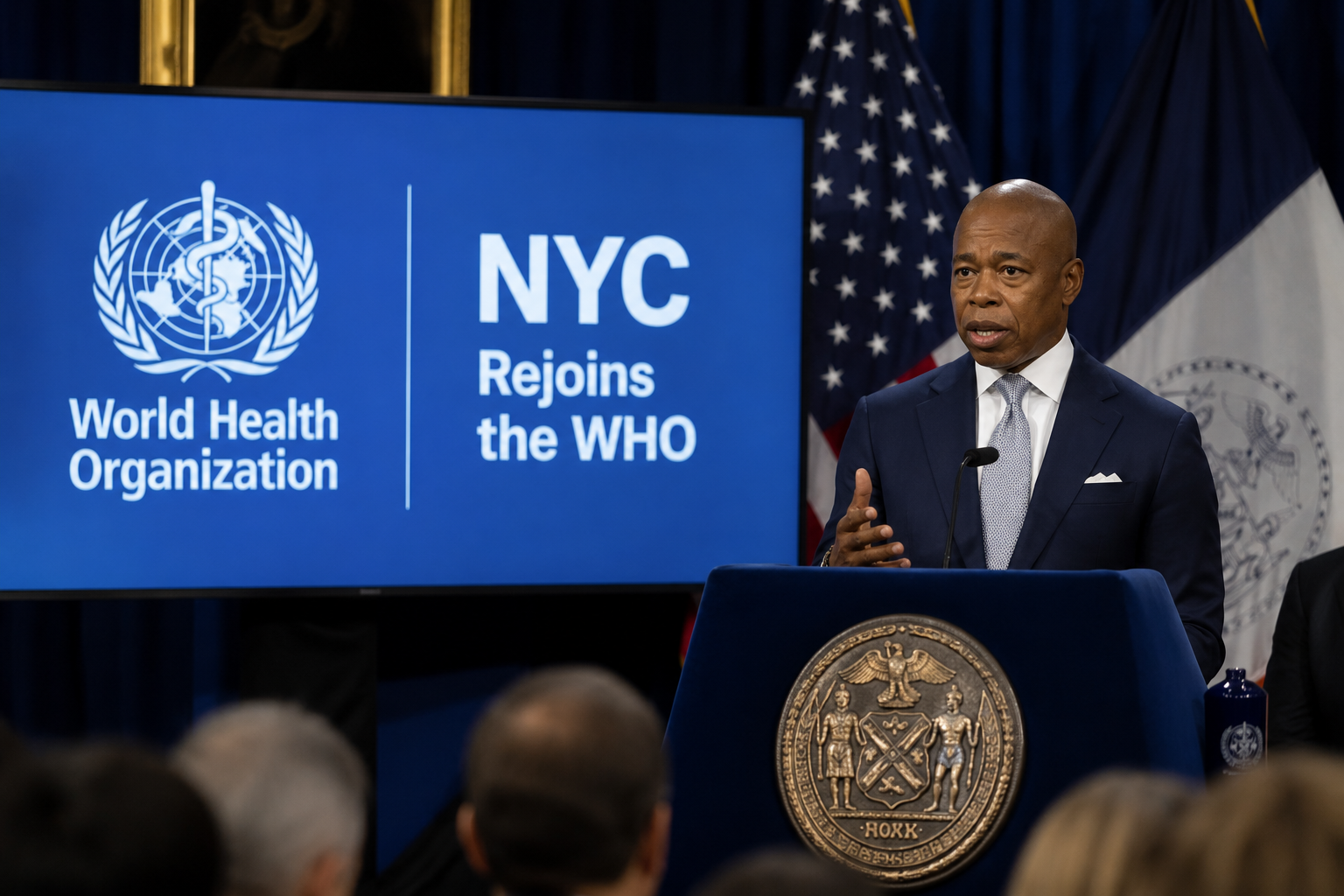
On February 5, 2026, the NYC Department of Health and Mental Hygiene announced it had joined the WHO’s Global Outbreak Alert and Response Network (GOARN) — becoming the first municipal health department in the United States to formally align with a WHO-affiliated body after the federal withdrawal. New York State, California, and Illinois have since followed with their own GOARN memberships.
The move was framed as a public health necessity. Critics see it as something else: a city government using a bureaucratic workaround to defy a federal policy decision made by the elected president of the United States.
What Is GOARN — And What Did NYC Just Sign Up For?
GOARN is not the WHO itself, but it is coordinated by the WHO and operates as an arm of its global outbreak infrastructure. The network includes more than 360 technical institutions — national health agencies, UN bodies, academic institutions, and nongovernmental organizations — and its stated mission is rapid detection and response to infectious disease outbreaks worldwide.
By joining, NYC’s health department gains:
- Early-warning outbreak intelligence — weekly briefings on emerging global health threats before they reach American shores
- Access to international laboratory networks — direct coordination with global health labs during active outbreaks
- Workforce training through real-world international response deployments
- Direct communication channels with global health partners during major health events
NYC Acting Health Commissioner Dr. Michelle Morse framed it in practical terms: “New York City is a global city with 8.5 million residents and more than 12 million international visitors every year,”she said. “To best prevent disease outbreaks and public health emergencies and to protect New Yorkers and visitors from them, the NYC Health Department is joining hundreds of public health institutions worldwide that share critical public health information.”
That logic has force. NYC is, in fact, a global disease entry point — as the city’s own 2026 measles cases (all linked to international travel) demonstrate.
The Political Reality
But the public health rationale doesn’t fully explain the timing or the tone.
Mayor Zohran Mamdani — a Democratic Socialist inaugurated on January 1, 2026 — has been on a collision course with the Trump administration since before he took office. Trump openly backed his opponent, warned he would withhold federal funding if Mamdani won, and called the new mayor a “communist” on national television. Mamdani, for his part, has signed executive orders directly countermanding federal immigration enforcement, vowed to use “every tool of the law” against White House threats, and now — through his health department — has formalized a relationship with the very international body the president just paid $490 million in arrears to exit.
The U.S. had committed to providing the WHO with $490 million in voluntary contributions for 2024 and 2025, which the Trump administration refused to pay before withdrawal — leaving the organization with a significant funding shortfall.
Governor Hochul’s own statement on joining GOARN at the state level made the political intent explicit: “New York has always led in public health and safety and now we’re doing our part to protect lives while the federal government puts Americans’ health at risk.”
That’s not a public health statement. That’s a campaign ad.
What the Federal Government Actually Did — And Why
The Trump administration’s HHS fact sheet on the WHO withdrawal cited three core reasons for leaving:
- The WHO’s mishandling of the COVID-19 pandemic — specifically its deference to China in the early months of the outbreak
- Persistent refusal to adopt internal reforms
- Lack of accountability, transparency, and independence from political influence of member states
These are not fringe complaints. They have been raised by public health experts across the political spectrum. As the WHO’s largest historical funder— contributing between $160 million and $815 million annually over the past decade — the U.S. had unique leverage to demand reform. Walking away, the argument goes, was the only credible threat left.
The counter-argument: without U.S. participation, countries like China, Russia, India, and Saudi Arabia now have greater influence over WHO’s priorities and guidelines. That has real consequences for how global health crises are managed — and what information the U.S. receives in the early hours of an emerging outbreak.
The 2026 FIFA World Cup Factor
There is one genuinely nonpartisan reason NYC’s move to GOARN carries urgency: the 2026 FIFA World Cup.
Matches will be played across North America this summer, with the final at MetLife Stadium in East Rutherford, New Jersey. Greater New York alone is expected to draw more than one million international visitors in a matter of weeks. The city’s health infrastructure will need to track disease threats from dozens of countries simultaneously — exactly the kind of scenario GOARN was designed for.
This is the one context where the “we need global intel” argument for GOARN membership is hardest to dismiss on partisan grounds.
What This Means for New Yorkers
In practical terms, day-to-day healthcare in New York City is not changing. GOARN membership does not give the WHO authority over NYC’s public health policy, vaccination mandates, or healthcare system. It is an information-sharing and coordination arrangement — not a governance transfer.
What it does represent is a growing patchwork of sub-national governments — cities and states — making independent foreign health policy decisions, in direct contrast to the federal government. That trend, if it accelerates, raises legitimate questions about who actually sets American public health priorities when Washington and major population centers are pulling in opposite directions.
For New Yorkers, the immediate question is simpler: does having earlier access to international outbreak intelligence make the city safer? The data suggests yes. Whether the political theater surrounding it helps or hurts is a separate question entirely.
Breaking This Week: The WHO Assembly the U.S. Isn’t Attending
The stakes of NYC’s GOARN move come into even sharper focus this week. The 79th World Health Assembly is currently underway in Geneva, Switzerland (May 18–23, 2026) — and for the first time in nearly 80 years, the United States has no seat at the table.
The assembly is moving forward without Washington on several fronts that directly affect New York City and American public health:
The WHO Pandemic Agreement annex negotiations. The WHO Pandemic Agreement — adopted by 120 countries in May 2025, without U.S. participation — is still being finalized. The critical PABS annex, which governs how countries share pathogen data and access vaccines during a future pandemic, is being negotiated at this assembly. The U.S. is not part of those talks. When the next pandemic begins, Washington will have no formal access to the early pathogen intelligence sharing system its own scientists helped build.
Global health architecture reform. The assembly this week voted to establish a Member State-led reform process for the entire global health architecture — redesigning how the world coordinates on outbreaks, funding, and emergency response. The U.S. has no voice in shaping that redesign.
The direct GOARN impact. In his address to the assembly on May 19, WHO Director-General Dr. Tedros Adhanom Ghebreyesus highlighted that GOARN coordinated 58 deployments to 16 countries in the past year alone — including rapid responses to Ebola in the DRC, Marburg virus in Tanzania and Ethiopia, and the ongoing hantavirus situation aboard the MV Hondius cruise ship. NYC’s GOARN membership means the city’s health department now receives that real-time intelligence directly. The federal CDC does not.
The financial vacuum. The assembly opened under what UN News described as “the shadow of Ebola, hantavirus and funding cuts.” Ghana’s president, in his keynote, said his country lost $78 million in health funding following USAID cuts, with critical malaria and HIV programs affected. The U.S. withdrawal has forced the WHO to scale back operations globally — creating gaps in exactly the outbreak surveillance infrastructure that NYC is now trying to plug through GOARN membership.
The irony is not subtle: as Washington steps back from the global health table, New York City has pulled up its own chair.
Timeline: How We Got Here
| Date | Event |
|---|---|
| Jan 20, 2025 | President Trump signs Executive Order 14155, initiating WHO withdrawal |
| Jan 22, 2026 | U.S. officially exits WHO; all funding terminated, personnel recalled |
| Feb 5, 2026 | NYC Health Dept. joins GOARN — first U.S. municipality to do so |
| Feb 10, 2026 | NY State joins GOARN under Gov. Hochul |
| Feb–March 2026 | California and Illinois health departments also join GOARN |