If meditation is feeling just one more thing on your to-do list, try this intention practice to connect with why you meditate.
Sometimes, we can start out a mindfulness practice with lots of energy, but after a while, that commitment fizzles. The key in meditation is to take time to get in touch with what you want, what you value most. Understanding why you meditate can feed your passion and motivation and help you to make a habit of your regular practice.
1. Feel the Body
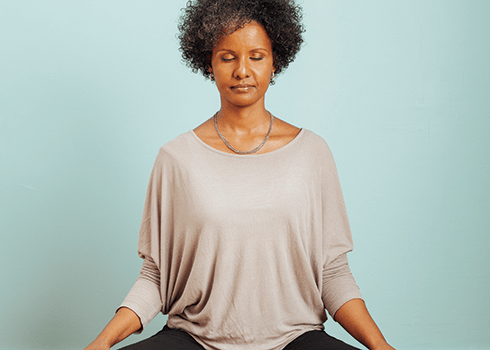
Begin by feeling your body, connecting with both feet, your legs, your seat, hips, tailbone. Sensing your spine, straight and upright, relax the shoulders down and allow your awareness to travel down through both arms and to the palms of the hands and fingers. Bring the awareness into the belly, the chest, the throat, and then resting your awareness on your face, release any tension in your jaw, eyes, forehead. Sense the whole body as you sit here. And feel the breath moving through the entire volume of the body. And from this place of connection and presence, inquire into why you are meditating. What is your hope, vision, intention?
Tip: Don’t worry if your intention is fuzzy—you can choose to simply pay attention to whatever thoughts or sensations arise.
2. Listen Closely
Listen deeply. Thoughts will arise. Note them, and let them go. Listen deeper still. What feels most compelling, most true in your body? Try not to think about your intention, or to analyze or cognitively discern it. Instead, see if you can listen from a deeper place, a still abiding awareness that is always already there. Listen with your body, with your whole being.
3. Note the Intention
Perhaps, for now, there is no clear answer, and your intention is simply to be present, to stay open, to be curious, allowing whatever arises to be here. Or perhaps a clear felt sense of your intention arises. Either way, hold your intention clearly in your consciousness, regardless of whether it is strong and clearly formed or amorphous and tentative.
4. Let Your Intention Go
Silently repeat your intention, anchor it in your mind and body. And once you feel that it is clear and stable, let it go. And rest back into the body, into the awareness that is enveloping you. The intention simply guides, it is not a goal that we fixate on, but a direction we incline our heart and mind to follow.
When we use our imaginations to envision the future life we most hope, we can bring ourselves one step closer to that actual life. This mindfulness practice is called “imagine if.”
If you joined me for Module 1, or even if you haven’t, let’s just recap: we’ve explored how to uncover the meaning in our lives, how to touch in with our core values. So, today, I want to build on that and really think about how to set an intention based on the things that are important to us. In order to do that, I always like to begin by taking a moment to arrive. As you’re listening to this, you may be just starting your day or arriving from a busy day. Whatever the circumstances, I always find it really nourishing to just take a moment to allow our mind and heart and body to catch up with one another—inviting all parts of us into the same moment and taking a moment to arrive here.
How to Set an Intention for Your Future
Watch the video:
Listen to the audio:
Read the practice:
1. If you’re comfortable, I invite you to close your eyes or simply direct your gaze downward, softening the visual field. Sit or find a comfortable position for your body. Allow your attention to settle.
2. Collect your attention and become aware of your body. Feel the places where your feet make contact with the ground or the chair. Tune into the felt sense of your body wherever you find yourself—perhaps sitting in a way that’s alert but relaxed at the same time; sitting in a way that embodies this quality of alertness, of clarity, that we will be practicing today.
3. Now gently but firmly gather your attention and direct it towards the sensation of breathing. Note the sense of the air moving in and out of your body. Bring your full, undivided attention in a firm but gentle way to this experience of breathing.
4. And just as you are, let’s continue this meditation on intention by considering something you hope for in your life. More specifically, what you may hope your life will look like at some future date and time. It could be near-term: the next six months or a year; or longer-term: three years, five years, 10 years. Choose whatever time horizon is useful for you at this moment.
5. Now, really consider what you envision for your life, with vividness and clarity. I invite you to imagine you living your best life. And to take this further, I’d like you to imagine you living your best life in a way as though it’s already happened. So, what are you hoping for? Imagine it’s five years from now, or 10, and you’re living your best life. What does that look like? Let’s pause here and really envision what this future life looks like. Who are you? What are you doing? Who is there with you? What conditions exist, what circumstances?
6. Continuing now, call into your mind and heart and sense in your body what it feels like to be living this future life that you most hope for. The easiest way to envision this is to simply imagine what it would feel like. What would it feel like to be living this future life?
7. As we end this meditation I invite you to take a few deeper breaths at your own pace. And then rejoin: Open your eyes, if you have your eyes closed.
Reflecting on your intention practice:
So, this is really an exercise in “imagine if.” And again, this is part of an intention-setting exercise. And the reason I’m inviting you to envision a future life that you most hope for is because imagining it, and thinking and acting as though we’ve already experienced it, we can bring ourselves one step closer to that actual life. If that doesn’t seem clear, here’s another simple prompt you can either use as a meditation or reflection, or you can write or journal about. It’s a kind of fill-in-the-blank: I am living my best life, and I am ….
If there’s something that you’re hoping for—a change, a difference in your life—begin with that. An example of this reflection would be: It is three years from now, and I’m living my best life, and I am …. I invite you to fill in that blank.
It’s 10 years from now, I am living my best life, and I am writing and teaching—that would be mine. And I am a published author of three books.
So I invite you to try this out for yourself: imagine your future life because this is the intention-setting exercise at the heart of this module.
I invite those who aren’t writing to just meditate on that prompt. And if you’re comfortable writing, please go ahead and take a minute or so and write this out: I’m living my best life and I am …. Fill in the blank.
Continue that reflection by considering how you feel. What does it feel like in this future place? Write that down, or inhabit that feeling. What are you doing? How do you feel? What’s happening in this best version of your life?
Just remember this vision, this felt sense, as we end the reflection. If you’re doing this as a meditation, take a couple of deep breaths at your own pace and then rejoin us.
Thank you for that thought exercise, that meditation. This is intention-setting: imagining the way forward and setting the intention around it. I specifically wanted to invite you to reflect on your own life, perhaps your life and work, and then consider how all of this would look in the best life you could hope for—and then, write it down. Or you can really get clear on the qualities of that best life and then live your way forward into that life. That is the intention-setting invitation. Have a great day.
Skip the resolutions this year. Set a different tone by cultivating your intentions for the new year with this mindful practice.
While many of us take stock at the end of a year, set goals, or make new plans for the upcoming year, that sense of letting go of what we’re caught up in and the habits we’ve been living through are a part of our everyday mindfulness practice. Each time we sit for a few minutes, there’s an opportunity to let go of wherever our minds, attention, and awareness have gotten caught up in, come back, and realign ourselves with our best intentions and efforts.
It might be a sense of bringing full awareness and attention to our experience, to the people around us, to a conversation with our children. It might be a sense of letting go of reactivity and coming back to resolve with more patience and clarity. It might also be balancing the tendency most of us have to get caught up in stress and giving more attention to gratefulness, positive moments, and things we enjoy. Or it might be a sense of wanting to bring more kindness and compassion to how we treat ourselves, how we treat others, or even how we treat the people we find difficult in our lives. All of that can be cultivated, sustained, and developed through any amount of time we spend in our mindfulness practice.
A Guided Meditation to Set Your Intentions for the New Year
Find a comfortable posture. Dropping your gaze or shutting your eyes, notice the physical movement your body makes with each breath. You might notice your belly, your chest, or perhaps the air moving in and out of your nose and mouth.
Check in with your effort and intention. What is it you’d like to bring to the practice today? Perhaps it’s an opportunity to settle and gather your attention or a sense of resolve and strength. Of course, you might have the intention to simply show up to this practice without adding any sense of stress or strain.
Bring that sense of intention and awareness to your practice today. One way to do that can be within each in-breath, developing a sense of open awareness.
With each out-breath, come up with a word that captures your intentions for yourself. Breathe in with awareness and maybe picture something or feel gratitude toward whatever feels appropriate to you right now. Breathe out with your intentions for this moment.
You might lose touch with your intentions throughout the practice and in life—you can come back again. If you lose touch with the practice and your mind gets caught up in distraction or reactivity or some sense of discomfort, that’s normal. That’s all part of the practice. Try coming back to the same practice with awareness.
As the practice ends, pause for a moment with intention, and choose when to move on with your day. Whatever you’re facing in life, all we indirectly influence is how we choose to relate to that. Reactivity and anger so often lead to more reactivity and anger. You can get caught up in self-criticism and in criticism of others. You can develop a more balanced sense of awareness, preciseness, and clarity through mindfulness practice. At any moment, you can catch yourself and realign yourself with your best intentions, recognizing that you may lose touch again and then come back when you do.