Tag: Heavy

  • A Meditation For When the Suffering In the World Feels Heavy

    A Meditation For When the Suffering In the World Feels Heavy

    If you’re feeling overwhelmed by the pain, uncertainty, and suffering in the world right now, here is a practice to find courage, peace, acceptance, and connection.

    Many of us are carrying the weight of the world’s suffering right now. How can we acknowledge the immense suffering in the world, including our own—and still tend to our hearts, minds, and bodies in a way that keeps us grounded and able to take compassionate action?

    This week, mindfulness teacher and author Wendy O’Leary shares a guided practice that offers refuge and reminds us of our real and loving connection to one another.

    There are three main parts of the practice. First, stabilizing or grounding. Second, settling back, softening, and soothing. And third, the one for me, one for you practice, which is based on the giving and receiving compassion practice from the Mindful Self-Compassion Program.

    A Meditation For When the Suffering In the World Feels Heavy

    Read and practice the guided meditation script below, pausing after each paragraph. Or listen to the audio practice.

    1. I invite you to get into a comfortable seated position. You can close your eyes or gently look down and soften your gaze. Whatever works best for you.
    2. Begin by directing your attention into your body, allowing it to gently move in and drift down as it drops all the way down to your feeling the connection of your feet on the floor. If your feet aren’t on the floor, simply notice wherever the feet are connected. That experience of contact and pressure. Or you might feel the contact and pressure of the backs of your legs on the chair or cushion. Connecting with this felt experience of being grounded and rooted, supported and held here on earth. As you feel the somatic experience of those contact points, the feet or the seat. Rooted, grounded, steady and stable. Connected and supported by the earth.
    3. From this place of steadiness and stability, bring to mind someone you know who’s having a hard time. It could be someone you know personally or more generally someone or a group of people you are aware of who are struggling at this time. On a scale of one to 10, choose an example of someone who is somewhere in the middle. So not the most difficult situation.
    4. As you allow them to more fully enter your awareness, check in with your body. Often, when we’re focused on difficulty, ours or others’, there can be a habitual tendency to contract, to tighten, and to even lean forward. Check it out to see if this is true for you. Counteract this tendency. I invite you to gently lean back, physically or even energetically, just a little. Settle back.
    5. Now, invite the body to soften and even widen, creating space to hold whatever is there. So we aren’t forcing anything here. It’s a very gentle invitation to settle back and soften. If it feels supportive for you, you can place your hand on your heart center as a way to care for and soothe the body, heart, and mind. Settle back, soften, soothe.
    6. Now begin to gently direct your attention to rest with the breath, feeling the flow of the breath moving in and out of the body. Just this in-breath. And just this out breath. Connecting with this experience of the breath, moving through the body like a wave moves through the ocean. And bringing back to mind this person or group of people whom you know are suffering.
    7. Check in with yourself to see what would best support you in being with their struggles. So that could be, for example, patience or calm, strength, acceptance. Whatever you feel would best support you. On the in-breath, offering that to yourself, and then gently releasing on the out-breath. If no word comes to mind, that’s totally fine. You can simply think to yourself, one for me on the inhale, and gently release on the exhale. One for me, and gently release.
    8. If it feels right for you, you can now consider what it is that they most need. It may be the same thing you need, or it could be something different. And again, if a word doesn’t come to you, you could think, one for you.
    9. Continue to take in for yourself what you need on the inhale, and offer them what they need on the exhale. Taking in one for me on the in-breath and one for you on the out-breath. One for me. And one for you.
    10. As you feel ready, open your eyes or look up as we close this practice. As we practice this more formally, it becomes accessible to us in our daily life, more available for us to use these practices when we come in contact with suffering in our lives. 

    Thank you for practicing with me and may our practice benefit all beings.


    Source link

  • Heavy Metal, Headbanging, and Our Health

    Heavy Metal, Headbanging, and Our Health

    How might we moderate the rare but very real risk of headbanging?

    If you search for heavy metal in the National Library of Medicine database, most of what you find is on heavy metal contamination in fish, which “makes it difficult to establish clearly the role of fish consumption on a healthy diet” and perhaps helps to explain the quintupling of odds of autoimmune diseases, such as juvenile arthritis. But searching for the hazards of heavy metal also pops up entries on the “risks from heavy metal music.” In this study, researchers were talking about traumatic injuries from slamming around “during a moshing session,” but you’re more likely to get injured at an alternative rock concert. (Check out some of the artists below and at 0:50 in my video The Dangerous Effects of Heavy Metal Music.)

    Certainly, music-induced hearing loss is a serious problem, but that can result from any loud music. Clinical recommendations include the “80–90 rule”—no more than 80% of the maximum volume on personal listening devices for no more than 90 minutes a day. That’s not what the science shows, however. “Do not exceed 60% of the maximum volume” may be more evidence-based, but researchers figure teens would just ignore that, so they came up with more “acceptable” advice.

    I assumed I’d see a lot of satanic panic nonsense from the 1980s, when “parents bereaved by suicide…accused Heavy Metal groups of promoting suicidal behaviours and…proceeded to sue musicians.” What kind of evidence did the parents present? There has been “little scholarly research” published until the “The Heavy Metal Subculture and Suicide” paper that tried to correlate the number of statewide heavy metal magazine subscriptions to youth suicide rates. Seriously?

    It got really wild, though, when researchers called psychiatric institutions, pretending to be parents worried because their son started listening to heavy metal music, even though they made it clear that their son didn’t exhibit any symptoms of mental illness, didn’t do drugs or drink alcohol, and was doing fine at school. Ten of the twelve facilities believed the son required psychiatric hospitalization. Imagine what that would do to a kid! Researchers found that, decades later, metalheads “were significantly happier in their youth and better adjusted” than their peers.

    Some studies were strange. Do Parkinson’s patients walk better listening to The Beatles’ “Yellow Submarine” or Metallica’s “Master of Puppets”? (See below and at 2:32 in my video.)

    Others were pretty nondescript. Heavy metal musicians exhibit a higher heart rate than those performing “contemporary Christian,” which isn’t so surprising, as you can see  here and at 2:40.

    Some others were kind of cute, like one that investigated the influence of music on promoting patient safety during surgery—veterinary patients, that is. Kittens got spayed with little earphones on their heads. It turns out that “Adagio for Strings” may be more relaxing than AC/DC.

    A review on music therapy for human patients warned: “Caution should be exercised…when guiding patients in selecting their music. ‘Chaotic music, such us [sic] hip-hop and metal, is not healing to human cells.’” That even had three citations, though two of them don’t say anything and the third is a nursing newsletter merely quoting someone’s opinion. I did some digging, and it turns out that stomach cancer cells like metal. If you play them Cannibal Corpse versus Beethoven, 12 hours of death metal increases their growth in a petri dish, as you can see below and at 3:28 in my video. (That’s so metal.)

    But who puts headphones on their stomach? Or their chests, for that matter? In one study, Mozart killed off one type of breast cancer cell line but not another; in another study, only Beethoven’s 5th Symphony seemed to work, and Mozart flopped when the petri dishes were surrounded by speakers. How does this stuff even get published?

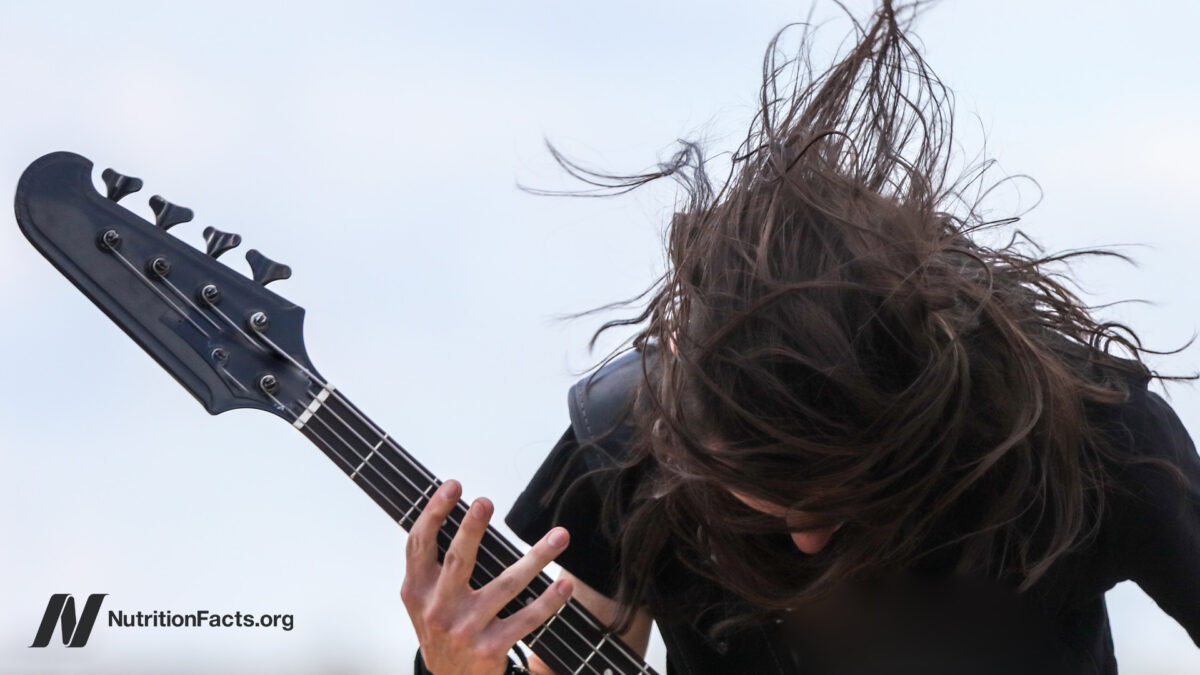
    Anyway, the true danger from heavy metal is headbanging. “Headbanging is a contemporary dance form consisting of abrupt flexion–extension movements of the head to the rhythm of rock music, most commonly seen in the heavy metal genre.” Although the “number of avid aficionados is unknown…some fans might be endangered by indulging excessive headbanging.” Despite headbanging generally being “considered harmless,” several health complications have been attributed to this practice, including ripping your carotid artery, rupturing your lung, whiplash injury, neck fracture, or subdural hematoma. One man reported headbanging at a Motörhead concert, and all that “brisk forward and backward acceleration and deceleration forces” might have ruptured his bridging veins and caused him to bleed into his skull.

    As shown here and at 4:47 in my video, bridging veins bridge the gap between the brain and the covering that lines the inside of our skull, and if the veins tear, blood can build up under our skull and compress our brain.

    This bridging vein rupture has been demonstrated on headbanging cadavers (another very metal study). See below and at 5:02 in my video. It’s been likened to a “pseudo shaken-baby syndrome” in adults.

    The researchers conclude that their “case serves as evidence in support of Motörhead’s reputation as one of the most hardcore rock’n’roll acts on earth,” but I think the real takeaway is that a potentially dangerous complication like subdural hematoma can result from “a seemingly benign activity like head banging.” And some of the brain bleeds can be massive. One man complained of a “headache after headbanging at a party.” Why? As you can see in his CT scan below and at 5:35, circled in red is all blood, squishing over his brain. Amazingly, he survived; another man didn’t, headbanging and losing his life to a fatal subdural hemorrhage.

    We can tear more than just veins. There are two sets of arteries that tunnel into the skull—the carotid arteries in the front and the vertebral arteries in the back—and we can tear both sets. A 15-year-old boy “indulged in headbanging” and ripped his carotid artery, which led to a massive stroke. He presented as half-paralyzed and unable to speak, and he died in a coma within a week.

    What about the vertebral arteries in the back? They’re wedged into our skull, rendering them susceptible to shearing forces from extremes of neck motion, and that’s exactly what appeared to happen when a heavy metal drummer tore the wall of the artery. All of this is really rare, probably afflicting less than one in a thousand or so. What can metalheads do to reduce their risk? “To prevent injury due to such head-banging, the range of head and neck motion should be reduced, slower-tempo music should replace heavy metal rock, the frequency of head-banging should be only on every second beat, or personal protective equipment should be used”—like a neck brace?

    “Little formal injury research has been conducted on the worldwide phenomenon of head banging,” so researchers constructed “a theoretical head banging model” with enough physics terms to make any nerd happy: “angular displacement,” “sinusoidal motion in the sagittal plane,” and “amplitude of the displacement curve.” The study participants? Headbangers. The control group? That’s easy with easy listening music.

    The head injury curves and neck injury curves, based on headbanging tempo and angular sweep, are shown below and at 7:23.

    “An average head-banging song has a tempo of about 146 beats per minute, which is predicted to cause mild head injury when the range of motion is greater than 75º,” so something like what’s seen below and at 7:34 in my video.

    The researchers conclude: “To minimise the risk of head and neck injury, head bangers should decrease their range of head and neck motion, head bang to slower tempo songs by replacing heavy metal with adult-oriented rock, only head bang to every second beat, or use personal protective equipment.”

    “Unfortunately, it is difficult, if not impossible, to change the habits of heavy metal aficionados.” Maybe what we need are metal-studded neck braces.

    Doctor’s Note

    What about the healing potential of music? Check out Music as Medicine and Music for Anxiety: Mozart vs. Metal.


    Source link

  • How Heavy Is Your Food’s Carbon Footprint? 

    How Heavy Is Your Food’s Carbon Footprint? 

    How much greenhouse gas does the production of different foods cause, measured in miles driven or lightbulb hour equivalents?

    “Our eating habits are making us and the planet increasingly unhealthy—it’s a lose-lose situation.” “A global transformation of the food system is urgently needed.”

    “In consideration of the mounting evidence regarding the environmental effects of foods, in 2015, the [U.S.] Dietary Guidelines Advisory Committee included for the first time a chapter focused on food safety and sustainability.” It concluded that “a dietary pattern that is higher in plant­based foods, such as vegetables, fruits, whole grains, legumes, nuts, and seeds, and lower in animal­based foods is more health promoting and is associated with lesser environmental impact than is the current average US diet.” However, unsurprisingly, “despite unprecedented public support, this and other sustainability language were not included in the final 2015–20 Dietary Guidelines published by the US Department of Health and Human Services and the US Department of Agriculture.”

    The U.S. Dietary Guidelines didn’t even sufficiently stick to the science of healthy eating either. “Many national dietary guidelines do not reflect this evidence on healthy eating and include no or too lax limits for animal-source foods, particularly meat and dairy, despite an opposing evidence base.” Even if it completely ignored planetary health and just stuck to the latest evidence on healthy eating, it would have knock-on environmental benefits. Replacing animal-sourced foods with plant-based ones would not only improve nutrition and help people live longer, but it could reduce greenhouse gas emissions by up to 84 percent.

    In general, “plant-based foods cause fewer adverse environmental effects” by nearly any measure. In terms of carbon footprint, all the foods that are the equivalent of driving more than a mile (1.6 km) per 4 ounces (113 g) served are animal products, as you can see below and at 1:44 in my video Which Foods Have the Lowest Carbon Footprint?.

    Below and at 2:05 in my video, you can see the greenhouse gas emissions from various foods. Even though something like a lamb chop or farmed fish may be the worst, eating chicken causes about five times the global warming than tropical fruit, for instance. What are the climate superstars? Legumes—beans, split peas, chickpeas, and lentils. 

    “For example, in the United States, substituting beans for beef at the national level could deliver up to 75% of the 2020 GHG [greenhouse gas] reduction target and spare an area of land 1.5 times the size of California,” not to mention health benefits. And it isn’t just greenhouse gases. “To produce 1 kg [2.2 lbs] of protein from kidney beans required approximately eighteen times less land, ten times less water, nine times less fuel, twelve times less fertilizer and ten times less pesticide in comparison to producing 1 kg [2.2 lbs] of protein from beef.”

    So, yes, according to the prestigious EAT-Lancet Commission, more plant-based may be better, but even “a shift towards a dietary pattern emphasizing whole grains, fruits, vegetables, nuts, and legumes without necessarily becoming a strict vegan, will be beneficial.” In Europe, for example, researchers found that just “halving the consumption of meat, dairy products, and eggs in the European Union would achieve a 40% reduction in nitrogen emissions, 25–40% reduction in greenhouse gas emissions and 23% per capita less use of cropland for food production. In addition, the dietary changes would also lower health risks,” reducing cardiovascular mortality, which is Europe’s leading cause of death.

    “However, minimizing environmental impacts does not necessarily maximize human health.” Yes, as you can see below and at 3:33 in my video, animal products, including dairy, eggs, fish, and other meat, release significantly more greenhouse gas per serving than foods from plants, but eating added sugar and oil won’t do your own body any favors. 

    In California, including more animal products in your diet requires an additional 10,000 quarts/liters of water each week. So, that’s like taking 150 more showers in seven days. As you can see below and at 4:00 in my video, skipping meat just on weekdays could conserve thousands of gallons of water a week, compared to eating meat every day, as well as cut your daily carbon footprint and total ecological footprint by about 40 percent. 

    Some countries are actually doing something about it. For example, the “Chinese government has outlined a plan to reduce its citizens’ meat consumption by 50%,” whereas much of the rest of the world appears to be doing the complete opposite, pumping billions of taxpayer dollars into subsidizing the meat, dairy, and egg industries, as you can see below and at 4:15 in my video

    We can certainly all try to do our part. However, an obstacle to dietary change may be that “consumers underestimate” the environmental impacts of different types of food. Labeling may help. For example, imagine picking up a can of beef noodle soup and seeing the image below, shown at 4:38 in my video.

    The carbon footprint of a single half-cup serving of beef noodle soup is like leaving on a light for 39 hours straight—and not an eco-bulb, but an old-school, 100-watt incandescent bulb. Compare that to eating a meat-free vegetable soup. Between the two, there’s a difference of 34 light-bulb hours, as you can see below and at 4:50 in my video. You can imagine someone getting on your case for unnecessarily leaving on a light for 34 minutes, but this is 34 hours wasted just from eating half a cup (120 ml) of a meaty soup rather than a meat-free vegetable soup. 

    This is the second in a three-video series. If you missed the first one, check out Friday Favorites: Win-Win Dietary Solutions to the Climate Crisis. Stay tuned for Which Diets Have the Lowest Carbon Footprint?. Also check: Friday Favorites: Which Foods and Diets Have the Lowest Carbon Footprint?.

    For more, see my older video Diet and Climate Change: Cooking Up a Storm and a [digital download] on using plant-based or cultivated meat as a climate (and pandemic) mitigation strategy. 


    Source link