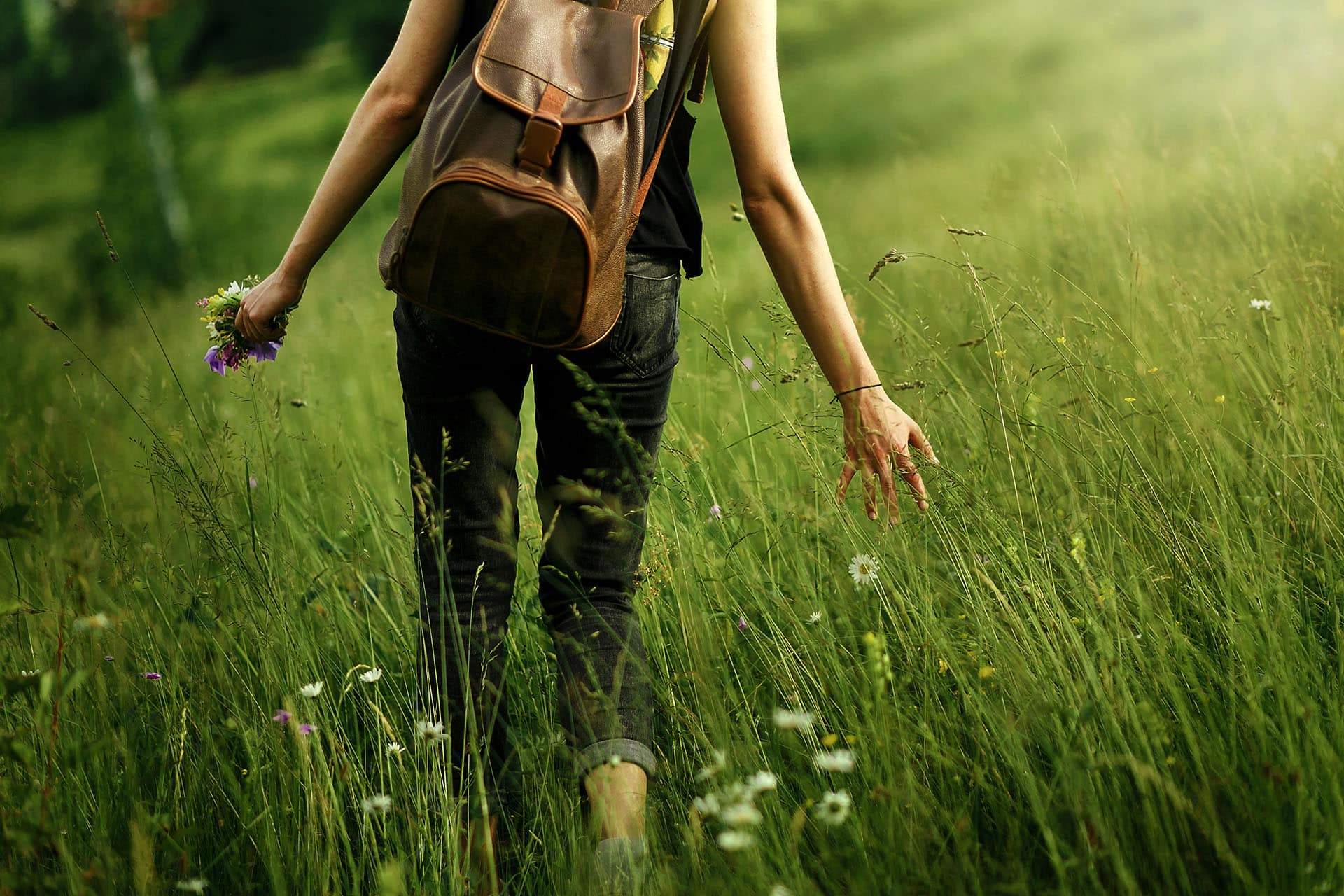
Whatever the season, spending time in nature happily coincides with one of my favorite mindfulness practices: outdoor walking meditation, or mindful walking. Focusing while our body remains still presents a challenge for many of us, from the easily triggered to the anxious to the attention deficient, which is why contemplative movement—be it ritual dance, sport, martial arts, or something else—exists in so many cultures. In fact, mindful walking practice is often what people describe as their favorite practice after they’ve taken a mindfulness course, and the one they are most likely to continue to practice. It’s the best reminder that mindfulness does not have to be a still, solitary, indoor activity.
Walking is a movement we do every day, and like breathing, is usually something we do without much thought. Getting outside to walk deliberately in nature can open our eyes, offering new perspectives different from those we encounter indoors or inside our digital devices. Author Richard Louv, among others, writes about “nature-deficit disorder” and how it affects our physical and emotional well-being, suggesting even just a little exposure to green spaces boosts happiness and attention. The Japanese practice of “forest bathing,” with its research-backed benefits to the mind and body, has been trending around the world. Trends aside, many of us have experienced the power of nature, be it mountains or beaches, forests or gardens, to soothe our most turbulent emotions. The natural world is full of lessons to be learned and metaphors to be explored.
Getting outside to walk deliberately in nature can open our eyes, offering new perspectives different from those we encounter indoors or inside our digital devices.
Integrating mindfulness into movement has the added benefit of combining mental exercise with physical exercise. Studies abound showing that light walking for 20 minutes can help mild depression, anxiety, and attention, not to mention our physical wellness. Getting outside and taking care of our mental health is always important, especially if we’re having a stressful day.
With that in mind, here are six ways to get the most out of your next walk.
How to Get Started with Mindful Walking Outdoors
1. Basic Mindful Walking Meditation
A basic mindful walking meditation is pretty simple. All you need to do is notice yourself walking as you walk, making your body sensations the anchor of the meditation. To break out of the autopilot we are often in, you might ask yourself, “How do I know I am walking?” and then check in with your senses.
It also may help to bring awareness to certain aspects of walking. For example, you can bring mindfulness to your body as you notice the sensation of your feet on the ground or the movement of your muscles, especially as you encounter different surfaces beneath you. Notice not just what your legs are doing, but also your arms, torsos, spine, and head as you walk. You might be able to detect subtle shifts in your pulse, body temperature, or breathing rate before, during, and after you begin moving. You can also focus on the gentle rocking motion of your weight shifting.
Sometimes in sitting practice we use our breath as our anchor and focus on the point between the in-breath and the out-breath, where there is a moment of stillness. Likewise, in mindful walking practice, we can notice the points of stillness where the right step becomes the left step and the left step becomes the right step.
2. Adding Words or Phrases
One simple way to focus your attention is to bring words or phrases to your steps. For one, you can count in rhythm with your steps. Whenever your mind wanders off and you lose count, simply notice where your mind has wandered, and return the count to one again. The key is to do this without judging yourself, and your wandering mind.
It may also help to have something to say along with the movements. You can, for example, say thank you and send gratitude or compassion to your feet and body as you move—a practice from Christopher Germer and Kristin Neff’s program Mindful Self-Compassion. Or, you can quietly or internally repeat reminder phrases to yourself.
You might enjoy repeating the following phrases, suggested by mindfulness teacher Thich Nhat Hanh, with each step:
I have arrived, I am home, in the here, in the now.
I also heard some other wonderful phrases once from a friend, saying for each footstep:
Nowhere to go. Nothing to do. No one to be.
Experiment with any or all of these on your next walk, or come up with your own phrases that resonate for you next time you are out.
3. Sensory Walking
This adaptation for the mindful walking meditation is simple, and just involves really tuning into our five senses as we move through space. As we get into the moment with our senses, we can really savor the precious moments we do have to be outside and moving, and all that is around us. Our senses keep us grounded in the moment while our thoughts drift to the past or future.
- First, walk while keeping your eyes still and watching the view change as shapes and objects shift in and out of your line of vision.
- Next, focus just on the soles of your feet, aware of different sensations there as the surface changes.
- Then, focus on sounds. Those of your own footsteps, as well as the changing sounds in the world around you as you move.
- Lastly, focus on smells and tastes in the air, and how they change depending on where you are.
4. Body Awareness Walking
Another practice I’ve been playing with recently is walking as I focus my awareness on parts of the body, almost like a body scan in motion.
- As you walk, begin by just resting your awareness in your feet, bringing attention to the soles of your feet.
- After about twenty steps, or maybe one block or 5 minutes, shift your awareness to your ankles and calves.
- After a few minutes of your attention there, just rest attention on the bending of your knees.
- Then focus your awareness on the sensations and movement of your hips.
- After some time focused on your hips, shift awareness to your hands and arms, falling naturally or swinging at your sides.
- You might then shift to awareness of sensations in your torso, including inside your body with your heart and lungs, maybe seeing if they’ve changed.
- After a few moments of attention in your torso, turn your attention to your neck and shoulders.
- Lastly, notice your head, as it shifts and moves slightly up and down with each footstep.
Continue to scan your body as you walk, noting how sensations change over the course of your walk.
5. Appreciative Walking
Bringing attention to the beauty of our surroundings is another way to bring deliberate awareness to mindful walking, and to actually shift our perception of the world out of the “negativity bias” or inherent pessimism wired into us, toward the positive and beautiful. Various experiments have found that focusing on the beauty around us as we walk tends to have a lasting effect on our mood long after we rest, similar to the way other gratitude and appreciation practices work.
This research is the inspiration for another mindful walking practice: to simply notice the beauty in the world around us as we walk. It may be a tree beginning to blossom, a particularly beautiful shaft of light, a house or car painted a favorite color. On your walk, make a regular practice of noticing one positive thing—something beautiful, something funny, or perhaps even an act of kindness—along the way. Note these to yourself in a journal or share them with family when you return, or share with others online.
You might also, if you take the same route each day, choose to focus on the changes that you encounter. Notice each day as the seasons gradually change, how the sights, sensations and even smells and sounds also change. What’s one new thing that you find, each day on your walk? How about at different times of day, or weekends compared to weekdays?
6. Observational Walking
You can also bring awareness to your own emotional experience of walking. Notice your emotional reactions to everything (and everyone) around you, especially as people and things get close to your personal space. This might bring up small feelings of self-consciousness as you pass others, or a slight pleasure when you step into sunshine, followed by a slight dread as a small hill approaches.
The inverse way to explore our emotions is by noticing how our emotions affect our walking and observations, and vice versa. How does your emotional state change your movement, what you see, or how you respond, depending on whether you are happy or sad, calm or anxious, frustrated or relaxed?
You can even do this on purpose: Change gears and try walking like you are fearful or anxious. Then walk as if loaded down by shame, or as if you are distracted. Try walking confidently after that, and then shifting back into your own rhythm and gait, if you can still find it. Reflect on all of these, noticing where on the spectrum of moods and emotions your regular pace of walking takes you.
You might notice that how you walked affected how you perceived the environment around you. When you walked with sadness, for example, you likely saw less as your eyes were downcast. Or perhaps you noticed that when you walked with confidence, you actually felt more confident, which you probably did if you know about the research of Amy Cuddy and the science of “power poses”.
Through mindful walking, we can take time to deepen our intimacy with our homes and neighborhoods. Mindfulness is about the here and now, and the state of the world presents a great opportunity to explore and appreciate the outdoors as social distancing continues. Plus, getting outside presents an opportunity to care for our mental health and perspective. If you need a few more ways to bring more awareness to your route, I hope I’ve offered you a few for the coming months.
Happy walking!