Tag: elderly

  • Capitol Police Zip-Tied Elderly Wheelchair Users During Protest Over Medicaid Cuts

    Capitol Police Zip-Tied Elderly Wheelchair Users During Protest Over Medicaid Cuts

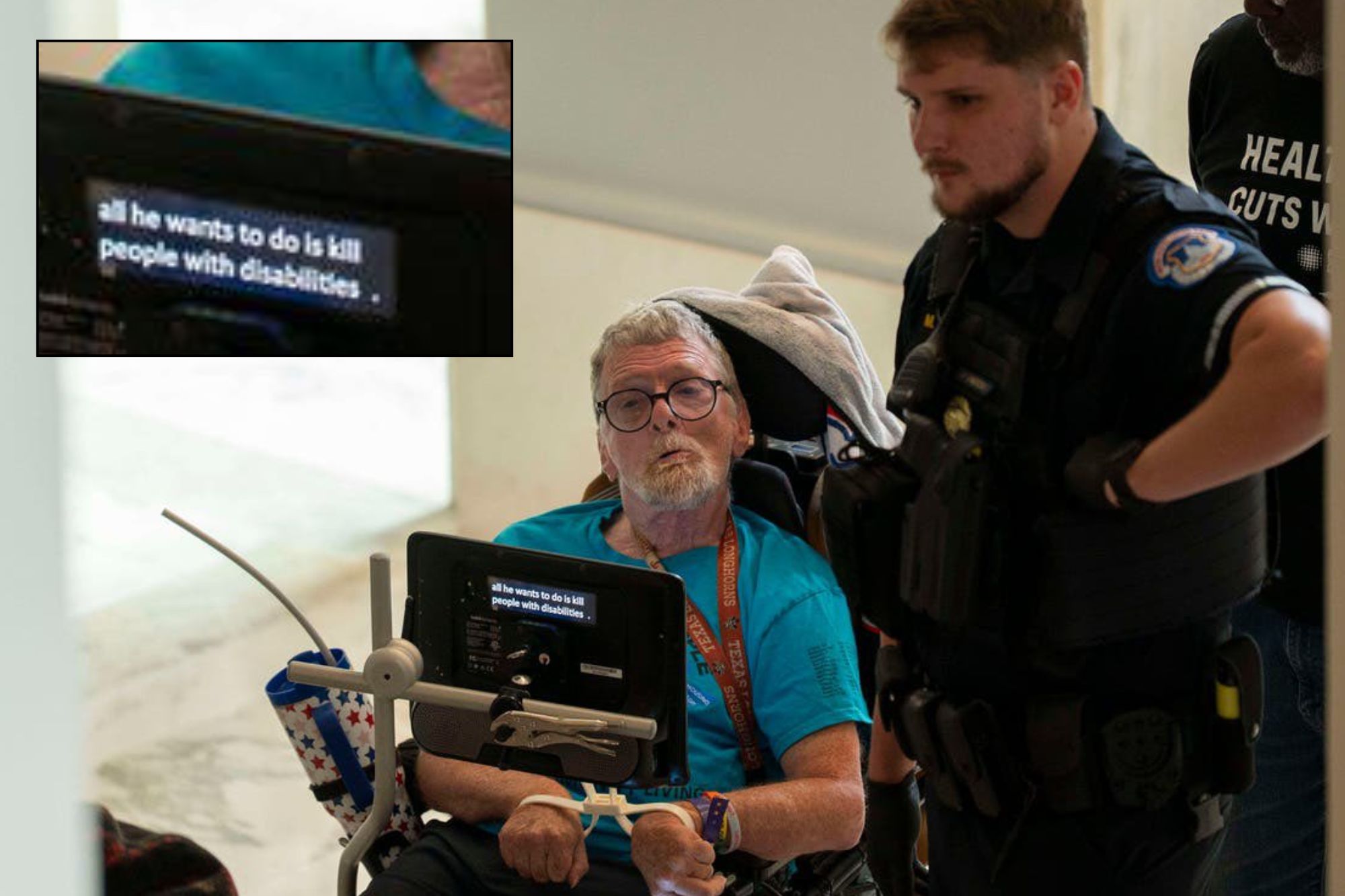
    U.S. Capitol Police zip-tied older people in their wheelchairs during a “die-in” demonstration protesting President Donald Trump’s “big, beautiful bill,” which is estimated to cut Medicaid by $793 billion over the next 10 years.

    More than 30 protesters were arrested Wednesday for “illegally demonstrating inside the Russell Senate Office Building,” a spokesperson for the U.S. Capitol Police told CNBC. “It is against the law to protest inside the Congressional buildings,” the spokesperson said, adding that “there are other places on Capitol grounds where people can lawfully demonstrate without issue.”

    Videos circulating on social media showed a line of protesters in wheelchairs, their wrists zip-tied in a way that allowed them to maneuver their devices. Many were accompanied by officers. In total, 34 demonstrators were arrested, CNBC reported.


    “Here are people in wheelchairs at Capitol on Wednesday arrested for their ‘die-in’ protest to oppose GOP’s plan to cut Medicaid which will literally kill them,” Dean Obeidallah, host of “The Dean Obeidallah Show,” wrote in a post on X. “The GOP is making these cuts to give their wealthy donors a tax cut. The anger towards GOP and oligarchs is why a Dem socialist won.”

    More than 70 million low-income and disabled Americans rely on Medicaid for health insurance. If Trump’s proposed legislation passes in the Senate, around 16 million people could lose coverage by 2034.


    A number of GOP senators have spoken out against the bill, including Missouri Sen. Josh Hawley, Maine Sen. Susan Collins and Alaska Sen. Lisa Murkowski, who told CBS News last week that she has “been pretty clear that when it comes to Medicaid, those cuts that would harm Alaskan beneficiaries, that’s not something that I can take home, right?”

    “We have some of the highest health care costs in the country. We have 40% of Alaska’s kids that are on Medicaid. I want to try to do what we can to address certain aspects of our entitlement spending,” Murkowski stated. “We’ve got to do that. But doing it with the most vulnerable bearing the brunt of that is not the answer,” she added.

    Originally published on Latin Times



    Source link

  • Simple Supplement May Boost Brain Function And Memory In Elderly

    Simple Supplement May Boost Brain Function And Memory In Elderly

    Experiencing memory issues and declining brain function is often seen as a natural part of aging, and it can also be an early warning sign of Alzheimer’s disease. But what if boosting memory was not as complicated as it seems? Research suggests that the key may lie in an unexpected place—the gut.

    Adding more evidence to the fascinating connection between gut health and brain function, a recent study published in Nature Communications, suggests that a daily prebiotic supplement could sharpen memory and boost cognitive performance in adults over 60.

    To investigate whether two inexpensive and widely available plant fiber supplements: inulin and fructooligosaccharides (FOS), could enhance brain function, researchers conducted a rigorous double-blind trial involving 36 pairs of twins over the age of 60. Since genetics play a significant role in cognitive health, using twins allowed the researchers to control for inherited differences, ensuring that any observed improvements in memory and brain function were more likely due to the supplements rather than genetic factors.

    During the trial, the participants either received a placebo or the supplement daily for 12 weeks. At the end of the trial, researchers observed significant changes in the gut microbiome of participants who took the fiber supplement, particularly an increase in Bifidobacterium, a beneficial bacteria linked to gut and brain health.

    By comparing the cognitive abilities of identical siblings using questionnaires and cognitive tests, the researchers found that after the end of the trial, the participants who took inulin or FOS consistently outperformed their sibling.

    “We are excited to see these changes in just 12 weeks. This holds huge promise for enhancing brain health and memory in our aging population. Unlocking the secrets of the gut-brain axis could offer new approaches for living more healthily for longer,” said first author Dr. Mary Ni Lochlainn from the Department of Twin Research in a news release.

    “These plant fibers, which are cheap and available over the counter, could benefit a wide group of people in these cash-strapped times. They are safe and acceptable too. Our next task is to see whether these effects are sustained over longer periods and in larger groups of people,” added senior author Professor Claire Steves, professor of aging and health.

    Source link

  • Insomnia In Elderly? Here’s Best Exercise For Better Sleep

    Insomnia In Elderly? Here’s Best Exercise For Better Sleep

    Regular physical activity is widely known for its benefits to overall health, but what about its impact on sleep? While exercise plays a crucial role in promoting better rest, not all types of exercise are equal when it comes to combating insomnia. New research has revealed that specific exercises can significantly reduce the risk of insomnia in older adults.

    The latest study, published in the journal Family Medicine and Community Health, evaluated five different types of physical activity and found that while combination and aerobic exercises are effective in improving sleep quality, resistance training works best for combating insomnia in older adults.

    The researchers pooled data from 25 trials involving more than 2,000 older adults, with an average age of 70. The researchers assessed how five different types of exercises impacted participants’ sleep quality, measured by the Global Pittsburgh Sleep Quality Index (GPSQI).

    The exercises examined included aerobic activities like brisk walking and swimming, which elevate the heart rate; combination exercises such as yoga, which blend flexibility and relaxation; balance exercises like standing on one leg, which improves stability; flexibility workouts like gymnastics, which enhance mobility; and strength training, including weightlifting, which builds muscle.

    Researchers noted that while aerobic exercise improved sleep by 3.76 points on the GPSQI scale, combination exercises contributed to a 2.54-point improvement. However, the most notable results came from strength and resistance training, which showed the greatest improvement in sleep, enhancing the GPSQI by 5.75 points.

    Further analysis revealed that strength training had a Surface Under the Cumulative Ranking Curve (SUCRA) value of 94.6%, indicating it was the most effective exercise for improving sleep quality among all the options tested.

    “This study shows that exercise, particularly strengthening exercise and aerobic exercise, is beneficial for enhancing subjective sleep quality at a clinically significant level compared with normal activities, which is consistent with previous studies,” the researchers wrote.

    “Nevertheless, caution should be applied when interpreting this study because of the diverse exercise characteristics, the small number of studies, and the high risk of bias among studies,” they added.

    The researchers also noted that the intensity of some exercises might pose challenges for older adults with limited physical abilities. This means that while certain exercises are highly beneficial, modifications or lower-intensity options may be necessary to ensure safety and effectiveness for all individuals.

    Source link

  • Excessive Daytime Sleepiness In Elderly Might Be Linked To Pre-Dementia Syndrome

    Excessive Daytime Sleepiness In Elderly Might Be Linked To Pre-Dementia Syndrome

    Struggling to sleep or feeling overly sleepy during the day may be more than just a sign of fatigue; they could indicate serious health risks. A recent study revealed that elderly adults who have excessive daytime sleepiness are at risk of developing motoric cognitive risk syndrome that can lead to dementia.

    Motoric cognitive risk syndrome can be considered a precursor of dementia marked by slow gait or memory issues, two characteristic features of dementia but not fully developed mobility disability or dementia. Individuals diagnosed with motoric cognitive risk syndrome might need to undergo a treatment plan that includes dietary changes, lifestyle interventions, and medications to slow cognitive decline.

    The researchers of the latest study found that older people with excessive daytime sleepiness and a lack of enthusiasm to get things done were more likely to develop the syndrome compared to those who do have sleep issues.

    “Our findings emphasize the need for screening for sleep issues. There’s potential that people could get help with their sleep issues and prevent cognitive decline later in life,” said study author Dr. Victoire Leroy in a news release.

    To understand the link, the researchers followed up 445 people with an average age of 76 who did not have dementia at the start of the study. Through questionnaires, they assessed sleep patterns, including difficulties falling asleep, waking during the night, and daytime sleepiness. The questions also addressed the participants’ enthusiasm levels and memory problems. The researchers assessed the participants’ walking speed using a treadmill at the beginning of the study and annually for an average of three years.

    Analysis showed that 35.5% of people who have excessive daytime sleepiness and lack of enthusiasm developed the syndrome, compared to 6.7% of the people who did not have these conditions.

    After adjusting for other factors that could influence the risk of the syndrome, researchers found that individuals with excessive daytime sleepiness and a lack of enthusiasm were more than three times as likely to develop motoric cognitive risk syndrome compared to those without these sleep-related issues.

    “More research needs to be done to look at the relationship between sleep issues and cognitive decline and the role played by motoric cognitive risk syndrome. We also need studies to explain the mechanisms that link these sleep disturbances to motoric cognitive risk syndrome and cognitive decline,” Leroy said.

    Source link