Feeling overwhelmed is a common trigger for my anxiety attacks. A project doesn’t go as well as I’d hoped or I miss a deadline, and fear and insecurity rise in my mind and body. “I’m going to be judged and found wanting,” goes the narrative. “They won’t want to work with me again. Who was I anyway to take on such a job? I’m an imposter. I always fall at the last hurdle.” My heart starts racing, my stomach churns, my muscles stiffen. These sensations are unpleasant, so I tense up further in an unconscious attempt not to feel them, even while my attention is pulled in their direction. Oh no, says a new thought. Why am I getting so anxious and blocked.
With so much energy expended internally, there’s less available to attend to daily matters. Panic may set in. “Now I can’t get any other work done,” my mind laments. “It’s the old cycle downwards again. I’m cursed with depression.” The familiar pressure builds up in my nose and chest, making it difficult to access any other feelings, and the negativity starts to spiral: I won’t be able to cope, I’ll be left with no money, no energy, unable to dig myself out of this hole. The doom-mongering thoughts fuel even more anxiety. It could go on indefinitely—a self-fulfilling prophecy.
With so much energy expended internally, there’s less available to attend to daily matters.
But hang on a minute. If these thoughts are just thoughts—and probably mere projections, tainted by the negative bias that comes especially at times of stress—then there’s no need to follow them. Anxiety is a feeling, and I know that feelings come and go. Yesterday’s thoughts and feelings were different, so who’s to say my internal weather isn’t due another change? There are patterns of experience, for sure, but this moment is just a vibration of energy experienced in consciousness, created by constellations of events in the mind, body, and outside world around a so-called “me” that in reality has no fixed location. Ideas in the mind are in flux, sensations in the body are in flux, and the trigger events are already receding into memory—no more than traces of causal energy that set the winds of mental and physical habit blowing. Suddenly, with this shift in perspective, thoughts, and feelings are no longer facts, and there’s not even a solid, single, separate “me” to feel upset or hurt by them. There is just experience, happening on and on. It’s painful experience right now, to be sure, but just energy in motion nevertheless. I’m changing from moment to moment, too—everything is in flow, as it always is. This won’t stay the same, and nor will I.
“No Feeling is Final.”
Rainer Maria Rilke once said: “Let everything happen to you: beauty and terror. Just keep going. No feeling is final.” We can make it even less personal. Just let everything happen (drop the “to you”)—watch and feel each aspect of the mind–body–world show play out on the stage of consciousness, experiencing it all with interest and kindness in the knowledge that the moment is already and inevitably on its way to becoming something else. If the energy is allowed to play out by itself, the next moments are less likely to be conditioned by misguided attempts to turn what is flowing into something solid, or to push away what is here so it’s no longer part of the moment. Neither solidifying nor separating from the moment can ever be successful, because the moment is always both here and in transition. But if there is no depression to get stuck in, and no self to get hurt, then everything in mind, body, and life can flow like an undammed river, with energy streaming through without the defensive psychic barriers that serve only to turn that energy in on itself.
By shifting perspective and approach—experiencing without grasping and resistance—this moment has already become different from how it might have been.
Negative thoughts—as well as the bodily symptoms of fear—may still be present. But they are not “mine” any more. They just are—present remnants of past events that do not need to be turned into unnecessary future suffering. By shifting perspective and approach—experiencing without grasping and resistance—this moment has already become different from how it might have been.
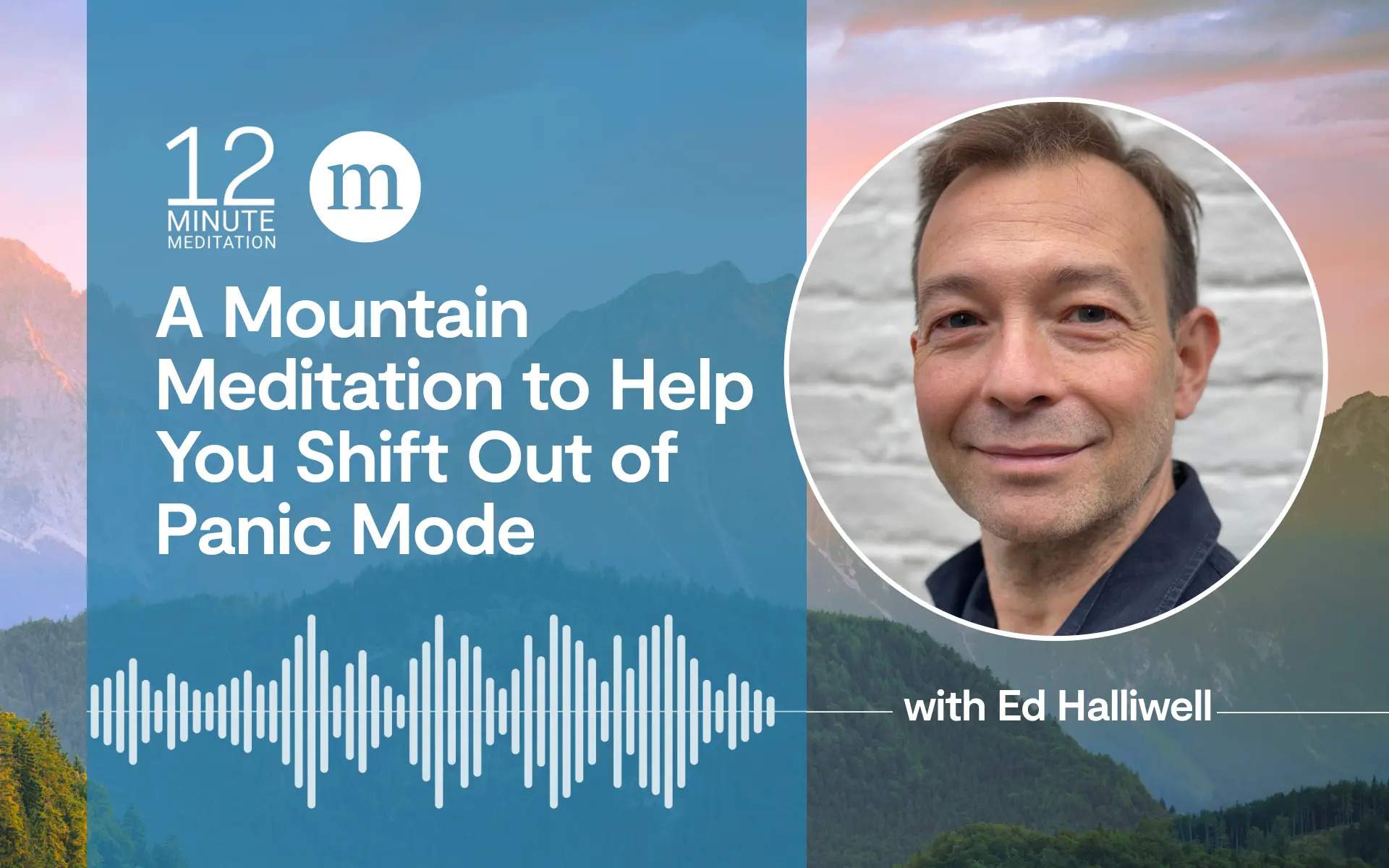
A Mountain Meditation to Help You Shift Out of Panic Mode
This mindfulness practice, often referred to as “the mountain meditation,” can help us center in our bodies especially in the midst of life’s shifting swirls. By imagining and then embodying the steadiness of a mountain, we’re training in being present to the weather of the world, as well as to our own internal weather: our thoughts and sensations.
1) Settle into an upright, comfortable sitting posture. Present and awake. Gentle and steady. Connected to the ground below. Body rising up into the air.
2) Imagine in your mind’s eye a beautiful mountain. It could be a mountain you’ve climbed or viewed from a distance, or perhaps one you’ve seen in a film or picture. Or maybe one you’ve just conjured up in your mind. Either way, visualize a mountain that for your embodies majesty and magnificence, full of natural wonder.
3) Notice the awesome qualities of the mountain: See in your mind how its foot is grounded firmly in the earth and how it rises up into the air unapologetically and fully taking its place in the landscape. Bring awareness to its solidity, its stillness, its strength, and its size. Come day or night, storm and sun, winter and summer, the mountain abides in the space, sitting still in its landscape, unwavering whatever the weather. It doesn’t have to do anything. It just is. A beautiful mountain. Amazing just by its very existence. And whether it’s sunny, snowing, blowing a gale, hot, warm, cool, or cold, the mountain just is there, sitting present.
4) Notice your own mountainous qualities as you sit here. Just like the mountain is plugged into the earth, so your feet are connected to the ground. Your body rising upwards like the body of the mountain. Your head rests on your shoulders like the peak of the mountain and you can be here, fully present like the mountain sits in its space. Your body and being as miraculous as the mountain that evokes such wonder just by its presence. Like the mountain, being an embodiment of stillness, solidity, beauty, without having to do anything else.
There may be weather going on of course: events in life, thoughts, and sensations ebbing and flowing in the internal and external environment. Whatever the weather, just for now, practice being a “breathing body mountain.” Naturally wonderful, whether the weather seems pleasant or unpleasant. Let the climates of the world happen: being rained on, shined on, snowed on—stay present as best you can to whatever comes.
5) When the mind wanders, invite attention back to the sense of being a mountain or if you prefer, let your attention rest on the mountain in your mind for a while before returning to sensations in the body. Let go of the need to feel a particular way. If you don’t feel mountainous, that’s fine.
This practice invites you to cultivate a quality rather than fabricate a feeling: just being a “breathing body mountain.”